- Market Value (2025): USD 595.3 Mn
- Estimated Value (2026): USD 445.0 Mn
- Forecast Value (2036): USD 1056.2 Mn
- CAGR (2026-2036): 5.4%
Thermoplastic Butterfly Valves Market Forecast and Outlook 2026 to 2036
As per the Fact.MR analysis, the thermoplastic butterfly valves market was valued at USD 595.3 million in 2025 and is projected to grow from USD 627.2 million in 2026 to USD 1,056.2 million by 2036. Demand for thermoplastic butterfly valves is likely to grow at a CAGR of 5.4% over the forecast period.
Demand for thermoplastic butterfly valves is rising as water, chemical and semiconductor plants need corrosion-resistant flow control at lower weight than metal valves. Manufacturers of thermoplastic butterfly valves are offering PVC, CPVC, PP and PVDF bodies with electric and pneumatic actuators. For example, in February 2024, TSMC's JASM plant in Kumamoto opened, adding high-purity chemical and ultrapure water piping. Similar fab investment is projected to drive sales of thermoplastic butterfly valves through 2036.
Key Takeaways from the Thermoplastic Butterfly Valves Market
- Thermoplastic Butterfly Valves Market Value (2025): USD 595.3 million
- Thermoplastic Butterfly Valves Market Value (2026): USD 627.2 million
- Thermoplastic Butterfly Valves Market Forecast Value (2036): USD 1,056.2 million
- Thermoplastic Butterfly Valves Market Forecast CAGR (2026-2036): 5.4%
- Leading Material Type: PVC (35.2%)
- Key Market Participants: Emerson Electric Co., Flowserve Corporation, KSB SE & Co. KGaA, AVK Holding A/S, Crane Co., Bray International Inc.
- Key Growth Regions: Brazil, United Kingdom, Germany, Japan, United States
Water utilities in Brazil and the United Kingdom are expanding treatment capacity under new investment programs, specifying plastic valves for chemical dosing and treated water lines. Demand for thermoplastic butterfly valves is growing as operators avoid corrosion in chlorine and coagulant service. Manufacturers of thermoplastic butterfly valves are widening size ranges. Similar water programs are projected to drive sales of thermoplastic butterfly valves across Europe and Latin America.
Thermoplastic Butterfly Valves Market
| Metric | Value |
|---|---|
| Estimated Value in (2026) | USD 627.2 million |
| Forecast Value in (2036) | USD 1,056.2 million |
| Forecast CAGR (2026 to 2036) | 5.4% |
Source: Fact.MR analysis. Updated Nov 20, 2026
Source: Fact.MR analysis.
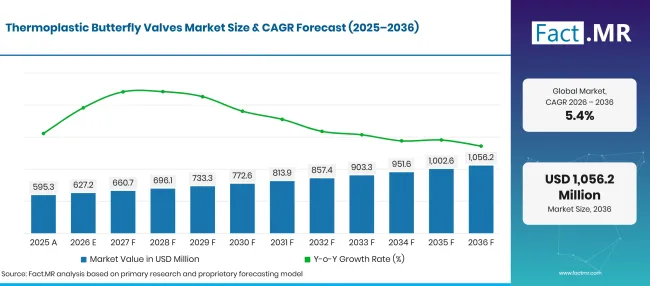
Thermoplastic Butterfly Valves Market Forecast Global | Source: Fact.MR
Category
| Category | Segments |
|---|---|
| Material Type | PVC, CPVC, PP, PVDF, Others |
| Application | Water Treatment, Chemical Processing, Oil & Gas, Food & Beverage, Pharmaceuticals, Others |
| End-User | Industrial, Commercial, Residential |
| Region | Brazil; United Kingdom; Germany; Japan; United States |
Source: Fact.MR analysis. Updated Nov 20, 2026
Segmental Analysis
What makes PVC the preferred material in the Thermoplastic Butterfly Valves Market?
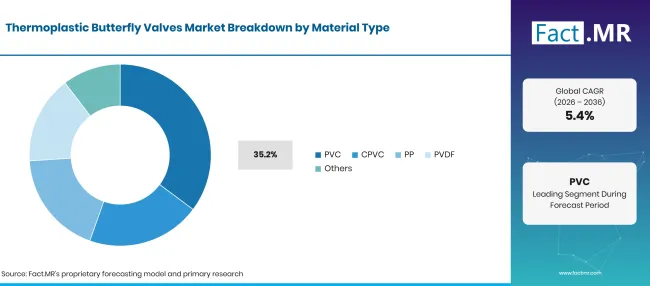
Thermoplastic Butterfly Valves Market Breakdown Material Type | Source: Fact.MR
Demand for PVC valves account for 35.2% of revenue in 2026, about USD 220 million, as PVC suits water and mild chemical service at low cost and is compatible with widely used PVC piping. CPVC and PVDF serve hotter or more aggressive media. Manufacturers of thermoplastic butterfly valves are offering PVC valves with EPDM and FKM liners. Similar cost advantages are projected to keep PVC the leading material. India's Ministry of Jal Shakti reported in 2026 that AMRUT and AMRUT 2.0 had supported approximately 93,457 km of urban water network installation or replacement, alongside the creation of 5,178 million litres per day of water treatment capacity. Expansion and maintenance of these networks create opportunities for PVC valves used in water conveyance and treatment systems.
Why does water treatment lead application demand in the Thermoplastic Butterfly Valves Market?
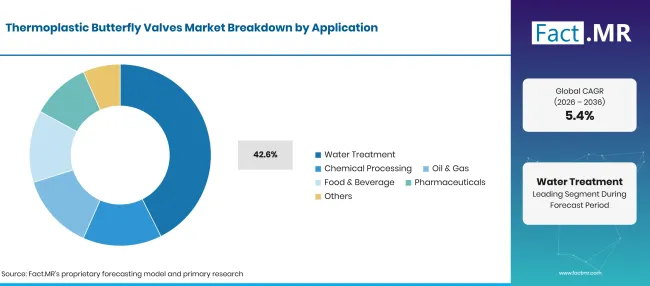
Thermoplastic Butterfly Valves Market Breakdown Application | Source: Fact.MR
Water treatment holds 42.6% of application revenue in 2026, about USD 265 million, as treatment plants use plastic valves on dosing, filtration and desalination lines. Corrosion resistance cuts maintenance. Manufacturers of thermoplastic butterfly valves are offering actuated valves for automated plants. Similar water investment is projected to keep water treatment the leading application. Plastic valves are particularly relevant where corrosion resistance and compatibility with treatment chemicals are important. India's Ministry of Statistics and Programme Implementation reported that water supply, sewerage and waste management recorded 5.8% industrial production growth in September 2026, while cumulative growth for April–September reached 6.3%. Continued activity across these services is supporting investment in water infrastructure and associated flow-control equipment.
Why do industrial users lead end-user demand in the Thermoplastic Butterfly Valves Market?
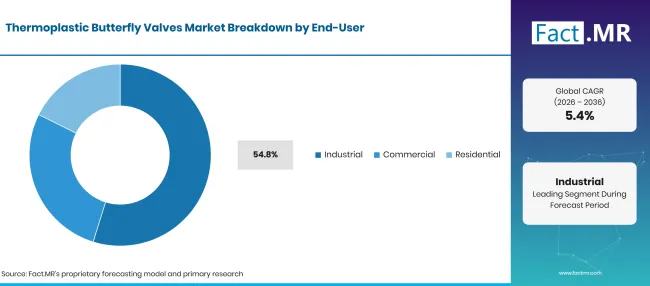
Thermoplastic Butterfly Valves Market Breakdown End User | Source: Fact.MR
Adoption by industrial users account for 54.8% of revenue in 2026, about USD 345 million, including chemical, semiconductor, metal finishing and power plants. These users need valves resistant to acids and caustics. Manufacturers such as Asahi/America and Cepex serve industrial customers through distributors. Similar process needs are projected to keep industrial users in the lead. PVC, CPVC and PVDF valves offer different levels of chemical and temperature resistance, allowing buyers to select materials according to process requirements. India's September 2026 industrial production data recorded 19.9% year-on-year growth in rubber and plastics product manufacturing, while overall manufacturing increased by 7.6%. The expansion of industrial production supports demand for durable piping components and specialized process valves. Manufacturers such as Asahi/America and Cepex serve these requirements through industrial valve portfolios and distributor networks.
Thermoplastic Butterfly Valves Market-Drivers, Restraints & Trends
Drivers – Expanding Water and Wastewater Infrastructure
Demand for thermoplastic butterfly valves is increasing as municipalities expand water distribution, sewage collection and wastewater treatment infrastructure. Brazil's National Sanitation Framework targets access to treated water for 99% of the population and sewage collection and treatment for 90% by 2033. In August 2026, Brazil's National Water and Basic Sanitation Agency (ANA) reported that only 62.3% of the population was served by sewage collection networks, while 85.2% of collected sewage received treatment. This infrastructure gap creates opportunities for corrosion-resistant thermoplastic valves in treatment plants, distribution networks and chemical dosing systems. Continued sanitation investment is expected to support valve procurement through the forecast period.
Restraints – Pressure and Temperature Limitations
Sales of thermoplastic butterfly valves face restrictions in applications requiring higher pressure and temperature resistance than standard polymer designs can provide. Metal valves remain preferred in high-pressure industrial pipelines, high-temperature processing systems and demanding oil and gas applications. Although reinforced polymers and advanced materials such as PVDF and PFA extend chemical compatibility and operating capabilities, material selection must still account for pressure ratings, temperature limits, mechanical loading and service conditions. These engineering requirements restrict thermoplastic valve penetration in demanding applications and encourage suppliers to develop reinforced and higher-performance polymer designs.
Opportunity – High-Purity PVDF Valves for Semiconductor Manufacturing
Demand for high-purity PVDF valves is gaining momentum as semiconductor manufacturers expand fabrication capacity and require contamination-controlled fluid-handling systems. In October 2026, Japan's Ministry of Foreign Affairs announced a USD 10 billion semiconductor manufacturing project in New York, with construction scheduled to begin by the end of 2026. Separately, India's Ministry of Electronics and Information Technology reported in February 2026 that 10 semiconductor projects had received government approval, representing proposed investments of approximately INR 1.6 lakh crore. These developments expand the potential customer base for high-purity polymer valves used in ultrapure water and chemical distribution systems. Manufacturers offering clean-room-assembled PVDF butterfly valves can benefit from new fabrication and supporting infrastructure investments.
Trend – Smart Actuation and Digital Valve Monitoring
Thermoplastic butterfly valve manufacturers are increasingly integrating electric actuators, position feedback and remote-control capabilities to support automated industrial operations. These features allow operators to regulate fluid flow, monitor valve positions and reduce manual intervention across water treatment and chemical processing facilities. India's Ministry of Statistics and Programme Implementation reported in November 2026 that gross value added in the manufacturing corporate sector increased by 9.28% in FY 2024–25, while gross value of plant and machinery in the registered manufacturing sector increased by 7.25%. This expansion in industrial assets supports the broader requirement for automated process-control equipment. Manufacturers combining corrosion-resistant polymer valves with smart actuation and monitoring capabilities are positioned to address modernization requirements.
Thermoplastic Butterfly Valves Market by Analysis by Key Country
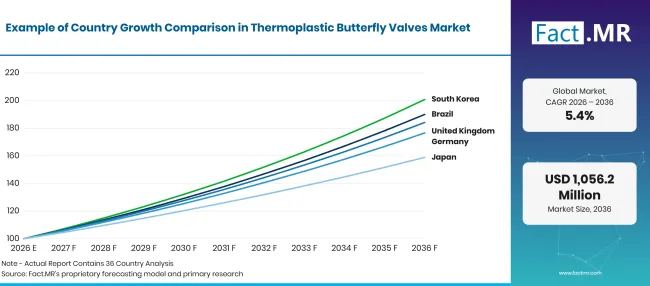
Thermoplastic Butterfly Valves Market Growth Index | Source: Fact.MR
| Country | CAGR (2026-2036) |
|---|---|
| Brazil | 6.6% |
| United Kingdom | 6.3% |
| Germany | 5.9% |
| Japan | 4.7% |
| United States | 3.8% |
Source: Fact.MR analysis. Updated Nov 20, 2026
Source: Fact.MR analysis.
Why is Brazil the fastest-growing market for thermoplastic butterfly valves?
Sales of thermoplastic butterfly valves in Brazil are projected to increase at a 6.6% CAGR through 2036 as sanitation concessions expand water distribution and wastewater treatment infrastructure.
According to BNDES, Brazil recorded BRL 29.5 billion in sanitation investment in 2024, while projects tendered or under development by March 2026 could enable approximately BRL 154 billion in investment. These projects create opportunities for corrosion-resistant plastic valves in water treatment and sewage networks.
What is driving thermoplastic butterfly valve demand in the United Kingdom?
Demand for thermoplastic butterfly valves in the United Kingdom is forecast to grow at a 6.3% CAGR, supported by water infrastructure modernization and wastewater treatment upgrades.
Ofwat's PR24 programme allocates GBP 104 billion over the 2025–2030 period, including GBP 6 billion for nutrient pollution reduction and GBP 12 billion for storm-overflow improvements. These investments increase procurement opportunities for corrosion-resistant valves used in treatment facilities and water infrastructure.
What is shaping thermoplastic butterfly valve demand in Germany?
Thermoplastic butterfly valve demand in Germany is projected to rise at a 5.9% CAGR as wastewater operators prepare for stricter treatment requirements under the revised EU Urban Wastewater Treatment Directive, which entered into force on 1 January 2025.
The European Commission identifies 30,354 urban wastewater treatment plants across the EU and requires additional nutrient and micropollutant removal. These upgrades create opportunities for chemically resistant plastic valves in wastewater treatment and chemical dosing systems.
What is supporting thermoplastic butterfly valve demand in Japan?
Sales of thermoplastic butterfly valves in Japan are anticipated to grow at a 4.7% CAGR as semiconductor manufacturing expansion increases requirements for chemical-resistant fluid-handling systems.
In April 2026, Japan's Ministry of Economy, Trade and Industry confirmed that TSMC's second Kumamoto plant had an upgraded plan for 3-nanometre semiconductor production. Separately, Japan's Ministry of Land, Infrastructure, Transport and Tourism reported a 94.0% wastewater-treatment population coverage rate for fiscal 2025, published in August 2026. Industrial expansion and ongoing wastewater infrastructure requirements support demand for specialized plastic valves.
Why is thermoplastic butterfly valve growth slower in the United States?
Thermoplastic butterfly valve sales in the United States are estimated to increase at a comparatively slower 3.8% CAGR as established water infrastructure generates demand primarily through maintenance, replacement and selective capacity upgrades.
However, the U.S. Environmental Protection Agency allocated approximately USD 1.61 billion in FY2026 for 1,163 drinking water, wastewater and stormwater infrastructure projects. These projects sustain procurement opportunities for corrosion-resistant valves, while semiconductor manufacturing investments under the CHIPS Act provide additional industrial demand.
Competitive Landscape for Thermoplastic Butterfly Valves Market
Competition in the thermoplastic butterfly valves market is shaped by specialized plastic valve manufacturers and diversified fluid-control companies. Asahi Yukizai Corporation, Cepex (Fluidra Group), GF Piping Systems, Hayward Flow Control, IPEX Inc., NIBCO (Chemtrol), SAFI and Spears Manufacturing Company compete through PVC, CPVC, PP and PVDF butterfly valve portfolios. Their offerings address water treatment, chemical processing, wastewater management and industrial fluid-handling applications.
From 2025 onward, manufacturers are competing to strengthen product coverage and serve industrial customers through broader material options and actuation capabilities. Companies with established distribution networks, technical support, product certifications and regional availability are better positioned to secure procurement contracts and strengthen their market presence. Competition increasingly centers on corrosion resistance, pressure-handling capabilities, material compatibility and automated operation. Manufacturers differentiate themselves through larger valve sizes, wafer and lug configurations, actuator compatibility and application-specific designs. Demand from water infrastructure and chemical processing projects supports opportunities for manufacturers offering reliable thermoplastic solutions. High-purity applications also create opportunities for suppliers with suitable PVDF product portfolios.
Recent Developments
- In February 2024, TSMC's JASM plant in Kumamoto opened, raising demand for high-purity plastic piping and valves.
- In December 2024, Ofwat published PR24 final determinations for 2025 to 2030 water investment.
- In January 2025, the revised EU Urban Wastewater Treatment Directive entered into force.
- In June 2026, Nanjing Comptech Composites Publishes PFA-Coated Butterfly Plate Patent. Patent US20260166790A1 describes a molding and vacuum process designed to produce PFA-coated butterfly plates without flow marks, improving coating uniformity and sealing performance in corrosive-fluid valve applications.
- In October 2025, GF introduced the thermoplastic Butterfly Valve 565 Big in DN350–DN600 sizes, featuring a glass-fiber-reinforced polypropylene body, PN10 pressure rating and applications in water distribution and desalination.
- In September 2025, GF Building Flow Solutions Americas introduced 565 Butterfly Valves for its Uponor ChlorFIT Schedule 80 CPVC piping system. Available in wafer and lug configurations, the valves target commercial water, chilled-water and industrial applications.
Key Players in Thermoplastic Butterfly Valves Market
Key companies profiled include Asahi Yukizai Corporation (Asahi/America); Cepex (Fluidra Group); GF Piping Systems (Georg Fischer); Hayward Flow Control; IPEX Inc.; NIBCO Inc. (Chemtrol); SAFI; and Spears Manufacturing Company.
- Asahi Yukizai Corporation (Asahi/America)
- Cepex (Fluidra Group)
- GF Piping Systems (Georg Fischer)
- Hayward Flow Control
- IPEX Inc.
- NIBCO Inc. (Chemtrol)
- SAFI
- Spears Manufacturing Company
Bibliography
- Agência Nacional de Águas e Saneamento Básico. (2026, August 26). Água e desenvolvimento: O papel da ANA na universalização do saneamento.
- Banco Nacional de Desenvolvimento Econômico e Social. (n.d.). BNDES Projects Hub: Sanitation.
- Checkpoint Surgical, Inc. (2026, August 20). Checkpoint Surgical expands peripheral nerve portfolio with new flexible nerve conduit.
- European Commission. (n.d.). Urban wastewater.
- European Parliament and Council of the European Union. (2024, November 27). Directive (EU) 2024/3019 concerning urban wastewater treatment (recast). EUR-Lex.
- GF Piping Systems. (2025, October 14). Built for the bigger picture.
- GF Building Flow Solutions Americas. (2025, September 22). GF expands Uponor ChlorFIT® offering with launch of 565 butterfly valves. Uponor.
- Japan Ministry of Economy, Trade and Industry. (2026, April 3). METI semiconductor manufacturing update.
- Ministry of Cities, Government of Brazil. (n.d.). Marco Legal do Saneamento.
- Ministry of Climate, Energy and Environment, Republic of Korea. (2026, May 18). Domestic ultra pure water demonstration plant technology transferred to private sector.
- Ministry of Electronics and Information Technology, Government of India. (2026, February 4). Semicon India Programme advances with approval of 10 projects; IT sector revenue rises to USD 283 billion. Press Information Bureau.
- Ministry of Foreign Affairs of Japan. (2026, October 15). Semiconductor manufacturing project to be implemented under the Japan-U.S. Strategic Investment Initiative.
- Ministry of Land, Infrastructure, Transport and Tourism, Japan. (2026, August). Wastewater treatment coverage reaches 94.0%.
- Ministry of Statistics and Programme Implementation, Government of India. (2026, November 4). Annual Survey of Industries 2024–25: Manufacturing corporate sector registered GVA growth of 9.28% over previous year.
- Ofwat. (2024). PR24 final determinations: Delivering outcomes for customers and the environment.
- Ofwat. (2024). PR24 investment programme.
- Taiwan Semiconductor Manufacturing Company. (2024, February 24). TSMC celebrates the opening of JASM in Kumamoto, Japan.
- U.S. Environmental Protection Agency. (2026, May). FY 2026 community grants implementation guidance.
Segmentation
Scope of Report
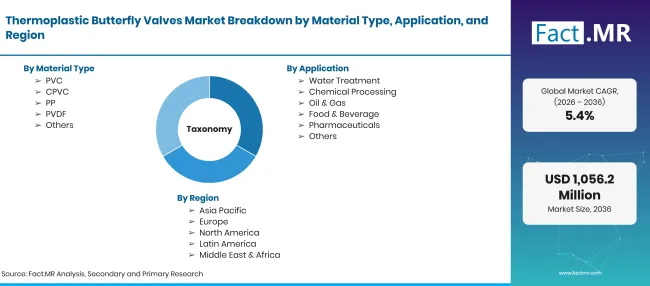
Thermoplastic Butterfly Valves Market Taxonomy | Source: Fact.MR
| Items | Values |
|---|---|
| Quantitative Units (2026) | USD 627.2 Million |
| Material Type | PVC, CPVC, PP, PVDF, Others |
| Application | Water Treatment, Chemical Processing, Oil & Gas, Food & Beverage, Pharmaceuticals, Others |
| End-User | Industrial, Commercial, Residential |
| Regions Covered | North America, Latin America, Europe, East Asia, South Asia and Pacific, Middle East & Africa |
| Countries Covered | United States, Germany, Japan, United Kingdom, Brazil, and other countries |
| Key Companies Profiled | Asahi Yukizai Corporation (Asahi/America); Cepex (Fluidra Group); GF Piping Systems (Georg Fischer); Hayward Flow Control; IPEX Inc.; NIBCO Inc. (Chemtrol); SAFI; Spears Manufacturing Company. |
| Additional Attributes | Dollar revenue in the Thermoplastic Butterfly Valves Market is segmented by material type (PVC, CPVC, PP, PVDF); application (water treatment, chemical processing, oil & gas, food & beverage, pharmaceuticals); end-user (industrial, commercial, residential) and region. |
Source: Fact.MR analysis. Updated Nov 20, 2026
Thermoplastic Butterfly Valves Market by Segments
-
Material Type
- PVC
- CPVC
- PP
- PVDF
- Others
-
Application
- Water Treatment
- Chemical Processing
- Oil & Gas
- Food & Beverage
- Pharmaceuticals
- Others
-
End-User
- Industrial
- Commercial
- Residential
-
Region:
- North America
- United States
- Canada
- Mexico
- Europe
- Germany
- United Kingdom
- France
- Italy
- Spain
- Rest of Europe
- Asia Pacific
- China
- India
- Japan
- South Korea
- Australia
- Rest of Asia Pacific
- Latin America
- Brazil
- Mexico
- Argentina
- Rest of Latin America
- Middle East & Africa
- GCC Countries
- South Africa
- Rest of Middle East & Africa
- North America
Who worked on this report


Preview the report firsthand - request a free sample
Free SampleGet the brochure for pricing and purchase details
Download PDF