- Market Value (2025): USD 3.12 Bn
- Estimated Value (2026): USD 3.25 Bn
- Forecast Value (2036): USD 4.93 Bn
- CAGR (2026-2036): 4.3%
Animal Source Hydrocolloids Market Forecast and Outlook 2026 to 2036
The animal source hydrocolloids market was valued at approximately USD 3.12 billion in 2025 and USD 3.25 billion in 2026. The market is set to reach USD 4.93 billion by 2036, expanding at a CAGR of 4.3% during the 2026 to 2036 assessment period.
In May 2025, Darling Ingredients and Tessenderlo Group agreed to combine their Rousselot and PB Leiner collagen and gelatin businesses under a new venture, Nextida. This move highlights continued investment in animal-derived ingredients across food, health and nutrition applications. Gelatin, collagen and casein continue to find use in formulations where texture, stability, binding and protein content matter. Manufacturers are also broadening their product portfolios to serve food, pharmaceutical and nutritional applications, keeping specialty animal-based ingredients relevant across these industries.
Key Takeaways from the Animal Source Hydrocolloids Market
- Sales of animal source hydrocolloids stood at USD 3.12 billion in 2025
- Animal Source Hydrocolloids Market Value (2026): USD 3.25 billion
- Animal Source Hydrocolloids Market Forecast Value (2036): USD 4.93 billion
- Animal Source Hydrocolloids Market Forecast CAGR (2026-2036): 4.3%
- Leading Product Type: Gelatin (42.3%)
- Key Market Participants: Cargill, DuPont de Nemours, Kerry Group, Ingredion, Tate & Lyle, Ashland
- Key Growth Regions: United States, Brazil, Japan, United Kingdom, Germany
Animal source hydrocolloids such as gelatin and casein continue to find applications in food texture, pharmaceutical capsules and nutritional products. Companies are also refining ingredient properties to suit specific processing and end-use requirements, creating more opportunities for specialized product offerings. In 2025, Gelita expanded its collagen peptide portfolio with new ingredient solutions for food, beverage and health applications, strengthening its position in specialty protein ingredients. Such product activity highlights the efforts of manufacturers to serve changing formulation needs across multiple industries.
Animal Source Hydrocolloids Market
| Metric | Value |
|---|---|
| Estimated Value in (2025) | USD 3.12 billion |
| Estimated Value in (2026) | USD 3.25 billion |
| Forecast Value in (2036) | USD 4.93 billion |
| Forecast CAGR (2026 to 2036) | 4.3% |
Source: Fact.MR analysis. Updated Nov 20, 2026
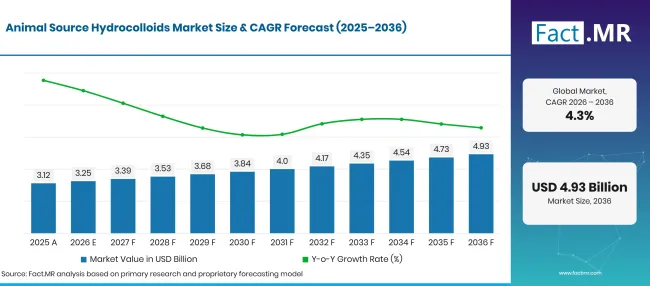
Animal Source Hydrocolloids Market Forecast Global | Source: Fact.MR
Category
| Category | Segments |
|---|---|
| Product Type | Gelatin, Casein, Others |
| Application | Food & Beverages, Pharmaceuticals, Cosmetics, Others |
| Animal Source | Bovine, Porcine, Fish, Others |
| Function | Thickening, Gelling, Stabilizing, Others |
| Region | United States; Brazil; Japan; United Kingdom; Germany |
Source: Fact.MR analysis. Updated Nov 20, 2026
Segmental Analysis
Why does gelatin lead product demand in the Animal Source Hydrocolloids Market?
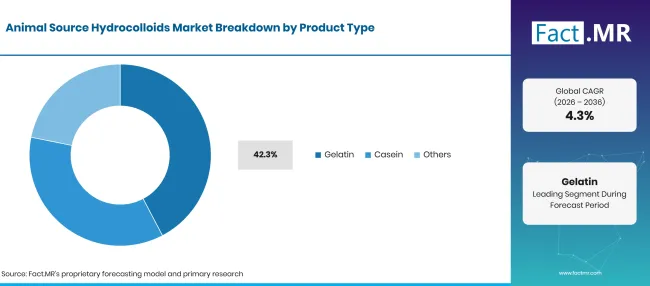
Animal Source Hydrocolloids Market Breakdown Product Type | Source: Fact.MR
Gelatin holds 42.3% of market revenue in 2026, equivalent to approximately USD 1.4 billion. Its ability to form gels, create foam and bind ingredients makes it useful in confectionery, dairy products, meat preparations and pharmaceutical capsules. Casein serves a different set of applications, particularly cheese, coffee whiteners and protein formulations. The Gelatin Representatives of the World (GROW), in its 2026 industry statement, identifies food and pharmaceutical products as the principal uses of gelatin, reinforcing its broad commercial relevance.
Why does food and beverages lead application demand in the Animal Source Hydrocolloids Market?
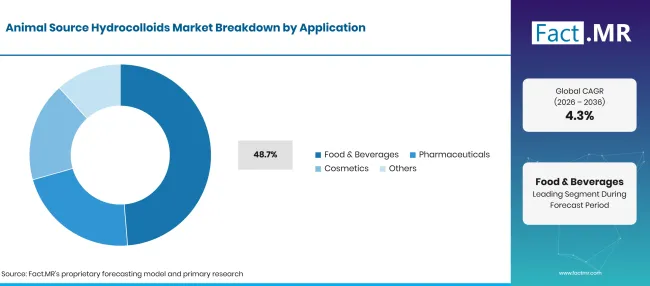
Animal Source Hydrocolloids Market Breakdown Application | Source: Fact.MR
Food and beverages contribute 48.7% of market revenue in 2026, reaching approximately USD 1.6 billion. Gelatin and casein are widely used in confectionery, dairy preparations, processed meat and nutritional products, where ingredient consistency influences the final product. Pharmaceutical applications also account for considerable usage, particularly in capsule manufacturing. The European Commission's February 2026 guidance on food additives highlights the importance of texture, stability and consistency in modern food production, keeping functional ingredients relevant to food manufacturers.
Why does bovine source lead the Animal Source Hydrocolloids Market?
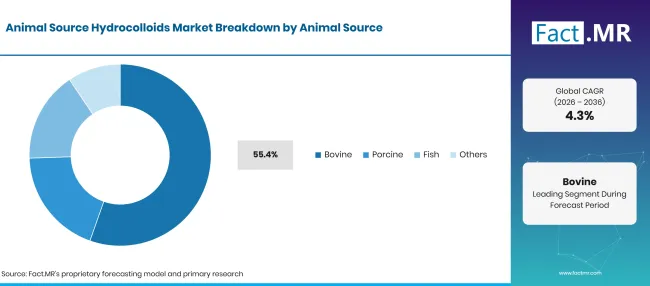
Animal Source Hydrocolloids Market Breakdown Animal Source | Source: Fact.MR
Bovine-derived ingredients hold 55.4% of market revenue in 2026, valued at approximately USD 1.8 billion. Cattle hides and bones serve as important raw materials for gelatin production, while established processing routes make bovine material commercially accessible. Porcine and fish-derived alternatives cater to buyers with different sourcing and dietary preferences. In March 2026, India's Department of Animal Husbandry and Dairying issued an official veterinary health certificate framework for imported gelatin derived from bovine and porcine bones or skins, highlighting the importance of source verification and animal health controls in international trade.
Why does thickening lead function demand in the Animal Source Hydrocolloids Market?
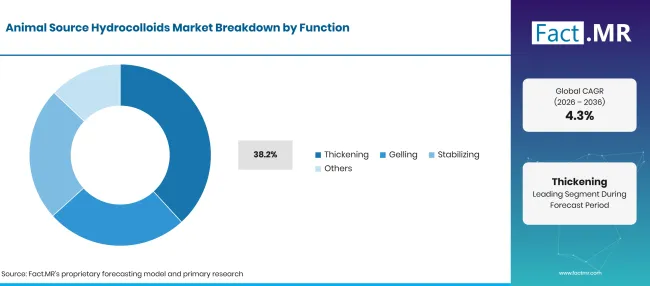
Animal Source Hydrocolloids Market Breakdown Function | Source: Fact.MR
Thickening contributes 38.2% of market revenue in 2026, amounting to approximately USD 1.2 billion. Food manufacturers use animal-derived hydrocolloids to achieve the required consistency in sauces, dairy preparations, soups and other processed products. Gelling and stabilizing serve additional formulation purposes, particularly where products need to retain their structure during storage. The European Commission's February 2026 food additives guidance specifically identifies improved consistency in sauces and yoghurts as an important function of thickeners and stabilizers.
Animal Source Hydrocolloids Market-Drivers, Restraints & Trends
Drivers: Rising interest in protein and collagen-based nutrition:
Food and nutrition manufacturers are increasingly using animal source hydrocolloids because these ingredients combine functional properties with nutritional value. Gelatin, collagen and casein serve applications ranging from protein-enriched beverages and nutritional bars to dietary supplements and fortified foods. Interest in maintaining muscle strength, joint health and adequate protein intake is also widening their use beyond conventional food processing. The 2026 Global Food Institute industry report identifies consumer interest in protein as an important influence on food innovation. This creates wider commercial opportunities for animal-derived ingredients across food and nutrition categories.
Restraints: Competition from plant-based alternatives:
The market faces pressure from changing dietary preferences, religious restrictions and the higher traceability standards associated with animal-derived raw materials. Pectin, agar and carrageenan offer alternatives in several food applications. According to the Good Food Institute, US retail sales of plant-based foods reached USD 7.9 billion in 2025, with 60% of households purchasing these products. Such alternatives give food manufacturers more flexibility when developing animal-free formulations.
Trend: Wider use of collagen peptides in wellness nutrition:
In September 2025, the European Food Safety Authority published a scientific opinion on the safety of egg membrane collagen peptides for use in adult food supplements. This highlights the expanding research and commercial interest in collagen-based nutrition. Wider interest in functional nutrition is also creating opportunities for specialized ingredient applications.
Trend: Protein fortification across food applications:
In August 2026, the American College of Cardiology highlighted the importance of adequate protein intake for preserving muscle mass among people using GLP-1 medications for weight management. This nutritional focus is influencing food formulation priorities, particularly in protein-enriched products. Gelatin and casein serve manufacturers looking to combine protein content with texture and formulation stability
Animal Source Hydrocolloids Market by Analysis by Key Country
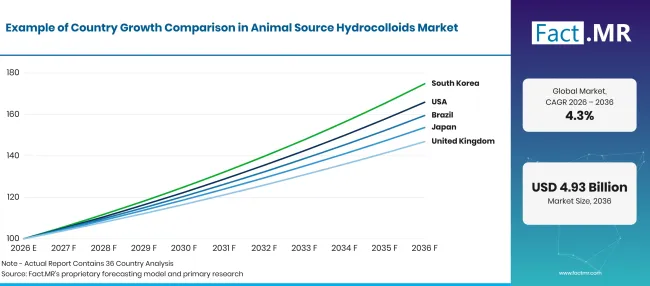
Animal Source Hydrocolloids Market Growth Index | Source: Fact.MR
| Country | CAGR (2026-2036) |
|---|---|
| United States | 5.2% |
| Brazil | 4.8% |
| Japan | 4.4% |
| United Kingdom | 3.9% |
| Germany | 3.5% |
Source: Fact.MR analysis. Updated Nov 20, 2026
Why is the United States the fastest-growing market for animal source hydrocolloids?
In 2025, the United States recorded 72,300 tonnes of gelatin sales, according to Agriculture and Agri-Food Canada's market assessment. Its animal source hydrocolloids market is set to expand at a 5.2% CAGR through 2036.
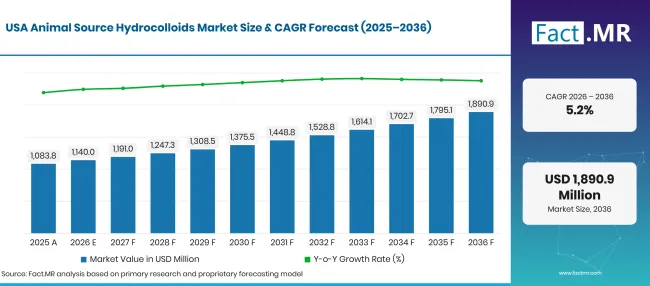
Animal Source Hydrocolloids Market Forecast Usa | Source: Fact.MR
A large food manufacturing base, widespread supplement consumption and pharmaceutical capsule production keep gelatin and casein in regular commercial use. Collagen-based nutrition products are also creating additional avenues for ingredient manufacturers, particularly in functional beverages and protein-enriched formulations.
What is supporting demand in Brazil?
Brazil exported approximately USD 269.5 million worth of gelatin and related products in 2025, according to World Bank trade data. This trade activity highlights the importance of its cattle-processing industry to the global gelatin supply chain.
The domestic market is set to advance at a 4.8% CAGR through 2036. Access to bovine hides and bones gives processors an important raw material base, while overseas shipments and food manufacturing create outlets for gelatin across confectionery, dairy and pharmaceutical applications.
What is shaping demand in Japan?
Japan's Consumer Affairs Agency continued updating its Foods with Function Claims notification database in 2025, maintaining a regulatory pathway for functional food products. Against this backdrop, the animal source hydrocolloids market is set to expand at a 4.4% CAGR through 2036.
Gelatin finds applications in gummy confectionery, desserts and pharmaceutical capsules, while collagen ingredients serve beauty and nutritional formulations. Japan's interest in specialized food products and convenient supplement formats creates a distinct commercial base for these ingredients.
What is shaping demand in the United Kingdom?
World Bank trade data placed UK imports of gelatin and related products at approximately USD 87.3 million in 2025. The domestic market is set to register a 3.9% CAGR through 2036, with confectionery, dairy processing and pharmaceutical manufacturing keeping gelatin and casein relevant.
Food manufacturers also use these ingredients to achieve specific textures and product consistency. However, plant-derived alternatives give formulators more choices, particularly in products targeting vegetarian consumers.
Why is growth slower in Germany?
Germany imported approximately USD 251 million worth of gelatin and related products in 2025, according to World Bank trade data. Even with this substantial import activity, the domestic market is set to record a comparatively modest 3.5% CAGR through 2036.
Gelatin remains useful in confectionery, dairy and pharmaceutical capsules, but manufacturers face competition from pectin, agar and other plant-derived alternatives. Ingredient traceability, raw material costs and strict sourcing standards also influence purchasing decisions, keeping market expansion measured.
Competitive Landscape for Animal Source Hydrocolloids Market
The animal source hydrocolloids market features specialized manufacturers with strong positions in gelatin, collagen and functional protein ingredients. Darling Ingredients (Rousselot), GELITA AG and PB Leiner serve food, pharmaceutical and nutrition applications through gelatin grades and collagen-based solutions.
Nitta Gelatin and Weishardt Group focus on gelatin and collagen ingredients for food, health and pharmaceutical formulations. Italgelatine, Jellice Group and Lapi Gelatine also cater to confectionery, dairy, capsule manufacturing and specialized food processing. Product purity, raw material traceability, processing standards and application-specific grades influence how these companies serve industrial buyers.
Recent Developments
- On May 12, 2025, Darling Ingredients and Tessenderlo Group announced plans to combine Rousselot and PB Leiner’s gelatin and collagen businesses into a new joint venture named Nextida, with Darling holding an 85% stake.
- On March 3, 2026, GELITA partnered with Black Drop to develop advanced gelatin-based bioinks for 3D bioprinting applications, including tissue models and medical implants.
- On April 27, 2026, Germany’s Federal Cartel Office cleared Darling Ingredients’ planned acquisition of a controlling stake in PB Leiner, allowing the companies to proceed with combining their gelatin and collagen businesses.
- On May 22, 2026, Weishardt launched an ultra-low molecular weight marine collagen ingredient designed to improve absorption, marking a new addition to its collagen portfolio.
- On June 12, 2026, Italgelatine launched Avvera, a branded collagen peptide ingredient for the beauty-from-within market, targeting skin health applications.
Key Players in Animal Source Hydrocolloids Market
Key companies operating in the market include Darling Ingredients Inc. (Rousselot), GELITA AG, PB Leiner, Nitta Gelatin Inc., Weishardt Group, Italgelatine S.p.A., Jellice Group, and Lapi Gelatine S.p.A.
- Darling Ingredients Inc. (Rousselot)
- GELITA AG
- PB Leiner
- Nitta Gelatin Inc.
- Weishardt Group
- Italgelatine S.p.A.
- Jellice Group
- Lapi Gelatine S.p.A.
Bibliography
- Consumer Affairs Agency. (2025, October 1). Guidelines for notification of foods with function claims. Government of Japan.
- Department of Animal Husbandry and Dairying. (2026, March 5). Veterinary health certificate for import of gelatine derived from the bones or skins of bovine/porcine (other than wild/feral) into India. Ministry of Fisheries, Animal Husbandry and Dairying, Government of India.
- European Commission. (2026). Food additives. Directorate-General for Health and Food Safety.
- Federal Statistical Office of Germany (Destatis). (2026, May 18). Nach jahrelangem Anstieg: Fleischersatz-Produktion sinkt 2025 um 1,2 % gegenüber dem Vorjahr [After years of growth, meat substitute production falls by 1.2% in 2025].
- World Bank. (2026). Brazil: Gelatin and derivatives, isinglass and glues of animal origin exports by country, 2025. World Integrated Trade Solution.
- World Bank. (2026). Gelatin and derivatives, isinglass and glues of animal origin imports by country, 2025. World Integrated Trade Solution.
Segmentation
Scope of Report
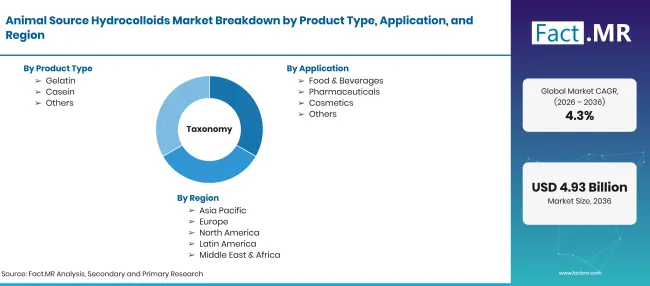
Animal Source Hydrocolloids Market Taxonomy | Source: Fact.MR
| Items | Values |
|---|---|
| Quantitative Units (2026) | USD 3.25 Billion |
| Product Type | Gelatin, Casein, Others |
| Application | Food & Beverages, Pharmaceuticals, Cosmetics, Others |
| Animal Source | Bovine, Porcine, Fish, Others |
| Function | Thickening, Gelling, Stabilizing, Others |
| Regions Covered | North America, Latin America, Europe, East Asia, South Asia and Pacific, Middle East & Africa |
| Countries Covered | United States, Germany, Japan, United Kingdom, Brazil, and other countries |
| Key Companies Profiled | Cargill, DuPont de Nemours, Kerry Group, Ingredion, Tate & Lyle, Ashland, CP Kelco, FMC, dsm-firmenich AG, Archer Daniels Midland |
| Additional Attributes | Dollar revenue in the Animal Source Hydrocolloids Market is segmented by product type (gelatin, casein); application (food & beverages, pharmaceuticals, cosmetics); animal source (bovine, porcine, fish); function (thickening, gelling, stabilizing) and region. |
Source: Fact.MR analysis. Updated Nov 20, 2026
Animal Source Hydrocolloids Market by Segments
-
Product Type
- Gelatin
- Casein
- Others
-
Application
- Food & Beverages
- Pharmaceuticals
- Cosmetics
- Others
-
Animal Source
- Bovine
- Porcine
- Fish
- Others
-
Function
- Thickening
- Gelling
- Stabilizing
- Others
-
Region:
- North America
- United States
- Canada
- Mexico
- Europe
- Germany
- United Kingdom
- France
- Italy
- Spain
- Rest of Europe
- Asia Pacific
- China
- India
- Japan
- South Korea
- Australia
- Rest of Asia Pacific
- Latin America
- Brazil
- Mexico
- Argentina
- Rest of Latin America
- Middle East & Africa
- GCC Countries
- South Africa
- Rest of Middle East & Africa
- North America
Frequently Asked Questions
How big is the global Animal Source Hydrocolloids Market in 2026?
What will be the size of the Animal Source Hydrocolloids Market by 2036?
How fast will the Animal Source Hydrocolloids Market grow during the forecast period?
Which product type segment holds the largest share of the Animal Source Hydrocolloids Market?
Who worked on this report


Preview the report firsthand - request a free sample
Free SampleGet the brochure for pricing and purchase details
Download PDF