- Market Value (2025): USD 1.1 Bn
- Estimated Value (2026): USD 1.2 Bn
- Forecast Value (2036): USD 2.7 Bn
- CAGR (2026-2036): 8.3%
What is the HPV-Associated Cancer p53 Restoration Market forecast to be worth by 2036?
USD 1.2 billion in 2026 to USD 2.7 billion by 2036, at 8.3% CAGR.
- The HPV-associated cancer p53 restoration market reached a valuation of USD 1.1 billion in 2025, supported by research into HPV-driven tumors and treatments designed to restore p53 activity.
- Demand is projected to increase from USD 1.2 billion in 2026 to USD 2.7 billion by 2036.
- The market is forecast to record an 8.3% CAGR from 2026 to 2036 as developers focus on functional p53 restoration, HPV-positive patient selection and repeatable evidence that treatments produce the intended effect.
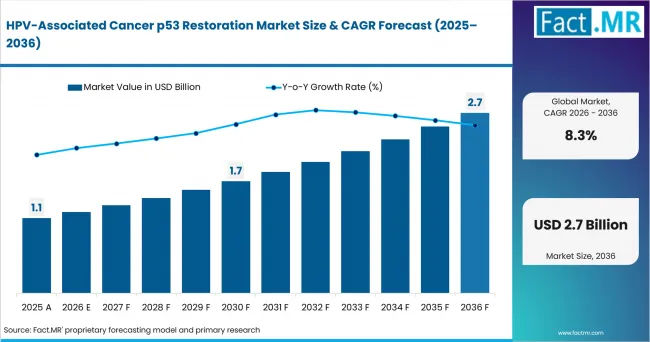
Hpv Associated Cancer P53 Restoration Market Value Analysis | Source: Fact.MR
What are the defining numbers behind HPV-Associated Cancer p53 Restoration Market growth?
USD 1.5 billion absolute opportunity by 2036, led by p53 Reactivation Therapies and Cervical Cancer alongside E6-p53 Interaction Blockade.
- Demand Drivers in the Market
- Developers are looking for clear proof that restored p53 can stop cancer cells from growing or cause them to die in HPV-positive tumors.
- Clinical study sponsors are using HPV type, tumor location and treatment response to identify suitable patients before starting larger trials.
- Research groups are working on delivery methods that can reach tumors in surface tissues and keep the treatment active for a useful period.
- Pharmaceutical companies are seeking consistent proof that the treatment works inside the body, along with clear safety results, before moving beyond early laboratory studies.
- Key Segments Analyzed
- By Therapy Type: p53 Reactivation Therapies is estimated to hold 25.0% share in 2026 supported by direct efforts to restore tumor-suppressor activity after HPV E6 disrupts the pathway.
- By Indication: Cervical Cancer is projected to account for 25.0% share in 2026 owing to its established link with persistent high-risk HPV infection and clearer treatment pathways.
- By Mechanism of Action: E6-p53 Interaction Blockade is anticipated to hold 25.0% share in 2026 due to its direct focus on preventing E6-driven p53 degradation.
- By Development Stage: Preclinical is forecast to account for 30.0% share in 2026 driven by ongoing work on pathway restoration, delivery, biomarkers and safety.\
- By End User: Pharmaceutical Companies are expected to hold 30.0% share in 2026 attributable to their role in toxicology, regulatory planning and early clinical development.
- Analyst Opinion at Fact.MR
- Shambhu Nath Jha, Senior Analyst at Fact.MR, states, “p53 restoration in HPV-associated cancer depends on a clear chain of evidence. Developers need to show that E6 or p53 engagement restores tumor-suppressor signaling and that this change slows cancer-cell growth or triggers cell death. Programs with reliable pharmacodynamic markers and repeatable tumor-response evidence are expected to be better placed for partnerships and broader clinical development.”
- Strategic Implications
- Development groups must show that restored p53 slows cancer-cell growth or causes cancer cells to die before making strong treatment claims.
- Clinical study sponsors should assess E6-p53 blocking, p53 protection and gene replacement as separate methods since each one brings different delivery and safety concerns.
- Research programs can use HPV type, tumor location and changes in the patient’s genes to find people who are more likely to respond.
- Pharmaceutical companies must link laboratory findings with the right dose, clear signs that the treatment is working and repeatable tumor results before starting wider clinical studies.
How does the HPV-Associated Cancer p53 Restoration Market break down by segment?
E6-p53 Interaction Blockade leads at 25.0% by Mechanism of Action and Preclinical leads at 30.0% by Development Stage.
Which therapy type dominates?
p53 Reactivation Therapies hold 25.0% share in 2026.
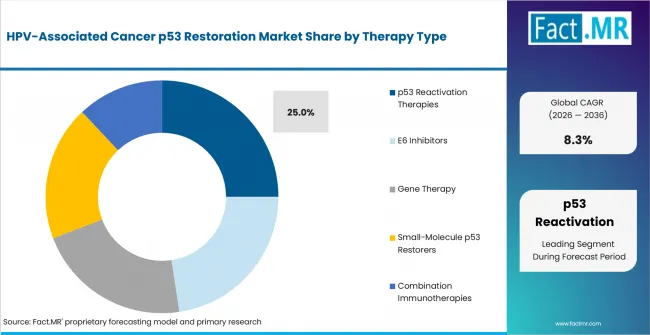
Hpv Associated Cancer P53 Restoration Market Analysis By Therapy Type | Source: Fact.MR
p53 Reactivation Therapies are estimated to hold 25.0% share in 2026. These treatments focus on bringing back the normal tumor-control role of p53 after HPV E6 has weakened or blocked it. E6 Inhibitors target the viral protein directly, while Small-Molecule p53 Restorers work to repair the damaged pathway. Gene Therapy and Combination Immunotherapies provide broader treatment options when restoring p53 alone does not produce enough effect. Researchers still need clear evidence that these treatments can slow tumor growth or help destroy cancer cells.
What leads the Indication segment?
Cervical Cancer accounts for 25.0% share in 2026.
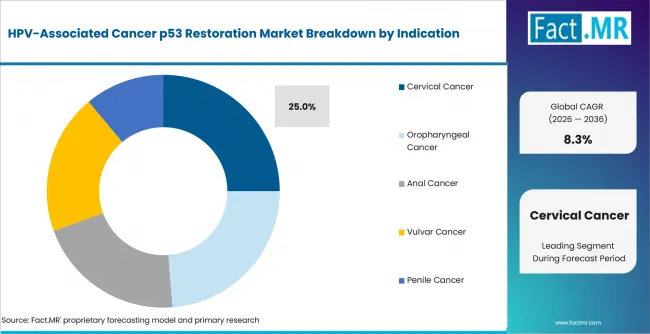
Hpv Associated Cancer P53 Restoration Market Analysis By Indication | Source: Fact.MR
Cervical Cancer is projected to account for 25.0% share in 2026. It has the strongest and most established link with long-term high-risk HPV infection, and existing screening programs make it easier to identify suitable patients. Oropharyngeal Cancer is another important area of research, although HPV affects these tumors differently. Anal Cancer provides a defined patient group for clinical studies. Vulvar and Penile Cancers involve fewer patients, so building strong clinical evidence takes more time. For these reasons, Cervical Cancer remains the main starting point for p53 restoration studies.
How does Mechanism of Action shape the market?
E6-p53 Interaction Blockade leads with 25.0% share in 2026.
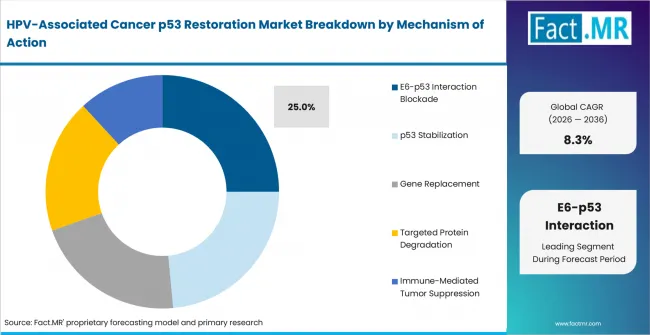
Hpv Associated Cancer P53 Restoration Market Analysis By Mechanism Of Action | Source: Fact.MR
E6-p53 Interaction Blockade is anticipated to hold 25.0% share in 2026. The approach blocks the interaction between HPV E6 and p53 so the protein can work again in tumor cells. p53 Stabilization aims to keep p53 active for a longer time. Gene Replacement introduces a working copy of the gene into affected cells. Targeted Protein Degradation removes harmful proteins, while Immune-Mediated Tumor Suppression helps the body's immune system fight the tumor. Every approach follows a different treatment path and brings its own delivery and safety challenges.
Why does Preclinical lead Development Stage?
Preclinical holds 30.0% share in 2026.
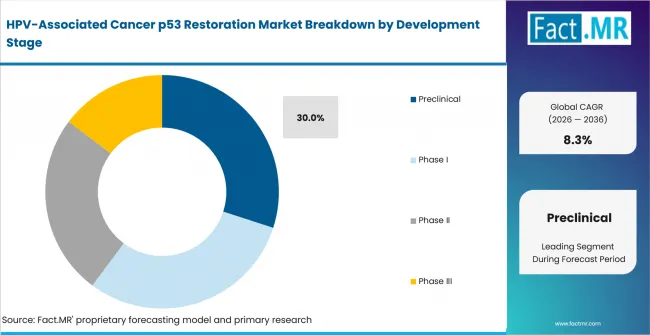
Hpv Associated Cancer P53 Restoration Market Analysis By Development Stage | Source: Fact.MR
Preclinical is forecast to account for 30.0% share in 2026. Most p53 restoration programs are still in laboratory testing, where researchers check whether the treatment reaches the target and restores p53 activity. They also study its effect on tumor cells and look for unwanted effects on healthy tissue. Only after these results are strong enough do treatments move into Phase I safety studies. Larger clinical trials come later and require consistent results across more patients. The high preclinical share shows that many programs are still building the evidence needed before wider clinical testing.
Which end user holds the leading position?
Pharmaceutical Companies represent 30.0% share in 2026.
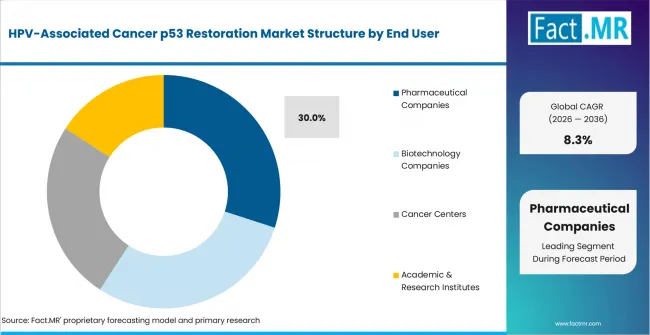
Hpv Associated Cancer P53 Restoration Market Analysis By End User | Source: Fact.MR
Pharmaceutical Companies are expected to hold 30.0% share in 2026. They manage the full development process, from laboratory studies to clinical trials and manufacturing. Their work includes safety testing, dose selection, production planning and regulatory activities. Biotechnology Companies mainly concentrate on early research or individual treatment platforms. Cancer Centers contribute patient care and clinical expertise, while Academic and Research Institutes study disease biology and early treatment methods. Large pharmaceutical companies take the leading role because these programs require long development timelines, extensive safety data and coordination across many stages of development.
What is accelerating HPV-Associated Cancer p53 Restoration Market adoption, and what is holding it back?
The accelerator is the clinical need to connect HPV biology with functional tumor-suppressor restoration. Adoption is expected to slow when tumor heterogeneity or delivery limits weaken that chain. Safety concerns then decide how much evidence a sponsor needs before broader trial work.
Drivers Impact Analysis
| DRIVER | (~) % IMPACT ON CAGR | GEOGRAPHIC RELEVANCE | IMPACT TIMELINE |
|---|---|---|---|
| Cervical and HPV-associated cancer burden | +1.3% | Global, with large cervical cancer burden in Asia and Africa | Long term (>= 4 years) |
| p53/E6 reactivation research advances | +1.0% | USA and Germany | Medium term (2-4 years) |
| National HPV surveillance and screening infrastructure | +0.7% | Germany, U.K., and USA | Medium term (2-4 years) |
| Pharmaceutical company-led preclinical pipeline investment | +0.6% | USA and South Korea | Short term (<= 2 years) |
| Vaccination and screening program evidence feeding future therapeutic demand | +0.4% | Brazil and public-health delivery systems | Long term (>= 4 years) |
Source: Fact.MR analysis. Updated Jul 20, 2026
- Cervical and HPV-related cancer cases: Long-term HPV infection continues to cause cervical cancer and several other cancers. Vaccination and screening lower future risk, but they do not help patients who already have advanced disease. Treatment research therefore remains important, especially in places where diagnosis and cancer care are still limited.
- Research on p53 and E6: New treatments are focusing more closely on the reason p53 stops working in HPV-positive cancer. Researchers are studying whether blocking E6 allows p53 to work again. They also check whether this change slows tumor growth or causes cancer cells to die. Programs are likely to receive more attention when test results clearly show that the treatment reaches its target and changes the tumor.
- HPV testing and screening systems: National screening programs help researchers find HPV-positive patients and group them by HPV type and tumor location. The National Cancer Institute lists several high-risk HPV types. HPV16 and HPV18 cause a large share of HPV-related cancers. Better patient grouping allows each cancer type to be studied separately instead of treating all HPV-related tumors in the same way.
Opportunity Impact Analysis
| OPPORTUNITY | (~) % IMPACT ON CAGR | GEOGRAPHIC RELEVANCE | IMPACT TIMELINE |
|---|---|---|---|
| Expansion into non-cervical HPV-associated cancers | +0.5% | USA | Medium term (2-4 years) |
| Gene-therapy and combination-immunotherapy pipeline diversification | +0.4% | Germany and South Korea | Medium term (2-4 years) |
| Patient-selection biomarker and companion-diagnostic development | +0.3% | Japan and South Korea | Long term (>= 4 years) |
| National screening-to-treatment pathway integration | +0.3% | U.K. and Brazil | Long term (>= 4 years) |
Source: Fact.MR analysis. Updated Jul 20, 2026
- Expansion into HPV-related cancers beyond cervical cancer: Oropharyngeal and anal cancers give researchers more areas to test treatments that restore p53 activity. Vulvar and penile cancers involve fewer patients, but they still offer focused study groups. Progress will depend on showing that the treatment works in each cancer type. Results from cervical cancer cannot simply be applied to every HPV-related tumor.
- Gene therapy and combined immune treatments: Gene replacement and immune-based treatments offer other options when direct p53 reactivation does not work well enough on its own. Gene therapy aims to bring back the tumor-control role of p53. Immune-based combinations help the body identify and attack HPV-positive cancer cells. Wider use will depend on safe delivery, strong safety results and clear proof that combining treatments gives a better result.
- Tests for choosing suitable patients: Patient testing can help researchers find tumors where restoring p53 is still likely to work. HPV type, tumor location, changes caused by the virus and changes in the patient’s genes can all affect treatment response. These tests will become more important when studies move away from treating all HPV-positive patients in the same way. Smaller groups with a better chance of response can then be selected.
Restraint Impact Analysis
| RESTRAINT | (~) % IMPACT ON CAGR | GEOGRAPHIC RELEVANCE | IMPACT TIMELINE |
|---|---|---|---|
| Tumor and host heterogeneity that bypasses p53 restoration | -0.4% | Global | Short term (<= 2 years) |
| Safety risk from p53 activation in normal tissue and durable gene-delivery exposure | -0.3% | USA and Germany | Medium term (2-4 years) |
| Preclinical-stage concentration and long translational timelines | -0.3% | Brazil and access-constrained public-health systems | Long term (>= 4 years) |
| Strict functional-restoration evidence bar raising cost of proof | -0.2% | Global | Medium term (2-4 years) |
Source: Fact.MR analysis. Updated Jul 20, 2026
- Tumor and host heterogeneity: HPV-positive cancers do not all depend on the same pathway after p53 has been disrupted. HPV genotype, tumor location and host mutations can change how strongly a tumor responds to restoration therapy. Programs are expected to face weaker results when cancer cells use alternative survival routes or no longer rely on the pathway being repaired.
- Safety risk in normal tissue: Restoring p53 activity inside cancer cells is the goal, but broad activation in healthy tissue may damage normal cells or limit the usable dose. Gene-delivery approaches add another concern because prolonged exposure can make treatment effects harder to control. Developers need a clear therapeutic window before wider clinical testing becomes realistic.
- Preclinical-stage concentration: Most programs remain focused on laboratory models, delivery studies and early safety work. This slows movement into larger patient trials and keeps the market dependent on a limited number of early candidates. Translational progress is expected to remain gradual until pathway rescue produces consistent tumor responses across more than one model.
Where is HPV-Associated Cancer p53 Restoration Market demand growing across key countries?
A global growth rate represents the weighted average of all markets included in the analysis. It therefore cannot exceed the growth rate of every individual market within the coverage set. This suggests that markets not shown here are growing at rates above 8.3%. The six countries presented are illustrative examples, and their comparison with the global figure makes this difference visible.
- The countries are distinguished less by their CAGRs and more by the factors shaping their growth.
- Germany and the USA follow research-led paths supported by specialist hospitals, molecular diagnostics and clinical-trial infrastructure. Brazil is shaped by cervical cancer burden, affordability and access across public and private healthcare systems.
- South Korea follows a biomarker-led path, with HPV type, tumour site and host mutations guiding patient selection. The United Kingdom and Japan rely more on structured evidence review before wider clinical use.
- Markets with broadly similar CAGRs can therefore follow substantially different development paths. These differences become relevant when comparing potential entry points across the countries covered.
The full report examines these dynamics across North America, Latin America, Western Europe, Eastern Europe, East Asia, South Asia and Pacific, and the Middle East and Africa.
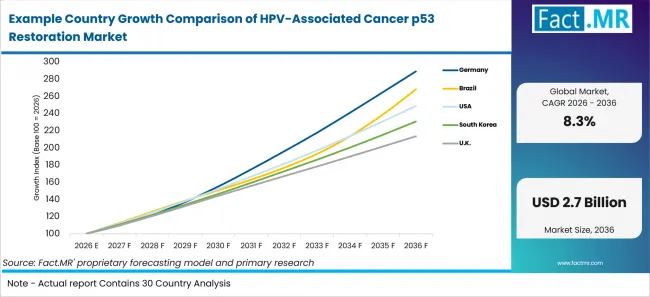
Example Country Growth Comparison Of Hpv Associated Cancer P53 Restoration Market | Source: Fact.MR
| COUNTRY | CAGR |
|---|---|
| Germany | 11.2% |
| Brazil | 10.4% |
| USA | 9.5% |
| South Korea | 8.7% |
| United Kingdom | 7.9% |
| Japan | 7.1% |
Source: Fact.MR analysis. Updated Jul 20, 2026
What is driving Germany's growth through 2036?
11.2% CAGR, supported by mechanism-led HPV cancer research and specialist assay capacity.
Germany combines university hospitals with molecular oncology laboratories that can test whether p53 signaling has been functionally restored after E6 inhibition. The market is expected to record an 11.2% CAGR by 2036 as sponsors move beyond total p53 measurement and seek repeatable evidence of pathway rescue before early clinical studies expand.
How is Brazil developing p53 restoration demand?
10.4% CAGR, driven by cervical cancer need and wider HPV-DNA screening.
Brazil has a large cervical cancer burden and a mixed public-private healthcare system that creates both clinical need and access challenges. The market is projected to expand at a 10.4% CAGR from 2026 to 2036 as research programs connect E6-mediated degradation blockade with affordable treatment routes beyond major referral centers.
What supports the USA outlook?
9.5% CAGR, owing to early-stage trial capacity and proof-of-mechanism research.
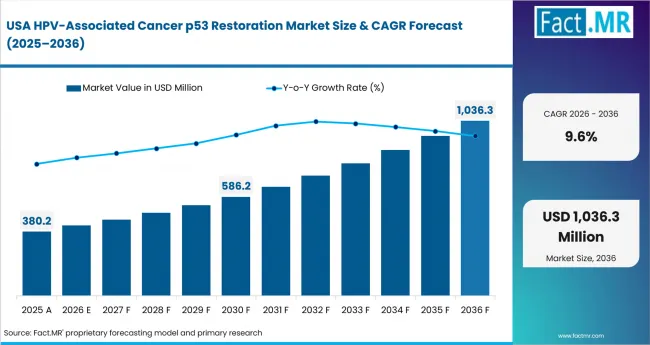
Hpv Associated Cancer P53 Restoration Market Country Value Analysis | Source: Fact.MR
The United States has deep oncology trial infrastructure and a defined HPV-associated cancer population. Demand is anticipated to post a 9.5% CAGR through 2036 as small early studies test whether restored p53 signaling produces cell-cycle arrest, apoptosis, or measurable tumor control before larger clinical programs begin.
What underpins South Korea’s growth?
8.7% CAGR, supported by genomic profiling and concentrated hospital infrastructure.
South Korea combines precision-medicine capability with major hospital networks that can support biomarker-led patient selection. The market is estimated to record an 8.7% CAGR by 2036 as HPV genotype, tumor site, viral integration, and host mutations become more closely linked with decisions on which patients enter p53-restoration studies.
How is the United Kingdom scaling p53 restoration demand?
7.9% CAGR, led by genomic laboratory networks and structured NHS evidence review.
The United Kingdom offers a coordinated route for biomarker assessment through NHS-linked genomic testing and specialist oncology pathways. The market is forecast to post a 7.9% CAGR from 2026 to 2036 as developers prove that restored p53 activity can be delivered into epithelial tumors and maintained long enough to support treatment decisions.
What shapes Japan’s growth through 2036?
7.1% CAGR, supported by specialist diagnostics and careful local evidence review.
Japan has strong cancer-genomic hospitals and diagnostic capability, but wider adoption depends on clear pharmacodynamic markers and tumor-specific patient-selection evidence. The market is expected to record a 7.1% CAGR by 2036 as local studies define where restored p53 signaling produces a reliable biological and clinical response.
Who leads the HPV-Associated Cancer p53 Restoration Market?
BioNTech and Precigen lead the closest clinical work around HPV E6 and E7 targets, while PDS Biotechnology and Merck strengthen HPV-positive cancer treatment and combination-therapy development.
BioNTech develops an mRNA immunotherapy directed at HPV oncoproteins, while Precigen contributes an investigational immunotherapy for HPV-associated cancers. PDS Biotechnology adds HPV-targeted immune therapy, and Merck brings checkpoint-inhibitor experience across cervical and head-and-neck cancer treatment. These companies compete on immune response, patient selection, tumor control, and combination-treatment evidence.
ISA Pharmaceuticals develops a synthetic peptide-based immunotherapy directed at HPV16 E6 and E7, while Transgene contributes viral-vector immunotherapy for HPV-positive cancers. Both companies add focused HPV-targeted development experience to the provider set. Competition through 2036 is expected to center on E6 and E7 targeting, functional p53 recovery, durable tumor response, patient selection, and treatment safety.
Which companies are the key providers?
- Merck & Co., Inc.
- ISA Pharmaceuticals B.V.
- Transgene SA
- BioNTech SE
- Precigen, Inc.
- PDS Biotechnology Corporation
Bibliography
- World Health Organization. (2026, July 3). Cervical cancer. World Health Organization.
- Centers for Disease Control and Prevention. (2025, December 3). Cancers linked with HPV each year. Centers for Disease Control and Prevention.
- World Health Organization. (2025, November 17). World Cervical Cancer Elimination Day 2025. World Health Organization.
- U.S. Food and Drug Administration. (2025, March 26). GARDASIL 9. U.S. Food and Drug Administration.
- International Agency for Research on Cancer. (2026). GLOBOCAN 2024: World fact sheet. Global Cancer Observatory, World Health Organization.
This Report Addresses
- The report provides strategic intelligence on HPV-Associated Cancer p53 Restoration across Therapy Type and Indication choices that shape early oncology development programs.
- Segment analysis covers p53 Reactivation Therapies and Cervical Cancer as the share leaders within the 2026 market structure.
- Regional outlook evaluates Germany and Brazil alongside the USA, South Korea, the United Kingdom, and Japan while additional countries complete the growth comparison.
- Competitive analysis profiles BioNTech and Precigen alongside PDS Biotechnology and Merck, followed by ISA Pharmaceuticals and Transgene as additional HPV-targeted developers.
- Mechanism assessment covers E6-p53 Interaction Blockade and p53 Stabilization alongside Gene Replacement, Targeted Protein Degradation, and Immune-Mediated Tumor Suppression.
- Development assessment covers Preclinical and Phase I alongside Phase II and Phase III programs across pharmaceutical companies, biotechnology companies, cancer centers, and research institutes.
What does the HPV-Associated Cancer p53 Restoration Market cover?
p53 Reactivation Therapies, E6 Inhibitors, Gene Therapy, Small-Molecule p53 Restorers, and Combination Immunotherapies used to restore tumor-suppressor activity in HPV-positive cancers.
The HPV-Associated Cancer p53 Restoration Market covers therapies intended to restore p53 signaling after HPV E6 weakens or disables the pathway. Coverage includes approaches that block E6-p53 interaction, stabilize p53, replace the gene, remove harmful proteins, or support immune-mediated tumor suppression across Cervical Cancer and other HPV-associated cancers.
The market differs from the broader HPV treatment field because commercial value comes from functional restoration of p53 signaling and proof that this change slows tumor growth or causes cancer-cell death. Preventive HPV vaccines and general oncology treatments remain outside the core boundary unless their main role is to support p53 pathway restoration.
What is included in the scope?
Therapies developed to restore functional p53 activity across HPV-associated cancer research and clinical development.
The scope includes p53 Reactivation Therapies and E6 Inhibitors alongside Gene Therapy, Small-Molecule p53 Restorers, and Combination Immunotherapies. Coverage spans Cervical Cancer, Oropharyngeal Cancer, Anal Cancer, Vulvar Cancer, and Penile Cancer. E6-p53 Interaction Blockade, p53 Stabilization, Gene Replacement, Targeted Protein Degradation, and Immune-Mediated Tumor Suppression are included when restoration of tumor-suppressor signaling is the main treatment objective. Coverage also considers development stage, patient-selection biomarkers, tumor location, HPV genotype, delivery, safety, and proof of functional pathway recovery.
What is excluded from the scope?
Preventive HPV vaccines and unrelated cancer treatments are outside the core scope.
The scope excludes HPV vaccines used only to prevent infection and therapies that do not seek to restore p53 activity. General checkpoint inhibitors, radiation, chemotherapy, screening tests, and diagnostic services remain adjacent unless they are used within a defined p53-restoration treatment program. Unrelated equipment, complete treatment expenditure, and unsupported company or segment shares are also excluded.
How Was the Analysis Built?
The analysis draws on 120+ sources, 35+ company portfolios, 25+ countries, and more than 20 industry interviews.
- Primary Research: Primary research includes discussions with manufacturers, service providers, technology developers, distributors, end users, procurement teams, and subject-matter experts. These conversations examine purchasing priorities, product adoption, operational challenges, approval requirements, competitive positioning, and the factors that influence wider market acceptance.
- Desk Research: Desk research covers government statistics, regulatory publications, company filings, trade data, technical studies, industry associations, standards, public policy, and other authoritative sources. Every source used in the analysis is documented in the bibliography.
- Market Sizing and Forecasting: Market estimates combine historical performance, demand indicators, pricing and volume trends, segment shares, company participation, country-level growth, adoption patterns, investment activity, and barriers to market expansion.
- Data Validation and Update Cycle: Findings are validated by comparing primary interviews with public data, company activity, regulatory changes, trade patterns, and industry developments. Regular updates review new product launches, capacity changes, partnerships, approvals, procurement trends, and shifts in commercial adoption.
Segmentation
What is the report's scope and coverage?
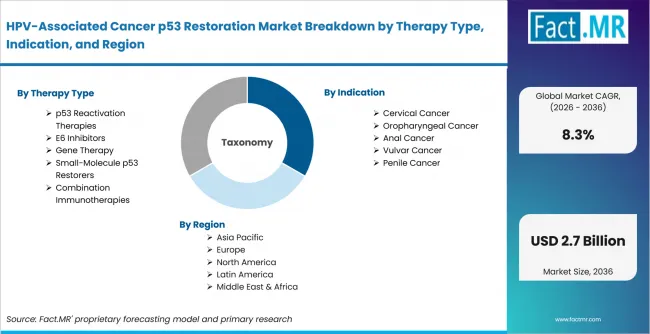
Hpv Associated Cancer P53 Restoration Market Breakdown By Therapy Type, Indication, And Region | Source: Fact.MR
| Attribute | Details |
|---|---|
| Quantitative Units | USD Billion in 2026 to USD Billion by 2036 at a CAGR |
| Market Definition | Therapies designed to restore p53 activity in HPV-associated cancers by blocking E6-mediated degradation, stabilizing p53, replacing the gene, or supporting immune-mediated tumor suppression |
| Therapy Type | p53 Reactivation Therapies; E6 Inhibitors; Gene Therapy; Small-Molecule p53 Restorers; Combination Immunotherapies |
| Indication | Cervical Cancer; Oropharyngeal Cancer; Anal Cancer; Vulvar Cancer; Penile Cancer |
| Mechanism of Action | E6-p53 Interaction Blockade; p53 Stabilization; Gene Replacement; Targeted Protein Degradation; Immune-Mediated Tumor Suppression |
| Development Stage | Preclinical; Phase I; Phase II; Phase III |
| End User | Pharmaceutical Companies; Biotechnology Companies; Cancer Centers; Academic & Research Institutes |
| Regions Covered | North America; Latin America; Western Europe; Eastern Europe; East Asia; South Asia and Pacific; Middle East and Africa |
| Countries Covered | Germany; Brazil; USA; South Korea; United Kingdom; Japan |
| Key Companies Profiled | Merck & Co., Inc.; ISA Pharmaceuticals B.V.; Transgene SA; BioNTech SE; Precigen, Inc.; PDS Biotechnology Corporation |
| Forecast Period | 2026 to 2036 |
| Approach | Hybrid top-down and bottom-up approach using HPV-associated cancer burden; p53 and E6 research activity; therapy-development stages; biomarker-led patient selection; functional pathway-restoration evidence; safety assessment; clinical-trial readiness and company validation |
Source: Fact.MR analysis. Updated Jul 20, 2026
How is the market segmented?
-
By Therapy Type
- p53 Reactivation Therapies
- E6 Inhibitors
- Gene Therapy
- Small-Molecule p53 Restorers
- Combination Immunotherapies
-
By Indication
- Cervical Cancer
- Oropharyngeal Cancer
- Anal Cancer
- Vulvar Cancer
- Penile Cancer
-
By Mechanism of Action
- E6-p53 Interaction Blockade
- p53 Stabilization
- Gene Replacement
- Targeted Protein Degradation
- Immune-Mediated Tumor Suppression
-
By Development Stage
- Preclinical
- Phase I
- Phase II
- Phase III
-
By End User
- Pharmaceutical Companies
- Biotechnology Companies
- Cancer Centers
- Academic & Research Institutes
-
By Region
- North America
- Latin America
- Western Europe
- Eastern Europe
- East Asia
- South Asia and Pacific
- Middle East and Africa
Frequently Asked Questions
Which Indication leads the HPV-Associated Cancer p53 Restoration Market?
Which Mechanism of Action leads the HPV-Associated Cancer p53 Restoration Market?
Which Development Stage leads the HPV-Associated Cancer p53 Restoration Market?
Which End User leads the HPV-Associated Cancer p53 Restoration Market?
Which country records the highest CAGR in the HPV-Associated Cancer p53 Restoration Market?
How does Brazil perform in the HPV-Associated Cancer p53 Restoration Market?
How does the USA perform in the HPV-Associated Cancer p53 Restoration Market?
How does South Korea perform in the HPV-Associated Cancer p53 Restoration Market?
What is the primary driver in the HPV-Associated Cancer p53 Restoration Market?
What is the main restraint in the HPV-Associated Cancer p53 Restoration Market?
Why are p53 Reactivation Therapies important?
Why do pharmaceutical companies dominate demand?
Who worked on this report


Preview the report firsthand - request a free sample
Free SampleGet the brochure for pricing and purchase details
Download PDF