- Market Value (2025): USD 792.3 Mn
- Estimated Value (2026): USD 871.5 Mn
- Forecast Value (2036): USD 2260.5 Mn
- CAGR (2026-2036): 10.0%
What is the HPV E6 Oncoprotein Inhibitor Market forecast to be worth by 2036?
USD 871.5 million in 2026 to USD 2,260.5 million by 2036, at a 10.0% CAGR.
- The market entered 2026 at USD 871.5 million, up from USD 792.3 million in 2025, supported by growing recognition of E6 as a druggable, tumor-restricted oncoprotein across cervical and other HPV-associated cancers.
- Demand is projected to increase from USD 871.5 million in 2026 to USD 2,260.5 million by 2036.
- The market is forecast to record a 10.0% CAGR from 2026 to 2036 as direct E6-p53 inhibition, targeted E6 degradation, and immune-mediated E6 targeting mature from preclinical proof toward funded clinical development.
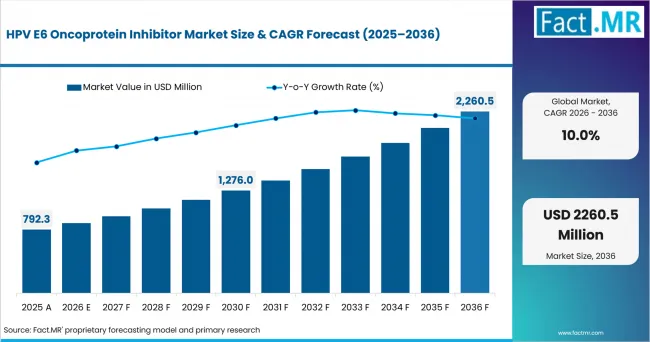
Hpv E6 Oncoprotein Inhibitor Market Value Analysis | Source: Fact.MR
What are the defining numbers behind HPV E6 Oncoprotein Inhibitor Market growth?
USD 1,389.0 million absolute opportunity is expected by 2036.
- Demand Drivers in the Market
- GLOBOCAN 2022 estimates record 662,301 new cervical cancer cases and 348,874 deaths worldwide in a single year, with the heaviest incidence and mortality burden concentrated in Asia and Africa, keeping HPV-associated disease central to oncology R&D demand.
- Structural biology work has established that E6 drives carcinogenesis by recruiting the host ubiquitin ligase E6AP to degrade the tumor-suppressor protein p53, and separately by degrading caspase-8 to blunt apoptosis; because this mechanism is well characterized, it gives developers a defined biochemical interface to design against rather than an empirical target.
- Multiple independent modalities are now in preclinical development against the same target, including AlphaScreen-identified small-molecule E6 inhibitors, in silico-derived candidates such as galangin, nanobody-based bioPROTAC degraders that eliminate E6 from tumor cells, and E6-specific TCR-engineered T-cell therapy, giving the category more than one credible route to a first approval.
- Key Segments Analyzed
- By Inhibitor Type: Small-Molecule E6 Inhibitors leads at 30.0% of 2026 demand.
- By Indication: Cervical Cancer leads at 25.0% of 2026 demand.
- By Mechanism of Action: E6-p53 Interaction Inhibition leads at 30.0% of 2026 demand.
- By Development Stage: Preclinical leads at 30.0% of 2026 demand.
- By End User: Pharmaceutical Companies leads at 30.0% of 2026 demand.
- Analyst Opinion at Fact.MR
- Fact.MR's analyst view is that near-term winners will be developers who pair their chosen route, direct inhibition or immune-mediated clearance, with a biomarker that can be measured cheaply and repeatably in a clinical setting. Programmes that can only demonstrate E6 engagement in specialized laboratory assays will struggle to attract co-development partners, regardless of how selective the underlying chemistry is.
- Strategic Implications
- Anchor a direct E6-p53 inhibition programme around a single, cheaply repeatable biomarker before advancing past preclinical work; retrofitting a biomarker after a laboratory finding has already been framed as a clinical claim is the most common early misstep in this category.
- Treat small molecules, covalent compounds, peptides, degradation agents, gene silencing, and immune targeting as genuinely different manufacturing and regulatory problems rather than variations on one playbook, and staff each modality's follow-up work accordingly; underfunding this support layer is the most common reason a promising modality stalls right after its first encouraging data readout.
- Insist on independent or multi-site confirmation of any E6-binding claim before broad expansion. A single-site binding result rarely survives scrutiny from regulators or downstream licensing partners on its own.
- Build intracellular delivery, stability, tumor exposure, and viral-genotype coverage data into the earliest pricing models rather than after Phase I, since these costs are easy to underestimate when pricing assumptions are built around trial-phase economics alone.
Germany is projected to record an 11.9% CAGR from 2026 to 2036, supported by university-hospital infrastructure and EU-wide regulatory alignment. Brazil is estimated to post a 12.5% CAGR through its large public-health cervical cancer burden. The USA is anticipated to advance at an 11.5% CAGR as the deepest concentration of active clinical trials and venture-backed developers in this set. South Korea is forecast to record a 10.5% CAGR through precision-medicine infrastructure. The U.K. is projected at 9.5%, while Japan is estimated to post an 8.5% CAGR through domestic preclinical validation requirements.
How does the HPV E6 Oncoprotein Inhibitor Market break down by segment?
Small-Molecule E6 Inhibitors are expected to lead Inhibitor Type at 30.0%, and Cervical Cancer is projected to lead Indication at 25.0% share in 2026.
Why does Small-Molecule E6 Inhibitors lead Inhibitor Type?
Small-Molecule E6 Inhibitors leads the Inhibitor Type segment at 30.0% of 2026 demand.
The inhibitor type categories are Small-Molecule E6 Inhibitors, Covalent E6 Inhibitors, Peptide-Based Inhibitors, and Targeted Protein Degradation Agents. Small molecules lead because E6 lacks an enzymatic pocket, so most discovery campaigns target the shallow groove where E6 binds E6AP or p53; high-throughput AlphaScreen screening has already identified flavonoid-derived hits, such as a gambogic-acid analog, that bind this groove with micromolar affinity in HPV-positive head and neck cancer models. Covalent and degrader approaches must additionally prove that irreversible target engagement does not compromise safety over long-term dosing.
Why does Cervical Cancer lead Indication?
Cervical Cancer leads the Indication segment at 25.0% of 2026 demand.
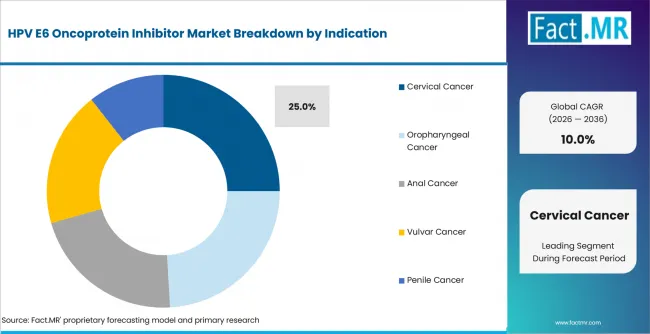
Hpv E6 Oncoprotein Inhibitor Market Analysis By Indication | Source: Fact.MR
The indication categories are Cervical Cancer, Oropharyngeal Cancer, Anal Cancer, Vulvar Cancer, and Penile Cancer. Cervical cancer leads because it has established screening pathways and the largest defined patient cohort tied to a single high-risk HPV genotype, HPV-16, whereas the rarer HPV-associated cancer sites depend on multi-site referral networks to reach adequate trial enrollment.
Why does E6-p53 Interaction Inhibition lead Mechanism of Action?
E6-p53 Interaction Inhibition leads the Mechanism of Action segment at 30.0% of 2026 demand.
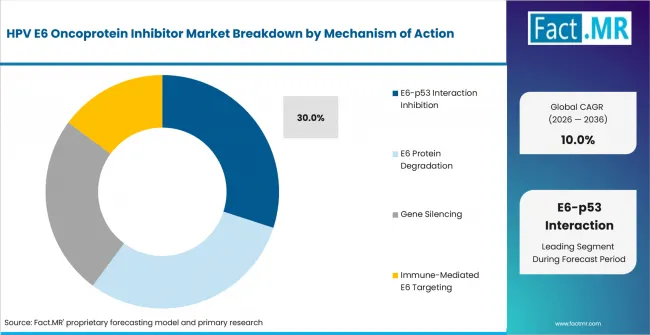
Hpv E6 Oncoprotein Inhibitor Market Analysis By Mechanism Of Action | Source: Fact.MR
The mechanism of action categories are E6-p53 Interaction Inhibition, E6 Protein Degradation, Gene Silencing, and Immune-Mediated E6 Targeting. E6-p53 interaction inhibition leads because it addresses the best-characterized node in E6 biology directly: peptide and small-molecule leads derived from the E6AP-binding domain have already demonstrated druggability of this interface, though a direct-inhibition candidate still has to show measurable p53 restoration in tumor tissue, while an immune-targeting candidate instead has to demonstrate durable trafficking of effector cells into the tumor.
Why does Preclinical lead Development Stage?
Preclinical leads the Development Stage segment at 30.0% of 2026 demand.
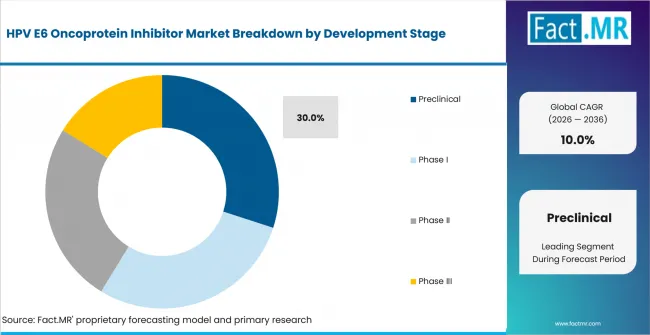
Hpv E6 Oncoprotein Inhibitor Market Analysis By Development Stage | Source: Fact.MR
The development stage categories are Preclinical, Phase I, Phase II, and Phase III. Preclinical work leads because no E6-targeting therapy has yet reached clinical approval; the most recent structural advances, including nanobody-based bioPROTAC degraders that reduced tumor burden in an immunocompetent mouse model, remain at the animal-model stage, reflecting a pipeline still resolving delivery and selectivity questions before it can support first-in-human dosing decisions.
Why does Pharmaceutical Companies lead End User?
Pharmaceutical Companies leads the End User segment at 30.0% of 2026 demand.
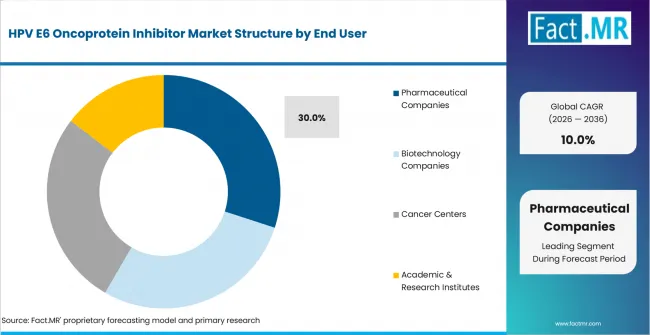
Hpv E6 Oncoprotein Inhibitor Market Analysis By End User | Source: Fact.MR
The end user categories are Pharmaceutical Companies, Biotechnology Companies, Cancer Centers, and Academic & Research Institutes. Large pharmaceutical companies bring late-stage development and regulatory capacity, while NCI-affiliated academic and cancer-center investigators typically originate the early biomarker and mechanism-of-action evidence, such as the NCI Surgery Branch's E6 TCR T-cell trials, that later licensing decisions rely on.
What is accelerating HPV E6 Oncoprotein Inhibitor Market adoption, and what is holding it back?
E6 is already well understood as a druggable, tumor-restricted target; what slows the field down is converting that understanding into a fundable clinical package. A developer needs direct E6-p53 inhibition evidence, a repeatable biomarker, and the staff and quality-control infrastructure to support a first-in-human trial before demand here turns into revenue.
Drivers Impact Analysis
| DRIVER | (~) % IMPACT ON CAGR | GEOGRAPHIC RELEVANCE | IMPACT TIMELINE |
|---|---|---|---|
| Direct E6-p53 interaction targeting | +1.8% | Germany | Medium term (2-4 years) |
| Rising global cervical cancer burden | +1.5% | Germany, Brazil, USA, South Korea, U.K., and Japan | Long term (>= 4 years) |
| Modality diversification across inhibitor classes | +1.2% | Brazil | Medium term (2-4 years) |
| Clinical-stage validation of E6-binding evidence | +0.9% | USA | Short term (<= 2 years) |
| Precision-oncology and genomic-laboratory infrastructure | +0.6% | South Korea and U.K. | Long term (>= 4 years) |
Source: Fact.MR analysis. Updated Jul 21, 2026
- Direct E6-p53 interaction targeting: E6-p53 Interaction Inhibition leads the Mechanism of Action segment at 30.0% of 2026 demand, and Germany's leading 11.9% CAGR is interpreted through this same pathway.
- Rising global cervical cancer burden: GLOBOCAN 2022 estimates record 662,301 new cervical cancer cases and 348,874 deaths worldwide, keeping this burden central to demand across all six countries covered.
- Modality diversification across inhibitor classes: The market spans small molecules, covalent compounds, peptides, degradation agents, silencing, and immune targeting, a breadth Brazil's 12.5% CAGR is explicitly tied to.
Opportunity Impact Analysis
| OPPORTUNITY | (~) % IMPACT ON CAGR | GEOGRAPHIC RELEVANCE | IMPACT TIMELINE |
|---|---|---|---|
| Expansion into non-cervical HPV-associated cancers | +0.5% | USA | Medium term (2-4 years) |
| Immune-mediated E6 targeting platforms | +0.4% | Germany and South Korea | Long term (>= 4 years) |
| Combination strategies addressing E6-independent resistance | +0.3% | USA | Long term (>= 4 years) |
| Preclinical-to-clinical translation pipelines | +0.2% | Japan and Brazil | Medium term (2-4 years) |
Source: Fact.MR analysis. Updated Jul 21, 2026
- Expansion into non-cervical HPV-associated cancers: Cervical Cancer leads Indication at only 25.0%, leaving Oropharyngeal, Anal, Vulvar, and Penile Cancer as adjacent settings.
- Immune-mediated E6 targeting platforms: The market splits into direct intracellular E6 control and immune recognition of E6-expressing cells; NCI's E6 TCR T-cell trials, which reported objective responses in 2 of 12 metastatic-cancer patients with no dose-limiting toxicity, illustrate this route's early clinical traction.
- Combination strategies addressing E6-independent resistance: The report names combination treatment and resistance as the central constraint, also framing an opportunity best supported in the USA's trial-dense ecosystem.
Restraints Impact Analysis
| RESTRAINT | (~) % IMPACT ON CAGR | GEOGRAPHIC RELEVANCE | IMPACT TIMELINE |
|---|---|---|---|
| Incomplete intracellular delivery and stability pathway | -0.5% | Global | Short term (<= 2 years) |
| Tumor resistance when growth no longer depends on E6 | -0.4% | Global | Medium term (2-4 years) |
| Early-stage, preclinical-heavy pipeline | -0.3% | Brazil | Medium term (2-4 years) |
| Access and affordability gaps in mixed delivery systems | -0.2% | Brazil | Long term (>= 4 years) |
Source: Fact.MR analysis. Updated Jul 21, 2026
- Incomplete intracellular delivery and stability pathway: The stated central adoption barrier is an incomplete pathway around intracellular delivery, stability, tumor exposure, and viral-genotype coverage; even the furthest-advanced bioPROTAC degrader work remains at the animal-model stage.
- Tumor resistance when growth no longer depends on E6: The same barrier flags resistance when tumors no longer depend on one viral function, a biological limit applying globally.
- Early-stage, preclinical-heavy pipeline: Preclinical work leads Development Stage at 30.0% of 2026 demand; Brazil's mixed public-private system feels this lag most directly.
Which countries are scaling HPV E6 Oncoprotein Inhibitor Market fastest?
A global growth rate represents the weighted average of all markets included in the analysis. Germany and Brazil remain above the 10.0% global figure, while South Korea, U.K. and Japan remain below it. The six countries presented are illustrative examples, and their comparison with the worldwide rate makes this difference visible.
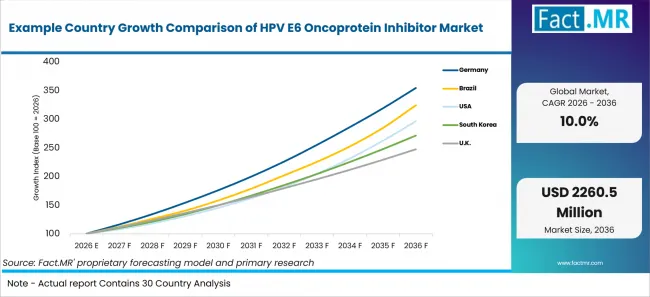
Example Country Growth Comparison Of Hpv E6 Oncoprotein Inhibitor Market | Source: Fact.MR
| COUNTRY | CAGR, 2026 to 2036 |
|---|---|
| Germany | 11.9% |
| Brazil | 12.5% |
| USA | 11.5% |
| South Korea | 10.5% |
| U.K. | 9.5% |
| Japan | 8.5% |
Source: Fact.MR analysis. Updated Jul 21, 2026
What shapes growth in Germany?
Germany: direct inhibition of the E6-p53 interaction.
Germany is projected at 11.9% CAGR from 2026 to 2036, the fastest pace in this set. A large university-hospital and laboratory base, EU-wide regulatory alignment, and structured specialist referral networks let Germany move investigational E6-p53 inhibitors from bench to clinic faster than most peers here, though the rate should be read against that specific pathway rather than as a sign that every German institution adopts new oncology tools at the same speed.
What shapes growth in Brazil?
Brazil: small molecules, covalent compounds, peptides, degradation agents, silencing, and immune targeting as different modalities.
Brazil is projected at 12.5% CAGR from 2026 to 2036, the fastest of the six markets tracked here. A large and diverse patient population, plus a substantial public-health cervical cancer burden, creates real scale, but Brazil's mixed public-private delivery system means access, regional laboratory capacity, and affordability will decide how quickly any of the modalities in this market actually reach patients outside major urban centres.
What shapes growth in USA?
USA: structural and biochemical evidence that a candidate binds the relevant E6 form.
USA is projected at 11.5% CAGR from 2026 to 2036. The United States holds the deepest concentration of regulatory approvals, active clinical trials, specialised cancer centres, and venture-backed developers in this source set, which supports faster movement of structural and biochemical E6-binding evidence from bench into early-phase trials than elsewhere in this group.
What shapes growth in South Korea?
South Korea: intracellular delivery, stability, tumor exposure, and viral-genotype coverage.
South Korea is projected at 10.5% CAGR from 2026 to 2036. Advanced digital health infrastructure, high hospital density, and active precision-medicine programmes give South Korea an edge in generating the intracellular delivery, stability, and viral-genotype coverage data that this class of inhibitor needs before wider adoption.
What shapes growth in U.K.?
U.K.: restoration of p53 and other E6-affected pathways as pharmacodynamic evidence.
U.K. is projected at 9.5% CAGR from 2026 to 2036. Centralised NHS purchasing, national screening programmes, and genomic laboratory networks let the United Kingdom coordinate population-level rollout once restoration of p53 and other E6-affected pathways is confirmed as pharmacodynamic evidence, rather than relying on institution-by-institution uptake.
What shapes growth in Japan?
Japan: preclinical proof in cervical and non-cervical HPV-positive models.
Japan is projected at 8.5% CAGR from 2026 to 2036, the slowest of the six markets tracked here. Japan's specialist medicine, diagnostics, and life-science base are strong, but adoption typically waits on local preclinical proof in cervical and non-cervical HPV-positive models, plus domestic regulatory review, before hospital pathways integrate a new inhibitor class.
Who leads the HPV E6 Oncoprotein Inhibitor Market?
ISA Pharmaceuticals, Precigen, Transgene and HOOKIPA Pharma show the strongest relevance through therapeutic programs targeting HPV E6 and E7 antigens, while BioNTech adds broader cancer-immunotherapy capabilities.
ISA Pharmaceuticals develops therapeutic vaccines designed to generate immune responses against HPV E6 and E7 proteins. Precigen supports HPV-related cancer treatment through therapeutic vaccine and immunotherapy programs. Transgene and HOOKIPA Pharma also develop immunotherapies aimed at HPV-positive cancers by targeting E6 and E7 antigens. BioNTech contributes mRNA and immune-oncology expertise, although its programs are more closely associated with HPV-targeted immunotherapy than direct E6 oncoprotein inhibition.
Competition is expected to depend on clinical effectiveness, durability of immune response and the ability to treat advanced HPV-associated cancers. Developers are also likely to compete through combination strategies, patient selection and evidence across different HPV-related cancers. Companies that demonstrate a clear therapeutic effect against E6- and E7-expressing tumors may gain stronger clinical and commercial interest.
Which companies are the key providers?
ISA Pharmaceuticals B.V.; Precigen, Inc.; Transgene SA; and BioNTech SE.
- ISA Pharmaceuticals B.V.
- Precigen, Inc.
- Transgene SA
- BioNTech SE
Bibliography
- Bhattacharjee, R. et al. (2025). Identification of novel therapeutic inhibitors against E6 and E7 oncogenes of HPV-16 associated with cervical cancer. PLOS ONE / PMC.
- Cerbo, F. et al. A high-content AlphaScreen identifies E6-specific small molecule inhibitors as potential therapeutics for HPV+ head and neck squamous cell carcinomas. Oncotarget.
- (2025). Targeted degradation of the HPV oncoprotein E6 reduces tumor burden in cervical cancer. Molecular Therapy (Cell Press) / PMC.
- Zhu, J. et al. (2021). Novel Affibody Molecules Targeting the HPV16 E6 Oncoprotein Inhibited the Proliferation of Cervical Cancer Cells. Frontiers in Cell and Developmental Biology / PMC.
- U.S. National Cancer Institute, Surgery Branch. ClinicalTrials.gov protocol NCT03197025 — Immunotherapy with E6 TCR T Cells for Vulvar High-Grade Squamous Intraepithelial Lesions.
- U.S. National Cancer Institute. ClinicalTrials.gov protocol NCT04476251 — E7 TCR T Cell Induction Immunotherapy for Stage IIB-IVA Cervical Cancer.
- ClinicalTrials.gov protocol NCT02481414 — A Clinical Trial of PepCan for Treating Cervical High-Grade Squamous Intraepithelial Lesions.
- Novel therapeutic strategies for targeting E6 and E7 oncoproteins in cervical cancer. ScienceDirect (2025).
This Report Addresses
- The report provides strategic intelligence on the HPV E6 Oncoprotein Inhibitor Market across Inhibitor Type and Indication choices that shape development decisions.
- Segment analysis covers Small-Molecule E6 Inhibitors as the share leader within the 2026 market structure.
- Regional outlook evaluates Germany and Brazil alongside USA and South Korea, while U.K. and Japan complete the growth comparison.
- Use-case assessment covers the mechanisms and modalities that shape HPV E6 oncoprotein inhibitor demand across the forecast period.
What does the HPV E6 Oncoprotein Inhibitor Market cover?
Investigational small molecules, peptides, degraders, gene-silencing tools, and immune approaches are used to inhibit or eliminate the HPV E6 oncoprotein in HPV-associated cancers.
The HPV E6 Oncoprotein Inhibitor Market covers direct and immune-mediated approaches to neutralizing the E6 viral oncoprotein, which drives carcinogenesis by degrading the tumor-suppressor protein p53 and the apoptosis regulator caspase-8. Coverage includes small-molecule protein-protein interaction disruptors, covalent inhibitors, peptide-based inhibitors, targeted protein degradation agents (bioPROTACs), gene-silencing constructs, and immune-mediated targeting approaches such as TCR-engineered T-cell therapy and therapeutic vaccines.
The market differs from the broader HPV therapeutics and prophylactic-vaccine sector because commercial value here comes specifically from agents designed against the E6 oncoprotein itself, a target with no counterpart in healthy human cells. General cervical-cancer chemotherapy and radiotherapy, and broad-spectrum immunotherapies not specifically directed at E6 remain outside the boundary.
What is included in the scope?
Included are the inhibitor mechanisms, indications, and development stages that define this investigational category.
The scope includes Inhibitor Type, Indication, Mechanism of Action, Development Stage, and End User, the recorded country growth estimates, recent non-commercial and academic evidence on E6 structural biology and degradation chemistry, clinical-trial protocol data, and long-term development considerations such as intracellular delivery and viral-genotype coverage.
What is excluded from the scope?
General cervical-cancer treatment, and unrelated oncology equipment remain outside the scope of this market.
Excluded are general chemotherapy, radiotherapy and surgical treatment for cervical and other HPV-associated cancers not specifically directed at the E6 oncoprotein, broad-spectrum immunotherapies without an E6-specific mechanism, and claims that cannot be tied to a current named academic or clinical source.
How Was the Analysis Built?
The analysis draws on peer-reviewed structural-biology and pharmacology literature, ClinicalTrials.gov protocol documentation, and academic pipeline surveys.
- Primary Research: Primary research includes discussions with manufacturers, service providers, technology developers, distributors, end users, procurement teams, and subject-matter experts. These conversations examine purchasing priorities, product adoption, operational challenges, approval requirements, competitive positioning, and the factors that influence wider market acceptance.
- Desk Research: Desk research covers government statistics, regulatory publications, company filings, trade data, technical studies, industry associations, standards, public policy, and other authoritative sources. Every source used in the analysis is documented in the bibliography.
- Market Sizing and Forecasting: Market estimates combine historical performance, demand indicators, pricing and volume trends, segment shares, company participation, country-level growth, adoption patterns, investment activity, and barriers to market expansion.
- Data Validation and Update Cycle: Findings are validated by comparing primary interviews with public data, company activity, regulatory changes, trade patterns, and industry developments. Regular updates review new product launches, capacity changes, partnerships, approvals, procurement trends, and shifts in commercial adoption.
Segmentation
What is the report's scope and coverage?
| Attribute | Details |
|---|---|
| 2025 Market Size | USD 792.3 million |
| 2026 Market Size | USD 871.5 million |
| 2036 Market Size | USD 2,260.5 million |
| Forecast CAGR | 10.0% |
| Forecast Period | 2026-2036 |
| Segmentation | Inhibitor Type, Indication, Mechanism of Action, Development Stage, End User |
| Countries Analyzed | Germany, Brazil, USA, South Korea, U.K., Japan + 30 countries |
Source: Fact.MR analysis. Updated Jul 21, 2026
How is the market segmented?
-
By Inhibitor Type
- Small-Molecule E6 Inhibitors - 30.0% in 2026
- Covalent E6 Inhibitors
- Peptide-Based Inhibitors
- Targeted Protein Degradation Agents
-
By Indication
- Cervical Cancer - 25.0% in 2026
- Oropharyngeal Cancer
- Anal Cancer
- Vulvar Cancer
- Penile Cancer
-
By Mechanism of Action
- E6-p53 Interaction Inhibition - 30.0% in 2026
- E6 Protein Degradation
- Gene Silencing
- Immune-Mediated E6 Targeting
-
By Development Stage
- Preclinical - 30.0% in 2026
- Phase I
- Phase II
- Phase III
-
By End User
- Pharmaceutical Companies - 30.0% in 2026
- Biotechnology Companies
- Cancer Centers
- Academic & Research Institutes
-
By Region
- North America
- Latin America
- Western Europe
- Eastern Europe
- East Asia
- South Asia and Pacific
- Middle East and Africa
Frequently Asked Questions
What exactly is included in the HPV E6 Oncoprotein Inhibitor Market?
What is the 2026 market size and 2036 outlook?
Why does Small-Molecule E6 Inhibitors lead Inhibitor Type?
What would cause a developer to prioritize Cervical Cancer over adjacent indications?
What is the central adoption barrier?
Why is Brazil the fastest-growing country in this set?
How should evidence be shown to transfer beyond one research site?
Who worked on this report


Preview the report firsthand - request a free sample
Free SampleGet the brochure for pricing and purchase details
Download PDF