
Hydrogenated Cosmetic Ingredients Market (2026 - 2036)
Hydrogenated Cosmetic Ingredients Market is segmented by Product Type (Hydrogenated Polyisobutene, Hydrogenated Polydecene, and Other Hydrogenated Derivatives), Function (Emollient, Thickening Agent, Pigment Dispenser, and Others), Application (Personal Care Products, Color Cosmetics, Skincare, Haircare, and Others) and Region. Forecast for 2026 to 2036.
Core Findings
Hydrogenated Cosmetic Ingredients Market Size, Market Forecast and Outlook By Fact.MR
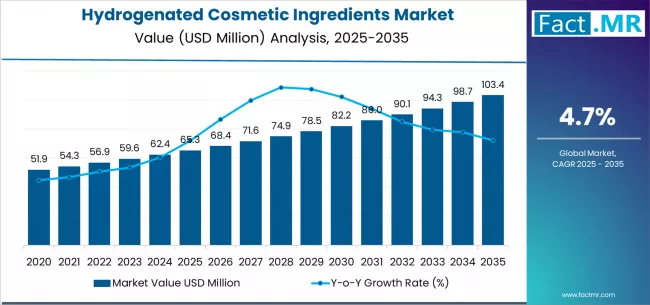
The hydrogenated cosmetic ingredients market was valued at USD 65.30 million in 2025, projected to reach USD 68.37 million in 2026, and is forecast to expand to USD 108.22 million by 2036 at a 4.7% CAGR. Growing consumer preference for stable, non-oxidizing cosmetic formulations and the regulatory pressure to replace volatile silicone alternatives are sustaining demand for hydrogenated emollients and texture modifiers in personal care and colour cosmetic product lines. Hydrogenated polyisobutene and polydecene deliver the sensory profile and oxidative stability that formulators require for long shelf-life products without the regulatory scrutiny facing cyclomethicone-based alternatives.
Summary of Hydrogenated Cosmetic Ingredients Market
- Market Overview
- The hydrogenated cosmetic ingredients market is valued at USD 65.30 million in 2025 and is projected to reach USD 108.22 million by 2036.
- The industry is expected to grow at a 4.7% CAGR from 2026 to 2036, creating an incremental opportunity of USD 39.85 million.
- The market operates as a specification-driven category where performance requirements, regulatory compliance, and quality consistency define procurement decisions.
- Demand and Growth Drivers
- Demand is sustained by tightening performance specifications and regulatory requirements across primary consuming sectors.
- Technology adoption and product reformulation cycles are expanding the addressable market into new application segments.
- Supply chain dynamics and raw material cost structures shape competitive positioning and margin management across regions.
- Among key countries, India leads at 6.0% CAGR, followed by China at 5.3%, Brazil at 4.2%, the USA at 4.1%, the UK at 3.9%, Germany at 3.8%, and Japan at 3.5%.
- Product and Segment View
- Hydrogenated cosmetic ingredients are catalytically hydrogenated hydrocarbon polymers and oligomers used as emollients, texture modifiers, pigment dispersants, and film-forming agents in personal care and cosmetic formulations.
- Hydrogenated Polyisobutene leads by Product Type with 40.0% share in 2026.
- Emollient leads by Function with 47.2% share in 2026.
- Market scope includes hydrogenated polyisobutene, hydrogenated polydecene, and other hydrogenated cosmetic-grade derivatives.
- The scope excludes non-hydrogenated mineral oils, petroleum jelly, silicone-based emollients (dimethicone, cyclomethicone), and plant-derived oils used without catalytic hydrogenation.
- Geography and Competitive Outlook
- Growth concentrates in markets with strong regulatory frameworks and expanding industrial or consumer demand bases.
- Competition centres on technical capability, quality consistency, and regulatory compliance, with BASF SE, Dowpol, and UpiChem among key participants.
- Analyst Opinion at Fact.MR
- Shambhu Nath Jha, Principal Consultant at Fact.MR, opines: 'Market participants must invest in quality consistency, specification compliance, and supply chain diversification to maintain competitive positioning. Producers without advanced formulation or processing capability risk losing specification eligibility as downstream requirements tighten across major application sectors.'
- Strategic Implications / Executive Takeaways
- Producers must invest in process control and quality consistency to meet tightening specification requirements across primary application sectors.
- Procurement managers should diversify supplier bases to mitigate supply concentration risk and maintain cost competitiveness.
- Technology investment in advanced processing and formulation capability is necessary to capture premium product tiers within the addressable market.
Hydrogenated Cosmetic Ingredients Market Key Takeaways
| Metric | Details |
|---|---|
| Industry Size (2026) | USD 68.37 million |
| Industry Value (2036) | USD 108.22 million |
| CAGR (2026 to 2036) | 4.7% |
Source: Fact.MR, 2026
The absolute dollar expansion of USD 39.85 million over the forecast period reflects a consumption trajectory driven by clean-beauty reformulation trends and the growing specification of hydrogenated ingredients as silicone alternatives in skin care, lip care, and foundation formulations. FMI analysts observe that cosmetic formulators are adopting hydrogenated polyisobutene as a primary emollient and pigment wetting agent in colour cosmetics where its clarity, low odour, and compatibility with mineral and organic pigments produce superior colour payoff compared to traditional mineral oil bases.
Skin care manufacturers across North America, Europe, and East Asia specify hydrogenated polydecene as a lightweight emollient in serum and moisturizer formulations where the ingredient's spreading characteristics and non-greasy sensory profile meet consumer texture expectations. Colour cosmetic producers use hydrogenated polyisobutene as a binder and gloss agent in lipstick and lip gloss formulations where oxidative stability prevents rancidity during the 30-month shelf life required by retail distribution timelines.
Country-level growth trajectories reflect varied regional demand drivers. Among key countries, India leads at 6.0% CAGR, followed by China at 5.3%, Brazil at 4.2%, the USA at 4.1%, the UK at 3.9%, Germany at 3.8%, and Japan at 3.5%.
Why Is the Hydrogenated Cosmetic Ingredients Market Growing Across Skincare and Personal Care Applications?
Market expansion is being supported by the increasing global emphasis on premium cosmetic formulations and the corresponding shift toward high-performance ingredients that can provide superior stability characteristics while meeting user requirements for enhanced texture properties and cost-effective formulation solutions. Modern cosmetic manufacturers are increasingly focused on incorporating ingredient systems that can enhance product performance while satisfying demands for consistent, precisely controlled texture development and optimized sensory experiences. Hydrogenated cosmetic ingredients' proven ability to deliver molecular stability excellence, compatibility benefits, and diverse application possibilities makes them essential components for innovation-focused manufacturers and quality-focused cosmetic professionals.
The growing emphasis on cosmetic innovation and product differentiation is driving demand for high-performance ingredient systems that can support distinctive formulation outcomes and comprehensive texture management across skincare applications, color cosmetic products, and premium personal care installations. User preference for ingredient solutions that combine functional excellence with stability enhancement is creating opportunities for innovative implementations in both traditional and emerging cosmetic formulation applications. The rising influence of advanced formulation technologies and sophisticated texture engineering is also contributing to increased adoption of specialized ingredient solutions that can provide authentic performance benefits and reliable formulation characteristics.
How Is the Hydrogenated Cosmetic Ingredients Market Segmented by Product Type, Function, and Application?
The market is segmented by product type, function, application, and region. By product type, the market is divided into hydrogenated polyisobutene, hydrogenated polydecene, and other hydrogenated derivatives. Based on function, the market is categorized into emollient, thickening agent, pigment dispenser, and others. By application, the market includes personal care products, color cosmetics, skincare, haircare, and others. Regionally, the market is divided into North America, Europe, Asia Pacific, Latin America, Middle East & Africa, and other regions.
By Product Type, the Hydrogenated Polydecene Segment Accounts for 40.0% Market Share
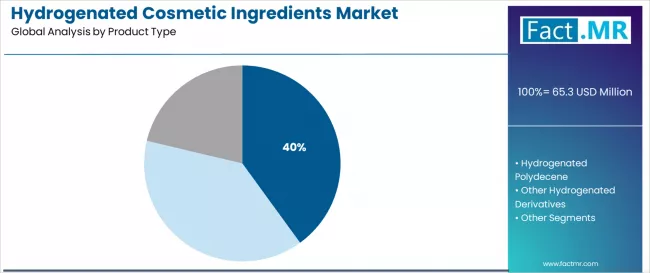
The hydrogenated polydecene segment is projected to account for 40% of the hydrogenated cosmetic ingredients market in 2025, reaffirming its position as the leading product type category. Cosmetic formulators and ingredient specialists increasingly utilize hydrogenated polydecene systems for their superior emollient characteristics, established performance standards, and essential functionality in diverse texture enhancement applications across multiple cosmetic categories. Hydrogenated polydecene's proven performance characteristics and established cost-effectiveness directly address user requirements for reliable texture enhancement and optimal formulation precision in skincare and color cosmetic applications.
This product type segment forms the foundation of modern cosmetic performance patterns, as it represents the ingredient configuration with the greatest formulation versatility and established compatibility across multiple cosmetic formulation systems. Cosmetic investments in advanced molecular technology and performance optimization continue to strengthen adoption among innovation-focused formulators. With manufacturers prioritizing formulation consistency and texture reliability, hydrogenated polydecene systems align with both efficiency objectives and performance requirements, making them the central component of comprehensive cosmetic ingredient strategies.
By Function, Emollient Segment Shows Strong Market Dominance
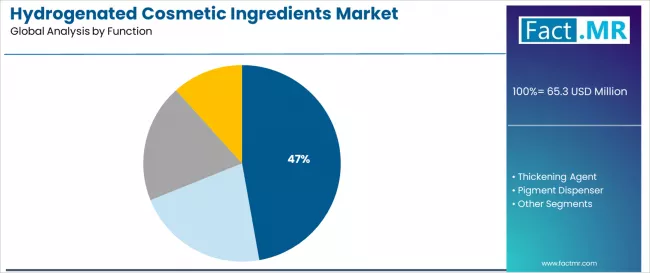
Emollient is projected to represent 47.2% of the hydrogenated cosmetic ingredients market in 2025, underscoring its critical role as the primary function for formulation-focused users seeking superior texture benefits and enhanced skincare product management credentials. Cosmetic formulators and product developers prefer emollient applications for their established performance requirements, proven texture demand, and ability to maintain exceptional skin feel while supporting versatile formulation coverage during diverse cosmetic activities. Positioned as essential functions for quality-focused manufacturers, emollient offerings provide both performance excellence and sensory optimization advantages.
The segment is supported by continuous improvement in cosmetic technology and the widespread availability of established formulation standards that enable performance assurance and premium positioning at the manufacturing level. Additionally, cosmetic users are optimizing ingredient selections to support product-specific applications and comprehensive formulation strategies. As cosmetic technology continues to advance and manufacturers seek efficient texture methods, emollient applications will continue to drive market growth while supporting formulation efficiency and performance optimization strategies.
By Application, Personal Care Products Segment Leads Market Growth
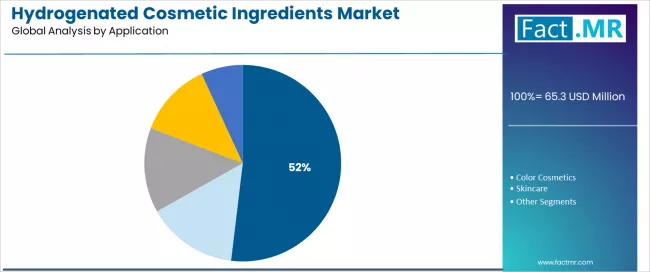
Personal care products is projected to represent 51.9% of the hydrogenated cosmetic ingredients market in 2025, highlighting its position as the dominant application category for manufacturers seeking enhanced product performance and comprehensive formulation solutions. Personal care applications demonstrate consistent growth due to their broad scope encompassing skincare, bodycare, and specialty treatment products that require reliable texture enhancement and stability optimization. The segment benefits from increasing consumer demand for premium personal care experiences and growing emphasis on product performance across diverse personal care categories.
Personal care products applications provide formulators with versatile ingredient utilization opportunities while supporting comprehensive product development strategies across multiple consumer segments. The widespread adoption of sophisticated personal care formulations and increasing consumer expectations for enhanced sensory experiences continue to drive demand for high-performance ingredients within this application category. As personal care markets expand and consumers seek more sophisticated product experiences, personal care products applications will maintain their market leadership while supporting continued innovation in cosmetic ingredient utilization.
What Are the Key Drivers, Restraints, and Emerging Trends Influencing the Hydrogenated Cosmetic Ingredients Market?
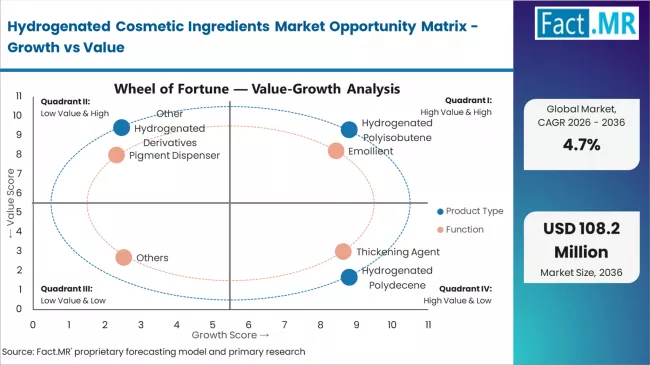
The hydrogenated cosmetic ingredients market is advancing rapidly due to increasing premium cosmetic product adoption and growing need for stability-enhanced formulation solutions that emphasize superior molecular performance across skincare segments and color cosmetic applications. However, the market faces challenges, including competition from alternative ingredient technologies, formulation complexity considerations, and regulatory compliance factors affecting adoption rates. Innovation in molecular optimization enhancement and advanced processing techniques continues to influence market development and expansion patterns.
Expansion of Premium Cosmetic Formulation Technologies
The growing adoption of hydrogenated cosmetic ingredients with advanced molecular engineering and premium formulation integration is enabling formulators to develop cosmetic strategies that provide distinctive performance benefits while commanding enhanced texture properties and superior stability characteristics. Premium formulation applications provide excellent performance consistency while allowing more sophisticated texture optimization features across various cosmetic categories. Users are increasingly recognizing the formulation advantages of specialized ingredient positioning for comprehensive product development outcomes and technology-integrated cosmetic management.
Integration of Advanced Processing and Purification Systems
Modern hydrogenated cosmetic ingredient manufacturers are incorporating advanced purification technologies, real-time quality monitoring capabilities, and specialized processing systems to enhance molecular precision, improve ingredient compatibility effectiveness, and meet cosmetic demands for high-performance formulation solutions. These systems improve formulation effectiveness while enabling new applications, including continuous quality monitoring programs and automated processing protocols. Advanced processing integration also allows users to support proactive quality positioning and performance assurance beyond traditional ingredient processing requirements.
How Does Market Growth Differ Across Leading Countries in the Hydrogenated Cosmetic Ingredients Industry?
.webp "Top Country Growth Comparison Hydrogenated Cosmetic Ingredients Market Cagr (2026 2036)")
| Country | CAGR (2026-2036) |
|---|---|
| China | 5.3% |
| India | 6.0% |
| Germany | 3.8% |
| Brazil | 4.2% |
| USA | 4.1% |
| UK | 3.9% |
| Japan | 3.5% |
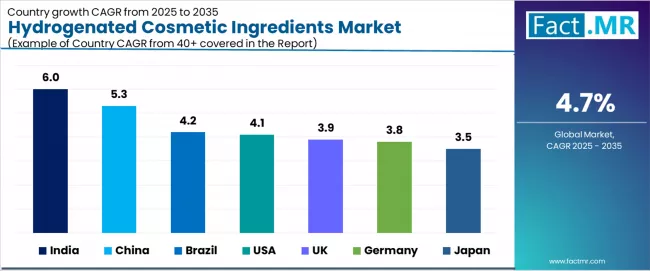
The hydrogenated cosmetic ingredients market is experiencing robust growth globally, with India leading at a 6% CAGR through 2036, driven by the expanding personal care sector, growing cosmetic manufacturing requirements, and increasing adoption of premium formulation ingredients. China follows at 5.3%, supported by rising beauty consciousness, expanding cosmetic production industry, and growing acceptance of advanced ingredient technologies. Brazil shows growth at 4.2%, emphasizing established beauty culture and comprehensive cosmetic market development. The USA demonstrates 4.1% growth, prioritizing advanced cosmetic technologies and formulation optimization.
The report covers an in-depth analysis of 40+ countries top-performing countries are highlighted below.
How Is Ingredient Innovation Accelerating Market Growth in India?
Revenue from hydrogenated cosmetic ingredient consumption and sales in India is projected to exhibit exceptional growth with a CAGR of 6.0% through 2036, driven by the country's rapidly expanding beauty and personal care sector, favorable demographics toward cosmetic consumption, and initiatives promoting premium cosmetic manufacturing across major urban regions. India's position as a growing beauty market and increasing focus on cosmetic innovation systems are creating substantial demand for high-quality hydrogenated ingredients in both domestic and international brand formulations. Major cosmetic companies and ingredient distributors are establishing comprehensive formulation capabilities to serve growing demand and emerging beauty opportunities.
- Established beauty culture and expanding cosmetic consciousness are driving demand for hydrogenated cosmetic ingredients across personal care products, premium skincare lines, and comprehensive formulation systems throughout Indian beauty markets.
- Strong manufacturing infrastructure and technology adoption initiatives are supporting the rapid adoption of premium cosmetic ingredients among innovation-focused manufacturers seeking to meet evolving beauty standards and quality requirements.
Why Is Cosmetic Manufacturing Expansion Driving Market Development in China?
Revenue from hydrogenated cosmetic ingredient products in China is expanding at a CAGR of 5.3%, supported by rising cosmetic manufacturing investment, growing beauty consciousness, and expanding ingredient supplier capabilities. The country's developing cosmetic infrastructure and increasing investment in beauty technologies are driving demand for hydrogenated ingredients across both traditional and modern cosmetic applications. International ingredient companies and domestic suppliers are establishing comprehensive operational networks to address growing market demand for formulation ingredients and efficient cosmetic solutions.
- Rising cosmetic development and expanding manufacturing capabilities are creating opportunities for hydrogenated ingredient adoption across beauty industries, modern formulation projects, and supplier companies throughout major Chinese cosmetic regions.
- Growing beauty awareness initiatives and formulation technology advancement are driving the adoption of specialized ingredient products and services among cosmetic users seeking to enhance their product quality and meet increasing beauty demand.
How Is Formulation Excellence Supporting Market Stability in Germany?
Revenue from hydrogenated cosmetic ingredient products in Germany is projected to grow at a CAGR of 3.8% through 2036, supported by the country's mature cosmetic standards, established beauty industry regulations, and leadership in precision formulation technology. Germany's sophisticated cosmetic standards and strong support for advanced ingredient systems are creating steady demand for both traditional and innovative hydrogenated ingredient varieties. Leading cosmetic manufacturers and specialty suppliers are establishing comprehensive operational strategies to serve both domestic markets and growing export opportunities.
- Advanced formulation technology capabilities and established beauty-focused markets are driving demand for premium hydrogenated ingredients across cosmetic facilities, beauty companies, and comprehensive formulation companies seeking superior performance profiles and ingredient innovation.
- Strong formulation excellence culture and regulatory leadership are supporting the adoption of innovative ingredient technology among users prioritizing product reliability and formulation precision in cosmetic applications.
Why Is Beauty Market Expansion Strengthening Ingredient Demand in Brazil?
Revenue from hydrogenated cosmetic ingredient products in Brazil is projected to grow at a CAGR of 4.2% through 2036, driven by the country's emphasis on beauty culture, cosmetic market modernization growth, and growing ingredient supplier capabilities. Brazilian cosmetic users and beauty facilities consistently seek innovation-focused ingredients that enhance product performance and support beauty excellence for both traditional and modern cosmetic applications. The country's position as a Latin American beauty leader continues to drive innovation in specialized cosmetic applications and beauty industry standards.
- Expanding beauty culture and growing cosmetic markets are driving demand for hydrogenated cosmetic ingredients across beauty consumers, formulation providers, and quality-focused suppliers seeking superior texture properties and distinctive performance profiles.
- Increasing focus on cosmetic quality and beauty innovation systems is supporting the adoption of specialty ingredient varieties among users and suppliers seeking authentic Brazilian beauty-focused products in regional markets with established cosmetic expertise.
How Is Technology Integration Advancing Market Growth in United States?
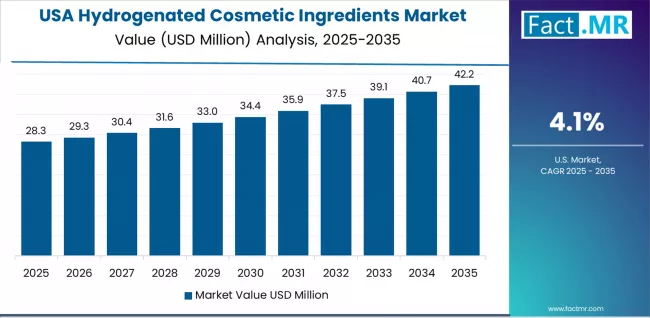
Revenue from hydrogenated cosmetic ingredient products in the USA is projected to grow at a CAGR of 4.1% through 2036, supported by the country's emphasis on cosmetic technology advancement, beauty industry optimization, and advanced formulation system integration requiring efficient ingredient solutions. American cosmetic users and innovation-focused facilities prioritize performance reliability and formulation precision, making specialized hydrogenated ingredients essential components for both traditional and modern cosmetic applications. The country's comprehensive beauty technology leadership and advancing formulation patterns support continued market expansion.
- Advanced cosmetic technology capabilities and growing precision formulation management are driving demand for hydrogenated ingredients across specialty applications, modern cosmetic formats, and technology-integrated beauty programs serving domestic markets with increasing performance requirements.
- Strong focus on formulation optimization and performance excellence is encouraging users and suppliers to adopt ingredient solutions that support beauty objectives and meet American quality standards for cosmetic applications.
Why Is Product Innovation Enhancing Market Performance in United Kingdom?
Revenue from hydrogenated cosmetic ingredient products in the UK is projected to grow at a CAGR of 3.9% through 2036, supported by established beauty standards, mature cosmetic markets, and emphasis on product innovation across skincare and color cosmetic sectors. British cosmetic users and beauty professionals prioritize quality performance and formulation consistency, creating steady demand for premium ingredient solutions. The country's comprehensive market maturity and established beauty practices support continued development in specialized applications.
- Established cosmetic markets and mature beauty industry are driving demand for quality hydrogenated ingredients across beauty operations, cosmetic facilities, and professional formulation companies throughout British beauty regions.
- Strong emphasis on quality standards and product innovation is supporting the adoption of premium ingredient varieties among users seeking proven performance and established beauty credentials in cosmetic applications.
How Is Precision Formulation Supporting Ingredient Adoption in Japan?
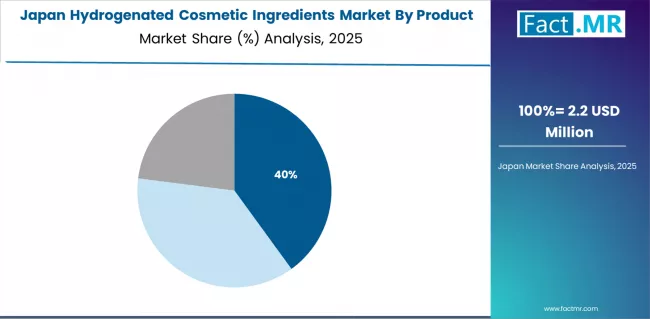
Revenue from hydrogenated cosmetic ingredient products in Japan is projected to grow at a CAGR of 3.5% through 2036, supported by the country's emphasis on precision cosmetics, beauty excellence, and advanced technology integration requiring efficient ingredient solutions. Japanese cosmetic users and beauty-focused facilities prioritize technical performance and formulation precision, making specialized hydrogenated ingredients essential components for both traditional and modern beauty applications. The country's comprehensive beauty leadership and advancing precision patterns support continued market expansion.
- Advanced precision cosmetic technology capabilities and growing technical beauty applications are driving demand for hydrogenated ingredients across specialty cosmetic applications, modern precision formats, and technology-integrated beauty programs serving domestic markets with increasing quality requirements.
- Strong focus on technical precision and beauty excellence is encouraging users and suppliers to adopt ingredient solutions that support cosmetic objectives and meet Japanese precision standards for beauty applications.
How Is Regional Composition Evolving Across Leading Economies in Europe?
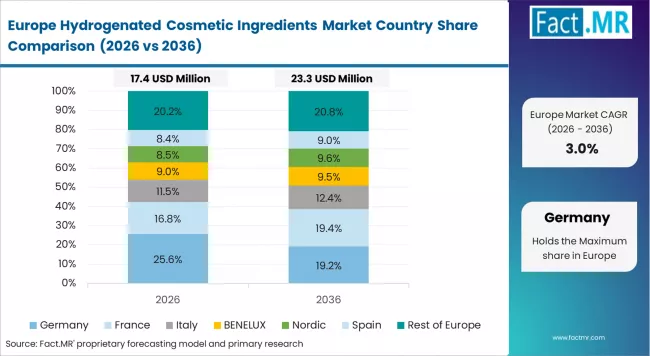
The Europe hydrogenated cosmetic ingredients market is projected to grow from USD 18.7 million in 2026 to USD 28.2 million by 2036, recording a CAGR of 4.2% over the forecast period. Germany leads the region with a 41.8% share in 2026, moderating slightly to 41.3% by 2036, supported by its strong cosmetic manufacturing traditions and demand for premium, precision-formulated ingredient solutions. France follows with 22.4% in 2026, easing to 21.9% by 2036, driven by a mature beauty industry and emphasis on luxury cosmetic formulations and quality performance. The United Kingdom accounts for 14.2% in 2026, rising to 14.7% by 2036, reflecting steady adoption of cosmetic innovation technologies and formulation optimization. Italy holds 9.6% in 2026, expanding to 10.4% by 2036 as beauty modernization and specialty cosmetic applications grow. Spain contributes 6.1% in 2026, growing to 6.4% by 2036, supported by expanding beauty development and cosmetic awareness modernization. The Nordic countries rise from 3.4% in 2026 to 3.6% by 2036 on the back of strong beauty consciousness and advanced cosmetic methodologies. BENELUX remains at 2.5% share across both 2026 and 2036, reflecting mature, beauty-focused cosmetic markets.
How Competitive Is the Global Hydrogenated Cosmetic Ingredients Market and What Shapes Its Structure?
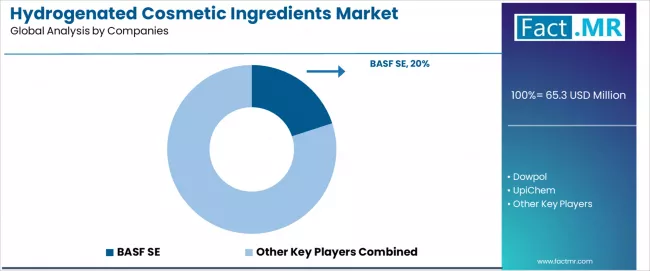
The hydrogenated cosmetic ingredients market is characterized by competition among established specialty chemical manufacturers, cosmetic ingredient companies, and integrated beauty solution providers. Companies are investing in advanced processing technologies, specialized molecular engineering, product innovation capabilities, and comprehensive distribution networks to deliver consistent, high-quality, and reliable hydrogenated ingredient systems. Innovation in molecular optimization, processing technology advancement, and cosmetic-focused product development is central to strengthening market position and customer satisfaction.
BASF SE leads the market with a strong focus on specialty chemical innovation and comprehensive cosmetic ingredient solutions, offering industrial and personal care systems with emphasis on performance excellence and chemical heritage. Dowpol provides integrated specialty chemicals with a focus on cosmetic market applications and precision formulation networks. UpiChem delivers comprehensive ingredient technology solutions with a focus on cosmetic positioning and formulation efficiency. Vantage specializes in comprehensive personal care ingredients with an emphasis on beauty applications. The Innovation Company focuses on comprehensive cosmetic innovation with advanced design and premium positioning capabilities.
Global Hydrogenated Cosmetic Ingredients Market - Stakeholder Contribution Framework
The success of hydrogenated cosmetic ingredients in meeting beauty industry demands, cosmetic performance requirements, and formulation integration will not only enhance cosmetic product outcomes but also strengthen global beauty ingredient manufacturing capabilities. It will consolidate emerging regions' positions as hubs for efficient cosmetic ingredient production and align advanced economies with comprehensive beauty systems. This calls for a concerted effort by all stakeholders -- governments, industry bodies, manufacturers, suppliers, and investors. Each can be a crucial enabler in preparing the market for its next phase of growth.
How Governments Could Spur Local Production and Adoption?
- Targeted Incentives: Introduce cosmetic industry modernization subsidies for companies adopting advanced ingredient production technologies in beauty and cosmetic regions, and production-linked incentives for facilities producing ingredients for domestic consumption and export markets.
- Trade Agreements: Accelerate export growth through bilateral and multilateral agreements that classify hydrogenated cosmetic ingredients under "personal care ingredients," easing cross-border regulatory approvals and cosmetic safety certifications.
- Facilitate Innovation: Establish Centers of Excellence for cosmetic ingredient innovation and molecular engineering. Fund R&D into efficient processing systems, molecular optimization, and cosmetic-standard integration for beauty and personal care applications.
How Industry Bodies Could Support Market Development?
- Foster Connectivity: Constitute a global cosmetic ingredient consortium linking ingredient manufacturers, beauty product suppliers, formulators, and policymakers to align production targets with beauty industry and cosmetic commitments.
- Promote Exports: Work with export councils to brand hydrogenated cosmetic ingredients as premium, performance-focused beauty solutions. Facilitate trade fairs to connect cosmetic ingredient innovators with global buyers in beauty, personal care, and cosmetic sectors.
- Upskilling Programs: Develop curricula on advanced ingredient manufacturing, molecular technology, cosmetic formulation processes, and performance optimization to prepare manufacturers and formulators for premium beauty market opportunities.
How Suppliers and Beauty Industry Players Could Strengthen the Ecosystem?
- Drive Integration: Bundle hydrogenated cosmetic ingredients with innovation-focused marketing and performance messaging systems. Position specialized ingredients as part of holistic "cosmetic performance optimization solutions."
- Forge Partnerships: Collaborate with ingredient manufacturers and technology providers for joint R&D on cosmetic applications, performance enhancement initiatives, and global quality assurance for premium markets.
How Manufacturers Could Navigate the Shift?
- Capture Premium Markets: Leverage government incentives and rising beauty demand to offer hydrogenated cosmetic ingredients into growth markets where general ingredient solutions face performance and compatibility challenges.
- Invest in Technology: Partner with technology providers to advance efficient processing workflows, cosmetic-grade quality, and advanced manufacturing practices.
- Build Capabilities: Train technical staff and formulation specialists to demonstrate hydrogenated ingredients' performance advantages, repositioning cosmetic relationships toward long-term beauty partnerships.
Who Are the Key Companies Driving Innovation in the Hydrogenated Cosmetic Ingredients Market?
- BASF SE
- Dowpol
- UpiChem
- Vantage
- The Innovation Company
- Glenn
- Sun Chemicals
- Nikko Chemicals
- ExxonMobil
- Shamrock Technologies
- Croda International
- Evonik Industries
- Lubrizol Corporation
- Clariant AG
- Ashland Global
- Eastman Chemical
- Inolex Inc
- Solvay SA
- Arkema Group
- Elementis Specialties
- Stepan Company
- Galaxy Surfactants
Bibliography
- 1. European Commission. (2024). Regulation (EC) No 1223/2009 on Cosmetic Products: Ingredient Annex Updates. EUR-Lex.
- 2. Cosmetic Ingredient Review. (2024). Safety Assessment of Hydrogenated Polyisobutene. CIR.
- 3. Personal Care Products Council. (2025). International Cosmetic Ingredient Dictionary and Handbook, 17th Edition. PCPC.
- 4. Japan Cosmetic Industry Association. (2024). Positive List of Cosmetic Ingredients. JCIA.
- 5. International Organization for Standardization. (2024). ISO 16128: Cosmetics, Guidelines on Technical Definitions for Natural and Organic Ingredients. ISO.
This bibliography is provided for reader reference. The full Fact.MR report contains the complete reference list with primary research documentation.
This Report Addresses
- Market sizing and quantitative forecast metrics through 2036.
- Segmentation analysis mapping demand across product types and application sectors.
- Regional deployment intelligence comparing growth dynamics across major consuming markets.
- Competitive posture evaluation tracking technical capability and market positioning of key participants.
- Regulatory compliance assessment analysing how evolving standards shape procurement and formulation decisions.
- Custom data delivery formats encompassing interactive dashboards, raw Excel datasets, and comprehensive PDF narrative reports.
Hydrogenated Cosmetic Ingredients Market Definition
Hydrogenated cosmetic ingredients are catalytically hydrogenated hydrocarbon polymers and oligomers used as emollients, texture modifiers, pigment dispersants, and film-forming agents in personal care and cosmetic formulations. The hydrogenation process saturates double bonds to eliminate oxidation-sensitive sites, providing enhanced stability and shelf life. Their primary commercial function is to deliver sensory performance, pigment compatibility, and formulation stability in skin care, colour cosmetics, and hair care products.
Hydrogenated Cosmetic Ingredients Market Inclusions
Market scope includes hydrogenated polyisobutene, hydrogenated polydecene, and other hydrogenated cosmetic-grade derivatives. Coverage spans global and regional market sizing from 2026 to 2036, segmented by product type, functional role, and application category.
Hydrogenated Cosmetic Ingredients Market Exclusions
The scope excludes non-hydrogenated mineral oils, petroleum jelly, silicone-based emollients (dimethicone, cyclomethicone), and plant-derived oils used without catalytic hydrogenation. Finished cosmetic and personal care products are omitted.
Hydrogenated Cosmetic Ingredients Market Research Methodology
- Primary Research: Analysts engaged with procurement managers, formulation engineers, and application specialists to map specification requirements and purchasing patterns.
- Desk Research: Data collection aggregated regulatory databases, industry production statistics, and trade registry filings from relevant sectors.
- Market-Sizing and Forecasting: Baseline values derive from a bottom-up aggregation of shipment volumes by grade, applying region-specific production and consumption indices.
- Data Validation and Update Cycle: Projections are tested against publicly reported revenue disclosures and industry association production statistics.
Scope of the Report

| Metric | Value |
|---|---|
| Quantitative Units | USD 68.37 million to USD 108.22 million, at a CAGR of 4.7% |
| Market Definition | Hydrogenated cosmetic ingredients are catalytically hydrogenated hydrocarbon polymers and oligomers used as emollients, texture modifiers, pigment dispersants, and film-forming agents in personal care and cosmetic formulations. |
| Regions Covered | North America, Latin America, Europe, East Asia, South Asia, Oceania, Middle East & Africa |
| Key Companies Profiled | BASF SE, Dowpol, UpiChem, Vantage, The Innovation Company, Glenn, Sun Chemicals, Nikko Chemicals, ExxonMobil, Shamrock Technologies, Croda International, Evonik Industries |
| Forecast Period | 2026 to 2036 |
How Is the Hydrogenated Cosmetic Ingredients Market Segmented by Product Type, Function, and Regional Distribution?
-
Product Type :
- Hydrogenated Polyisobutene
- Hydrogenated Polydecene
- Other Hydrogenated Derivatives
-
Function :
- Emollient
- Thickening Agent
- Pigment Dispenser
- Others
-
Application :
- Personal Care Products
- Color Cosmetics
- Skincare
- Haircare
- Others
-
Region :
-
North America
- United States
- Canada
- Mexico
-
Europe
- Germany
- United Kingdom
- France
- Italy
- Spain
- Nordic Countries
- BENELUX
- Rest of Europe
-
Asia Pacific
- China
- India
- Japan
- South Korea
- Australia
- Rest of Asia Pacific
-
Latin America
- Brazil
- Argentina
- Rest of Latin America
-
Middle East & Africa
- Kingdom of Saudi Arabia
- United Arab Emirates
- South Africa
- Rest of Middle East & Africa
-
Other Regions
- Oceania
- Central Asia
- Other Markets
-
Table of Content
- Executive Summary
- Global Market Outlook
- Demand to side Trends
- Supply to side Trends
- Technology Roadmap Analysis
- Analysis and Recommendations
- Market Overview
- Market Coverage / Taxonomy
- Market Definition / Scope / Limitations
- Research Methodology
- Chapter Orientation
- Analytical Lens and Working Hypotheses
- Market Structure, Signals, and Trend Drivers
- Benchmarking and Cross-market Comparability
- Market Sizing, Forecasting, and Opportunity Mapping
- Research Design and Evidence Framework
- Desk Research Programme (Secondary Evidence)
- Company Annual and Sustainability Reports
- Peer-reviewed Journals and Academic Literature
- Corporate Websites, Product Literature, and Technical Notes
- Earnings Decks and Investor Briefings
- Statutory Filings and Regulatory Disclosures
- Technical White Papers and Standards Notes
- Trade Journals, Industry Magazines, and Analyst Briefs
- Conference Proceedings, Webinars, and Seminar Materials
- Government Statistics Portals and Public Data Releases
- Press Releases and Reputable Media Coverage
- Specialist Newsletters and Curated Briefings
- Sector Databases and Reference Repositories
- Fact.MR Internal Proprietary Databases and Historical Market Datasets
- Subscription Datasets and Paid Sources
- Social Channels, Communities, and Digital Listening Inputs
- Additional Desk Sources
- Expert Input and Fieldwork (Primary Evidence)
- Primary Modes
- Qualitative Interviews and Expert Elicitation
- Quantitative Surveys and Structured Data Capture
- Blended Approach
- Why Primary Evidence is Used
- Field Techniques
- Interviews
- Surveys
- Focus Groups
- Observational and In-context Research
- Social and Community Interactions
- Stakeholder Universe Engaged
- C-suite Leaders
- Board Members
- Presidents and Vice Presidents
- R&D and Innovation Heads
- Technical Specialists
- Domain Subject-matter Experts
- Scientists
- Physicians and Other Healthcare Professionals
- Governance, Ethics, and Data Stewardship
- Research Ethics
- Data Integrity and Handling
- Primary Modes
- Tooling, Models, and Reference Databases
- Desk Research Programme (Secondary Evidence)
- Data Engineering and Model Build
- Data Acquisition and Ingestion
- Cleaning, Normalisation, and Verification
- Synthesis, Triangulation, and Analysis
- Quality Assurance and Audit Trail
- Market Background
- Market Dynamics
- Drivers
- Restraints
- Opportunity
- Trends
- Scenario Forecast
- Demand in Optimistic Scenario
- Demand in Likely Scenario
- Demand in Conservative Scenario
- Opportunity Map Analysis
- Product Life Cycle Analysis
- Supply Chain Analysis
- Investment Feasibility Matrix
- Value Chain Analysis
- PESTLE and Porter’s Analysis
- Regulatory Landscape
- Regional Parent Market Outlook
- Production and Consumption Statistics
- Import and Export Statistics
- Market Dynamics
- Global Market Analysis 2021 to 2025 and Forecast, 2026 to 2036
- Historical Market Size Value (USD Million) Analysis, 2021 to 2025
- Current and Future Market Size Value (USD Million) Projections, 2026 to 2036
- Y to o to Y Growth Trend Analysis
- Absolute $ Opportunity Analysis
- Global Market Pricing Analysis 2021 to 2025 and Forecast 2026 to 2036
- Global Market Analysis 2021 to 2025 and Forecast 2026 to 2036, By Product Type
- Introduction / Key Findings
- Historical Market Size Value (USD Million) Analysis By Product Type, 2021 to 2025
- Current and Future Market Size Value (USD Million) Analysis and Forecast By Product Type, 2026 to 2036
- Hydrogenated Polyisobutene
- Hydrogenated Polydecene
- Other Hydrogenated Derivatives
- Hydrogenated Polyisobutene
- Y to o to Y Growth Trend Analysis By Product Type, 2021 to 2025
- Absolute $ Opportunity Analysis By Product Type, 2026 to 2036
- Global Market Analysis 2021 to 2025 and Forecast 2026 to 2036, By Function
- Introduction / Key Findings
- Historical Market Size Value (USD Million) Analysis By Function, 2021 to 2025
- Current and Future Market Size Value (USD Million) Analysis and Forecast By Function, 2026 to 2036
- Emollient
- Thickening Agent
- Pigment Dispenser
- Others
- Emollient
- Y to o to Y Growth Trend Analysis By Function, 2021 to 2025
- Absolute $ Opportunity Analysis By Function, 2026 to 2036
- Global Market Analysis 2021 to 2025 and Forecast 2026 to 2036, By Application
- Introduction / Key Findings
- Historical Market Size Value (USD Million) Analysis By Application, 2021 to 2025
- Current and Future Market Size Value (USD Million) Analysis and Forecast By Application, 2026 to 2036
- Personal Care Products
- Color Cosmetics
- Skincare
- Haircare
- Others
- Personal Care Products
- Y to o to Y Growth Trend Analysis By Application, 2021 to 2025
- Absolute $ Opportunity Analysis By Application, 2026 to 2036
- Global Market Analysis 2021 to 2025 and Forecast 2026 to 2036, By Region
- Introduction
- Historical Market Size Value (USD Million) Analysis By Region, 2021 to 2025
- Current Market Size Value (USD Million) Analysis and Forecast By Region, 2026 to 2036
- North America
- Latin America
- Western Europe
- Eastern Europe
- East Asia
- South Asia and Pacific
- Middle East & Africa
- Market Attractiveness Analysis By Region
- North America Market Analysis 2021 to 2025 and Forecast 2026 to 2036, By Country
- Historical Market Size Value (USD Million) Trend Analysis By Market Taxonomy, 2021 to 2025
- Market Size Value (USD Million) Forecast By Market Taxonomy, 2026 to 2036
- By Country
- USA
- Canada
- Mexico
- By Product Type
- By Function
- By Application
- By Country
- Market Attractiveness Analysis
- By Country
- By Product Type
- By Function
- By Application
- Key Takeaways
- Latin America Market Analysis 2021 to 2025 and Forecast 2026 to 2036, By Country
- Historical Market Size Value (USD Million) Trend Analysis By Market Taxonomy, 2021 to 2025
- Market Size Value (USD Million) Forecast By Market Taxonomy, 2026 to 2036
- By Country
- Brazil
- Chile
- Rest of Latin America
- By Product Type
- By Function
- By Application
- By Country
- Market Attractiveness Analysis
- By Country
- By Product Type
- By Function
- By Application
- Key Takeaways
- Western Europe Market Analysis 2021 to 2025 and Forecast 2026 to 2036, By Country
- Historical Market Size Value (USD Million) Trend Analysis By Market Taxonomy, 2021 to 2025
- Market Size Value (USD Million) Forecast By Market Taxonomy, 2026 to 2036
- By Country
- Germany
- UK
- Italy
- Spain
- France
- Nordic
- BENELUX
- Rest of Western Europe
- By Product Type
- By Function
- By Application
- By Country
- Market Attractiveness Analysis
- By Country
- By Product Type
- By Function
- By Application
- Key Takeaways
- Eastern Europe Market Analysis 2021 to 2025 and Forecast 2026 to 2036, By Country
- Historical Market Size Value (USD Million) Trend Analysis By Market Taxonomy, 2021 to 2025
- Market Size Value (USD Million) Forecast By Market Taxonomy, 2026 to 2036
- By Country
- Russia
- Poland
- Hungary
- Balkan & Baltic
- Rest of Eastern Europe
- By Product Type
- By Function
- By Application
- By Country
- Market Attractiveness Analysis
- By Country
- By Product Type
- By Function
- By Application
- Key Takeaways
- East Asia Market Analysis 2021 to 2025 and Forecast 2026 to 2036, By Country
- Historical Market Size Value (USD Million) Trend Analysis By Market Taxonomy, 2021 to 2025
- Market Size Value (USD Million) Forecast By Market Taxonomy, 2026 to 2036
- By Country
- China
- Japan
- South Korea
- By Product Type
- By Function
- By Application
- By Country
- Market Attractiveness Analysis
- By Country
- By Product Type
- By Function
- By Application
- Key Takeaways
- South Asia and Pacific Market Analysis 2021 to 2025 and Forecast 2026 to 2036, By Country
- Historical Market Size Value (USD Million) Trend Analysis By Market Taxonomy, 2021 to 2025
- Market Size Value (USD Million) Forecast By Market Taxonomy, 2026 to 2036
- By Country
- India
- ASEAN
- Australia & New Zealand
- Rest of South Asia and Pacific
- By Product Type
- By Function
- By Application
- By Country
- Market Attractiveness Analysis
- By Country
- By Product Type
- By Function
- By Application
- Key Takeaways
- Middle East & Africa Market Analysis 2021 to 2025 and Forecast 2026 to 2036, By Country
- Historical Market Size Value (USD Million) Trend Analysis By Market Taxonomy, 2021 to 2025
- Market Size Value (USD Million) Forecast By Market Taxonomy, 2026 to 2036
- By Country
- Kingdom of Saudi Arabia
- Other GCC Countries
- Turkiye
- South Africa
- Other African Union
- Rest of Middle East & Africa
- By Product Type
- By Function
- By Application
- By Country
- Market Attractiveness Analysis
- By Country
- By Product Type
- By Function
- By Application
- Key Takeaways
- Key Countries Market Analysis
- USA
- Pricing Analysis
- Market Share Analysis, 2025
- By Product Type
- By Function
- By Application
- Canada
- Pricing Analysis
- Market Share Analysis, 2025
- By Product Type
- By Function
- By Application
- Mexico
- Pricing Analysis
- Market Share Analysis, 2025
- By Product Type
- By Function
- By Application
- Brazil
- Pricing Analysis
- Market Share Analysis, 2025
- By Product Type
- By Function
- By Application
- Chile
- Pricing Analysis
- Market Share Analysis, 2025
- By Product Type
- By Function
- By Application
- Germany
- Pricing Analysis
- Market Share Analysis, 2025
- By Product Type
- By Function
- By Application
- UK
- Pricing Analysis
- Market Share Analysis, 2025
- By Product Type
- By Function
- By Application
- Italy
- Pricing Analysis
- Market Share Analysis, 2025
- By Product Type
- By Function
- By Application
- Spain
- Pricing Analysis
- Market Share Analysis, 2025
- By Product Type
- By Function
- By Application
- France
- Pricing Analysis
- Market Share Analysis, 2025
- By Product Type
- By Function
- By Application
- India
- Pricing Analysis
- Market Share Analysis, 2025
- By Product Type
- By Function
- By Application
- ASEAN
- Pricing Analysis
- Market Share Analysis, 2025
- By Product Type
- By Function
- By Application
- Australia & New Zealand
- Pricing Analysis
- Market Share Analysis, 2025
- By Product Type
- By Function
- By Application
- China
- Pricing Analysis
- Market Share Analysis, 2025
- By Product Type
- By Function
- By Application
- Japan
- Pricing Analysis
- Market Share Analysis, 2025
- By Product Type
- By Function
- By Application
- South Korea
- Pricing Analysis
- Market Share Analysis, 2025
- By Product Type
- By Function
- By Application
- Russia
- Pricing Analysis
- Market Share Analysis, 2025
- By Product Type
- By Function
- By Application
- Poland
- Pricing Analysis
- Market Share Analysis, 2025
- By Product Type
- By Function
- By Application
- Hungary
- Pricing Analysis
- Market Share Analysis, 2025
- By Product Type
- By Function
- By Application
- Kingdom of Saudi Arabia
- Pricing Analysis
- Market Share Analysis, 2025
- By Product Type
- By Function
- By Application
- Turkiye
- Pricing Analysis
- Market Share Analysis, 2025
- By Product Type
- By Function
- By Application
- South Africa
- Pricing Analysis
- Market Share Analysis, 2025
- By Product Type
- By Function
- By Application
- USA
- Market Structure Analysis
- Competition Dashboard
- Competition Benchmarking
- Market Share Analysis of Top Players
- By Regional
- By Product Type
- By Function
- By Application
- Competition Analysis
- Competition Deep Dive
- BASF SE
- Overview
- Product Portfolio
- Profitability by Market Segments (Product/Age /Sales Channel/Region)
- Sales Footprint
- Strategy Overview
- Marketing Strategy
- Product Strategy
- Channel Strategy
- Dowpol
- UpiChem
- Vantage
- The Innovation Company
- Glenn
- Sun Chemicals
- Nikko Chemicals
- ExxonMobil
- Shamrock Technologies
- Croda International
- Evonik Industries
- Lubrizol Corporation
- Clariant AG
- Ashland Global
- Eastman Chemical
- Inolex Inc
- Solvay SA
- Arkema Group
- Elementis Specialties
- BASF SE
- Competition Deep Dive
- Assumptions & Acronyms Used
List Of Table
- Table 1: Global Market Value (USD Million) Forecast by Region, 2021 to 2036
- Table 2: Global Market Value (USD Million) Forecast by Product Type, 2021 to 2036
- Table 3: Global Market Value (USD Million) Forecast by Function, 2021 to 2036
- Table 4: Global Market Value (USD Million) Forecast by Application, 2021 to 2036
- Table 5: North America Market Value (USD Million) Forecast by Country, 2021 to 2036
- Table 6: North America Market Value (USD Million) Forecast by Product Type, 2021 to 2036
- Table 7: North America Market Value (USD Million) Forecast by Function, 2021 to 2036
- Table 8: North America Market Value (USD Million) Forecast by Application, 2021 to 2036
- Table 9: Latin America Market Value (USD Million) Forecast by Country, 2021 to 2036
- Table 10: Latin America Market Value (USD Million) Forecast by Product Type, 2021 to 2036
- Table 11: Latin America Market Value (USD Million) Forecast by Function, 2021 to 2036
- Table 12: Latin America Market Value (USD Million) Forecast by Application, 2021 to 2036
- Table 13: Western Europe Market Value (USD Million) Forecast by Country, 2021 to 2036
- Table 14: Western Europe Market Value (USD Million) Forecast by Product Type, 2021 to 2036
- Table 15: Western Europe Market Value (USD Million) Forecast by Function, 2021 to 2036
- Table 16: Western Europe Market Value (USD Million) Forecast by Application, 2021 to 2036
- Table 17: Eastern Europe Market Value (USD Million) Forecast by Country, 2021 to 2036
- Table 18: Eastern Europe Market Value (USD Million) Forecast by Product Type, 2021 to 2036
- Table 19: Eastern Europe Market Value (USD Million) Forecast by Function, 2021 to 2036
- Table 20: Eastern Europe Market Value (USD Million) Forecast by Application, 2021 to 2036
- Table 21: East Asia Market Value (USD Million) Forecast by Country, 2021 to 2036
- Table 22: East Asia Market Value (USD Million) Forecast by Product Type, 2021 to 2036
- Table 23: East Asia Market Value (USD Million) Forecast by Function, 2021 to 2036
- Table 24: East Asia Market Value (USD Million) Forecast by Application, 2021 to 2036
- Table 25: South Asia and Pacific Market Value (USD Million) Forecast by Country, 2021 to 2036
- Table 26: South Asia and Pacific Market Value (USD Million) Forecast by Product Type, 2021 to 2036
- Table 27: South Asia and Pacific Market Value (USD Million) Forecast by Function, 2021 to 2036
- Table 28: South Asia and Pacific Market Value (USD Million) Forecast by Application, 2021 to 2036
- Table 29: Middle East & Africa Market Value (USD Million) Forecast by Country, 2021 to 2036
- Table 30: Middle East & Africa Market Value (USD Million) Forecast by Product Type, 2021 to 2036
- Table 31: Middle East & Africa Market Value (USD Million) Forecast by Function, 2021 to 2036
- Table 32: Middle East & Africa Market Value (USD Million) Forecast by Application, 2021 to 2036
List Of Figures
- Figure 1: Global Market Pricing Analysis
- Figure 2: Global Market Value (USD Million) Forecast 2021 to 2036
- Figure 3: Global Market Value Share and BPS Analysis by Product Type, 2026 and 2036
- Figure 4: Global Market Y-o-Y Growth Comparison by Product Type, 2026 to 2036
- Figure 5: Global Market Attractiveness Analysis by Product Type
- Figure 6: Global Market Value Share and BPS Analysis by Function, 2026 and 2036
- Figure 7: Global Market Y-o-Y Growth Comparison by Function, 2026 to 2036
- Figure 8: Global Market Attractiveness Analysis by Function
- Figure 9: Global Market Value Share and BPS Analysis by Application, 2026 and 2036
- Figure 10: Global Market Y-o-Y Growth Comparison by Application, 2026 to 2036
- Figure 11: Global Market Attractiveness Analysis by Application
- Figure 12: Global Market Value (USD Million) Share and BPS Analysis by Region, 2026 and 2036
- Figure 13: Global Market Y-o-Y Growth Comparison by Region, 2026 to 2036
- Figure 14: Global Market Attractiveness Analysis by Region
- Figure 15: North America Market Incremental Dollar Opportunity, 2026 to 2036
- Figure 16: Latin America Market Incremental Dollar Opportunity, 2026 to 2036
- Figure 17: Western Europe Market Incremental Dollar Opportunity, 2026 to 2036
- Figure 18: Eastern Europe Market Incremental Dollar Opportunity, 2026 to 2036
- Figure 19: East Asia Market Incremental Dollar Opportunity, 2026 to 2036
- Figure 20: South Asia and Pacific Market Incremental Dollar Opportunity, 2026 to 2036
- Figure 21: Middle East & Africa Market Incremental Dollar Opportunity, 2026 to 2036
- Figure 22: North America Market Value Share and BPS Analysis by Country, 2026 and 2036
- Figure 23: North America Market Value Share and BPS Analysis by Product Type, 2026 and 2036
- Figure 24: North America Market Y-o-Y Growth Comparison by Product Type, 2026 to 2036
- Figure 25: North America Market Attractiveness Analysis by Product Type
- Figure 26: North America Market Value Share and BPS Analysis by Function, 2026 and 2036
- Figure 27: North America Market Y-o-Y Growth Comparison by Function, 2026 to 2036
- Figure 28: North America Market Attractiveness Analysis by Function
- Figure 29: North America Market Value Share and BPS Analysis by Application, 2026 and 2036
- Figure 30: North America Market Y-o-Y Growth Comparison by Application, 2026 to 2036
- Figure 31: North America Market Attractiveness Analysis by Application
- Figure 32: Latin America Market Value Share and BPS Analysis by Country, 2026 and 2036
- Figure 33: Latin America Market Value Share and BPS Analysis by Product Type, 2026 and 2036
- Figure 34: Latin America Market Y-o-Y Growth Comparison by Product Type, 2026 to 2036
- Figure 35: Latin America Market Attractiveness Analysis by Product Type
- Figure 36: Latin America Market Value Share and BPS Analysis by Function, 2026 and 2036
- Figure 37: Latin America Market Y-o-Y Growth Comparison by Function, 2026 to 2036
- Figure 38: Latin America Market Attractiveness Analysis by Function
- Figure 39: Latin America Market Value Share and BPS Analysis by Application, 2026 and 2036
- Figure 40: Latin America Market Y-o-Y Growth Comparison by Application, 2026 to 2036
- Figure 41: Latin America Market Attractiveness Analysis by Application
- Figure 42: Western Europe Market Value Share and BPS Analysis by Country, 2026 and 2036
- Figure 43: Western Europe Market Value Share and BPS Analysis by Product Type, 2026 and 2036
- Figure 44: Western Europe Market Y-o-Y Growth Comparison by Product Type, 2026 to 2036
- Figure 45: Western Europe Market Attractiveness Analysis by Product Type
- Figure 46: Western Europe Market Value Share and BPS Analysis by Function, 2026 and 2036
- Figure 47: Western Europe Market Y-o-Y Growth Comparison by Function, 2026 to 2036
- Figure 48: Western Europe Market Attractiveness Analysis by Function
- Figure 49: Western Europe Market Value Share and BPS Analysis by Application, 2026 and 2036
- Figure 50: Western Europe Market Y-o-Y Growth Comparison by Application, 2026 to 2036
- Figure 51: Western Europe Market Attractiveness Analysis by Application
- Figure 52: Eastern Europe Market Value Share and BPS Analysis by Country, 2026 and 2036
- Figure 53: Eastern Europe Market Value Share and BPS Analysis by Product Type, 2026 and 2036
- Figure 54: Eastern Europe Market Y-o-Y Growth Comparison by Product Type, 2026 to 2036
- Figure 55: Eastern Europe Market Attractiveness Analysis by Product Type
- Figure 56: Eastern Europe Market Value Share and BPS Analysis by Function, 2026 and 2036
- Figure 57: Eastern Europe Market Y-o-Y Growth Comparison by Function, 2026 to 2036
- Figure 58: Eastern Europe Market Attractiveness Analysis by Function
- Figure 59: Eastern Europe Market Value Share and BPS Analysis by Application, 2026 and 2036
- Figure 60: Eastern Europe Market Y-o-Y Growth Comparison by Application, 2026 to 2036
- Figure 61: Eastern Europe Market Attractiveness Analysis by Application
- Figure 62: East Asia Market Value Share and BPS Analysis by Country, 2026 and 2036
- Figure 63: East Asia Market Value Share and BPS Analysis by Product Type, 2026 and 2036
- Figure 64: East Asia Market Y-o-Y Growth Comparison by Product Type, 2026 to 2036
- Figure 65: East Asia Market Attractiveness Analysis by Product Type
- Figure 66: East Asia Market Value Share and BPS Analysis by Function, 2026 and 2036
- Figure 67: East Asia Market Y-o-Y Growth Comparison by Function, 2026 to 2036
- Figure 68: East Asia Market Attractiveness Analysis by Function
- Figure 69: East Asia Market Value Share and BPS Analysis by Application, 2026 and 2036
- Figure 70: East Asia Market Y-o-Y Growth Comparison by Application, 2026 to 2036
- Figure 71: East Asia Market Attractiveness Analysis by Application
- Figure 72: South Asia and Pacific Market Value Share and BPS Analysis by Country, 2026 and 2036
- Figure 73: South Asia and Pacific Market Value Share and BPS Analysis by Product Type, 2026 and 2036
- Figure 74: South Asia and Pacific Market Y-o-Y Growth Comparison by Product Type, 2026 to 2036
- Figure 75: South Asia and Pacific Market Attractiveness Analysis by Product Type
- Figure 76: South Asia and Pacific Market Value Share and BPS Analysis by Function, 2026 and 2036
- Figure 77: South Asia and Pacific Market Y-o-Y Growth Comparison by Function, 2026 to 2036
- Figure 78: South Asia and Pacific Market Attractiveness Analysis by Function
- Figure 79: South Asia and Pacific Market Value Share and BPS Analysis by Application, 2026 and 2036
- Figure 80: South Asia and Pacific Market Y-o-Y Growth Comparison by Application, 2026 to 2036
- Figure 81: South Asia and Pacific Market Attractiveness Analysis by Application
- Figure 82: Middle East & Africa Market Value Share and BPS Analysis by Country, 2026 and 2036
- Figure 83: Middle East & Africa Market Value Share and BPS Analysis by Product Type, 2026 and 2036
- Figure 84: Middle East & Africa Market Y-o-Y Growth Comparison by Product Type, 2026 to 2036
- Figure 85: Middle East & Africa Market Attractiveness Analysis by Product Type
- Figure 86: Middle East & Africa Market Value Share and BPS Analysis by Function, 2026 and 2036
- Figure 87: Middle East & Africa Market Y-o-Y Growth Comparison by Function, 2026 to 2036
- Figure 88: Middle East & Africa Market Attractiveness Analysis by Function
- Figure 89: Middle East & Africa Market Value Share and BPS Analysis by Application, 2026 and 2036
- Figure 90: Middle East & Africa Market Y-o-Y Growth Comparison by Application, 2026 to 2036
- Figure 91: Middle East & Africa Market Attractiveness Analysis by Application
- Figure 92: Global Market - Tier Structure Analysis
- Figure 93: Global Market - Company Share Analysis
- Frequently Asked Questions -
How large is the demand for hydrogenated cosmetic ingredients in the global market in 2026?
Demand in the global market is estimated to be valued at USD 68.37 million in 2026.
What will be the market size by 2036?
Market size is projected to reach USD 108.22 million by 2036.
What is the expected demand growth between 2026 and 2036?
Demand is expected to grow at a CAGR of 4.7% between 2026 and 2036.
Which segment is poised to lead by 2026?
Hydrogenated Polyisobutene accounts for 40.0% share in 2026 by Product Type.
How significant is Emollient in driving demand in 2026?
Emollient represents 47.2% of Function share in 2026.
What are the key companies in this market?
Key participants include BASF SE, Dowpol, and others profiled in the full report.
What is the scope of this report?
Market scope includes hydrogenated polyisobutene, hydrogenated polydecene, and other hydrogenated cosmetic-grade derivatives.
What is excluded from this report?
The scope excludes non-hydrogenated mineral oils, petroleum jelly, silicone-based emollients (dimethicone, cyclomethicone), and plant-derived oils used without catalytic hydrogenation.

Related Reports

Hydrogenated Cosmetic Ingredients Market