- Market Value (2025): USD 1.73 Bn
- Estimated Value (2026): USD 1.81 Bn
- Forecast Value (2036): USD 2.77 Bn
- CAGR (2026-2036): 4.3%
What is the Idler Pulley Market forecast to be worth by 2036?
USD 1.8 billion in 2026 to USD 2.8 billion by 2036 at a 4.3% CAGR.
- As per Fact.MR analysis, the idler pulley market reached USD 1.73 billion in 2025.
- Demand will increase from USD 1.81 billion in 2026 to USD 2.77 billion by 2036.
- The idler pulley market will record 4.3% CAGR from 2026 to 2036.
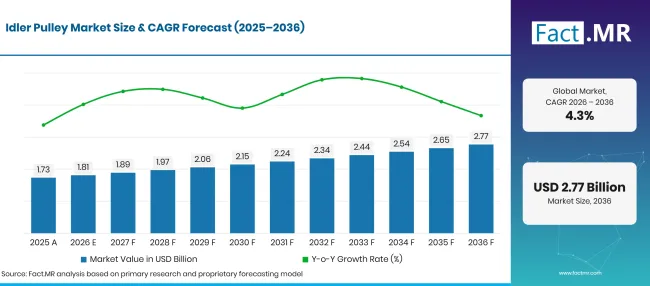
Factmr Idler Pulley Market Forecast Global | Source: Fact.MR
| Year | Basis | Market value (USD Billion) |
|---|---|---|
| 2025 | Actual | 1.73 |
| 2026 | Estimate | 1.81 |
| 2036 | Forecast | 2.77 |
| CAGR 2026 to 2036 | Forecast period | 4.3% |
Source: Fact.MR analysis. Updated Oct 14, 2026
What are the defining numbers behind Idler Pulley Market growth?
An absolute opportunity of USD 1.0 billion will be created between 2026 and 2036.
- Demand Drivers in the Market
- Vehicle production and the installed vehicle base continue to expand. Every belt-driven engine uses at least one idler pulley, so new vehicle output sustains OEM orders, while a larger fleet increases replacement volumes.
- Replacement needs are growing as vehicles age. Wear on bearings and belts shortens pulley life, and workshops typically fit new pulleys alongside belts and tensioners at scheduled service intervals.
- Industrial and agricultural equipment forms a second source of demand. Machinery builders specify these components in conveyor, drive, and power-transmission systems, and maintenance contractors swap them out during routine upkeep.
- Material and design advances are broadening adoption. Lighter plastic and aluminum pulleys cut rotating mass, while sealed bearing designs extend service life.
- Key Segments Analyzed
- By Product Type: V-Belt Idler Pulley will command 43.2% share in 2026, as V-belt drives remain widely used in engines and machinery.
- By Material: Steel will comprise 48.3% share in 2026, supported by its strength, wear resistance, and low cost.
- By Application: Automotive will secure 38.4% share in 2026, owing to the use of idler pulleys in every belt-driven engine.
- By End-User: OEM will constitute 64.2% share in 2026, given long-term supply contracts with vehicle and equipment makers.
- Analyst Opinion at Fact.MR
- Shambhu Nath Jha, Principal Consultant at Fact.MR, states, “Idler pulleys are now bought as part of complete belt-drive systems rather than as stand-alone parts. Buyers will favor suppliers that offer pulleys together with belts and tensioners, built with lighter materials and sealed bearings that extend service life. Manufacturers that pair long-term OEM contracts with a strong aftermarket presence will gain the most through 2036.”
- Strategic Implications
- Idler pulley suppliers are advised to sell pulleys as part of complete belt-drive kits with belts and tensioners, since workshops prefer to replace related parts together.
- Product developers are encouraged to invest in lighter plastic and aluminum designs and in sealed bearings, so that pulleys meet efficiency goals without losing durability.
- Aftermarket distributors are well placed to widen online and workshop channels, given that replacement demand grows as vehicles and equipment age.
The United Kingdom will lead at 5.1% CAGR. Brazil will follow at 4.7%. Germany will record 4.0%, the United States will post 3.6%, and Japan will close the range at 3.3%.
How does the Idler Pulley Market break down by segment?
V-Belt Idler Pulley will lead Product Type at 43.2%; Steel will lead Material at 48.3%; Automotive will lead Application at 38.4%; OEM will lead End-User at 64.2%.
Which Product Type dominates?
V-Belt Idler Pulley will hold 43.2% share in 2026.
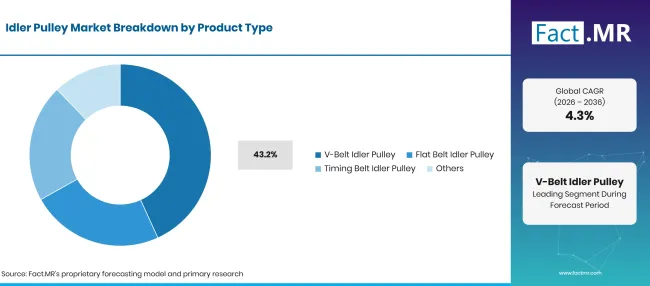
Factmr Idler Pulley Market Breakdown Product Type | Source: Fact.MR
| Product Type | Share (2026) |
|---|---|
| V-Belt Idler Pulley (Leading segment) | 43.2% |
| Other segments combined | 56.8% |
| Total | 100.0% |
Source: Fact.MR analysis. Updated Oct 14, 2026
V-belt idler pulleys dominate because V-belt drives are found in engines, compressors, pumps, and general machinery, and their simple design suits high-volume manufacturing and easy replacement. Flat belt idler pulleys serve industrial drives where belts transmit power over longer spans. Timing belt idler pulleys guide toothed belts that keep engine components synchronized and demand tight tolerances. Other designs address specialty drive systems.
What leads the Material segment?
Steel will account for 48.3% share in 2026.
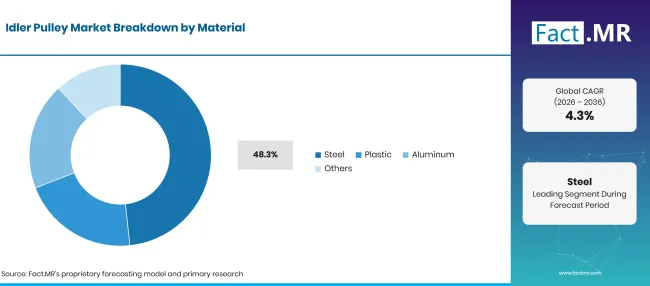
Factmr Idler Pulley Market Breakdown Material | Source: Fact.MR
| Material | Share (2026) |
|---|---|
| Steel (Leading segment) | 48.3% |
| Other segments combined | 51.7% |
| Total | 100.0% |
Source: Fact.MR analysis. Updated Oct 14, 2026
Steel prevails owing to its strength, wear resistance, and low unit cost under heavy loads, and manufacturers favor it for commercial vehicles, industrial machinery, and agricultural equipment. Plastic pulleys are lighter and corrosion-resistant, which suits passenger vehicles and applications sensitive to weight and noise. Aluminum pulleys pair low weight with good heat dissipation. Other materials address specialty uses.
What drives the Application segment?
Automotive will capture 38.4% share in 2026.
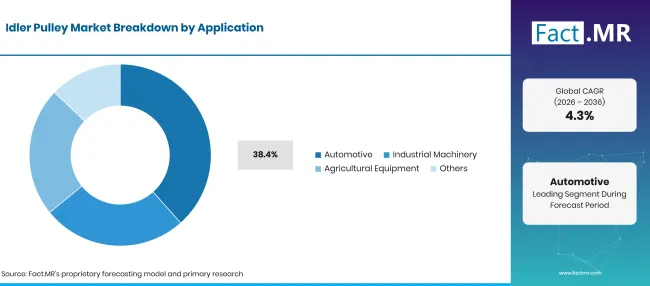
Factmr Idler Pulley Market Breakdown Application | Source: Fact.MR
| Application | Share (2026) |
|---|---|
| Automotive (leading segment) | 38.4% |
| Other segments combined | 61.6% |
| Total | 100.0% |
Source: Fact.MR analysis. Updated Oct 14, 2026
Automotive tops the segment because nearly every belt-driven engine incorporates one or more idler pulleys in its accessory or timing system, and steady vehicle production alongside a large serviceable fleet sustains both OEM and replacement demand. Industrial machinery uses them in conveyors, pumps, compressors, and power-transmission systems. Agricultural equipment depends on them in harvesters, tractors, and other machines operating under dust and heavy load. Other applications cover smaller niche uses.
How does End-User shape demand?
OEM will represent 64.2% share in 2026.
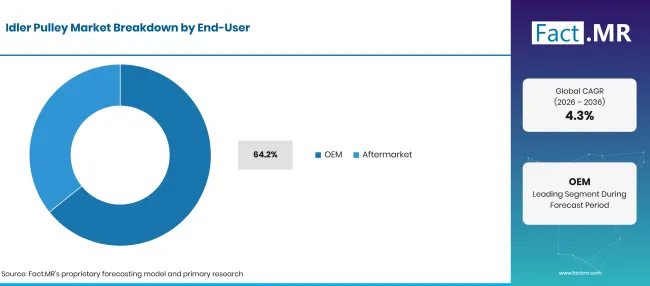
Factmr Idler Pulley Market Breakdown End User | Source: Fact.MR
| End-User | Share (2026) |
|---|---|
| OEM (leading segment) | 64.2% |
| Aftermarket (other segment) | 35.8% |
| Total | 100.0% |
Source: Fact.MR analysis. Updated Oct 14, 2026
OEM commands the segment because vehicle and equipment manufacturers purchase in large volumes under long-term supply agreements and install pulleys at the factory, while qualification requirements favor established suppliers with proven quality records. The aftermarket serves replacement needs through distributors, parts retailers, and repair workshops, where pulleys are often bundled with belts and tensioners, encouraging repeat purchases as installed equipment ages.
What is accelerating Idler Pulley Market adoption, and what is holding it back?
Demand will rise through vehicle production growth, replacement cycles, and industrial use. Growth is held back by the shift toward electric vehicles and price pressure from low-cost parts.
Drivers Impact Analysis
| DRIVER | (~) % IMPACT ON CAGR | GEOGRAPHIC RELEVANCE | IMPACT TIMELINE |
|---|---|---|---|
| Expansion of vehicle production and the installed vehicle base | +1.1% | Global | Short term (<= 2 years) |
| Higher replacement demand from aging vehicles and equipment | +0.9% | North America, Western Europe, East Asia | Medium term (2-4 years) |
| Preference for bundled replacement of pulleys, belts, and tensioners | +0.5% | Global | Medium term (2-4 years) |
| Growing adoption in industrial and agricultural machinery | +0.4% | Latin America, South Asia & Pacific, East Asia | Long term (>= 4 years) |
Source: Fact.MR analysis. Updated Oct 14, 2026
Opportunity Impact Analysis
| OPPORTUNITY | (~) % IMPACT ON CAGR | GEOGRAPHIC RELEVANCE | IMPACT TIMELINE |
|---|---|---|---|
| Lightweight plastic and aluminum pulley designs | +0.6% | Global | Medium term (2-4 years) |
| Kit-based aftermarket sales bundling belts and tensioners | +0.5% | North America, Western Europe | Short term (<= 2 years) |
| Online procurement of replacement parts | +0.3% | North America, Western Europe, East Asia | Short term (<= 2 years) |
| Pulleys for hybrid and thermal-management drive systems | +0.2% | Western Europe, East Asia | Long term (>= 4 years) |
Source: Fact.MR analysis. Updated Oct 14, 2026
Restraints Impact Analysis
| RESTRAINT | (~) % IMPACT ON CAGR | GEOGRAPHIC RELEVANCE | IMPACT TIMELINE |
|---|---|---|---|
| Declining engine belt systems as electric vehicles gain share | -0.5% | Western Europe, East Asia | Long term (>= 4 years) |
| Price pressure from low-cost and counterfeit parts | -0.4% | Global | Short term (<= 2 years) |
| Price volatility in steel and aluminum raw materials | -0.3% | Global | Medium term (2-4 years) |
Source: Fact.MR analysis. Updated Oct 14, 2026
Which countries are scaling the Idler Pulley Market through 2036?
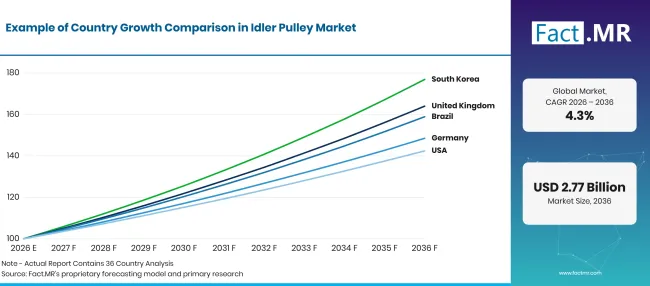
Factmr Idler Pulley Market Growth Index | Source: Fact.MR
| Country | CAGR (2026-2036) |
|---|---|
| United Kingdom | 5.1% |
| Brazil | 4.7% |
| Germany | 4.0% |
| United States | 3.6% |
| Japan | 3.3% |
Source: Fact.MR analysis. Updated Oct 14, 2026
What supports United Kingdom adoption?
5.1% CAGR, supported by aftermarket replacement demand.
Independent workshops and online parts channels support steady replacement sales of idler pulleys and related belt-drive components. Kits that bundle pulleys with belts and tensioners encourage workshops to renew several parts in a single service visit.
How is Brazil scaling demand?
4.7% CAGR, driven by automotive and agricultural equipment use.
Brazil combines vehicle production with a large agricultural machinery sector, both of which use idler pulleys in new equipment and in repair. Steady fleet usage and demanding field conditions also sustain regular replacement of worn drive components.
What is supporting Germany’s adoption?
4.0% CAGR, supported by a strong automotive manufacturing base.
German vehicle and machinery makers buy idler pulleys under long-term OEM contracts, and demand for high-precision components favors established suppliers. Strict quality requirements and close supplier relationships keep volumes steady across new production.
How does the United States perform?
3.6% CAGR, shaped by a large and mature vehicle base.
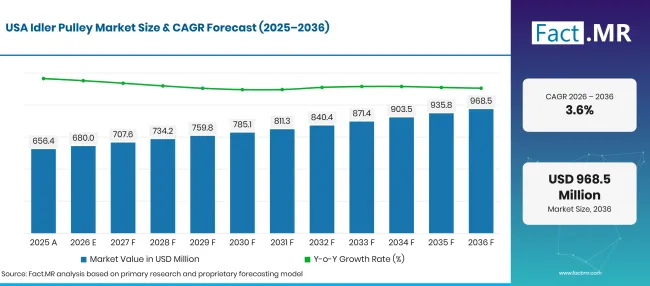
Factmr Idler Pulley Market Forecast Usa | Source: Fact.MR
The aftermarket provides steady replacement demand, while OEM volumes grow at a more moderate pace. An extensive network of distributors, parts retailers, and repair workshops keeps replacement parts widely available to owners and fleet operators.
How is Japan developing demand?
3.3% CAGR, backed by a mature automotive sector.
Japan has a well-established base of vehicle and component makers, so growth is steady rather than fast. Long-standing OEM supply relationships and a high standard for component quality support consistent demand, while market maturity limits the pace of expansion.
Who leads the Idler Pulley Market?
Competition falls into two groups. Diversified bearing and automotive component groups compete on global reach and long-standing OEM relationships: SKF Group and NSK Ltd. supply bearing-based pulley solutions, Schaeffler AG markets its INA and FAG brands, NTN Corporation serve Japanese and global vehicle makers, and Continental AG (ContiTech) offers belts and related drive components. Belt-drive specialists compete on complete system portfolios and aftermarket kits: Gates Corporation and Dayco Products LLC pair pulleys with belts and tensioners, Litens Automotive Group focuses on tensioning and decoupling systems, and GMB Corporation supplies replacement parts to the aftermarket. OEM approvals, quality records, and the ability to supply pulleys together with belts and tensioners will decide competition through 2036.
Which companies are the key providers?
Key companies include Gates Corporation; SKF Group; Schaeffler AG; Dayco Products LLC; NTN Corporation; Litens Automotive Group; GMB Corporation; Continental AG (ContiTech); and NSK Ltd.
- Gates Corporation
- SKF Group
- Schaeffler AG
- Dayco Products LLC
- NTN Corporation
- Litens Automotive Group
- GMB Corporation
- Continental AG (ContiTech)
- NSK Ltd.
Bibliography
- [1] International Organization of Motor Vehicle Manufacturers. (2026, April 23). Auto industry growth shifted east in 2025 amid global repositioning.
- [2] Campau, T. (2025, May 21). Average age of vehicles in the US rises to 12.8 years in 2025. S&P Global Mobility.
- [3] European Automobile Manufacturers’ Association. (2026, January 15). Vehicles on European roads 2026.
- [4] International Energy Agency. (2026). Global EV Outlook 2026.
- [5] Automobile Inspection & Registration Information Association. (2025).
This Report Answers
- The report explains how idler pulleys are used by product type, material, application, and end-user.
- Segment analysis identifies the sub-segment that leads each segment and the demand factors behind its 2026 share.
- Country analysis compares the five listed countries through vehicle production, aftermarket demand, and industrial use.
- Competitive analysis reviews bearing groups, automotive component makers, and belt-drive specialists.
- Market analysis tracks the drivers, opportunities, and restraints that will shape growth through 2036.
What does the Idler Pulley Market cover?
The Idler Pulley Market covers pulleys that guide belts and maintain tension and alignment in belt-drive systems. They are fitted in vehicle engines, industrial machinery, and agricultural equipment, and they are sold both to OEMs and through the aftermarket.
The assessment tracks V-belt, flat belt, and timing belt idler pulleys made from steel, plastic, aluminum, and other materials.
What is included in the scope?
The scope includes idler pulleys supplied as individual parts and as part of belt-drive kits with belts and tensioners. It covers pulleys sold to OEMs for new vehicles and equipment, as well as replacement pulleys sold through distributors, retailers, and workshops.
Kit products are included when the idler pulley forms part of the set. Only the value of the idler pulley is counted.
What is excluded from the scope?
The scope excludes drive pulleys, crankshaft pulleys, and other pulleys that transmit power rather than guide the belt. Belts, chains, sprockets, and standalone tensioner assemblies sold without an idler pulley are also excluded.
Conveyor idler rollers used in bulk material handling fall outside the revenue boundary. Standalone bearings sold without a pulley are excluded.
How Was the Analysis Built?
The analysis draws on 120+ sources, 35+ company portfolios, 25+ countries, and more than 20 industry interviews.
- Primary Research: Primary research includes discussions with manufacturers, service providers, technology developers, distributors, end users, and subject-matter experts. These conversations examine purchasing priorities, product adoption, operational challenges, approval requirements, competitive positioning, and the factors that influence wider market acceptance.
- Desk Research: Desk research covers government statistics, regulatory publications, company filings, trade data, technical studies, industry associations, standards, public policy, and other authoritative sources. Every source used in the analysis is documented in the bibliography.
- Market Sizing and Forecasting: Market estimates combine historical performance, demand indicators, pricing and volume trends, segment shares, company participation, country-level growth, adoption patterns, investment activity, and barriers to market expansion.
- Data Validation and Update Cycle: Findings are validated by comparing primary interviews with public data, company activity, regulatory changes, trade patterns, and industry developments. Regular updates review new product launches, capacity changes, partnerships, approvals, and shifts in commercial adoption.
Segmentation
What is the report’s scope and coverage?
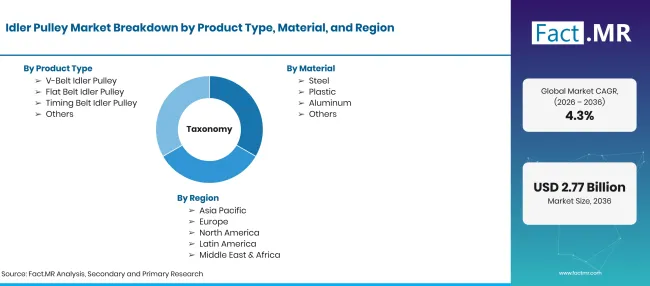
Factmr Idler Pulley Market Taxonomy | Source: Fact.MR
| Attribute | Details |
|---|---|
| Quantitative Units | USD 1.8 billion in 2026 to USD 2.8 billion by 2036 at a 4.3% CAGR |
| Market Definition | Idler pulleys used in belt-drive systems to guide belts and maintain tension and alignment in vehicles, industrial machinery, and agricultural equipment. |
| Product Type | V-Belt Idler Pulley; Flat Belt Idler Pulley; Timing Belt Idler Pulley; Others |
| Material | Steel; Plastic; Aluminum; Others |
| Application | Automotive; Industrial Machinery; Agricultural Equipment; Others |
| End-User | OEM; Aftermarket |
| Regions Covered | North America; Latin America; Western Europe; Eastern Europe; East Asia; South Asia & Pacific; Middle East & Africa |
| Countries Covered | United Kingdom; Brazil; Germany; United States; Japan |
| Key Companies Profiled | Gates Corporation; SKF Group; Schaeffler AG; Dayco Products LLC; NTN Corporation; Litens Automotive Group; GMB Corporation; Continental AG (ContiTech); NSK Ltd. |
| Forecast Period | 2026 to 2036 |
| Approach | Hybrid top-down and bottom-up approach using vehicle and machinery production; replacement cycles; OEM and aftermarket channel mix; country growth; and supplier portfolio review. |
Source: Fact.MR analysis. Updated Oct 14, 2026
How is the market segmented?
-
By Product Type
- V-Belt Idler Pulley
- Flat Belt Idler Pulley
- Timing Belt Idler Pulley
- Others
-
By Material
- Steel
- Plastic
- Aluminum
- Others
-
By Application
- Automotive
- Industrial Machinery
- Agricultural Equipment
- Others
-
By End-User
- OEM
- Aftermarket
-
By Region
- North America
- Latin America
- Western Europe
- Eastern Europe
- East Asia
- South Asia & Pacific
- Middle East & Africa
Frequently Asked Questions
How big is the idler pulley market in 2026?
What is the CAGR of the idler pulley market from 2026 to 2036?
Which product type leads the idler pulley market?
Which material leads the idler pulley market?
Which application leads the idler pulley market?
Which end-user leads the idler pulley market?
Which country will grow the most in the idler pulley market?
Who are the main companies in the idler pulley market?
Who worked on this report


Preview the report firsthand - request a free sample
Free SampleGet the brochure for pricing and purchase details
Download PDF