- Base Value(2025): 0.9 Bn
- Forecast Value (2036): 7.0 Bn
- CAGR (2036): 20.3%
What is the indoor ski centers market forecast to be worth by 2036?
USD 1.1 billion in 2026 to USD 7.0 billion by 2036, at 20.3% CAGR.
- The Indoor Ski Centers Market was valued at USD 0.9 billion in 2025.
- The indoor ski centers market is estimated at USD 1.1 billion in 2026 and is projected to reach USD 7.0 billion by 2036.
- The market is forecast to expand at 20.3% CAGR from 2026 to 2036 as investments in indoor snow recreation facilities, destination entertainment projects and year-round winter sports experiences accelerate worldwide.
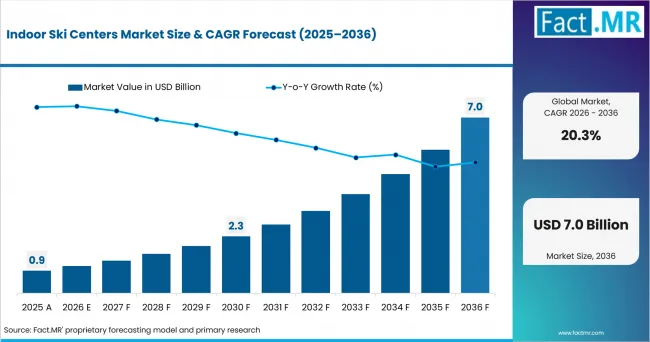
Indoor Ski Centers Market Market Value Analysis | Source: Fact.MR
What are the defining numbers behind indoor ski center growth?
USD 5.9 billion absolute opportunity by 2036 led by the United States and Saudi Arabia.
- Demand Drivers in the Market
- Year-round access is increasing participation in skiing and snow sports.
- Urban consumers are seeking climate-independent recreational experiences.
- Tourism and entertainment developments increasingly incorporate indoor snow attractions.
- Advanced snow generation technologies improve operating efficiency.
- Key Segments Analyzed
- By Facility Type: Destination Indoor Ski Centers are expected to hold 48.0% share in 2026 because they combine recreation, hospitality and tourism offerings.
- By Ski Technology: Real Snow Systems are projected to account for 54.0% share in 2026 due to their ability to provide authentic skiing experiences.
- By Revenue Stream: Admission and Ski Pass Sales are expected to hold 39.0% share in 2026 because visitor access remains the primary revenue source.
- By End User: Recreational Skiers hold 58.0% share in 2026 as leisure participation drives facility utilization.
- By Application: Sports and Recreation account for 51.0% share in 2026 due to strong demand for accessible winter sports experiences.
- By Geography: Saudi Arabia is projected to record 22.4% CAGR through 2036, supported by tourism megaprojects and winter recreation infrastructure.
- Analyst Opinion at Fact.MR
- Shambhu Nath Jha, Senior Analyst at Fact.MR, states, “Indoor ski centers are increasingly becoming multi-purpose destination assets that combine sports participation, tourism and family entertainment. Advances in snow technology and energy efficiency are improving commercial viability while expanding winter sports accessibility beyond traditional mountain regions.”
- Strategic Implications
- Developers should prioritize mixed-use entertainment and tourism concepts.
- Operators should expand training programs and membership offerings to increase repeat visitation.
- Technology providers should focus on energy-efficient snow generation systems.
- Investors should target high-density urban markets with limited access to natural ski facilities.
Indoor ski centers provide climate-controlled environments for skiing, snowboarding and snow-based recreation regardless of outdoor weather conditions. These facilities support recreational users, professional athletes, tourists and training programs. Growing demand for experiential leisure activities and increasing investments in destination entertainment projects continue to support market expansion.
Saudi Arabia is expected to register 22.4% CAGR through 2036 as Trojena and broader tourism megaproject investments accelerate winter recreation infrastructure development. The United States remains the largest market and is projected to record 21.0% CAGR through 2036, supported by expansion of the Big Snow model and rising interest in year-round snow sports. Japan is forecast to advance at 19.8% CAGR, supported by established skiing culture, the Sayama legacy and new indoor facility developments. The United Kingdom is expected to grow at 19.4% CAGR, benefiting from mature indoor ski center networks and steady participation in snow sports. South Korea is projected to expand at 18.9% CAGR through 2036 due to growing indoor recreation demand and continued investment in leisure infrastructure.
How does the indoor ski centers market break down by segment?
Destination Indoor Ski Centers lead at 48.0%; Recreational Skiers lead at 58.0%.
Which facility type dominates?
Destination Indoor Ski Centers hold 48.0% share in 2026.
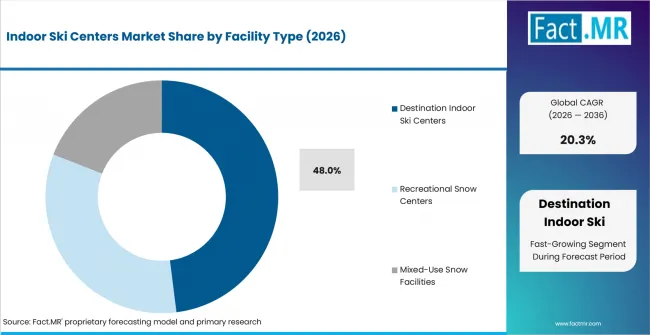
Indoor Ski Centers Market Analysis By Facility Type | Source: Fact.MR
Destination Indoor Ski Centers lead because they combine skiing, hospitality, retail and entertainment within a single facility. These venues attract tourists, families and recreational visitors while generating revenue from multiple services. Their ability to support year-round operations and destination tourism strengthens long-term utilization and profitability. SnowWorld announced the acquisition/combination with The Snow Centre in Hemel Hempstead, United Kingdom. The transaction created a group operating 12 indoor snow centers across five countries, serving more than 4.5 million visitors annually and becoming one of the largest indoor ski operators globally.
Which ski technology dominates?
Real Snow Systems lead with 54.0% share in 2026.
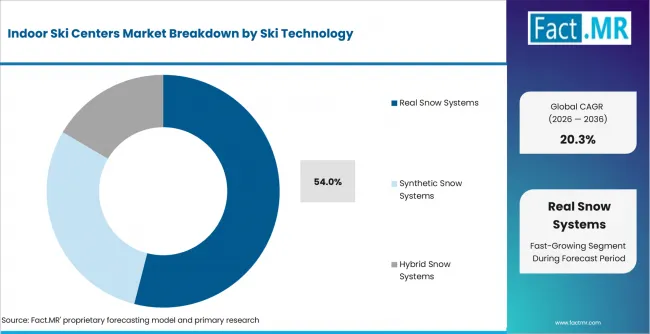
Indoor Ski Centers Market Analysis By Ski Technology | Source: Fact.MR
Real Snow Systems lead because they provide authentic skiing conditions that closely resemble outdoor snow environments. Operators increasingly invest in advanced snow-making technologies to improve slope quality, customer satisfaction and repeat visitation. The technology remains essential for premium indoor ski experiences. Qianhai Snow World in Shenzhen opened as the world's largest indoor ski resort, surpassing previous records for indoor ski facility size and reinforcing China's investment in large-scale indoor winter sports infrastructure.
Which revenue stream dominates?
Admission and Ski Pass Sales hold 39.0% share in 2026.
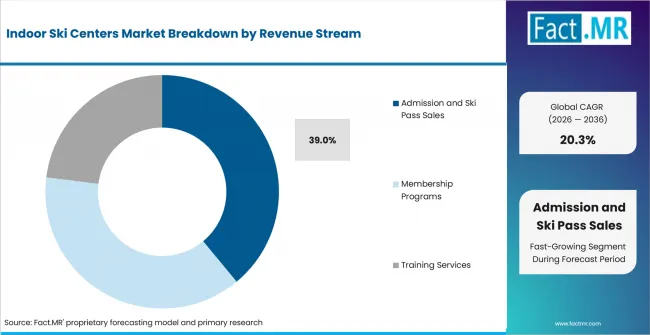
Indoor Ski Centers Market Analysis By Revenue Stream | Source: Fact.MR
Admission and Ski Pass Sales dominate because visitor access fees remain the largest source of recurring revenue for operators. Strong attendance levels and repeat participation support stable cash flow across commercial facilities. Premium packages and membership programs further enhance revenue generation. IHG Hotels & Resorts announced the opening of the Shanghai Snow World Hotel under its Vignette Collection brand. The hotel is integrated within the Shanghai Snow World complex, home to one of the world's largest indoor ski resorts. The development combines indoor skiing, snow entertainment, hospitality, and tourism infrastructure, supporting the commercialization and expansion of large-scale indoor snow centers.
Which end user dominates?
Recreational Skiers account for 58.0% share in 2026.
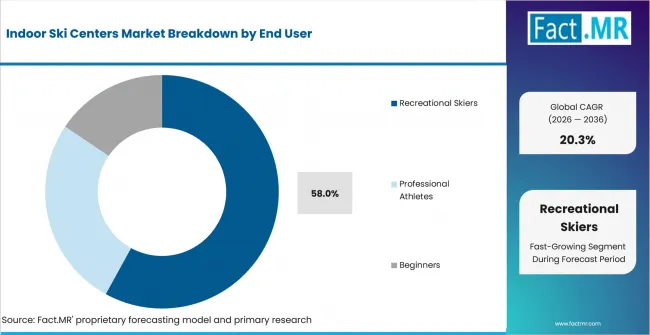
Indoor Ski Centers Market Analysis By End User | Source: Fact.MR
Recreational Skiers dominate because most visitors participate for leisure, fitness and family entertainment rather than professional training. Indoor facilities make skiing accessible to consumers regardless of season or geographic location. Growing interest in experiential recreation continues to support visitor growth.
Which application dominates?
Sports and Recreation lead with 51.0% share in 2026.
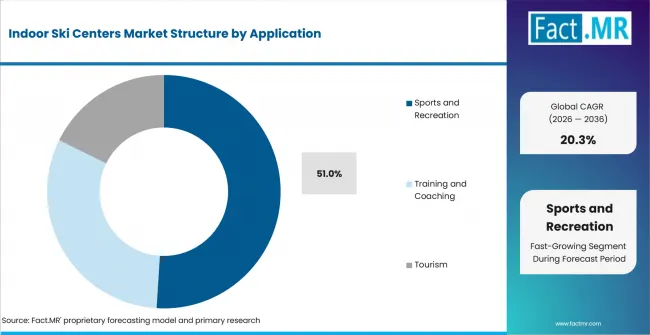
Indoor Ski Centers Market Analysis By Application | Source: Fact.MR
Sports and Recreation lead because indoor ski centers primarily serve consumers seeking year-round skiing and snowboarding experiences. Facilities support a broad range of skill levels from beginners to experienced participants. Recreational demand remains the largest contributor to attendance and facility revenues.
What is accelerating indoor ski center demand and what is holding it back?
Year-round winter sports participation drives demand while development costs restrain adoption.
The primary growth driver is increasing consumer demand for skiing and snow recreation in regions without reliable natural snowfall. Indoor facilities eliminate seasonal limitations while providing convenient access to winter sports throughout the year. Rising investments in destination entertainment and active leisure experiences further support market growth.
The main restraint is the substantial capital investment required for snow generation systems, climate control infrastructure and facility operations. Energy consumption, maintenance requirements and construction costs can affect project economics. Long development timelines may also slow new facility deployment.
Where do the biggest indoor ski center opportunities sit?
Destination resorts, athlete training facilities and entertainment districts.
- Destination Resort Development
- Integrated snow destinations create opportunities to combine winter recreation, hospitality, retail and tourism services within a single venue. These projects can attract both local visitors and international tourists while generating diversified revenue streams.
- Professional Training Centers
- Indoor ski centers provide consistent conditions for athlete development, coaching programs and year-round training activities. Growing interest in competitive skiing and snowboarding is increasing demand for dedicated training environments.
- Entertainment and Mixed-Use Projects
- Large-scale entertainment districts increasingly incorporate indoor snow attractions to diversify visitor experiences and strengthen destination appeal. Indoor ski facilities are becoming anchor attractions within tourism developments, lifestyle destinations and mixed-use entertainment projects.
Which countries are scaling indoor ski center adoption fastest?
Saudi Arabia 22.4% CAGR, United States 21.0% CAGR, Japan 19.8% CAGR, United Kingdom 19.4% CAGR, and South Korea 18.9% CAGR.
Based on regional analysis, the indoor ski centers market is segmented into North America, Western Europe, Asia Pacific, Latin America and Middle East & Africa.
| Country | CAGR (2026-2036) |
|---|---|
| Saudi Arabia | 22.4% |
| United States | 21.0% |
| Japan | 19.8% |
| United Kingdom | 19.4% |
| South Korea | 18.9% |
Source: Fact.MR analysis. Updated Jun 25, 2026
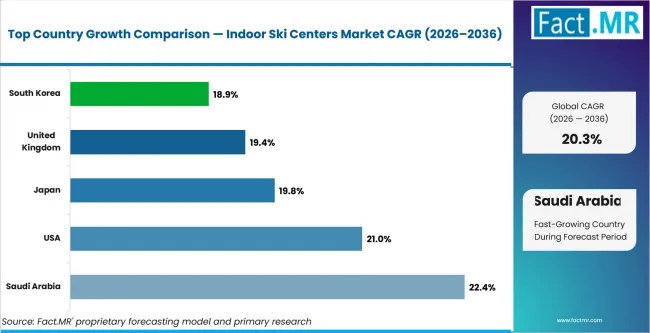
Indoor Ski Centers Market Cagr Analysis By Country | Source: Fact.MR
How is Saudi Arabia transforming indoor snow recreation?
22.4% CAGR, supported by winter sports infrastructure
Saudi Arabia is projected to register 22.4% CAGR as Trojena and other tourism megaprojects accelerate investment in winter recreation infrastructure. Indoor snow attractions align with broader efforts to diversify tourism and entertainment offerings. Government-backed development initiatives continue to create significant opportunities for indoor ski facilities.
What is supporting the United States leadership?
21.0% CAGR, driven by destination entertainment investments
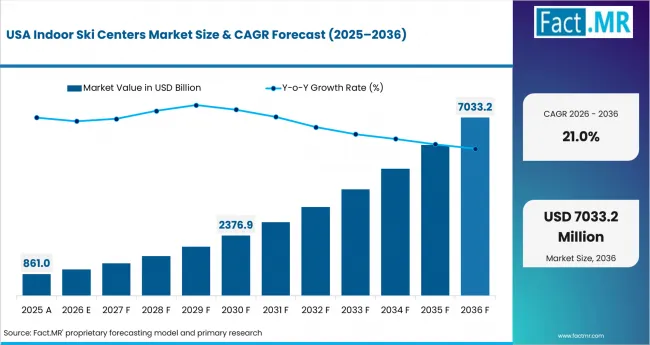
Indoor Ski Centers Market Country Value Analysis | Source: Fact.MR
The United States is projected to record 21.0% CAGR by 2036 as successful facilities such as Big Snow demonstrate growing demand for year-round skiing and snowboarding experiences. Rising consumer interest in indoor recreation and expanding destination entertainment investments continue to support new project development. Operators are increasingly targeting urban markets with limited access to traditional ski resorts.
Why is the United Kingdom a mature indoor ski market?
19.4% CAGR, due to strong ski center network
The United Kingdom is expected to post 19.4% CAGR through 2036 due to its established indoor ski center network and strong participation in snow sports training programs. Existing facilities continue to benefit from consistent recreational demand and investments in visitor experience enhancements. Growing interest in accessible winter sports is supporting long-term market expansion. The £300 million Rhydycar West leisure resort project advanced through the planning process in Wales, featuring a 400–424 meter indoor real-snow ski slope that would become the United Kingdom's largest indoor snow center if completed. The project also includes hotels, a water park, and snow sports training facilities, significantly expanding the United Kingdom's indoor skiing infrastructure.
What is driving South Korea's indoor ski center expansion?
18.9% CAGR, driven by investment in snow sports
South Korea is expected to register 18.9% CAGR by 2036 due to increasing demand for family entertainment and indoor recreation experiences. Growing participation in skiing and snowboarding is encouraging investment in modern snow sports facilities. Continued development of leisure infrastructure supports market growth.
How does Japan contribute to market expansion?
19.8% CAGR, supported by expanding indoor recreation demand
Japan is forecast to advance at 19.8% CAGR as its established skiing culture and strong consumer familiarity with winter sports support demand. Facilities benefit from the legacy of long-standing indoor ski operations such as Sayama while new developments expand market capacity. Urban consumers increasingly seek convenient year-round access to snow-based recreation.
Who leads the indoor ski centers landscape?
Big Snow, SnowWorld, Snozone, Majid Al Futtaim and Compagnie des Alpes lead through facility development expertise and operational scale.
The market is characterized by competition focused on visitor experience, snow quality and operational efficiency. Operators continue investing in advanced snow-making technologies, training programs and entertainment offerings to improve profitability and attract repeat visitors. Many facilities are expanding beyond traditional skiing activities by incorporating family entertainment, hospitality and retail services to strengthen revenue generation.
Big Snow benefits from its successful year-round indoor skiing model in the United States, while SnowWorld and Snozone leverage extensive operating experience across Europe. Compagnie des Alpes benefits from deep expertise in winter sports operations and destination management. These companies continue investing in facility upgrades and customer experience enhancements to maintain competitive advantages.
Competition through 2036 will depend on energy efficiency, facility utilization and integration with tourism and entertainment ecosystems. Operators that combine high-quality snow experiences with diversified revenue streams, strong brand positioning and effective cost management will be better positioned to expand market share. Partnerships with tourism developers and mixed-use entertainment projects are also expected to become increasingly important growth strategies.
Which companies are the key players?
Big Snow, SnowWorld, Snozone, Majid Al Futtaim, Compagnie des Alpes
- Big Snow American Dream
- SnowWorld
- Snozone
- Majid Al Futtaim
- Compagnie des Alpes
Bibliography
- [1] The Snow Centre. (2025). Snow Centre and SnowWorld join forces. The Snow Centre.
- [2] IHG Hotels & Resorts. (2024). IHG Hotels & Resorts introduces Shanghai Snow World Hotel, Vignette Collection. IHG Hotels & Resorts.
- [3] NEOM. (2024). Trojena: The mountains of NEOM. NEOM.
- [4] Big SNOW American Dream. (2026). Big SNOW American Dream. Big SNOW American Dream.
- [5] SnowWorld. (2025). SnowWorld. SnowWorld.
- [6] Snozone. (2026). Indoor snow centres. Snozone.
This Report Addresses
- Strategic intelligence on indoor snow recreation and skiing facility development.
- Segment analysis covering facility types, technologies and revenue streams.
- Regional outlook covering the United States, United Kingdom, Saudi Arabia, South Korea and Japan.
- Competitive assessment of leading indoor ski center operators and developers.
- Analysis of winter sports participation and destination entertainment trends.
- Evaluation of facility economics, operating models and investment opportunities.
- Primary interviews, company benchmarking and industry validation supporting forecast development.
What does the indoor ski centers market cover?
Indoor snow recreation and skiing facilities designed for sports, leisure and tourism.
The market covers commercial indoor ski facilities that provide skiing, snowboarding and snow-based recreational experiences in climate-controlled environments. It includes destination ski centers, recreational snow facilities and mixed-use entertainment venues.
What is included in the scope?
Indoor ski slopes, snowboarding equipment and facilities, snow parks and associated recreational infrastructure.
The scope includes snow generation systems, ski instruction services, recreational snow attractions, equipment rentals and hospitality offerings.
What is excluded from the scope?
Outdoor ski resorts and natural snow mountain destinations.
The scope excludes alpine ski resorts, mountain tourism operations and outdoor winter recreation facilities.
How was the analysis built?
100+ sources, 40+ company assessments, 25+ countries and industry interviews.
- Primary Research:
- Interviews with ski center operators, snow technology providers, developers and industry experts.
- Desk Research:
- Analysis of winter sports participation trends, indoor recreation investments and facility development projects.
- Market-Sizing and Forecasting:
- Estimates based on facility revenues, visitor volumes and expansion projects.
- Data Validation and Update Cycle:
- Forecasts validated through project benchmarking, company disclosures and investment analysis.
Segmentation
What is the report's scope and coverage?
| Attribute | Details |
|---|---|
| Quantitative Units | USD Billion in 2026 to USD Billion by 2036 |
| Market Definition | Indoor snow recreation and skiing facilities |
| Facility Type | Destination Indoor Ski Centers, Recreational Snow Centers, Mixed-Use Snow Facilities |
| Ski Technology | Real Snow Systems, Synthetic Snow Systems, Hybrid Systems |
| Revenue Stream | Admission Fees, Memberships, Training Services, Equipment Rentals, Hospitality |
| End User | Recreational Skiers, Professional Athletes, Tourists, Beginners |
| Application | Sports & Recreation, Training, Tourism, Events |
| Regions Covered | North America, Western Europe, Asia Pacific, Latin America, Middle East & Africa |
| Countries Covered | United States, United Kingdom, Saudi Arabia, South Korea, Japan |
| Companies Covered | Big Snow, SnowWorld, Snozone, Majid Al Futtaim, Compagnie des Alpes |
| Forecast Period | 2026 to 2036 |
| Approach | Hybrid top-down and bottom-up approach using facility deployment, attendance and revenue analysis |
Source: Fact.MR analysis. Updated Jun 25, 2026
How is the market segmented?
-
By Facility Type
- Destination Indoor Ski Centers
- Recreational Snow Centers
- Mixed-Use Snow Facilities
-
By Ski Technology
- Real Snow Systems
- Synthetic Snow Systems
- Hybrid Snow Systems
-
By Revenue Stream
- Admission and Ski Pass Sales
- Membership Programs
- Equipment Rentals
- Training Services
- Hospitality and Food Services
-
By End User
- Recreational Skiers
- Professional Athletes
- Beginners
- Tourists
-
By Application
- Sports and Recreation
- Training and Coaching
- Tourism
- Events and Competitions
-
Region:
- North America
- United States
- Canada
- Europe
- United Kingdom
- Germany
- France
- Netherlands
- Spain
- Asia Pacific
- Australia
- Japan
- South Korea
- Singapore
- India
- Latin America
- Brazil
- Mexico
- Chile
- Middle East & Africa
- GCC Countries
- South Africa
- Israel
- North America
Frequently Asked Questions
Which facility type leads the market?
Which ski technology dominates the market?
Which revenue stream generates the highest share?
Why are indoor ski centers gaining popularity globally?
Which country leads the Indoor Ski Centers Market?
What is driving demand for indoor ski centers?
What is the primary challenge facing the market?
How do indoor ski centers support athlete training?
Why are tourism developers investing in indoor snow attractions?
How are snow technologies influencing the market?
What opportunities exist for indoor ski center developers?
How does tourism contribute to market growth?
Who worked on this report


Preview the report firsthand - request a free sample
Free SampleGet the brochure for pricing and purchase details
Download PDF