- Forecast Value (2036): 8.60 Bn
- CAGR (2036): 22.8%
What is the indoor pickleball clubs market forecast to be worth by 2036?
USD 1.10 billion in 2026 to USD 8.60 billion by 2036, at 22.8% CAGR.
- The indoor pickleball clubs market crossed a valuation of USD 0.90 billion in 2025. Revenue is projected to increase from USD 1.10 billion in 2026 to USD 8.60 billion by 2036.
- The market is forecast to record 22.8% CAGR during 2026 to 2036 as clubs shift from one-time court rental toward memberships, leagues and event-led revenue.
- Climate-controlled pickleball venues form the core of this market. Indoor clubs become billable when players need reliable court access after work and during harsh weather seasons.
- This supports recurring revenue because members reserve courts, join ladders and pay for coaching inside the same facility. Operators can also add beverages, events and branded merchandise beside court access.
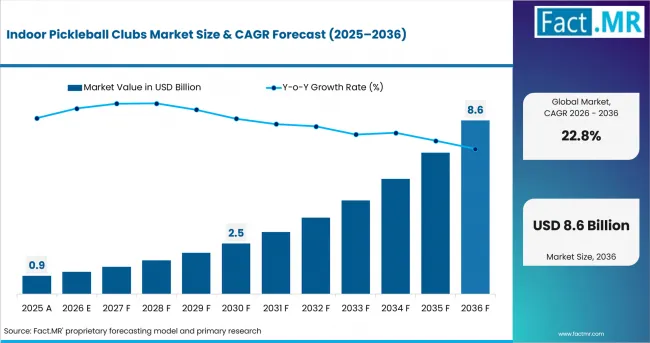
Indoor Pickleball Clubs Market Value Analysis | Source: Fact.MR
What are the defining numbers behind indoor pickleball clubs growth?
USD 7.50 billion absolute opportunity by 2036. United States, Canada and India lead the country view.
- Demand Drivers in the Market
- Players pay for indoor access because weather, court scarcity and evening schedules make public courts less dependable for repeat play.
- Franchises shorten the opening cycle because operators receive site selection support and court layouts. Software tools and pre-opening membership playbooks support the same process.
- Food and beverage service raises the value of each visit because groups stay after play and private events use the court space as social inventory.
- Corporate and league bookings support weekday utilization because clubs can sell structured play during hours that casual members use less often.
- Key Segments Analyzed
- By Revenue Stream: Memberships are expected to account for 42.0% of market share in 2026, because predictable monthly revenue matters more than occasional court rental when rents and staffing costs are fixed.
- By Venue Format: Franchise Clubs are projected to capture 38.0% share in 2026. Territory sales and standard playbooks support site layout. Coaching programs and local member acquisition also matter.
- By Court Count: 8 to 12 Courts are estimated to hold 36.0% share in 2026, as this size balances league capacity with manageable rent exposure in suburban retail boxes.
- By Customer Type: Adult Players are likely to represent 34.0% share in 2026, since after-work booking and social leagues provide the highest repeat-use base.
- By Service Offering: Open Play is forecast to secure 32.0% share in 2026, as new players prefer scheduled sessions that match ability level and reduce coordination work.
- By Location Type: Retail Boxes are anticipated to contribute 31.0% share in 2026. Vacant big-box space can fit courts and lounges. Viewing areas improve event use.
- By Booking Model: App Reservations are projected to account for 30.0% share in 2026 because players expect court booking and payments in one workflow. League alerts make the same system more useful.
- By Geography: The United States is expected to record a 24.6% CAGR through 2036, supported by the largest visible franchise pipeline and the deepest player base.
- Analyst Opinion
- Shambhu Nath Jha, Senior Analyst at Fact.MR, states, "Indoor pickleball is more than a court-count story. I see buyers asking whether a club can keep courts full on Tuesday morning, keep neighbors comfortable with sound control and keep members returning after the first lesson."
- Strategic Implications
- Club operators should model membership capacity before signing leases because the wrong court count can leave fixed rent unsupported.
- Franchise developers need clearer site rules around ceiling height and sound treatment. Parking and food permits should be checked before new territories are awarded.
- Equipment suppliers can treat clubs as repeat institutional accounts because balls and nets are consumed through daily play. Dividers and cleaning supplies add repeat orders.
- Investors should separate open clubs from sold territories, because unit sales do not become revenue until facilities pass permitting and pre-sales thresholds.
The United States is projected to record 24.6% CAGR through 2036 as franchise operators build the deepest indoor venue pipeline. Canada is likely to post 24.1% CAGR because winter play supports demand for enclosed courts. India is expected to register 23.8% CAGR as franchise rights and organized club play expand from a smaller base. The United Kingdom is forecast to advance at 22.9% CAGR as leisure-center conversions support venue demand. Australia is projected to record 22.3% CAGR as venue networks and affiliate activity support organized play. Japan is expected to post 21.7% CAGR, while Germany follows at 20.9% CAGR.
How does the indoor pickleball clubs market break down by segment?
Memberships lead at 42.0%. Franchise Clubs follow with 38.0% share in 2026.
Which revenue stream dominates?
Memberships hold 42.0% share in 2026.
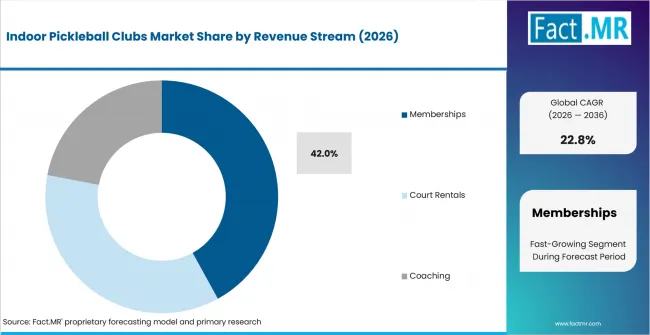
Indoor Pickleball Clubs Market Analysis By Revenue Stream | Source: Fact.MR
Memberships are expected to hold 42.0% share in 2026 because they turn court time into repeat revenue. A club can then schedule lessons, leagues and private events around a known member base. Retail sales of pickleball equipment add margin, but equipment alone does not replace recurring access revenue.
Which venue format dominates?
Franchise Clubs hold 38.0% share in 2026.
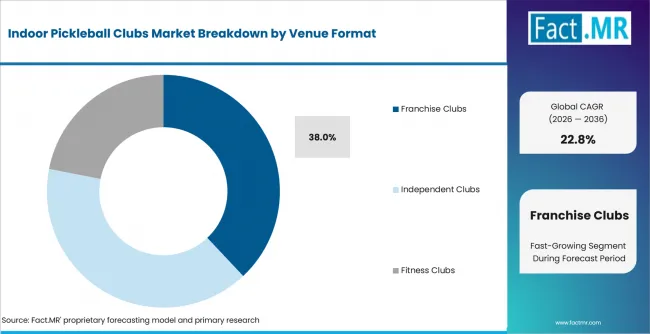
Indoor Pickleball Clubs Market Analysis By Venue Format | Source: Fact.MR
Franchise Clubs are projected to account for 38.0% share in 2026 because operators want playbooks for site selection and pre-opening sales. The format also gives landlords a clearer tenant profile than a one-off club. Independent venues remain relevant where local owners already control property or have community relationships.
Which court count dominates?
8 to 12 Courts hold 36.0% share in 2026.
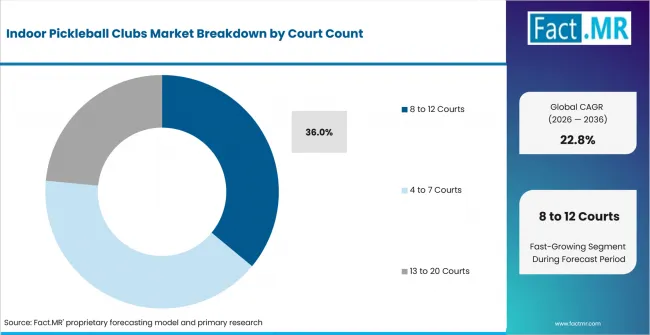
Indoor Pickleball Clubs Market Analysis By Court Count | Source: Fact.MR
8 to 12 Courts are forecast to account for 36.0% share in 2026 because this size supports leagues without requiring arena-scale space. It gives operators enough courts for member play and coaching during peak hours. Larger clubs can serve tournaments, but they need deeper pre-sales and more parking.
Which customer type dominates?
Adult Players hold 34.0% share in 2026.
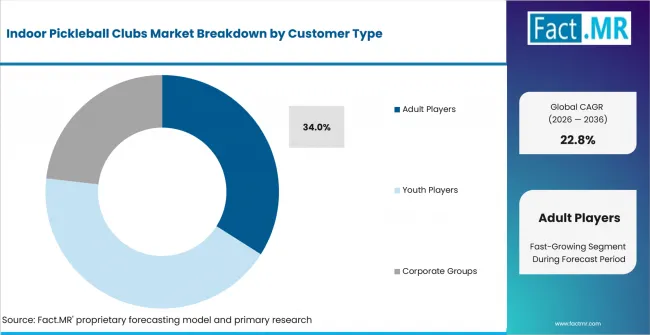
Indoor Pickleball Clubs Market Analysis By Customer Type | Source: Fact.MR
Adult Players are likely to capture 34.0% share in 2026 because indoor clubs fit after-work routines and social sports groups. Youth programs are building a future base, but adult members still pay for most recurring access. Group play also supports ratings, ladders and clinics inside one facility.
Which service offering dominates?
Open Play holds 32.0% share in 2026.
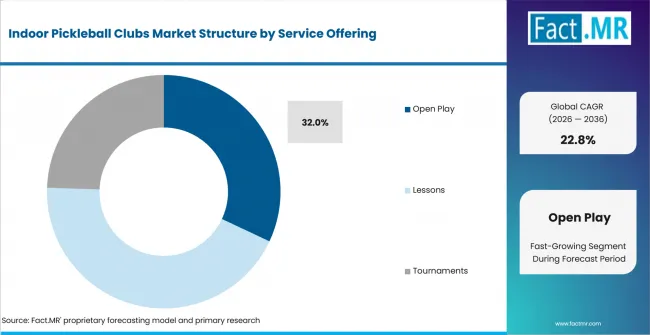
Indoor Pickleball Clubs Market Analysis By Service Offering | Source: Fact.MR
Open Play is estimated to hold 32.0% share in 2026 because new players need organized games more than empty courts. The club controls skill levels and creates repeat sessions. Similar scheduling habits appear in connected sports equipment use cases, where connected tools work best after participation becomes routine.
Which location type dominates?
Retail Boxes hold 31.0% share in 2026.
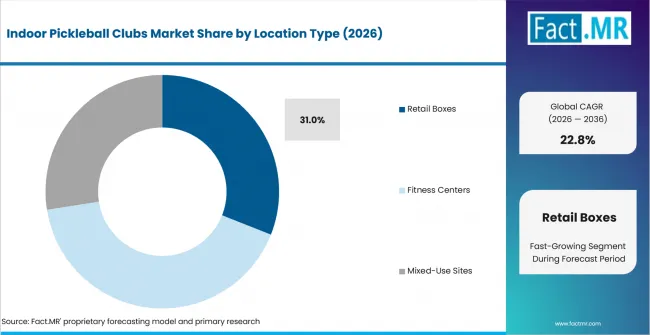
Indoor Pickleball Clubs Market Analysis By Location Type | Source: Fact.MR
Retail Boxes are expected to hold 31.0% share in 2026 because former big-box stores often have ceiling height, parking and open floor plates. These sites reduce build complexity compared with purpose-built sports halls. The constraint is sound carryover into nearby tenants, which can raise fit-out costs.
Which booking model dominates?
App Reservations hold 30.0% share in 2026.
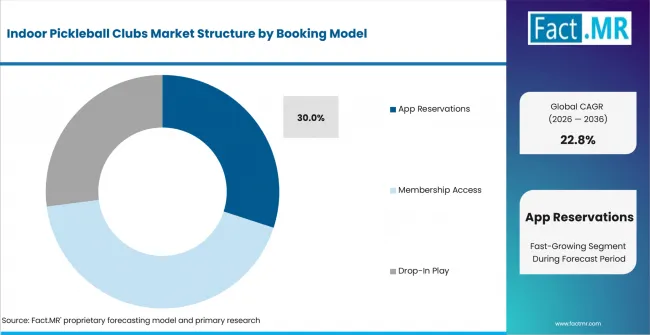
Indoor Pickleball Clubs Market Analysis By Booking Model | Source: Fact.MR
App Reservations are projected to hold 30.0% share in 2026 because members expect court booking and payment without staff calls. Operators also use booking records to manage peak pricing and league balance. The same customer habit supports home fitness app subscriptions, where routine tracking protects retention.
What is accelerating indoor pickleball clubs demand, and what is holding it back?
Participation scale and venue scarcity support demand. Lease cost, noise control and off-peak utilization restrain wider openings.
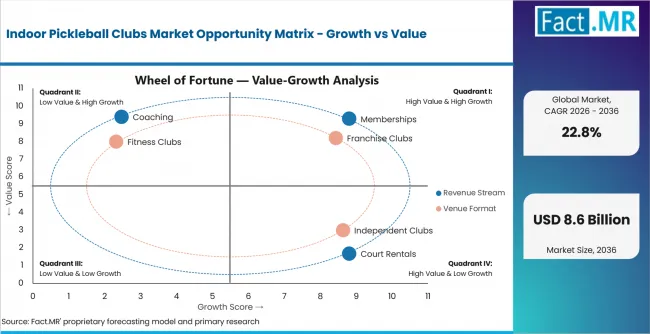
Indoor Pickleball Clubs Market Opportunity Matrix Growth Vs Value | Source: Fact.MR
Pickleball participation moved beyond occasional recreation and became a weekly habit for a large player base. The Sports & Fitness Industry Association reported 24.3 million American players in 2025. USA Pickleball’s 2025 growth update confirms that the national court-location base continued to expand. Those numbers show why dedicated clubs can sell access rather than only court time. The same member-use logic appears in the health and fitness club category, where recurring attendance decides facility economics.
Club supply is expanding through franchising because operators need operating systems before they sign large leases. The Picklr’s franchise page shows a large real-estate and franchise pipeline, which supports the early growth curve. This pipeline supports an early growth curve, yet it also creates execution risk when a sold territory takes longer to become an open venue.
Expansion is constrained by rent, acoustics and weekday utilization. Pickleball sound can disturb neighboring tenants when ceilings and dividers are not treated correctly. Food permits add another approval layer when clubs depend on events and beverages. Operators also need morning programs for retirees, clinics or corporate users because evening courts alone cannot carry a high-rent facility. Member retention tools from the fitness tracking category show why clubs are shifting toward software-backed engagement rather than walk-in access only.
Where do the biggest indoor pickleball clubs opportunities sit?
Suburban retail conversion, corporate play packages and academy-style coaching are the most practical revenue pools.
- Suburban Retail Conversion: Empty retail boxes give operators floor plates that can fit 8 to 12 courts and viewing areas without building from the ground up.
- Corporate Play Packages: Employers can book courts and food service together, which gives clubs daytime volume outside peak member hours.
- Academy-Style Coaching: Structured lessons create repeat visits and raise paddle, ball and shoe sales inside the venue.
- Practice Technology: Clubs can add pickleball machine stations where coaching demand is high and court time is limited.
- Back-of-House Efficiency: Large venues can use a ball picking robot or similar retrieval tools when lessons and drill courts create heavy ball movement.
Which countries are scaling indoor pickleball clubs fastest?
United States at 24.6% and Canada at 24.1% lead the country view. India at 23.8%, United Kingdom at 22.9% and Australia at 22.3% follow. Japan at 21.7% and Germany at 20.9% complete the top seven.
Based on regional analysis, the indoor pickleball clubs market is segmented into North America and Europe. Asia Pacific is also covered. Latin America and Middle East and Africa complete the regional scope.
.webp "Top Country Growth Comparison Indoor Pickleball Clubs Market Cagr (2026 2036)")
Top Country Growth Comparison Indoor Pickleball Clubs Market Cagr (2026 2036) | Source: Fact.MR
| Country | CAGR |
|---|---|
| United States | 24.6% |
| Canada | 24.1% |
| India | 23.8% |
| United Kingdom | 22.9% |
| Australia | 22.3% |
| Japan | 21.7% |
| Germany | 20.9% |
Source: Fact.MR analysis. Updated Jun 23, 2026
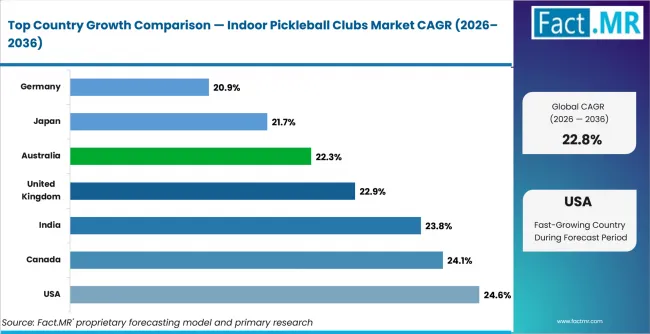
Indoor Pickleball Clubs Market Cagr Analysis By Country | Source: Fact.MR
What powers the United States lead?
24.6% CAGR, supported by club-chain scale and a deep player base.
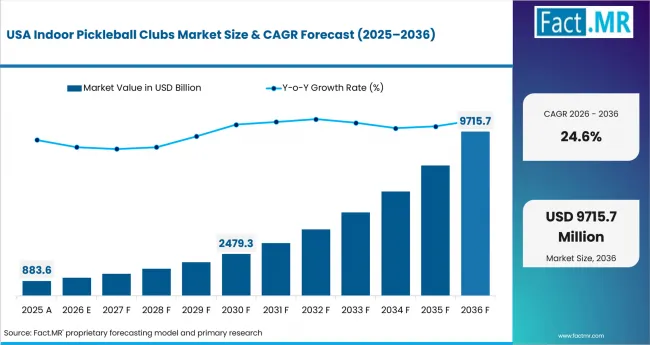
Indoor Pickleball Clubs Market Country Value Analysis | Source: Fact.MR
The United States has the clearest commercial path because participation and private facility chains are both visible. USA Pickleball reported 144 sanctioned tournaments in 2025 and 1,864 ambassadors promoting the sport nationwide. That organized base feeds leagues, coaching and local club referrals. The United States is projected to record a 24.6% CAGR through 2036, supported by franchise openings and repeat member use.
Why does Canada matter?
24.1% CAGR, supported by national membership depth and franchise entry.
Canadian buyers are moving from seasonal play toward indoor access because winter limits outdoor court reliability. Pickleball Canada reached 93,888 paid members in 2025, supporting demand for indoor access in winter-heavy markets. The Picklr expansion plan for Canada gives venue developers a franchised path into major provinces. Canada is expected to expand at 24.1% CAGR through 2036, supported by member density and weather-proof play. Retail sales from connected rackets and related accessories are expected to follow club traffic rather than drive the first lease decision.
How is India opening a club pathway?
23.8% CAGR, supported by franchise rights and racket-sport familiarity.
India is at an earlier club stage, but badminton and tennis habits make the format easier to explain to urban consumers. The All India Pickleball Association states that active participation is spread across 24 states and includes more than 10,000 players. Pickleball Kingdom announced India franchising in November 2025. Pickleball Kingdom named Delhi NCR and Maharashtra among its target regions, with other major states also included in the India franchise plan. India is forecast to grow at 23.8% CAGR through 2036, as early clubs test pricing in dense urban neighborhoods.
What supports the United Kingdom outlook?
22.9% CAGR, supported by club settings and recognition work.
United Kingdom development is shaped by sport halls, leisure trusts and private centers rather than one large club chain. Pickleball England reported that 41,500 people had taken part in the last 28 days in the 2023 to 2024 Active Lives view. The same update pointed to more than 640 settings across England. The United Kingdom is expected to advance at 22.9% CAGR through 2036, because indoor courts can be added to existing leisure venues before dedicated clubs scale.
Why is Australia commercially relevant?
22.3% CAGR, supported by venues and affiliate networks.
Australia has a broader participation base than its dedicated club count suggests. Pickleball Australia cites more than 155,000 casual players. It also cites over 500 venues and 299 dedicated affiliates. That base gives operators room to test memberships in Brisbane and Sydney. Melbourne and Perth provide additional city clusters. Australia is projected to rise at 22.3% CAGR through 2036, and gives distributors account opportunities as clubs formalize purchasing.
How does Japan create an overseas franchise route?
21.7% CAGR, supported by indoor-sport culture and franchise testing.
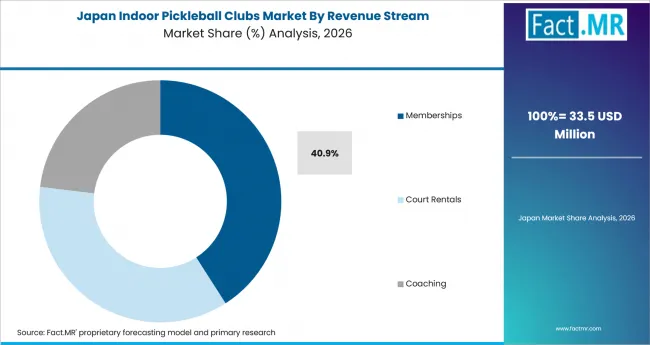
Indoor Pickleball Clubs Market Japan Market Share Analysis By Revenue Stream | Source: Fact.MR
Japan is important because indoor sports and booked court systems already fit urban consumer behavior. The Picklr lists Japan as an international franchise region on its official franchise page. The country lacks the same open-club count as the United States, so early revenue depends on a smaller set of higher-service venues. Japan is forecast at 21.7% CAGR through 2036, as operators prove whether member pricing works in dense city sites.
What makes Germany part of the country view?
20.9% CAGR, supported by European federation growth and sports-club infrastructure.
Germany is not yet a high-count dedicated club market, but it has organized sports clubs and a clear route for indoor hall use. The Global Pickleball Federation reported 76 member countries in 2025, up from 54 in 2024. That broader federation base helps suppliers and event organizers build a European calendar. Germany is expected to post 20.9% CAGR through 2036, although a slower franchise pipeline keeps its rate below North America.
Who leads the indoor pickleball clubs landscape?
The Picklr, Pickleball Kingdom and Dill Dinkers lead through franchise scale. Life Time and Chicken N Pickle add club and hospitality routes.
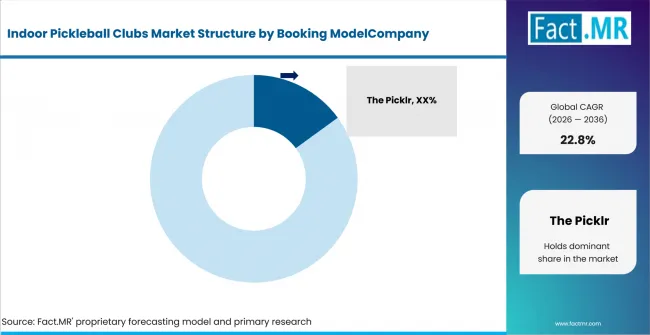
Indoor Pickleball Clubs Market Analysis By Company | Source: Fact.MR
Competition is split between dedicated indoor franchise chains and multi-activity venues. The Picklr competes on franchise depth and real estate systems. Its higher-service club layout and member programming also matter. Pickleball Kingdom competes through awarded territories and international expansion. Dill Dinkers is building a more community-led indoor franchise model with smaller footprints in several states.
Capability matters because a club must sell memberships before the first full operating month. Buyers compare sound treatment and court surface first. Booking software, coaching depth and food service permits follow. Suppliers of functional fitness equipment face a similar facility-test problem, because the equipment only works commercially when member programming keeps rooms active.
Venue economics create a barrier for smaller operators. Large rent commitments require clear evidence on utilization and churn. Staffing and event revenue are also checked. The Picklr claims annual membership churn of less than 1% on its franchise page, which is a useful benchmark for operators that need lender and landlord confidence.
Food and beverage operators compete differently because court time supports social dwell time. Chicken N Pickle publishes location-level indoor court counts and hourly rates, which makes its model easier for groups to understand before booking. Rally uses craft beverages, coffee and private event service to raise spend per visit. The same experience-led logic appears in yoga equipment settings, where recurring classes create more reliable revenue than occasional equipment replacement.
Providers with real estate discipline and repeat programming should be better placed through 2036. Larger chains can standardize construction and software. Member onboarding and instructor training can then be repeated across sites. Local clubs can still compete when they control property, know the player community and keep off-peak courts active through clinics and corporate events.
Which companies are the key players?
The Picklr, Pickleball Kingdom and Dill Dinkers are key players. Ace Pickleball Club and Life Time are also profiled. Chicken N Pickle and Rally complete the company set.
- The Picklr
- Pickleball Kingdom
- Dill Dinkers
- Ace Pickleball Club
- Life Time
- Chicken N Pickle
- Rally
Bibliography
- [1] Sports & Fitness Industry Association. (2026). U.S. pickleball participation statistics: Growth & market report.
- [2] Sports & Fitness Industry Association. (2025, February 27). SFIA’s Topline Report shows 247.1 million Americans were active in 2024.
- [3] USA Pickleball. (2026, January 30). Annual growth reports.
- [4] USA Pickleball. (2026, February 4). USA Pickleball announces expanded path to nationals for 2026.
- [5] Pickleball Canada. (2026, May 28). Pickleball Canada’s annual report—2025.
- [6] Pickleball Canada. (2025, February 4). Pickleball in Canada—January 2025 survey.
- [7] Pickleball England. (2026, January 4). Final 2025 Annual General Meeting report.
- [8] Pickleball Australia. (2025, November 5). Pickleball Australia serves up a fresh new look and bold vision for the future.
- [9] Pickleball Australia. (2026). We dink different.
- [10] Global Pickleball Federation. (2026, January 30). Global Pickleball Federation 2025 milestones.
- [11] The Picklr. (2026). Join The Picklr: Start your indoor pickleball franchise now.
- [12] Jones Lang LaSalle IP, Inc. (2025, February 3). JLL tapped to lead global expansion for The Picklr.
- [13] Pickleball Kingdom. (2025, November 12). Pickleball Kingdom India.
- [14] Life Time Group Holdings, Inc. (2025, October 20). Lea Jansen and Christopher Haworth crowned champions at Life Time’s inaugural LT Open, each taking home $50,000.
- [15] Dill Dinkers. (2025, April 7). Dill Dinkers pickleball picks this Freehold Township shopping center for first NJ location.
- [16] Chicken N Pickle. (2026). What’s pickleball?
This Report Addresses
- Strategic intelligence on indoor pickleball clubs across revenue stream and venue format. Customer type and booking model are also covered.
- Segment analysis covers Memberships and Franchise Clubs. It also covers 8 to 12 Courts. Adult Players and Open Play complete the segment view.
- Regional outlook covers the United States and Canada. India and the United Kingdom are included. Australia, Japan and Germany complete the country view.
- Competitive analysis covers The Picklr and Pickleball Kingdom. Dill Dinkers is also profiled. Ace Pickleball Club and Life Time are also included. Chicken N Pickle and Rally complete the company set.
- Service assessment covers open play and lessons. Leagues and tournaments are included. Corporate events and food service are also assessed.
- Operating assessment covers site selection and sound control. Software booking and coaching programs are included. Off-peak utilization is also reviewed.
- Source-led market sizing uses participation data and venue counts. Court density and franchise disclosures were reviewed. Official company pages were checked.
What does the indoor pickleball clubs market cover?
Dedicated indoor venues that sell court access and memberships. Leagues and lessons are included. Tournaments and food and beverage service are also included.
The indoor pickleball clubs market covers private and commercial venues where pickleball is the main reason for customer visits. It includes memberships and court rental. Coaching, leagues and tournaments are included. Private events, food service and pro-shop revenue are also covered. The scope also includes franchise fees and managed club services tied to indoor venue operation.
What is included in the scope?
Dedicated courts and member programs. Coaching and social play are included. Corporate events and venue-level services are also included.
The scope includes indoor clubs with permanent courts and recurring player programs. It covers franchised clubs and independent clubs. Fitness-club pickleball zones and social venues are included when indoor pickleball is a repeat-use service. It also includes technology fees when the booking system supports member ratings and leagues. Court utilization is included when the same system handles reservations.
What is excluded from the scope?
Outdoor public courts, equipment sales that are not tied to club access and general gym memberships that do not include dedicated pickleball revenue.
The scope excludes municipal outdoor courts and temporary event courts that do not generate recurring club revenue. It excludes paddles, shoes and balls sold through retail channels unless sold inside a club. It also excludes tennis club revenue when pickleball is a small add-on and cannot be separated from general racquet membership.
How was the analysis built?
100+ sources and 40+ company or association pages. 25+ countries were checked with 18+ interviews.
- Primary Research:
- Interviews covered club owners and franchise developers. Real estate advisors and equipment distributors were also included. Player coaches and corporate-event buyers added the customer view.
- Desk Research:
- Desk research reviewed association participation releases and club location pages. Franchise pages and company newsrooms were checked. Official sport-body documents added participation context.
- Market-Sizing and Forecasting:
- Forecasting used venue counts and court counts. Average monthly revenue per court and member conversion assumptions supported the model. The model was reconciled against franchise pipelines and disclosed club pricing.
- Data Validation and Update Cycle:
- Estimates were checked against Sports & Fitness Industry Association participation data. USA Pickleball court counts were reviewed with The Picklr franchise metrics. Pickleball Kingdom location awards added a second franchise check.
Segmentation
What is the report’s scope and coverage?
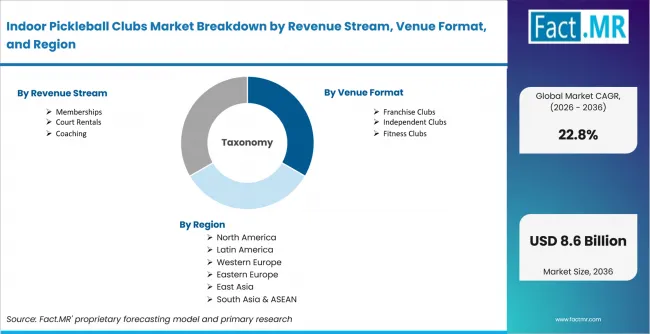
Indoor Pickleball Clubs Market Breakdown By Revenue Stream, Venue Format, And Region | Source: Fact.MR
| Attribute | Details |
|---|---|
| Quantitative Units | USD Billion in 2026 to USD Billion by 2036 at CAGR |
| Market Definition | Dedicated indoor pickleball venues that sell court access, memberships, coaching, leagues, events and venue services |
| Revenue Stream | Memberships, Court Rentals, Coaching, Leagues, Events, Food Service |
| Venue Format | Franchise Clubs, Independent Clubs, Fitness Clubs, Social Venues, School Facilities |
| Court Count | 4 to 7 Courts, 8 to 12 Courts, 13 to 20 Courts, 20+ Courts |
| Customer Type | Adult Players, Youth Players, Corporate Groups, Senior Players, League Teams |
| Service Offering | Open Play, Lessons, Leagues, Tournaments, Private Events |
| Location Type | Retail Boxes, Fitness Centers, Mixed-Use Sites, University Sites, Community Centers |
| Booking Model | App Reservations, Membership Access, Drop-In Play, Corporate Booking |
| Regions Covered | North America, Europe, Asia Pacific, Latin America, Middle East and Africa |
| Countries Covered | United States, Canada, India, United Kingdom, Australia, Japan and Germany |
| Key Companies Profiled | The Picklr, Pickleball Kingdom, Dill Dinkers, Ace Pickleball Club, Life Time, Chicken N Pickle and Rally |
| Forecast Period | 2026 to 2036 |
| Approach | Hybrid top-down and bottom-up approach using venue counts, court density, membership pricing, franchise pipelines and company validation |
Source: Fact.MR analysis. Updated Jun 23, 2026
How is the market segmented?
-
By Revenue Stream:
- Memberships
- Court Rentals
- Coaching
- Leagues
- Events
- Food Service
-
By Venue Format:
- Franchise Clubs
- Independent Clubs
- Fitness Clubs
- Social Venues
- School Facilities
-
By Court Count:
- 4 to 7 Courts
- 8 to 12 Courts
- 13 to 20 Courts
- 20+ Courts
-
By Customer Type:
- Adult Players
- Youth Players
- Corporate Groups
- Senior Players
- League Teams
-
By Service Offering:
- Open Play
- Lessons
- Leagues
- Tournaments
- Private Events
-
By Location Type:
- Retail Boxes
- Fitness Centers
- Mixed-Use Sites
- University Sites
- Community Centers
-
By Booking Model:
- App Reservations
- Membership Access
- Drop-In Play
- Corporate Booking
-
By Region:
- North America
- United States
- Canada
- Mexico
- Latin America
- Brazil
- Argentina
- Rest of Latin America
- Europe
- Germany
- United Kingdom
- France
- Italy
- Spain
- Rest of Europe
- Asia Pacific
- China
- India
- Japan
- South Korea
- Australia
- ASEAN
- Middle East & Africa
- GCC Countries
- South Africa
- UAE
- Rest of Middle East & Africa
- North America
Frequently Asked Questions
How is the Indoor Pickleball Clubs Market positioned?
What is the long-term outlook for the Indoor Pickleball Clubs Market?
Why is the Indoor Pickleball Clubs Market expected to grow?
Which revenue stream supports the club model?
What venue format is preferred by operators?
Which country shows the strongest expansion path?
How is Canada developing in this market?
How is India contributing to market development?
What role does the United Kingdom play in market expansion?
What is the main factor driving market expansion?
What is the primary challenge facing the market?
Which companies are shaping the indoor club model?
Who worked on this report


Preview the report firsthand - request a free sample
Free SampleGet the brochure for pricing and purchase details
Download PDF