
- Market Value (2025): USD 440.0 Mn
- Estimated Value (2026): USD 459.8 Mn
- Forecast Value (2036): USD 785.4 Mn
- CAGR (2026-2036): 5.5%
Industrial Dissolved Oxygen Analyzers Market Forecast and Outlook 2026 to 2036
As per the Fact.MR analysis, the industrial dissolved oxygen analyzer market was valued at USD 440.0 million in 2025 and is projected to grow from USD 459.8 million in 2026 to USD 785.4 million by 2036. Demand for industrial dissolved oxygen analyzers is likely to grow at a CAGR of 5.5% over the forecast period.
Demand for industrial dissolved oxygen analyzers is rising as wastewater plants, power stations, food producers and chemical sites monitor oxygen to control aeration energy, limit corrosion and protect product quality. The key players are offering optical luminescent, amperometric and galvanic sensors with digital outputs, self-diagnostics and low-maintenance designs.
Key Takeaways from the Industrial Dissolved Oxygen Analyzers Market
- Industrial Dissolved Oxygen Analyzers Market Value (2025): USD 440.0 million
- Industrial Dissolved Oxygen Analyzers Market Value (2026): USD 459.8 million
- Industrial Dissolved Oxygen Analyzers Market Forecast Value (2036): USD 785.4 million
- Industrial Dissolved Oxygen Analyzers Market Forecast CAGR (2026-2036): 5.5%
- Leading Technology: Optical luminescent (48.0%)
- Key Market Participants: Hach, Endress+Hauser, Mettler-Toledo, Emerson, Yokogawa
- Key Growth Countries: India, China, South Korea, United Kingdom, United States
Efforts to reduce aeration energy in wastewater treatment and to tighten corrosion control in boilers are expected to keep demand growing, with optical sensors replacing membrane-based probes in many sites. Growing investment in wastewater treatment infrastructure, rising energy-efficiency requirements and stricter industrial water-quality management are expected to strengthen demand for dissolved oxygen sensors through 2036. India's Ministry of Housing and Urban Affairs reported in March 2026 that the country had an installed sewage treatment capacity of 36,048 million litres per day (MLD), highlighting the expanding infrastructure requiring continuous monitoring and process optimization. The Bureau of Energy Efficiency also identifies dissolved oxygen sensors and automated aeration control as opportunities to reduce wastewater treatment energy consumption, with potential savings of around 20% in documented applications. These developments are encouraging treatment operators to adopt optical sensors for more reliable oxygen measurement, lower maintenance and improved process control, while industrial boiler operators increasingly require accurate water-quality monitoring to manage corrosion risks.
Industrial Dissolved Oxygen Analyzers Market
| Metric | Value |
|---|---|
| Estimated Value in (2026) | USD 459.8 million |
| Forecast Value in (2036) | USD 785.4 million |
| Forecast CAGR (2026 to 2036) | 5.5% |
Source: Fact.MR analysis.
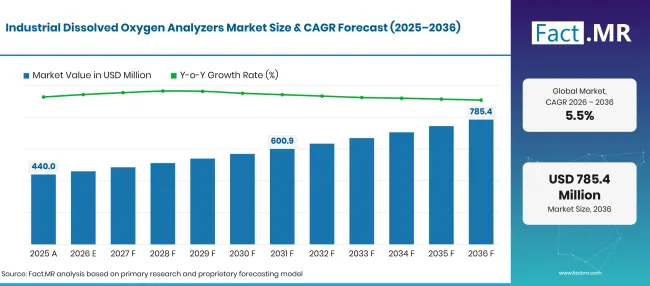
Industrial Dissolved Oxygen Analyzers Market Forecast Global | Source: Fact.MR
Category
| Category | Segments |
|---|---|
| Technology | Optical luminescent, Amperometric, Galvanic, Ultra-trace ppb analyzers |
| Application | Wastewater aeration control, Power generation feedwater, Municipal drinking water, Food and beverage, Chemicals and petrochemicals |
| Installation | Immersion and insertion probe, Flow-through cell, Retractable assembly, Sample-line panel |
| Output | Digital fieldbus and Ethernet, Analog 4-20 mA, HART, Wireless |
| Region | India; China; South Korea; United Kingdom; United States |
Source: Fact.MR analysis.
Segmental Analysis
What is accelerating optical luminescent analyzer demand in the Industrial Dissolved Oxygen Analyzers Market?
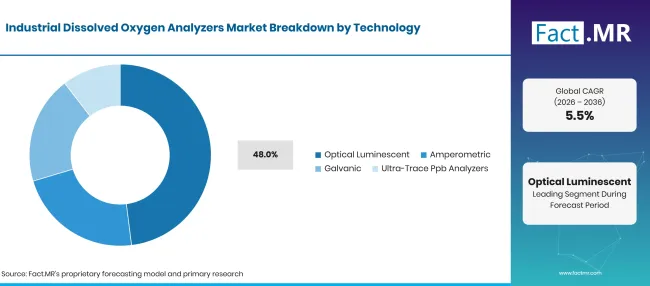
Industrial Dissolved Oxygen Analyzers Market Breakdown Technology | Source: Fact.MR
Demand for optical luminescent analyzers account for 48.0% of market revenue in 2026, manufacturers USD 220.7 million, as wastewater operators and industrial facilities increasingly prioritize continuous oxygen measurement with lower maintenance requirements. India's Ministry of Jal Shakti reported in April 2026 that 18 sewage treatment projects added 538.03 million litres per day (MLD) of treatment capacity during FY 2025–26. Expanding treatment infrastructure creates opportunities for optical analyzers that eliminate membrane and electrolyte replacement, reduce calibration requirements and provide reliable dissolved oxygen readings. These advantages support procurement by municipal treatment operators and industrial water-management facilities.
Which wastewater treatment requirements are increasing aeration control analyzer sales?
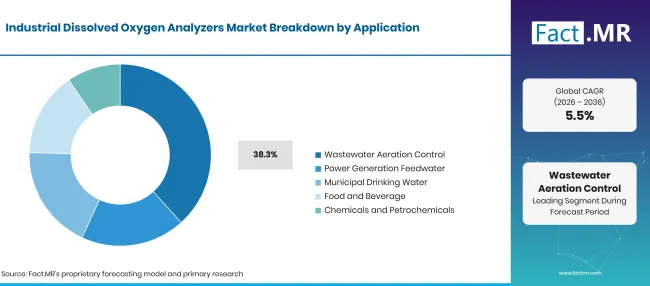
Industrial Dissolved Oxygen Analyzers Market Breakdown Application | Source: Fact.MR
Sales of wastewater aeration control represents 38.3% of market revenue in 2026, manufacturers USD 176.1 million, as treatment operators seek accurate dissolved oxygen measurements to regulate blower operation and maintain biological treatment efficiency. India's Ministry of Jal Shakti reported in August 2026 that Namami Gange had generated 4,263 MLD of sewage treatment capacity by June 2026. The expansion of operational treatment infrastructure increases the importance of continuous oxygen monitoring across activated-sludge processes. Operators are increasingly interested in analyzer systems that support automated aeration adjustment, reduce unnecessary energy consumption and maintain treatment performance against wastewater discharge requirements.
How are direct measurement requirements supporting immersion and insertion probe demand?
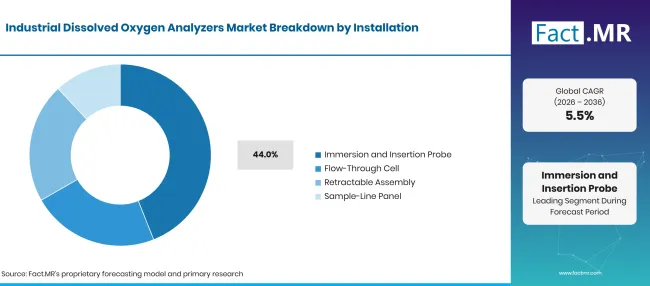
Industrial Dissolved Oxygen Analyzers Market Breakdown Installation | Source: Fact.MR
Demand for immersion and insertion probes holds 44.0% of market revenue in 2026, manufacturers USD 202.3 million, as wastewater plants, chemical facilities and industrial processing units require continuous dissolved oxygen measurements directly inside tanks, aeration basins and pipelines. The Ministry of Jal Shakti reported in March 2026 that 173 sewage treatment plants under the Namami Gange Programme were operational as of January 2026. This installed infrastructure supports demand for probes that can withstand continuous operation and simplify routine maintenance. The key players are targeting treatment facilities with retractable assemblies, corrosion-resistant probe housings and installation arrangements suited to different process environments.
What is encouraging the adoption of digital fieldbus and Ethernet outputs in industrial oxygen analyzers?
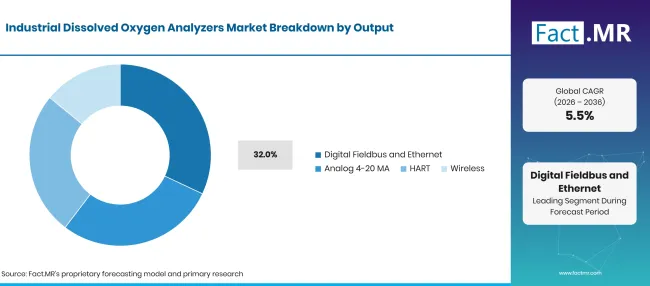
Industrial Dissolved Oxygen Analyzers Market Breakdown Output | Source: Fact.MR
Sales of digital fieldbus and Ethernet outputs to capture 32.0% of market revenue in 2026, manufacturers USD 147.1 million, as industrial operators increasingly connect dissolved oxygen analyzers with distributed control systems, programmable logic controllers and centralized monitoring platforms. India's Ministry of Jal Shakti announced in July 2026 that the National Mission for Clean Ganga was using Ganga Pulse and online continuous effluent monitoring systems to monitor sewage treatment plant performance. Its GIS-enabled Drain Dashboard also supports monitoring of sewage outfalls and industrial discharges. Such digital monitoring initiatives strengthen demand for analyzers offering network connectivity, remote diagnostics and continuous transmission of process measurements.
Industrial Dissolved Oxygen Analyzers Market-Drivers, Restraints & Trends
Drivers:
Wastewater Treatment and Industrial Oxygen Monitoring -: Demand for industrial dissolved oxygen analyzers is rising as wastewater operators use oxygen control to cut aeration energy and as power and process plants monitor feedwater oxygen to limit corrosion. Demand for industrial dissolved oxygen analyzers is supported by expanding wastewater treatment infrastructure and the need for continuous process monitoring. India's Ministry of Jal Shakti reported that the Namami Gange Programme added 538.03 million litres per day (MLD) of sewage treatment capacity through 18 projects during FY 2025–26. Additionally, 28 sewage treatment plants were completed during the year, compared with 22 in the previous year. The government also reported cumulative treatment capacity creation of approximately 4,263 MLD by June 2026. Increasing treatment infrastructure creates opportunities for dissolved oxygen monitoring in biological treatment processes, particularly aeration control and wastewater quality management.
Restraints:
Sensor Maintenance, Calibration and Operating Costs -: Sales is constrained by sensor fouling and calibration needs in harsh process streams, by the cost of premium optical systems and by the long service life of installed instruments. Maintenance requirements and calibration procedures remain important considerations for industrial dissolved oxygen analyzer installations, particularly in wastewater and demanding process environments. A Delhi Pollution Control Committee government report dated October 2026 recorded that Delhi operated 37 sewage treatment plants with an installed capacity of 3,700 MLD, while actual treatment utilization reached 3,374.59 MLD. The report identified 10 non-complying plants among the operational facilities assessed. These findings demonstrate continuing operational and performance-management challenges across wastewater infrastructure. For analyzer suppliers, maintaining measurement reliability requires suitable sensor maintenance, calibration protocols and servicing arrangements, which can increase the operating burden for treatment facilities.
Opportunity: Optical Sensors Replace Membrane Probes
The opportunity for optical dissolved oxygen analyzers is supported by increasing government attention to measurement accuracy and sensor calibration infrastructure. India's Central Water and Power Research Station (CWPRS), under the Ministry of Jal Shakti, provides a dedicated testing and calibration facility for water-quality sensors. Its official specifications include dissolved oxygen measurement over a range of 0–12 mg/L, with a resolution of 0.01 mg/L and accuracy of ±0.1 mg/L or 1% of the reading. The facility also uses NIST-traceable calibration solutions and automated testing equipment. This infrastructure highlights the importance of reliable DO measurement and creates a relevant technology-validation environment for advanced optical sensor manufacturers.
Trend: Connected and Self-Diagnosing Sensors
Digital sensors that store calibration data and report faults to the plant network are being adopted to reduce site visits and downtime. Digital monitoring and connected measurement systems are gaining importance in India's industrial environmental-monitoring framework. According to the Central Pollution Control Board, approximately 6,400 industrial units have installed Online Continuous Emission and Effluent Monitoring Systems (OCEMS), transmitting data through approximately 38,000 monitoring devices at 15-minute intervals. The system enables real-time data transfer, automated exceedance alerts and monitoring by regulatory authorities. CPCB has also directed sewage treatment plants to install online monitoring analyzers. This regulatory infrastructure supports opportunities for connected dissolved oxygen instruments with digital communication, automated reporting, calibration records and diagnostic capabilities in industrial wastewater applications.
Industrial Dissolved Oxygen Analyzers Market Analysis by Key Country
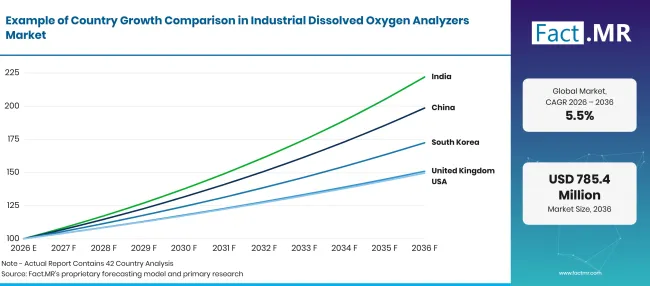
Industrial Dissolved Oxygen Analyzers Market Growth Index | Source: Fact.MR
| Country | CAGR (2026-2036) |
|---|---|
| India | 8.3% |
| China | 7.1% |
| South Korea | 5.6% |
| United Kingdom | 4.2% |
| United States | 4.1% |
Source: Fact.MR analysis.
Why is India the fastest-growing market for industrial dissolved oxygen analyzers?
Demand for industrial dissolved oxygen analyzers in India is forecast to rise at an 8.3% CAGR through 2036, the fastest among the five countries.
Rapid expansion of municipal and industrial wastewater treatment, together with growing power and process capacity, supports demand for water-quality instruments. India's industrial dissolved oxygen analyzers market is the fastest among the five profiled countries. Expansion of municipal sewage treatment, industrial effluent management and process-water monitoring is increasing demand for continuous oxygen measurement. According to the Ministry of Jal Shakti, the Namami Gange programme added 538 MLD of sewage treatment capacity during FY 2025–26, taking cumulative capacity to approximately 4,260 MLD. This infrastructure expansion creates opportunities for online dissolved oxygen analyzers used to monitor biological treatment, aeration efficiency and wastewater quality across municipal and industrial treatment facilities.
What is driving industrial dissolved oxygen analyzers demand in China?
Sales of industrial dissolved oxygen analyzers in China is likely to increase at a 7.1% CAGR through 2036, above the global rate of 5.5%.
Large investment in wastewater, power and industrial water treatment, along with tighter discharge standards, supports demand for online analyzers. China's industrial dissolved oxygen analyzers market is forecast to expand as investments in wastewater treatment, industrial pollution control and water-resource management are strengthening demand for continuous water-quality monitoring instruments. China's National Bureau of Statistics reported that urban sewage treatment reached 98.9% in 2024, while investment in wastewater treatment for traditional industrial pollution control increased 106.4% compared with 2021. These figures were reported in a government assessment published in June 2026. Expansion and upgrading of treatment infrastructure support analyzer requirements for aeration control, biological treatment and industrial discharge monitoring.
What is shaping industrial dissolved oxygen analyzers demand in South Korea?
Demand for industrial dissolved oxygen analyzers in South Korea is expected to advance at a 5.6% CAGR through 2036, above the global rate of 5.5%.
Semiconductor, chemical and power industries need tight water-quality control, which supports demand for high-accuracy online oxygen measurement. Semiconductor fabrication, chemical processing and power generation require controlled water quality across production and wastewater treatment operations. In June 2026, South Korea's Ministry of Climate, Energy and Environment announced a water-supply plan for a new southwestern semiconductor complex with projected daily water requirements of 650,000 tonnes. The plan also identifies reclaimed wastewater as a potential source of general process water. These large-scale industrial water requirements create opportunities for online dissolved oxygen measurement in treatment, recycling and process-water management systems.
How is demand for industrial dissolved oxygen analyzers developing in United Kingdom?
Sales of industrial dissolved oxygen analyzers in United Kingdom is set to expand at a 4.2% CAGR through 2036, below the global rate of 5.5%.
Ageing water-treatment assets in need of upgrades and a focus on energy-efficient aeration encourage replacement of older sensors with optical designs. Demand is supported by wastewater infrastructure upgrades, tighter environmental monitoring requirements and the replacement of ageing treatment equipment. According to the Environment Agency's November 2026 environmental performance report, water and sewerage companies in England have a record £91.95 billion investment allocation for 2025–2030, including £50.45 billion for wastewater. This spending supports improvements to treatment facilities, discharge monitoring and operational efficiency, creating opportunities for dissolved oxygen analyzers used in biological treatment and aeration-control applications.
Why is growth slower for industrial dissolved oxygen analyzers in United States?
Demand for industrial dissolved oxygen analyzers in United States is projected to grow at a 4.1% CAGR through 2036, the slowest among the five countries.
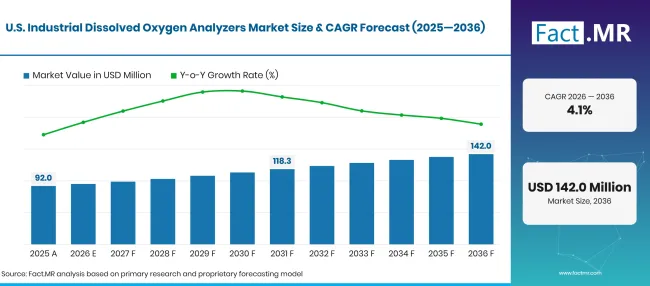
Industrial Dissolved Oxygen Analyzers Market Forecast Usa | Source: Fact.MR
A well-established water and process-instrumentation base supports steady replacement demand and a gradual shift to digital sensors. An established wastewater-treatment and process-instrumentation market generates recurring replacement demand, while modernization projects support gradual adoption of digital and optical measurement technologies. The US Environmental Protection Agency's 2026 Office of Inspector General report reiterated that clean-water infrastructure requires approximately USD 630 billion over 20 years, based on its latest comprehensive needs assessment. Although this represents a substantial modernization opportunity, established treatment infrastructure, procurement cycles and replacement-led purchasing patterns moderate incremental analyzer demand.
Competitive Landscape for Industrial Dissolved Oxygen Analyzers Market
The industrial dissolved oxygen analyzer market is relatively concentrated, with Hach, Endress+Hauser, Mettler-Toledo, Emerson and Yokogawa together hold about 63% of 2026 revenue, based on Fact.MR estimates. Competition centers on sensor accuracy, drift and maintenance interval, digital connectivity and local service. Established process-instrumentation groups lead, with specialist water-analysis companies competing in wastewater and drinking-water applications.
Recent Developments
- In April 17, 2025, Emerson introduced the Rosemount 490A, a digital Modbus-enabled optical dissolved oxygen sensor for industrial applications. The product uses luminescence-quenching technology and supports water and wastewater treatment, biopharmaceutical manufacturing, food processing and steam power generation.
- In 2025, Hach introduced the LDO sc Model 2 as an addition to its dissolved oxygen monitoring portfolio. The optical luminescent sensor is designed to simplify wastewater oxygen monitoring and reduce maintenance requirements.
- In 2026, Mettler-Toledo's OptiOx portfolio adds an optical dissolved oxygen sensor and portable measurement devices. Its technology uses optical measurement to provide stable readings without consuming oxygen in the sample.
Key Players in Industrial Dissolved Oxygen Analyzers Market
Key Companies: Hach, Endress+Hauser, Mettler-Toledo, Emerson, and Yokogawa.
- Hach
- Endress+Hauser
- Mettler-Toledo
- Emerson
- Yokogawa
About The Report
- Industrial Dissolved Oxygen Analyzers Market Forecast and Outlook 2026 to 2036
- Industrial Dissolved Oxygen Analyzers Market
- Category
- Segmental Analysis
- Industrial Dissolved Oxygen Analyzers Market-Drivers, Restraints & Trends
- Industrial Dissolved Oxygen Analyzers Market Analysis by Key Country
- Competitive Landscape for Industrial Dissolved Oxygen Analyzers Market
Bibliography
- Bureau of Energy Efficiency. (n.d.). Paper sector energy efficiency report: Dissolved oxygen sensor and ETP blower optimization. Government of India.
- Central Pollution Control Board. (n.d.). Online monitoring system factsheet. Government of India.
- Central Water and Power Research Station. (n.d.). Water quality sensor testing and calibration. Government of India.
- Delhi Pollution Control Committee. (2026, August). Monthly progress report: August 2026. Government of NCT of Delhi.
- Emerson. (2025, April). Emerson's new digital dissolved oxygen sensor enhances operational versatility with lower maintenance costs. Official company announcement.
- Hach. (n.d.). LDO 2 sc process sensor for dissolved oxygen. Official product page.
- Ministry of Housing and Urban Affairs. (2026, March 16). Sewage generation and treatment capacity in urban areas. Government of India.
- Ministry of Jal Shakti. (2026, April 21). NMCG powers capacity growth and infrastructure milestones in FY 2025–26. Press Information Bureau, Government of India.
- Ministry of Jal Shakti. (2026, July 30). Promotion of digital technologies in water resources management. Press Information Bureau, Government of India.
- Ministry of Jal Shakti. (2026, August 6). Projects under Namami Gange Mission. Press Information Bureau, Government of India.
- Ministry of Jal Shakti. (2026, March 16). Status of STPs, expansion of river cleaning, LiDAR mapping and e-flow compliance. Press Information Bureau, Government of India.
Segmentation
Scope of Report
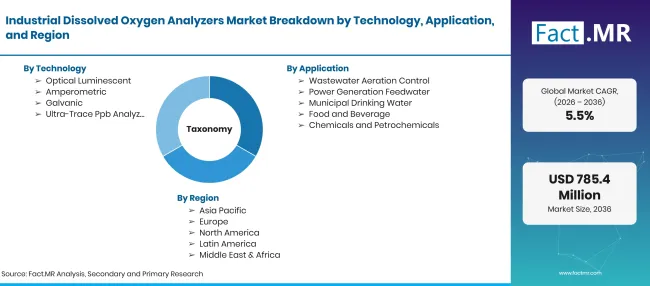
Industrial Dissolved Oxygen Analyzers Market Taxonomy | Source: Fact.MR
| Items | Values |
|---|---|
| Quantitative Units (2026) | USD 459.8 Million |
| Technology | Optical luminescent, Amperometric, Galvanic, Ultra-trace ppb analyzers |
| Application | Wastewater aeration control, Power generation feedwater, Municipal drinking water, Food and beverage, Chemicals and petrochemicals |
| Installation | Immersion and insertion probe, Flow-through cell, Retractable assembly, Sample-line panel |
| Output | Digital fieldbus and Ethernet, Analog 4-20 mA, HART, Wireless |
| Regions Covered | North America, Latin America, Europe, Asia Pacific, Middle East & Africa |
| Countries Covered | India, China, South Korea, United Kingdom, United States, and other countries |
| Key Companies Profiled | Hach, Endress+Hauser, Mettler-Toledo, Emerson, Yokogawa |
| Additional Attributes | Dollar revenue in the Industrial Dissolved Oxygen Analyzers Market is segmented by technology, application, installation and output and region. |
Source: Fact.MR analysis.
Industrial Dissolved Oxygen Analyzers Market by Segments
-
Technology
- Optical luminescent
- Amperometric
- Galvanic
- Ultra-trace ppb analyzers
-
Application
- Wastewater aeration control
- Power generation feedwater
- Municipal drinking water
- Food and beverage
- Chemicals and petrochemicals
-
Installation
- Immersion and insertion probe
- Flow-through cell
- Retractable assembly
- Sample-line panel
-
Output
- Digital fieldbus and Ethernet
- Analog 4-20 mA
- HART
- Wireless
-
Region:
- North America
- United States
- Canada
- Mexico
- Europe
- Germany
- United Kingdom
- France
- Italy
- Spain
- Rest of Europe
- Asia Pacific
- China
- India
- Japan
- South Korea
- Australia and New Zealand
- Rest of Asia Pacific
- Latin America
- Brazil
- Argentina
- Rest of Latin America
- Middle East & Africa
- GCC Countries
- South Africa
- Rest of Middle East & Africa
- North America
Table of Contents
Key Takeaways
- Market Size and CAGR
- Top Growth Driver
- Fastest Growing Segment
- Leading Region
- Key Companies
- Emerging Opportunities

