- Market Value (2025): USD 1.8 Bn
- Estimated Value (2026): USD 1.89 Bn
- Forecast Value (2036): USD 3.0 Bn
- CAGR (2026-2036): 4.7%
What is the Industrial Indoor Overhead Cranes Market forecast to be worth by 2036?
USD 1.9 billion in 2026 to USD 3.0 billion by 2036 at a 4.7% CAGR.
- The industrial indoor overhead cranes market was valued at USD 1.8 billion in 2025, with demand concentrated in plants that move heavy parts between machining, assembly and dispatch.
- Revenue will grow from USD 1.89 billion in 2026 to USD 3.0 billion by 2036 as manufacturers, vehicle makers and warehouse operators renew their in-plant lifting equipment.
- A 4.7% CAGR reflects a mix of new crane bays in fresh factory buildings and steady replacement of older cranes in established plants.
| Year | Basis | Market Value (USD billion) |
|---|---|---|
| 2025 | Actual | 1.8 |
| 2026 | Estimate | 1.89 |
| 2036 | Forecast | 3.0 |
| CAGR 2026 to 2036 | Forecast period | 4.7% |
Source: Fact.MR analysis. Updated Nov 13, 2026
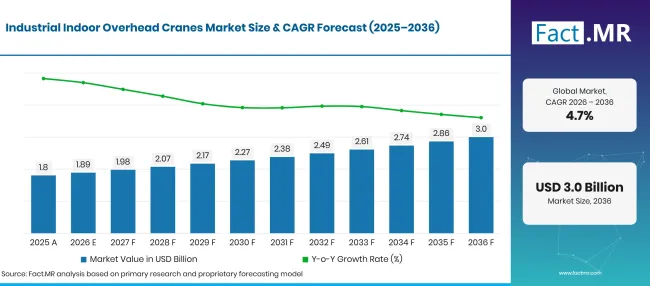
Industrial Indoor Overhead Cranes Market Forecast Global | Source: Fact.MR
What are the defining numbers behind Industrial Indoor Overhead Cranes Market growth?
New value of USD 1.1 billion will be added between 2026 and 2036, led by automated material handling, automotive plant work and the modernization of ageing crane fleets.
- Demand Drivers in the Market
- Workplace safety is pushing plants to retire worn lifting gear and adopt cranes with overload protection and controlled braking. The U.S. Bureau of Labor Statistics recorded 756 fatal contact incidents at work in 2024, including 357 deaths from being struck by an object or equipment.
- New industrial buildings create demand for runway beams and crane bays planned in at the design stage. U.S. nonresidential construction spending stood at a seasonally adjusted annual rate of USD 790.6 billion in September 2026.
- Vehicle and component plants need repeated lifts of dies, engines and body assemblies, which keeps crane utilization high across stamping and assembly lines.
- Warehouse operators are adding overhead lifting to handle bulky goods while keeping aisles clear for people and vehicles.
- Automation projects are lifting interest in cranes with radio control, anti-sway functions and automated positioning that link to plant control systems.
- Key Segments Analyzed
- By Product Type: Double Girder will hold 38.4% share in 2026, since its two-beam bridge carries heavier loads and higher hook heights than single girder designs.
- By Application: Manufacturing will account for 34.7% of 2026 value as plants move raw stock, machine parts and finished goods between production stages.
- By End-User Industry: Automotive will capture 27.2% in 2026, given the constant handling of dies, engines and body assemblies in vehicle plants.
- By Capacity: 10-20 Tons will take 28.7% of 2026 sales, owing to its fit with the medium to heavy loads found in most fabrication and assembly halls.
- Analyst Opinion at Fact.MR
- Shambhu Nath Jha, Principal Consultant at Fact.MR, states, “Indoor overhead cranes will gain wider use as factories add capacity and rework their internal material flow. Buyers will judge suppliers on duty classification, control precision and the cost of keeping a crane in service for twenty years or more. Double girder cranes will keep their place in heavy work, while cranes with variable frequency drives and remote diagnostics will win a growing share of replacement orders.”
- Strategic Implications
- Crane manufacturers should build modular double girder and single girder ranges that can be configured quickly for automotive, machinery and metal processing plants.
- Industrial buyers should match load capacity, duty cycle and lift frequency to building structure before ordering, since an undersized runway limits future upgrades.
- Distributors and service partners should bundle inspection contracts, spare parts and operator training to keep installed cranes running and secure repeat orders.
- Investors should track plant construction and vehicle program launches, as these signal crane bay orders several quarters ahead of delivery.
The United States will lead the five-country comparison at 6.0%, with foreign investment flowing into new factories that need crane bays from day one. The United Kingdom follows at 5.4%, 0.6 points behind, where replacement of older plant cranes carries more weight than new building. Brazil reaches 4.9% as federal programs fund vehicle and component investment. Japan grows at 4.3%, held 0.6 points below Brazil by a mature plant base that favors upgrades over new halls. Germany closes the range at 3.5%, a 0.8-point gap to Japan, reflecting a dense installed base and uneven factory orders through 2025 and 2026.
How does the Industrial Indoor Overhead Cranes Market break down by segment?
Double Girder will lead Product Type at 38.4%; Manufacturing will head Application at 34.7%; Automotive will lead End-User Industry at 27.2%; 10-20 Tons will top Capacity at 28.7% in 2026.
Which Product Type leads?
Double Girder holds 38.4% of 2026 revenue.
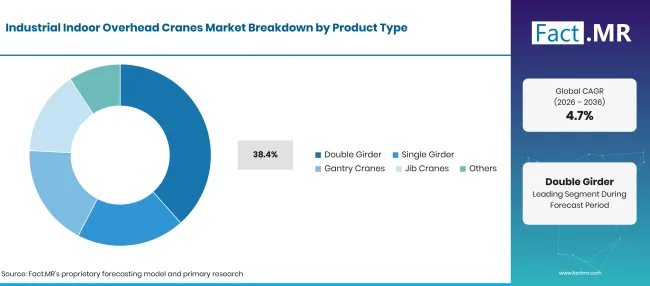
Industrial Indoor Overhead Cranes Market Breakdown Product Type | Source: Fact.MR
| Product Type | Share (2026) |
|---|---|
| Double Girder (Leading segment) | 38.4% |
| Other segments combined | 61.6%* |
| Total | 100.0% |
Source: Fact.MR analysis. Updated Nov 13, 2026
Steel mills, machinery builders and vehicle plants choose two-girder bridges when loads are heavy and hook height is tight. The trolley runs between or on top of the girders, which gives more lift height under a fixed roof and carries open winch or wire rope hoists with ease. These cranes also tolerate higher duty classes, so they suit plants that lift many times per shift. Buyers often pair them with an electric hoist sized for the heaviest part on the line. Single girder cranes stay popular in workshops and lighter assembly halls because they cost less and load the building structure less. Indoor gantry crane systems serve bays where no runway can be fixed to the walls. A jib crane covers single workstations and machine tools, while other designs handle niche tasks.
What supports Manufacturing within Application?
Manufacturing takes 34.7% of 2026 value.
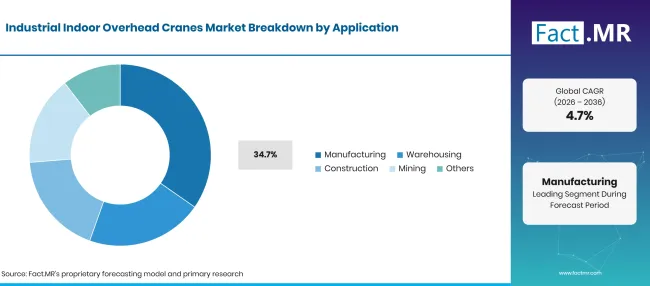
Industrial Indoor Overhead Cranes Market Breakdown Application | Source: Fact.MR
| Application | Share (2026) |
|---|---|
| Manufacturing (Leading segment) | 34.7% |
| Other segments combined | 65.3%* |
| Total | 100.0% |
Source: Fact.MR analysis. Updated Nov 13, 2026
Production plants lift raw stock into machines, shift work in progress between cells and load finished goods for dispatch, so cranes run through the whole shift. Overhead travel keeps the floor clear for people, carts and machine tools. Plants adding industrial robotics often redesign their material flow at the same time and specify cranes that can feed robot cells. Warehousing uses overhead cranes for coils, rolls and bulky goods that racks and forklifts handle poorly. Construction and mining users mostly need cranes in fabrication yards and maintenance workshops, which keeps their demand tied to specific sites and project cycles.
How does End-User Industry shape demand?
Automotive accounts for 27.2% of 2026 sales.
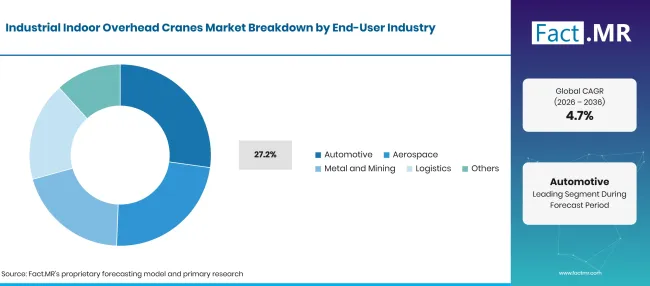
Industrial Indoor Overhead Cranes Market Breakdown End User Industry | Source: Fact.MR
| End-User Industry | Share (2026) |
|---|---|
| Automotive (Leading segment) | 27.2% |
| Other segments combined | 72.8%* |
| Total | 100.0% |
Source: Fact.MR analysis. Updated Nov 13, 2026
Vehicle makers and their suppliers handle press dies, engines, gearboxes and body shells many times each shift. Cranes serve stamping halls, die storage, powertrain lines and maintenance shops, where precise load control prevents damage to costly tooling. New electric vehicle programs add battery pack handling, which brings fresh lift points into existing plants. Aerospace plants need slow, exact movement of large structures and engines. Metal and mining users lift heavy castings and spare parts in workshops, while logistics sites use cranes for bulky freight in covered yards.
How does Capacity shape demand?
The 10-20 Tons class captures 28.7% of 2026 value.
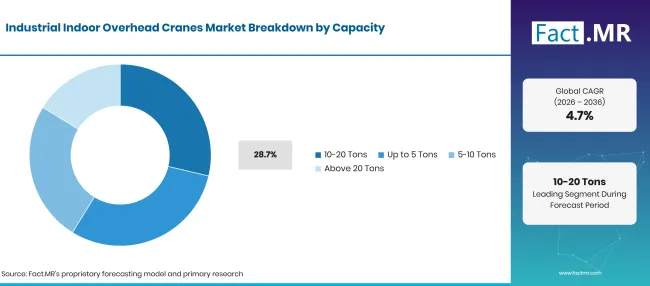
Industrial Indoor Overhead Cranes Market Breakdown Capacity | Source: Fact.MR
| Capacity | Share (2026) |
|---|---|
| 10-20 Tons (Leading segment) | 28.7% |
| Other segments combined | 71.3%* |
| Total | 100.0% |
Source: Fact.MR analysis. Updated Nov 13, 2026
Fabrication shops, machinery builders and vehicle plants regularly lift components, fixtures and dies in this weight range. A crane rated at 10 to 20 tons handles these parts without the heavy runway steel and foundations that larger cranes demand. That balance keeps installed cost manageable for mid-size factories. Cranes up to 5 tons and 5-10 Tons units serve workshops, assembly lines and warehouses with lighter loads. Units above 20 tons are reserved for steel, power equipment and heavy machinery plants that move exceptional loads.
What is accelerating Industrial Indoor Overhead Cranes Market adoption, and what is holding it back?
Factory investment, vehicle output and warehouse upgrades keep orders for indoor cranes moving, while safety rules push plants to replace worn equipment. Automation and remote control features open further room for growth. High installation costs and the need to strengthen older buildings hold back smaller plants. Maintenance spending and a shortage of trained operators also slow adoption in emerging markets.
Drivers Impact Analysis
| DRIVER | (~) % IMPACT ON CAGR | GEOGRAPHIC RELEVANCE | IMPACT TIMELINE |
|---|---|---|---|
| Expansion of manufacturing facilities and demand for efficient in-plant material handling | +1.5% | Global | Short term (<=2 years) |
| Automotive production and frequent handling of heavy vehicle components | +1.0% | North America, Europe, East Asia | Medium term (2-4 years) |
| Warehouse modernization and demand for space-saving lifting systems | +0.7% | Global | Medium term (2-4 years) |
| Adoption of automated crane controls and connected material handling | +0.5% | Western Europe, North America, East Asia | Long term (>=4 years) |
Source: Fact.MR analysis. Updated Nov 13, 2026
Opportunity Impact Analysis
| OPPORTUNITY | (~) % IMPACT ON CAGR | GEOGRAPHIC RELEVANCE | IMPACT TIMELINE |
|---|---|---|---|
| Automated overhead cranes with remote operation and load monitoring | +0.7% | Global | Medium term (2-4 years) |
| Replacement of ageing cranes with energy-efficient, digitally controlled systems | +0.5% | Western Europe, North America, East Asia | Long term (>=4 years) |
| Automotive and aerospace plant expansion needing specialized lifting equipment | +0.4% | North America, Western Europe, East Asia | Medium term (2-4 years) |
| Custom crane systems for new industrial and warehouse buildings | +0.2% | Latin America, South Asia & Pacific, Middle East & Africa | Long term (>=4 years) |
Source: Fact.MR analysis. Updated Nov 13, 2026
Restraints Impact Analysis
| RESTRAINT | (~) % IMPACT ON CAGR | GEOGRAPHIC RELEVANCE | IMPACT TIMELINE |
|---|---|---|---|
| High upfront cost of crane installation and structural modification | -0.4% | Global | Short term (<=2 years) |
| Maintenance costs, downtime and replacement of critical components | -0.2% | Global | Medium term (2-4 years) |
| Shortage of skilled operators and maintenance staff | -0.2% | Emerging markets | Long term (>=4 years) |
Source: Fact.MR analysis. Updated Nov 13, 2026
Which countries are scaling the Industrial Indoor Overhead Cranes Market through 2036?
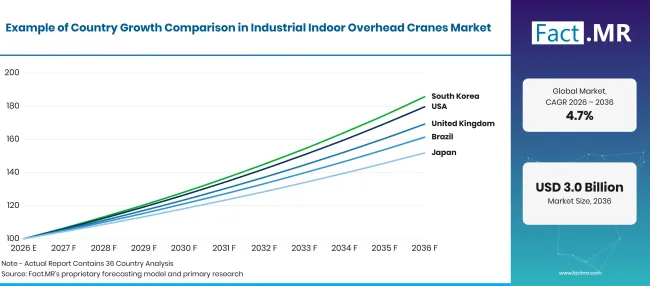
Industrial Indoor Overhead Cranes Market Growth Index | Source: Fact.MR
| Country | CAGR (2026 to 2036) |
|---|---|
| United States | 6.0% |
| United Kingdom | 5.4% |
| Brazil | 4.9% |
| Japan | 4.3% |
| Germany | 3.5% |
Source: Fact.MR analysis. Updated Nov 13, 2026
What is supporting United States adoption?
6.0% CAGR, backed by foreign investment in new factories and the replacement of ageing material handling systems.
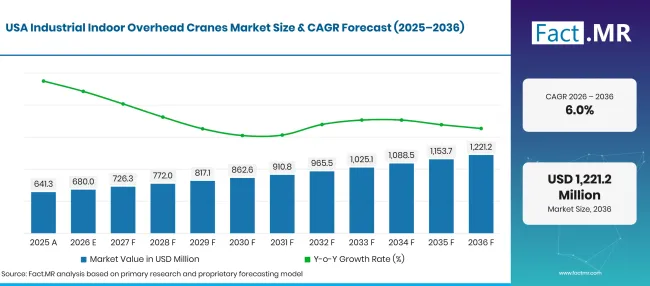
Industrial Indoor Overhead Cranes Market Forecast Usa | Source: Fact.MR
American plants in automotive, aerospace, metal fabrication and machinery rely on overhead cranes to move heavy parts inside production and maintenance buildings. New foreign direct investment expenditures in the United States reached USD 232.2 billion in 2025, and manufacturing took USD 121.8 billion, or 52.5% of the total. Each new plant built with that capital needs runway beams, bridges and hoists fitted before production starts.
How is the United Kingdom scaling demand?
5.4% CAGR, driven by plant modernization and stricter attention to lifting safety.
British manufacturers recorded product sales of GBP 452.0 billion in 2025, down 1.8% from 2024, according to the Office for National Statistics. Softer output is steering budgets toward upgrades of existing plants over new buildings, and older cranes are a common target. The Health and Safety Executive counted 126 workers killed in work-related accidents in 2025/26, with 21 deaths from being struck by a moving object. Such figures keep safe lifting on the agenda of plant managers.
How is Brazil developing demand?
4.9% CAGR, helped by federal funding for vehicle and component investment.
Brazilian demand comes from vehicle assembly, auto parts, metal processing, machinery and warehousing. The Ministry of Development, Industry, Trade and Services reports that its Mover program allocated BRL 3.8 billion in 2025 and has drawn BRL 190 billion in announced investment, of which BRL 140 billion comes from automakers. New body shops, stamping lines and powertrain plants funded by that program will need indoor cranes sized for dies and engines.
How does Japan perform?
4.3% CAGR, reflecting factory upgrades and the push for digital production.
Japan’s industrial base in vehicles, machinery, electronics and precision engineering depends on accurate lifting inside crowded plants. METI’s preliminary report put the seasonally adjusted production index at 104.1 in September 2026, up 2.2% on the prior month, with production machinery ranked second among contributing industries. The government’s White Paper on Manufacturing Industries 2026 names AI and digital technology as priorities for manufacturing competitiveness. Cranes with precise positioning and data links fit those plans.
What supports Germany’s adoption?
3.5% CAGR, as replacement demand across a dense installed base offsets uneven factory orders.
Germany’s automotive, machinery, metal processing and engineering plants already run large crane fleets, so most new orders replace or upgrade existing units. Destatis reported that new orders in machinery and equipment rose 8.3% and automotive orders rose 10.5% in September 2026 against the prior month. Earlier in the year, February 2026 orders stood 3.5% above February 2025, with automotive the main driver. Those swings show why German buyers time crane upgrades carefully.
Who leads the Industrial Indoor Overhead Cranes Market?
The market splits into three groups. Konecranes and ABUS Kransysteme form the first tier, with full ranges of single and double girder cranes, wire rope hoists and service networks that cover whole plants. Konecranes reported strong year-on-year growth in external Industrial Equipment orders in its first quarter of 2026.
GH Cranes & Components, Street Crane and EMH occupy the second tier, winning engineered orders where heavy duty classes, custom spans or local fabrication count most. Columbus McKinnon, Gorbel and Eilbeck Cranes complete the field with hoists, workstation cranes and regional crane builds that serve lighter lifts and specific markets. Gorbel launched its GS VFD electric chain hoist in February 2026, bringing variable frequency control to its workstation lifting range. Across all three groups, contests will turn on control precision, delivery speed and the reach of service teams that keep cranes certified and running.
Which companies are the key providers?
Key companies in the Industrial Indoor Overhead Cranes Market include Konecranes, ABUS Kransysteme, GH Cranes & Components, Street Crane, EMH, Columbus McKinnon, Gorbel and Eilbeck Cranes.
- Konecranes
- ABUS Kransysteme
- GH Cranes & Components
- Street Crane
- EMH
- Columbus McKinnon
- Gorbel
- Eilbeck Cranes
Bibliography
- Federal Statistical Office (Destatis). (2026, April 8). New orders in manufacturing in February 2026: +0.9% on the previous month.
- Federal Statistical Office (Destatis). (2026, November 5). New orders in manufacturing in September 2026: +4.4% on the previous month.
- Gorbel. (2026, February 23). Newest Gorbel Hoist Features Advanced Variable Frequency Drive Technology.
- Health and Safety Executive. (2026, June 30). Work-related fatal injuries in Great Britain.
- Konecranes. (2026, April 29). Konecranes Plc’s Interim report, January-March 2026: Q1: A solid start to the year.
- Ministério do Desenvolvimento, Indústria, Comércio e Serviços. (2026, October 26). Brasil avança com indústria inovadora, competitiva, exportadora e sustentável.
- Ministry of Economy, Trade and Industry. (2026, May 29). FY2025 Measures to Promote Manufacturing Technology (White Paper on Manufacturing Industries 2026) Released.
- Ministry of Economy, Trade and Industry. (2026, October 30). Indices of Industrial Production: Preliminary Report for September 2026.
- Office for National Statistics. (2026, July 24). UK manufacturers’ sales by product: 2025.
- U.S. Bureau of Economic Analysis. (2026, June 10). New Foreign Direct Investment in the United States, 2025.
- U.S. Bureau of Labor Statistics. (2026, February 19). Table 2. Fatal occupational injuries for selected events or exposures, 2023-24.
- U.S. Census Bureau. (2026, November 2). Monthly Construction Spending, September 2026.
This Report Answers
- How large is the indoor overhead crane market in 2026, and how much value will it add by 2036?
- Which product type, application, end-user industry and capacity class hold the top position in each segment?
- How do factory investment, vehicle production and warehouse upgrades shape crane orders?
- Where do the United States, the United Kingdom, Brazil, Japan and Germany differ in growth and why?
- Which crane builders and hoist specialists compete, and on what terms?
- What role do automated controls, duty classification and safety systems play in buying decisions?
What does the Industrial Indoor Overhead Cranes Market cover?
This market covers overhead crane systems built to lift, lower and carry loads horizontally inside enclosed industrial buildings. A typical system consists of a bridge with one or two girders, end trucks, a trolley, a hoist and electrical controls running on a fixed runway.
Values reflect complete crane systems at the point of sale to the end user. Products may include wire rope or chain hoists, variable frequency drives, radio controls, automated positioning and load monitoring when delivered as part of the crane.
What is included in the scope?
Single girder and double girder bridge cranes sold for indoor use, with their bridges, trolleys, end carriages and integrated controls.
Indoor gantry cranes and jib cranes used in production halls and workshops.
Cranes installed in manufacturing, warehousing, automotive, aerospace, metal processing, mining workshops and logistics buildings.
Automation and safety functions delivered as part of the crane, such as anti-sway control and overload protection.
What is excluded from the scope?
Outdoor mobile cranes, truck-mounted cranes, crawler cranes and tower cranes.
Forklifts, autonomous mobile robots and other floor-based handling machines.
Separately sold hoists, spare parts, installation services and maintenance contracts.
Building steel, general automation hardware and bulk handling equipment such as a screw conveyor.
How Was the Analysis Built?
The analysis draws on 120+ sources, 35+ company portfolios, 25+ countries, and more than 20 industry interviews.
- Primary Research: Primary research includes discussions with manufacturers, service providers, technology developers, distributors, end users, and subject-matter experts. These conversations examine purchasing priorities, product adoption, operational challenges, approval requirements, competitive positioning, and the factors that influence wider market acceptance.
- Desk Research: Desk research covers government statistics, regulatory publications, company filings, trade data, technical studies, industry associations, standards, public policy, and other authoritative sources. Every source used in the analysis is documented in the bibliography.
- Market Sizing and Forecasting: Market estimates combine historical performance, demand indicators, pricing and volume trends, segment shares, company participation, country-level growth, adoption patterns, investment activity, and barriers to market expansion.
- Data Validation and Update Cycle: Findings are validated by comparing primary interviews with public data, company activity, regulatory changes, trade patterns, and industry developments. Regular updates review new product launches, capacity changes, partnerships, approvals, and shifts in commercial adoption.
Segmentation
What is the report’s scope and coverage?
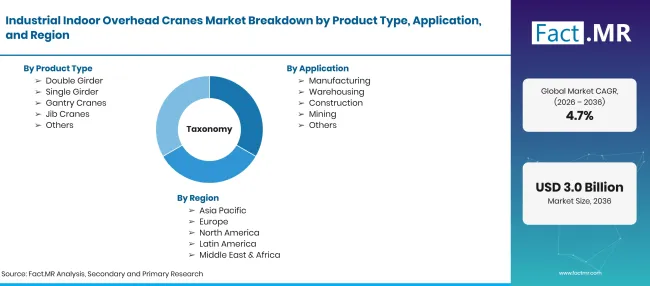
Industrial Indoor Overhead Cranes Market Taxonomy | Source: Fact.MR
| Attribute | Details |
|---|---|
| Quantitative Units | USD billion in 2026 to USD billion by 2036 at CAGR |
| Market Definition | Industrial overhead cranes used to lift, lower and move materials, machinery and components horizontally inside enclosed factories, warehouses, workshops and other industrial buildings. |
| Product Type | Double Girder; Single Girder; Gantry Cranes; Jib Cranes; Others |
| Application | Manufacturing; Warehousing; Construction; Mining; Others |
| End-User Industry | Automotive; Aerospace; Metal and Mining; Logistics; Others |
| Capacity | Up to 5 Tons; 5-10 Tons; 10-20 Tons; Above 20 Tons |
| Regions Covered | North America; Latin America; Western Europe; Eastern Europe; East Asia; South Asia & Pacific; Middle East & Africa |
| Countries Covered | United States; United Kingdom; Brazil; Japan; Germany |
| Companies Profiled | Konecranes; ABUS Kransysteme; GH Cranes & Components; Street Crane; EMH; Columbus McKinnon; Gorbel; Eilbeck Cranes |
| Forecast Period | 2026 to 2036 |
| Approach | Top-down and bottom-up modeling built on factory activity, crane installations, capacity needs, end-user demand and replacement cycles in each country. |
Source: Fact.MR analysis. Updated Nov 13, 2026
How is the market segmented?
-
By Product Type
- Double Girder
- Single Girder
- Gantry Cranes
- Jib Cranes
- Others
-
By Application
- Manufacturing
- Warehousing
- Construction
- Mining
- Others
-
By End-User Industry
- Automotive
- Aerospace
- Metal and Mining
- Logistics
- Others
-
By Capacity
- Up to 5 Tons
- 5-10 Tons
- 10-20 Tons
- Above 20 Tons
-
By Region
- North America
- Latin America
- Western Europe
- Eastern Europe
- East Asia
- South Asia & Pacific
- Middle East & Africa
Frequently Asked Questions
How large is the industrial indoor overhead cranes market in 2026?
What growth rate will the industrial indoor overhead cranes market record?
Which product type leads?
Which application leads?
Which end-user industry leads?
Which capacity class leads?
Which country will grow quickest?
Who are the main companies?
What holds the market back?
Who worked on this report


Preview the report firsthand - request a free sample
Free SampleGet the brochure for pricing and purchase details
Download PDF