- Base Value(2025): 486.7 Mn
- Estimated Value(2026): 523.4 Mn
- Forecast Value (2036): 1012.6 Mn
- CAGR (2026 - 2036): 6.8%
Anti-Sway Overhead Cranes for Steel Plant Logistics Market Forecast and Outlook By Fact.MR
In 2025, the anti-sway overhead cranes for steel plant logistics market was valued at USD 486.7 million. Based on Fact MR analysis, demand for anti-sway overhead crane systems used in steel plant logistics is estimated to grow to USD 523.4 million in 2026 and USD 1,012.6 million by 2036. FMR projects a CAGR of 6.8% during the forecast period.
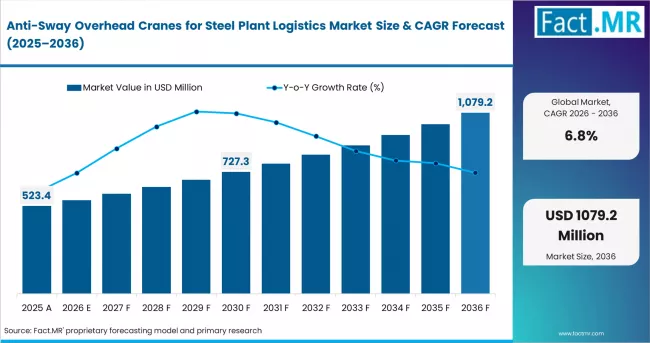
Anti Sway Overhead Cranes For Steel Plant Logistics Market Market Value Analysis | Source: Fact.MR
Summary of the Anti-Sway Overhead Cranes for Steel Plant Logistics Market
- Market Definition
- The market includes overhead crane systems equipped with sway control technologies designed to minimize load oscillation during transport of coils, slabs, billets, and ladles across steel manufacturing facilities.
- Demand Drivers
- Increasing need for stabilized load transport supporting safe handling of high mass steel materials.
- Rising adoption of motion control algorithms improving positioning accuracy across continuous casting logistics workflows.
- Growing requirement for reduction of load swing amplitude improving cycle time performance across repetitive lifting operations.
- Expansion of automated steel plant material handling systems supporting precision logistics coordination.
- Increasing deployment of sensor-based feedback control supporting real time adjustment of crane acceleration profiles.
- Rising focus on operational safety compliance supporting reduced collision probability across dense production layouts.
- Key Segments Analyzed
- Crane Type: Bridge cranes lead with 48% share due to suitability for heavy load transport across large plant layouts.
- Control Type: Active anti-sway holds 44% share supported by real time motion stabilization capability.
- Application Role: Coil handling and ladle handling represent primary use cases requiring high precision load positioning.
- Technology Role: Anti-sway control algorithms reduce pendulum motion caused by acceleration and deceleration cycles.
- Geography: Asia Pacific and Europe maintain strong deployment supported by modernization of steel production infrastructure.
- Analyst Opinion at Fact MR
- Shambhu Nath Jha, Principal Consultant, Fact MR, opines, 'In this updated edition of the Anti-Sway Overhead Cranes for Steel Plant Logistics Market report, motion stabilization technologies remain essential for improving safety, positioning accuracy, and throughput consistency across heavy industrial material handling environments through 2036.'
- Strategic Implications or Executive Takeaways
- Invest in active anti-sway control systems supporting dynamic stabilization of suspended loads.
- Strengthen integration of sensor feedback systems enabling precise positioning across steel logistics workflows.
- Improve synchronization capability supporting optimized crane acceleration and deceleration profiles.
- Expand retrofit capability across existing crane infrastructure requiring enhanced load control performance.
- Focus on automation integration supporting coordination across plant logistics and storage operations.
- Enhance operational safety capability supporting reduction of collision risk across high density material handling environments.
- Methodology
- Primary interviews conducted with crane manufacturers, automation providers, and steel plant engineering specialists.
- Benchmarked against steel production capacity influencing demand for heavy load material handling equipment.
- Evaluated installation trends across continuous casting and rolling mill logistics environments requiring precise positioning accuracy.
- Hybrid modeling applied combining top down industrial material handling demand assessment with bottom up crane installation benchmarking.
- Validation conducted using supplier level automation deployment indicators across heavy manufacturing facilities.
- Peer review applied using Fact MR analytical frameworks linking steel production logistics modernization with crane stabilization technology adoption patterns.
Anti-Sway Overhead Cranes for Steel Plant Logistics Market
| Metric | Details |
|---|---|
| Industry Size (2026E) | USD 523.4 million |
| Industry Value (2036F) | USD 1,012.6 million |
| CAGR (2026 to 2036) | 6.8% |
Source: Fact.MR analysis. Updated Apr 13, 2026
An increase of USD 489.2 million indicates moderate expansion supported by demand for load stability and safety improvement in high-capacity steel handling operations. Growth remains steady due to productivity optimization needs, while constraints persist from capital equipment costs, retrofit complexity in existing plants, and cyclic investment patterns in steel production.
China leads with a projected CAGR of 7.6%, supported by expansion of automated material handling systems across integrated steel production facilities. India follows with a CAGR of 7.3%, driven by increasing modernization of steel plant logistics infrastructure with precision load control technologies. Germany records a CAGR of 7.1%, reflecting steady integration of anti-sway crane automation across heavy industrial material transport operations. The United Kingdom shows a CAGR of 6.9%, supported by stable demand for controlled lifting systems across industrial metals processing environments. The United States records the slowest growth at 6.8%, reflecting a mature market tied to replacement demand within existing heavy-duty crane logistics infrastructure.
Segmental Analysis
Anti-Sway Overhead Cranes for Steel Plant Logistics Market Analysis by Crane Type
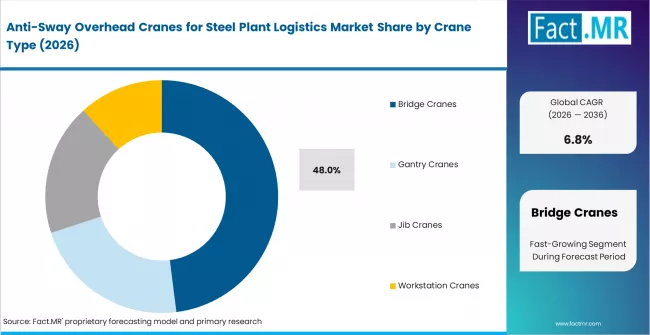
Anti Sway Overhead Cranes For Steel Plant Logistics Market Analysis By Crane Type | Source: Fact.MR
- Market Overview: Based on Fact MR assessment, bridge cranes are projected to account for 48% share of the anti-sway overhead cranes for steel plant logistics market in 2026. Bridge crane structures are installed across steel manufacturing facilities requiring controlled movement of heavy loads including coils, slabs, billets, and ladles across production bays. Anti-sway control systems are integrated within crane drive architecture enabling stabilization of suspended loads during acceleration and deceleration cycles. Structural configuration supports movement across longitudinal runway beams enabling coverage of large operational areas requiring consistent load positioning accuracy across high temperature industrial environments.
- Demand Drivers:
- Load Handling Stability Requirements: Bridge cranes support controlled transport of high mass steel products requiring minimized oscillation across suspended lifting operations.
- Operational Coverage Parameters: Overhead bridge configuration enables movement of materials across extended plant layouts requiring consistent positioning accuracy.
- Process Coordination Needs: Anti-sway functionality supports precise alignment of steel components across storage, processing, and transport stages within steel production workflows.
Anti-Sway Overhead Cranes for Steel Plant Logistics Market Analysis by Control Type
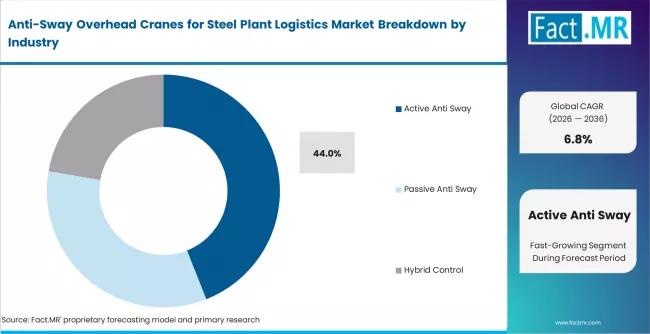
Anti Sway Overhead Cranes For Steel Plant Logistics Market Analysis By Control Type | Source: Fact.MR
- Market Overview: Active anti-sway control is estimated to hold 44% share of the anti-sway overhead cranes for steel plant logistics market in 2026, supported by utilization of sensor based motion control algorithms enabling real time compensation of load oscillation dynamics. Control systems incorporate feedback signals from encoders and inertial sensors enabling adjustment of motor torque to maintain stable load trajectory during lifting and transfer operations. Automated stabilization performance supports reduction of load swing amplitude enabling improved positioning precision across material handling tasks requiring controlled movement of heavy steel components.
- Demand Drivers:
- Motion Stabilization Requirements: Active anti-sway systems support dynamic adjustment of crane movement enabling reduction of oscillation during load transport operations.
- Positioning Accuracy Parameters: Feedback control architecture supports precise placement of steel loads across production and storage locations.
- Operational Efficiency Needs: Reduced load swing supports improved cycle time performance across repetitive material handling workflows within steel plant logistics environments.
Key Dynamics
Anti-Sway Overhead Cranes for Steel Plant Logistics Market Drivers, Restraints, and Opportunities
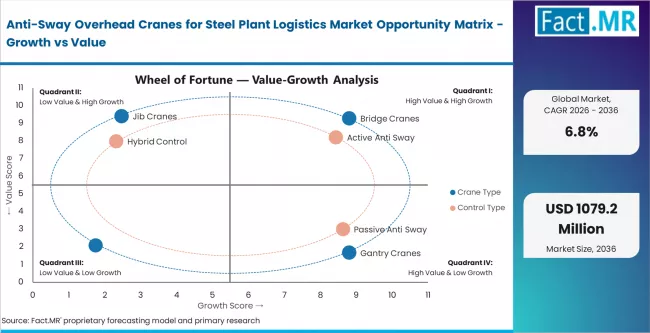
Anti Sway Overhead Cranes For Steel Plant Logistics Market Opportunity Matrix Growth Vs Value | Source: Fact.MR
Fact MR analysis indicates historical demand has been structurally linked to heavy material handling requirements across steel production stages where molten metal ladles, coils, billets, and slabs must be transported safely within high-temperature industrial environments. The current market size reflects a transitional modernization phase where conventional overhead cranes are being upgraded with anti-sway control algorithms to improve positioning precision and reduce cycle time variability across continuous casting and rolling operations. Structural reality indicates a mature but evolving market because steel plants operate high-capacity crane systems as essential logistics infrastructure supporting furnace charging, coil storage, and downstream fabrication workflows. Overhead cranes remain integral to metal production handling due to their ability to transport high loads across fixed plant layouts.
The present structural shift reflects declining tolerance for manual load stabilization delays as digital anti-sway control systems reduce oscillation amplitude and improve placement accuracy under variable load conditions. Higher control system cost associated with sensor feedback integration and inverter-based motion control is offset by improved throughput consistency and reduced load collision risk within dense plant layouts. Value growth remains linked to productivity optimization initiatives where cycle time reduction improves utilization of capital-intensive steel processing assets. Anti-sway control algorithms dampen pendulum motion caused by crane acceleration and deceleration, improving operational safety and positioning accuracy.
- Precision Load Control: Anti-sway algorithms stabilize suspended loads by adjusting acceleration profiles, improving placement accuracy and reducing handling cycle delays.
- Industrial Safety Compliance: ISO 12100 machinery safety principles and OSHA crane safety frameworks support adoption of controlled motion systems to reduce accident probability in heavy material handling environments.
- Asia Steel Capacity: China and India maintain strong demand due to high installed base of continuous casting and coil handling facilities requiring high-throughput crane logistics systems.
Regional Analysis
The Anti-Sway Overhead Cranes for Steel Plant Logistics Market is assessed across North America, Europe, and Asia Pacific, segmented by country-level demand in coil handling automation, slab transport optimization, ladle movement control, and warehouse crane stability systems. Regional demand reflects modernization of steel mill material handling infrastructure and adoption of precision motion control technologies. The full report offers market attractiveness analysis.
.webp "Top Country Growth Comparison Anti Sway Overhead Cranes For Steel Plant Logistics Market Cagr (2026 2036)")
Top Country Growth Comparison Anti Sway Overhead Cranes For Steel Plant Logistics Market Cagr (2026 2036) | Source: Fact.MR
CAGR Table of Anti-Sway Overhead Cranes for Steel Plant Logistics Market
| Country | CAGR (2026–2036) |
|---|---|
| China | 7.6% |
| India | 7.3% |
| Germany | 7.1% |
| United Kingdom | 6.9% |
| United States | 6.8% |
Source: Fact.MR analysis. Updated Apr 13, 2026
Source: Fact MR analysis, based on proprietary forecasting model and primary research
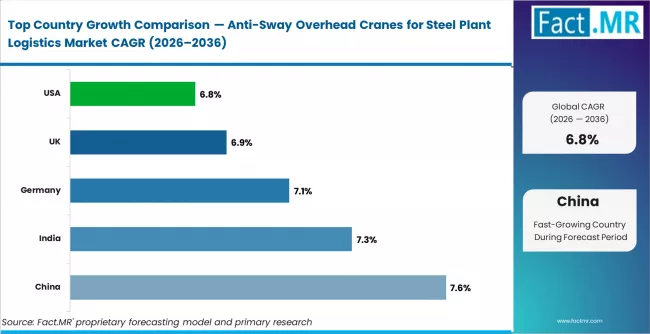
Anti Sway Overhead Cranes For Steel Plant Logistics Market Cagr Analysis By Country | Source: Fact.MR
Asia Pacific
Asia Pacific functions as the steel production logistics automation hub, supported by expansion of integrated steel manufacturing capacity and demand for precision load control technologies. Konecranes Plc strengthens advanced crane automation capability. ABB Ltd. expands motion control integration solutions. Siemens AG supports digital crane stability optimization platforms.
- China: China is projected to record 7.6% CAGR in anti-sway overhead cranes for steel plant logistics through 2036. Smart Manufacturing programme expansion for heavy industry (MIIT, March 2024) supports precision crane control deployment. Konecranes Plc expanded automated crane motion stabilization capability (June 2023).
- India: Deployment of anti-sway overhead cranes for steel plant logistics in India is forecast to grow at 7.3% CAGR through 2036. National Steel Policy capacity modernization focus update (Ministry of Steel, January 2024) supports adoption of automated material handling systems. ABB Ltd. expanded industrial crane drive control engineering capability (May 2023).
Europe
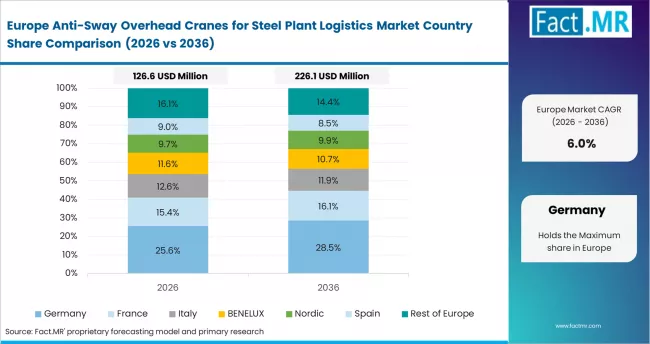
Anti Sway Overhead Cranes For Steel Plant Logistics Market Europe Country Market Share Analysis, 2026 & 2036 | Source: Fact.MR
Europe operates as the heavy equipment motion control engineering center, supported by structured industrial automation standards and modernization of legacy steel plant logistics infrastructure. Demag Cranes & Components GmbH strengthens intelligent crane automation capability. Siemens AG expands precision drive control integration platforms. Liebherr Group supports advanced crane stabilization technologies.
- Germany: Germany is anticipated to observe 7.1% CAGR in anti-sway overhead cranes for steel plant logistics through 2036. Industrie 4.0 smart factory logistics initiative update (BMWK, October 2023) supports digitally stabilized crane movement deployment. Demag Cranes & Components GmbH expanded intelligent crane automation capability (April 2023).
- United Kingdom: Adoption of anti-sway overhead cranes for steel plant logistics in United Kingdom is expected to expand at 6.9% CAGR through 2036. Industrial Energy Transformation Fund modernization update (Department for Energy Security, February 2024) supports precision material handling improvements. Street Crane Company Ltd. expanded automated crane control engineering capability (July 2023).
North America
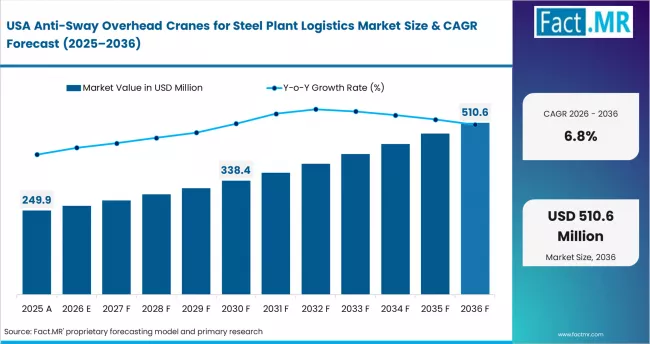
Anti Sway Overhead Cranes For Steel Plant Logistics Market Country Value Analysis | Source: Fact.MR
North America represents the steel mill equipment modernization environment, supported by replacement of legacy crane control systems and integration of advanced motion stability technologies. Columbus McKinnon Corporation strengthens crane automation solution capability. Rockwell Automation Inc. expands drive synchronization platforms. Terex Corporation supports automated lifting control technologies.
- United States: The United States is forecast to witness 6.8% CAGR in anti-sway overhead cranes for steel plant logistics through 2036. Advanced Manufacturing Office modernization funding update (U.S. Department of Energy, April 2024) supports automated material handling deployment. Columbus McKinnon Corporation expanded intelligent lifting control capability (August 2023).
- Fact MR's analysis of anti-sway overhead cranes for steel plant logistics market in global regions consists of country-wise assessment that includes China, India, Germany, United Kingdom, and United States. Readers can find industrial crane automation trends, motion stability developments, steel plant logistics modernization signals, and competitive positioning across key markets.
Competitive Landscape
Competitive Structure and Buyer Dynamics in the Anti-Sway Overhead Cranes for Steel Plant Logistics Market
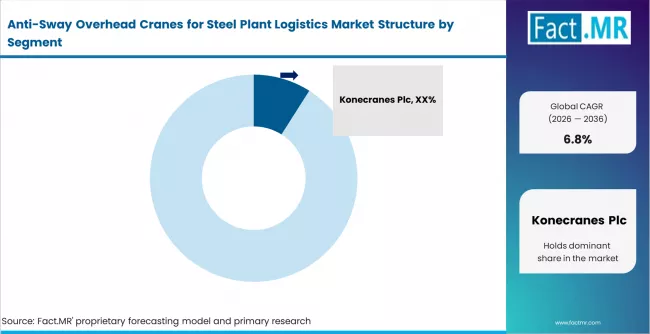
Anti Sway Overhead Cranes For Steel Plant Logistics Market Analysis By Company | Source: Fact.MR
The competitive structure of the Anti-Sway Overhead Cranes for Steel Plant Logistics Market is moderately concentrated, with crane manufacturers and industrial automation providers controlling a significant share of high capacity material handling deployments. Companies such as Konecranes Plc, Demag Cranes & Components GmbH, Liebherr Group, Terex Corporation, ABUS Kransysteme GmbH, GH Cranes & Components, Columbus McKinnon Corporation, and Street Crane Company Ltd. maintain strong positions through established crane engineering capabilities and global industrial distribution networks. Automation providers such as Siemens AG and ABB Ltd. contribute through control systems and anti-sway motion technologies integrated with crane operations. Competition is primarily influenced by load stability performance, motion precision, system reliability, and integration with plant logistics control systems.
Several companies maintain structural advantages through extensive engineering expertise in heavy lifting equipment and established relationships with steel producers and industrial facility operators. Firms such as Konecranes Plc, Demag Cranes & Components GmbH, and Liebherr Group benefit from large installed equipment bases supporting long term service contracts and retrofit opportunities. Siemens AG and ABB Ltd. maintain advantages through advanced drive control technologies enabling precise sway reduction performance. Steel manufacturers typically adopt multi vendor sourcing strategies to reduce dependence on a single crane provider and ensure operational flexibility. Procurement decisions evaluate suppliers based on equipment durability, automation compatibility, and long term maintenance support, moderating supplier pricing leverage across steel plant logistics applications.
Key Players of the Anti-Sway Overhead Cranes for Steel Plant Logistics Market
- Konecranes Plc
- ABUS Kransysteme GmbH
- Demag Cranes & Components GmbH
- GH Cranes & Components
- Liebherr Group
- Siemens AG
- ABB Ltd.
- Columbus McKinnon Corporation
- Street Crane Company Ltd.
- Terex Corporation
Anti-Sway Overhead Cranes for Steel Plant Logistics Market Key Segments
-
Control Type:
- Active Anti Sway
- Passive Anti Sway
- Hybrid Control
-
Application:
- Coil Handling
- Slab Handling
- Billet Transport
- Ladle Handling
- Warehouse Logistics
-
Crane Type:
- Bridge Cranes
- Gantry Cranes
- Jib Cranes
- Workstation Cranes
-
Region:
- North America
- USA
- Canada
- Mexico
- Europe
- Germany
- UK
- France
- Italy
- Spain
- Nordic Countries
- BENELUX
- Rest of Europe
- Asia Pacific
- China
- Japan
- South Korea
- India
- Australia
- Rest of Asia Pacific
- Latin America
- Brazil
- Argentina
- Rest of Latin America
- Middle East and Africa
- Kingdom of Saudi Arabia
- United Arab Emirates
- South Africa
- Rest of Middle East and Africa
- Other Regions
- Oceania
- Central Asia
- Other Markets
- North America
Bibliographies
- [1] Ministry of Industry and Information Technology. (2024, March). Smart manufacturing program expansion for heavy industry precision crane control deployment guidelines. Government of China.
- [2] Ministry of Steel. (2024, January). National steel policy modernization focus for automated material handling systems. Government of India.
- [3] Federal Ministry for Economic Affairs and Climate Action. (2023, October). Industrie 4.0 smart factory logistics initiative digitally stabilized crane movement deployment. Government of Germany.
- [4] Department for Energy Security and Net Zero. (2024, February). Industrial energy transformation fund precision material handling modernization update. UK Government.
- [5] U.S. Department of Energy. (2024, April). Advanced manufacturing office modernization funding automated material handling deployment. U.S. Department of Energy.
- [6] International Organization for Standardization. (2023). ISO 12100 safety of machinery general principles for design amendment update. ISO.
- [7] Konecranes Plc. (2023, June). Automated crane motion stabilization capability expansion for steel plant logistics. Konecranes Plc.
This Report Addresses
- Market size forecasts for 2026 to 2036 based on modernization of steel plant material handling systems requiring stabilized load movement.
- Opportunity mapping across active anti-sway, passive anti-sway, and hybrid control technologies supporting oscillation reduction performance.
- Segment and regional forecasts covering coil handling, slab handling, billet transport, ladle handling, and warehouse logistics operations.
- Competition benchmarking based on motion control precision capability, load stabilization response performance, and integration compatibility with digital crane automation systems.
- Industrial standards assessment covering machinery safety frameworks influencing adoption of controlled lifting technologies in heavy manufacturing environments.
- Report delivery in PDF, Excel, PPT, and dashboard formats supporting steel plant engineers, crane system integrators, and industrial automation planners.
- Operational risk analysis covering sensor calibration drift, retrofit integration constraints in legacy crane systems, variable load dynamics, and control tuning complexity across high-capacity lifting workflows.
Anti-Sway Overhead Cranes for Steel Plant Logistics Market Definition
The Anti-Sway Overhead Cranes for Steel Plant Logistics Market includes overhead crane systems equipped with active or passive sway control technologies that minimize load oscillation during lifting and transport of heavy steel materials such as coils, slabs, billets, and ladles, improving positioning accuracy, safety, and handling efficiency in steel manufacturing facilities.
Anti-Sway Overhead Cranes for Steel Plant Logistics Market Inclusions
The report includes global and regional market size estimates, forecast analysis, and segmentation by crane type, sway control technology, load capacity, application area, end use industry, pricing structure, and integration with steel plant material handling automation systems.
Anti-Sway Overhead Cranes for Steel Plant Logistics Market Exclusions
The scope excludes conventional overhead cranes without sway control capability, mobile cranes used for construction activities, material handling equipment not designed for steel plant logistics, and automation software not directly controlling crane motion stability.
Anti-Sway Overhead Cranes for Steel Plant Logistics Market Research Methodology
- Primary Research
- Interviews were conducted with crane manufacturers, steel producers, automation integrators, material handling specialists, and industrial engineering consultants.
- Desk Research
- Public sources included industrial crane technology publications, company technical documentation, safety standards literature, and research studies on load sway control systems.
- Market-Sizing and Forecasting
- A hybrid model combining top-down steel production logistics demand evaluation and bottom-up analysis of anti-sway crane installations across steel manufacturing facilities was applied.
- Data Validation and Update Cycle
- Outputs were validated through cross comparison of supplier data, expert consultation, and periodic monitoring of automation adoption trends in heavy material handling industries.
Segmentation
Report Scope
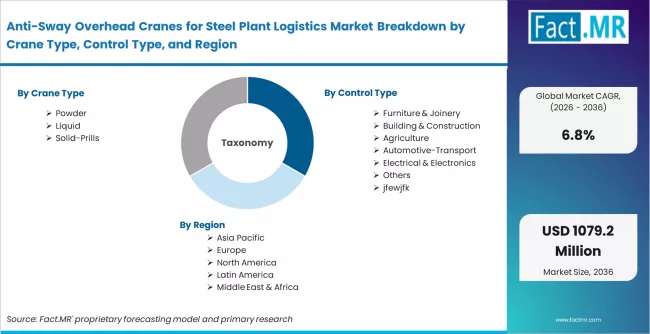
Anti Sway Overhead Cranes For Steel Plant Logistics Market Breakdown By Crane Type, Control Type, And Region | Source: Fact.MR
| Metric | Value |
|---|---|
| Quantitative Units | USD 523.4 million (2026) to USD 1,012.6 million (2036), at a CAGR of 6.8% |
| Market Definition | The anti-sway overhead cranes for steel plant logistics market includes crane systems equipped with sway control technologies designed to stabilize suspended loads, improve positioning accuracy, enhance operational safety, and increase material handling efficiency in high-capacity steel manufacturing environments. |
| Control Type Segmentation | Active anti-sway, Passive anti-sway, Hybrid control |
| Application Segmentation | Coil handling, Slab handling, Billet transport, Ladle handling, Warehouse logistics |
| Crane Type Segmentation | Bridge cranes, Gantry cranes, Jib cranes, Workstation cranes |
| Regions Covered | North America, Latin America, Europe, East Asia, South Asia, Oceania, Middle East and Africa |
| Countries Covered | United States, Canada, Germany, France, United Kingdom, Italy, Spain, Sweden, China, Japan, South Korea, India, Brazil, Mexico, Turkey, Saudi Arabia, United Arab Emirates, Australia, and 40+ countries |
| Key Companies Profiled | Konecranes Plc, ABUS Kransysteme GmbH, Demag Cranes & Components GmbH, GH Cranes & Components, Liebherr Group, Siemens AG, ABB Ltd., Columbus McKinnon Corporation, Street Crane Company Ltd., Terex Corporation |
| Forecast Period | 2026 to 2036 |
| Approach | Hybrid top-down and bottom-up market estimation based on steel plant material handling automation trends, industrial crane modernization demand benchmarking, load stabilization control technology adoption, heavy manufacturing productivity optimization requirements, and validation through primary interviews with crane manufacturers, steel producers, and industrial automation system integrators. |
Source: Fact.MR analysis. Updated Apr 13, 2026
Frequently Asked Questions
How large is the demand for Anti-Sway Overhead Cranes for Steel Plant Logistics in the global market in 2026?
What will be the market size of Anti-Sway Overhead Cranes for Steel Plant Logistics in the global market by 2036?
What is the expected demand growth for Anti-Sway Overhead Cranes for Steel Plant Logistics in the global market between 2026 and 2036?
Which company is identified as a leading manufacturer in the Anti-Sway Overhead Cranes for Steel Plant Logistics market?
Which crane type is projected to dominate anti-sway overhead crane deployment by 2026?
Why are anti-sway overhead cranes widely used in steel plant logistics operations?
What is driving demand for anti-sway overhead cranes in China?
What is the growth outlook for the Anti-Sway Overhead Cranes for Steel Plant Logistics market in China?
Why is India an important market for overhead crane automation technologies?
What is the growth outlook for the Anti-Sway Overhead Cranes for Steel Plant Logistics market in India?
What is the growth outlook for the Anti-Sway Overhead Cranes for Steel Plant Logistics market in Germany?
How is demand for anti-sway overhead cranes evolving in the United Kingdom industrial sector?
What is the growth outlook for the Anti-Sway Overhead Cranes for Steel Plant Logistics market in the United Kingdom?
How is the United States positioned in the Anti-Sway Overhead Cranes for Steel Plant Logistics market?
What is the growth outlook for the Anti-Sway Overhead Cranes for Steel Plant Logistics market in the United States?
What are anti-sway overhead cranes and what are they mainly used for in steel plant logistics?
What does the Anti-Sway Overhead Cranes for Steel Plant Logistics market include in this report?
What applications are included in the scope of the Anti-Sway Overhead Cranes for Steel Plant Logistics market?
What is excluded from the scope of the Anti-Sway Overhead Cranes for Steel Plant Logistics market report?
What does market forecast mean in the Anti-Sway Overhead Cranes for Steel Plant Logistics market report?
How is the Anti-Sway Overhead Cranes for Steel Plant Logistics market forecast developed in this report?
What does primary validation indicate in the Anti-Sway Overhead Cranes for Steel Plant Logistics market analysis?
Who worked on this report


Preview the report firsthand - request a free sample
Free SampleGet the brochure for pricing and purchase details
Download PDF