- Market Value (2025): USD 622.8 Mn
- Estimated Value (2026): USD 655.0 Mn
- Forecast Value (2036): USD 1085.0 Mn
- CAGR (2026-2036): 5.2%
What is the Inline Static Mixer Market forecast to be worth by 2036?
USD 655.0 million in 2026 to USD 1,085.0 million by 2036 at a 5.2% CAGR from 2026 to 2036.
- The Inline Static Mixer Market was valued at USD 622.8 million in 2025. Demand was tied to chemical blending, water dosing and compact process lines.
- Demand is projected to increase from USD 655.0 million in 2026 to USD 1,085.0 million by 2036.
- The market is forecast to record a 5.2% CAGR from 2026 to 2036 as brownfield process plants keep choosing pipe-mounted mixing sections where floor space is limited.
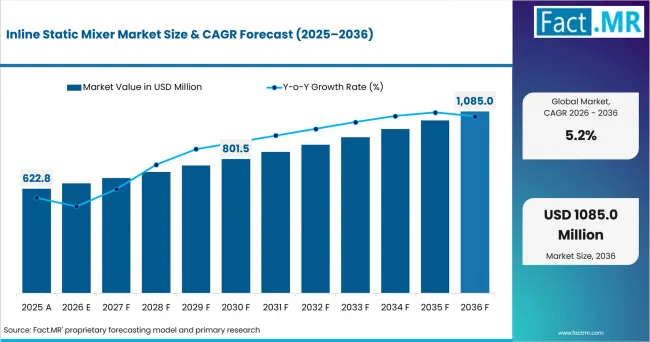
Inline Static Mixer Market Value Analysis | Source: Fact.MR
What are the defining numbers behind Inline Static Mixer Market growth?
USD 430.0 million absolute opportunity is expected by 2036.
- Demand Drivers in the Market
- A mixer section can be fitted into an existing pipe. This avoids the building work, wiring and extra space required for a new mixing tank.
- Water treatment plants use static mixers when chemicals must spread evenly within a short length of pipe or channel.
- Chemical plants prefer designs without motors or seals because corrosive liquids often damage moving parts first.
- Food and pharmaceutical plants use smooth sanitary designs that can be cleaned in place. This helps remove product residue without taking the mixer apart.
- Key Segments Analyzed
- By Mixer Type: Helical element mixers are expected to hold 30.0% share in 2026. The element geometry serves both steady chemical blending and viscosity changes across multiproduct plants.
- By Material: Stainless steel 316L is estimated to hold 34.0% share in 2026. Its molybdenum content helps plants manage chlorides and mild acids without moving straight to higher-cost alloys.
- By Application: Chemical blending is projected to account for 28.0% share in 2026. This use case remains the core job for inline static mixers because two streams must reach a target concentration before the next unit operation.
- By Flow Regime: Laminar mixing is anticipated to hold 33.0% share in 2026. Low-Reynolds-number fluids need fixed geometry to fold layers that turbulence cannot break apart on its own.
- By End User: Chemical processors are forecast to hold 30.0% share in 2026. These operators specify mixer length and metallurgy. They also review pressure drop and element count as part of routine process design.
- Analyst Opinion at Fact.MR
- Shambhu Nath Jha, Senior Analyst at Fact.MR, states, “A static mixer may appear simple, yet its performance becomes harder to prove when the fluid is thick or the flow rate changes. The final design also depends on the chemical being handled. Plant engineers usually review pressure loss, cleaning results and the available pipe space before approving the equipment. The mixer must fit into the existing line without turning a small installation into a long shutdown.”
- Strategic Implications
- Process engineers may ask for test results from a similar plant before approving a static mixer for the required fluid thickness, flow rate and material combination.
- Suppliers can make installation easier by providing drawings, pressure data and fitting instructions in one complete package.
- Plants are more likely to place repeat orders with suppliers that help during start-up and provide clear cleaning guidance. Fast access to spare mixer parts and common replacements also supports continued use.
China is projected to record a 6.4% CAGR from 2026 to 2036. UAE is estimated to post a 5.9% CAGR through 2036. USA is anticipated to advance at a 5.2% CAGR by 2036. Japan is forecast to record a 5.1% CAGR from 2026 to 2036. United Kingdom is projected to post a 4.9% CAGR by 2036. Germany is estimated to record a 4.6% CAGR through 2036.
How does the Inline Static Mixer Market break down by segment?
Helical element mixers are estimated to lead Mixer Type at 30.0% share in 2026. Stainless steel 316L is projected to lead Material at 34.0% share in 2026.
Why do Helical Element Mixers lead Mixer Type?
Helical Element Mixers are estimated to hold 30.0% share in 2026.
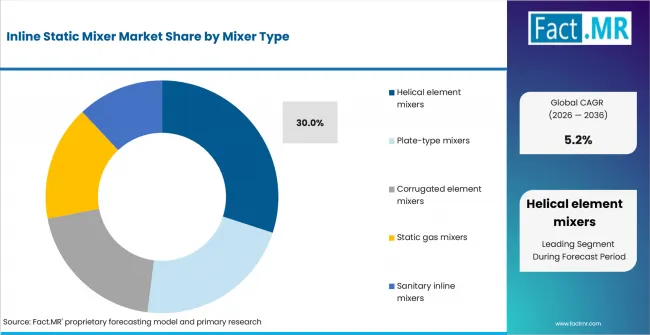
Inline Static Mixer Market Analysis By Mixer Type | Source: Fact.MR
Their twisted shape keeps dividing the liquid and sending it in a new direction as it moves through the pipe. This makes them useful for many common mixing jobs, from blending similar liquids to handling thick materials that move slowly. They also work across a wide range of pipe sizes and operating conditions, which gives plant engineers a familiar and flexible option for new lines and replacement projects.
Why does Stainless Steel 316L lead Material?
Stainless Steel 316L is projected to hold 34.0% share in 2026.
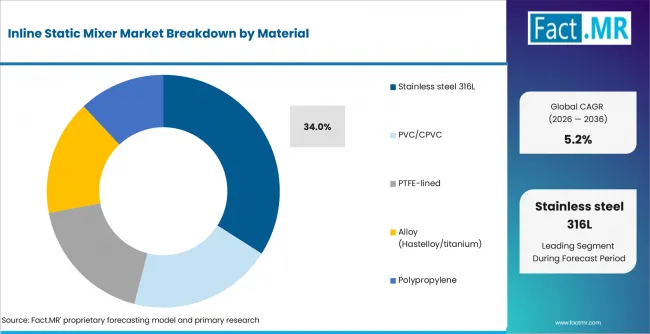
Inline Static Mixer Market Analysis By Material | Source: Fact.MR
It suits both chemical plants and clean production areas where corrosion resistance and easy cleaning are important. Compared with 304 stainless steel, it handles chloride exposure more effectively. Plant staff are also familiar with how it is welded, inspected and cleaned. Its wide acceptance across chemical, food and pharmaceutical lines makes approval easier when companies want a material with proven service history and clear records.
Why does Chemical Blending lead Application?
Chemical Blending is anticipated to hold 28.0% share in 2026.
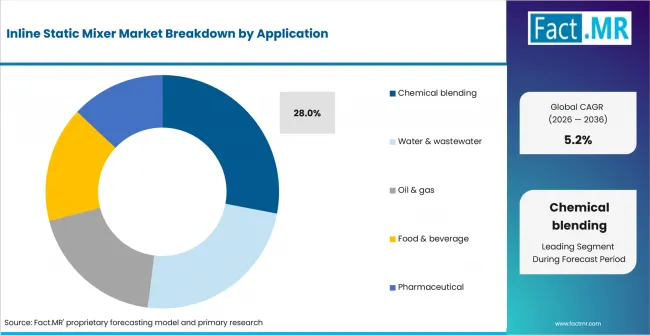
Inline Static Mixer Market Analysis By Application | Source: Fact.MR
Static mixers are often installed where two or more liquid streams must be combined before a reaction, dilution step or neutralization stage. Even mixing helps plants keep product quality steady and reduces the risk of material falling outside the required specification. Better control at dosing points can also improve yield and reduce waste. These practical uses make Chemical blending one of the most common reasons for installing inline static mixers.
Why does Laminar Mixing lead Flow Regime?
Laminar Mixing is forecast to hold 33.0% share in 2026.
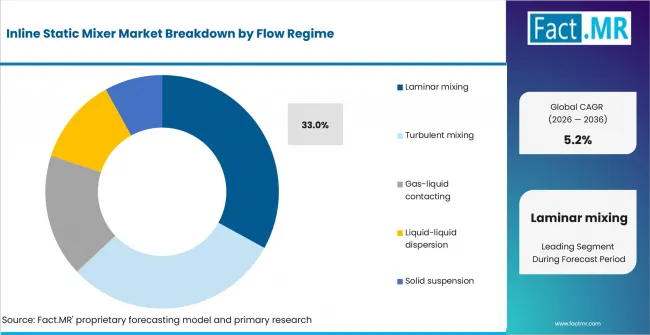
Inline Static Mixer Market Analysis By Flow Regime | Source: Fact.MR
Thick fluids move in smooth layers and create very little natural mixing inside a plain pipe. Static elements break those layers and fold the material again and again until the blend becomes more even. This method is well suited to syrups, polymers, resins and other slow-moving chemical streams. It gives engineers a practical way to improve mixing without adding a motor-driven vessel or increasing the size of the process line.
Why do Chemical Processors lead End User?
Chemical Processors are estimated to hold 30.0% share in 2026.
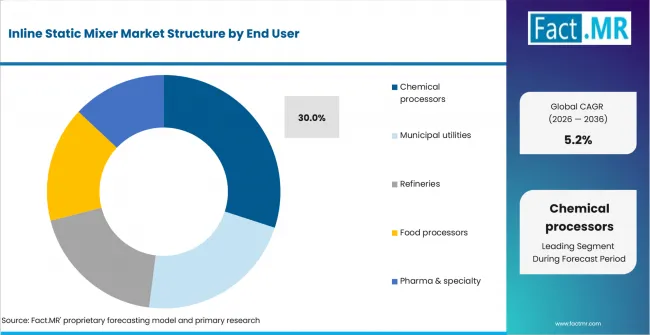
Inline Static Mixer Market Analysis By End User | Source: Fact.MR
A single chemical site may have many points where liquids are dosed, diluted or combined before a reaction. This creates steady demand for mixers across different production lines. Suppliers become more useful when they can provide similar designs for several duties while adjusting the metal grade, mixer length and pressure loss for each pipe. That mix of repeat use and line-by-line changes supports the leading position of chemical processors.
What is accelerating Inline Static Mixer Market adoption, and what is holding it back?
Continuous process retrofits are expected to expand Inline Static Mixer Market demand. Pressure-drop penalty is anticipated to restrain adoption where pumping energy is already tight.
Drivers Impact Analysis
| DRIVER | (~) % IMPACT ON CAGR | GEOGRAPHIC RELEVANCE | IMPACT TIMELINE |
|---|---|---|---|
| Continuous process retrofits | +1.5% | Global | Short term (<= 2 years) |
| Water-treatment dosing control | +1.1% | Municipal and industrial water markets | Short term (<= 2 years) |
| Lower mechanical maintenance | +0.8% | Chemical and utility plants | Medium term (2-4 years) |
| Demand for hygienic flow paths | +0.5% | North America, Europe and Japan | Medium term (2-4 years) |
Source: Fact.MR analysis. Updated Jul 21, 2026
- Continuous process retrofits: A pipe spool is easier to justify when a plant lacks space for another vessel. The driver is strongest in older chemical sites where downtime and tie-in length decide the purchase.
- Water-treatment dosing control: EPA reported in 2026 that drinking water systems need USD 625 billion for infrastructure over 20 years. That spending context supports compact dosing hardware where treatment trains are being renewed.
- Lower mechanical maintenance: A static mixer removes the shaft seal and gearbox from the mixing point. This supports use in abrasive, acidic or polymer service where rotating equipment often sets the maintenance schedule.
- Demand for hygienic flow paths: Sanitary inline mixers are expected to gain where processors need cleanable welds, smooth surfaces and clear documentation for product-contact equipment.
Opportunity Impact Analysis
| OPPORTUNITY | (~) % IMPACT ON CAGR | GEOGRAPHIC RELEVANCE | IMPACT TIMELINE |
|---|---|---|---|
| Retrofit-ready cartridges | +0.9% | China and UAE | Short term (<= 2 years) |
| Digital sizing and validation | +0.7% | USA, Germany and Japan | Medium term (2-4 years) |
| High-alloy and lined designs | +0.5% | Chemical clusters and desalination-linked markets | Short term (<= 2 years) |
Source: Fact.MR analysis. Updated Jul 21, 2026
- Retrofit-ready cartridges: Removable elements reduce cleaning work when the pipe run is hard to access. This opportunity is strongest where plants want better mixing without rebuilding the surrounding line.
- Digital sizing and validation: CFD-backed sizing helps engineers compare mixing quality against pressure loss before fabrication starts. That evidence is expected to carry weight in specialty chemical and semiconductor-related duties.
- High-alloy and lined designs: Corrosive streams create room for PTFE-lined and titanium mixer bodies. These designs are not volume leaders. They lift value per unit where failure risk is costly.
Restraints Impact Analysis
| RESTRAINT | (~) % IMPACT ON CAGR | GEOGRAPHIC RELEVANCE | IMPACT TIMELINE |
|---|---|---|---|
| Pressure-drop penalty | -1.2% | Global | Short term (<= 2 years) |
| Fouling and blockage | -0.8% | Slurry, crystallizing and fibrous streams | Medium term (2-4 years) |
| Application-specific sizing | -0.6% | Global | Short term (<= 2 years) |
Source: Fact.MR analysis. Updated Jul 21, 2026
- Pressure-drop penalty: Better mixing usually requires the fluid to change direction more often inside the element pack. Plants with limited pump head are expected to reject designs that solve dispersion but overload the pump.
- Fouling and blockage: Static elements create surfaces where solids can collect. Sludge, crystallizing chemicals and fiber-bearing flows need careful element choice because cleaning access decides uptime.
- Application-specific sizing: A catalog diameter is not enough when viscosity ratio, Reynolds number and phase behavior set performance. Poor sizing can create off-spec mixing or excessive pressure loss.
Which countries are scaling Inline Static Mixer Market fastest?
The country comparison is shaped less by the overall CAGR range and more by how closely the markets are grouped. China and the UAE form the upper group, while the USA, Japan, the United Kingdom and Germany sit close together below them.
- The countries differ more in how demand develops than in their CAGR figures. New plant construction supports some markets, while upgrades to existing plants and water systems drive others.
- China gains from new chemical, petrochemical and water-treatment plants where inline mixers are included during the design stage. The UAE follows a similar growth rate, although demand comes mainly from desalination, water reuse and chemical plants that require steady and accurate chemical dosing.
- The USA depends more on upgrades to existing plants. Engineers often replace old mixing sections without adding more equipment space or stopping production for long periods. Japan also focuses on compact plant layouts, although equipment approval places greater attention on pressure loss, cleaning and accurate performance data.
- The United Kingdom and Germany form the lower group. Both countries depend mainly on replacement and upgrade work. Water-system improvements support demand in the United Kingdom, while German plants place more attention on testing, corrosion resistance and past operating results before approving equipment.
- Countries with similar CAGRs can therefore follow very different growth paths. The timing of new projects, plant upgrades and equipment approval affects supplier choice and purchasing schedules.
The full report examines these differences across all countries covered in the study. It provides country-level CAGR analysis across North America, Latin America, Europe, East Asia, South Asia, Oceania and the Middle East and Africa.
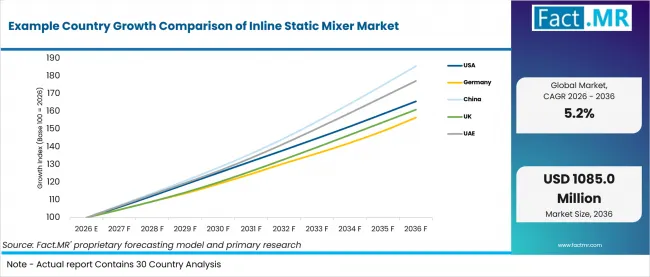
Example Country Growth Comparison Of Inline Static Mixer Market | Source: Fact.MR
| COUNTRY | 2026 to 2036 CAGR |
|---|---|
| China | 6.4% |
| UAE | 5.9% |
| USA | 5.2% |
| Japan | 5.1% |
| United Kingdom | 4.9% |
| Germany | 4.6% |
Source: Fact.MR analysis. Updated Jul 21, 2026
What is driving China’s growth from 2026 to 2036?
6.4% CAGR, supported by municipal water projects and higher-value chemical production.
China’s 6.4% CAGR is linked to investment in sewage treatment and advanced chemical plants. New treatment systems create regular demand for chemical dosing, pH control and sludge treatment. Static mixers are also useful in large chemical plants where liquids must be mixed continuously and evenly. Their small size makes them easier to place inside existing pipe systems.
How is UAE scaling demand?
5.9% CAGR, driven by desalination, water reuse and national water-security projects.
The UAE’s 5.9% CAGR comes from continued spending on desalination and treated-water reuse. Storage and water transport systems also support demand. These projects use static mixers during remineralisation, disinfection and chemical treatment. The equipment works well in large membrane plants since it mixes chemicals inside pipelines without adding motors or other moving parts.
What supports USA adoption?
5.2% CAGR, led by water-system renewal and upgrades to existing treatment plants.
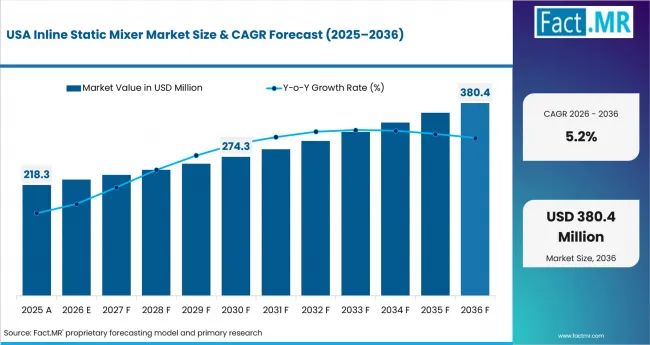
Inline Static Mixer Market Country Value Analysis | Source: Fact.MR
USA demand is expected to come mainly from improvements to older plants. Federal funding for drinking water, wastewater, reuse and contaminant removal gives utilities more money for upgrades. Static mixer sections can be added to current pipework, helping operators improve chemical dosing and treatment results without building new mixing tanks.
How does Japan perform?
5.1% CAGR, supported by semiconductor investment and precise chemical-processing work.
Japan’s 5.1% CAGR is connected to growth in semiconductors, electronic materials and advanced manufacturing. These industries use ultrapure water, photoresists and specialty chemicals that must stay clean and consistent. Static mixers used in these plants are judged by mixing accuracy, ease of cleaning, control over how long fluids remain in the line and proven operating results.
What shapes United Kingdom growth?
4.9% CAGR, backed by water-utility spending and wastewater-treatment upgrades.
The United Kingdom’s 4.9% CAGR is supported by projects that improve drinking-water supply and reduce sewage releases. Spending on chemical dosing, phosphorus removal, disinfection and plant improvement creates more openings for static mixers. Their compact design is useful in older treatment plants where pipe space is limited and there is little room for new tanks or major building work.
How does Germany develop?
4.6% CAGR, supported by industrial upgrades, better use of resources and careful equipment approval.
Germany’s 4.6% CAGR reflects a mature industrial base where equipment changes are reviewed closely. Chemical plants, public water systems and water-heavy industries are upgrading older facilities while meeting stricter operating rules. Suppliers are more likely to win projects when they provide clear pressure-loss data, proof that materials resist corrosion and reliable performance across changing flow rates.
Who leads the Inline Static Mixer Market?
Sulzer and Chemineer lead broad industrial static-mixer coverage, while Statiflo and Komax Systems strengthen water-treatment and process-line applications.
Sulzer supplies static mixers for turbulent and transitional duties through established industrial designs and has also expanded into open-channel water-treatment mixing. Chemineer supports the market through Kenics static mixers used across water, wastewater and chemical-processing lines. Statiflo adds pipe and channel mixers for dosing, desalination and utility projects. Komax Systems contributes inline mixing and direct-injection heating equipment, while StaMixCo serves polymer and difficult-ratio blending duties. SPX FLOW, Koflo Corporation broaden the competitive set through process equipment and application support.
From 2026 to 2036, competition is expected to depend on pressure-drop control, element geometry and material selection. Plant operators are also likely to compare cleaning access, installation drawings and lead times. Providers that combine application testing with retrofit-ready designs may gain stronger demand from chemical plants and water utilities.
Which companies are the key providers?
Sulzer; Chemineer (NOV); Statiflo; Komax Systems; StaMixCo; SPX FLOW; Koflo Corporation.
- Sulzer
- Chemineer (NOV)
- Statiflo
- Komax Systems
- StaMixCo
- SPX FLOW
- Koflo Corporation
Bibliography
- Sulzer. (2025, December 9). Sulzer introduces SyncX™ non-ragging channel mixer for water treatment. Sulzer.
- U.S. Environmental Protection Agency. (2026). EPA’s 7th Drinking Water Infrastructure Needs Survey and Assessment. U.S. Environmental Protection Agency.
- U.S. Department of Agriculture Rural Development. (2026). Water & waste disposal loan & grant program. U.S. Department of Agriculture.
- Department for Environment, Food & Rural Affairs. (2025, March 24). Storm overflows: Policy and guidance. GOV.UK.
This Report Answers
- The report provides strategic intelligence on Inline Static Mixer Market across Mixer Type and Material choices that shape purchasing decisions.
- Segment analysis covers Helical element mixers as the share leader within the 2026 market structure.
- Regional outlook evaluates China and UAE alongside USA and Japan, while UK and Germany complete the growth comparison.
- Competitive analysis profiles Sulzer and Chemineer (NOV) alongside Statiflo and Komax Systems. StaMixCo and additional active providers complete the company review.
- Use-case assessment covers the categories and applications that shape inline static mixer market demand across the forecast period.
What does the Inline Static Mixer Market cover?
Pipe-mounted mixing equipment uses fixed internal elements to blend, disperse or contact fluids without motors or rotating shafts.
The Inline Static Mixer Market covers mixer bodies, fixed element assemblies and related application-engineering services used within continuous process lines. Coverage includes helical, plate-type and corrugated element mixers. It also includes static gas mixers and sanitary inline designs. Products made from stainless steel, polymers, lined materials and corrosion-resistant alloys are included when supplied as defined mixing components.
The market differs from motor-driven mixing equipment because value comes from fixed-element geometry, material selection and process-line integration. Buyers assess mixing performance alongside pressure loss, available pipe length and compatibility with the fluid being handled. Complete process plants and broader engineering, procurement and construction expenditure remain outside the market boundary unless directly attributable to the static mixer package.
What is included in the scope?
Inline static mixers are used across chemical plants, water systems, refineries, food production and pharmaceutical processing.
The scope includes Mixer Type, Material, Application, Flow Regime and End User. Mixer Type coverage spans helical element, plate-type, corrugated element, static gas and sanitary inline mixers. Material coverage includes stainless steel 316L, PVC or CPVC, polypropylene, PTFE-lined designs and alloys such as Hastelloy or titanium.
Application coverage includes chemical blending, water and wastewater treatment, oil and gas processing, food and beverage production and pharmaceutical manufacturing. Laminar mixing, turbulent mixing, gas-liquid contacting, liquid-liquid dispersion and solid suspension are included within Flow Regime. Removable element cartridges, sanitary connections, custom mixer spools and technical sizing support are included when sold as part of mixer selection or installation.
What is excluded from the scope?
Motor-driven mixers and equipment without fixed static mixing elements remain outside the scope of this market.
The scope excludes inline high-shear mixers, rotor-stator systems, tank agitators and other mixing devices that rely on motors, shafts or rotating impellers. Eductors and simple injection nozzles are excluded when they do not contain a defined fixed-element mixing section. Pumps, storage tanks, dosing systems and heat exchangers are excluded unless their value is inseparable from the supplied static mixer package.
Complete EPC plant expenditure, civil construction, pipework beyond the mixer spool and unrelated process-control equipment also remain outside the scope. Maintenance services, replacement piping and general plant operations are excluded unless directly linked to an inline static mixer assembly. These categories follow different purchasing and performance criteria and would distort the market value attributed specifically to static mixing equipment.
How Was the Analysis Built?
The analysis draws on 120+ sources, 35+ company portfolios, 25+ countries, and more than 20 industry interviews.
- Primary Research: Primary research includes discussions with manufacturers, service providers, technology developers, distributors, end users, procurement teams, and subject-matter experts. These conversations examine purchasing priorities, product adoption, operational challenges, approval requirements, competitive positioning, and the factors that influence wider market acceptance.
- Desk Research: Desk research covers government statistics, regulatory publications, company filings, trade data, technical studies, industry associations, standards, public policy, and other authoritative sources. Every source used in the analysis is documented in the bibliography.
- Market Sizing and Forecasting: Market estimates combine historical performance, demand indicators, pricing and volume trends, segment shares, company participation, country-level growth, adoption patterns, investment activity, and barriers to market expansion.
- Data Validation and Update Cycle: Findings are validated by comparing primary interviews with public data, company activity, regulatory changes, trade patterns, and industry developments. Regular updates review new product launches, capacity changes, partnerships, approvals, procurement trends, and shifts in commercial adoption.
Segmentation
What is the report’s scope and coverage?
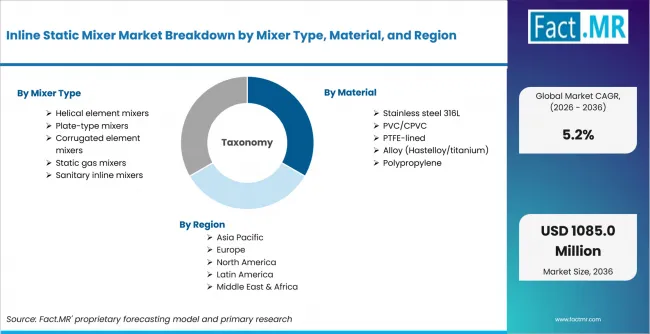
Inline Static Mixer Market Breakdown By Mixer Type, Material, And Region | Source: Fact.MR
| Attribute | Details |
|---|---|
| Quantitative Units | USD million |
| Market Definition | Pipe-mounted static mixers that use fixed elements to blend, disperse or contact fluids inside a process line. |
| Mixer Type | Helical element mixers; Plate-type mixers; Corrugated element mixers; Static gas mixers; Sanitary inline mixers |
| Material | Stainless steel 316L; PVC/CPVC; PTFE-lined; Alloy (Hastelloy/titanium); Polypropylene |
| Application | Chemical blending; Water & wastewater; Oil & gas; Food & beverage; Pharmaceutical |
| Flow Regime | Laminar mixing; Turbulent mixing; Gas-liquid contacting; Liquid-liquid dispersion; Solid suspension |
| End User | Chemical processors; Municipal utilities; Refineries; Food processors; Pharma & specialty |
| Regions Covered | North America; Latin America; Europe; East Asia; South Asia & Oceania; Middle East & Africa |
| Countries Covered | USA; Canada; Brazil; Mexico; Germany; U.K.; France; Italy; Spain; South Korea; Japan; China; India; Australia & New Zealand; GCC Countries; South Africa; UAE |
| Key Companies Profiled | Sulzer; Chemineer (NOV); Statiflo; Komax Systems; StaMixCo; SPX FLOW; Koflo Corporation. |
| Forecast Period | 2026 to 2036 |
| Approach | Hybrid top-down and bottom-up approach using demand indicators across Mixer Type, Material, Application, Flow Regime and End User. |
Source: Fact.MR analysis. Updated Jul 21, 2026
How is the market segmented?
-
By Mixer Type
- Helical element mixers
- Plate-type mixers
- Corrugated element mixers
- Static gas mixers
- Sanitary inline mixers
-
By Material
- Stainless steel 316L
- PVC/CPVC
- PTFE-lined
- Alloy (Hastelloy/titanium)
- Polypropylene
-
By Application
- Chemical blending
- Water & wastewater
- Oil & gas
- Food & beverage
- Pharmaceutical
-
By Flow Regime
- Laminar mixing
- Turbulent mixing
- Gas-liquid contacting
- Liquid-liquid dispersion
- Solid suspension
-
By End User
- Chemical processors
- Municipal utilities
- Refineries
- Food processors
- Pharma & specialty
-
By Region
- North America
- USA
- Canada
- Latin America
- Brazil
- Mexico
- Rest of Latin America
- Europe
- Germany
- U.K.
- France
- Italy
- Spain
- Rest of Europe
- East Asia
- South Korea
- Japan
- China
- South Asia & Oceania
- India
- Australia & New Zealand
- Rest of South Asia & Oceania
- Middle East & Africa
- GCC Countries
- South Africa
- UAE
- Rest of Middle East & Africa
- North America
Frequently Asked Questions
Which Mixer Type leads the Inline Static Mixer Market?
Which Material leads the Inline Static Mixer Market?
Which Application leads the Inline Static Mixer Market?
Which Flow Regime leads the Inline Static Mixer Market?
Which End User leads the Inline Static Mixer Market?
Which country records the highest CAGR in the Inline Static Mixer Market?
How does UAE perform in the Inline Static Mixer Market?
How does USA perform in the Inline Static Mixer Market?
What is the primary driver in the Inline Static Mixer Market?
What is the main restraint in the Inline Static Mixer Market?
Who worked on this report


Preview the report firsthand - request a free sample
Free SampleGet the brochure for pricing and purchase details
Download PDF