- Base Value(2025): 28.80 Bn
- Estimated Value(2026): 29.81 Bn
- Forecast Value (2036): 42.05 Bn
- CAGR (2026 - 2036): 3.50%
Inorganic Catalysts Market Forecast and Outlook By FACT.MR
In 2025, the inorganic catalysts market was valued at USD 28.80 billion. Based on Fact.MR analysis, demand for inorganic catalysts is estimated to grow to USD 29.81 billion in 2026 and USD 42.05 billion by 2036. FACT.MR projects a CAGR of 3.50% during the forecast period.
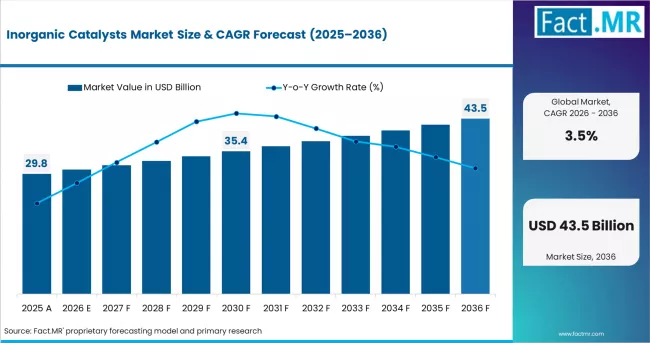
Inorganic Catalysts Market Value Analysis | Source: Fact.MR
Summary Of Inorganic Catalysts Market
- Market Definition
- The market covers inorganic chemical compounds, metal-based catalysts, and related formulations supplied for petroleum refining, environmental emission control, and chemical synthesis applications across industrial and specialty sectors globally.
- Demand Drivers
- India is scaling refinery capacity under the National Biofuel Policy and Bharat Stage VI emission norms. Driven by domestic fuel demand and clean transportation mandates.
- China is expanding petrochemical output and enforcing stricter emission limits under the 14th Five-Year Plan. Environmental catalyst demand is growing across power and industrial sectors.
- U.S. refinery catalyst upgrade demand is rising under EPA Tier 3 fuel standards and FCC modernisation programmes. This drives structured procurement cycles for high-activity formulations.
- Key Segments Analyzed
- By Type: Chemical Compounds leads with 41.0% share in 2026. Driven by broad applicability across refining, synthesis, and environmental control applications.
- By Application: Environmental leads with 30.0% share in 2026. Driven by mandatory emission control regulations across industrial and transportation sectors globally.
- By Region: Asia Pacific leads global demand. India and China drive volume growth through refinery expansion and tightening environmental compliance enforcement.
- Analyst Opinion at FACT.MR
- Shambhu Nath Jha, Principal Consultant at Fact.MR, opines, 'CXOs will find that high-activity, regulatory-grade inorganic catalyst formulations are capturing disproportionate revenue share. Commodity-grade volumes are stagnating. Producers with certified activity profiles and regeneration documentation have a structural pricing advantage across refining and environmental segments.
- Strategic Implications
- Invest in high-activity FCC and hydroprocessing catalyst formulations with documented regeneration cycles. This supports refinery procurement in India, China, and the U.S. under clean fuel compliance mandates.
- Develop specialty environmental catalyst lines aligned with EU Industrial Emissions Directive and EPA Tier 3 standards. This captures premium pricing in regulation-driven retrofit markets.
- Expand distributor and licensing partnerships in India and China. This supports growing refinery and chemical plant demand and enables local specification compliance.
- Methodology
- Market sizing is based on manufacturer revenues and volume shipments by catalyst type. Validated using 2024–2025 financials and refinery procurement benchmarks.
- Demand and country analysis use EPA Tier 3 data, EU IED regulations, India BSV/BSVI compliance timelines, and refinery capacity expansion records.
Forecasts incorporate refinery turnaround cycles, emission compliance deadlines, and chemical plant commissioning activity. Supported by expert interviews with procurement and operations teams.
| Metric | Value |
|---|---|
| Estimated Value in 2026 | USD 29.81 billion |
| Forecast Value in 2036 | USD 42.05 billion |
| Forecast CAGR (2026 to 2036) | 3.50% |
Source: Fact.MR analysis. Updated Apr 22, 2026
Between 2026 and 2036, the market is projected to generate USD 12.24 billion in absolute opportunity. Growth is sustained by emission control mandates, refinery modernisation, and chemical synthesis expansion. Volume growth is moderated by long catalyst replacement cycles and competitive pressure from bio-based alternatives in select niches.
Procurement of inorganic catalysts is becoming specification-driven. Buyers require documented activity profiles and regeneration data. Regulatory-grade certification is now essential. Refining and chemical companies are consolidating supplier lists. Preference is shifting toward producers with traceable sourcing and consistent performance. Low-cost suppliers without validation are losing relevance. Reliability and compliance now outweigh upfront cost advantages.
India leads country-level growth at 4.9% CAGR through 2036, driven by refinery capacity expansion and environmental catalyst demand under Bharat Stage VI compliance. China follows at 4.6% through petrochemical investment and emission control enforcement under the 14th Five-Year Plan. South Korea records 3.7%, anchored by refining exports and specialty chemical expansion. The United States records 3.4%, supported by clean fuel catalyst upgrades and FCC unit modernisation. Brazil records 3.2% through pre-salt refining development and industrial chemical demand growth, with growth moderated by infrastructure investment cycles.
Segmental Analysis
Inorganic Catalysts Market Analysis by Type
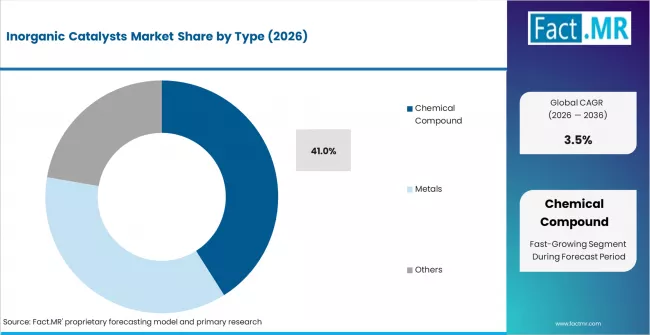
Inorganic Catalysts Market Analysis By Type | Source: Fact.MR
Chemical compounds are projected to hold 41.0% share in 2026. This segment leads due to versatility across refining and environmental uses. These catalysts offer stable activity and compatibility with existing units.
- BASF Catalyst Portfolio Expansion: BASF SE expanded FCC catalyst capacity in Ludwigshafen in 2024. This supports low-sulfur fuel demand in Europe. [1]
- Albemarle Hydroprocessing Development: Albemarle Corporation launched STARS RT catalysts in 2024. These improve activity by up to 15%. Focus is on ultra-low sulfur compliance. [2]
- Refinery Catalyst Reload Trend: U.S. refineries maintained high FCC utilisation above 85% in 2024. This supports steady annual catalyst replacement demand. [3]
Inorganic Catalysts Market Analysis by Application
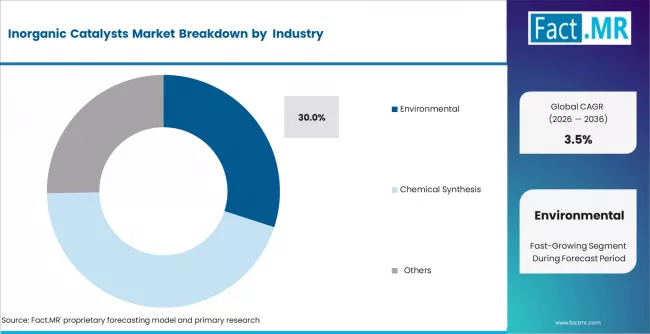
Inorganic Catalysts Market Analysis By Application | Source: Fact.MR
Environmental catalysts are projected to hold 30.0% share in 2026. Demand is driven by mandatory emission regulations. Procurement follows compliance timelines and audit cycles.
- Haldor Topsoe Emission Catalyst Launch: Topsoe A/S launched CataFlex SCR modules in 2024. These target NOx reduction across industrial sectors. [4]
- Honeywell Environmental Catalyst Development: Honeywell International expanded UOP catalyst offerings in 2025. Focus is on Tier 3 fuel compliance. [5]
- Industrial Emission Compliance Trend: IED deadlines accelerated upgrades across European industrial sites in 2024. This is driving multi-year demand for SCR and oxidation catalysts. [6]
Drivers, Restraints, and Opportunities
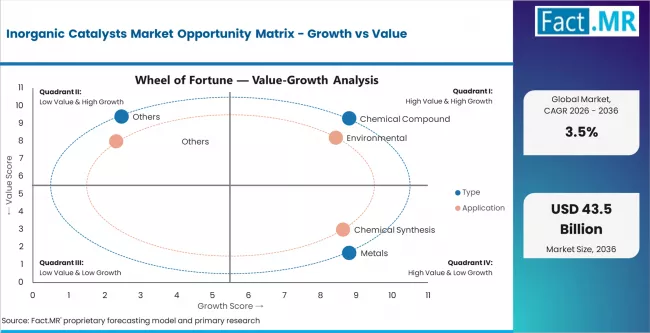
Inorganic Catalysts Market Opportunity Matrix Growth Vs Value | Source: Fact.MR
Fact.MR analysis indicates the inorganic catalysts market is structurally anchored in refining and environmental compliance, valued at USD 28.80 billion in 2025. Demand is supported by mandatory use in FCC units, hydrotreaters, and emission control systems. Regulatory enforcement ensures stable procurement cycles, independent of broader chemical sector volatility.
A clear formulation divide is visible. Bulk catalysts face margin pressure and substitution risk. High-activity, selectivity-driven catalysts for clean fuels and emissions control are gaining share. Premium formulations command 20–35% higher prices. Revenue growth is driven more by specification upgrades than volume expansion, with overall CAGR at 3.50%.
- Emission Compliance Catalyst Demand: U.S. EPA Tier 3 standards reduced sulfur limits to 10 ppm. This increased demand for advanced hydrotreating catalysts. Albemarle Corporation and BASF SE reported higher reload demand during 2024–2025. Procurement is recurring and regulation-driven.
- EU Industrial Emissions Directive Driver: IED Phase II mandates BAT compliance across industrial sites. Evonik Industries expanded its environmental catalyst portfolio in 2025. Demand is rising for NOx and SOx control systems across Europe. This is driving systematic catalyst upgrades.
- Asia Pacific Refinery Expansion: Refinery capacity additions are increasing catalyst demand. Oil and Natural Gas Corporation expanded Barauni and Gujarat units in 2024. SINOPEC increased procurement under national planning targets. The region drives bulk volume growth.
Regional Analysis
The inorganic catalysts market is assessed across Asia Pacific, Europe, North America, Latin America, and Middle East and Africa, covering 40+ key countries with distinct demand profiles shaped by refinery complexity, emission compliance intensity, and chemical sector investment. The full report offers market attractiveness analysis by region and country.
.webp "Top Country Growth Comparison Inorganic Catalysts Market Cagr (2026 2036)")
Top Country Growth Comparison Inorganic Catalysts Market Cagr (2026 2036) | Source: Fact.MR
| Country | CAGR (2026 to 2036) |
|---|---|
| India | 4.9% |
| China | 4.6% |
| South Korea | 3.7% |
| USA | 3.4% |
| Brazil | 3.2% |
Source: Fact.MR analysis. Updated Apr 22, 2026
Source: Fact.MR (FACT.MR) analysis, based on proprietary forecasting model and primary research
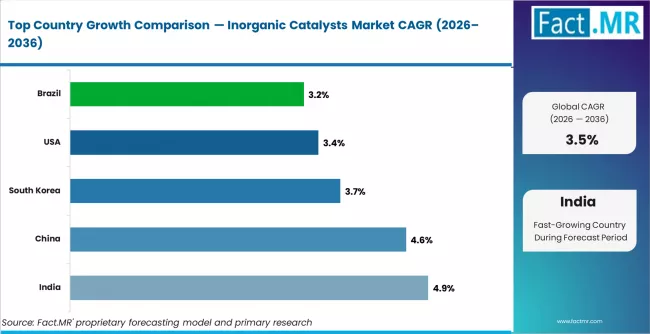
Inorganic Catalysts Market Cagr Analysis By Country | Source: Fact.MR
Asia Pacific Inorganic Catalysts Market Analysis
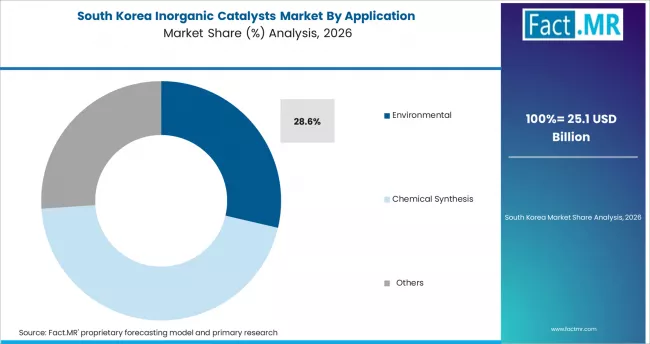
Inorganic Catalysts Market South Korea Market Share Analysis By Application | Source: Fact.MR
Asia Pacific continues to lead growth. Expansion in refining and petrochemicals supports demand. India and China show distinct procurement structures. BASF SE and Albemarle Corporation remain active across both markets with differentiated offerings.
- India: Regulation-led demand remains consistent across refinery operations. The market is expected to grow at 4.9% CAGR through 2036. Bharat Stage VI norms continue to sustain hydrotreating catalyst usage. Indian Oil Corporation is advancing upgrades at Panipat and Mathura. Refinery throughput growth is supporting steady catalyst reload cycles. Imports of advanced formulations indicate limited domestic high-spec capability.
- China: Industrial scale and policy direction are shaping catalyst demand. Growth is projected at 4.6% CAGR through 2036. SINOPEC and PetroChina continue to expand procurement under national plans. Stricter emission rules are increasing SCR and oxidation catalyst adoption. Domestic suppliers dominate standard volumes, while imports address high-performance needs.
- South Korea: Petrochemical integration and refinery efficiency upgrades are shaping catalyst demand. Growth is projected at 3.7% CAGR through 2036. Major refiners are focusing on hydroprocessing optimization and emission compliance upgrades. Demand is supported by high utilisation rates across integrated refining and chemical complexes. Environmental catalyst adoption is also increasing in line with tightening industrial emission standards.
FACT.MR covers China, India, Japan, South Korea, ASEAN, and Australia & New Zealand. Includes production data, emission standards impact, and catalyst demand benchmarks.
North America Inorganic Catalysts Market Analysis
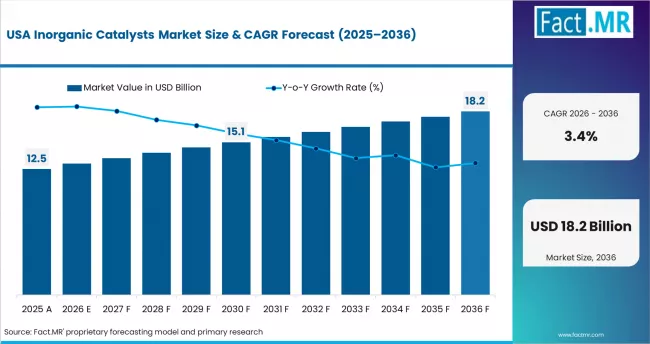
Inorganic Catalysts Market Country Value Analysis | Source: Fact.MR
North America reflects a stable, compliance-driven environment. Demand is tied to emission standards and refinery upgrades. FCC modernisation continues to support consumption. Leading suppliers include BASF SE, Albemarle Corporation, W. R. Grace & Co., and Honeywell UOP.
- USA: Market movement is largely replacement-driven. A 3.4% CAGR is projected through 2036. Tier 3 fuel standards continue to require periodic catalyst reloads. W. R. Grace & Co. reported strong FCC demand linked to refinery utilisation. Federal upgrade programmes are supporting long-term procurement visibility.
FACT.MR covers the United States, Canada, and Mexico. Includes refinery upgrade benchmarks, EPA compliance data, and catalyst procurement trends.
Latin America Inorganic Catalysts Market Analysis
Latin America shows moderate growth led by Brazil. Refining investments define demand cycles. Market timing depends on infrastructure spending and policy stability.
- Brazil: Refinery investment is the key growth lever. Demand is expected to grow at 3.2% CAGR through 2036. Petrobras is advancing upgrades and FCC expansion. Low-sulfur fuel mandates continue to support hydroprocessing catalyst demand. Procurement remains centralised and favours global suppliers with proven performance records.
FACT.MR covers Brazil, Mexico, and Rest of Latin America. Includes refinery capex data, procurement cycles, and catalyst trade flow analysis.
Key Players
- BASF SE
- Albemarle Corporation
- Evonik Industries AG
- LyondellBasell Industries N.V.
- Arkema S.A.
- Dow Inc.
- Haldor Topsoe A/S (Topsoe A/S)
- W. R. Grace & Co.
- Honeywell International Inc.
Bibliography
- [1] BASF SE. Catalyst Division Operational Update: FCC Catalyst Capacity Expansion at Port Arthur Texas Facility Supporting North American Tier 3 Refinery Compliance Demand. Q1 2025. basf.com/investor-relations
- [2] Albemarle Corporation. Refining Solutions Business Update: STARS RT Hydroprocessing Catalyst Series Launch for Ultra-Low Sulfur Diesel Compliance in Asia Pacific and North American Refinery Markets. 2024. albemarle.com
- [3] U.S. Energy Information Administration. Petroleum Supply Monthly: FCC Unit Utilisation Rates and Catalyst Reload Procurement Trends Across U.S. Gulf Coast Refinery Operations. 2024. eia.gov
- [4] Topsoe A/S. Product Launch Announcement: CataFlex SCR Catalyst Module for Industrial NOx Emission Control Targeting European and Asian Power and Chemical Sector Installations. 2024. topsoe.com
- [5] Honeywell International Inc. UOP Division Update: Environmental Catalyst Portfolio Expansion Including Tier 3 Low-Sulfur Gasoline Formulations for Mid-Size U.S. Refinery Compliance. 2025. honeywell.com/investor-relations
- [6] European Environment Agency. Industrial Emissions Directive Compliance Assessment: Catalyst Upgrade Procurement Trends Across Registered Industrial Installations in Germany and France Under IED Phase II BAT Requirements. 2024. eea.europa.eu
This Report Addresses
- Strategic intelligence on inorganic catalyst demand across petroleum refining, environmental emission control, and chemical synthesis applications globally.
- Market forecast from USD 29.81 billion in 2026 to USD 42.05 billion by 2036 at a CAGR of 3.50%.
- Growth opportunities across India refinery expansion, China petrochemical investment, U.S. Tier 3 compliance upgrades, and Brazil pre-salt downstream development.
- Segment analysis by type (chemical compounds, metals, others) and application (environmental, chemical synthesis, petroleum refining, others).
- Regional outlook covering Asia Pacific refinery growth, North America compliance-driven procurement, and Europe IED-driven catalyst upgrades.
- Competitive landscape of BASF SE, Albemarle Corporation, Evonik Industries, LyondellBasell, Arkema, Dow, Topsoe, W.R. Grace, and Honeywell. Focus on formulation IP, feedstock integration, and compliance positioning.
- Regulatory analysis covering EPA Tier 3 standards, EU Industrial Emissions Directive, India Bharat Stage VI norms, and China 14th Five-Year Plan emission targets.
- Report delivered in PDF, Excel, and presentation formats. Supported by primary interviews, company financials, regulatory records, and refinery procurement benchmarks.
Inorganic Catalysts Market Definition
The inorganic catalysts market covers metal compounds, chemical compound formulations, and other inorganic materials used to accelerate chemical reactions without being consumed. Core applications include petroleum refining, environmental emission control, and chemical synthesis across industrial and specialty processes globally.
Inorganic Catalysts Market Inclusions
Includes global and regional forecasts from 2026 to 2036 by type, application, and region. Covers chemical compound catalysts, metal-based catalysts, environmental catalysts, FCC catalysts, hydroprocessing catalysts, and synthesis catalysts used in refining, chemicals, and emission control across all end-use industries.
Inorganic Catalysts Market Exclusions
Excludes organic and bio-based catalysts, enzyme catalysts, and homogeneous catalysts in solution unless used in hybrid inorganic-organic systems. Also excludes downstream finished chemical products and catalyst equipment. Focus remains on inorganic catalyst materials supplied to industrial end users.
Inorganic Catalysts Market Research Methodology
- Primary Research
- Interviews with refinery procurement managers, chemical plant operations teams, catalyst distributors, and emission control compliance officers across key markets in Asia, North America, and Europe.
- Desk Research
- Analysis of BASF SE, Albemarle Corporation, and Evonik Industries annual reports, EPA emission catalyst standards data, EU industrial emission compliance records, and inorganic catalyst trade statistics from 2024 to 2025.
- Market-Sizing and Forecasting
- Hybrid model integrating top-down estimates from catalyst manufacturer revenues with bottom-up application-level volume forecasts by type and end-use application segment.
- Data Validation and Update Cycle
- Validated through manufacturer revenue data, refinery turnaround procurement volumes, application-level consumption benchmarks, and expert interviews with catalyst specification and procurement specialists.
Segmentation
Scope of Report
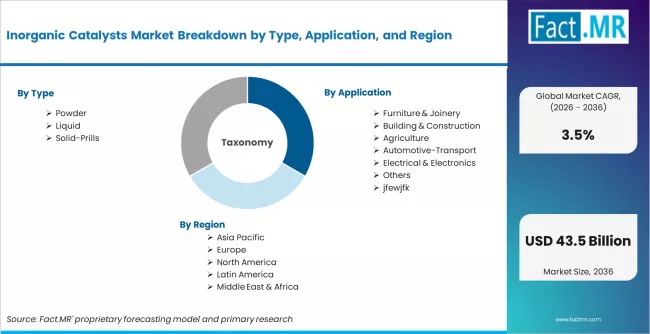
Inorganic Catalysts Market Breakdown By Type, Application, And Region | Source: Fact.MR
| Attribute | Details |
|---|---|
| Quantitative Units | USD 29.81 billion (2026) to USD 42.05 billion (2036), at a CAGR of 3.50% |
| Market Definition | Inorganic chemical compound, metal-based, and specialty catalyst materials used in petroleum refining, environmental emission control, and chemical synthesis applications supplied to industrial end users globally. |
| Type Segmentation | Chemical Compounds, Metals, Others |
| Application Segmentation | Environmental, Chemical Synthesis, Petroleum Refining, Others |
| Application Coverage | Environmental emission control catalyst supply, petroleum FCC and hydroprocessing catalyst demand, chemical synthesis catalyst procurement, and specialty inorganic catalyst formulations for industrial applications globally. |
| Regions Covered | North America, Europe, Asia Pacific, Latin America, Middle East and Africa |
| Countries Covered | USA, Canada, Mexico, Germany, UK, France, Italy, Spain, Nordic, BENELUX, China, Japan, South Korea, India, ASEAN, Australia and New Zealand, Brazil, Argentina, Chile, Saudi Arabia, GCC, Turkey, South Africa, Rest of MEA |
| Key Companies Profiled | BASF SE, Albemarle Corporation, Evonik Industries AG, LyondellBasell Industries N.V., Arkema S.A., Dow Inc., Haldor Topsoe A/S, W. R. Grace & Co., Honeywell International Inc. |
| Forecast Period | 2026 to 2036 |
| Approach | Hybrid top-down and bottom-up model using inorganic catalyst manufacturer revenues, volume shipments by type, average selling prices by application segment, refinery turnaround procurement benchmarks, and primary interviews with catalyst procurement and operations specialists. |
Source: Fact.MR analysis. Updated Apr 22, 2026
Inorganic Catalysts Market by Segments
-
By Type:
- Chemical Compounds
- Metals
- Others
-
By Application:
- Environmental
- Chemical Synthesis
- Petroleum Refining
- Others
-
By Region:
- North America
- United States
- Canada
- Mexico
- Latin America
- Brazil
- Mexico
- Argentina
- Chile
- Rest of Latin America
- Western Europe
- Germany
- United Kingdom
- France
- Italy
- Spain
- Nordic Countries
- BENELUX
- Rest of Western Europe
- Eastern Europe
- Russia
- Poland
- Hungary
- Balkan and Baltic
- Rest of Eastern Europe
- East Asia
- China
- Japan
- South Korea
- South Asia and Pacific
- India
- ASEAN
- Australia and New Zealand
- Rest of South Asia and Pacific
- Middle East and Africa
- Kingdom of Saudi Arabia
- Other GCC Countries
- Turkey
- South Africa
- Rest of Middle East and Africa
- North America
Frequently Asked Questions
How large is the global inorganic catalysts market in 2025?
What will the market size be in 2026?
What is the projected market size by 2036?
What is the expected CAGR from 2026 to 2036?
Which type segment is poised to lead the inorganic catalysts market?
Which application segment holds the largest share?
Which country shows the fastest growth in the inorganic catalysts market?
What are inorganic catalysts used for?
What drives demand in this market?
Who are the key players in the market?
What are the major restraints?
Who worked on this report


Preview the report firsthand - request a free sample
Free SampleGet the brochure for pricing and purchase details
Download PDF