- Market Value (2025): USD 13.0 Bn
- Estimated Value (2026): USD 13.8 Bn
- Forecast Value (2036): USD 25.2 Bn
- CAGR (2026-2036): 6.2%
What is the Insulated Wall Panels (IWP) Market forecast to be worth by 2036?
USD 13.8 billion in 2026 to USD 25.2 billion by 2036 at a 6.2% CAGR.
- The insulated wall panels market crossed a valuation of USD 13.0 billion in 2025, ahead of its 2026 forecast baseline.
- According to Fact.MR analysis, market revenue is projected to increase from USD 13.8 billion in 2026 to USD 25.2 billion by 2036 as developers use factory-insulated panels in commercial, industrial and temperature-controlled buildings.
- The forecast 6.2% CAGR from 2026 to 2036 reflects demand for faster building enclosure and wall systems designed around defined thermal-performance requirements.
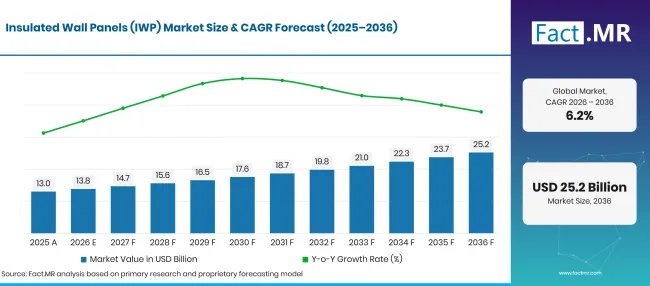
Insulated Wall Panels Iwp Market Forecast Global | Source: Fact.MR
| Year | Basis | Market Value (USD billion) |
|---|---|---|
| 2025 | Actual | 13.0 |
| 2026 | Estimate | 13.8 |
| 2036 | Forecast | 25.2 |
| CAGR 2026 to 2036 | Forecast period | 6.2% |
Source: Fact.MR analysis. Updated Nov 10, 2026
What are the defining numbers behind Insulated Wall Panels (IWP) Market growth?
USD 11.4 billion in additional market value by 2036; polyurethane, commercial buildings and construction lead the market mix.
- Demand Drivers in the Market
- An insulated panel combines the protective outer surface with the thermal layer, allowing contractors to close large wall areas using fewer separate installation steps. Once the building envelope is complete, internal trades can begin work with less exposure to weather-related delays.
- Commercial developers assess the wall assembly against both energy requirements and the construction schedule.
- Cold-store operators need a continuous insulated envelope around temperature-controlled spaces. Panel-joint details and the continuity of insulation influence day-to-day heat gain and refrigeration work.
- Industrial contractors often use repeated panel lengths to reduce on-site cutting and simplify installation across large wall bays. Factory-applied finishes can also reduce the amount of exterior work needed after the supporting frame is ready, although lifting access and opening details remain important.
- Project owners compare complete installed systems rather than panel prices alone. Weather sealing, fire performance and access for repairs influence long-term value.
- Key Segments Analyzed
- By Material Type: Polyurethane is estimated to account for 42.1% of 2026 revenue, reflecting its use in thermally insulated building shells.
- By Application: Commercial Buildings are forecast to represent 48.3% in 2026, where exterior appearance and enclosure speed both influence selection.
- By End-Use Industry: Construction is projected to contribute 62.4% in 2026 as new buildings and envelope work specify factory-insulated wall systems.
- Analyst Opinion at Fact.MR
- Shambhu Nath Jha, Principal Consultant at Fact.MR, states, “Insulated wall panel demand is shaped by how effectively a complete wall assembly combines thermal performance, installation speed and project-specific fire requirements. Buyers assess joint design, panel dimensions, lifting access and installed cost before approving a system.”
- Strategic Implementations
- Panel manufacturers should provide clearly identified thermal and fire-test information for complete assemblies, helping designers compare approved wall systems.
- Architects should agree on panel-joint details before finalizing the façade layout, so structural connections and weather sealing can be coordinated.
- Cold-store developers need to check the complete wall system against operating temperatures, with particular attention to joints and service penetrations.
Germany is projected to grow at 6.7% CAGR; Brazil at 6.1%; the USA at 5.5%; the UK at 4.9%; and Japan at 4.4% through 2036.
How does the Insulated Wall Panels (IWP) Market break down by segment?
Polyurethane holds 42.1%; Commercial Buildings hold 48.3%; Construction accounts for 62.4% in 2026.
Which Material Type dominates?
Polyurethane represents 42.1% of 2026 value.
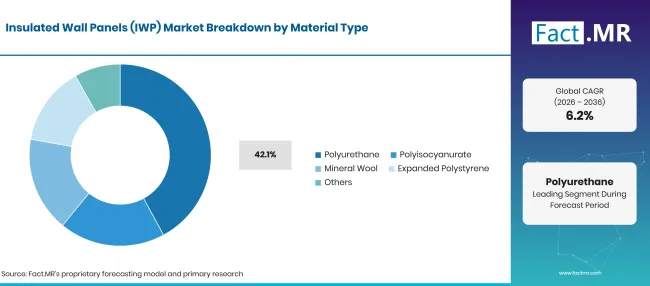
Insulated Wall Panels Iwp Market Breakdown Material Type | Source: Fact.MR
| Material Type | Share (2026) |
|---|---|
| Polyurethane (Leading segment) | 42.1% |
| Other segments combined | 57.9% |
| Total | 100.0% |
Source: Fact.MR analysis. Updated Nov 10, 2026
Polyurethane cores appeal to project teams that need light panels with useful insulation performance. Their share reflects the broad use of foam-core systems in commercial and industrial wall construction. Polyisocyanurate offers an alternative foam chemistry used in fire-tested wall-panel products. Mineral wool systems serve projects that place particular weight on fire performance and sound control.
What leads the Application segment?
Commercial Buildings account for 48.3% of 2026 demand.
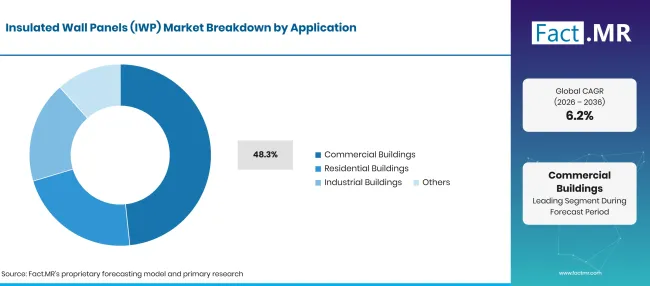
Insulated Wall Panels Iwp Market Breakdown Application | Source: Fact.MR
| Application | Share (2026) |
|---|---|
| Commercial Buildings (Leading segment) | 48.3% |
| Other segments combined | 51.7% |
| Total | 100.0% |
Source: Fact.MR analysis. Updated Nov 10, 2026
Commercial projects often need an exterior wall that closes quickly while presenting a consistent architectural finish. Insulated wall panels suit designs with repeated modules and coordinated openings. Residential Buildings form a separate application where local building methods determine the preferred exterior assembly. Industrial Buildings generally place more weight on durable finishes and practical installation access. Cold Storage requires particular attention to thermal bridging at joints and service penetrations.
How does End-Use Industry shape demand?
Construction captures 62.4% of 2026 value.
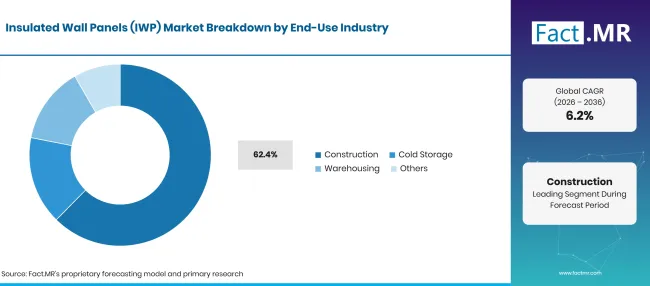
Insulated Wall Panels Iwp Market Breakdown End Use Industry | Source: Fact.MR
| End-Use Industry | Share (2026) |
|---|---|
| Construction (Leading segment) | 62.4% |
| Other segments combined | 37.6% |
| Total | 100.0% |
Source: Fact.MR analysis. Updated Nov 10, 2026
Construction accounts for the principal route through which insulated wall panels reach finished buildings. General contractors integrate the product with steel framing and the schedule for closing the exterior envelope. Warehousing adds demand where broad wall areas favor repeatable factory-made components. Temperature-controlled storage requires more careful sealing than ordinary ambient warehouses.
What is accelerating Insulated Wall Panels (IWP) Market adoption, and what is holding it back?
Adoption will grow through faster commercial building enclosure, cold-storage expansion, warehouse construction and energy-performance requirements. Fire-code qualification, higher installed-system costs, transport and lifting challenges, and changes in core-material and steel-facing costs will limit how quickly demand expands.
Drivers Impact Analysis
| DRIVER | (~) % IMPACT ON CAGR | GEOGRAPHIC RELEVANCE | IMPACT TIMELINE |
|---|---|---|---|
| Faster closure of commercial building envelopes | +1.2% | Global | Short term (≤2 years) |
| Demand for thermally controlled cold stores | +1.0% | Global | Medium term (2–4 years) |
| Industrial and warehouse wall construction | +0.9% | North America, Europe | Medium term (2–4 years) |
| Building energy-performance requirements | +0.7% | Europe | Long term (≥4 years) |
| Factory-finished architectural facades | +0.5% | Developed markets | Medium term (2–4 years) |
Source: Fact.MR analysis. Updated Nov 10, 2026
Opportunity Impact Analysis
| OPPORTUNITY | (~) % IMPACT ON CAGR | GEOGRAPHIC RELEVANCE | IMPACT TIMELINE |
|---|---|---|---|
| Refurbishment of commercial facades | +0.8% | Europe | Long term (≥4 years) |
| Cold-chain building additions | +0.7% | Global | Medium term (2–4 years) |
| Modular warehouse building formats | +0.5% | Global | Medium term (2–4 years) |
| Fire-tested mineral wool wall assemblies | +0.4% | Europe, North America | Long term (≥4 years) |
Source: Fact.MR analysis. Updated Nov 10, 2026
Restraints Impact Analysis
| RESTRAINT | (~) % IMPACT ON CAGR | GEOGRAPHIC RELEVANCE | IMPACT TIMELINE |
|---|---|---|---|
| Fire-code and assembly qualification | -0.7% | Global | Short term (≤2 years) |
| Upfront installed-system expense | -0.6% | Global | Short term (≤2 years) |
| Transport and lifting of long panels | -0.4% | Global | Medium term (2–4 years) |
| Core input and steel-facing cost changes | -0.3% | Global | Medium term (2–4 years) |
Source: Fact.MR analysis. Updated Nov 10, 2026
Which countries are scaling the Insulated Wall Panels (IWP) Market through 2036?
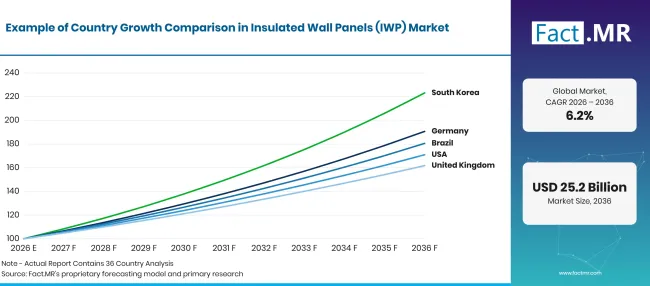
Insulated Wall Panels Iwp Market Growth Index | Source: Fact.MR
| Country | CAGR (2026 to 2036) |
|---|---|
| Germany | 6.7% |
| Brazil | 6.1% |
| USA | 5.5% |
| UK | 4.9% |
| Japan | 4.4% |
Source: Fact.MR analysis. Updated Nov 10, 2026
What supports Germany’s insulated wall panel outlook?
6.7% CAGR, tied to energy-focused building envelopes and commercial refurbishment.
German building-envelope teams compare the complete wall assembly for thermal performance and approved fire classification. The European building-performance framework makes the assessment of external wall performance relevant to longer-term renovation decisions [6]. Destatis reported 238,500 permitted dwellings in 2025, an increase of 10.8% over 2024 [1].
How is Brazil developing its insulated wall-panel demand?
6.1% CAGR, supported by industrial enclosures and cold-room requirements.
Brazilian industrial developers assess panel delivery distances as closely as installation time. The Brazilian Institute of Geography and Statistics reported construction costs rising by 5.63% during 2025 [4]. Weather exposure and joint sealing shape product choice in humid locations.
What supports the USA insulated wall-panel outlook?
5.5% CAGR, linked to commercial envelopes and refrigerated facilities.
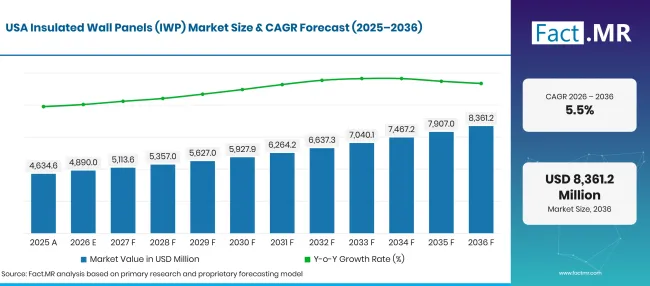
Insulated Wall Panels Iwp Market Forecast Usa | Source: Fact.MR
United States industrial contractors compare insulated metal panel systems with conventional wall assemblies using installation schedules and code-approved assembly details. Repeated warehouse wall bays favor standard panel sizes, while refrigerated buildings require closer attention to the thermal performance of the entire envelope. The US Census Bureau placed private nonresidential construction spending at a seasonally adjusted annual rate of USD 790.6 billion in September 2026 [3].
How does the UK insulated wall-panel market develop?
4.9% CAGR, influenced by refurbishment and warehouse envelope work.
United Kingdom building teams evaluate insulated wall panels against each building’s fire classification and facade design. Existing commercial facades offer a separate refurbishment route, while industrial sheds provide long runs of wall area suited to factory-made components. The Office for National Statistics recorded £139,106 million of construction new work in Great Britain in 2025 [2].
What shapes Japan’s insulated wall-panel adoption?
4.4% CAGR, associated with controlled interiors and precise building specifications.
Japanese industrial building teams place close attention on dimensional accuracy and the coordination of openings before insulated wall panels arrive on site. Factory-controlled panel manufacture offers a practical choice for projects that have limited storage space and require carefully planned installation sequences. Japan’s Ministry of Land, Infrastructure, Transport and Tourism reported non-wood construction work valued at ¥18.7331 trillion for 2025 [5].
Who leads the Insulated Wall Panels (IWP) Market?
Kingspan, Metecno, ArcelorMittal Construction and Isopan compete in insulated wall systems.
Metecno Group and Isopan also participate in sandwich-panel systems for building envelopes. ArcelorMittal Construction offers insulated envelope products alongside steel-based building components.
Nucor Building Systems participates through engineered building systems and related wall-envelope solutions. Ruukki Construction supplies sandwich panels and facade systems. Alubel, ATAS International and All Weather Insulated Panels are profiled for their wall-system offerings.
Which companies are the key providers?
Key companies include Kingspan Group, Metecno Group, Nucor Building Systems, ArcelorMittal Construction, Tata Steel UK, Ruukki Construction, Alubel SpA, Isopan S.p.A., ATAS International, and All Weather Insulated Panels (AWIP).
- Kingspan Group
- Metecno Group
- Nucor Building Systems
- ArcelorMittal Construction
- Tata Steel UK
- Ruukki Construction
- Alubel SpA
- Isopan S.p.A.
- ATAS International
- All Weather Insulated Panels (AWIP)
Bibliography
- [1] Statistisches Bundesamt (Destatis). (2026, February 18). 10,8 % mehr Baugenehmigungen für Wohnungen im Jahr 2025.
- [2] Office for National Statistics. (2026, October 23). Construction statistics, Great Britain: 2025.
- [3] U.S. Census Bureau. (2026, November 2). Monthly Construction Spending, September 2026.
- [4] Instituto Brasileiro de Geografia e Estatística. (2026, January 9). Índice Nacional da Construção Civil varia 0,51% em dezembro.
- [5] Ministry of Land, Infrastructure, Transport and Tourism, Japan. (2026, September 30). 建築工事費調査(令和7年分)の調査結果について [Results of the 2025 Building Construction Cost Survey].
- [6] European Parliament & Council of the European Union. (2024, May 8). Directive (EU) 2024/1275 on the energy performance of buildings (recast). Official Journal of the European Union.
This Report Answers
- How polyurethane, polyisocyanurate and mineral-wool core choices affect insulated wall-panel specifications.
- Why commercial building envelopes account for a substantial share of application demand.
- How construction and warehouse projects differ in installation priorities.
- Why Germany, Brazil, the USA, the UK and Japan have different growth outlooks.
- What fire approval, installation access and project cost mean for suppliers.
- Which product families are relevant to the competitive landscape.
What does the Insulated Wall Panels (IWP) Market cover?
The market covers insulated wall-panel systems sold for commercial buildings and other building envelopes. The product combines a factory-made insulated core with protective facings and specified joints. The revenue boundary covers panels designed for wall applications and relevant internal partitions where a complete insulating panel is installed.
What is included in the scope?
Polyurethane, polyisocyanurate, mineral wool and expanded polystyrene core options are included when sold as insulated wall panels.
Exterior cladding panels and appropriate internal cold-room wall panels form part of the product coverage. Material shares refer to the insulating-core classification while applications describe the building use.
What is excluded from the scope?
Standalone rigid insulation boards and loose mineral-wool batts fall outside the finished-panel definition.
Insulated roof-only products and uninsulated metal sheets are excluded. Any complete building-system contract is counted only to the extent that identifiable insulated wall-panel revenue belongs in the category.
How Was the Analysis Built?
The analysis draws on 120+ sources, 35+ company portfolios, 25+ countries, and more than 20 industry interviews.
- Primary Research: Primary research includes discussions with manufacturers, service providers, technology developers, distributors, end users, and subject-matter experts. These conversations examine purchasing priorities, product adoption, operational challenges, approval requirements, competitive positioning, and the factors that influence wider market acceptance.
- Desk Research: Desk research covers government statistics, regulatory publications, company filings, trade data, technical studies, industry associations, standards, public policy, and other authoritative sources. Every source used in the analysis is documented in the bibliography.
- Market Sizing and Forecasting: Market estimates combine historical performance, demand indicators, pricing and volume trends, segment shares, company participation, country-level growth, adoption patterns, investment activity, and barriers to market expansion.
- Data Validation and Update Cycle: Findings are validated by comparing primary interviews with public data, company activity, regulatory changes, trade patterns, and industry developments. Regular updates review new product launches, capacity changes, partnerships, approvals, and shifts in commercial adoption.
Segmentation
What is the report’s scope and coverage?
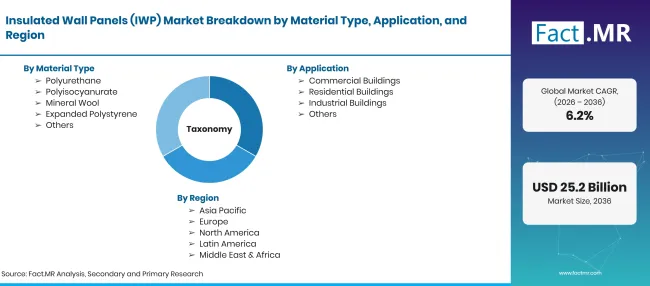
Insulated Wall Panels Iwp Market Taxonomy | Source: Fact.MR
| Attribute | Details |
|---|---|
| Quantitative Units | USD billion |
| Market Definition | Factory-made insulated wall assemblies with a thermal core and structural or protective facings; excludes standalone insulation boards and roofing-only panels. |
| Material Type | Polyurethane; Polyisocyanurate; Mineral Wool; Expanded Polystyrene; Others |
| Application | Commercial Buildings; Residential Buildings; Industrial Buildings; Cold Storage; Others |
| End-Use Industry | Construction; Warehousing; Others |
| Regions Covered | North America; Latin America; Western Europe; Eastern Europe; East Asia; South Asia & Pacific; Middle East & Africa |
| Countries Covered | Germany; Brazil; USA; UK; Japan |
| Companies Profiled | Kingspan Group, Metecno Group, Nucor Building Systems, ArcelorMittal Construction, Tata Steel UK, Ruukki Construction, Alubel SpA, Isopan S.p.A., ATAS International, and All Weather Insulated Panels (AWIP) |
| Forecast Period | 2026 to 2036 |
| Approach | Market sizing, product segmentation, construction demand indicators and supplier product review |
Source: Fact.MR analysis. Updated Nov 10, 2026
How is the market segmented?
-
By Material Type
- Polyurethane
- Polyisocyanurate
- Mineral Wool
- Expanded Polystyrene
- Others
-
By Application
- Commercial Buildings
- Residential Buildings
- Industrial Buildings
- Cold Storage
- Others
-
By End-Use Industry
- Construction
- Warehousing
- Others
-
By Region
- North America
- Latin America
- Western Europe
- Eastern Europe
- East Asia
- South Asia & Pacific
- Middle East & Africa
Frequently Asked Questions
How big is the Insulated Wall Panels (IWP) Market in 2026?
What is the CAGR of the Insulated Wall Panels (IWP) Market from 2026 to 2036?
Which material type leads the Insulated Wall Panels (IWP) Market?
Which application leads the Insulated Wall Panels (IWP) Market?
Who are the leading companies in the Insulated Wall Panels (IWP) Market?
Who worked on this report


Preview the report firsthand - request a free sample
Free SampleGet the brochure for pricing and purchase details
Download PDF