- Market Value (2025): USD 380.0 Mn
- Estimated Value (2026): USD 409.6 Mn
- Forecast Value (2036): USD 864.0 Mn
- CAGR (2026-2036): 7.8%
What is the Automated Powder-Liquid Integration Units Market forecast to be worth by 2036?
USD 409.6 million in 2026 to USD 864.0 million by 2036, registering a CAGR of 7.8%.
- Fact.MR estimates that the market reached USD 380.1 million in 2025.
- Demand is forecast to rise from USD 409.6 million in 2026 to USD 864.0 million by 2036.
- The market is forecast to grow at a 7.8% CAGR during 2026–2036 as manufacturers seek more controlled powder incorporation and automated processing.
| Year | Basis | Market Value (USD million) |
|---|---|---|
| 2025 | Actual | 380.1 |
| 2026 | Estimate | 409.6 |
| 2036 | Forecast | 864.0 |
| CAGR 2026 to 2036 | Forecast period | 7.8% |
Source: Fact.MR analysis. Updated Nov 10, 2026
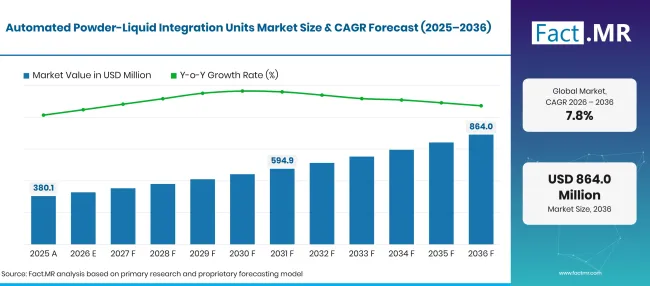
Automated Powder Liquid Integration Units Forecast Global | Source: Fact.MR
What are the defining numbers behind Automated Powder-Liquid Integration Units Market growth?
The forecast represents an increase of USD 454.4 million between 2026 and 2036.
- Demand Drivers in the Market
- Automation of powder incorporation is supporting equipment demand. Manufacturers are investing in automated mixing systems to improve dosing consistency and reduce manual powder handling. Integrated powder feeding and dispersion can help limit operator exposure to dust while improving process repeatability and production efficiency.
- Need for uniform dispersion and fewer agglomerates has raised the demand for the automated powder-liquid integration units. Powders such as gums and thickeners can form lumps when added directly to liquids. High-shear and vacuum-induction systems help wet and disperse these materials more consistently. Silverson's Flashmix and Ystral's Conti-TDS are designed to address these processing challenges.
- Expansion of food and beverage processing has created lucrative opportunity for the market growth. Dairy products and beverage formulations often require the controlled incorporation of powders such as milk ingredients and stabilizers. Automated systems can support repeatable mixing and hygienic processing. SPX FLOW's APV Flex-Mix range is designed for applications including recombined dairy products and beverage preparation.
- Demand for efficient continuous manufacturing supports the market growth. Industrial facilities are seeking systems that can incorporate solids into liquid streams without relying on repeated batch operations. Continuous powder wetting and dispersion can reduce process interruptions and support higher production throughput. Ystral Coflow and IKA's MHD systems illustrate this approach.
- Greater focus on process control and integration have increased the demand of the automated powder-liquid integration units. Manufacturers need mixing systems that can work with automated powder feeding and plant-level process controls. PLC options and controlled ingredient addition can improve operating consistency. Admix's Fastfeed system offers PLC automation options, while Ystral provides integrated process-line engineering and automation.
- Key Segments Analyzed
- By Powder-Liquid Incorporation: Inline Rotor-Stator systems are projected to hold a 32.3% share in 2026, supported by its ability to combine powder wetting and high-shear dispersion within a continuous or recirculating process.
- By Installation / System Integration: Machine-Integrated systems account for 29.8% of the market in 2026, reflecting demand for equipment incorporated directly into production lines.
- By Industrial Operating Environment: Energy / Utilities leads with a 30.6% share in 2026, reflecting applications that require controlled blending and dispersion in industrial processing operations.
- By Control / Communications: Standalone systems hold a 24.7% share in 2026, narrowly ahead of Fieldbus and Remote Condition Monitoring configurations.
- Analyst Opinion at Fact.MR
- Shambhu Nath Jha, Principal Consultant at Fact.MR, states, “Automated powder-liquid integration units are gaining importance as manufacturers seek consistent dispersion and lower manual handling requirements. Equipment suppliers that can demonstrate reliable powder induction across different viscosities and production scales are likely to gain consideration. Integration flexibility and ease of cleaning will remain important purchasing factors.”
- Strategic Implications
- Equipment manufacturers need to demonstrate performance across different powder characteristics and liquid viscosities. Product trials can help buyers assess wetting efficiency and the risk of agglomeration under actual operating conditions.
- System integrators should design installations around powder feeding and liquid circulation requirements. They should also ensure that the mixer can connect with existing vessels and production controls.
- Food and pharmaceutical processors must prioritize hygienic equipment designs and cleaning procedures that suit the formulation and applicable production requirements.
- Industrial operators can compare energy consumption and maintenance requirements alongside throughput. A system with high incorporation capacity may not be the most suitable option for every batch size or formulation.
- Automation providers should support reliable communication between mixers and plant control systems. Remote monitoring should provide useful information on equipment condition without complicating routine operation.
The India market is projected to record a 10.5% CAGR through 2036. China is set to grow at 10.0%, followed by the USA at 8.4%. Germany is forecast to expand at 7.1%, while Japan is expected to record a 6.7% CAGR.
How does the Automated Powder-Liquid Integration Units Market break down by segment?
Fact.MR finds that Inline Rotor-Stator leads Powder-Liquid Incorporation at 32.3%; Machine-Integrated Leads Installation / System Integration at 29.8%; Energy / Utilities leads Industrial Operating Environment at 30.6%; and Standalone Leads Control / Communications at 24.7%.
Which Powder-Liquid Incorporation technology dominates?
Inline Rotor-Stator is set to hold a 32.3% share in 2026.
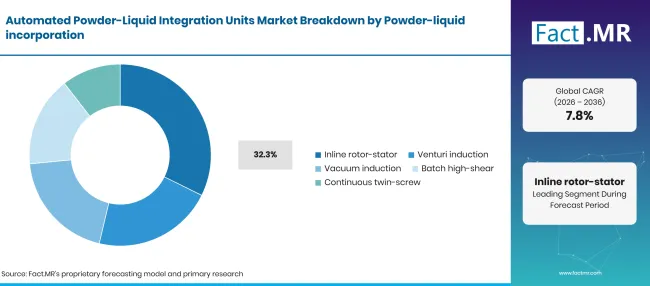
Automated Powder Liquid Integration Units Breakdown Powder Liquid Incorporation | Source: Fact.MR
| Powder-Liquid Incorporation | Share (2026) |
|---|---|
| Inline Rotor-Stator (Leading segment) | 32.3% |
| Other segments combined | 67.7%* |
| Total | 100.0% |
Source: Fact.MR analysis. Updated Nov 10, 2026
Inline rotor-stator systems lead because they combine powder induction with high-shear mixing in a compact processing arrangement. The rotor-stator action helps wet and disperse solids while reducing the formation of lumps. Such configurations can be used in batch recirculation or continuous production depending on equipment design. Ystral and Silverson offer examples of this technology.
What leads the Installation / System Integration segment?
Machine-Integrated systems are set to represent a 29.8% share in 2026.
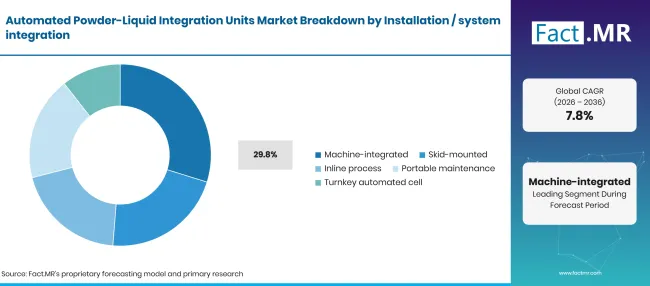
Automated Powder Liquid Integration Units Breakdown Installation System Integration | Source: Fact.MR
| Installation / System Integration | Share (2026) |
|---|---|
| Machine-Integrated (Leading segment) | 29.8% |
| Other segments combined | 70.2%* |
| Total | 100.0% |
Source: Fact.MR analysis. Updated Nov 10, 2026
Machine-integrated systems are incorporated directly into production equipment or process lines. This arrangement can reduce the need for separate powder-handling steps and simplify coordination between liquid circulation and powder addition. Buyers consider machine-integrated configurations when they need a defined processing sequence and consistent incorporation within an existing manufacturing setup.
How does Industrial Operating Environment shape demand?
Energy / Utilities is likely to account for a 30.6% share in 2026.
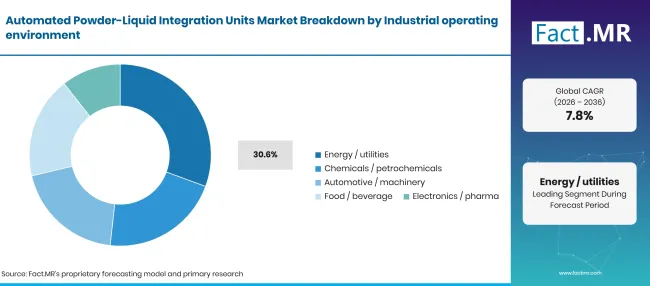
Automated Powder Liquid Integration Units Breakdown Industrial Operating Environment | Source: Fact.MR
| Industrial Operating Environment | Share (2026) |
|---|---|
| Energy / Utilities (Leading segment) | 30.6% |
| Other segments combined | 69.4%* |
| Total | 100.0% |
Source: Fact.MR analysis. Updated Nov 10, 2026
Energy and utility operations can require the controlled preparation of liquid mixtures and process chemicals. Automated powder incorporation can support repeatable formulation and reduce manual material handling. Chemical and petrochemical facilities also use mixing and dispersion systems for process formulations, while automotive and machinery manufacturers may require them for coatings and other production materials.
Which Control / Communications configuration accounts for the largest share?
Standalone systems are set to account for a 24.7% share in 2026.
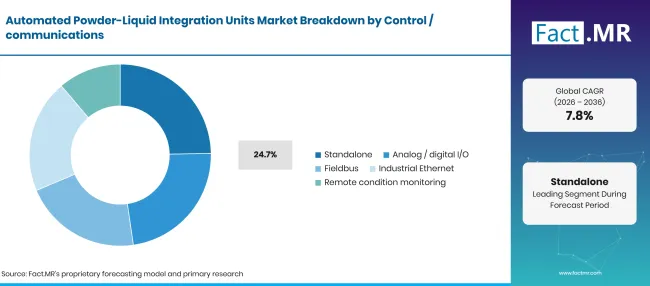
Automated Powder Liquid Integration Units Breakdown Control Communications | Source: Fact.MR
| Control / Communications | Share (2026) |
|---|---|
| Standalone (Leading segment) | 24.7% |
| Other segments combined | 75.3%* |
| Total | 100.0% |
Source: Fact.MR analysis. Updated Nov 10, 2026
Standalone configurations lead narrowly, indicating that a considerable portion of installations use equipment-level controls rather than relying on more extensive plant communication architectures. Fieldbus and Industrial Ethernet configurations support communication with wider industrial automation systems. Remote condition monitoring can help operators assess equipment status and maintenance needs without requiring continuous on-site inspection.
What is accelerating Automated Powder-Liquid Integration Units Market adoption, and what is holding it back?
Demand is supported by the need for consistent powder dispersion and automated production. However, high equipment investment and process-specific integration requirements can slow adoption. Drivers Impact Analysis
| DRIVER | Approx. % IMPACT ON CAGR | GEOGRAPHIC RELEVANCE | IMPACT TIMELINE |
|---|---|---|---|
| Demand for automated powder feeding | +1.0% | Asia, North America | Medium term (2–4 years) |
| Need for consistent high-shear dispersion | +0.9% | Global | Short term (≤ 2 years) |
| Expansion of continuous manufacturing | +0.8% | Asia, Europe | Medium term (2–4 years) |
| Hygienic processing requirements | +0.6% | Europe, North America | Medium term (2–4 years) |
| Integration with plant automation systems | +0.5% | Global | Long term (≥ 4 years) |
Source: Fact.MR analysis. Updated Nov 10, 2026
Opportunity Impact Analysis
| OPPORTUNITY | Approx. % IMPACT ON CAGR | GEOGRAPHIC RELEVANCE | IMPACT TIMELINE |
|---|---|---|---|
| Turnkey powder-handling and mixing lines | +0.9% | Asia, Europe | Medium term (2–4 years) |
| Automated dosing and process monitoring | +0.8% | Global | Medium term (2–4 years) |
| Systems for high-viscosity formulations | +0.7% | North America, Europe | Long term (≥ 4 years) |
| Hygienic powder induction solutions | +0.6% | Global | Short term (≤ 2 years) |
| Remote condition monitoring | +0.4% | Global | Long term (≥ 4 years) |
Source: Fact.MR analysis. Updated Nov 10, 2026
Restraints Impact Analysis
| RESTRAINT | Approx. % IMPACT ON CAGR | GEOGRAPHIC RELEVANCE | IMPACT TIMELINE |
|---|---|---|---|
| High initial equipment and installation costs | -0.8% | Global | Short term (≤ 2 years) |
| Complex integration with existing process lines | -0.7% | Global | Medium term (2–4 years) |
| Powder-specific clogging and agglomeration risks | -0.6% | Global | Short term (≤ 2 years) |
| Maintenance and specialist service requirements | -0.5% | Emerging markets | Medium term (2–4 years) |
Source: Fact.MR analysis. Updated Nov 10, 2026
Which countries are scaling the Automated Powder-Liquid Integration Units Market through 2036?
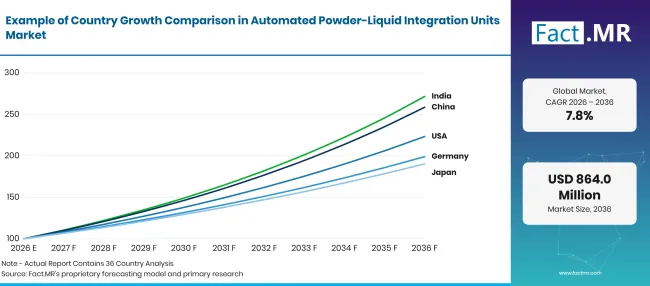
Automated Powder Liquid Integration Units Growth Index | Source: Fact.MR
| Country | CAGR (2026-2036) |
|---|---|
| India | 10.5% |
| China | 10.0% |
| USA | 8.4% |
| Germany | 7.1% |
| Japan | 6.7% |
Source: Fact.MR analysis. Updated Nov 10, 2026
What supports India's market growth?
10.5% CAGR, supported by manufacturing expansion and investment in automated production facilities.
India's expanding manufacturing base creates opportunities for automated mixing and processing equipment. The Ministry of Statistics and Programme Implementation reported that output in the registered manufacturing sector increased by 7.81% in 2024–25 compared with 2023–24. Fixed capital increased by 10.54% over the same period [8].[8]od processing and chemical manufacturers can use automated powder-liquid systems to improve production consistency and reduce manual ingredient handling.
How is China developing automated powder-liquid integration?
10.0% CAGR, driven by industrial production growth and investment in advanced manufacturing.
China's large manufacturing base supports demand for process equipment used in chemical production and industrial formulation. The National Bureau of Statistics reported that value added in manufacturing enterprises above the designated size increased by 6.4% in 2025, while equipment-manufacturing value added increased by 9.2% [9].[9]ese developments create opportunities for suppliers of automated powder feeding and dispersion systems serving large-scale production facilities.
What supports United States market growth?
8.4% CAGR, led by investment in production efficiency and industrial process modernization.
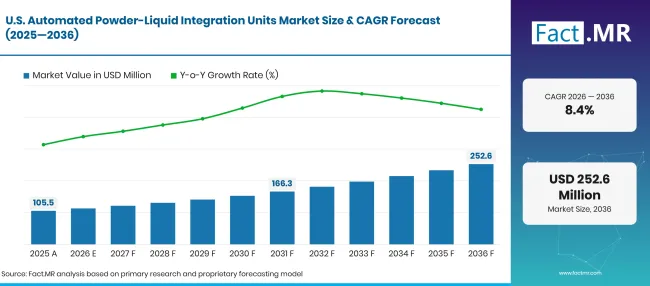
Automated Powder Liquid Integration Units Forecast Usa | Source: Fact.MR
The United States has an established base of food and beverage as well as chemical and pharmaceutical manufacturers that use controlled mixing processes. The Federal Reserve reported on August 18, 2026, that U.S. manufacturing production increased by 0.2% in July, following a 0.3% increase in June [10].[10]ipment suppliers can target facilities seeking improved powder incorporation and more consistent processing through automated systems.
How is Germany building market demand?
7.1% CAGR, backed by its industrial engineering base and demand for specialized processing equipment.
Germany's chemical and machinery industries provide an established customer base for high-shear mixers and powder induction systems. However, calendar-adjusted industrial production declined by 1.1% in 2025 compared with 2024, while machinery and equipment manufacturing output fell by 2.6% [11].[11]ipment suppliers can focus on modernization projects that improve process efficiency and reduce material losses rather than relying solely on new production capacity.
What supports Japan market development?
6.7% CAGR, shaped by demand for precise manufacturing processes and equipment modernization.
Japan's manufacturing sector includes automotive and machinery production alongside chemical and food processing. Its Ministry of Economy, Trade and Industry tracks industrial production across these sectors through its Current Survey of Production [12]. Automated powder-liquid integration systems can serve manufacturers seeking controlled material incorporation and consistent product quality. Suppliers should emphasize equipment reliability and compatibility with existing production facilities.
Who leads the Automated Powder-Liquid Integration Units Market?
Fact.MR finds that Ystral GmbH, Silverson Machines, Alfa Laval AB, IKA-Werke GmbH & Co. KG, Charles Ross & Son Company, Admix Inc. and SPX FLOW are profiled across the automated powder-liquid mixing equipment value chain.
Ystral offers powder induction and dispersion systems such as Conti-TDS and Coflow. Its technologies support vacuum-based powder feeding and inline dispersion, including continuous processing configurations [13]. Silverson provides Flashmix and Flashblend systems for rapid powder incorporation into liquids, including high-viscosity formulations [14].
Alfa Laval supplies powder mixers that draw solids into liquid streams through an inline high-shear arrangement. Its equipment can be configured as stationary or mobile units and integrated into circulation loops [15]. IKA offers MHD and CMX solid-liquid mixing systems designed for controlled powder incorporation and dispersion in production processes.
Charles Ross & Son Company offers its SLIM powder induction technology, which introduces powders into the high-shear zone to support rapid wetting and dispersion. Admix supplies Fastfeed powder induction systems with high-shear dispersion and optional PLC automation. SPX FLOW participates through its APV Flex-Mix range, including powder mixers that use Venturi or vacuum-based powder induction. These systems serve applications such as dairy recombination and beverage preparation.
Competition depends on the ability to match equipment design with powder characteristics and liquid properties. Suppliers need to demonstrate consistent incorporation and practical cleaning procedures. Buyers also compare installation flexibility and control-system compatibility, particularly when upgrading existing production lines.
Which companies are the key providers?
The companies covered in this market include: Ystral GmbH, Silverson Machines, Alfa Laval AB, IKA-Werke GmbH & Co. KG, Charles Ross & Son Company, Admix Inc., and SPX FLOW (APV / Lightnin).
- Ystral GmbH
- Silverson Machines
- Alfa Laval AB
- IKA-Werke GmbH & Co. KG
- Charles Ross & Son Company
- Admix Inc.
- SPX FLOW (APV / Lightnin)
Bibliography
- [1]Silverson Machines. (n.d.). Flashmix Powder/Liquid Mixers. https://www.silverson.com/us/products/flashmix-powder-liquid-mixers/
- [2] ystral GmbH. (n.d.). YSTRAL Conti-TDS. https://ystral.com/en/machines/inline-dispersers/conti-tds/
- [3] SPX FLOW. (n.d.). Flex-Mix TPM+ Powder Mixer. https://www.spxflow.com/apv/products/flex-mix-tpmplus-powder-mixer/
- [4] ystral GmbH. (n.d.). YSTRAL Coflow: Continuous Powder Wetting & Dispersing. https://ystral.com/en/machines/inline-dispersers/coflow/
- [5] IKA-Werke GmbH & Co. KG. (2026). Mass Production of Battery Cells: Mixing and Process Technology. https://www.ika.com/ika/pdf/flyer-catalog/IKA_Battery%20Flyer_IWS_EN.pdf
- [6] Admix, Inc. (n.d.). Fastfeed® Powder Induction and Dispersion System. https://admix.com/hygienic-sanitary-industrial-mixing-equipment/fastfeed-powder-induction-dispersion-system
- [7] ystral India Pvt. Ltd. (n.d.). Machines, Plants & Service. https://ystral.in/
- [8] Press Information Bureau, Ministry of Statistics and Programme Implementation, Government of India. (2026, September 30). Release of the Annual Survey of Industries (2024–25) Results. https://www.pib.gov.in/PressReleasePage.aspx?PRID=2316981
- [9] National Bureau of Statistics of China. (2026, January 21). Preliminary Accounting Results of GDP for the Fourth Quarter and Full Year of 2025. https://www.stats.gov.cn/english/PressRelease/202601/t20260121_1962363.html
- [10] Board of Governors of the Federal Reserve System. (2026, August 18). Industrial production and capacity utilization: July 2026 (G.17).https://www.federalreserve.gov/releases/g17/current/
- [11] Statistisches Bundesamt (Destatis). (2026, February 6). Production in December 2025: -1.9% on the previous month. https://www.destatis.de/EN/Press/2026/02/PE26_043_421.html
- [12] Ministry of Economy, Trade and Industry, Japan. (2026, June 30). Current Survey of Production: 2025 Yearbook . https://www.meti.go.jp/english/statistics/tyo/seidou/
- [13] ystral GmbH. (n.d.). Machines. https://ystral.com/en/machines/
- [14] Silverson Machines. (n.d.). High Shear Mixer Processes. https://www.silverson.com/process/agitation.html
- [15] Alfa Laval. (n.d.). Powder Mixers. https://www.alfalaval.in/products/fluid-handling/mixing-equipment/powder-mixers/
This Report Answers
The report examines how automated powder-liquid integration units are used across industrial mixing and processing applications.
Segment analysis compares powder incorporation technologies and installation configurations. Country analysis covers China, the USA, Germany, Japan and India alongside industrial production indicators. The competitive overview profiles Ystral, Silverson, Alfa Laval, IKA, Charles Ross, Admix and SPX FLOW. Control and communications analysis compares standalone equipment with systems using industrial communication and remote monitoring capabilities.
What does the Automated Powder-Liquid Integration Units Market cover?
The market covers industrial equipment designed to incorporate powdered ingredients into liquid formulations through controlled induction and dispersion.
t includes inline rotor-stator systems and vacuum-induction equipment as well as Venturi-based and batch high-shear configurations. The market also considers installation arrangements and automation features used across industrial operating environments.
What is included in the scope?
Included equipment performs powder feeding and liquid incorporation as part of an industrial mixing process.
The scope covers integrated mixers and skid-mounted systems as well as inline and turnkey automated configurations. It includes equipment used in chemical processing and food production alongside energy-related and other industrial applications.
What is excluded from the scope?
The analysis excludes standalone powder-handling equipment that does not perform powder-liquid incorporation.
General-purpose liquid agitators without a defined powder-induction function are also excluded. Basic pumps and storage vessels sold independently are outside the equipment boundary unless supplied as part of an integrated powder-liquid processing system. Revenue from raw powders and liquid ingredients is excluded.
How Was the Analysis Built?
The analysis draws on 120+ sources, 35+ company portfolios, 25+ countries and more than 20 industry interviews.
- Primary Research: Primary research includes discussions with equipment manufacturers and system integrators as well as process engineers and industrial buyers. These conversations examine equipment selection and installation requirements alongside powder characteristics and throughput expectations.
- Desk Research: Desk research covers government industrial statistics and company product documentation as well as technical publications and industry information. Sources used in the analysis are documented in the bibliography.
- Market Sizing and Forecasting: Market estimates combine historical performance and industrial demand indicators with equipment pricing and installation trends. The analysis also considers technology preferences and country-level growth alongside manufacturing investment.
- Data Validation and Update Cycle: Findings are validated by comparing primary interviews with company disclosures and public data. Regular updates review new product launches and equipment developments alongside automation capabilities and changes in industrial investment.
Segmentation
What is the report's scope and coverage?
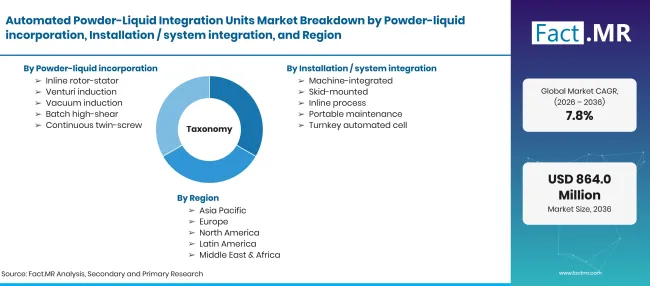
Automated Powder Liquid Integration Units Taxonomy | Source: Fact.MR
| Attribute | Details |
|---|---|
| Quantitative Units | USD million |
| Market Definition | Automated powder-liquid integration units are industrial processing systems designed to introduce powders into liquid streams or batches while ensuring controlled wetting, dispersion and uniform incorporation. These systems use technologies such as high-shear mixing and vacuum induction to minimize lump formation and improve product consistency. |
| Powder-Liquid Incorporation | Inline Rotor-Stator; Venturi Induction; Vacuum Induction; Batch High-Shear; Continuous Twin-Screw |
| Installation / System Integration | Machine-Integrated; Skid-Mounted; Inline Process; Portable Maintenance; Turnkey Automated Cell |
| Industrial Operating Environment | Energy / Utilities; Chemicals / Petrochemicals; Automotive / Machinery; Food / Beverage; Electronics / Pharma |
| Control / Communications | Standalone; Analog / Digital I/O; Fieldbus; Industrial Ethernet; Remote Condition Monitoring |
| Regions Covered | North America; Latin America; Western Europe; Eastern Europe; East Asia; South Asia & Pacific; Middle East & Africa |
| Countries Covered | China; USA; Germany; Japan; India |
| Companies Profiled | Ystral; Silverson; Alfa Laval; IKA; Charles Ross; Admix; SPX FLOW |
| Forecast Period | 2026 to 2036 |
| Approach | Market segmentation and scenario-based analysis supported by industrial statistics and company product information |
Source: Fact.MR analysis. Updated Nov 10, 2026
How is the market segmented?
-
By Powder-Liquid Incorporation
- Inline Rotor-Stator
- Venturi Induction
- Vacuum Induction
- Batch High-Shear
- Continuous Twin-Screw
-
By Installation / System Integration
- Machine-Integrated
- Skid-Mounted
- Inline Process
- Portable Maintenance
- Turnkey Automated Cell
-
By Industrial Operating Environment
- Energy / Utilities
- Chemicals / Petrochemicals
- Automotive / Machinery
- Food / Beverage
- Electronics / Pharma
-
By Control / Communications
- Standalone
- Analog / Digital I/O
- Fieldbus
- Industrial Ethernet
- Remote Condition Monitoring
-
By Region
- North America
- Latin America
- Western Europe
- Eastern Europe
- East Asia
- South Asia & Pacific
- Middle East & Africa
Frequently Asked Questions
How big is the Automated Powder-Liquid Integration Units Market in 2026?
What is the CAGR from 2026 to 2036?
Which Powder-Liquid Incorporation technology has the largest share?
Which Installation / System Integration segment leads?
Which Industrial Operating Environment has the largest share?
Which Control / Communications configuration dominates?
Which countries are covered in the report?
Which companies are profiled?
Who worked on this report


Preview the report firsthand - request a free sample
Free SampleGet the brochure for pricing and purchase details
Download PDF