- Market Value (2025): USD 69.2 Mn
- Estimated Value (2026): USD 72.8 Mn
- Forecast Value (2036): USD 122.3 Mn
- CAGR (2026-2036): 5.3%
What is the Sodium-t-Amylate Market forecast to be worth by 2036?
USD 72.8 million in 2026 to USD 122.3 million by 2036 at a 5.3% CAGR.
- The valuation of the sodium-t-amylate market was USD 69.2 million in 2025, with powder grades carrying most of the volume shipped to synthesis plants.
- Market value will advance from USD 72.8 million in 2026 to USD 122.3 million by 2036 as drug and agrochemical producers scale up routes that call for a soluble hindered base.
- A 5.3% CAGR reflects steady pull from pharmaceutical intermediate work, balanced against competition from cheaper alkoxides such as sodium tert-butoxide.
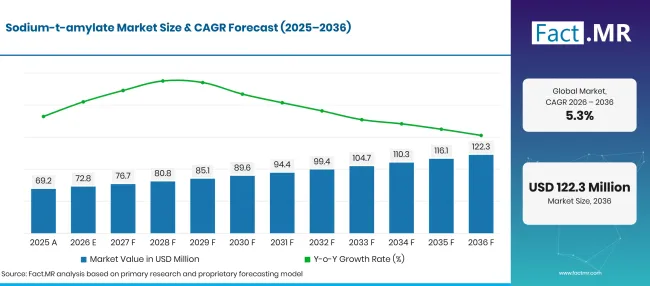
Sodium T Amylate Market Forecast Global | Source: Fact.MR
| Year | Basis | Market Value (USD million) |
|---|---|---|
| 2025 | Actual | 69.2 |
| 2026 | Estimate | 72.8 |
| 2036 | Forecast | 122.3 |
| CAGR 2026 to 2036 | Forecast period | 5.3% |
Source: Fact.MR analysis. Updated Nov 4, 2026
What are the defining numbers behind Sodium-t-Amylate Market growth?
The 2026 to 2036 period will add USD 49.5 million in new value, led by pharmaceutical synthesis and powder supply.
- Demand Drivers in the Market
- Agrochemical synthesis keeps a steady base of demand. FAO data show that global pesticide use stood at about 3.73 million tonnes of active ingredients in 2023, and many of those molecules pass through base-mediated coupling or condensation steps during manufacture [1].
- Drug pipelines in Europe add fresh routes that need strong bases. The European Medicines Agency recommended 104 human medicines for authorisation in 2025, and 38 of them carried a new active substance [2]. Each new small molecule brings process chemistry where a soluble alkoxide can replace a less selective base.
- Policy support for regional medicine production favours reliable reagent supply. The European Commission proposed the Critical Medicines Act in March 2025 to strengthen EU manufacturing capacity for critical medicines through strategic projects [3]. Plants built under such programmes will qualify reagent sources close to home.
- Solvent compatibility gives sodium-t-amylate a place that cheaper bases cannot fill. It dissolves in hexane, toluene and tetrahydrofuran, which lets chemists run homogeneous reactions at controlled temperatures. That property earns it a role in scale-up work where sodium tert-butoxide forms slurries.
- Key Segments Analyzed
- By Product Form: Powder will hold 56.8% share in 2026, since dry material ships economically and lets plants prepare solutions at the strength each batch needs.
- By Application: Pharmaceuticals will account for 38.4% of 2026 value, owing to the reagent’s use in deprotonation and condensation steps for drug intermediates.
- Analyst Opinion at Fact.MR
- Shambhu Nath Jha, Principal Consultant at Fact.MR, states, “Sodium-t-amylate wins business on solubility and selectivity. Suppliers that guarantee low hydroxide content and tight moisture limits will keep pharmaceutical accounts. New alkoxide capacity in Asia and fresh drug approvals in the United States and Europe will widen the user base through 2036. Distributors with inert-gas packaging and short lead times will capture the growing share of orders placed by process development teams.”
- Strategic Implications
- Manufacturers should publish lot-level data on residual hydroxide, sodium content and moisture, because pharmaceutical quality teams now ask for these figures before qualifying a new source.
- Distributors should stock both powder and pre-made solutions in nitrogen-blanketed containers, which shortens delivery for laboratories that cannot handle bulk powder safely.
- Pharmaceutical buyers should qualify a second source early in process development, since switching suppliers after regulatory filing involves costly comparability work.
- Investors should track alkoxide plant additions in Asia and Europe, as regional capacity will shape pricing for tert-amyl alcohol derivatives over the forecast period.
Germany leads the five-country comparison at 6.0%, helped by a chemical export base that supplies synthesis reagents across Europe and beyond. Brazil follows at 5.5%, with crop-protection output and a fast-growing medicine sector both lifting reagent use. The United States trails at 4.9% because demand comes from a large but mature fine-chemical industry, even as federal policy pushes new drug plants onshore. The United Kingdom at 4.4% relies on research-led pharmaceutical work, where volumes stay modest per project. Japan closes the group at 3.9%, reflecting high existing reagent penetration and slower expansion in domestic production.
How does the Sodium-t-Amylate Market break down by segment?
Powder will lead Product Form at 56.8% and Pharmaceuticals will head Application at 38.4% in 2026.
Which Product Form leads?
Powder takes 56.8% of 2026 sales.
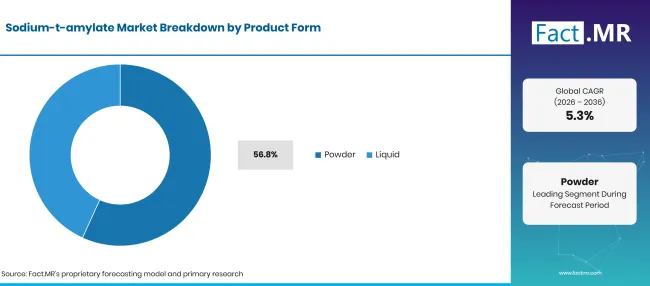
Sodium T Amylate Market Breakdown Product Form | Source: Fact.MR
| Product Form | Share (2026) |
|---|---|
| Powder (Leading segment) | 56.8% |
| Other segments combined | 43.2%* |
| Total | 100.0% |
Source: Fact.MR analysis. Updated Nov 4, 2026
Plants that run several base-mediated reactions prefer to buy one dry material and dissolve it at the concentration each step requires. Free-flowing powder with high purity and low hydroxyl content travels in sealed PE bags inside drums, and it keeps for long periods when stored dry and cool. Bulk users also avoid paying freight on solvent they already hold on site, which many buy through the tetrahydrofuran supply chain. Liquid grades serve customers who want to skip the dissolution step and limit operator exposure to reactive dust. Suppliers offer ready solutions in toluene, hexane and tetrahydrofuran, so a reactor can be charged directly by pump. Process teams that standardise on toluene as a reaction medium often pick the matching solution grade to simplify solvent recovery.
What supports Pharmaceuticals within Application?
Pharmaceuticals represent 38.4% of 2026 revenue.
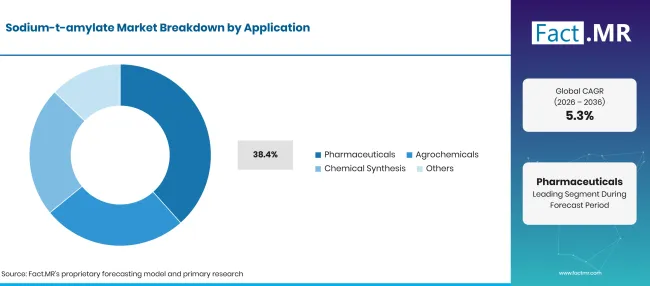
Sodium T Amylate Market Breakdown Application | Source: Fact.MR
| Application | Share (2026) |
|---|---|
| Pharmaceuticals (Leading segment) | 38.4% |
| Other segments combined | 61.6%* |
| Total | 100.0% |
Source: Fact.MR analysis. Updated Nov 4, 2026
Drug makers use the reagent to remove protons from weak carbon acids, build heterocycles and drive eliminations under controlled conditions. FDA’s drug evaluation centre approved 46 novel drugs in 2025, including 34 new molecular entities, and each approved route sets reagent demand for commercial supply [4]. Contract makers working in oral solid dosage manufacturing depend on intermediates produced with such bases upstream. Agrochemicals use the same chemistry in coupling and condensation steps for herbicide and fungicide actives, tying demand to the output of the crop protection chemicals industry. Chemical synthesis covers fragrance molecules, polymer catalysts and specialty intermediates. Smaller uses include laboratory research and isomerisation work. Alkoxide producers also serve biodiesel production plants with sodium methylate, which shares plant infrastructure with tert-amylate output.
What is accelerating Sodium-t-Amylate Market adoption, and what is holding it back?
New small-molecule drugs, steady crop-protection output and regional alkoxide capacity are widening the user base for sodium-t-amylate. Its solubility in common solvents keeps it in routes where other bases fail. Price remains the main brake, since sodium tert-butoxide and potassium tert-butoxide cost less per mole. Moisture sensitivity and hazardous-goods shipping rules add handling cost for smaller buyers. Many laboratories also hold older routes built on sodium hydride or lithium bases and see little reason to revalidate them.
Drivers Impact Analysis
| DRIVER | (~) % IMPACT ON CAGR | GEOGRAPHIC RELEVANCE | IMPACT TIMELINE |
|---|---|---|---|
| DRIVER | (~) % IMPACT ON CAGR | GEOGRAPHIC RELEVANCE | IMPACT TIMELINE |
| Use in pharmaceutical intermediate synthesis | +1.5% | Global | Short term (<=2 years) |
| Base-mediated steps in agrochemical active production | +1.0% | Latin America, East Asia, Western Europe | Medium term (2-4 years) |
| Solubility advantage in homogeneous scale-up reactions | +0.8% | North America, Western Europe | Medium term (2-4 years) |
| Regional alkoxide capacity additions | +0.6% | East Asia, South Asia & Pacific | Long term (>=4 years) |
Source: Fact.MR analysis. Updated Nov 4, 2026
Opportunity Impact Analysis
| OPPORTUNITY | (~) % IMPACT ON CAGR | GEOGRAPHIC RELEVANCE | IMPACT TIMELINE |
|---|---|---|---|
| OPPORTUNITY | (~) % IMPACT ON CAGR | GEOGRAPHIC RELEVANCE | IMPACT TIMELINE |
| Low-hydroxide grades qualified for drug substance routes | +0.8% | Global | Short term (<=2 years) |
| Ready-to-use solution grades for contract manufacturers | +0.6% | North America, Western Europe | Medium term (2-4 years) |
| Onshore medicine production programmes | +0.5% | North America, Western Europe | Medium term (2-4 years) |
| Inert-gas packaging for small-lot laboratory buyers | +0.4% | Global | Long term (>=4 years) |
Source: Fact.MR analysis. Updated Nov 4, 2026
Restraints Impact Analysis
| RESTRAINT | (~) % IMPACT ON CAGR | GEOGRAPHIC RELEVANCE | IMPACT TIMELINE |
|---|---|---|---|
| RESTRAINT | (~) % IMPACT ON CAGR | GEOGRAPHIC RELEVANCE | IMPACT TIMELINE |
| Competition from cheaper tert-butoxide bases | -0.6% | Global | Short term (<=2 years) |
| Moisture sensitivity and storage cost | -0.4% | Global | Short term (<=2 years) |
| Hazardous-goods transport requirements | -0.3% | North America, Western Europe, East Asia | Medium term (2-4 years) |
| Tert-amyl alcohol and sodium price swings | -0.2% | Global | Long term (>=4 years) |
Source: Fact.MR analysis. Updated Nov 4, 2026
Which countries are scaling the Sodium-t-Amylate Market through 2036?
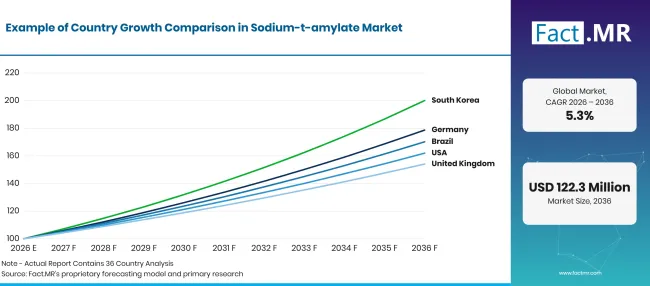
Sodium T Amylate Market Growth Index | Source: Fact.MR
| Country | CAGR (2026 to 2036) |
|---|---|
| Germany | 6.0% |
| Brazil | 5.5% |
| United States | 4.9% |
| United Kingdom | 4.4% |
| Japan | 3.9% |
Source: Fact.MR analysis. Updated Nov 4, 2026
What supports sodium-t-amylate adoption in Germany?
6.0% CAGR, supported by a large chemical export base and EU efforts to secure medicine supply.
German chemical firms export reagents and intermediates far beyond Europe. Eurostat reports that Germany shipped €130 billion of chemicals to non-EU countries in 2025, more than any other member state [5]. Evonik runs alkoxide production in Germany, and drug intermediate makers along the Rhine qualify local sources for strong bases. Purchases will grow as EU medicine-supply programmes bring new synthesis projects to German sites.
How is Brazil developing demand?
5.5% CAGR, helped by crop-protection manufacturing and rising medicine sales.
Brazil pairs a large agrochemical market with a growing pharmaceutical sector. Anvisa’s medicines pricing chamber reported market revenue of about R$182 billion in 2025, up 13.7% in nominal terms, with 6.3 billion packages sold [6]. Local formulators and active-ingredient makers rely on imported strong bases for synthesis steps. Distributors that hold stock in São Paulo can shorten lead times for these buyers. Import duties and port handling for reactive solids add cost, which favours solution grades for smaller users.
What is supporting United States adoption?
4.9% CAGR, as federal policy pushes new drug manufacturing capacity onshore.
An executive order signed on May 5, 2025 directed FDA and EPA to streamline reviews for new domestic pharmaceutical plants [7]. FDA then launched its PreCheck pilot on February 1, 2026 and selected seven participants after receiving more than 80 requests [8]. New facilities of this kind will source reagents for intermediate and drug substance steps. Catalogue suppliers in the country already list sodium-t-amylate in powder and solution form.
How is the United Kingdom developing demand?
4.4% CAGR, reflecting research-led pharmaceutical work and specialist manufacturing.
British demand comes mainly from process development labs and specialist fine-chemical producers. Government indicators show pharmaceutical manufacturing gross value added of £20.4 billion in 2023, while pharmaceutical exports reached £24.7 billion in 2024 [9]. Both figures fell from the year before, which tempers volume growth. Purchases tend to be small lots of high-purity material for route scouting and clinical supply. Contract research groups around Cambridge and the North West buy through catalogue channels and value next-day delivery over bulk pricing.
What supports Japan’s adoption?
3.9% CAGR, owing to a mature but sizeable domestic medicine industry.
Japan has long used alkoxide bases in drug and fine-chemical synthesis, so new demand comes mainly from fresh routes. The health ministry’s 2024 annual production survey was released in December 2025. It put domestic pharmaceutical output at about ¥10.2 trillion, up 2.1% on the prior year [10]. Domestic reagent houses such as Tokyo Chemical Industry supply research quantities across the country. Generic drug makers looking to cut costs tend to keep existing bases unless a route change brings a clear yield gain.
Who leads the Sodium-t-Amylate Market?
Supply falls into three groups. Integrated alkoxide producers such as Evonik Industries AG make sodium-t-amylate at scale and sell powder and solutions in tetrahydrofuran, hexane and toluene for pharma and agro synthesis. Evonik opened a world-scale alkoxides plant on Jurong Island in Singapore in August 2025 [11].
The site completes a production network that also covers Germany, the United States and Argentina. Research chemical suppliers form the second group. Merck KGaA through Sigma-Aldrich, Thermo Fisher Scientific and Tokyo Chemical Industry list sodium tert-pentoxide for laboratory and pilot use. Merck opened a climate-neutral filtration facility in Ireland in September 2025 as part of its wider Life Science investment programme [12]. A third group covers sourcing specialists such as American Elements and Nordmann, which supply bulk drums and solution totes to industrial buyers. Producers win on low hydroxide content and batch consistency. Catalogue houses win on speed and documentation.
Which companies are the key providers?
Key companies in the Sodium-t-Amylate Market include Evonik Industries AG, Merck KGaA, Thermo Fisher Scientific, Tokyo Chemical Industry, American Elements and Nordmann.
- Evonik Industries AG
- Merck KGaA
- Thermo Fisher Scientific
- Tokyo Chemical Industry
- American Elements
- Nordmann
Bibliography
- [1] Food and Agriculture Organization of the United Nations. (2025, July 15). Pesticides use and trade. 1990-2023.
- [2] European Medicines Agency. (2026, June 11). EMA’s 2025 annual report shows strong approval numbers for human and veterinary medicines.
- [3] European Commission. (2025, March 11). Commission proposes new rules to ensure stable supply of critical medicines.
- [4] U.S. Food and Drug Administration. (2026, January). Advancing Health Through Innovation: New Drug Therapy Approvals 2025.
- [5] Eurostat. (2026, October 15). EU chemicals trade surplus at €257 billion in 2025.
- [6] Agência Nacional de Vigilância Sanitária. (2026, September 28). CMED divulga 9° edição do Anuário Estatístico do Mercado Farmacêutico.
- [7] The White House. (2025, May 5). Regulatory Relief to Promote Domestic Production of Critical Medicines.
- [8] U.S. Food and Drug Administration. (2026, June 29). FDA Selects Seven Participants for PreCheck Pilot Program to Advance U.S. Drug Manufacturing.
- [9] Office for Life Sciences. (2026, March 19). Life sciences competitiveness indicators 2026: summary.
- [10] Ministry of Health, Labour and Welfare. (2025, December 24)
- [11] Evonik Industries AG. (2025, August 27). Evonik Celebrates Opening of World-Scale Alkoxides Plant in Singapore.
- [12] Merck KGaA. (2025, September 18). Merck Opens Climate-Neutral €150 Million Filter Manufacturing Facility in Ireland.
This Report Answers
- How large will sodium-t-amylate revenue be in 2026 and 2036, and what growth rate links the two?
- Why do synthesis plants prefer powder, and when do solution grades win orders?
- Which drug and crop-protection routes create the most reagent demand?
- Why will growth differ across the five countries studied?
- Which producers, catalogue houses and sourcing specialists supply the reagent today?
- How will cheaper bases, moisture sensitivity and shipping rules limit adoption through 2036?
What does the Sodium-t-Amylate Market cover?
This assessment values sales of sodium tert-amylate, the sodium salt of tert-amyl alcohol, in dry and dissolved form. Revenue is counted at the point of first sale by producers and distributors to end users.
Valuation includes powder and solutions in toluene, hexane, tetrahydrofuran and similar carriers. Solution grades are counted at full invoice value, including the carrier solvent. Figures are stated in USD million at constant exchange rates.
What is included in the scope?
Industrial and pilot-scale purchases by drug substance and intermediate producers.
Purchases by agrochemical active-ingredient makers and fragrance chemists.
Laboratory and research quantities sold through catalogue suppliers.
Powder and solution grades across all purity levels and pack sizes.
What is excluded from the scope?
Other sodium and potassium alkoxides, such as sodium methoxide, sodium tert-butoxide and potassium tert-amylate.
Tert-amyl alcohol and process solvents sold on their own, including ketone-based solvents.
Finished drugs, crop-protection formulations and other end products made with the reagent.
Captive output consumed inside the producing company.
How Was the Analysis Built?
The analysis draws on 120+ sources, 35+ company portfolios, 25+ countries, and more than 20 industry interviews.
- Primary Research: Primary research includes discussions with manufacturers, service providers, technology developers, distributors, end users, and subject-matter experts. These conversations examine purchasing priorities, product adoption, operational challenges, approval requirements, competitive positioning, and the factors that influence wider market acceptance.
- Desk Research: Desk research covers government statistics, regulatory publications, company filings, trade data, technical studies, industry associations, standards, public policy, and other authoritative sources. Every source used in the analysis is documented in the bibliography.
- Market Sizing and Forecasting: Market estimates combine historical performance, demand indicators, pricing and volume trends, segment shares, company participation, country-level growth, adoption patterns, investment activity, and barriers to market expansion.
- Data Validation and Update Cycle: Findings are validated by comparing primary interviews with public data, company activity, regulatory changes, trade patterns, and industry developments. Regular updates review new product launches, capacity changes, partnerships, approvals, and shifts in commercial adoption.
Segmentation
What is the report’s scope and coverage?
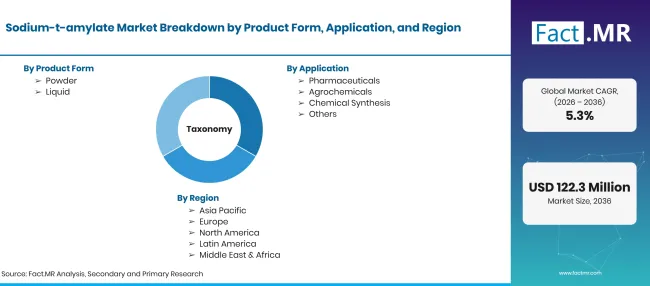
Sodium T Amylate Market Taxonomy | Source: Fact.MR
| Attribute | Details |
|---|---|
| Quantitative Units | USD million |
| Market Definition | Sodium tert-amylate (sodium tert-pentoxide, CAS 14593-46-5) sold as powder or solution for use as a strong base in pharmaceutical, agrochemical and chemical synthesis. |
| Product Form | Powder; Liquid |
| Application | Pharmaceuticals; Agrochemicals; Chemical Synthesis; Others |
| End-User Industry | Pharmaceutical; Agriculture; Chemical; Others |
| Regions Covered | North America; Latin America; Western Europe; Eastern Europe; East Asia; South Asia & Pacific; Middle East & Africa |
| Countries Covered | Germany; Brazil; United States; United Kingdom; Japan |
| Companies Profiled | Evonik Industries AG; Merck KGaA; Thermo Fisher Scientific; Tokyo Chemical Industry; American Elements; Nordmann |
| Forecast Period | 2026 to 2036 |
| Approach | Reagent consumption per synthesis route, mapped to drug and agrochemical output and cross-checked with producer and distributor portfolios. |
Source: Fact.MR analysis. Updated Nov 4, 2026
How is the market segmented?
-
By Product Form
- Powder
- Liquid
-
By Application
- Pharmaceuticals
- Agrochemicals
- Chemical Synthesis
- Others
-
By End-User Industry
- Pharmaceutical
- Agriculture
- Chemical
- Others
-
By Region
- North America
- Latin America
- Western Europe
- Eastern Europe
- East Asia
- South Asia & Pacific
- Middle East & Africa
Frequently Asked Questions
How large is the sodium-t-amylate market in 2026?
What growth rate will the sodium-t-amylate market record?
Which product form leads?
Which application leads?
Which end-user industries buy sodium-t-amylate?
Which country will grow quickest?
Who are the main companies?
What holds the market back?
Who worked on this report


Preview the report firsthand - request a free sample
Free SampleGet the brochure for pricing and purchase details
Download PDF