- Market Value (2025): USD 3.1 Bn
- Estimated Value (2026): USD 3.6 Bn
- Forecast Value (2036): USD 14.3 Bn
- CAGR (2026-2036): 14.8%
What is the Invisible Aero-Conformal Arrays Market forecast to be worth by 2036?
USD 3.6 billion in 2026 to USD 14.3 billion by 2036 at a 14.8% CAGR.
- The Invisible Aero-Conformal Arrays Market crossed a valuation of USD 3.1 billion in 2025.
- Demand is projected to increase from USD 3.6 billion in 2026 to USD 14.3 billion by 2036.
- The market is forecast to record a 14.8% CAGR from 2026 to 2036 as fighter integrators and UAS teams move exposed antennas into conformal aperture layouts.
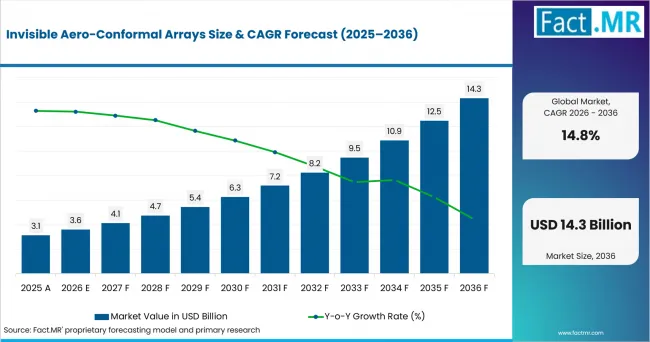
Invisible Aero Conformal Arrays Value Analysis | Source: Fact.MR
What are the defining numbers behind Invisible Aero-Conformal Arrays Market growth?
USD 10.7 billion absolute opportunity by 2036.
- Demand Drivers in the Market
- Airframe engineers need low-profile RF surfaces that preserve aircraft shape and leave room for mission hardware.
- Fighter program teams need missile, radar and EW integration routes. The U.S. State Department approved a possible USD 211 million Foreign Military Sale to Italy in June 2025 covering AMRAAM missiles and related equipment.
- UAS designers need lighter radar packages where payload, cooling and power budgets remain tight.
- Mission-system teams need common aperture paths that support radar and electronic attack on the same aircraft family.
- Key Segments Analyzed
- By Aperture Integration: Skin-embedded phased array is expected to hold 36.0% share in 2026 because it places RF function inside the aircraft surface.
- By Platform: Fighter aircraft is projected to account for 34.0% share in 2026 owing to stealth upgrades and electronic attack needs.
- By Function: Radar is anticipated to capture 34.0% share in 2026 due to fire-control and air-picture tasks.
- By Band: X-band is estimated to represent 31.0% share in 2026 because fighter radar tasks need compact high-resolution sensing.
- Analyst Opinion at Fact.MR
- Shambhu Nath Jha, Principal Consultant at Fact.MR, states, "Aero-conformal arrays draw attention because the antenna becomes part of the aircraft integration plan. Demand is expected to favor suppliers that combine RF design, materials testing and airframe fit evidence. Defense customers value low-profile arrays that keep radar or EW performance repeatable after installation."
- Strategic Implications
- Aperture suppliers should document curvature limits, thermal behavior and repair access before design freeze.
- Airframe integrators should test radome materials and embedded arrays together so installed RF performance remains stable.
- Defense electronics teams should align radar and EW roadmaps when one aperture family supports several functions.
- Program managers should reserve qualification time for vibration, temperature and maintainability tests tied to aircraft skin integration.
Italy is estimated to record 16.7% CAGR through 2036 due to airborne electronic attack work. The USA is projected to post 16.3% CAGR as stealth fighter upgrades guide RF integration. The UK is anticipated to advance at 15.9% CAGR because drone and combat-air funding widen aircraft programs. France is forecast to hold 15.5% CAGR owing to Rafale modernization. Israel is expected to reach 14.5% CAGR as fighter renewal supports long-range missions.
How does the Invisible Aero-Conformal Arrays Market break down by segment?
Skin-embedded phased array leads at 36.0%; fighter aircraft leads at 34.0%.
Which Aperture Integration dominates?
Skin-embedded phased array holds 36.0% share in 2026.
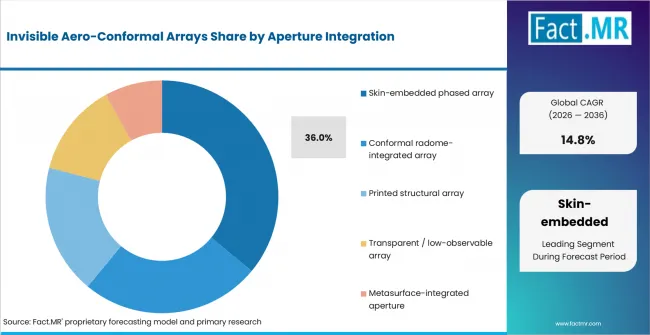
Invisible Aero Conformal Arrays Analysis By Aperture Integration | Source: Fact.MR
Skin-embedded phased array is expected to lead Aperture Integration because it gives aircraft designers a direct route to low-profile sensing. Conformal radome-integrated arrays remain relevant where protected RF windows are part of the nose or leading-edge structure. Printed structural arrays fit lighter UAS concepts. Metasurface-integrated apertures are expected to gain pilot use where flatter RF surfaces reduce installation depth.
What leads the Platform segment?
Fighter aircraft leads with 34.0% share in 2026.
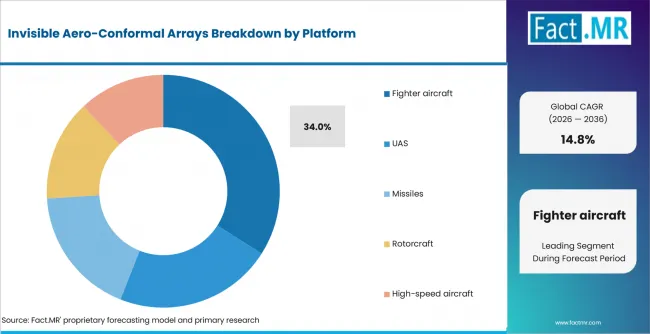
Invisible Aero Conformal Arrays Analysis By Platform | Source: Fact.MR
Fighter aircraft is projected to lead Platform owing to stealth, radar and EW modernization. UAS platforms follow as smaller aircraft need compact sensors with lower power draw. Missiles create narrower requirements for flush RF windows. Rotorcraft use cases remain tied to surveillance and electronic protection where external antennas affect drag and maintenance access.
How does Function shape demand?
Radar accounts for 34.0% share in 2026.
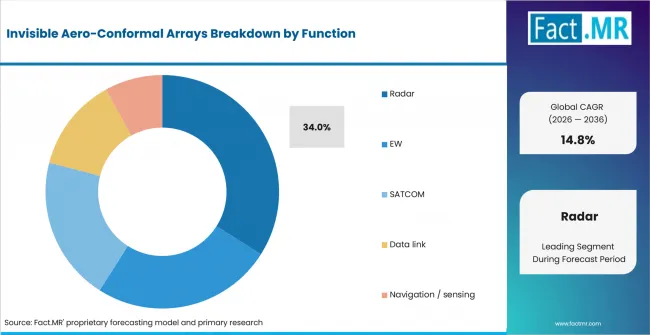
Invisible Aero Conformal Arrays Analysis By Function | Source: Fact.MR
Radar is anticipated to lead Function due to fire-control and threat-tracking needs. EW follows where aircraft detect or disrupt hostile emitters from shaped surfaces. RTX said in September 2025 that PhantomStrike weighs less than 130 pounds, showing why compact AESA design fits UAS and light-aircraft integration.
What supports demand for X-band within Band?
X-band holds 31.0% share in 2026.
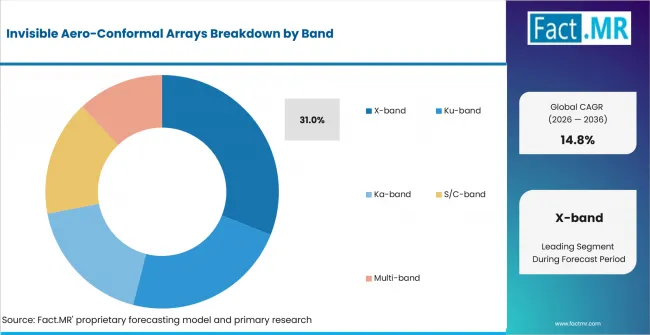
Invisible Aero Conformal Arrays Analysis By Band | Source: Fact.MR
X-band is estimated to lead Band because fighter radar tasks need sharper target resolution within compact apertures. Ku-band and Ka-band remain relevant for SATCOM and narrow-beam links. S/C-band supports wider-area communication and selected lower-frequency sensing roles. Multi-band arrays are expected to gain share where platform teams combine sensing and communication in one aperture family.
What is accelerating Invisible Aero-Conformal Arrays Market adoption, and what is holding it back?
Low-observable sensing drives it; airframe qualification restrains it.
Drivers Impact Analysis
| Driver | (~) % Impact on CAGR | Geographic Relevance | Impact Timeline |
|---|---|---|---|
| Stealth aircraft sensor integration | +1.7% | USA, UK, France, Israel | Short term (<= 2 years) |
| Multifunction radar and EW apertures | +1.3% | North America, Europe | Medium term (2-4 years) |
| UAS and collaborative aircraft programs | +1.0% | USA, UK, Italy | Medium term (2-4 years) |
| Compact X-band fire-control radar needs | +0.8% | Global | Long term (>= 4 years) |
Opportunity Impact Analysis
| Opportunity | (~) % Impact on CAGR | Geographic Relevance | Impact Timeline |
|---|---|---|---|
| Retrofit kits for fifth-generation aircraft | +1.1% | USA, Israel, UK | Short term (<= 2 years) |
| Conformal apertures for electronic attack aircraft | +0.9% | Italy, USA | Medium term (2-4 years) |
| Metasurface aperture research | +0.7% | USA, Europe, Israel | Long term (>= 4 years) |
| Exportable modular antenna families | +0.6% | NATO, Middle East | Long term (>= 4 years) |
Restraints Impact Analysis
| Restraint | (~) % Impact on CAGR | Geographic Relevance | Impact Timeline |
|---|---|---|---|
| Airframe qualification and test burden | -0.8% | Global | Short term (<= 2 years) |
| Thermal and power limits | -0.6% | USA, Europe, Israel | Medium term (2-4 years) |
| Repair access for embedded hardware | -0.4% | Global | Medium term (2-4 years) |
| Classified performance evidence | -0.3% | Defense programs | Long term (>= 4 years) |
Which countries are scaling Invisible Aero-Conformal Arrays Market fastest?
- The country comparison spans 2.2 percentage points across the forecast period.
- Italy remains 0.4 percentage point above the USA with airborne electronic attack and fighter mission work.
- The USA remains 0.4 percentage point above the UK as stealth modernization supports embedded radar and EW apertures.
- The UK remains 0.4 percentage point above France with drone investment and GCAP activity supporting future aircraft integration.
- France remains 1.0 percentage point above Israel as Rafale modernization guides combat aircraft sensing work.
- Israel closes the displayed range with fighter renewal and long-range mission planning.
Comparable CAGRs create different entry conditions due to aircraft type, qualification routes and national defense programs. Full report coverage includes North America, Western Europe, Eastern Europe, Asia Pacific, and Middle East & Africa.
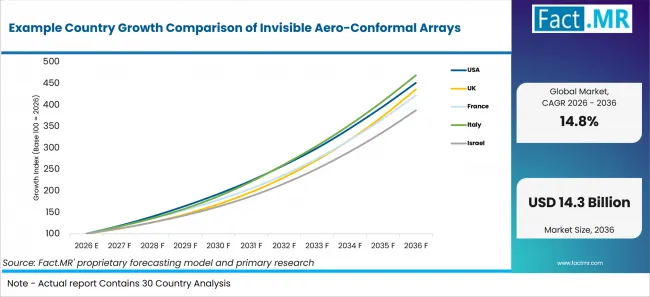
Example Country Growth Comparison Of Invisible Aero Conformal Arrays | Source: Fact.MR
| Country | CAGR |
|---|---|
| Italy | 16.7% |
| USA | 16.3% |
| UK | 15.9% |
| France | 15.5% |
| Israel | 14.5% |
What supports Italy adoption?
16.7% CAGR through 2036, driven by fighter and airborne electronic attack integration.
Italy is moving special mission aircraft toward integrated electronic attack. It is estimated to record 16.7% CAGR through 2036. L3Harris announced in July 2025 a USD 300 million contract from Italy to deliver two Gulfstream G550 aircraft provisioned for a modern electromagnetic warfare system.
What is powering USA demand?
16.3% CAGR through 2036, led by stealth aircraft upgrades and multifunction sensing.
U.S. combat-air modernization keeps RF apertures tied to aircraft shape and mission-system upgrades. The USA is projected to post 16.3% CAGR through 2036. GAO reported in September 2025 that F-35 Block 4 modernization includes radar enhancements as well as electronic warfare, communication and navigation capabilities.
What supports the UK outlook?
15.9% CAGR through 2036, backed by uncrewed teaming and combat-air funding.
The UK links uncrewed aircraft work with future combat-air spending. It is anticipated to advance at 15.9% CAGR through 2036. GOV.UK reported in June 2026 that more than GBP 5 billion would be invested in drones and autonomous systems over four years.
How is France scaling demand?
15.5% CAGR through 2036, shaped by Rafale modernization and electromagnetic operations.
France gives the market a clear fighter modernization path through Rafale work. France is forecast to hold 15.5% CAGR through 2036. The Ministry of the Armed Forces reported in August 2026 that the updated 2024-2030 Military Programming Law provides an additional EUR 36 billion between 2026 and 2030 to accelerate rearmament and strengthen critical military capabilities.
What underpins Israel growth?
14.5% CAGR through 2036, supported by combat aircraft renewal and long-range mission needs.
Israel keeps low-observable aircraft and range-extension work central to sensing choices. Israel is expected to reach 14.5% CAGR through 2036. IMOD stated in May 2026 that Israel’s decade-long IDF force buildup plan has a dedicated NIS 350 billion budget, alongside approval to acquire a fourth F-35 squadron and a second F-15IA squadron.
Who leads the Invisible Aero-Conformal Arrays Market?
Northrop Grumman and RTX are active in airborne multifunction AESA radar, while BAE Systems provides direct conformal antenna coverage and L3Harris participates in airborne electronic warfare integration.
Northrop Grumman is relevant through AESA fire-control radar and airborne sensing portfolios supporting fighter missions. RTX participates through Raytheon's PhantomStrike, a compact, air-cooled AESA fire-control radar designed for uncrewed, light-attack and fighter aircraft, with an additional U.S. Air Force application on the autonomous X-62A VISTA. BAE Systems adds direct conformal-antenna capability through its Silver Link portfolio.
L3Harris is relevant through its work on Italy's G550 electromagnetic-warfare aircraft. Across these suppliers, relevant technical differentiators include flight-test and qualification evidence, RF performance, compact integration and compatibility with aircraft-level mission systems.
Which companies are the key providers?
Northrop Grumman and RTX are key providers. L3Harris and BAE Systems are also profiled.
- Northrop Grumman
- RTX
- L3Harris
- BAE Systems
This Report Answers
- The report explains where invisible aero-conformal arrays are used across aperture integration and platform type.
- Segment analysis identifies the leading subsegments and technical selection reasons.
- Country analysis examines Italy, USA, UK, France and Israel with program evidence.
- Competitive analysis reviews Northrop Grumman, RTX, L3Harris, BAE Systems.
- Application analysis covers radar, EW, SATCOM, data-link and navigation functions.
Bibliography
- BAE Systems. (2026, March 2). BAE Systems introduces Silver Link™ conformal antenna aperture solutions.
- Defense Security Cooperation Agency. (2025, June 16). Italy – Advanced Medium-Range Air-to-Air Missiles.
- Israel Ministry of Defense. (2026, March 5). IDF to receive two new fighter squadrons: Ministerial Procurement Committee approves acquisition of F-35 and F-15IA squadrons.
- L3Harris Technologies. (2025, July 21). L3Harris receives $300 million contract to enhance Italy’s airborne electronic warfare capabilities.
- Leonardo Electronics. (2025, February). ECRS Mk2: European Common Radar System Mk2 – Multi Function Array [Product brochure]. Leonardo UK Ltd.
- Ministère des Armées et des Anciens combattants. (2026, August 18). Actualisation de la LPM : la France intensifie son effort de réarmement.
- Ministry of Defence. (2026, June 29). UK drone transformation to strengthen Armed Forces backed by more than £5 billion. GOV.UK.
- Raytheon. (2025, September 17). Big radar power for small aircraft. RTX.
- Thales. (2026, July 23). Thales reports its 2026 half-year results.
- U.S. Government Accountability Office. (2025, September 3). F-35 Joint Strike Fighter: Actions needed to address late deliveries and improve future development (GAO-25-107632).
- U.S. Government Accountability Office. (2026, June 11). F-35 sustainment: Actions needed to ensure updated strategy improves persistent readiness challenges (GAO-26-108113).
What does the Invisible Aero-Conformal Arrays Market cover?
Skin-embedded, radome-integrated, printed and metasurface apertures used for airborne RF missions.
The Invisible Aero-Conformal Arrays Market covers low-profile RF apertures placed inside or against aircraft surfaces. It includes radar arrays, EW apertures, SATCOM antennas and data-link systems where integration reduces external protrusions.
The scope is narrower than broad military antenna systems and focuses on aircraft-surface placement. It connects with airborne radar systems when the radar aperture is designed for skin, radome or structural integration.
What is included in the scope?
Invisible Aero-Conformal Arrays Market systems used on combat aircraft, UAS, missiles, rotorcraft and high-speed aircraft.
The scope includes skin-embedded phased arrays, conformal radome-integrated arrays, printed structural arrays, transparent low-observable arrays and metasurface-integrated apertures. It includes radar, EW and SATCOM functions when integrated into aerodynamic surfaces. Adjacent coverage links to electronic warfare systems and aircraft sensor technologies where RF integration supports airborne missions.
What is excluded from the scope?
Standalone pods, ground radars and conventional protruding antennas are outside the scope.
The scope places external jamming pods, ground-based radar systems and civil aircraft communication antennas outside the market boundary. Aircraft structures are included only when RF performance or mission-system functionality is part of the integrated aperture design.
How Was the Analysis Built?
The analysis draws on 120+ sources, 35+ company portfolios, 25+ countries, and more than 20 industry interviews.
- Primary Research: Primary research includes discussions with manufacturers, service providers, technology developers, distributors, end users, and subject-matter experts. These conversations examine purchasing priorities, product adoption, operational challenges, approval requirements, competitive positioning, and the factors that influence wider market acceptance.
- Desk Research: Desk research covers government statistics, regulatory publications, company filings, trade data, technical studies, industry associations, standards, public policy, and other authoritative sources. Every source used in the analysis is documented in the bibliography.
- Market Sizing and Forecasting: Market estimates combine historical performance, demand indicators, pricing and volume trends, segment shares, company participation, country-level growth, adoption patterns, investment activity, and barriers to market expansion.
- Data Validation and Update Cycle: Findings are validated by comparing primary interviews with public data, company activity, regulatory changes, trade patterns, and industry developments. Regular updates review new product launches, capacity changes, partnerships, approvals, and shifts in commercial adoption.
What is the report’s scope and coverage?
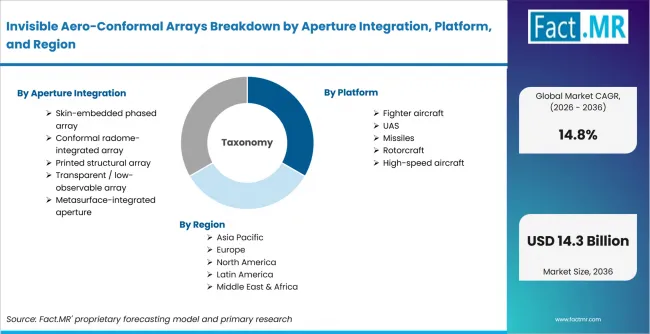
Invisible Aero Conformal Arrays Breakdown By Aperture Integration, Platform, And Region | Source: Fact.MR
| Attribute | Details |
|---|---|
| Quantitative Units | USD billion in 2026 to USD billion by 2036 at a CAGR |
| Market Definition | Low-profile RF aperture systems integrated into aircraft skins, radomes, structural panels or low-observable surfaces. |
| Aperture Integration | Skin-embedded phased array; Conformal radome-integrated array; Printed structural array; Transparent or low-observable array; Metasurface-integrated aperture |
| Platform | Fighter aircraft; UAS; Missiles; Rotorcraft; High-speed aircraft |
| Function | Radar; EW; SATCOM; Data link; Navigation or sensing |
| Band | X-band; Ku-band; Ka-band; S/C-band; Multi-band |
| Regions Covered | North America; Western Europe; Eastern Europe; Middle East & Africa; Asia Pacific |
| Countries Covered | Italy; USA; UK; France; Israel |
| Key Companies Profiled | Northrop Grumman; RTX; L3Harris; BAE Systems |
| Forecast Period | 2026 to 2036 |
| Approach | Hybrid top-down and bottom-up approach using aircraft programs, mission-system fit, country activity and provider portfolio review. |
How is the market segmented?
-
By Aperture Integration
- Skin-embedded phased array
- Conformal radome-integrated array
- Printed structural array
- Transparent or low-observable array
- Metasurface-integrated aperture
-
By Platform
- Fighter aircraft
- UAS
- Missiles
- Rotorcraft
- High-speed aircraft
-
By Function
- Radar
- EW
- SATCOM
- Data link
- Navigation or sensing
-
By Band
- X-band
- Ku-band
- Ka-band
- S/C-band
- Multi-band
-
By Region
- North America
- Western Europe
- Eastern Europe
- Middle East & Africa
- Asia Pacific