Airborne Radar Market (2026 - 2036)
Airborne Radar Market is segmented by Component (Antenna, Transmitter, Duplexer, Receiver, Power Amplifier, Digital Signal Processor, Stabilization System, Graphical User Interface, and Others), Technology (Software-Defined Radar/SDR, Conventional Radar, and Quantum Radar), Platform (Commercial Aircraft, Military Aircraft, Business Jets, Helicopters, UAVs, UAM, and Aerostats), and Region. Forecast for 2026 to 2036.
Core Findings
Airborne Radar Market Forecast and Outlook 2026 to 2036
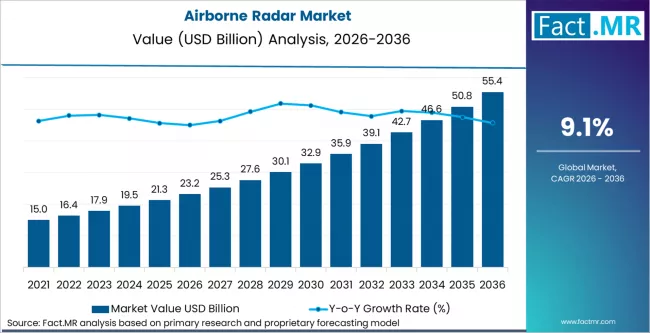
In 2025, the airborne radar market was valued at USD 20.1 billion. Based on Fact.MR analysis demand for airborne radar systems is estimated to grow to USD 23.2 billion in 2026 and USD 53.1 billion by 2036. FACT.MR projects a CAGR of 9.1% during the forecast period.
The absolute dollar growth from 2026 to 2036 represents a transformational gain of USD 29.9 billion. It reflects a structural shift from fixed-function radar platforms to reconfigurable, software-defined architectures. These next-generation systems support multi-mission capability, including air-to-air, air-to-ground, and synthetic aperture radar (SAR) operations.
As Hyuk Park, Head of Defense Electronics at Hanwha Systems stated, “Hanwha Systems is the one and only company in Korea to successfully develop, mass-produce, and export AESA radar systems. We are expanding our global reach with scalable radar solutions tailored to a wide range of platforms, from light fighters to unmanned aerial vehicles.”
Country-level CAGR reflects defense budgets and fleet expansion. South Korea leads at 11.8% CAGR, driven by KF-21 radar procurement, maritime helicopter acquisitions, and counter-drone deployments near the DMZ. Japan follows at 10.9% with F-35 AESA integration and indigenous fighter radar programs. The United Kingdom posts 9.9% supported by Tempest R&D and Typhoon AESA retrofits. China records 9.4% through PLA modernization and AESA deployment on J-20 and J-16 platforms. The United States grows at 9.3%, sustained by F-35, F-15EX, and NGAD programs, though moderated by a mature installed base.
Market Definition
Airborne radar systems are RF sensors mounted on aircraft, helicopters, UAVs, and aerostats. They detect, track, and classify air and surface targets across surveillance, fire control, ISR, and weather applications. The market includes mechanically scanned radars, AESA systems, and software-defined platforms enabling multi-mode operations. End users include military aircraft, commercial airliners, and unmanned systems.
Market Inclusions
The report covers global airborne radar forecasts from 2026 to 2036 by component, technology, platform, and geography. It analyzes AESA adoption, GaN versus GaAs trade-offs, radar cross-section impacts, and export control considerations.
Market Exclusions
Ground-based, naval, and space-based radar systems are excluded unless integrated into airborne platforms. Radar altimeters and navigation-only systems are also excluded. The focus is on multi-mode search, track, and fire-control radar subsystems.
Research Methodology
- Primary Research: Interviews were conducted with radar engineers, aircraft OEM integration leaders, and defense procurement officials across major programs.
- Desk Research: Data sources included DoD acquisition reports, NATO studies, SIPRI expenditure data, and defense prime segment disclosures.
- Market-Sizing and Forecasting: Sizing combined defense budget allocations with aircraft production forecasts and validated radar ASPs from contract awards.
- Data Validation and Update Cycle: Results were cross-checked with quarterly earnings, foreign military sales notifications, and major platform upgrade decisions.
Key Takeaways
- Market Definition
- Airborne radar systems support detection, tracking, and targeting across military, commercial, and UAV platforms, with growth led by AESA and software-defined architectures.
- Demand Drivers
- F-35 production at 156 annual deliveries supports steady AESA radar procurement revenue for Northrop Grumman and suppliers.
- FAA turbulence detection mandates require upgraded weather radar on commercial aircraft, supporting avionics demand.
- Counter-UAS regulations in the U.S. and EU are driving airborne radar adaptation for airport and infrastructure protection.
- Key Segments Analyzed
- By Component, Antenna holds 39.6% share due to high-cost AESA array modules driving performance and system pricing.
- By Technology, Software-Defined Radar holds 55.7% share, offering flexible upgrades and premium pricing over legacy systems.
- By Platform, Military Aircraft account for 54.4% share, reflecting high-value fire-control radar integration across combat fleets.
- Analyst Opinion at FACT.MR
- Shambhu Nath Jha, Principal Consultant at Fact.MR, opines, 'CXOs will find this report valuable for understanding how AESA technology maturation and software-defined architecture adoption are reshaping competitive dynamics from platform-specific radar specialists toward multi-domain sensor integrators who can navigate ITAR export controls while delivering gallium nitride T/R module cost reductions enabling AESA price parity with mechanically-scanned predecessors by 2028-2030.'
- Strategic Implications
- Radar suppliers should prioritize software-defined and AESA architectures to align with next-generation fighter and ISR platform requirements.
- OEMs must diversify gallium nitride and critical semiconductor supply chains to mitigate export control and geopolitical risk.
- Defense primes should invest in open-architecture integration to enable rapid software upgrades and long-term platform relevance.
- Methodology
- Market sizing combined combat and surveillance aircraft production forecasts with radar system content benchmarks derived from defense contract disclosures.
- AESA and SDR adoption curves were benchmarked against F-35, F-15EX, Typhoon retrofit, and maritime patrol upgrade programs.
- Component cost modeling incorporated antenna array pricing, T/R module content per system, and GaN versus GaAs semiconductor cost trends.
Segmental Analysis
Airborne Radar Market Analysis by Component
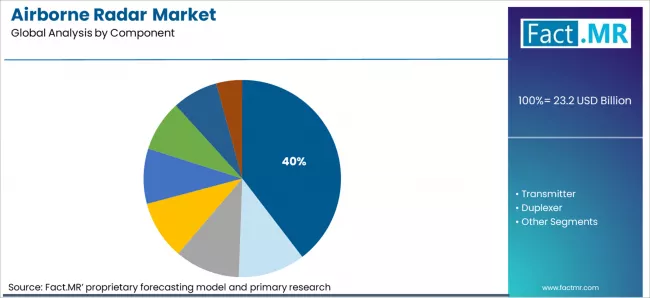
Based on FACT.MR’s report, antenna systems hold 39.6% share of the airborne radar market. The antenna is the performance-defining subsystem, responsible for signal transmission, reception, beam steering, and target resolution. In AESA radars, planar and conformal arrays integrate thousands of transmit/receive modules, directly influencing detection range, tracking accuracy, and electronic countermeasure resistance. Antenna assemblies typically account for 35-45% of total radar system cost due to material complexity and power density requirements.
- Northrop Grumman AESA Production Scaling: Northrop Grumman continues scaling AN/APG-81 and next-generation AESA array production for fighter platforms, reinforcing antenna subsystem demand across U.S. and allied fleets. [4]
- Raytheon GaN Radar Module Investment: Raytheon is advancing gallium nitride-based T/R modules to improve power output and thermal efficiency in next-generation airborne radar arrays. [5]
- Leonardo Multi-Role Radar Arrays: Leonardo is expanding electronically scanned array development for European fighter and ISR platforms, emphasizing modular antenna architectures.
Airborne Radar Market Analysis by Technology
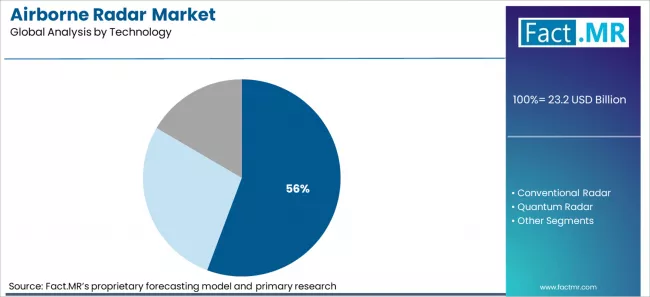
Software-defined radar (SDR) commands 55.7% share, reflecting the transition from fixed-function hardware to reprogrammable architectures. SDR enables mission updates through waveform and signal processing software changes without hardware replacement. This flexibility supports air-to-air, air-to-ground, maritime patrol, and SAR modes within a single platform. Although priced 25-40% above legacy systems, SDR provides extended upgrade cycles and lifecycle cost efficiency.
- Lockheed Martin NGAD Radar Architecture: Lockheed Martin is integrating open-architecture, software-defined radar capabilities into next-generation air dominance programs, supporting rapid capability updates.
- Saab AESA Software Upgrade Path: Saab’s fighter radar systems emphasize software-based enhancements to extend operational relevance without major hardware redesign.
- Thales Multi-Mode Radar Integration: Thales continues advancing SDR-based multi-role radar systems for combat and surveillance aircraft, focusing on mission adaptability.
Drivers, Restraints, and Opportunities
Fact.MR analysis indicates strong airborne radar growth driven by fighter modernization and multi-domain surveillance demand. AESA adoption, export programs, and UAV integration are expanding the addressable market. However, budget trade-offs with hypersonic and directed energy systems constrain incremental radar spending in mature markets.
The primary tension lies between rapid modernization requirements and long procurement cycles. Advanced air forces prioritize next-generation AESA upgrades, while smaller nations face funding and technology transfer limitations.
- Fighter Fleet Modernization Programs: Ongoing F-35, F-15EX, and allied fighter upgrades are sustaining steady AESA radar procurement volumes globally. [2]
- Export Control and Technology Transfer Constraints: Strict U.S. and EU export regulations on AESA and GaN technologies limit addressable markets and extend approval timelines. [3]
- UAV and Counter-UAS Integration Opportunity: Expanding unmanned aerial system deployment and counter-drone mandates are creating new demand for compact, software-defined airborne radar solutions. [4]
Regional Analysis
The airborne radar market is analyzed across North America, Europe, and Asia-Pacific. Regional demand is shaped by defense modernization budgets, indigenous fighter development, AESA adoption rates, export controls, and airborne ISR fleet expansion. The report provides market attractiveness benchmarking based on radar content per aircraft, domestic semiconductor capability, and next-generation platform funding pipelines.
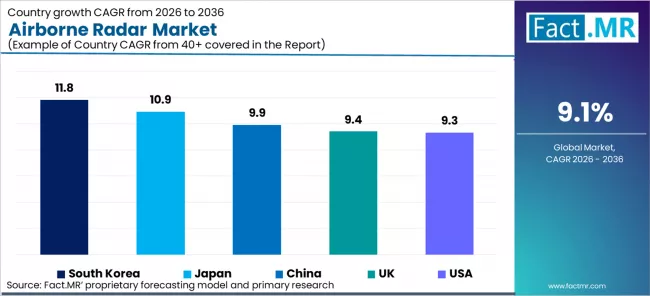
| Country | CAGR% |
|---|---|
| South Korea | 11.8% |
| Japan | 10.9% |
| United Kingdom | 9.4% |
| China | 9.9% |
| United States | 9.3% |
Source: Fact.MR (FACT.MR) analysis, based on proprietary forecasting model and primary research
Asia Pacific Airborne Radar Market Analysis
Asia Pacific is the fastest-growing region, driven by indigenous fighter programs, maritime surveillance expansion, and counter-UAS deployments. Governments are prioritizing AESA localization and radar software capability upgrades to strengthen domestic defense supply chains.
- South Korea: Demand for airborne radar systems in South Korea is projected to rise at 11.8% CAGR through 2036. Growth is led by KF-21 Boramae fighter radar procurement, rotary-wing maritime patrol expansion, and counter-drone radar deployment along the DMZ. Domestic AESA development strengthens long-term self-reliance.
- Japan: Demand in Japan is projected to grow at 10.9% CAGR through 2036. Expansion is supported by F-35A/B radar integration, E-2D early warning upgrades, and indigenous next-generation fighter radar R&D under national defense modernization programs.
- China: Demand in China is projected to rise at 9.4% CAGR through 2036. Growth is anchored by PLA Air Force modernization and domestic AESA production for J-20, J-16, and AWACS platforms, supported by state-backed semiconductor capability expansion.
FACT.MR’s Asia Pacific analysis covers South Korea, Japan, China, Australia, and India. Readers can find fighter fleet forecasts, domestic AESA production trends, and regional ISR deployment data.
North America Airborne Radar Market Analysis
North America remains the global revenue anchor for airborne radar, supported by advanced fighter procurement and next-generation air dominance programs. Strong defense R&D funding and established prime contractors sustain technology leadership.
- United States: Demand for airborne radar systems in the United States is projected to rise at 9.3% CAGR through 2036. Growth is driven by F-35, F-15EX, and NGAD radar procurements. However, expansion is moderated by a mature installed base and budget prioritization toward hypersonic and directed energy systems.
FACT.MR’s North America analysis includes the United States and Canada. It evaluates DoD procurement allocations, AESA upgrade cycles, and defense contractor revenue exposure.
Europe Airborne Radar Market Analysis
Europe combines next-generation fighter development with retrofit programs across legacy fleets. AESA upgrades and collaborative defense programs support steady radar demand.
- United Kingdom: Demand for airborne radar systems in the United Kingdom is projected to rise at 9.9% CAGR through 2036. Growth reflects Tempest future fighter radar R&D funding, Typhoon AESA retrofit programs, and expanding civil drone detection requirements.
FACT.MR’s Europe analysis covers the United Kingdom, Germany, France, and Italy. It includes Tempest program timelines, retrofit investment trends, and export market participation analysis.
Competitive Aligners for Market Players
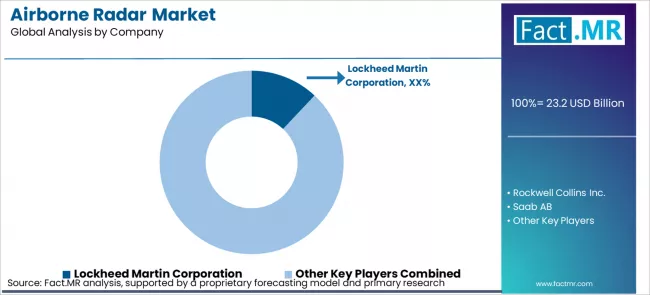
The airborne radar market is dominated by a small group of global aerospace and defense primes that possess the technical depth, security clearances, and certification capabilities required by national defense authorities. A significant share of global production capacity is controlled by vertically integrated players that design both the radar systems and the aircraft platforms. This integration streamlines system compatibility, enhances sensor fusion performance, and reduces program risk during integration and flight qualification phases.
Competitive advantage is increasingly defined by software adaptability rather than purely hardware performance. Vendors using open-architecture and modular software frameworks can deliver faster capability upgrades in response to emerging electronic warfare threats. Strong in-house digital signal processing expertise enables companies to optimize performance through software updates, extending system relevance without requiring major hardware redesign.
Buyer power remains concentrated, as sovereign governments represent the core customer base. Defense ministries exercise substantial pricing leverage and frequently adopt multi-sourcing strategies to avoid supplier lock-in.
Key Players in Airborne Radar Market
- Lockheed Martin Corporation
- Rockwell Collins Inc.
- Saab AB
- Honeywell International Inc.
- General Dynamics Corporation
- Rheinmetall AG
- BAE Systems
- Northrop Grumman Corporation
- Raytheon Technologies
- Thales Group
Scope of Report
| Items | Values |
|---|---|
| Quantitative Units | USD 23.2 billion (2026) to USD 53.1 billion (2036), at a CAGR of 9.1% |
| Market Definition | The airborne radar market encompasses the worldwide manufacturing and supply of radar systems installed on aircraft to detect location, speed, and target attributes. These systems support military surveillance, threat identification, terrain imaging, and commercial flight safety by using advanced electromagnetic sensing and signal processing technologies. |
| Component Segmentation | Antenna, Transmitter, Duplexer, Receiver, Power Amplifier, Digital Signal Processor, Stabilization System, Graphical User Interface, Others |
| Technology Segmentation | Software-Defined Radar (SDR), Conventional Radar, Quantum Radar |
| Platform Segmentation | Military Aircraft, Commercial Aircraft, Business Jets, Helicopters, UAVs, UAM, Aerostats |
| Installation Type Coverage | New Installation, Upgradation |
| Waveform Coverage | Frequency Modulated Continuous Wave (FMCW), Doppler, Ultra-Wideband Impulse (UWB) |
| Range Coverage | Long Range, Very Long Range, Medium Range, Short Range, Very Short Range |
| Dimension Coverage | 2D, 3D, 4D |
| Regions Covered | North America, Latin America, Western Europe, Eastern Europe, South Asia & Pacific, East Asia, Middle East & Africa |
| Approach | The market was estimated using a combined top-down and bottom-up modeling approach. Findings were validated through primary interviews with radar manufacturers, aerospace engineers, and defense procurement officials. The analysis was further supported by aircraft order backlogs, defense budget comparisons, aerospace trade data, and facility-level production capacity assessments. |
Airborne Radar Analysis by Segments
-
Component
- Antenna
- Transmitter
- Duplexer
- Receiver
- Power Amplifier
- Digital Signal Processor
- Stabilization System
- Graphical User Interface
- Others
-
Technology
- Software-Defined Radar (SDR)
- Conventional Radar
- Quantum Radar
-
Platform
- Commercial Aircraft
- Military Aircraft
- Business Jets
- Helicopters
- UAVs
- UAM
- Aerostats
-
Region
- Asia Pacific
- China
- Japan
- South Korea
- Australia & New Zealand
- India
- ASEAN
- Rest of Asia Pacific
- Europe
- Norway
- Germany
- United Kingdom
- France
- Spain
- Netherlands
- Nordics
- Rest of Europe
- North America
- United States
- Canada
- Mexico
- Latin America
- Brazil
- Chile
- Ecuador
- Rest of Latin America
- Middle East & Africa
- Kingdom of Saudi Arabia
- United Arab Emirates
- South Africa
- Turkey
- Rest of Middle East & Africa
- Asia Pacific
Bibliography
- [1] Hanwha Systems. (2023). Hanwha Systems expands global AESA radar exports and defense electronics capabilities. Battle Updates.
- [2] U.S. Department of Defense (DoD). (2024). Selected acquisition reports: F-35 Lightning II, F-15EX Eagle II, and related modernization programs. Office of the Under Secretary of Defense (Comptroller).
- [3] U.S. Department of State. (2023). International Traffic in Arms Regulations (ITAR) and export administration controls for advanced defense electronics. Directorate of Defense Trade Controls.
- [4] Northrop Grumman Corporation. (2024). AN/APG-81 AESA radar production and advanced fighter radar programs. Northrop Grumman Newsroom and Investor Relations.
- [5] RTX Corporation (Raytheon). (2024). Gallium nitride (GaN) radar module advancements for next-generation airborne systems. RTX Investor Relations and Press Releases.
This Report Addresses
- Market intelligence to enable structured strategic decision making across aerospace sensor procurement and platform modernization.
- Market size estimation and 10-year revenue forecasts from 2026 to 2036, supported by aircraft production backlogs and defense budget analysis.
- Growth opportunity mapping across software-defined and quantum technologies with emphasis on the transition to AESA architectures.
- Segment and regional revenue forecasts covering military aircraft, commercial aviation, and emerging Urban Air Mobility applications.
- Competition strategy assessment including vertical integration models, software update agility, and cost survivability positioning.
- Product reformulation tracking including the use of Gallium Nitride (GaN) and compact form factors for tactical UAVs.
- Regulatory impact analysis covering flight safety certifications, frequency allocation mandates, and export control restrictions on advanced radar.
- Market report delivery in PDF, Excel, PPT, and interactive dashboard formats for executive and operational planning.
Table of Content
- Executive Summary
- Global Market Outlook
- Demand to side Trends
- Supply to side Trends
- Technology Roadmap Analysis
- Analysis and Recommendations
- Market Overview
- Market Coverage / Taxonomy
- Market Definition / Scope / Limitations
- Research Methodology
- Chapter Orientation
- Analytical Lens and Working Hypotheses
- Market Structure, Signals, and Trend Drivers
- Benchmarking and Cross-market Comparability
- Market Sizing, Forecasting, and Opportunity Mapping
- Research Design and Evidence Framework
- Desk Research Programme (Secondary Evidence)
- Company Annual and Sustainability Reports
- Peer-reviewed Journals and Academic Literature
- Corporate Websites, Product Literature, and Technical Notes
- Earnings Decks and Investor Briefings
- Statutory Filings and Regulatory Disclosures
- Technical White Papers and Standards Notes
- Trade Journals, Industry Magazines, and Analyst Briefs
- Conference Proceedings, Webinars, and Seminar Materials
- Government Statistics Portals and Public Data Releases
- Press Releases and Reputable Media Coverage
- Specialist Newsletters and Curated Briefings
- Sector Databases and Reference Repositories
- FMR Internal Proprietary Databases and Historical Market Datasets
- Subscription Datasets and Paid Sources
- Social Channels, Communities, and Digital Listening Inputs
- Additional Desk Sources
- Expert Input and Fieldwork (Primary Evidence)
- Primary Modes
- Qualitative Interviews and Expert Elicitation
- Quantitative Surveys and Structured Data Capture
- Blended Approach
- Why Primary Evidence is Used
- Field Techniques
- Interviews
- Surveys
- Focus Groups
- Observational and In-context Research
- Social and Community Interactions
- Stakeholder Universe Engaged
- C-suite Leaders
- Board Members
- Presidents and Vice Presidents
- R&D and Innovation Heads
- Technical Specialists
- Domain Subject-matter Experts
- Scientists
- Physicians and Other Healthcare Professionals
- Governance, Ethics, and Data Stewardship
- Research Ethics
- Data Integrity and Handling
- Primary Modes
- Tooling, Models, and Reference Databases
- Desk Research Programme (Secondary Evidence)
- Data Engineering and Model Build
- Data Acquisition and Ingestion
- Cleaning, Normalisation, and Verification
- Synthesis, Triangulation, and Analysis
- Quality Assurance and Audit Trail
- Market Background
- Market Dynamics
- Drivers
- Restraints
- Opportunity
- Trends
- Scenario Forecast
- Demand in Optimistic Scenario
- Demand in Likely Scenario
- Demand in Conservative Scenario
- Opportunity Map Analysis
- Product Life Cycle Analysis
- Supply Chain Analysis
- Investment Feasibility Matrix
- Value Chain Analysis
- PESTLE and Porter’s Analysis
- Regulatory Landscape
- Regional Parent Market Outlook
- Production and Consumption Statistics
- Import and Export Statistics
- Market Dynamics
- Global Market Analysis 2021 to 2025 and Forecast, 2026 to 2036
- Historical Market Size Value (USD Million) Analysis, 2021 to 2025
- Current and Future Market Size Value (USD Million) Projections, 2026 to 2036
- Y to o to Y Growth Trend Analysis
- Absolute $ Opportunity Analysis
- Global Market Pricing Analysis 2021 to 2025 and Forecast 2026 to 2036
- Global Market Analysis 2021 to 2025 and Forecast 2026 to 2036, By Component
- Introduction / Key Findings
- Historical Market Size Value (USD Million) Analysis By Component , 2021 to 2025
- Current and Future Market Size Value (USD Million) Analysis and Forecast By Component , 2026 to 2036
- Antenna
- Transmitter
- Duplexer
- Receiver
- Power Amplifier
- Digital Signal Processor
- Stabilization System
- Graphical User Interface
- Antenna
- Y to o to Y Growth Trend Analysis By Component , 2021 to 2025
- Absolute $ Opportunity Analysis By Component , 2026 to 2036
- Global Market Analysis 2021 to 2025 and Forecast 2026 to 2036, By Technology
- Introduction / Key Findings
- Historical Market Size Value (USD Million) Analysis By Technology, 2021 to 2025
- Current and Future Market Size Value (USD Million) Analysis and Forecast By Technology, 2026 to 2036
- Software-Defined Radar (SDR)
- Conventional Radar
- Quantum Radar
- Software-Defined Radar (SDR)
- Y to o to Y Growth Trend Analysis By Technology, 2021 to 2025
- Absolute $ Opportunity Analysis By Technology, 2026 to 2036
- Global Market Analysis 2021 to 2025 and Forecast 2026 to 2036, By Platform
- Introduction / Key Findings
- Historical Market Size Value (USD Million) Analysis By Platform, 2021 to 2025
- Current and Future Market Size Value (USD Million) Analysis and Forecast By Platform, 2026 to 2036
- Military Aircraft
- Commercial Aircraft
- Business Jets
- Helicopters
- UAVs
- UAM
- Aerostats
- Military Aircraft
- Y to o to Y Growth Trend Analysis By Platform, 2021 to 2025
- Absolute $ Opportunity Analysis By Platform, 2026 to 2036
- Global Market Analysis 2021 to 2025 and Forecast 2026 to 2036, By Region
- Introduction
- Historical Market Size Value (USD Million) Analysis By Region, 2021 to 2025
- Current Market Size Value (USD Million) Analysis and Forecast By Region, 2026 to 2036
- North America
- Latin America
- Western Europe
- Eastern Europe
- East Asia
- South Asia and Pacific
- Middle East & Africa
- Market Attractiveness Analysis By Region
- North America Market Analysis 2021 to 2025 and Forecast 2026 to 2036, By Country
- Historical Market Size Value (USD Million) Trend Analysis By Market Taxonomy, 2021 to 2025
- Market Size Value (USD Million) Forecast By Market Taxonomy, 2026 to 2036
- By Country
- USA
- Canada
- Mexico
- By Component
- By Technology
- By Platform
- By Country
- Market Attractiveness Analysis
- By Country
- By Component
- By Technology
- By Platform
- Key Takeaways
- Latin America Market Analysis 2021 to 2025 and Forecast 2026 to 2036, By Country
- Historical Market Size Value (USD Million) Trend Analysis By Market Taxonomy, 2021 to 2025
- Market Size Value (USD Million) Forecast By Market Taxonomy, 2026 to 2036
- By Country
- Brazil
- Chile
- Rest of Latin America
- By Component
- By Technology
- By Platform
- By Country
- Market Attractiveness Analysis
- By Country
- By Component
- By Technology
- By Platform
- Key Takeaways
- Western Europe Market Analysis 2021 to 2025 and Forecast 2026 to 2036, By Country
- Historical Market Size Value (USD Million) Trend Analysis By Market Taxonomy, 2021 to 2025
- Market Size Value (USD Million) Forecast By Market Taxonomy, 2026 to 2036
- By Country
- Germany
- UK
- Italy
- Spain
- France
- Nordic
- BENELUX
- Rest of Western Europe
- By Component
- By Technology
- By Platform
- By Country
- Market Attractiveness Analysis
- By Country
- By Component
- By Technology
- By Platform
- Key Takeaways
- Eastern Europe Market Analysis 2021 to 2025 and Forecast 2026 to 2036, By Country
- Historical Market Size Value (USD Million) Trend Analysis By Market Taxonomy, 2021 to 2025
- Market Size Value (USD Million) Forecast By Market Taxonomy, 2026 to 2036
- By Country
- Russia
- Poland
- Hungary
- Balkan & Baltic
- Rest of Eastern Europe
- By Component
- By Technology
- By Platform
- By Country
- Market Attractiveness Analysis
- By Country
- By Component
- By Technology
- By Platform
- Key Takeaways
- East Asia Market Analysis 2021 to 2025 and Forecast 2026 to 2036, By Country
- Historical Market Size Value (USD Million) Trend Analysis By Market Taxonomy, 2021 to 2025
- Market Size Value (USD Million) Forecast By Market Taxonomy, 2026 to 2036
- By Country
- China
- Japan
- South Korea
- By Component
- By Technology
- By Platform
- By Country
- Market Attractiveness Analysis
- By Country
- By Component
- By Technology
- By Platform
- Key Takeaways
- South Asia and Pacific Market Analysis 2021 to 2025 and Forecast 2026 to 2036, By Country
- Historical Market Size Value (USD Million) Trend Analysis By Market Taxonomy, 2021 to 2025
- Market Size Value (USD Million) Forecast By Market Taxonomy, 2026 to 2036
- By Country
- India
- ASEAN
- Australia & New Zealand
- Rest of South Asia and Pacific
- By Component
- By Technology
- By Platform
- By Country
- Market Attractiveness Analysis
- By Country
- By Component
- By Technology
- By Platform
- Key Takeaways
- Middle East & Africa Market Analysis 2021 to 2025 and Forecast 2026 to 2036, By Country
- Historical Market Size Value (USD Million) Trend Analysis By Market Taxonomy, 2021 to 2025
- Market Size Value (USD Million) Forecast By Market Taxonomy, 2026 to 2036
- By Country
- Kingdom of Saudi Arabia
- Other GCC Countries
- Turkiye
- South Africa
- Other African Union
- Rest of Middle East & Africa
- By Component
- By Technology
- By Platform
- By Country
- Market Attractiveness Analysis
- By Country
- By Component
- By Technology
- By Platform
- Key Takeaways
- Key Countries Market Analysis
- USA
- Pricing Analysis
- Market Share Analysis, 2025
- By Component
- By Technology
- By Platform
- Canada
- Pricing Analysis
- Market Share Analysis, 2025
- By Component
- By Technology
- By Platform
- Mexico
- Pricing Analysis
- Market Share Analysis, 2025
- By Component
- By Technology
- By Platform
- Brazil
- Pricing Analysis
- Market Share Analysis, 2025
- By Component
- By Technology
- By Platform
- Chile
- Pricing Analysis
- Market Share Analysis, 2025
- By Component
- By Technology
- By Platform
- Germany
- Pricing Analysis
- Market Share Analysis, 2025
- By Component
- By Technology
- By Platform
- UK
- Pricing Analysis
- Market Share Analysis, 2025
- By Component
- By Technology
- By Platform
- Italy
- Pricing Analysis
- Market Share Analysis, 2025
- By Component
- By Technology
- By Platform
- Spain
- Pricing Analysis
- Market Share Analysis, 2025
- By Component
- By Technology
- By Platform
- France
- Pricing Analysis
- Market Share Analysis, 2025
- By Component
- By Technology
- By Platform
- India
- Pricing Analysis
- Market Share Analysis, 2025
- By Component
- By Technology
- By Platform
- ASEAN
- Pricing Analysis
- Market Share Analysis, 2025
- By Component
- By Technology
- By Platform
- Australia & New Zealand
- Pricing Analysis
- Market Share Analysis, 2025
- By Component
- By Technology
- By Platform
- China
- Pricing Analysis
- Market Share Analysis, 2025
- By Component
- By Technology
- By Platform
- Japan
- Pricing Analysis
- Market Share Analysis, 2025
- By Component
- By Technology
- By Platform
- South Korea
- Pricing Analysis
- Market Share Analysis, 2025
- By Component
- By Technology
- By Platform
- Russia
- Pricing Analysis
- Market Share Analysis, 2025
- By Component
- By Technology
- By Platform
- Poland
- Pricing Analysis
- Market Share Analysis, 2025
- By Component
- By Technology
- By Platform
- Hungary
- Pricing Analysis
- Market Share Analysis, 2025
- By Component
- By Technology
- By Platform
- Kingdom of Saudi Arabia
- Pricing Analysis
- Market Share Analysis, 2025
- By Component
- By Technology
- By Platform
- Turkiye
- Pricing Analysis
- Market Share Analysis, 2025
- By Component
- By Technology
- By Platform
- South Africa
- Pricing Analysis
- Market Share Analysis, 2025
- By Component
- By Technology
- By Platform
- USA
- Market Structure Analysis
- Competition Dashboard
- Competition Benchmarking
- Market Share Analysis of Top Players
- By Regional
- By Component
- By Technology
- By Platform
- Competition Analysis
- Competition Deep Dive
- Lockheed Martin Corporation
- Overview
- Product Portfolio
- Profitability by Market Segments (Product/Age /Sales Channel/Region)
- Sales Footprint
- Strategy Overview
- Marketing Strategy
- Product Strategy
- Channel Strategy
- Rockwell Collins Inc.
- Saab AB
- Honeywell International Inc.
- General Dynamics Corporation
- Rheinmetall AG
- BAE Systems
- Northrop Grumman Corporation
- Raytheon Technologies
- Thales Group
- Lockheed Martin Corporation
- Competition Deep Dive
- Assumptions & Acronyms Used
List Of Table
- Table 1: Global Market Value (USD Million) Forecast by Region, 2021 to 2036
- Table 2: Global Market Value (USD Million) Forecast by Component , 2021 to 2036
- Table 3: Global Market Value (USD Million) Forecast by Technology, 2021 to 2036
- Table 4: Global Market Value (USD Million) Forecast by Platform, 2021 to 2036
- Table 5: North America Market Value (USD Million) Forecast by Country, 2021 to 2036
- Table 6: North America Market Value (USD Million) Forecast by Component , 2021 to 2036
- Table 7: North America Market Value (USD Million) Forecast by Technology, 2021 to 2036
- Table 8: North America Market Value (USD Million) Forecast by Platform, 2021 to 2036
- Table 9: Latin America Market Value (USD Million) Forecast by Country, 2021 to 2036
- Table 10: Latin America Market Value (USD Million) Forecast by Component , 2021 to 2036
- Table 11: Latin America Market Value (USD Million) Forecast by Technology, 2021 to 2036
- Table 12: Latin America Market Value (USD Million) Forecast by Platform, 2021 to 2036
- Table 13: Western Europe Market Value (USD Million) Forecast by Country, 2021 to 2036
- Table 14: Western Europe Market Value (USD Million) Forecast by Component , 2021 to 2036
- Table 15: Western Europe Market Value (USD Million) Forecast by Technology, 2021 to 2036
- Table 16: Western Europe Market Value (USD Million) Forecast by Platform, 2021 to 2036
- Table 17: Eastern Europe Market Value (USD Million) Forecast by Country, 2021 to 2036
- Table 18: Eastern Europe Market Value (USD Million) Forecast by Component , 2021 to 2036
- Table 19: Eastern Europe Market Value (USD Million) Forecast by Technology, 2021 to 2036
- Table 20: Eastern Europe Market Value (USD Million) Forecast by Platform, 2021 to 2036
- Table 21: East Asia Market Value (USD Million) Forecast by Country, 2021 to 2036
- Table 22: East Asia Market Value (USD Million) Forecast by Component , 2021 to 2036
- Table 23: East Asia Market Value (USD Million) Forecast by Technology, 2021 to 2036
- Table 24: East Asia Market Value (USD Million) Forecast by Platform, 2021 to 2036
- Table 25: South Asia and Pacific Market Value (USD Million) Forecast by Country, 2021 to 2036
- Table 26: South Asia and Pacific Market Value (USD Million) Forecast by Component , 2021 to 2036
- Table 27: South Asia and Pacific Market Value (USD Million) Forecast by Technology, 2021 to 2036
- Table 28: South Asia and Pacific Market Value (USD Million) Forecast by Platform, 2021 to 2036
- Table 29: Middle East & Africa Market Value (USD Million) Forecast by Country, 2021 to 2036
- Table 30: Middle East & Africa Market Value (USD Million) Forecast by Component , 2021 to 2036
- Table 31: Middle East & Africa Market Value (USD Million) Forecast by Technology, 2021 to 2036
- Table 32: Middle East & Africa Market Value (USD Million) Forecast by Platform, 2021 to 2036
List Of Figures
- Figure 1: Global Market Pricing Analysis
- Figure 2: Global Market Value (USD Million) Forecast 2021-2036
- Figure 3: Global Market Value Share and BPS Analysis by Component , 2026 and 2036
- Figure 4: Global Market Y to o to Y Growth Comparison by Component , 2026-2036
- Figure 5: Global Market Attractiveness Analysis by Component
- Figure 6: Global Market Value Share and BPS Analysis by Technology, 2026 and 2036
- Figure 7: Global Market Y to o to Y Growth Comparison by Technology, 2026-2036
- Figure 8: Global Market Attractiveness Analysis by Technology
- Figure 9: Global Market Value Share and BPS Analysis by Platform, 2026 and 2036
- Figure 10: Global Market Y to o to Y Growth Comparison by Platform, 2026-2036
- Figure 11: Global Market Attractiveness Analysis by Platform
- Figure 12: Global Market Value (USD Million) Share and BPS Analysis by Region, 2026 and 2036
- Figure 13: Global Market Y to o to Y Growth Comparison by Region, 2026-2036
- Figure 14: Global Market Attractiveness Analysis by Region
- Figure 15: North America Market Incremental Dollar Opportunity, 2026-2036
- Figure 16: Latin America Market Incremental Dollar Opportunity, 2026-2036
- Figure 17: Western Europe Market Incremental Dollar Opportunity, 2026-2036
- Figure 18: Eastern Europe Market Incremental Dollar Opportunity, 2026-2036
- Figure 19: East Asia Market Incremental Dollar Opportunity, 2026-2036
- Figure 20: South Asia and Pacific Market Incremental Dollar Opportunity, 2026-2036
- Figure 21: Middle East & Africa Market Incremental Dollar Opportunity, 2026-2036
- Figure 22: North America Market Value Share and BPS Analysis by Country, 2026 and 2036
- Figure 23: North America Market Value Share and BPS Analysis by Component , 2026 and 2036
- Figure 24: North America Market Y to o to Y Growth Comparison by Component , 2026-2036
- Figure 25: North America Market Attractiveness Analysis by Component
- Figure 26: North America Market Value Share and BPS Analysis by Technology, 2026 and 2036
- Figure 27: North America Market Y to o to Y Growth Comparison by Technology, 2026-2036
- Figure 28: North America Market Attractiveness Analysis by Technology
- Figure 29: North America Market Value Share and BPS Analysis by Platform, 2026 and 2036
- Figure 30: North America Market Y to o to Y Growth Comparison by Platform, 2026-2036
- Figure 31: North America Market Attractiveness Analysis by Platform
- Figure 32: Latin America Market Value Share and BPS Analysis by Country, 2026 and 2036
- Figure 33: Latin America Market Value Share and BPS Analysis by Component , 2026 and 2036
- Figure 34: Latin America Market Y to o to Y Growth Comparison by Component , 2026-2036
- Figure 35: Latin America Market Attractiveness Analysis by Component
- Figure 36: Latin America Market Value Share and BPS Analysis by Technology, 2026 and 2036
- Figure 37: Latin America Market Y to o to Y Growth Comparison by Technology, 2026-2036
- Figure 38: Latin America Market Attractiveness Analysis by Technology
- Figure 39: Latin America Market Value Share and BPS Analysis by Platform, 2026 and 2036
- Figure 40: Latin America Market Y to o to Y Growth Comparison by Platform, 2026-2036
- Figure 41: Latin America Market Attractiveness Analysis by Platform
- Figure 42: Western Europe Market Value Share and BPS Analysis by Country, 2026 and 2036
- Figure 43: Western Europe Market Value Share and BPS Analysis by Component , 2026 and 2036
- Figure 44: Western Europe Market Y to o to Y Growth Comparison by Component , 2026-2036
- Figure 45: Western Europe Market Attractiveness Analysis by Component
- Figure 46: Western Europe Market Value Share and BPS Analysis by Technology, 2026 and 2036
- Figure 47: Western Europe Market Y to o to Y Growth Comparison by Technology, 2026-2036
- Figure 48: Western Europe Market Attractiveness Analysis by Technology
- Figure 49: Western Europe Market Value Share and BPS Analysis by Platform, 2026 and 2036
- Figure 50: Western Europe Market Y to o to Y Growth Comparison by Platform, 2026-2036
- Figure 51: Western Europe Market Attractiveness Analysis by Platform
- Figure 52: Eastern Europe Market Value Share and BPS Analysis by Country, 2026 and 2036
- Figure 53: Eastern Europe Market Value Share and BPS Analysis by Component , 2026 and 2036
- Figure 54: Eastern Europe Market Y to o to Y Growth Comparison by Component , 2026-2036
- Figure 55: Eastern Europe Market Attractiveness Analysis by Component
- Figure 56: Eastern Europe Market Value Share and BPS Analysis by Technology, 2026 and 2036
- Figure 57: Eastern Europe Market Y to o to Y Growth Comparison by Technology, 2026-2036
- Figure 58: Eastern Europe Market Attractiveness Analysis by Technology
- Figure 59: Eastern Europe Market Value Share and BPS Analysis by Platform, 2026 and 2036
- Figure 60: Eastern Europe Market Y to o to Y Growth Comparison by Platform, 2026-2036
- Figure 61: Eastern Europe Market Attractiveness Analysis by Platform
- Figure 62: East Asia Market Value Share and BPS Analysis by Country, 2026 and 2036
- Figure 63: East Asia Market Value Share and BPS Analysis by Component , 2026 and 2036
- Figure 64: East Asia Market Y to o to Y Growth Comparison by Component , 2026-2036
- Figure 65: East Asia Market Attractiveness Analysis by Component
- Figure 66: East Asia Market Value Share and BPS Analysis by Technology, 2026 and 2036
- Figure 67: East Asia Market Y to o to Y Growth Comparison by Technology, 2026-2036
- Figure 68: East Asia Market Attractiveness Analysis by Technology
- Figure 69: East Asia Market Value Share and BPS Analysis by Platform, 2026 and 2036
- Figure 70: East Asia Market Y to o to Y Growth Comparison by Platform, 2026-2036
- Figure 71: East Asia Market Attractiveness Analysis by Platform
- Figure 72: South Asia and Pacific Market Value Share and BPS Analysis by Country, 2026 and 2036
- Figure 73: South Asia and Pacific Market Value Share and BPS Analysis by Component , 2026 and 2036
- Figure 74: South Asia and Pacific Market Y to o to Y Growth Comparison by Component , 2026-2036
- Figure 75: South Asia and Pacific Market Attractiveness Analysis by Component
- Figure 76: South Asia and Pacific Market Value Share and BPS Analysis by Technology, 2026 and 2036
- Figure 77: South Asia and Pacific Market Y to o to Y Growth Comparison by Technology, 2026-2036
- Figure 78: South Asia and Pacific Market Attractiveness Analysis by Technology
- Figure 79: South Asia and Pacific Market Value Share and BPS Analysis by Platform, 2026 and 2036
- Figure 80: South Asia and Pacific Market Y to o to Y Growth Comparison by Platform, 2026-2036
- Figure 81: South Asia and Pacific Market Attractiveness Analysis by Platform
- Figure 82: Middle East & Africa Market Value Share and BPS Analysis by Country, 2026 and 2036
- Figure 83: Middle East & Africa Market Value Share and BPS Analysis by Component , 2026 and 2036
- Figure 84: Middle East & Africa Market Y to o to Y Growth Comparison by Component , 2026-2036
- Figure 85: Middle East & Africa Market Attractiveness Analysis by Component
- Figure 86: Middle East & Africa Market Value Share and BPS Analysis by Technology, 2026 and 2036
- Figure 87: Middle East & Africa Market Y to o to Y Growth Comparison by Technology, 2026-2036
- Figure 88: Middle East & Africa Market Attractiveness Analysis by Technology
- Figure 89: Middle East & Africa Market Value Share and BPS Analysis by Platform, 2026 and 2036
- Figure 90: Middle East & Africa Market Y to o to Y Growth Comparison by Platform, 2026-2036
- Figure 91: Middle East & Africa Market Attractiveness Analysis by Platform
- Figure 92: Global Market - Tier Structure Analysis
- Figure 93: Global Market - Company Share Analysis
- FAQs -
How big is the airborne radar market in 2026?
The global airborne radar market is projected to reach USD 23.2 billion in 2026.
What is the projected market value by 2036?
The market is expected to grow to USD 53.1 billion by 2036.
What CAGR is forecast between 2026 and 2036?
The airborne radar market is anticipated to expand at a CAGR of 9.1% over the forecast period.
Which technology segment will lead sales in 2026?
Software-Defined Radar (SDR) is forecast to lead with about 53.7% market share, driven by its mission adaptability.
Which component segment holds the largest share in 2026?
Antenna systems are expected to dominate with a 39.6% share, supported by AESA upgrades and GaN scaling.
Which platform accounts for the highest demand?
Military aircraft lead demand with an estimated 54.4% share due to modernization priorities.
What is the growth outlook for South Korea?
South Korea is projected to grow at 11.8% CAGR through 2036, supported by the KF-21 program.
How is the United States expected to perform?
The U.S. market is forecast to expand at 9.3% CAGR, driven by fleet retrofits and AESA integration.
Why is SDR considered strategically critical?
SDR allows rapid waveform updates and electronic countermeasure enhancements without replacing hardware.
What does this report cover?
The report includes radar hardware, embedded software, installation types, components, and platform integration.
What is excluded from the analysis?
Ground, naval, and standalone satellite radar systems, routine aircraft maintenance, and experimental quantum sensing are excluded.