- Market Value (2025): USD 106.3 Mn
- Estimated Value (2026): USD 123.7 Mn
- Forecast Value (2036): USD 558.8 Mn
- CAGR (2026-2036): 16.3%
What is the Jet Lag Therapy App Market forecast to be worth by 2036?
USD 123.7 million in 2026 to USD 558.8 million by 2036 at a 16.3% CAGR.
- Demand for jet lag therapy apps was worth USD 106.3 million in 2025, with most spending coming from frequent flyers who bought personalized plans before long-haul trips.
- Revenue will expand from USD 123.7 million in 2026 to USD 558.8 million by 2036 as airline, hotel and corporate travel channels bring circadian plans to passengers at the point of booking.
- A 16.3% CAGR reflects a small base meeting wider distribution, since each new travel partnership opens the app to thousands of travelers at once.
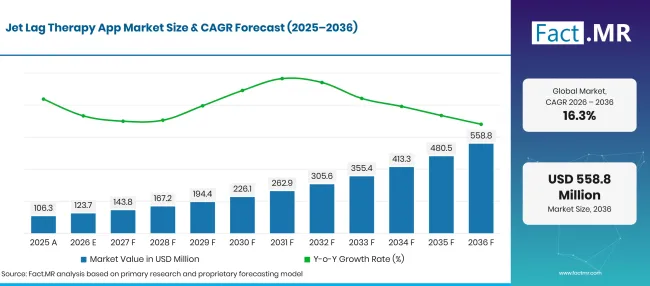
Jet Lag Therapy App Market Forecast Global | Source: Fact.MR
| Year | Basis | Market Value (USD million) |
|---|---|---|
| 2025 | Actual | 106.3 |
| 2026 | Estimate | 123.7 |
| 2036 | Forecast | 558.8 |
| CAGR 2026 to 2036 | Forecast period | 16.3% |
Source: Fact.MR analysis. Updated Nov 6, 2026
What are the defining numbers behind Jet Lag Therapy App Market growth?
Between 2026 and 2036, the market will gain USD 435.1 million in new value, with paid plans for business travelers and light-based schedules on iOS accounting for much of that gain.
- Demand Drivers in the Market
- Jet lag is a common and recognized problem for working travelers. The CDC Yellow Book notes that one recent survey found 68% of international business travelers experienced negative symptoms on a regular basis [1]. That level of disruption gives employers and travelers a clear reason to pay for structured adjustment plans.
- Clinical guidance is pointing travelers toward app-based planning. Timeshifter reported in June 2025 that the CDC Yellow Book 2026 features its jet lag app as a resource for health care providers who care for international travelers [2]. Recognition of this kind helps clinicians and travel medicine advisers recommend a named digital tool.
- Travel brands are buying plans on behalf of their customers. Airlines and hotels now bundle jet lag plans into loyalty tiers and room bookings, which lowers the cost of reaching new users and gets the app in place before departure.
- Personal sleep data is becoming easier to use. Phones and wearables already record sleep timing, so an app can build a plan around a person’s real pattern in place of a generic schedule.
- Key Segments Analyzed
- By Platform: iOS will hold 52.5% share in 2026, since premium travelers who buy paid plans skew toward iPhone and Apple Watch, and several sleep features launch there first.
- By Application: Business Travelers will account for 38.2% of 2026 value, as repeated long-haul trips and post-arrival meetings make lost alertness a direct work cost.
- By Therapy Type: Light Therapy will capture 41.7% in 2026, given that timed light exposure and avoidance is the main signal used to shift the body clock.
- By Subscription Model: Paid will command 68.6% of 2026 revenue, because multi-trip plans and partner-funded subscriptions turn one-off buyers into recurring users.
- Analyst Opinion at Fact.MR
- Shambhu Nath Jha, Principal Consultant at Fact.MR, states, “Jet lag apps will grow less through app store searches and more through airlines, hotel groups and corporate travel programs that hand plans to travelers at booking. Providers whose plans follow the full itinerary, including connections and return legs, will keep users across many trips. The next stage of value will come from linking light and sleep timing to wearable data, so that each plan adjusts to how the traveler actually slept.”
- Strategic Implications
- App developers should build plans that cover whole itineraries, including multi-stop and return trips, since frequent flyers judge value across a year of travel.
- Airlines and hotel groups should treat jet lag plans as a loyalty benefit, attaching them to premium cabins, round the world fares and long stays.
- Corporate travel managers should add circadian planning to duty of care programs for staff who cross several time zones each quarter.
- Investors should look for providers with distribution contracts and clinical recognition, as these cut purchase cost in a category where awareness is still low.
The United Kingdom leads the profiled group at 19.6%, only 0.6 points ahead of Brazil at 19.0%, as dense long-haul links from London feed both business and leisure demand. Brazil’s lead over Germany at 18.7% is a narrow 0.3 points, driven by a sharp rise in international arrivals and the long flights that link the country with Europe and North America. A wide 5.2-point gap then separates Germany from the United States at 13.5%, where a larger and more mature user base slows percentage growth. Japan closes the range at 11.7%, 1.8 points behind the United States, since outbound travel there is still rebuilding toward earlier levels.
How does the Jet Lag Therapy App Market break down by segment?
iOS will lead Platform at 52.5%; Business Travelers will head Application at 38.2%; Light Therapy will top Therapy Type at 41.7%; Paid will hold Subscription Model at 68.6% in 2026.
Which Platform leads?
iOS represents 52.5% of 2026 market revenue.
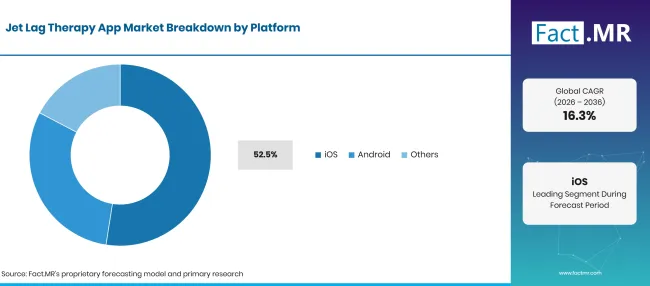
Jet Lag Therapy App Market Breakdown Platform | Source: Fact.MR
| Platform | Share (2026) |
|---|---|
| iOS (Leading segment) | 52.5% |
| Other segments combined | 47.5%* |
| Total | 100.0% |
Source: Fact.MR analysis. Updated Nov 6, 2026
Travelers who pay for premium plans are more likely to carry iPhones and Apple Watches, and these devices give apps clean access to sleep and activity data through Apple Health. Several sleep apps also roll out new features to iOS users first. Sleep Cycle, for example, launched its Luma AI coach to new iOS users in December 2025, with a wider rollout planned for 2026 [3]. Android brings a broad global user base, which counts in Brazil, parts of Europe and Asia where Android phones are common. Web-based planners and other platforms serve users who want a printed or emailed plan. Developers that keep features equal across systems will reach travelers on mixed device fleets, and wider mHealth apps adoption keeps both stores active.
What supports Business Travelers within Application?
Business Travelers take 38.2% of 2026 revenue.
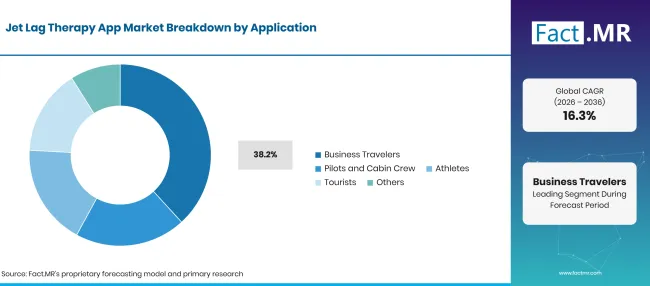
Jet Lag Therapy App Market Breakdown Application | Source: Fact.MR
| Application | Share (2026) |
|---|---|
| Business Travelers (Leading segment) | 38.2% |
| Other segments combined | 61.8%* |
| Total | 100.0% |
Source: Fact.MR analysis. Updated Nov 6, 2026
Professionals often land and go straight into meetings, so a lost day of alertness carries a clear cost. Many travel several times a year and buy plans that cover each trip, which lifts their spending above that of a one-time tourist. Employers that fund corporate wellness programs are starting to include sleep and travel fatigue in that support. Pilots and cabin crew face repeated time zone shifts and need plans that fit duty rosters. Athletes use jet lag planning before competitions abroad, while tourists form a broad group that is now reached through airline and hotel offers. Other users include students and people visiting family overseas.
What supports Light Therapy within Therapy Type?
Light Therapy accounts for 41.7% of 2026 value.
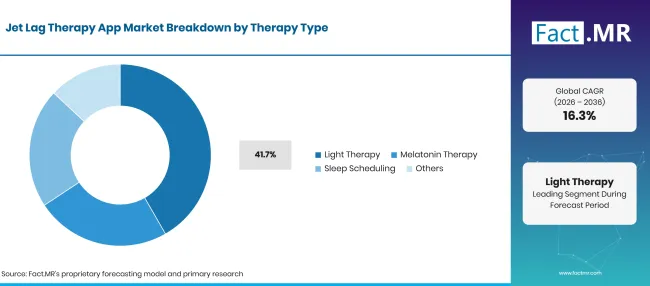
Jet Lag Therapy App Market Breakdown Therapy Type | Source: Fact.MR
| Therapy Type | Share (2026) |
|---|---|
| Light Therapy (Leading segment) | 41.7% |
| Other segments combined | 58.3%* |
| Total | 100.0% |
Source: Fact.MR analysis. Updated Nov 6, 2026
Light is the strongest cue for resetting the body clock. CDC guidance states that bright light in the morning shifts the clock earlier, which helps eastward travel, while evening light shifts it later and helps westward travel [1]. Apps translate this timing into simple prompts to seek or avoid light, and some users pair those prompts with wearable light glasses. Melatonin therapy guidance covers dose timing within the plan, and CDC advises against high doses above 5 mg [1]. Sleep scheduling shifts bedtimes before departure and after arrival. Other approaches include caffeine timing and nap planning, and the supplements themselves belong to the separate insomnia treatment space.
What makes Paid the leading Subscription Model?
Paid plans capture 68.6% of 2026 revenue.
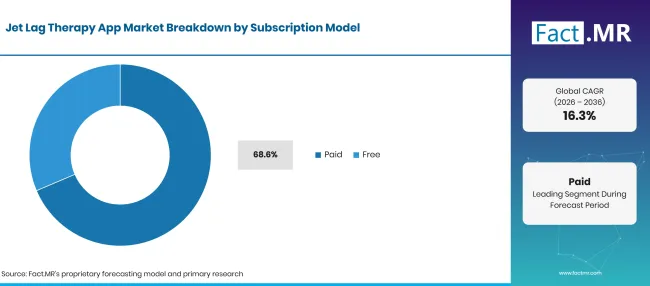
Jet Lag Therapy App Market Breakdown Subscription Model | Source: Fact.MR
| Subscription Model | Share (2026) |
|---|---|
| Paid (Leading segment) | 68.6% |
| Other segments combined | 31.4%* |
| Total | 100.0% |
Source: Fact.MR analysis. Updated Nov 6, 2026
Frequent travelers want unlimited plans, multi-trip management and full itinerary support, and most apps keep these features behind a paywall. Partner deals also create paid subscriptions without the traveler paying directly. In November 2025, Timeshifter and United Airlines extended a multi-year agreement under which United Premier 1K members keep a complimentary subscription and MileagePlus members can earn miles by subscribing annually [4]. Free versions and web calculators still attract occasional travelers who want basic advice for a single trip. Many providers offer a first plan at no cost to show value before asking for payment, so free use acts as the main route to conversion.
What is accelerating Jet Lag Therapy App Market adoption, and what is holding it back?
Rising long-haul travel, clinical recognition of light-based planning and partner distribution through airlines and hotels are widening the user base. Low awareness of dedicated jet lag apps still limits uptake. Travelers also find it hard to follow precisely timed light and sleep steps on busy trips, and free sleep apps compete for the same attention.
Drivers Impact Analysis
| DRIVER | (~) % IMPACT ON CAGR | GEOGRAPHIC RELEVANCE | IMPACT TIMELINE |
|---|---|---|---|
| More people taking frequent long-haul trips across time zones | +2.8% | Global | Medium term (2-4 years) |
| Business travel and cross-border work keeping professionals on the move | +2.5% | North America, Western Europe, East Asia | Short term (<=2 years) |
| Airline and hotel partnerships bundling jet lag plans with bookings | +2.2% | Global | Medium term (2-4 years) |
| Clinical guidance recognizing timed light exposure and app-based plans | +1.2% | Global | Long term (>=4 years) |
Source: Fact.MR analysis. Updated Nov 6, 2026
Opportunity Impact Analysis
| OPPORTUNITY | (~) % IMPACT ON CAGR | GEOGRAPHIC RELEVANCE | IMPACT TIMELINE |
|---|---|---|---|
| Plans that use wearable sleep data to adjust in real time | +1.3% | Global | Medium term (2-4 years) |
| Corporate duty of care programs covering frequent business travelers | +0.9% | North America, Western Europe | Medium term (2-4 years) |
| Extension of circadian planning into shift work and health care settings | +0.8% | Global | Long term (>=4 years) |
| Local language apps for Latin American and Asian travelers | +0.5% | Latin America, East Asia | Long term (>=4 years) |
Source: Fact.MR analysis. Updated Nov 6, 2026
Restraints Impact Analysis
| RESTRAINT | (~) % IMPACT ON CAGR | GEOGRAPHIC RELEVANCE | IMPACT TIMELINE |
|---|---|---|---|
| Few travelers know that dedicated jet lag apps exist | -1.1% | Global | Medium term (2-4 years) |
| Difficulty following timed light and sleep steps while traveling | -1.0% | Global | Short term (<=2 years) |
| Free sleep and travel apps competing for the same users | -0.9% | Global | Medium term (2-4 years) |
| Subscription costs deterring occasional travelers | -0.7% | Global | Medium term (2-4 years) |
Source: Fact.MR analysis. Updated Nov 6, 2026
Which countries are scaling the Jet Lag Therapy App Market through 2036?
| Country | CAGR (2026 to 2036) |
|---|---|
| United Kingdom | 19.6% |
| Brazil | 19.0% |
| Germany | 18.7% |
| United States | 13.5% |
| Japan | 11.7% |
Source: Fact.MR analysis. Updated Nov 6, 2026
How does the United Kingdom perform?
19.6% CAGR, driven by heavy outbound travel and long-haul hubs.
British residents travel abroad often, and many trips cross several time zones. The Office for National Statistics estimates that UK residents made 99.9 million visits abroad in 2025 [5]. London’s long-haul links to North America, Asia and the Gulf create steady demand among bankers, consultants and crew. Paid plans with multi-trip support suit this group, and airline loyalty schemes give providers a ready channel.
How is Brazil developing demand?
19.0% CAGR, helped by a surge in international travel.
Brazil received 9.3 million international tourists in 2025, 37% more than in 2024, according to the federal government news agency citing UN Tourism data [6]. More flights to and from Europe and North America mean more travelers crossing four or more time zones. Portuguese-language plans and lower-priced monthly options will help providers convert this growing pool of travelers.
What supports Germany’s adoption?
18.7% CAGR, backed by a strong habit of foreign travel.
Germans travel abroad more than most Europeans. Eurostat reports that 61% of German residents took part in foreign tourism in 2024 [7]. Frankfurt and Munich serve as long-haul hubs for business travel to Asia and the Americas. German-language plans, privacy-focused data handling and links with corporate travel programs will shape uptake among firms that send staff overseas.
What is supporting United States adoption?
13.5% CAGR, reflecting a large and established user base.
American travelers are among the earliest users of jet lag apps, so growth from this base runs below the faster-rising markets. Outbound flows stay strong. The International Trade Administration reported 6.9 million U.S. citizen air departures in December 2025, up 3.2% from December 2024 [8]. Airline partnerships and employer travel programs will keep paid subscriptions renewing.
What supports Japan’s adoption?
11.7% CAGR, as outbound travel rebuilds.
Japanese outbound travel is still recovering. The Japan Tourism Agency reports about 14.73 million departures in 2025, around 1.72 million more than in 2024 but below the pre-pandemic peak of 20.08 million [9]. Trips to Europe and the Americas cross many time zones, which makes advance planning useful. Japanese-language prompts and wearable links will help apps reach business travelers and crew.
Who leads the Jet Lag Therapy App Market?
The market splits into three groups. Dedicated circadian planners, led by Timeshifter, StopJetLag and Re-Time Pty Ltd, compete on plan accuracy, full itinerary coverage and distribution through travel brands. Timeshifter is building the widest partner network: it extended its United Airlines agreement in November 2025 [4], raised new funding in April 2026 to take its technology into shift work and health care [10], and extended its InterContinental Hotels & Resorts partnership in August 2026 [11].
In September 2026, the oneworld alliance began giving Round the World customers a complimentary Timeshifter subscription [12]. StopJetLag sells reviewed flight-aligned plans, while Re-Time pairs light glasses with its app. A second group of general sleep apps, including Sleep Cycle, Pzizz, BetterSleep and Headspace, competes for the same users through sleep tracking, naps and audio content. Distribution deals and clinical credibility will decide which providers gain share.
Which companies are the key providers?
Key companies profiled include Timeshifter; StopJetLag; Re-Time Pty Ltd; Sleep Cycle; Pzizz; BetterSleep; and Headspace.
- Timeshifter
- StopJetLag
- Re-Time Pty Ltd
- Sleep Cycle
- Pzizz
- BetterSleep
- Headspace
Bibliography
- [1] Centers for Disease Control and Prevention. (2025, April 23). Jet Lag Disorder.
- [2] Timeshifter. (2025, June 24). CDC Yellow Book 2026 features the Timeshifter jet lag app.
- [3] Sleep Cycle. (2025, December 3). Sleep Cycle Launches Luma, a Life-Improving AI Backed by Science.
- [4] Timeshifter. (2025, November 18). Timeshifter and United Airlines extend collaboration to help passengers tackle jet lag.
- [5] Office for National Statistics. (2026, October 16). Travel trends: 2025.
- [6] Agência Gov. (2026, January 21). Brasil recebe 37% a mais de turistas estrangeiros em 2025, diz pesquisa da ONU.
- [7] Eurostat. (2025, October). Tourism statistics: participation in tourism.
- [8] International Trade Administration. (2026, January 15). December 2025 International Air Passenger Travel.
- [9] Japan Tourism Agency. (2026, June 17). 観光庁長官定例会見配付資料 (Commissioner’s regular press conference materials).
- [10] Timeshifter. (2026, April 15). Timeshifter raises new funding to scale circadian technology across travel, shift work and healthcare.
- [11] Timeshifter. (2026, August 26). Timeshifter extends worldwide partnership with InterContinental Hotels & Resorts.
- [12] oneworld. (2026, September 8). oneworld Partners with Popular App Timeshifter to Help Round the World Travellers Beat Jet Lag.
This Report Answers
- How is jet lag app revenue split between iOS, Android and other platforms?
- Why do business travelers spend more on jet lag plans than tourists or crew?
- Which therapy approach anchors most plans, and how do apps time light, sleep and melatonin?
- How are airline, hotel and corporate partnerships changing the way paid subscriptions are sold?
- Where will growth be quickest among the United Kingdom, Brazil, Germany, the United States and Japan?
- Which providers compete on circadian accuracy, and which compete through general sleep features?
What does the Jet Lag Therapy App Market cover?
This report tracks apps built to help travelers shift their body clock to a new time zone. Plans cover when to seek and avoid light, when to sleep or nap, and when to take caffeine or melatonin, before, during and after a flight.
Value is measured as revenue from paid plans and subscriptions, including subscriptions funded by airlines, hotels or employers. Free use is tracked as a share of users and a route to paid conversion.
What is included in the scope?
Mobile and web apps whose main purpose is jet lag planning, such as personalized light, sleep and melatonin timing plans.
Single-trip purchases, unlimited subscriptions and partner-funded subscriptions bundled with flights, fares or hotel stays.App features that read data from wearables or phone health platforms to adjust a jet lag plan, a link to the wider wearable display field.Jet lag modules inside broader sleep or digital therapeutics apps, counted only for the travel planning feature.
What is excluded from the scope?
Physical light therapy glasses, lamps and other hardware sold on their own.
Melatonin supplements and prescription sleep medicines.General sleep tracking, meditation and relaxation apps that offer no jet lag planning.Airfares, hotel charges and travel packages, including wellness tourism retreats, as well as fees for medical consultations.
How Was the Analysis Built?
The analysis draws on 120+ sources, 35+ company portfolios, 25+ countries, and more than 20 industry interviews.
- Primary Research: Primary research includes discussions with manufacturers, service providers, technology developers, distributors, end users, and subject-matter experts. These conversations examine purchasing priorities, product adoption, operational challenges, approval requirements, competitive positioning, and the factors that influence wider market acceptance.
- Desk Research: Desk research covers government statistics, regulatory publications, company filings, trade data, technical studies, industry associations, standards, public policy, and other authoritative sources. Every source used in the analysis is documented in the bibliography.
- Market Sizing and Forecasting: Market estimates combine historical performance, demand indicators, pricing and volume trends, segment shares, company participation, country-level growth, adoption patterns, investment activity, and barriers to market expansion.
- Data Validation and Update Cycle: Findings are validated by comparing primary interviews with public data, company activity, regulatory changes, trade patterns, and industry developments. Regular updates review new product launches, capacity changes, partnerships, approvals, and shifts in commercial adoption.
Segmentation
What is the report’s scope and coverage?
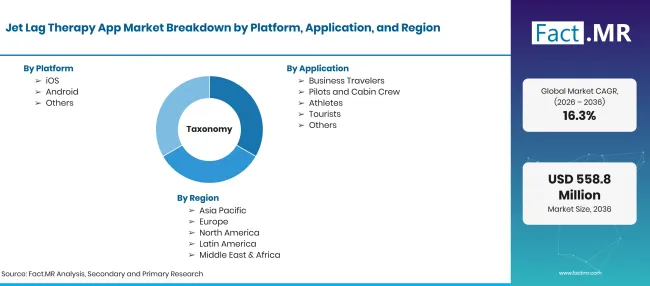
Jet Lag Therapy App Market Taxonomy | Source: Fact.MR
| Attribute | Details |
| Quantitative Units | USD million |
| Market Definition | Mobile and web applications that give travelers personalized plans for light exposure, sleep timing and melatonin timing to reduce jet lag after crossing time zones. |
| Platform | iOS; Android; Others |
| Application | Business Travelers; Pilots and Cabin Crew; Athletes; Tourists; Others |
| Therapy Type | Light Therapy; Melatonin Therapy; Sleep Scheduling; Others |
| Subscription Model | Paid; Free |
| Regions Covered | North America; Latin America; Western Europe; Eastern Europe; East Asia; South Asia & Pacific; Middle East & Africa |
| Countries Covered | United Kingdom; Brazil; Germany; United States; Japan |
| Companies Profiled | Timeshifter; StopJetLag; Re-Time Pty Ltd; Sleep Cycle; Pzizz; BetterSleep; Headspace |
| Forecast Period | 2026 to 2036 |
| Approach | Revenue built from paid plan pricing, subscriber counts and partner-funded subscriptions, checked against long-haul travel volumes by country. |
Source: Fact.MR analysis. Updated Nov 6, 2026
How is the market segmented?
-
By Platform
- iOS
- Android
- Others
-
By Application
- Business Travelers
- Pilots and Cabin Crew
- Athletes
- Tourists
- Others
-
By Therapy Type
- Light Therapy
- Melatonin Therapy
- Sleep Scheduling
- Others
-
By Subscription Model
- Paid
- Free
-
By Region
- North America
- Latin America
- Western Europe
- Eastern Europe
- East Asia
- South Asia & Pacific
- Middle East & Africa
Frequently Asked Questions
How large is the jet lag therapy app market in 2026?
What growth rate will the jet lag therapy app market record?
Which platform leads?
Which application leads?
Which therapy type leads?
Which subscription model leads?
Which country will grow quickest?
Who are the main companies?
What holds the market back?
Who worked on this report


Preview the report firsthand - request a free sample
Free SampleGet the brochure for pricing and purchase details
Download PDF