- Market Value (2025): USD 72.8 Mn
- Estimated Value (2026): USD 77.7 Mn
- Forecast Value (2036): USD 148.7 Mn
- CAGR (2026-2036): 6.7%
What is the Medical Overtube Market forecast to be worth by 2036?
USD 77.7 million in 2026 to USD 148.7 million by 2036 at a 6.7% CAGR.
- The medical overtube market stood at USD 72.8 million in 2025, with sales concentrated in upper GI foreign body work, variceal care and deep enteroscopy.
- Revenue will expand from USD 77.7 million in 2026 to USD 148.7 million by 2036 as therapeutic endoscopy spreads from tertiary centers into district hospitals.
- A 6.7% CAGR reflects steady growth in procedure counts and a gradual shift in spend from reusable sleeves to sterile, single-use units.
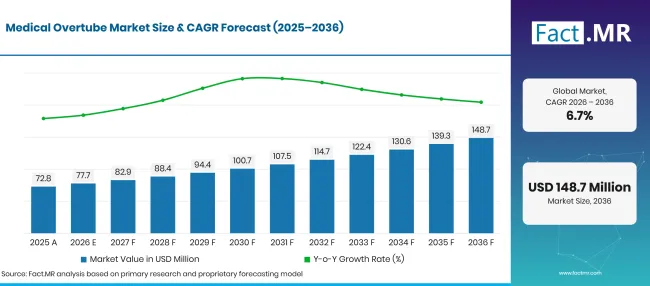
Medical Overtube Market Forecast Global | Source: Fact.MR
| Year | Basis | Market Value (USD million) |
|---|---|---|
| 2025 | Actual | 72.8 |
| 2026 | Estimate | 77.7 |
| 2036 | Forecast | 148.7 |
| CAGR 2026 to 2036 | Forecast period | 6.7% |
Source: Fact.MR analysis. Updated Nov 6, 2026
What are the defining numbers behind Medical Overtube Market growth?
The 2026 to 2036 period adds USD 71.0 million in new value, with single-use sleeves, GI endoscopy and hospital buyers carrying most of it.
- Demand Drivers in the Market
- Colorectal disease keeps endoscopy lists full. WHO’s colorectal cancer fact sheet reports about 1.9 million new cases and more than 900,000 deaths worldwide in 2022, and each screening and surveillance pathway adds scope passages where a sleeve can protect the lumen [1].
- Obesity is widening the base for bariatric and endoscopic weight-loss work. WHO counted 1.1 billion people living with obesity in 2024, which supports demand for long access sleeves used during bariatric endoscopy and revision procedures [2].
- Regulators continue to clear new access designs. The FDA cleared Neptune Medical’s Pathfinder Endoscope Overtube under the endoscopic access overtube classification on September 18, 2026 [3].
- Foreign body and food bolus cases need a protected channel for repeated scope insertion. This keeps two-tube esophageal and gastric sleeves on standard emergency endoscopy carts.
- Infection prevention teams prefer devices that skip the reprocessing loop. Sterile, single-use sleeves remove a cleaning step and a source of audit findings in busy units.
- Key Segments Analyzed
- By Product Type: Single-Use Overtubes will hold 58.3% share in 2026, since sterile sleeves leave the room in the waste bin and never enter the reprocessing queue.
- By Application: Gastrointestinal Endoscopy will account for 58.9% of 2026 revenue, given the volume of foreign body, variceal and enteroscopy procedures that need repeated scope passage.
- By End-User: Hospitals will capture 54.2% in 2026 owing to their emergency endoscopy cover and the complex therapeutic cases referred to them.
- Analyst Opinion at Fact.MR
- Shambhu Nath Jha, Principal Consultant at Fact.MR, states, “Overtubes are small-ticket items, yet they decide whether a difficult foreign body case or a deep enteroscopy can be finished safely in one session. Buyers will reward sleeves that match the scopes already installed in their units, insert smoothly and arrive sterile. Suppliers that bundle the sleeve with the scope platform will hold the advantage over stand-alone accessory sellers through 2036.”
- Strategic Implications
- Manufacturers should publish clear compatibility charts for each scope diameter and working length, because a mismatched sleeve is returned unused.
- Distributors should stock both esophageal and gastric lengths near emergency endoscopy units, where food bolus cases arrive without notice.
- Hospital buyers should compare the full cost of a reusable sleeve, including cleaning labor and audits, with the unit price of a sterile disposable.
- Investors should track regulatory clearances in the endoscopic access overtube category as an early signal of new entrants and design changes.
Germany leads the country set at 7.8%, as a dense network of hospital endoscopy departments and a heavy colorectal caseload keep sleeve use high. Brazil follows at 7.1%, where public cancer services are adding diagnostic endoscopy capacity from a lower base. The United States grows at 6.5%, a pace that reflects a large but already mature installed base. The United Kingdom posts 5.8% as national screening keeps colonoscopy volumes steady, while Japan closes the range at 5.1% since its endoscopy practice is long established and its population is shrinking.
How does the Medical Overtube Market break down by segment?
Single-Use Overtubes will lead Product Type at 58.3%; Gastrointestinal Endoscopy will head Application at 58.9%; Hospitals will hold End-User at 54.2% in 2026.
Which Product Type leads?
Single-Use Overtubes take 58.3% of 2026 sales.
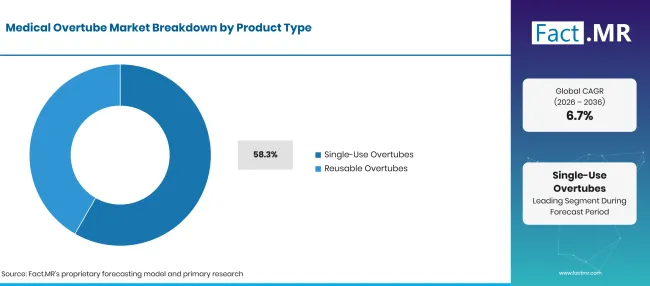
Medical Overtube Market Breakdown Product Type | Source: Fact.MR
| Product Type | Share (2026) |
|---|---|
| Single-Use Overtubes (Leading segment) | 58.3% |
| Other segments combined | 41.7%* |
| Total | 100.0% |
Source: Fact.MR analysis. Updated Nov 6, 2026
Endoscopy nurses spend less time on a sleeve that arrives sterile and is discarded after one patient. Boston Scientific labels its OverTube Endoscopic Access System for foreign body removal and multiple upper GI intubations and states that the device must not be reused or reprocessed [4]. That labeling style is now common across the category and fits the wider move toward disposable endoscopes. Reusable overtubes keep a place in units with validated cleaning lines and high caseloads, where the per-use cost can fall below that of a disposable. Silicone and urethane sleeves sold with balloon enteroscopy systems are the main reusable formats. Their uptake depends on material life and on how easily staff can clean long, narrow lumens.
What supports Gastrointestinal Endoscopy within Application?
Gastrointestinal Endoscopy accounts for 58.9% of 2026 revenue.
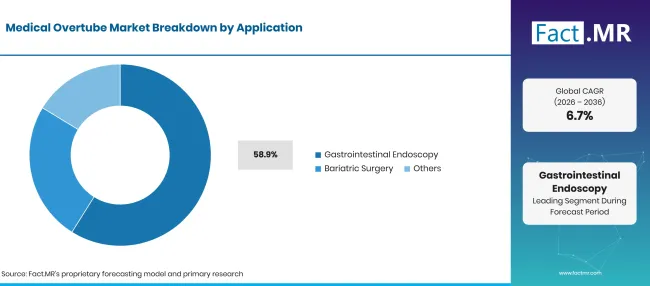
Medical Overtube Market Breakdown Application | Source: Fact.MR
| Application | Share (2026) |
|---|---|
| Gastrointestinal Endoscopy (Leading segment) | 58.9% |
| Other segments combined | 41.1%* |
| Total | 100.0% |
Source: Fact.MR analysis. Updated Nov 6, 2026
Upper GI emergencies, variceal care and deep small bowel work all call for repeated scope passage through a protected channel. NHS England asks each accredited bowel screening colonoscopist to complete at least one list a week, described as over 120 colonoscopies per year [5]. Volumes of that scale keep endoscopy operative devices and access sleeves in steady use. Bariatric surgery forms the second application, with sleeves used to guide instruments during endoscopic suturing and revision work. Other uses cover selected therapeutic procedures such as stent removal. Olympus reported in February 2026 that its CADDIE computer-aided detection solution for colonoscopy is FDA cleared and CE marked, which points to more lesions found and more follow-up therapy [6].
What leads the End-User segment?
Hospitals represent 54.2% of 2026 demand.
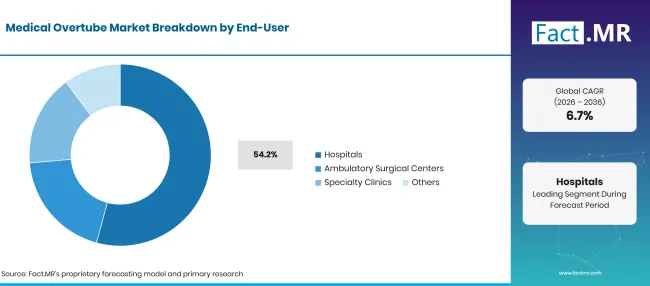
Medical Overtube Market Breakdown End User | Source: Fact.MR
| End-User | Share (2026) |
|---|---|
| Hospitals (Leading segment) | 54.2% |
| Other segments combined | 45.8%* |
| Total | 100.0% |
Source: Fact.MR analysis. Updated Nov 6, 2026
Emergency food bolus impactions, bleeding varices and complex enteroscopy cases are routed to hospital endoscopy suites with anesthesia cover. These suites run several scope platforms and keep a range of sleeve lengths on hand. Central purchasing also favors contracts that bundle sleeves with endoscopy systems and other accessories. Ambulatory surgical centers form the next buyer group, focused on elective upper GI and colonoscopy lists where disposable sleeves keep turnover quick. Specialty clinics add demand through focused gastroenterology and bariatric services. Other buyers include teaching centers and military facilities.
What is accelerating Medical Overtube Market adoption, and what is holding it back?
Rising endoscopy volumes, foreign body cases and deep enteroscopy keep sleeves in daily use, and infection control pressure is moving purchases toward sterile disposables. The recurring cost of single-use units, the labor needed to reprocess reusable ones and fit problems across scope brands slow adoption. Smaller hospitals also tend to buy sleeves only for emergency carts.
Drivers Impact Analysis
| DRIVER | (~) % IMPACT ON CAGR | GEOGRAPHIC RELEVANCE | IMPACT TIMELINE |
|---|---|---|---|
| Growing GI endoscopy procedures that require repeated scope passage | +1.5% | Global | Medium term (2-4 years) |
| Wider use of therapeutic endoscopy and deep enteroscopy | +1.2% | North America, Western Europe, East Asia | Medium term (2-4 years) |
| Preference for single-use accessories to simplify infection control | +0.9% | Global | Short term (<= 2 years) |
| Expansion of bariatric endoscopy and revision procedures | +0.7% | North America, Western Europe, East Asia | Long term (>= 4 years) |
| Focus on procedural efficiency and scope compatibility | +0.6% | Global | Medium term (2-4 years) |
Source: Fact.MR analysis. Updated Nov 6, 2026
Opportunity Impact Analysis
| OPPORTUNITY | (~) % IMPACT ON CAGR | GEOGRAPHIC RELEVANCE | IMPACT TIMELINE |
|---|---|---|---|
| Flexible single-use sleeves for complex therapeutic procedures | +0.9% | Global | Medium term (2-4 years) |
| Endoscopy capacity growth in emerging health systems | +0.7% | Latin America, South Asia & Pacific, Middle East & Africa | Long term (>= 4 years) |
| Sleeves designed for bariatric and third-space endoscopy | +0.6% | North America, Western Europe, East Asia | Medium term (2-4 years) |
| Durable reusable materials suited to validated reprocessing | +0.6% | Global | Long term (>= 4 years) |
Source: Fact.MR analysis. Updated Nov 6, 2026
Restraints Impact Analysis
| RESTRAINT | (~) % IMPACT ON CAGR | GEOGRAPHIC RELEVANCE | IMPACT TIMELINE |
|---|---|---|---|
| Recurring spend on single-use overtubes | -0.4% | Global | Short term (<= 2 years) |
| Cleaning, disinfection and upkeep costs of reusable sleeves | -0.3% | Global | Medium term (2-4 years) |
| Fit limits across scope models and diameters | -0.2% | Global | Medium term (2-4 years) |
| Tight budgets in smaller hospitals and clinics | -0.1% | Latin America, South Asia & Pacific, Middle East & Africa | Long term (>= 4 years) |
Source: Fact.MR analysis. Updated Nov 6, 2026
Which countries are scaling the Medical Overtube Market through 2036?
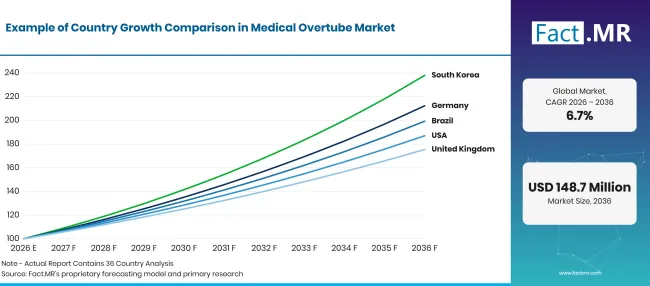
Medical Overtube Market Growth Index | Source: Fact.MR
| Country | CAGR (2026 to 2036) |
|---|---|
| Germany | 7.8% |
| Brazil | 7.1% |
| United States | 6.5% |
| United Kingdom | 5.8% |
| Japan | 5.1% |
Source: Fact.MR analysis. Updated Nov 6, 2026
What supports adoption in Germany?
7.8% CAGR, backed by a dense hospital endoscopy network and a high colorectal caseload.
The Robert Koch Institute’s cancer registry center reports that about 55,300 people in Germany were newly diagnosed with bowel cancer in 2023, split between roughly 30,250 men and 25,070 women [7]. Each case brings diagnostic colonoscopy, polyp removal and surveillance work. German gastroenterology departments also handle therapeutic upper GI work in volume, which keeps sterile sleeves and enteroscopy accessories on regular reorder.
How is Brazil developing demand?
7.1% CAGR, helped by new diagnostic endoscopy capacity in public cancer services.
Brazil’s National Cancer Institute (INCA) estimates 53,810 new colon and rectum cancer cases and 22,530 new stomach cancer cases for 2026 [8]. Both cancers drive upper and lower GI endoscopy in state hospitals and private networks. Price and distributor reach shape which sleeve designs reach regional centers outside the large state capitals.
What is supporting United States adoption?
6.5% CAGR, as therapeutic endoscopy and new access designs keep sleeve use steady.
The National Cancer Institute’s SEER program estimates 158,850 new colorectal cancer cases in the United States in 2026 [9]. That caseload supports large colonoscopy and therapy volumes across hospitals and ambulatory centers. FDA clearance of the Pathfinder Endoscope Overtube adds a newer sleeve design aimed at reducing looping during difficult GI procedures, alongside established foreign body sleeves [3].
How is the United Kingdom developing demand?
5.8% CAGR, reflecting national screening that keeps colonoscopy lists steady.
NHS England invites people aged 50 to 74 for bowel cancer screening every two years and offers a colonoscopy to anyone with an abnormal result [10]. Screening centers must meet accreditation rules on colonoscopist activity, which keeps endoscopy suites busy through the year [5]. NHS trusts buy sleeves mainly through framework contracts, so unit price and scope compatibility weigh heavily in tender scoring.
How does Japan perform?
5.1% CAGR, owing to a mature endoscopy practice with high per capita procedure rates.
The National Cancer Center Japan lists colorectal cancer as the most common cancer by incidence in 2023, with a lifetime risk of 9.6% for men and 7.9% for women [11]. Balloon enteroscopy and endoscopic submucosal dissection are routine in Japanese hospitals, so sleeve use is already widespread. Growth comes from replacing reusable units and from newer designs for third-space procedures.
Who leads the Medical Overtube Market?
Competition falls into three tiers. Scope platform owners Olympus and Fujifilm sell sleeves as part of their balloon enteroscopy systems, so their accessories follow the installed scope base and win on guaranteed fit. Olympus also keeps building its GI franchise; in May 2026 it signed a global distribution agreement with EndoRobotics to add robot-assisted tools for endoscopic submucosal dissection to its EndoTherapy portfolio [12].
Accessory specialists Boston Scientific and STERIS compete on single-use upper GI sleeves for foreign body removal and multiple intubations, where sterile packaging and broad hospital contracts carry weight. STERIS, whose consumables range includes Guardus esophageal and gastric overtubes, reported growth in healthcare consumables revenue in its November 2026 results [13]. Focused innovators such as Neptune Medical and Sumitomo Bakelite target difficult anatomy with flexible or shape-locking sleeves. Through 2036, success will turn on scope compatibility, clinical training support and the ability to supply sterile sleeves at a price that hospital tenders accept.
Which companies are the key providers?
Key companies in the Medical Overtube Market include Olympus, Fujifilm, Boston Scientific, STERIS, Neptune Medical and Sumitomo Bakelite.
- Olympus
- Fujifilm
- Boston Scientific
- STERIS
- Neptune Medical
- Sumitomo Bakelite
How is the market segmented?
-
By Product Type
- Single-Use Overtubes
- Reusable Overtubes
-
By Application
- Gastrointestinal Endoscopy
- Bariatric Surgery
- Others
-
By End-User
- Hospitals
- Ambulatory Surgical Centers
- Specialty Clinics
- Others
-
By Region
- North America
- Latin America
- Western Europe
- Eastern Europe
- East Asia
- South Asia & Pacific
- Middle East & Africa
Bibliography
- [1] World Health Organization. (2026, February 13). Colorectal cancer.
- [2] World Health Organization. (2026, October 7). Obesity and overweight.
- [3] U.S. Food and Drug Administration. (2026, September 18). 510(k) Premarket Notification: Pathfinder Endoscope Overtube (K262262).
- [4] Boston Scientific Corporation. (2025). OverTube Endoscopic Access System: Directions for Use.
- [5] NHS England. (2025, July 11). Bowel Cancer Screening: Guidelines for Endoscopy.
- [6] Olympus Corporation. (2026, February 3). EAGLE Trial Shows Olympus CADDIE AI Solution Aids in the Detection of High-Risk and Hard-to-Detect Colorectal Lesions.
- [7] Robert Koch Institute, Center for Cancer Registry Data. (2026, August 25). Krebs: Darmkrebs.
- [8] Instituto Nacional de Câncer (INCA). (2026, February 4). Brasil: estimativa dos casos novos.
- [9] National Cancer Institute, SEER Program. (2026). Cancer Stat Facts: Colorectal Cancer.
- [10] NHS England. (2026, March 17). Bowel cancer screening: programme overview.
- [11] National Cancer Center Japan. (2026, July 14). Latest Cancer Statistics.
- [12] Olympus Corporation. (2026, May 4). Olympus Signs Global Distribution Agreement with EndoRobotics, Adds Robot-Assisted Technologies to EndoTherapy Portfolio.
- [13] STERIS plc. (2026, November 4). STERIS Announces Financial Results for Fiscal 2027 Second Quarter.
This Report Answers
- How is overtube revenue split between single-use and reusable sleeves, and what sustains the lead of disposables?
- Which GI procedures generate the most sleeve use, and how does bariatric work add to it?
- Why do hospitals buy more sleeves than ambulatory centers and clinics?
- What separates scope platform owners from accessory specialists in this category?
- Where in the five-country set will sleeve demand grow quickest through 2036?
- Which regulatory and infection control trends will shape product design?
What does the Medical Overtube Market cover?
This study tracks flexible sleeves that slide over the whole insertion tube of an endoscope, guiding the endoscope into the esophagus, stomach or small bowel. They support foreign body retrieval, variceal treatment, balloon enteroscopy and procedures that require several passes of the scope.
Revenue is valued at manufacturer selling prices across single-use and reusable sleeves. Sales are traced to GI endoscopy, bariatric work and other uses, and to hospitals, ambulatory surgical centers, specialty clinics and other buyers.
What is included in the scope?
Single-use and reusable overtubes for upper GI, small bowel and colonic access are included, as are sleeves sold with balloon enteroscopy systems.
Esophageal and gastric sleeves used for foreign body and food bolus removal are counted. Sleeves sold as part of broader endoscopy devices kits are counted at their accessory value. vertubes used to guide instruments during endoscopic suturing and bariatric revision work are part of the market. Shape-locking and balloon-tipped sleeves cleared as endoscopic access overtubes for GI use fall within coverage.
What is excluded from the scope?
Endoscopes, video processors and other endoscopy equipment are not counted.
Ureteral access sheaths and urology introducers are left out, even when they share a regulatory product code with GI overtubes.Laparoscopic trocars and wider general surgical devices are excluded.Endoscope reprocessing machines, disinfectants and procedure fees fall outside the sleeve revenue counted here.
How Was the Analysis Built?
The analysis draws on 120+ sources, 35+ company portfolios, 25+ countries, and more than 20 industry interviews.
- Primary Research: Primary research includes discussions with manufacturers, service providers, technology developers, distributors, end users, and subject-matter experts. These conversations examine purchasing priorities, product adoption, operational challenges, approval requirements, competitive positioning, and the factors that influence wider market acceptance.
- Desk Research: Desk research covers government statistics, regulatory publications, company filings, trade data, technical studies, industry associations, standards, public policy, and other authoritative sources. Every source used in the analysis is documented in the bibliography.
- Market Sizing and Forecasting: Market estimates combine historical performance, demand indicators, pricing and volume trends, segment shares, company participation, country-level growth, adoption patterns, investment activity, and barriers to market expansion.
- Data Validation and Update Cycle: Findings are validated by comparing primary interviews with public data, company activity, regulatory changes, trade patterns, and industry developments. Regular updates review new product launches, capacity changes, partnerships, approvals, and shifts in commercial adoption.
Segmentation
What is the report’s scope and coverage?
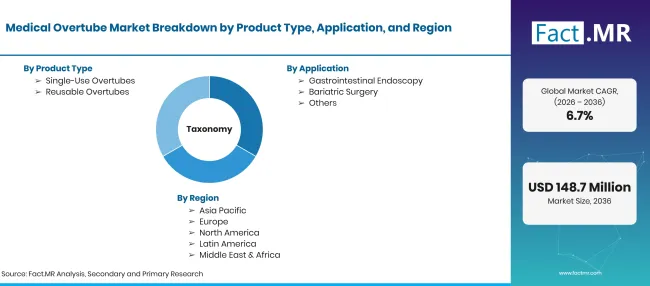
Medical Overtube Market Taxonomy | Source: Fact.MR
| Attribute | Details |
|---|---|
| Quantitative Units | USD million |
| Market Definition | Flexible sleeves placed over an endoscope to ease insertion, protect the mucosa and allow repeated scope passage during GI and bariatric procedures. |
| Product Type | Single-Use Overtubes; Reusable Overtubes |
| Application | Gastrointestinal Endoscopy; Bariatric Surgery; Others |
| End-User | Hospitals; Ambulatory Surgical Centers; Specialty Clinics; Others |
| Regions Covered | North America; Latin America; Western Europe; Eastern Europe; East Asia; South Asia & Pacific; Middle East & Africa |
| Countries Covered | Germany; Brazil; United States; United Kingdom; Japan |
| Companies Profiled | Olympus; Fujifilm; Boston Scientific; STERIS; Neptune Medical; Sumitomo Bakelite |
| Forecast Period | 2026 to 2036 |
| Approach | Country GI endoscopy procedure counts multiplied by sleeve use rates and average selling prices, cross-checked against supplier portfolios. |
Source: Fact.MR analysis. Updated Nov 6, 2026
Frequently Asked Questions
How large is the medical overtube market in 2026?
What growth rate will the medical overtube market record?
Which product type leads?
Which application leads?
Which end-user leads?
Which country will grow quickest?
Who are the main companies?
What holds the market back?
Who worked on this report


Preview the report firsthand - request a free sample
Free SampleGet the brochure for pricing and purchase details
Download PDF