- Market Value (2025): USD 2.8 Bn
- Estimated Value (2026): USD 2.96 Bn
- Forecast Value (2036): USD 5.2 Bn
- CAGR (2026-2036): 5.8%
What is the Ureteroscopy Market forecast to be worth by 2036?
USD 2.96 billion in 2026 to USD 5.2 billion by 2036, at a CAGR of 5.8%.
- As per Fact.MR analysis, the ureteroscopy market was valued at USD 2.8 billion in 2025.
- Demand will grow from USD 2.96 billion in 2026 to USD 5.2 billion by 2036.
- The report forecasts a 5.8% CAGR from 2026 to 2036, reflecting demand for minimally invasive management of urinary stones and selected upper urinary tract disorders.
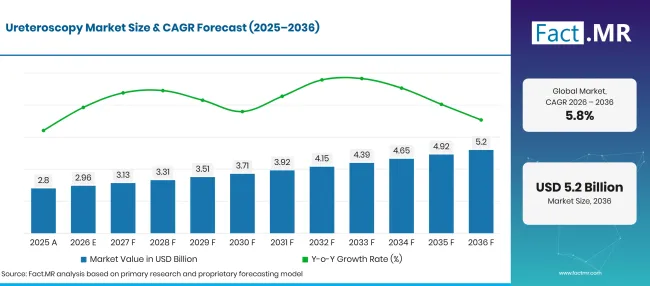
Ureteroscopy Market Forecast Global | Source: Fact.MR
| Year | Basis | Market Value (USD billion) |
|---|---|---|
| 2025 | Actual | 2.8 |
| 2026 | Estimate | 2.96 |
| 2036 | Forecast | 5.2 |
| CAGR 2026 to 2036 | Forecast period | 5.8% |
Source: Fact.MR analysis. Updated Nov 6, 2026
What are the defining numbers behind Ureteroscopy Market growth?
USD 2.2 billion absolute opportunity between 2026 and 2036.
- Demand Drivers in the Market
- Rising need for minimally invasive stone removal has increased demand for the ureteroscopy for diagnosis purpose. Urolithiasis is a major indication for ureteroscopy. The European Association of Urology (EAU) describes advances in ureteroscope miniaturisation, deflection and optical quality supporting the use of ureteroscopy in renal and ureteral stone treatment [11]. [1]
- Advances in flexible endoscope technology supports the growth of the market. Improvements in scope miniaturisation, image quality and deflection mechanisms help urologists access difficult areas of the renal collecting system.
- Growth in stone-management accessories has driven the market growth. Ureteral access sheaths, guidewires, laser fibres and retrieval baskets support more complex endourological procedures. Manufacturers are developing integrated products to improve access, stone extraction and procedural workflow [2].
- Key Segments Analyzed
- By Product Type: Flexible Ureteroscopes are projected to account for 48.2% of the market in 2026. Their manoeuvrability and ability to access the kidney support their use in renal stone procedures.
- By Application: Urolithiasis segment to lead with a 66.4% share in 2026, reflecting the use of ureteroscopy to diagnose and remove urinary stones.
- By End User: Hospitals are projected to hold 63.9% of the market in 2026, supported by their access to operating rooms, imaging systems and specialist urology teams.
- Analyst Opinion at Fact.MR
- Shambhu Nath Jha, Principal Consultant at Fact.MR, states, “Ureteroscopy is benefiting from improvements in flexible endoscope design and stone-management technologies. Hospitals are likely to remain important buyers, while single-use devices and improved accessories can help providers manage procedural efficiency. Manufacturers should balance image quality and clinical performance with equipment cost and reprocessing requirements.”
- Strategic Implications
- Medical device manufacturers should improve scope durability, image quality and deflection performance while maintaining access to narrow anatomical spaces.
- Hospitals need to compare reusable and single-use ureteroscopes based on procedure volume, repair costs and reprocessing capacity.
- Accessory suppliers must focus on compatibility between ureteroscopes, laser fibres, retrieval baskets and access sheaths.
- Healthcare providers can evaluate outpatient and ambulatory settings for suitable ureteroscopy procedures where clinical infrastructure and patient needs permit.
Germany is projected to record a 6.7% CAGR through 2036. Brazil is set to grow at 6.1%, followed by the USA at 5.5%. The UK is estimated to advance at 4.9%, while Japan is forecast at 4.4%.
How does the Ureteroscopy Market break down by segment?
Fact.MR identifies Flexible Ureteroscopes as the leading Product Type at 48.2%, Urolithiasis as the leading Application at 66.4%, and Hospitals as the leading End User at 63.9%.
Which Product Type dominates?
Flexible Ureteroscopes are set to hold 48.2% share in 2026.
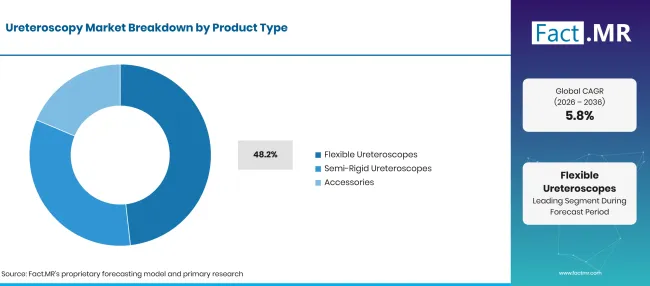
Ureteroscopy Market Breakdown Product Type | Source: Fact.MR
| Product Type | Share (2026) |
|---|---|
| Flexible Ureteroscopes (Leading segment) | 48.2% |
| Other segments combined | 51.8%* |
| Total | 100.0% |
Source: Fact.MR analysis. Updated Nov 6, 2026
Flexible ureteroscopes allow surgeons to navigate the upper urinary tract and access renal stones located in different parts of the collecting system. Improved deflection and smaller insertion diameters can support access to challenging anatomical locations. The EAU describes advances in flexible ureteroscope design and use for ureteral and renal stone treatment [11].
Semi-rigid ureteroscopes remain useful for treating stones in the ureter, particularly when direct access and stone fragmentation are required. Accessories form another important product category because guidewires, access sheaths and retrieval baskets support scope placement and stone removal.
What leads the Application segment?
Urolithiasis is projected to account for 66.4% share in 2026.
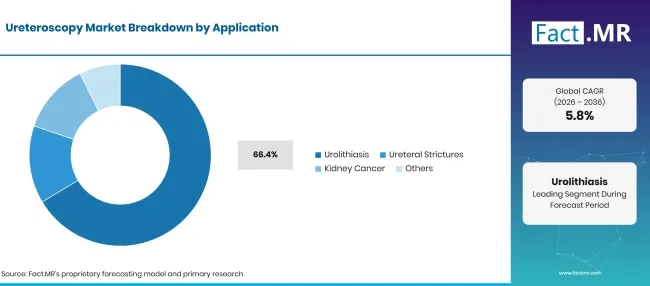
Ureteroscopy Market Breakdown Application | Source: Fact.MR
| Application | Share (2026) |
|---|---|
| Urolithiasis (Leading segment) | 66.4% |
| Other segments combined | 33.6%* |
| Total | 100.0% |
Source: Fact.MR analysis. Updated Nov 6, 2026
Urolithiasis is the primary application for ureteroscopy because the procedure enables direct visualization and treatment of stones in the ureter and kidney. Laser lithotripsy can fragment stones, while retrieval baskets help remove fragments. The EAU recommends holmium:YAG or thulium fibre laser lithotripsy for flexible ureteroscopy [11].
Ureteral strictures and upper urinary tract cancers represent other clinical applications. In these cases, ureteroscopy can support visual assessment and selected diagnostic or therapeutic interventions. The equipment and accessories used depend on the clinical objective and anatomical location.
Which End User accounts for the largest share?
Hospitals are expected to hold 63.9% share in 2026.
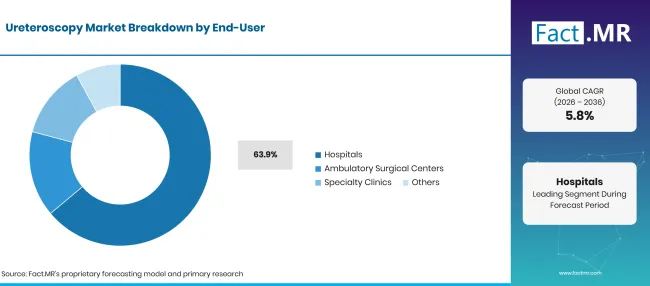
Ureteroscopy Market Breakdown End User | Source: Fact.MR
| End User | Share (2026) |
|---|---|
| Hospitals (Leading segment) | 63.9% |
| Other segments combined | 36.1%* |
| Total | 100.0% |
Source: Fact.MR analysis. Updated Nov 6, 2026
Hospitals remain important end users because ureteroscopy requires specialist equipment, trained urologists and access to anesthesia and imaging support. Complex stone cases may also require additional procedures or postoperative monitoring. Ambulatory surgical centres can handle selected procedures where suitable facilities and patient pathways are available. Specialty clinics contribute through diagnosis, patient assessment and follow-up care.
What is accelerating Ureteroscopy Market adoption, and what is holding it back?
Growing use of minimally invasive stone treatment and improvements in endoscope design support demand, while equipment costs and reprocessing requirements can constrain adoption.
Drivers Impact Analysis
| DRIVER | (~) % IMPACT ON CAGR | GEOGRAPHIC RELEVANCE | IMPACT TIMELINE |
|---|---|---|---|
| Rising use of ureteroscopy for urinary stones | +1.0% | Global | Short term (≤ 2 years) |
| Improvements in flexible scope imaging and deflection | +0.8% | North America, Europe, Asia | Medium term (2–4 years) |
| Adoption of digital and single-use ureteroscopes | +0.7% | North America, Europe | Medium term (2–4 years) |
| Growth in laser lithotripsy procedures | +0.6% | Global | Medium term (2–4 years) |
| Wider availability of stone-management accessories | +0.4% | Global | Short term (≤ 2 years) |
Source: Fact.MR analysis. Updated Nov 6, 2026
Opportunity Impact Analysis
| OPPORTUNITY | (~) % IMPACT ON CAGR | GEOGRAPHIC RELEVANCE | IMPACT TIMELINE |
|---|---|---|---|
| Development of smaller-diameter flexible scopes | +0.8% | Global | Medium term (2–4 years) |
| Improved single-use scope performance | +0.7% | North America, Europe | Medium term (2–4 years) |
| Integrated suction and stone retrieval systems | +0.6% | Global | Long term (≥ 4 years) |
| Expansion of ambulatory ureteroscopy | +0.5% | North America, Europe | Medium term (2–4 years) |
| Improved laser and accessory compatibility | +0.4% | Global | Short term (≤ 2 years) |
Source: Fact.MR analysis. Updated Nov 6, 2026
Restraints Impact Analysis
| RESTRAINT | (~) % IMPACT ON CAGR | GEOGRAPHIC RELEVANCE | IMPACT TIMELINE |
|---|---|---|---|
| High acquisition cost of advanced scopes | -0.8% | Global | Short term (≤ 2 years) |
| Repair and reprocessing costs for reusable scopes | -0.6% | Global | Medium term (2–4 years) |
| Environmental concerns around disposable devices | -0.5% | Europe, North America | Medium term (2–4 years) |
| Need for specialised training and infrastructure | -0.5% | Emerging markets | Long term (≥ 4 years) |
| Procedural complications and anatomical access limitations | -0.4% | Global | Short term (≤ 2 years) |
Source: Fact.MR analysis. Updated Nov 6, 2026
Which countries are scaling the Ureteroscopy Market through 2036?
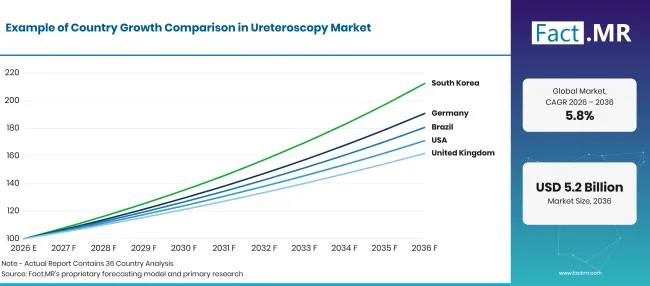
Ureteroscopy Market Growth Index | Source: Fact.MR
| Country | CAGR (2026–2036) |
|---|---|
| Germany | 6.7% |
| Brazil | 6.1% |
| USA | 5.5% |
| UK | 4.9% |
| Japan | 4.4% |
Source: Fact.MR analysis. Updated Nov 6, 2026
What supports Germany adoption?
6.7% CAGR, supported by urinary stone disease and established urology services.
Kidney and ureteral stones create a recurring need for diagnostic and minimally invasive treatment in Germany. The German federal health information portal reports that approximately 1% to 2% of the population develops kidney stones each year, with incidence highest among people aged 40 to 60 [3]. Ureteroscopy can be used when stones require active removal rather than observation or spontaneous passage. Hospitals and specialist urology centers can support adoption through access to flexible endoscopes and laser lithotripsy systems.
What supports market development in the Brazil?
6.1% CAGR, shaped by a significant nephrolithiasis burden and demand for stone-management procedures.
The Brazilian Society of Nephrology's 2025 guidelines describe nephrolithiasis as affecting approximately 10% to 15% of the population; this is a general prevalence estimate rather than a newly measured 2025 Brazilian rate [12]. This disease burden creates a need for effective diagnosis and treatment across the country's healthcare system. Ureteroscopy can provide a minimally invasive option for patients requiring stone removal. Wider access to trained urologists and suitable endoscopic equipment can support adoption, although differences in healthcare infrastructure and affordability may influence procedure availability.[4]
How is the United States supporting market growth?
5.5% CAGR, driven by urinary stone treatment demand and adoption of advanced endoscopic equipment.
Urinary stone disease creates a substantial clinical burden in the United States. The National Institute of Diabetes and Digestive and Kidney Diseases reported claims-based annual prevalence of 1% to 2% among adults aged 18 to 64 and 3% to 5% among people aged 65 and above during 2012–2021 [5]. A 2026 analysis of Medicare procedure data also reported increasing ureteroscopy utilization between 2014 and 2024, alongside a shift toward outpatient and other non-hospital settings [6].
How is the United Kingdom advancing in the market?
4.9% CAGR, shaped by the burden of urinary stones and established minimally invasive urology pathways.
Kidney stones affect a substantial proportion of the UK population. The NHS identifies kidney stones as a condition that may require specialist treatment when stones are unlikely to pass on their own [7]. Ureteroscopy is one of the treatment options for stones that require active removal. Access to specialist services and suitable endoscopic systems can support market development.[7]
What supports Japan adoption in the market?
4.4% CAGR, supported by established endourology practice and continued use of minimally invasive stone procedures.
Japan uses minimally invasive procedures, including ureteroscopy and percutaneous nephrolithotomy, for selected urinary stone cases. Choice of procedure depends on stone location, size, anatomical factors and specialist assessment. These developments support demand for endoscopes and related accessories, although the country CAGR remains a separate market forecast.[8][8]
Who leads the Ureteroscopy Market?
Fact.MR identifies Boston Scientific, Olympus, KARL STORZ, Stryker, Richard Wolf, Cook Medical and Rocamed among the companies participating in the ureteroscopy equipment and accessory market.
Competition spans flexible and semi-rigid ureteroscopes, stone extraction systems, access sheaths and irrigation equipment. Companies differ in their product focus, with some supplying complete endoscope systems and others concentrating on procedural accessories. Boston Scientific Corporation offers the LithoVue single-use digital flexible ureteroscope range. Its LithoVue Elite system includes intrarenal pressure monitoring and enhanced image and video capabilities. The FDA also recorded a 510(k) decision for its LithoVue Elite Digital Flexible Ureteroscope System in August 2026 [9] [10].
Olympus Corporation supplies flexible video ureteroscopes, including the URF-V3/V3R. Its product features include an 8.4 Fr insertion profile, enhanced manoeuvrability and a wide angulation range. KARL STORZ SE & Co. KG offers the FLEX-XC1 single-use video uretero-renoscope. The product is designed for ureteroscopy and retrograde intrarenal surgery, with a 270-degree deflection range and integrated light source.
Stryker Corporation offers urology equipment that includes a semi-rigid autoclavable ureteroscope and ureteroscope accessories. Its portfolio also includes visualization platforms and related surgical equipment. Richard Wolf GmbH has a broad urology endoscopy portfolio covering ureteroscopy, nephroscopy and other minimally invasive procedures. The company identifies flexible ureteroscopes and its RIWO D-URS system among its urology product offerings.
Cook Medical LLC participates in ureteroscopy through stone-management accessories. Its portfolio includes Flexor ureteral access sheaths, NGage nitinol stone extractors, guidewires, ureteral stents and other access and drainage products. Rocamed SAM supplies endourology products, including RocaStone nitinol stone extractors, BiFlex ureteral access sheaths and Endoflow irrigation systems. Its products are designed to support semi-rigid and flexible ureteroscopy procedures.
Commercial competition depends on scope performance, image quality, procedural compatibility and total cost of ownership. Reusable devices require reprocessing and maintenance, while single-use scopes can reduce repair and sterilization requirements but introduce recurring purchasing costs and environmental considerations. Manufacturers that offer compatible scopes and accessory systems can strengthen their position with hospitals and specialist urology centres.
Which companies are the key providers?
The competitive set includes manufacturers of ureteroscopes and companies providing complementary stone-management devices.
- Boston Scientific Corporation
- Olympus Corporation
- KARL STORZ SE & Co. KG
- Stryker Corporation
- Richard Wolf GmbH
- Cook Medical LLC
- Rocamed SAM
Bibliography
- [1] National Institute of Diabetes and Digestive and Kidney Diseases. (2024, April 26). Urologic Diseases in America: Annual Data Report 2024 – Urinary Stone Disease.
- [2] Cook Medical. (n.d.). Streamline your stone management procedures.
- [3] Federal Ministry of Health, Germany. (n.d.). Kidney stones and ureteral stones.
- [4] National Institute of Diabetes and Digestive and Kidney Diseases. (n.d.). Treatment for kidney stones.
- [5] National Institute of Diabetes and Digestive and Kidney Diseases. (2024, April 26). Urologic Diseases in America: Annual Data Report 2024 – Urinary Stone Disease.
- [6] National Institute of Diabetes and Digestive and Kidney Diseases. (n.d.). Kidney stones.
- [7] NHS. (2026). Kidney stones
- [8] Frimley Health NHS Foundation Trust. (2025, October 17). ED management of patients with stone disease.
- [9] Boston Scientific Corporation. (n.d.). LithoVue™ Elite Single-Use Digital Flexible Ureteroscope System.
- [10] U.S. Food and Drug Administration. (2026, August 26). 510(k) Premarket Notification K261153: LithoVue Elite Digital Flexible Ureteroscope System.
- [11] European Association of Urology. (2026). EAU guidelines on urolithiasis: Guidelines.
- [12] Carvalho, M., et al. (2025). Brazilian guidelines on evaluation and clinical management of nephrolithiasis. Brazilian Journal of Nephrology, 47(2), e20240189.
This Report Answers
- The report describes how ureteroscopes and related accessories are used in the diagnosis and treatment of urinary tract conditions.
- Product analysis compares flexible ureteroscopes, semi-rigid ureteroscopes and accessories.
- Application analysis examines urolithiasis, ureteral strictures and kidney cancer.
- Country analysis discusses Germany, Brazil, the USA, the UK and Japan alongside available urinary stone disease evidence.
- The competitive overview profiles Boston Scientific, Olympus, KARL STORZ, Stryker, Richard Wolf, Cook Medical and Rocamed.
- End-user analysis compares hospitals, ambulatory surgical centers and specialty clinics.
What does the Ureteroscopy Market cover?
The market covers medical endoscopes and associated devices used to examine and treat the ureter and upper urinary tract. It includes flexible and semi-rigid ureteroscopes used for stone management and selected diagnostic procedures. Accessories such as guidewires, retrieval baskets, access sheaths and irrigation systems are included when they are specifically designed for ureteroscopy.
What is included in the scope?
Included products comprise reusable and single-use flexible ureteroscopes, semi-rigid ureteroscopes and supporting accessories used during ureteroscopic procedures.
The market also covers equipment used for stone access, fragmentation support and retrieval. Applications include urolithiasis and selected ureteral or upper urinary tract conditions.
What is excluded from the scope?
The analysis excludes general-purpose cystoscopes and endoscopes not designed for ureteroscopy. It also excludes standalone lithotripsy equipment, imaging systems and operating-room infrastructure unless they are specifically incorporated into a ureteroscopy product system.
General urology consumables without a direct ureteroscopy application are outside the defined product boundary.
How Was the Analysis Built?
The analysis draws on 120+ sources, 35+ company portfolios, 25+ countries and more than 20 industry interviews.
- Primary Research: Primary research includes discussions with medical device manufacturers, urologists, hospital teams, distributors, ambulatory surgical centers and subject-matter experts. These discussions examine device selection, product performance, purchasing priorities, reprocessing costs, clinical adoption and competitive positioning.
- Desk Research: Desk research covers clinical guidelines, government health statistics, medical device regulatory records, company product catalogues, clinical studies, industry publications and healthcare procedure data. Sources are documented in the bibliography.
- Market Sizing and Forecasting: Market estimates combine historical performance, procedure volumes, device pricing, product adoption, segment shares, company participation, country-level growth and barriers to market expansion.
- Data Validation and Update Cycle: Findings are reviewed against clinical recommendations, product approvals, company portfolio updates, new device introductions and changes in endourology practice. Regular updates assess shifts in reusable and single-use device adoption and the use of supporting accessories.
Segmentation
What is the report’s scope and coverage?
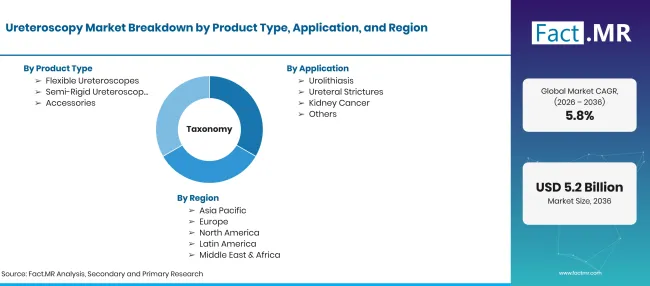
Factmr Ureteroscopy Market Taxonomy | Source: Fact.MR
| Attribute | Details |
|---|---|
| Quantitative Units | USD billion |
| Market Definition | The ureteroscopy market comprises endoscopic instruments and related accessories used to examine and treat conditions affecting the ureters and kidneys. It includes flexible and semi-rigid ureteroscopes along with accessories such as guidewires and stone retrieval baskets as well as laser fibers and access sheaths. |
| Product Type | Flexible Ureteroscopes; Semi-Rigid Ureteroscopes; Accessories |
| Application | Urolithiasis; Ureteral Strictures; Kidney Cancer; Others |
| End User | Hospitals; Ambulatory Surgical Centers; Specialty Clinics; Others |
| Regions Covered | North America; Latin America; Western Europe; Eastern Europe; East Asia; South Asia & Pacific; Middle East & Africa |
| Countries Covered | Germany; Brazil; USA; UK; Japan |
| Companies Profiled | Boston Scientific; Olympus; KARL STORZ; Stryker; Richard Wolf; Cook Medical; Rocamed |
| Forecast Period | 2026 to 2036 |
| Approach | Market segmentation and scenario-based analysis supported by clinical guidelines, epidemiological studies and company product information |
Source: Fact.MR analysis. Updated Nov 6, 2026
How is the market segmented?
-
By Product Type
- Flexible Ureteroscopes
- Semi-Rigid Ureteroscopes
- Accessories
-
By Application
- Urolithiasis
- Ureteral Strictures
- Kidney Cancer
- Others
-
By End User
- Hospitals
- Ambulatory Surgical Centers
- Specialty Clinics
- Others
-
By Region
- North America
- Latin America
- Western Europe
- Eastern Europe
- East Asia
- South Asia & Pacific
- Middle East & Africa
Frequently Asked Questions
How big is the Ureteroscopy Market in 2026?
What is the CAGR from 2026 to 2036?
Which product type has the largest share?
Which application leads the market?
Which end user has the largest share?
Which country is projected to grow fastest?
Which companies are covered?
Who worked on this report


Preview the report firsthand - request a free sample
Free SampleGet the brochure for pricing and purchase details
Download PDF