- Market Value (2025): USD 225.7 Mn
- Estimated Value (2026): USD 239.2 Mn
- Forecast Value (2036): USD 429.3 Mn
- CAGR (2026-2036): 6.0%%
What is the Jet Lag Treatment Market forecast to be worth by 2036?
USD 239.2 million in 2026 to USD 429.3 million by 2036 at a 6.0% CAGR.
- As per Fact.MR analysis, the jet lag treatment market reached USD 225.7 million in 2025.
- Demand will increase from USD 239.2 million in 2026 to USD 429.3 million by 2036.
- The jet lag treatment market will record 6.0% CAGR from 2026 to 2036.
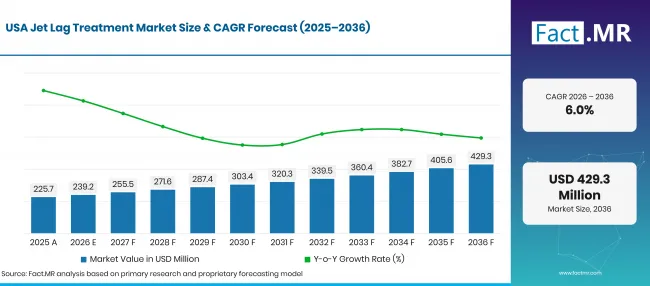
Jet Lag Treatment Market Forecast Usa | Source: Fact.MR
What are the defining numbers behind Jet Lag Treatment Market growth?
An absolute opportunity of USD 519.3 million will be created between 2026 and 2036.
- Demand Drivers in the Market
- International travel keeps adding people who cross time zones each year. UN Tourism estimated that 1.52 billion international tourists were recorded in 2025, almost 60 million more than in 2024 [1]. Each long-haul trip across time zones adds a potential buyer.
- Pre-trip ordering is now a normal habit for European shoppers. Eurostat reported that 78% of people in the EU bought or ordered goods or services online in 2025, up from 62% in 2015 [2]. Online pharmacies will capture more of this planned demand.
- Occupational users create steady repeat purchases. The U.S. Bureau of Labor Statistics projects flight attendant employment to grow 9% from 2025 to 2035 [3]. Crew members who rotate across time zones will keep buying sleep and alertness aids.
- Prescribers now look beyond general sleeping pills. Timed melatonin, short-acting hypnotics and scheduled bright light form the core of physician advice for travelers.
- Key Segments Analyzed
- By Product Type: Prescription Medication will hold 38.5% share in 2026 since physician oversight and defined dosing give travelers more confidence in a fast response.
- By Application: Business Travelers will account for 40.7% share in 2026, supported by frequent long-haul trips and meetings scheduled soon after landing.
- By Distribution Channel: Online Pharmacies will capture 53.2% share in 2026 owing to pre-trip ordering, home delivery and easy price comparison.
- Analyst Opinion at Fact.MR
- Shambhu Nath Jha, Principal Consultant at Fact.MR, states, “Jet lag treatment is moving from a last-minute airport purchase to a planned item in the travel kit. Prescription products backed by clinical evidence will stay at the center of the category, while melatonin and light therapy glasses widen the self-care tier. Suppliers that combine clear timing guidance with strong online access will gain the most from frequent flyers and airline crews through 2036.”
- Strategic Implications
- Prescription drug developers should build evidence on dosing by travel direction and on next-day safety, given that regulators expect proof of benefit for jet lag claims.
- Online pharmacies and telehealth providers should bundle consultation, product and timing guidance into one pre-trip order, since most travelers plan their trips weeks ahead.
- Melatonin and homeopathic remedy brands should publish dose and timing instructions that match public health advice, which builds trust among careful travelers.
- Light therapy device makers should target airline crews and athletes with travel-ready wearables, as these users repeat circadian shifts many times a year.
Mexico will lead at 7.5% CAGR as more residents fly abroad each year. South Korea will follow at 6.9% on heavy international air traffic. Poland will record 6.6% with fast airport growth and charter travel. The United States will post 6.0% given its large pool of outbound travelers. Germany will reach 5.4% on high international passenger volumes, while Italy will close at 4.3% in a pharmacy-led market with lower online shopping.
How does the Jet Lag Treatment Market break down by segment?
Prescription Medication will lead Product Type at 38.5%; Business Travelers will lead Application at 40.7%; Online Pharmacies will lead Distribution Channel at 53.2%.
Which Product Type dominates?
Prescription Medication will hold 38.5% share in 2026.
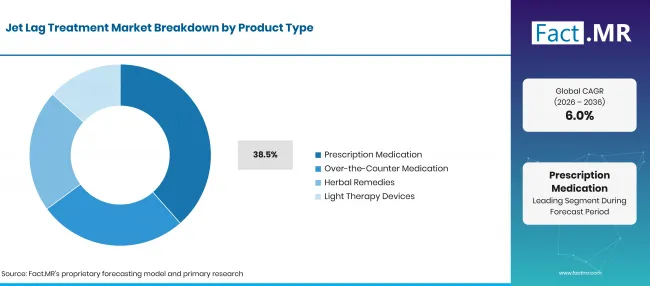
Jet Lag Treatment Market Breakdown Product Type | Source: Fact.MR
Prescription medication will lead as physicians can match short-acting hypnotics or melatonin dosing to travel direction and the number of time zones crossed. Clinical evidence drives prescriber choice across the circadian rhythm sleep treatment category.
Tasimelteon has no U.S. approval for jet lag yet. The FDA published notice in June 2026 that it had granted a formal hearing on its proposal to refuse a supplemental application for tasimelteon 20 mg capsules to treat jet lag disorder [4]. Over-the-counter medication covers melatonin and sleep aid supplements for self-managing travelers. CDC guidance states that 0.5 to 1 mg of melatonin is often enough to shift circadian timing [5]. Herbal remedies include homeopathic tablets sold as OTC herbal medicines, while light therapy devices deliver timed bright light to move the body clock.
What leads the Application segment?
Business Travelers will account for 40.7% share in 2026.
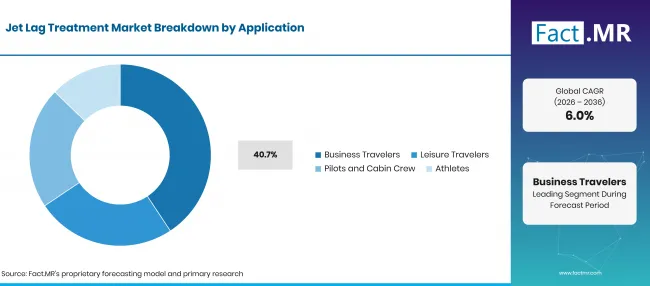
Jet Lag Treatment Market Breakdown Application | Source: Fact.MR
Business travelers will lead since impaired alertness is costly in meetings and negotiations held soon after arrival. CDC guidance notes that 68% of international business travelers experienced negative jet lag symptoms on a regular basis [5]. Employers with travel policies also fund remedies for staff.
Leisure travelers form a broad but less frequent buyer group. Pilots and cabin crew face repeated circadian shifts through rostered flying, and the U.S. Bureau of Labor Statistics counted 104,600 airline pilot jobs in 2025 [6]. Athletes use structured routines that pair light exposure with timed melatonin gummies before international events.
How does Distribution Channel shape demand?
Online Pharmacies will capture 53.2% share in 2026.
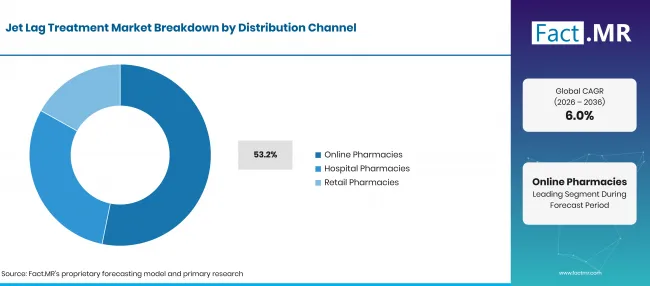
Jet Lag Treatment Market Breakdown Distribution Channel | Source: Fact.MR
Online pharmacies will lead given that travel is planned in advance and buyers can order before departure. Telehealth consultations simplify prescription access, and repeat orders suit frequent flyers. Eurostat reported that 64% of EU internet users searched for health information online in 2025 [2].
Hospital pharmacies serve travelers seen at travel health clinics. Retail pharmacies remain important for first-time users and last-minute buyers who want pharmacist guidance. These counters also carry the wider range of sleeping aids that travelers compare in store.
What is accelerating Jet Lag Treatment Market adoption, and what is holding it back?
Demand will rise with international travel, online access to treatment and the needs of airline crews and athletes. Growth is held back by the pending FDA decision on a prescription jet lag claim and by safety concerns about hypnotics. Low awareness among occasional travelers also slows uptake.
Drivers Impact Analysis
| DRIVER | (~) % IMPACT ON CAGR | GEOGRAPHIC RELEVANCE | IMPACT TIMELINE |
|---|---|---|---|
| Rising frequency of long-haul business and leisure travel | +1.8% | Global | Short term (<= 2 years) |
| Wider access through online pharmacies and telehealth | +1.5% | North America, Western Europe, East Asia | Medium term (2-4 years) |
| Occupational demand from airline crews and athletes | +1.0% | Global | Medium term (2-4 years) |
| Growing awareness of sleep and circadian health | +0.7% | Global | Long term (>= 4 years) |
Opportunity Impact Analysis
| OPPORTUNITY | (~) % IMPACT ON CAGR | GEOGRAPHIC RELEVANCE | IMPACT TIMELINE |
|---|---|---|---|
| Telehealth prescription access for frequent travelers | +1.0% | North America, East Asia, Western Europe | Medium term (2-4 years) |
| Wearable light therapy for crews and athletes | +0.8% | Global | Medium term (2-4 years) |
| Airline and corporate travel wellness programs | +0.6% | Global | Long term (>= 4 years) |
Restraints Impact Analysis
| RESTRAINT | (~) % IMPACT ON CAGR | GEOGRAPHIC RELEVANCE | IMPACT TIMELINE |
|---|---|---|---|
| Pending FDA decision on a prescription jet lag claim | -0.6% | North America | Short term (<= 2 years) |
| Safety and side-effect concerns with hypnotics | -0.5% | Global | Medium term (2-4 years) |
| Low awareness and self-management among occasional travelers | -0.4% | Global | Long term (>= 4 years) |
Which countries are scaling the Jet Lag Treatment Market through 2036?
- The country comparison spans 3.2 percentage points between Mexico at 7.5% and Italy at 4.3%.
- More Mexican residents flying abroad will give Mexico a 0.6-point lead over South Korea.
- Only 0.3 percentage point will separate South Korea from Poland, with Korean demand drawn from heavy international air traffic.
- Charter and scheduled flight growth will keep Poland 0.6 points clear of the United States.
- In the United States, a large outbound travel base will leave the country 0.6 points ahead of Germany.
- Germany will hold a 1.1-point edge over Italy, helped by high international passenger volumes at its main airports.
- Italy will close the displayed range, where pharmacy counters still handle most purchases.
Comparable CAGRs can mask different entry conditions, since travel volumes and pharmacy rules vary by country. Full report coverage includes North America, Latin America, Western Europe, Eastern Europe, East Asia, South Asia & Pacific, Middle East & Africa.
As per Fact.MR, global jet lag treatment consumption is estimated at USD 0.079 per capita in 2026, compared with USD 0.076 per capita in 2025. It will grow to USD 0.132 per capita by 2036 as more people take long-haul flights and plan treatment before they travel. Demand will rise across business travelers, leisure travelers, airline crews and athletes in both mature and emerging economies. As per Fact.MR, the growth of jet lag treatment will come less from one-off purchases at the airport and more from planned online orders, prescriber guidance on timing and wearable light therapy.
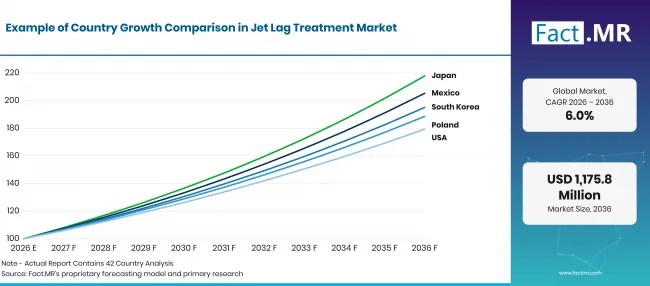
Jet Lag Treatment Market Growth Index | Source: Fact.MR
| Country | CAGR (2026-2036) |
|---|---|
| Mexico | 7.5% |
| South Korea | 6.9% |
| Poland | 6.6% |
| United States | 6.0% |
| Germany | 5.4% |
| Italy | 4.3% |
What supports Mexico adoption?
7.5% CAGR, supported by a growing number of residents flying abroad.
Mexican travelers are taking more international flights for business and leisure. INEGI reported that 8.05 million Mexican residents traveled abroad by air in 2025, up 6.3% from 2024 [7]. Long flights to Europe and Asia will lift demand for treatments that shorten recovery after arrival.
How is South Korea scaling demand?
6.9% CAGR, driven by heavy international air traffic.
South Korean demand rests on dense international air links. The Ministry of Land, Infrastructure and Transport reported that international air passengers rose 30.2% to 88.93 million in 2024 [8]. Many Korean travelers research and buy health products online before departure.
What supports Poland’s growth?
6.6% CAGR, backed by fast airport growth and charter travel.
Polish airports grew well above the European average in 2025. The Civil Aviation Authority reported that Polish airports handled 66.1 million passengers in 2025, up 11.7% from 2024 [9]. International charter traffic reached 10.4 million passengers, a rise of 13.1% [9]. Holiday flights to distant destinations will widen the buyer pool.
How is the United States developing demand?
6.0% CAGR, led by a large pool of outbound travelers.
American travelers make many long-haul and transcontinental trips each year. The National Travel and Tourism Office reported that U.S. resident outbound travelers reached a record 107.7 million in 2024, and overseas trips were planned 109 days in advance on average [10]. Long planning windows favor online orders and telehealth visits.
What is supporting Germany’s adoption?
5.4% CAGR, supported by high international passenger volumes.
German demand draws on a large base of outbound business and holiday travelers. Destatis reported that the main German airports counted 207.2 million passengers in 2025, up 3.9% from 2024, with 195.3 million on international flights [11].
How does Italy perform?
4.3% CAGR, shaped by a pharmacy-led purchase pattern.
Italy’s dense pharmacy network remains the main route to purchase. ENAC reported that Italian airports handled more than 229.7 million passengers in 2025, up 5% from 2024 [12]. Online buying is less common than in most of the EU, at 62% of internet users in 2025 [2]. Slower channel change keeps Italian growth below the other listed countries.
Who leads the Jet Lag Treatment Market?
Competition splits into three tiers. Prescription developers compete on clinical evidence and regulatory standing, and Vanda Pharmaceuticals Inc. is seeking a jet lag claim for HETLIOZ (tasimelteon).
In August 2025, a federal appeals court overturned the FDA order that denied approval of HETLIOZ for jet lag disorder [13]. Vanda expects the resulting FDA hearing to end with a five-day session before an Administrative Law Judge in December 2026 [14]. Self-care brands compete on shelf reach and price, such as Pharmavite with Nature Made melatonin and Miers Laboratories with NO-JET-LAG homeopathic tablets. Device makers Lucimed and Re-Time Pty Ltd compete on comfort and portability with Luminette and retimer light therapy glasses. Digital planners also steer purchases, as Timeshifter extended its jet lag app collaboration with United Airlines in November 2025 [15]. The FDA hearing outcome and proof of correct timing will decide competition through 2036.
Which companies are the key providers?
Key companies include Vanda Pharmaceuticals Inc.; Pharmavite LLC (Nature Made); Lucimed SA (Luminette); Re-Time Pty Ltd (retimer); and Miers Laboratories (NO-JET-LAG).
- Vanda Pharmaceuticals Inc.
- Pharmavite LLC (Nature Made)
- Lucimed SA (Luminette)
- Re-Time Pty Ltd (retimer)
- Miers Laboratories (NO-JET-LAG)
Bibliography
- [1] UN Tourism. (2026, January 20). International tourist arrivals up 4% in 2025 reflecting strong travel demand around the world.
- [2] Eurostat. (2026, April 23). Digitalisation in Europe, 2026 edition.
- [3] U.S. Bureau of Labor Statistics. (2026, August 27). Flight Attendants: Occupational Outlook Handbook.
- [4] U.S. Food and Drug Administration. (2026, June 3). Vanda Pharmaceuticals, Inc.; Grant of Hearing Request Regarding a Proposal To Refuse To Approve a Supplemental New Drug Application for HETLIOZ (Tasimelteon).
- [5] Centers for Disease Control and Prevention. (2025, April 23). Jet Lag Disorder. CDC Yellow Book: Health Information for International Travel.
- [6] U.S. Bureau of Labor Statistics. (2026, August 27). Airline and Commercial Pilots: Occupational Outlook Handbook.
- [7] Instituto Nacional de Estadística y Geografía. (2026, February 12). Encuestas de Viajeros Internacionales (EVI), Boletín de Indicador 82/26 [International Travelers Surveys, Indicator Bulletin 82/26].
- [8] Ministry of Land, Infrastructure and Transport of Korea. (2026, January 14). 항공 여객 수송(국내, 국제) [Air passenger transport, domestic and international].
- [9] Urząd Lotnictwa Cywilnego. (2026, April 22). Przewozy pasażerskie w polskich portach lotniczych w 2025 roku [Passenger traffic at Polish airports in 2025].
- [10] National Travel and Tourism Office, International Trade Administration. (2025, September 23). U.S. Outbound Travelers Characteristics 2024.
- [11] Statistisches Bundesamt (Destatis). (2026, January 29). 3,9 % mehr Fluggäste im Jahr 2025 als im Vorjahr [3.9% more air passengers in 2025 than in the previous year].
- [12] Ente Nazionale per l’Aviazione Civile. (2026, May 11). Enac pubblica i Dati di Traffico 2025: +5% rispetto al 2024 per oltre 229,7 milioni di passeggeri negli aeroporti italiani [Enac publishes 2025 traffic data: up 5% on 2024 to more than 229.7 million passengers at Italian airports].
- [13] Vanda Pharmaceuticals Inc. (2025, August 18). In a Major Win for Vanda, a Federal Appeals Court Overturns FDA’s Order Denying Approval of Hetlioz for the Treatment of Jet Lag Disorder.
- [14] Vanda Pharmaceuticals Inc. (2026, August 5). Vanda Pharmaceuticals Reports Second Quarter 2026 Financial Results.
- [15] Timeshifter Inc. (2025, November 18). Timeshifter and United Airlines extend collaboration to help passengers tackle jet lag.
This Report Answers
- The report explains how jet lag treatments are sold by product type, application and distribution channel.
- Segment analysis identifies the subsegment that leads each segment and the buyer needs behind its 2026 share.
- Country analysis compares the six listed countries through air travel volumes, pharmacy channels and online buying habits.
- Competitive analysis reviews prescription developers, melatonin and homeopathic brands and light therapy device makers.
- Regulatory analysis tracks the status of prescription jet lag claims and public health guidance on melatonin and light timing.
What does the Jet Lag Treatment Market cover?
The Jet Lag Treatment Market covers products used to prevent or relieve symptoms after travel across time zones. These symptoms include disturbed sleep, daytime fatigue and reduced alertness at the destination.
The assessment tracks sales to business and leisure travelers, airline crews and athletes. It measures demand through online, hospital and retail pharmacies across the listed countries and regions.
What is included in the scope?
The scope includes prescription medication used for jet lag, such as short-acting hypnotics and melatonin products dispensed on prescription. It covers over-the-counter melatonin, homeopathic and herbal supplement remedies marketed for travel-related sleep disruption.
Wearable light therapy glasses and portable light boxes sold for circadian adjustment are included. These products overlap with phototherapy devices when they are marketed for time zone change.
What is excluded from the scope?
The scope excludes treatments for chronic sleep disorders when they are not used for jet lag. Products in the wider insomnia treatment category fall outside the revenue boundary unless travelers buy them for time zone change.
Standalone jet lag planning apps, airline amenities and travel services are excluded. General wellness and relaxation products without a jet lag use are also excluded.
How Was the Analysis Built?
The analysis draws on 120+ sources, 35+ company portfolios, 25+ countries, and more than 20 industry interviews.
- Primary Research: Primary research includes discussions with manufacturers, service providers, technology developers, distributors, end users, and subject-matter experts. These conversations examine purchasing priorities, product adoption, operational challenges, approval requirements, competitive positioning, and the factors that influence wider market acceptance.
- Desk Research: Desk research covers government statistics, regulatory publications, company filings, trade data, technical studies, industry associations, standards, public policy, and other authoritative sources. Every source used in the analysis is documented in the bibliography.
- Market Sizing and Forecasting: Market estimates combine historical performance, demand indicators, pricing and volume trends, segment shares, company participation, country-level growth, adoption patterns, investment activity, and barriers to market expansion.
- Data Validation and Update Cycle: Findings are validated by comparing primary interviews with public data, company activity, regulatory changes, trade patterns, and industry developments. Regular updates review new product launches, capacity changes, partnerships, approvals, and shifts in commercial adoption.
What is the report’s scope and coverage?
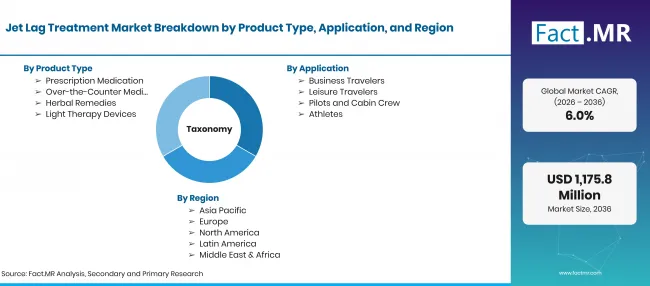
Jet Lag Treatment Market Taxonomy | Source: Fact.MR
| Attribute | Details |
|---|---|
| Quantitative Units | USD million in 2026 to USD million by 2036 at a CAGR |
| Market Definition | Products used to prevent or relieve jet lag symptoms such as disturbed sleep, daytime fatigue and reduced alertness after travel across time zones. The scope covers prescription and over-the-counter medication, herbal remedies and light therapy devices sold through online, hospital and retail pharmacies. |
| Product Type | Prescription Medication; Over-the-Counter Medication; Herbal Remedies; Light Therapy Devices |
| Application | Business Travelers; Leisure Travelers; Pilots and Cabin Crew; Athletes |
| Distribution Channel | Online Pharmacies; Hospital Pharmacies; Retail Pharmacies |
| Regions Covered | North America; Latin America; Western Europe; Eastern Europe; East Asia; South Asia & Pacific; Middle East & Africa |
| Countries Covered | Mexico; South Korea; Poland; United States; Germany; Italy |
| Key Companies Profiled | Vanda Pharmaceuticals Inc.; Pharmavite LLC (Nature Made); Lucimed SA (Luminette); Re-Time Pty Ltd (retimer); Miers Laboratories (NO-JET-LAG) |
| Forecast Period | 2026 to 2036 |
| Approach | Hybrid top-down and bottom-up approach using international air traveler volumes; treatment use by product type; occupational user pools; distribution channel mix; country growth; and supplier portfolio review. |
How is the market segmented?
-
By Product Type
- Prescription Medication
- Over-the-Counter Medication
- Herbal Remedies
- Light Therapy Devices
-
By Application
- Business Travelers
- Leisure Travelers
- Pilots and Cabin Crew
- Athletes
-
By Distribution Channel
- Online Pharmacies
- Hospital Pharmacies
- Retail Pharmacies
-
By Region
- North America
- Latin America
- Western Europe
- Eastern Europe
- East Asia
- South Asia & Pacific
- Middle East & Africa