- Market Value (2025): USD 3.22 Bn
- Estimated Value (2026): USD 3.53 Bn
- Forecast Value (2036): USD 8.90 Bn
- CAGR (2026-2036): 9.7%
Laser Welding and Cutting Robots Market Forecast and Outlook 2026 to 2036
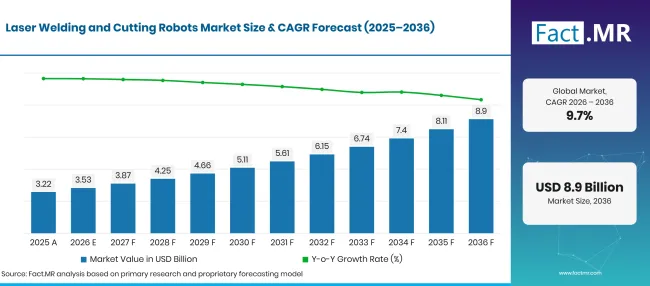
The laser welding and cutting robots market is forecast to increase from USD 3.53 billion in 2026 to USD 8.90 billion by 2036. Demand for laser welding and cutting robots is forecast to record a CAGR of 9.7% over the forecast period.
Automakers use robotic laser welding to join battery trays and body panels where short cycle times and controlled heat input are valuable. A six-axis arm positions the laser head around complex joints while vision systems help locate the seam. In September 2026, the International Federation of Robotics reported that factories installed more than 600,000 industrial robots worldwide in 2025.
Market Highlights: Laser Welding and Cutting Robots Market
- Sales of laser welding and cutting robots stood at USD 3.22 billion in 2025
- Laser Welding and Cutting Robots Market Value (2026): USD 3.53 billion
- Laser Welding and Cutting Robots Market Forecast Value (2036): USD 8.90 billion
- Laser Welding and Cutting Robots Market Forecast CAGR (2026-2036): 9.7%
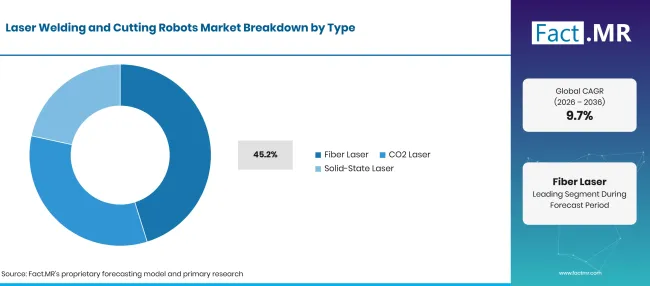
- Leading Type: Fiber Laser (45.2%)
- Key Market Participants: ABB Ltd., Fanuc Corporation, KUKA AG, Yaskawa Electric Corporation
- Key Growth Regions: Japan, United States, United Kingdom, Brazil, Germany
Hyundai Motor Group opened its Metaplant America in Georgia in March 2025 [2]. Its official announcement identified a planned annual capacity of up to 500,000 electric and hybrid vehicles at the combined vehicle and battery operation. Such investment creates opportunities for precision joining equipment used in suitable vehicle and battery production steps. For robot manufacturers, local commissioning support and the ability to qualify different metal joints remain practical selling points.
Laser Welding and Cutting Robots Market
| Metric | Value |
|---|---|
| Estimated Value in (2026) | USD 3.53 billion |
| Forecast Value in (2036) | USD 8.90 billion |
| Forecast CAGR (2026 to 2036) | 9.7% |
Source: Fact.MR analysis. Updated Nov 21, 2026
Source: Fact.MR analysis.
Laser Welding And Cutting Robots Market Forecast Global 1 | Source: Fact.MR
Category
| Category | Segments |
|---|---|
| Type | Fiber Laser, CO2 Laser, Solid-State Laser |
| Application | Automotive, Aerospace, Electronics, Metal Fabrication, Others |
| End-User Industry | Manufacturing, Construction, Shipbuilding, Others |
| Payload Capacity | Up to 50 kg, 51-150 kg, Above 150 kg |
| Region | Japan; United States; United Kingdom; Brazil; Germany |
Source: Fact.MR analysis. Updated Nov 21, 2026
Source: Fact.MR analysis.
Segmental Analysis
Why do fiber lasers lead type demand in the Laser Welding and Cutting Robots Market?
Laser Welding And Cutting Robots Market Breakdown Type | Source: Fact.MR
Fiber laser robots hold 45.2% of the laser welding and cutting robots market in 2026, valued at USD 1.6 billion, because flexible fiber delivery allows manufacturers to position the laser source separately from the robotic arm. This arrangement supports accurate welding and cutting across complex metal components. Fiber lasers are particularly useful for thin sheets and joints requiring controlled heat input. Manufacturers are improving beam control and robotic movement to maintain weld quality.
Why does automotive lead application demand in the Laser Welding and Cutting Robots Market?
Laser Welding And Cutting Robots Market Breakdown Application 1 | Source: Fact.MR
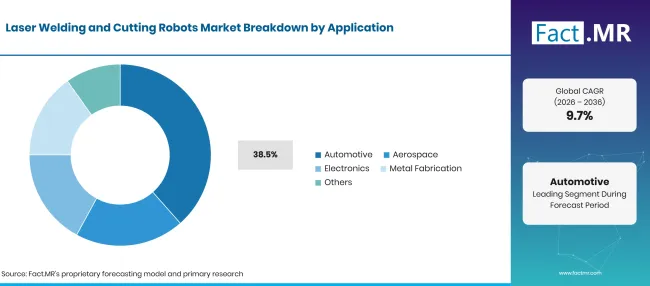
Automotive accounts for 38.5% of laser welding and cutting robots revenue in 2026, generating USD 1.4 billion, as vehicle manufacturers use automated laser systems for precise joining of body structures, battery housings and electric motor components. In May 2025, the International Federation of Robotics reported that US automotive manufacturers installed 13,700 industrial robots in 2024, an increase of 10.7% from the previous year. These installations cover multiple robotic processes and indicate continued investment in automotive automation.
Why does manufacturing lead end-user demand in the Laser Welding and Cutting Robots Market?
Laser Welding And Cutting Robots Market Breakdown End User Industry 1 | Source: Fact.MR
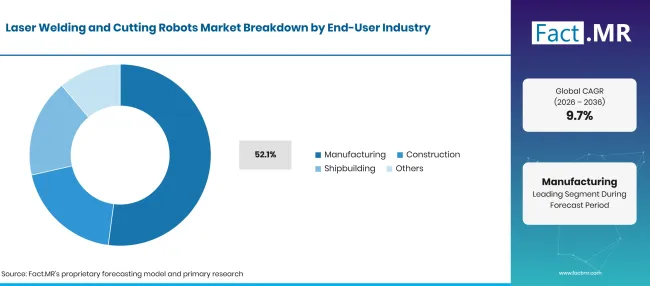
Manufacturing represents 52.1% of laser welding and cutting robots revenue in 2026, equivalent to USD 1.8 billion, because factories require consistent processing quality across metal fabrication and component assembly. In September 2025, the International Federation of Robotics recorded 542,000 industrial robot installations worldwide during 2024, reflecting the scale of investment in automated manufacturing. The figure covers industrial robots across different applications. Factory operators are selecting laser processing systems based on production volume, programming flexibility and component requirements. Flexible robotic cells also allow manufacturers to handle changing product designs.
Why do robots with payloads up to 50 kg lead the Laser Welding and Cutting Robots Market?
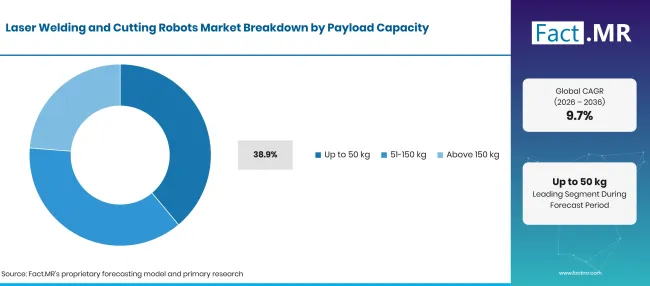
Laser Welding And Cutting Robots Market Breakdown Payload Capacity | Source: Fact.MR
Robots with payloads up to 50 kg contribute 38.9% of laser welding and cutting robots revenue in 2026, worth USD 1.4 billion, because many laser processing heads can operate on relatively lightweight robotic arms. Robotic laser welding systems are commercially available with payload capacities of 6 kg, 12 kg and 20 kg, demonstrating their suitability for compact processing equipment. Lower payload requirements allow engineers to focus on movement speed, positioning accuracy and access to complex joints. Manufacturers assess arm reach, tooling weight and production requirements when selecting laser processing robots. Larger systems remain suitable for heavier tooling and specialized operations.
Laser Welding and Cutting Robots Market-Drivers, Restraints & Trends
Drivers
Vehicle and metal-product factories invest in robotic laser systems when repeatable weld quality can reduce inspection and rework. Hiring skilled welding staff can be difficult, yet automation also demands technicians who understand fixtures and laser safety. In November 2026, the U.S. Bureau of Labor Statistics reported about 313,000 manufacturing job openings in September 2026.
Restraints
A laser processing cell involves more than the cost of a robot arm. Enclosures and interlocks must protect staff from the beam while fume extraction and reliable fixtures add to installation costs. Poor part fit-up can prevent a repeatable weld even when the robot follows its programmed path. Smaller metal shops may need outside support to test a process before committing capital.
Trend
Hairpin Stator and Battery Welding. Manufacturers of electric motors investigate laser joining for copper hairpins where stable electrical connections and low heat damage are essential. Battery tab and enclosure work creates separate process requirements. Laser wavelength and beam settings depend on the metal and joint design, so suppliers must adapt the setup to each application.
Trend
Remote Laser Welding. Scanner optics redirect the beam across a work area without moving the entire robot between every short seam. This can reduce motion between weld positions when the part geometry permits clear beam access. Manufacturers still need accurate fixtures and process checks to confirm that each seam receives the required energy.
Laser Welding and Cutting Robots Market by Analysis by Key Country
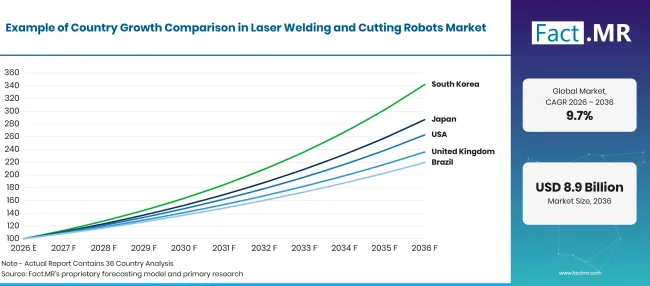
Laser Welding And Cutting Robots Market Growth Index | Source: Fact.MR
| Country | CAGR (2026-2036) |
|---|---|
| Japan | 11.1% |
| United States | 10.2% |
| United Kingdom | 9.0% |
| Brazil | 8.2% |
| Germany | 7.4% |
Source: Fact.MR analysis. Updated Nov 21, 2026
Source: Fact.MR analysis.
Why is Japan the fastest-growing market for laser welding and cutting robots?
Japan's automotive production base creates opportunities for laser joining equipment that can process changing vehicle parts with steady seam quality.
Demand for laser welding and cutting robots in Japan is projected to rise at an 11.1% CAGR from 2026 to 2036. In July 2025, the International Federation of Robotics reported that Japanese automotive plants installed about 13,000 industrial robots during 2024. In September 2026, the same federation reported 36,219 new industrial robot installations across Japan in 2025. FANUC and Yaskawa supply robot platforms, while local integration teams adapt cutting paths and welding programs to each production line. Electronics producers offer another application base because thin metal parts require precise beam placement.
How are new EV plants supporting sales in the United States?
New vehicle assembly projects in the United States are giving equipment integrators more opportunities to propose robotic laser joining. domestic sales of laser welding and cutting robots are projected to increase at a 10.2% CAGR between 2026 and 2036.
In March 2025, Hyundai Motor Group announced that its Georgia Metaplant had opened with a planned annual capacity of up to 500,000 electric and hybrid vehicles. In September 2026, the International Federation of Robotics reported almost 38,500 new industrial robot installations across the United States during 2025. Vehicle bodies and battery enclosures provide practical applications where laser joining may shorten repeated processing steps. Metal fabricators can consider a combined cutting and welding cell when the same parts are made in regular batches.
What is shaping demand in the United Kingdom?
Vehicle manufacturers in the United Kingdom are changing production processes to accommodate newer model designs and different joining requirements.
Demand for laser welding and cutting robots is projected to grow at a 9.0% CAGR during 2026 to 2036. In July 2026, the Office for National Statistics reported GBP 452.0 billion in UK manufacturers' product sales for 2025. In November 2026, the same office reported that UK vehicle production rose 36.3% year on year in September 2026, drawing on industry production statistics. The September 2026 increase in vehicle production also reflects the weak comparison period in September 2025, when a cyberattack disrupted automotive manufacturing.
What is supporting demand in Brazil?
Automotive investment in Brazil is creating opportunities for industrial automation companies serving vehicle assembly and component manufacturing.
laser welding and cutting robot sales in Brazil are forecast to rise at an 8.2% CAGR from 2026 to 2036. In September 2026, the International Federation of Robotics reported that Brazilian factories installed almost 4,300 industrial robots in 2025. In June 2026, the Brazilian Institute of Geography and Statistics reported a 0.7% monthly increase in national industrial production during April 2026.
Why is growth slower in Germany?
Germany's automotive and machinery industries provide an experienced customer base for robotic laser processing.
Demand for laser welding and cutting robots in Germany is projected to advance at a 7.4% CAGR from 2026 to 2036. In September 2026, the International Federation of Robotics reported that Germany represented 41% of industrial robot installations in the European Union during 2025. In November 2026, the Federal Statistical Office reported a 17.1% monthly increase in German automotive production during September 2026. These measures describe the wider manufacturing setting in which new automation systems are assessed. Vehicle engineers consider laser joining when redesigned components need controlled heat input and repeatable seam quality.
Competitive Landscape for Laser Welding and Cutting Robots Market
Competition in laser welding and cutting robots involves industrial robot manufacturers and integrators that assemble complete laser work cells. ABB, FANUC, KUKA and Yaskawa supply robot platforms that can be configured for industrial joining and cutting. Other manufacturers in the company roster offer industrial automation or welding equipment, with capabilities that vary by application. Engineering departments generally test beam access and repeatability before reviewing service coverage. Integration work also includes extraction systems, guards and parts handling. Each work cell needs a qualified laser process before the robot arm can become part of a dependable production system. Service contracts also depend on the availability of optics and controller parts during regular production.
Automotive electrification has widened the range of materials that joining systems must handle, particularly where copper and aluminum are involved. Integrators that document weld quality and support process trials have a more useful commercial offer than companies competing on arm speed alone.
Recent Developments
- In October 2025, Comau presented its Cell to Pack Laser Welding Cell, developed in Southfield, Michigan, at The Battery Show North America. The system supports automated laser welding in battery module and pack assembly, reflecting the company's focus on precision joining technologies for electric vehicle manufacturing.
- In June 2024, ABB launched its OmniCore robotics control platform, incorporating advanced motion control, AI integration, and improved path accuracy to support high-precision industrial operations, including automated laser cutting and welding applications.
Key Players in Laser Welding and Cutting Robots Market
Key companies profiled include ABB Ltd.; Fanuc Corporation; KUKA AG; Yaskawa Electric Corporation; Comau S.p.A.; Daihen Corporation; Panasonic Corporation; and Kawasaki Heavy Industries.
- ABB Ltd.
- Fanuc Corporation
- KUKA AG
- Yaskawa Electric Corporation
- Comau S.p.A.
- Daihen Corporation
- Panasonic Corporation
- Kawasaki Heavy Industries
Bibliography
- ABB. (2024, June 4). ABB launches next-generation robotics control platform OmniCore.
- Comau. (2025, October 6). Comau's e-Mobility solutions on display at the Battery Show Detroit: Innovation, efficiency and flexibility for the American market.
- Federal Statistical Office of Germany. (2026, November 6). Production in September 2026: +0.7% on the previous month.
- Hyundai Motor Group. (2025, March 26). Hyundai Motor Group Metaplant America celebrates grand opening, powering U.S. economic growth.
- Instituto Brasileiro de Geografia e Estatística. (2026, June 3). Produção industrial brasileira variou 0,7% em abril.
- International Federation of Robotics. (2025, May 8). Robot installed in US auto industry up by double digits.
- International Federation of Robotics. (2025, July 15). Japan’s car industry has highest robot installations in five years.
- International Federation of Robotics. (2025, September 25). Global robot demand in factories doubles over 10 years.
- International Federation of Robotics. (2026, September 24). Five million robots now operate in factories globally.
- KUKA. (2025, August 4). SCHWEISSEN & SCHNEIDEN 2025: Efficient and simple automation with KUKA robots.
- Office for National Statistics. (2026, July 24). UK manufacturers’ sales by product: 2025.
- Office for National Statistics. (2026, November 12). GDP monthly estimate, UK: September 2026.
- U.S. Bureau of Labor Statistics. (2026, November 3). Job openings and labor turnover—September 2026 (USDL-26-1630). U.S. Department of Labor.
Segmentation
Scope of Report
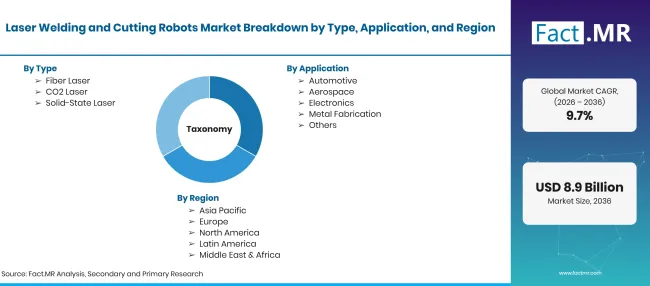
Factmr Laser Welding And Cutting Robots Market Taxonomy | Source: Fact.MR
| Items | Values |
|---|---|
| Quantitative Units (2026) | USD 3.53 Billion |
| Type | Fiber Laser, CO2 Laser, Solid-State Laser |
| Application | Automotive, Aerospace, Electronics, Metal Fabrication, Others |
| End-User Industry | Manufacturing, Construction, Shipbuilding, Others |
| Payload Capacity | Up to 50 kg, 51-150 kg, Above 150 kg |
| Regions Covered | North America, Latin America, Europe, East Asia, South Asia and Pacific, Middle East & Africa |
| Countries Covered | United States, Germany, Japan, United Kingdom, Brazil, and other countries |
| Key Companies Profiled | ABB Ltd., Fanuc Corporation, KUKA AG, Yaskawa Electric Corporation, Comau S.p.A., Daihen Corporation, Panasonic Corporation, Kawasaki Heavy Industries |
| Additional Attributes | Dollar revenue in the Laser Welding and Cutting Robots Market is segmented by type (fiber laser, CO2 laser, non-fiber solid-state laser), application (automotive, aerospace, electronics, metal fabrication), end-user industry (manufacturing, construction, shipbuilding), payload capacity (up to 50 kg, 51–150 kg, above 150 kg) and region. |
Source: Fact.MR analysis. Updated Nov 21, 2026
Laser Welding and Cutting Robots Market by Segments
-
Type
- Fiber Laser
- CO2 Laser
- Solid-State Laser
-
Application
- Automotive
- Aerospace
- Electronics
- Metal Fabrication
- Others
-
End-User Industry
- Manufacturing
- Construction
- Shipbuilding
- Others
-
Payload Capacity
- Up to 50 kg
- 51-150 kg
- Above 150 kg
-
Region:
- North America
- United States
- Canada
- Mexico
- Europe
- Germany
- United Kingdom
- France
- Italy
- Spain
- Rest of Europe
- Asia Pacific
- China
- India
- Japan
- South Korea
- Australia
- Rest of Asia Pacific
- Latin America
- Brazil
- Mexico
- Argentina
- Rest of Latin America
- Middle East & Africa
- GCC Countries
- South Africa
- Rest of Middle East & Africa
- North America
Frequently Asked Questions
How big is the global Laser Welding and Cutting Robots Market in 2026?
What will be the size of the Laser Welding and Cutting Robots Market by 2036?
How fast will the Laser Welding and Cutting Robots Market grow during the forecast period?
Which type segment holds the largest share of the Laser Welding and Cutting Robots Market?
Who worked on this report


Preview the report firsthand - request a free sample
Free SampleGet the brochure for pricing and purchase details
Download PDF