- Market Value (2025): USD 480.6 Mn
- Estimated Value (2026): USD 517.2 Mn
- Forecast Value (2036): USD 1079.0 Mn
- CAGR (2026-2036): 7.6%
Riveting Robots Market Forecast and Outlook 2026 to 2036
The riveting robots market is forecast to increase from USD 517.2 million in 2026 to USD 1079.0 million by 2036. Demand for riveting robots is forecast to record a CAGR of 7.6% over the forecast period.
Aircraft builders are investing in more reliable fastening processes as production rates rise and assembly tolerances remain tight. Robotic riveting equipment is used where a joint requires a repeatable setting force and a record of the operation. In October 2026, Airbus maintained its plan to reach an A320-family production rate of 70 to 75 aircraft monthly by the end of 2027. During a riveting-cell assessment, aircraft assembly engineers have to understand how the tool approaches each joint and how the workpiece stays in position.
Market Highlights: Riveting Robots Market
- Sales of riveting robots stood at USD 480.6 million in 2025
- Riveting Robots Market Value (2026): USD 517.2 million
- Riveting Robots Market Forecast Value (2036): USD 1079.0 million
- Riveting Robots Market Forecast CAGR (2026-2036): 7.6%
- Leading Product Type: Industrial Riveting Robots (42.5%)
- Key Market Participants: Fanuc Corporation, ABB Ltd., KUKA AG, Kawasaki Heavy Industries
- Key Growth Regions: United States, United Kingdom, Brazil, Germany, Japan
In September 2026, the International Federation of Robotics reported that the worldwide stock of industrial robots had reached five million units in 2025. The wider installation base illustrates how factories are using robot platforms for specialized operations. It also shows the installed automation base available to manufacturers considering new fastening tools. For riveting cells, purchasing teams need evidence that a robot can reach the joint accurately and monitor whether the rivet was set correctly.
Riveting Robots Market
| Metric | Value |
|---|---|
| Estimated Value in (2026) | USD 517.2 million |
| Forecast Value in (2036) | USD 1079.0 million |
| Forecast CAGR (2026 to 2036) | 7.6% |
Source: Fact.MR analysis. Updated Nov 21, 2026
Source: Fact.MR analysis.
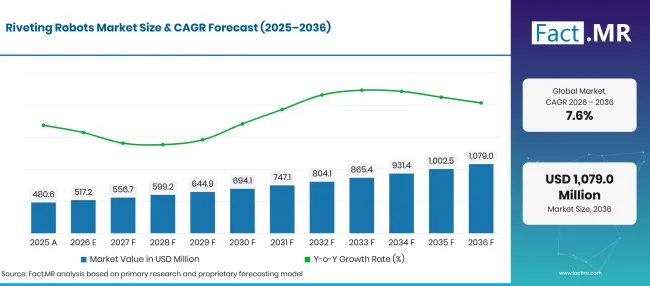
Riveting Robots Market Forecast Global | Source: Fact.MR
Category
| Category | Segments |
|---|---|
| Product Type | Industrial Riveting Robots, Collaborative Riveting Robots, Autonomous Riveting Robots |
| Application | Automotive, Aerospace, Electronics, Construction, Others |
| End-User | Manufacturing, Construction, Aerospace, Automotive, Others |
| Payload Capacity | 10-50 kg, Up to 10 kg, Above 50 kg |
| Region | United States; United Kingdom; Brazil; Germany; Japan |
Source: Fact.MR analysis. Updated Nov 21, 2026
Source: Fact.MR analysis.
Segmental Analysis
Why do industrial riveting robots lead product demand in the Riveting Robots Market?
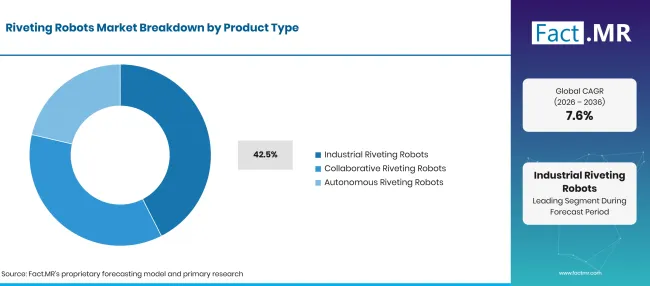
Riveting Robots Market Breakdown Product Type | Source: Fact.MR
Industrial riveting robots hold 42.5% of the riveting robots market in 2026, valued at USD 220 million, because automated fastening cells provide consistent joint positioning and controlled riveting force during repeated production cycles. Belotti's Automatic Riveting Cell, presented in its 2025 product materials, uses a robotic riveting head to install rivets and inserts on composite components. Such equipment allows manufacturers to handle different fastening requirements with improved accuracy. Industrial users assess tool access, cycle times and fastening quality when selecting robotic cells.
Why does automotive lead application demand in the Riveting Robots Market?
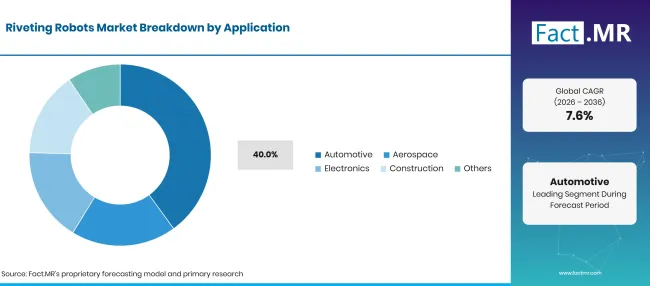
Riveting Robots Market Breakdown Application | Source: Fact.MR
Automotive accounts for 40.0% of riveting robots revenue in 2026, generating USD 206.9 million, as vehicle manufacturers require reliable methods for joining aluminum, high-strength steel and other body materials. Atlas Copco's Henrob self-piercing riveting technology allows automotive manufacturers to create strong joints without pre-drilling, making it suitable for mixed-material body structures. Robotic riveting also supports consistent fastening across large production runs. Vehicle manufacturers are combining mechanical joining with other techniques to meet structural requirements.
Why does manufacturing lead end-user demand in the Riveting Robots Market?
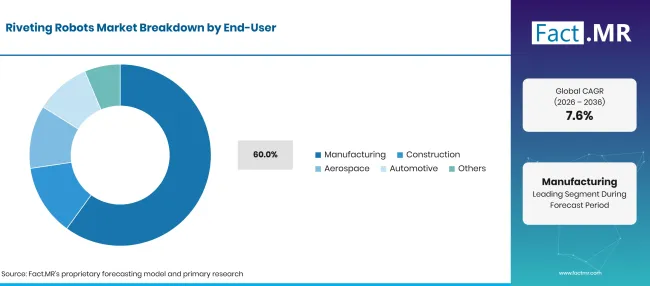
Riveting Robots Market Breakdown End User | Source: Fact.MR
Manufacturing represents 60.0% of riveting robots revenue in 2026, equivalent to USD 310 million, because factories use automated fastening equipment to maintain consistent assembly quality across repeated production cycles. Restart Automation's robotic self-piercing riveting cell uses an ABB IRB 6700 robot with integrated process controls for joining sheet materials. Such systems help manufacturers manage fastening positions and production sequences within a controlled workcell. Factories producing large volumes can benefit from dedicated equipment, while varied production runs may require flexible tooling.
Why do 10–50 kg robots lead payload demand in the Riveting Robots Market?
Riveting Robots Market Breakdown Payload Capacity | Source: Fact.MR
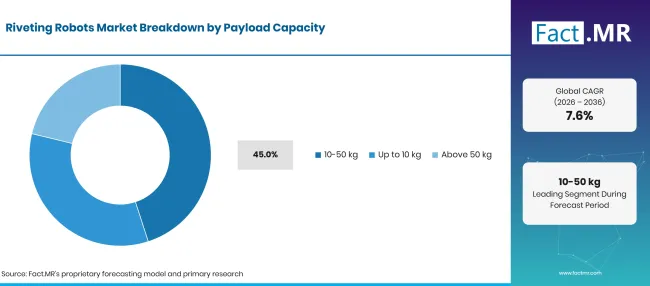
Robots with payloads above 10 kg and up to 50 kg contribute 45.0% of riveting robots revenue in 2026, worth USD 232.7 million, because this capacity range can accommodate suitable riveting tools used for smaller fastening operations. Engineers consider the combined weight of the fastening head, feeding equipment and additional tooling when selecting a robot. Riveting also requires accurate positioning and sufficient access to the joint during each cycle. Böllhoff offers automated self-piercing riveting systems with robot-mounted fastening equipment and rivet feeding arrangements.
Riveting Robots Market-Drivers, Restraints & Trends
Drivers:
Manufacturers choosing riveting robots want consistent joints across repeat production runs and better records of fastening quality. In February 2026, Airbus reported 793 commercial aircraft deliveries for 2025, showing the scale of aircraft assembly activity in which controlled fastening matters.
Restraints:
Robotic riveting requires a suitable joint design and enough clearance for the fastening head. Many applications also require a supporting die or other access behind the sheets. Adhesive bonding and flow-drill screws compete for some of the same mixed-material joints.
Trend:
Flexible Riveting Cells Manufacturers handling changing part shapes are examining robot cells that allow tools and fixtures to be adjusted without rebuilding the whole line. Collaborative robots offer one possible layout for suitable low-force operations, although safeguarding still depends on the application and risk assessment.
Trend:
Recorded Fastening Quality Aerospace assembly teams increasingly value process records that identify the fastening location and confirm the result of the setting cycle. Sensors on a riveting system may track force and displacement, provided the tool and controller support those functions.
Riveting Robots Market by Analysis by Key Country
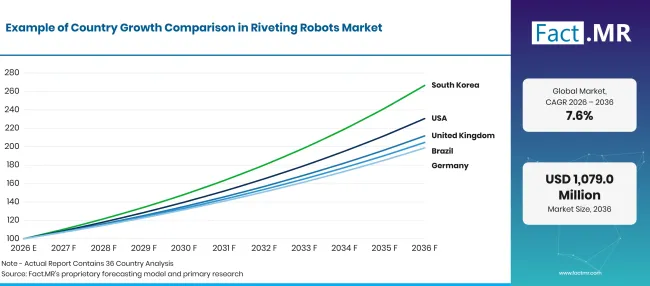
Riveting Robots Market Growth Index | Source: Fact.MR
| Country | CAGR (2026-2036) |
|---|---|
| United States | 8.7% |
| United Kingdom | 7.8% |
| Brazil | 7.4% |
| Germany | 7.1% |
| Japan | 5.6% |
Source: Fact.MR analysis. Updated Nov 21, 2026
Source: Fact.MR analysis.
Why is the United States the fastest-growing market for riveting robots?
Aircraft production and automotive body assembly are shaping demand for robotic riveting equipment in the United States.
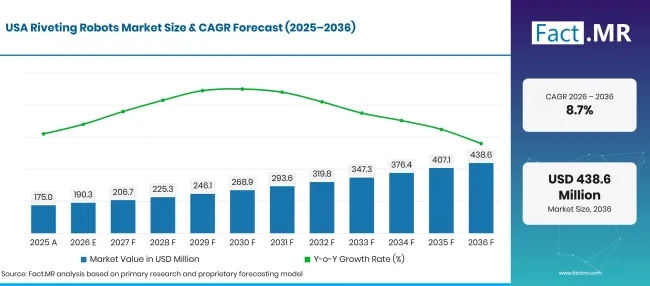
Riveting Robots Market Forecast Usa | Source: Fact.MR
sales are projected to rise at an 8.7% CAGR between 2026 and 2036. In October 2025, Airbus inaugurated a second A320-family assembly line in Mobile, Alabama, expanding aircraft manufacturing capacity at the site. The International Federation of Robotics reported in June 2026 that US factories installed 38,000 industrial robots in 2025.
What is driving riveting robot demand in the United Kingdom?
Aerospace wing production provides an opportunity for riveting robot sales in the United Kingdom.
the market is forecast to expand at a 7.8% CAGR between 2026 and 2036. In June 2025, the Department for Business and Trade reported that the UK aerospace sector generated GBP 34 billion in turnover during 2024. Airbus operations at Broughton are part of an established aircraft manufacturing network where fastening quality and access around large structural parts shape equipment choices. The Department for Business and Trade identified aerospace as one of six advanced manufacturing industries in its June 2025 sector plan.
What is supporting riveting robot demand in Brazil?
Brazilian aircraft production offers a defined customer base for automated fastening equipment, particularly for repeatable structural work.
riveting robot revenue in Brazil is projected to increase at a 7.4% CAGR during 2026–2036. In January 2026, Brazil’s Ministry of Ports and Airports reported that Embraer increased aircraft deliveries by 18% during 2025. In November 2025, the Brazilian development bank BNDES approved BRL 1.09 billion to support Embraer aircraft production for export. Automotive assembly offers another possible application where vehicle designers select mechanical fastening for particular material combinations.
What is shaping riveting robot demand in Germany?
Germany’s established automotive equipment sector gives riveting robot suppliers access to manufacturers experienced in automated joining.
German sales are anticipated to grow at a 7.1% CAGR from 2026 to 2036. In September 2026, the Federal Statistical Office reported that Germany exported approximately 2.0 million new passenger cars between January and July 2026. The International Federation of Robotics identified Germany as Europe’s largest industrial robot market in its September 2025 review. Equipment decisions are expected to place weight on tool stiffness, repeatable setting force and integration with established body-shop controls.
Why is riveting robot growth slower in Japan?
Japan’s automotive factories already use extensive robot automation, so new riveting equipment must offer a clear advantage for the chosen joint design.
riveting robot sales are estimated to rise at a 5.6% CAGR from 2026 to 2036. In July 2025, the International Federation of Robotics reported that Japanese automotive manufacturers installed about 13,000 industrial robots during 2024. The Japan Robot Association released its January–March 2026 production statistics in April 2026, showing continuing domestic robot manufacturing activity.
Competitive Landscape for Riveting Robots Market
Riveting robots are sold through two closely linked groups of businesses. Industrial robot manufacturers offer the motion platform and controls, while fastening specialists and cell integrators specify the actual riveting process. FANUC, ABB and KUKA provide robot platforms that can be used in manufacturing cells. A plant buying such a platform still needs a compatible rivet-setting head and validated joining process. Capacity planning also involves industrial robot selection when assessing production layout. The fastening specialist generally controls the rivet feed and setting process, while the robot maker provides movement and position control. Integration work connects the two systems so the fastening operation can be repeated at each approved location.
Competition is also shaped by the difference between an aircraft production line and an automotive body shop. Aircraft work may involve larger structures and close monitoring of individual fasteners. Automotive cells are often judged on repeated cycle performance within a fixed production layout. In its October 2025 announcement, Airbus confirmed an additional A320-family assembly line in Mobile. That expansion illustrates the need for suppliers to support industrial customers near their production sites. Body-shop equipment is selected alongside robot end-effectors when assessing production layout. The choice of service partner also changes the economics of a robotic fastening cell.
Recent Developments
- In October 2025, Universal Robots launched its UR18 collaborative robot, featuring a compact design, 950 mm reach, and advanced motion control capabilities for flexible assembly, material handling, and industrial automation applications.
- In July 2025, ABB introduced an upgraded IRB 1200 industrial robot family with improved speed, motion accuracy, and positioning repeatability, expanding automation capabilities for precision assembly and industrial manufacturing applications.
Key Players in Riveting Robots Market
Key companies operating in the market include Fanuc Corporation, ABB Ltd., KUKA AG, Kawasaki Heavy Industries, Comau S.p.A., Staubli International AG, and Universal Robots A/S.
- Fanuc Corporation
- ABB Ltd.
- KUKA AG
- Kawasaki Heavy Industries
- Comau S.p.A.
- Staubli International AG
- Universal Robots A/S
Bibliography
- ABB. (2025, July 2). ABB evolves IRB 1200 family, with greater speed, precision and choice.
- Airbus SE. (2025, October 13). Airbus inaugurates second A320 Final Assembly Line in the U.S.
- Airbus SE. (2026, February 19). Airbus reports Full-Year (FY) 2025 results.
- Airbus SE. (2026, June 15). Airbus inaugurates new A320 Family final assembly line in Toulouse.
- Banco Nacional de Desenvolvimento Econômico e Social. (2025, November 25). BNDES aprova R$ 1,09 bilhão para Embraer produzir aeronaves para exportação.
- Department for Business and Trade, & Department for Business, Innovation, Science and Trade. (2025, June 23). Advanced Manufacturing Sector Plan. GOV.UK.
- Department for Business and Trade. (2025, June 17). £250m for green aerospace projects ahead of Industrial Strategy. GOV.UK.
- Federal Statistical Office of Germany. (2026, September 21). Exports of new passenger cars down 4.0% year on year in the first seven months of 2026.
- International Federation of Robotics. (2025, July 15). Japan’s car industry has highest robot installations in five years.
- International Federation of Robotics. (2025, September 25). World Robotics 2025—Industrial Robots: Executive summary.
- International Federation of Robotics. (2026, June 18). US robot industry returns to double digit growth.
- International Federation of Robotics. (2026, September 24). Five million robots now operate in factories globally.
- Japan Robot Association. (2026, April 24). Quarterly statistics: January–March 2026.
- Ministry of Ports and Airports. (2025, September 22). LATAM anuncia compra de até 74 aeronaves da Embraer, reforçando a indústria nacional e a conectividade aérea do Brasil. Government of Brazil.
- Ministry of Ports and Airports. (2026, January 19). Aviação civil registra recordes históricos em 2025 e consolida bases para novo ciclo de crescimento em 2026. Government of Brazil.
- Universal Robots. (2025, October 6). Universal Robots welcomes UR18 to its portfolio.
Segmentation
Scope of Report
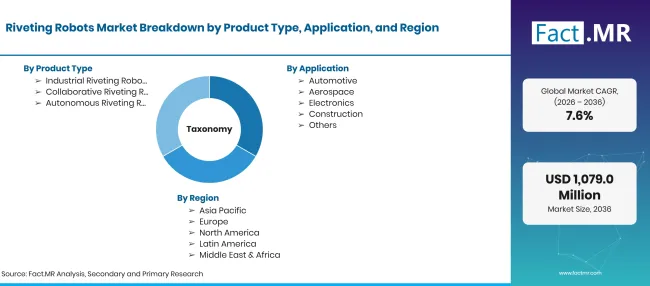
Riveting Robots Market Taxonomy | Source: Fact.MR
| Items | Values |
|---|---|
| Quantitative Units (2026) | USD 517.2 Million |
| Product Type | Industrial Riveting Robots, Collaborative Riveting Robots, Autonomous Riveting Robots |
| Application | Automotive, Aerospace, Electronics, Construction, Others |
| End-User | Manufacturing, Construction, Aerospace, Automotive, Others |
| Payload Capacity | 10-50 kg, Up to 10 kg, Above 50 kg |
| Regions Covered | North America, Latin America, Europe, East Asia, South Asia and Pacific, Middle East & Africa |
| Countries Covered | United States, Germany, Japan, United Kingdom, Brazil, and other countries |
| Key Companies Profiled | Fanuc Corporation, ABB Ltd., KUKA AG, Kawasaki Heavy Industries, Comau S.p.A., Staubli International AG, Universal Robots A/S |
| Additional Attributes | Dollar revenue in the Riveting Robots Market is segmented by product type (industrial riveting robots, collaborative riveting robots, autonomous riveting robots); application (automotive, aerospace, electronics, construction); end-user (manufacturing, construction, aerospace, automotive); payload capacity (10-50 kg, up to 10 kg, above 50 kg) and region. |
Source: Fact.MR analysis. Updated Nov 21, 2026
Riveting Robots Market by Segments
-
Product Type
- Industrial Riveting Robots
- Collaborative Riveting Robots
- Autonomous Riveting Robots
-
Application
- Automotive
- Aerospace
- Electronics
- Construction
- Others
-
End-User
- Manufacturing
- Construction
- Aerospace
- Automotive
- Others
-
Payload Capacity
- 10-50 kg
- Up to 10 kg
- Above 50 kg
-
Region:
- North America
- United States
- Canada
- Mexico
- Europe
- Germany
- United Kingdom
- France
- Italy
- Spain
- Rest of Europe
- Asia Pacific
- China
- India
- Japan
- South Korea
- Australia
- Rest of Asia Pacific
- Latin America
- Brazil
- Mexico
- Argentina
- Rest of Latin America
- Middle East & Africa
- GCC Countries
- South Africa
- Rest of Middle East & Africa
- North America
Frequently Asked Questions
How big is the global Riveting Robots Market in 2026?
What will be the size of the Riveting Robots Market by 2036?
How fast will the Riveting Robots Market grow during the forecast period?
Which product type segment holds the largest share of the Riveting Robots Market?
Who worked on this report


Preview the report firsthand - request a free sample
Free SampleGet the brochure for pricing and purchase details
Download PDF