- Market Value (2025): USD 1.18 Bn
- Estimated Value (2026): USD 1.26 Bn
- Forecast Value (2036): USD 2.53 Bn
- CAGR (2026-2036): 7.2%
Stamping Robots Market Forecast and Outlook 2026 to 2036
The stamping robots market was valued at USD 1.18 billion in 2025 and is forecast to increase from USD 1.26 billion in 2026 to USD 2.53 billion by 2036. Demand is forecast to increase at a CAGR of 7.2% over the 2026 to 2036 period.
Automotive press shops buy stamping robots to move large body panels consistently between forming operations. Robot selection depends on reach, payload, motion speed and compatibility with existing tooling. In September 2026, the International Federation of Robotics reported that factories worldwide installed more than 600,000 industrial robots during 2025.
Market Highlights: Stamping Robots Market
- Sales of stamping robots stood at USD 1.18 billion in 2025
- Stamping Robots Market Value (2026): USD 1.26 billion
- Stamping Robots Market Forecast Value (2036): USD 2.53 billion
- Stamping Robots Market Forecast CAGR (2026-2036): 7.2%
- Leading Type: Articulated Robots (54.3%)
- Key Market Participants: ABB Ltd., FANUC Corporation, KUKA AG, Yaskawa Electric Corporation, Nachi-Fujikoshi Corp., Comau S.p.A.
- Key Growth Regions: Germany, Brazil, United States, United Kingdom, Japan
The commercial case for stamping robots rests on reducing manual transfers while maintaining stable part placement. A press shop must assess the full cell, including grippers, protective guarding and controls, before judging the cost of a robot arm. In May 2025, FANUC America described a press-tending installation that increased daily output from 1,200 to 3,000 units at a manufacturer handling lead plates. Results vary by installation.
Stamping Robots Market
| Metric | Value |
|---|---|
| Estimated Value in (2026) | USD 1.26 billion |
| Forecast Value in (2036) | USD 2.53 billion |
| Forecast CAGR (2026 to 2036) | 7.2% |
Source: Fact.MR analysis. Updated Nov 21, 2026
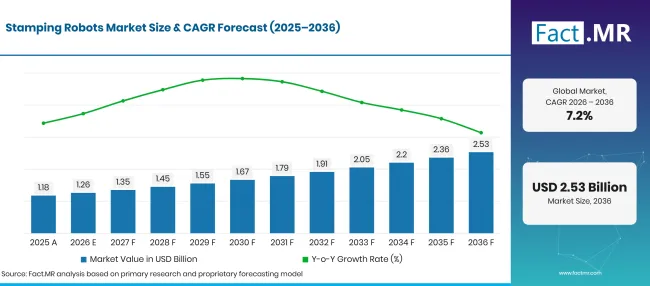
Stamping Robots Market Forecast Global | Source: Fact.MR
Category
| Category | Segments |
|---|---|
| Type | Articulated Robots, SCARA Robots, Cartesian Robots, Others |
| Application | Automotive, Electronics, Metal and Machinery, Others |
| Payload Capacity | Above 60 kg to 225 kg, Up to 16 kg, Above 16 kg to 60 kg, Above 225 Kg |
| End-User Industry | Automotive, Aerospace, Electronics, Metal and Machinery, Others |
| Region | Germany; Brazil; United States; United Kingdom; Japan |
Source: Fact.MR analysis. Updated Nov 21, 2026
Segmental Analysis
Why do articulated robots lead type demand in the Stamping Robots Market?
Stamping Robots Market Breakdown Type | Source: Fact.MR
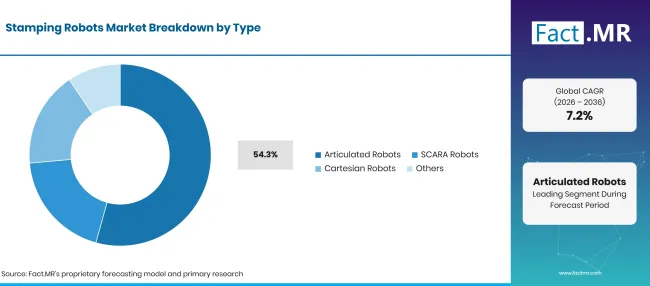
Articulated robots hold 54.3% of stamping robots revenue in 2026, valued at USD 685 million, because their multi-joint design allows flexible movement when loading metal blanks and removing stamped components. In June 2025, ABB expanded its industrial robot portfolio with the IRB 6760, designed for press tending applications in automotive, electronics and general manufacturing. These robots can handle different press heights, part orientations and transfer requirements.
Why does automotive lead application demand in the Stamping Robots Market?
Stamping Robots Market Breakdown Application | Source: Fact.MR
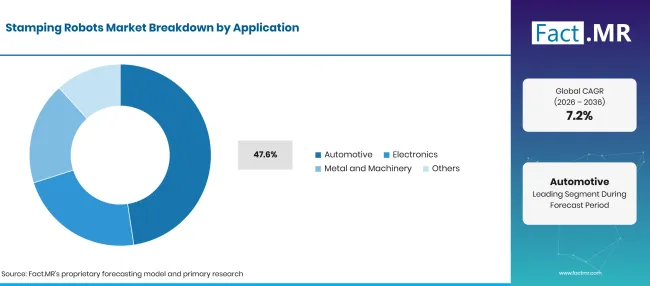
Automotive applications account for a reported 47.6% of stamping robots revenue in 2026, equivalent to USD 600 million, covering robots used to handle and transfer stamped vehicle components during production. In September 2026, the International Federation of Robotics reported that Brazil's automotive industry installed nearly 2,100 industrial robots in 2025, reflecting increased automation investment in vehicle manufacturing. The figure includes multiple robotic applications beyond stamping. Automotive producers are improving material handling between presses to maintain production speed and consistent part positioning.
Why do 60–225 kg robots lead payload demand in the Stamping Robots Market?
Stamping Robots Market Breakdown Payload Capacity | Source: Fact.MR
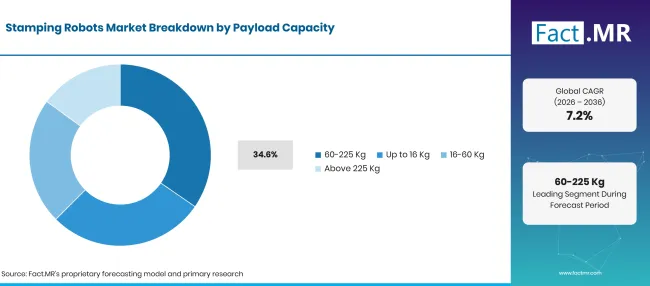
Robots with payload capacities above 60 kg and up to 225 kg represent 34.6% of stamping robots revenue in 2026, equivalent to USD 435 million, because this range accommodates metal components and the tooling required for automated press handling. ABB's IRB 6760, introduced in 2025, offers 150 kg and 200 kg payload configurations with reach options of 3.5 metres and 3.2 metres, respectively. Such specifications allow integrators to match robot capacity with component weight and press layout.
Why does automotive lead end-user demand in the Stamping Robots Market?
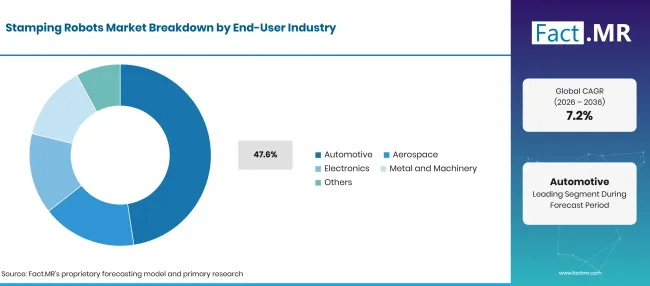
Stamping Robots Market Breakdown End User Industry | Source: Fact.MR
Automotive end users represent a reported 47.6% of stamping robots revenue in 2026, equivalent to USD 600 million, based on equipment purchases attributed to automotive manufacturers and their production operations. In June 2025, the International Federation of Robotics reported that European automotive manufacturers installed 23,000 industrial robots during 2024, demonstrating continued investment in automated vehicle production. These installations cover several manufacturing processes. Automotive companies assess stamping automation according to production volumes, vehicle model changes and tooling requirements.
Stamping Robots Market-Drivers, Restraints & Trends
Drivers:
Vehicle model changes create work for press-line integrators when new body panels require revised tooling and transfer paths. Press-handling robots also reduce the need for operators to reach into hazardous handling zones during routine production. In September 2026, the International Federation of Robotics reported that the United States installed almost 38,500 industrial robots in 2025, a rise of 12%.
Restraints:
the purchase price of a robot is only one part of a stamping-line upgrade. Press-shop managers must also budget for grippers, safety equipment, programming and production stoppages during installation. Large aluminum castings can remove certain stamped body assemblies from future vehicle designs, reducing transfer points in those applications. At the same time, conventional sheet-metal panels remain necessary elsewhere in a vehicle. Suppliers face a project-by-project test of whether a robotic transfer cell offers enough capacity and reliability to justify the total installation cost.
Trend: Higher-Speed Press Transfers. Trend:
Higher-Speed Press Transfers. Press shops are seeking consistent transfers between strokes without damaging painted or unfinished metal surfaces. ABB describes its IRB 6760 as a press-tending robot capable of handling up to 15 strokes per minute under specified conditions. That specification is a product capability rather than a typical result for every installation.
Trend: Flexible Grippers for Lightweight Panels. gripper selection follows part design. Trend:
Flexible Grippers for Lightweight Panels. Aluminum panels and thinner sheet-metal parts require gripping tools that limit distortion during lifting and release. Vacuum-based systems and configurable end effectors can reduce contact marks when the part geometry permits their use. Press-line integrators assess how a gripper behaves after lubrication and under repeated acceleration.
Stamping Robots Market by Analysis by Key Country
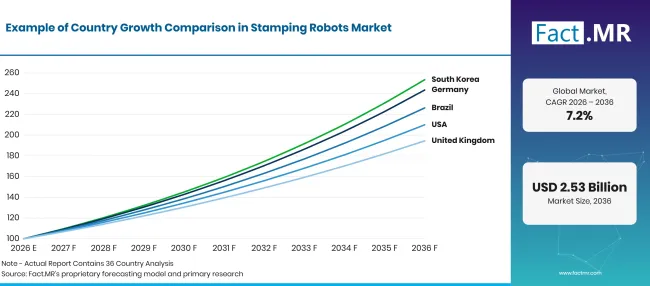
Stamping Robots Market Growth Index | Source: Fact.MR
| Country | CAGR (2026-2036) |
|---|---|
| Germany | 9.3% |
| Brazil | 8.5% |
| United States | 7.7% |
| United Kingdom | 6.9% |
| Japan | 6.1% |
Source: Fact.MR analysis. Updated Nov 21, 2026
Why is Germany the fastest-growing market for stamping robots?
Germany's car makers and metal-forming specialists are expected to renew press-handling equipment as vehicle models and tooling programs change.
Demand for stamping robots is projected to rise at a 9.3% CAGR from 2026 to 2036. In September 2026, the International Federation of Robotics reported that Germany accounted for 41% of industrial robot installations across the European Union in 2025. In November 2026, the Federal Statistical Office reported that automotive production rose 17.1% month on month in September 2026.
What is supporting stamping robot demand in Brazil?
Brazil's vehicle production plans are creating opportunities for press-line automation at established factories and newly developed production sites.
Stamping robot revenue is forecast to increase at an 8.5% CAGR between 2026 and 2036. In September 2026, the International Federation of Robotics reported that Brazil's automotive industry installed almost 2,100 industrial robots during 2025. In March 2025, the Ministry of Development, Industry, Trade and Services stated that the Stellantis Betim complex had an annual production capacity of 630,000 vehicles. Press shops evaluating new model programs need grippers matched to locally produced panels and transfer paths suited to their current dies.
What is shaping stamping robot sales in the United States?
Automotive factories in the United States use robots to handle sheet-metal parts during repeated forming and transfer operations.
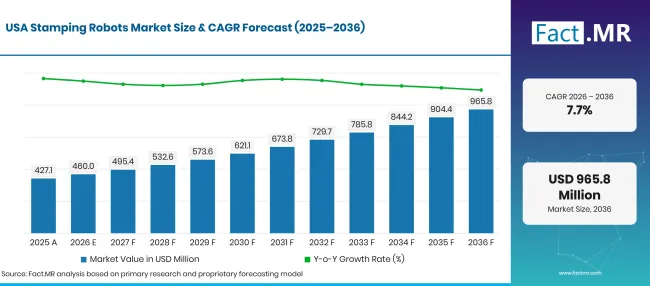
Stamping Robots Market Forecast Usa | Source: Fact.MR
Demand for stamping robots is projected to grow at a 7.7% CAGR between 2026 and 2036. In June 2026, the International Federation of Robotics reported approximately 38,000 industrial robot installations in the United States for 2025. In May 2025, the same organization reported that automotive factories installed 13,700 industrial robots during 2024. Both measures describe broad industrial automation activity and offer a useful picture of investment among potential stamping-robot customers.
What is shaping stamping robot demand in the United Kingdom?
Vehicle-model changes at UK assembly plants are expected to influence spending on stamping robots and press-handling equipment.
Demand is forecast to grow at a 6.9% CAGR from 2026 to 2036. In January 2026, the Society of Motor Manufacturers and Traders reported that UK factories produced 717,371 passenger cars in 2025. In a 2026 release covering 2025 manufacturing, the Office for National Statistics reported GBP 16.0 billion in UK sales of petrol-engine cars above 1,500 cubic centimeters.
Why is stamping robot growth slower in Japan?
Japan has a long-established base of industrial automation, so stamping-robot orders are expected to depend heavily on equipment renewal and new vehicle programs.
The market is projected to expand at a 6.1% CAGR from 2026 to 2036. In September 2026, the International Federation of Robotics recorded 36,219 industrial robot installations in Japan during 2025. In July 2025, the association reported that installations in Japan's automotive industry had reached their highest level in five years. The measures cover several robot uses and provide context for Japan's automated manufacturing base.
Competitive Landscape for Stamping Robots Market
Fact.MR analysis examines the complete press cell: Competition in stamping robots centers on the robot arm and the ability to deliver a complete working press cell. ABB offers dedicated press-tending equipment and software for stamping transfers. FANUC supplies industrial robots used for loading presses and moving formed components. KUKA and Yaskawa compete through articulated robot ranges and integration partners, while Nachi-Fujikoshi and Comau address industrial handling needs. Press-shop engineers compare reach and cycle time.
Robotic press cells are judged on more than maximum payload. The market estimate places weight on service access and the time needed to program a new die set. KUKA described a metal-forming customer installation in December 2025 involving a KR 50 IONTEC robot operating a press brake. High-speed stamping lines require their own transfer timing and panel-gripping designs. Integrators that understand these differences are expected to offer more reliable installation support.
Recent Developments
- In June 2025, ABB introduced its IRB 6760 industrial robot for automated press tending in automotive, electronics and general manufacturing. The robot supports automated component handling between press operations and, when combined with ABB's carbon-fiber tooling boom, can achieve up to 15 strokes per minute under specified operating conditions
- In May 2025, FANUC introduced its M-710iD/50M and M-710iD/70 industrial robots, featuring improved payload capacities, compact mechanical designs, and precise motion capabilities for machine tending, material handling, and manufacturing automation applications.
Key Players in Stamping Robots Market
Key companies operating in the market include ABB Ltd., FANUC Corporation, KUKA AG, Yaskawa Electric Corporation, Nachi-Fujikoshi Corp., Comau S.p.A., Kawasaki Heavy Industries, and Universal Robots A/S.
- ABB Ltd.
- FANUC Corporation
- KUKA AG
- Yaskawa Electric Corporation
- Nachi-Fujikoshi Corp.
- Comau S.p.A.
- Kawasaki Heavy Industries
- Universal Robots A/S
Bibliography
- ABB. (2025, June 24). ABB expands large industrial robot portfolio.
- FANUC. (2025, May 13). New M-710 series robots provide eye-catching design and notable enhancements.
- FANUC America Corporation. (2025, May 9). Smart automation, safer workspaces: How one manufacturer doubled production.
- FANUC America Corporation. (2026, April 15). Automated brake press tending helps Thunder Creek increase output and reduce labor strain.
- Federal Statistical Office of Germany. (2026, September 7). Production in July 2026: -1.1% on the previous month.
- Federal Statistical Office of Germany. (2026, November 6). Production in September 2026: +0.7% on the previous month.
- International Federation of Robotics. (2025, May 8). Robot installed in US auto industry up by double digits.
- International Federation of Robotics. (2025, June 17). Europe’s auto industry installed 23,000 new robots.
- International Federation of Robotics. (2025, July 15). Japan’s car industry has highest robot installations in five years.
- International Federation of Robotics. (2025, September 25). Global robot demand in factories doubles over 10 years.
- International Federation of Robotics. (2026, June 18). US robot industry returns to double digit growth.
- International Federation of Robotics. (2026, September 24). Five million robots now operate in factories globally.
- KUKA. (2025, December). KWM Gutterman increases output, worker safety with easier automation.
- Ministry of Development, Industry, Trade and Services. (2025, March 11). Com Lula, Alckmin inaugura centro de mobilidade híbrida-flex em Betim. Government of Brazil.
- Office for National Statistics. (2026, July 24). UK manufacturers’ sales by product: 2025.
- Society of Motor Manufacturers and Traders. (2026, January 29). Tough year for auto but new models and Industrial Strategy can deliver growth.
Segmentation
Scope of Report
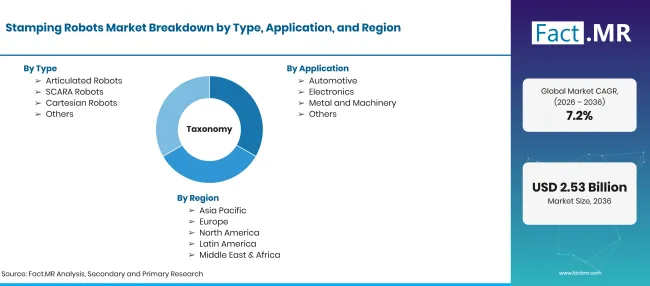
Stamping Robots Market Taxonomy | Source: Fact.MR
| Items | Values |
|---|---|
| Quantitative Units (2026) | USD 1.26 Billion |
| Type | Articulated Robots, SCARA Robots, Cartesian Robots, Others |
| Application | Automotive, Electronics, Metal and Machinery, Others |
| Payload Capacity | Above 60 kg to 225 kg, Up to 16 kg, Above 16 kg to 60 kg, Above 225 Kg |
| End-User Industry | Automotive, Aerospace, Electronics, Metal and Machinery, Others |
| Regions Covered | North America, Latin America, Europe, East Asia, South Asia and Pacific, Middle East & Africa |
| Countries Covered | United States, Germany, Japan, United Kingdom, Brazil, and other countries |
| Key Companies Profiled | ABB Ltd., FANUC Corporation, KUKA AG, Yaskawa Electric Corporation, Nachi-Fujikoshi Corp., Comau S.p.A., Kawasaki Heavy Industries, Universal Robots A/S |
| Additional Attributes | Dollar revenue in the Stamping Robots Market is segmented by type (articulated robots, SCARA Robots, cartesian robots); application (automotive, electronics, metal and machinery); payload capacity (Above 60 kg to 225 kg, Up to 16 kg, Above 16 kg to 60 kg, above 225 kg); end-user industry (automotive, aerospace, electronics, metal and machinery) and region. |
Source: Fact.MR analysis. Updated Nov 21, 2026
Stamping Robots Market by Segments
-
Type
- Articulated Robots
- SCARA Robots
- Cartesian Robots
- Others
-
Application
- Automotive
- Electronics
- Metal and Machinery
- Others
-
Payload Capacity
- Above 60 kg to 225 kg
- Up to 16 kg
- Above 16 kg to 60 kg
- Above 225 Kg
-
End-User Industry
- Automotive
- Aerospace
- Electronics
- Metal and Machinery
- Others
-
Region:
- North America
- United States
- Canada
- Mexico
- Europe
- Germany
- United Kingdom
- France
- Italy
- Spain
- Rest of Europe
- Asia Pacific
- China
- India
- Japan
- South Korea
- Australia
- Rest of Asia Pacific
- Latin America
- Brazil
- Mexico
- Argentina
- Rest of Latin America
- Middle East & Africa
- GCC Countries
- South Africa
- Rest of Middle East & Africa
- North America
Frequently Asked Questions
How big is the global Stamping Robots Market in 2026?
What will be the size of the Stamping Robots Market by 2036?
How fast will the Stamping Robots Market grow during the forecast period?
Which type segment holds the largest share of the Stamping Robots Market?
Who worked on this report


Preview the report firsthand - request a free sample
Free SampleGet the brochure for pricing and purchase details
Download PDF