- Market Value (2025): USD 15.2 Bn
- Estimated Value (2026): USD 16.6 Bn
- Forecast Value (2036): USD 39.7 Bn
- CAGR (2026-2036): 9.1%
What is the Li-polymer Battery Market forecast to be worth by 2036?
USD 16.6 billion in 2026 to USD 39.7 billion by 2036 at a 9.1% CAGR.
- As per Fact.MR analysis, the Li-polymer battery market was valued at USD 15.2 billion in 2025.
- Demand will grow from USD 16.6 billion in 2026 to USD 39.7 billion by 2036.
- The forecast records a 9.1% CAGR from 2026 to 2036 as demand for lightweight, high-energy-density batteries increases across portable electronics and other compact electronic devices.
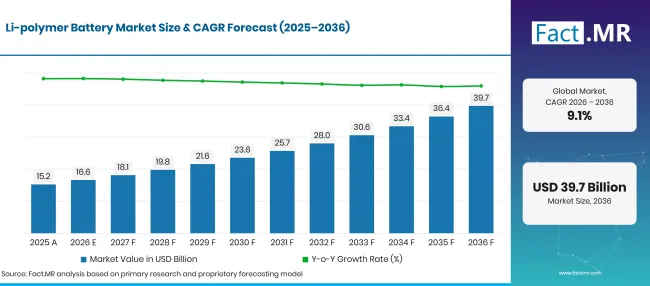
Factmr Li Polymer Battery Market Forecast Global | Source: Fact.MR
| Year | Basis | Market Value (USD billion) |
|---|---|---|
| 2025 | Actual | 15.2 |
| 2026 | Estimate | 16.6 |
| 2036 | Forecast | 39.7 |
| CAGR 2026 to 2036 | Forecast period | 9.1% |
Source: Fact.MR analysis. Updated Oct 19, 2026
What are the defining numbers behind Li-polymer Battery Market growth?
USD 23.1 billion absolute opportunity between 2026 and 2036.
- Demand Drivers in the Market
- Growing demand for portable consumer electronics is supporting Li-polymer battery adoption. Smartphones, tablets, wearable devices, and other compact electronics require lightweight batteries with high energy density and flexible form factors.
- Electric vehicle development and automotive electrification are creating opportunities for lithium-polymer batteries in applications requiring rechargeable energy storage, compact battery designs, and dependable performance.
- Demand for lightweight power sources across aerospace and defense, medical devices, and industrial equipment is supporting interest in batteries that can fit specialized device designs and operating requirements.
- Key Segments Analyzed
- By Capacity: The 1000–5000mAh segment will account for 38.5% of the market, supported by its suitability for portable consumer electronics and other compact electronic devices.
- By Application: Consumer Electronics will represent 52.8% of the market, driven by demand for rechargeable batteries in smartphones, tablets, wearables, and other portable devices.
- By Distribution Channel: Offline channels will represent 68.4% of the market, reflecting the role of physical retailers, electronics distributors, and specialist suppliers in battery sales.
- Analyst Opinion at Fact.MR
- Shambhu Nath Jha, Principal Consultant at Fact.MR, states, “Demand for lithium-polymer batteries is being shaped by the need for lightweight, compact, and rechargeable power solutions. Manufacturers that improve energy density, safety, and battery performance while meeting application-specific requirements can strengthen their position across consumer electronics, automotive, and industrial markets.”
- Strategic Implications
- Battery manufacturers need to prioritize energy density, charging performance, safety, and product durability to meet the requirements of different end-use applications.
- Consumer electronics suppliers must select battery capacities and form factors that balance device size, operating time, and performance.
- Automotive and industrial battery developers can focus on thermal management, reliability, and application-specific battery designs.
- Distributors are advised to strengthen product availability and technical support across offline and online sales channels to serve different customer requirements.
- Manufacturers need to monitor battery safety standards, raw material costs, and advances in battery technology to maintain competitiveness.
Germany is projected to record a 7.3% CAGR through 2036. Brazil is expected to grow at 7.7%, while the USA is forecast to register the fastest growth among the five listed countries at 9.5%. The UK is projected to expand at 8.5%, while Japan is expected to grow at 6.9%. Differences in electronics demand, automotive electrification, and industrial applications will influence adoption across these markets.
How does the Li-polymer Battery Market break down by segment?
Fact.MR finds that 1000–5000 mAh leads the Capacity segment at 38.5%; Consumer Electronics leads the Application segment at 52.8%; Offline leads the Distribution Channel segment at 68.4%.
Which Capacity segment dominates?
The 1000–5000 mAh holds 38.5% share in 2026.
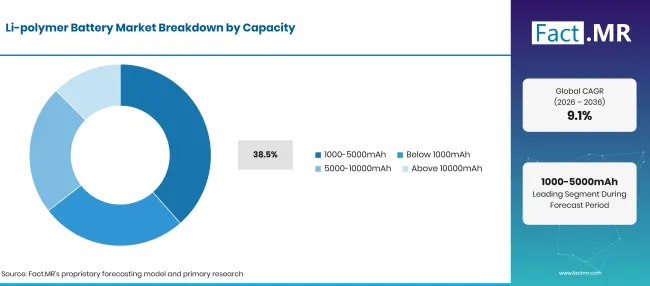
Factmr Li Polymer Battery Market Breakdown Capacity | Source: Fact.MR
| Capacity | Share (2026) |
|---|---|
| 1000–5000 mAh (Leading segment) | 38.5% |
| Other segments combined | 61.5%* |
| Total | 100.0% |
Source: Fact.MR analysis. Updated Oct 19, 2026
The 1000–5000 mAh capacity range serves a broad range of portable electronic devices that require a balance between battery size, operating time, and power requirements. Lower-capacity batteries suit compact electronics, while higher-capacity cells support applications requiring longer operating periods.
What leads the Application segment?
Consumer Electronics lead with 52.8% share in 2026.
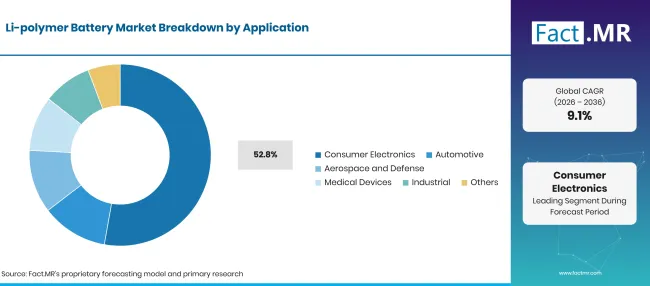
Factmr Li Polymer Battery Market Breakdown Application | Source: Fact.MR
| Application | Share (2026) |
|---|---|
| Consumer Electronics (Leading segment) | 52.8% |
| Other segments combined | 47.2%* |
| Total | 100.0% |
Source: Fact.MR analysis. Updated Oct 19, 2026
Consumer electronics account for the largest stated application share, supported by demand for lightweight rechargeable batteries in smartphones, tablets, wearables, and other portable devices. Automotive, medical devices, aerospace and defense, and industrial applications serve additional requirements for compact energy storage.
How does Distribution Channel shape demand?
Offline lead with 68.4% share in 2026.
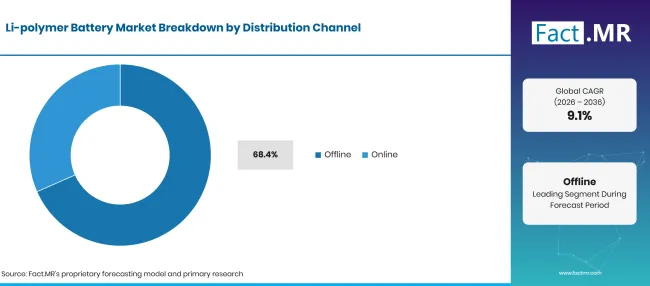
Factmr Li Polymer Battery Market Breakdown Distribution Channel | Source: Fact.MR
| Distribution Channel | Share (2026) |
|---|---|
| Offline (Leading segment) | 68.4% |
| Other segments combined | 31.6%* |
| Total | 100.0% |
Source: Fact.MR analysis. Updated Oct 19, 2026
Offline distribution remains the leading channel in the Li-polymer battery market data, reflecting the role of established suppliers, battery distributors, and business-to-business procurement networks. Online channels provide an alternative for buyers seeking product specifications, supplier comparisons, and convenient purchasing options.
What is accelerating Li-polymer Battery Market adoption, and what is holding it back?
Rising demand for portable electronics and electric vehicles boosts growth, while raw material costs and safety concerns challenge adoption.
Drivers Impact Analysis
| DRIVER | (~) % IMPACT ON CAGR | GEOGRAPHIC RELEVANCE | IMPACT TIMELINE |
|---|---|---|---|
| Demand for portable consumer electronics | +1.2% | Global, Asia | Medium term (2–4 years) |
| Growing adoption of lightweight rechargeable batteries | +0.9% | Global | Short term (≤ 2 years) |
| Expansion of wearable and compact electronic devices | +0.7% | Asia, North America | Medium term (2–4 years) |
| Demand for flexible battery configurations | +0.5% | Europe, Asia | Long term (≥ 4 years) |
| Advancements in battery energy density | +0.4% | Global | Long term (≥ 4 years) |
Source: Fact.MR analysis. Updated Oct 19, 2026
Opportunity Impact Analysis
| OPPORTUNITY | (~) % IMPACT ON CAGR | GEOGRAPHIC RELEVANCE | IMPACT TIMELINE |
|---|---|---|---|
| Next-generation polymer battery development | +0.8% | Global, Asia | Medium term (2–4 years) |
| Integration into wearable medical devices | +0.6% | North America, Europe | Medium term (2–4 years) |
| Customized batteries for compact electronics | +0.5% | Asia, Europe | Short term (≤ 2 years) |
| Improved battery safety and thermal stability | +0.4% | Global | Long term (≥ 4 years) |
Source: Fact.MR analysis. Updated Oct 19, 2026
Restraints Impact Analysis
| RESTRAINT | (~) % IMPACT ON CAGR | GEOGRAPHIC RELEVANCE | IMPACT TIMELINE |
|---|---|---|---|
| Volatility in raw material prices | -0.8% | Global | Short term (≤ 2 years) |
| Safety risks and thermal instability | -0.6% | Global | Medium term (2–4 years) |
| Competition from alternative battery chemistries | -0.5% | Global | Medium term (2–4 years) |
| Manufacturing costs and recycling challenges | -0.4% | Europe, Asia | Long term (≥ 4 years) |
Source: Fact.MR analysis. Updated Oct 19, 2026
Which countries are scaling the Li-polymer Battery Market through 2036?
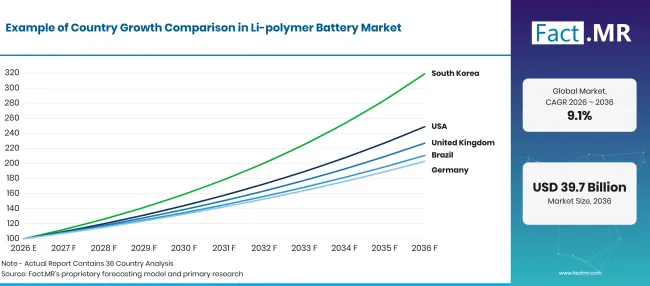
Factmr Li Polymer Battery Market Growth Index | Source: Fact.MR
| Country | CAGR (2026-2036) |
|---|---|
| Germany | 7.3% |
| Brazil | 7.7% |
| USA | 9.5% |
| UK | 8.5% |
| Japan | 6.9% |
Source: Fact.MR analysis. Updated Oct 19, 2026
What supports Germany adoption?
7.3% CAGR, supported by demand for portable electronics, industrial equipment and specialized battery applications.
Germany’s Li-polymer battery demand is linked to portable electronic devices, compact power systems and specialized industrial applications that require lightweight, rechargeable cells. Battery adoption also benefits from the wider transition toward electrified transport and energy storage, although these markets include several battery chemistries beyond lithium-polymer.
How is Brazil developing Li-polymer battery adoption?
7.7% CAGR, driven by consumer electronics and emerging applications in drones and portable equipment.
Brazil’s Li-polymer battery demand is supported by consumer electronics and the increasing use of portable power solutions. The country’s wider lithium-ion battery market is also expanding through electric mobility, energy storage and electronics demand. Li-polymer suppliers can target compact devices, unmanned aerial vehicles and specialized battery packs, while import dependence and logistics costs remain important commercial considerations.
What supports United States adoption?
9.5% CAGR, supported by consumer electronics, unmanned aerial vehicles and specialized portable devices.
The United States offers demand opportunities for lightweight, high-energy-density batteries used in portable electronics, drones, medical equipment and industrial devices. Battery imports continue to support domestic demand, alongside investment in local manufacturing capacity. S&P Global reported that US lithium-ion battery imports rose 26% quarter over quarter in the second quarter of 2026, demonstrating continued movement across the broader battery supply chain. However, this import trend covers multiple lithium-ion chemistries and does not directly measure Li-polymer demand [1].
How is the United Kingdom building adoption?
8.5% CAGR, shaped by demand for compact electronics, drones and specialized battery systems.
The United Kingdom’s Li-polymer battery opportunity is associated with portable electronic equipment, unmanned aerial vehicles and applications that require lightweight, customized power solutions. Domestic battery activity also includes pack integration and battery-system development, while cell supply remains dependent on international manufacturers. Suppliers can differentiate through custom form factors, high-discharge performance, reliable quality and application-specific technical support [2].
What supports Japan adoption?
6.9% CAGR, supported by consumer electronics, advanced battery development and specialized portable applications.
Japan has an established battery technology industry and continues to strengthen its battery manufacturing base. The Ministry of Economy, Trade and Industry revised its Battery Industry Strategy in June 2026 to expand domestic manufacturing capacity and improve competitiveness across the battery supply chain. For Li-polymer suppliers, opportunities include compact consumer electronics, wearable devices and other applications that require thin, lightweight rechargeable cells. These national initiatives cover multiple battery technologies, so their impact on Li-polymer demand specifically requires separate validation [3].
Who leads the Li-polymer Battery Market?
Fact.MR identifies LiPol Battery Co. Ltd., Amperex Technology Limited (ATL), Samsung SDI, LG Energy Solution, Panasonic Energy, Shenzhen Motoma Power Co., Ltd. and Shenzhen Grepow Battery Co., Ltd. (Grepow) across the Li-Polymer Battery Market.
ATL and Shenzhen Motoma Power Co., Ltd. show direct activity in lithium-polymer manufacturing. In November 2025, ATL reported completion-related environmental acceptance for polymer lithium battery production-line expansions, while Motoma showcased customized LiPo batteries for AI wearables, robotics and medical IoT at CES 2026. Grepow also announced a manufacturing agreement with Powerbanc Group in September 2025 for portable power-bank batteries [4][5]
Broader battery-industry developments in 2026 include Samsung SDI’s agreement with General Motors to develop next-generation prismatic cells and its acquisition of GM’s stake in their Indiana joint venture. In August 2026, LG Energy Solution began production at its Lansing battery plant, while in September 2026, Panasonic Energy launched a battery R&D hub in Japan [6] [7] [8]
Which companies are the key providers?
Key companies profiled in the Li-Polymer Battery Market include: LiPol Battery Co. Ltd; Amperex Technology Limited (ATL); Samsung SDI; LG Energy Solution; Panasonic Energy; Shenzhen Motoma Power Co., Ltd; and Shenzhen Grepow Battery Co., Ltd. (Grepow)
- LiPol Battery Co. Ltd.
- Amperex Technology Limited (ATL)
- Samsung SDI
- LG Energy Solution
- Panasonic Energy
- Shenzhen Motoma Power Co., Ltd.
- Shenzhen Grepow Battery Co., Ltd. (Grepow)
Bibliography
- [1] S&P Global. (2026, August 24). US lithium-ion battery imports rebound in Q2 despite trade friction.
- [2] Ricardo. (2026, June 9). Ricardo secures government funding to design advanced modular battery system.
- [3] Ministry of Economy, Trade and Industry. (2026, June 2). “Battery Industry Strategy” revised as the “Battery and Power Industry Strategy.”
- [4] Amperex Technology Limited. (n.d.). Company profile. https://atlbattery.com/en/about.html atlbattery.com
- [5] MOTOMA. (2026, January 11). MOTOMA showcases advanced pouch lithium polymer battery solutions for AI electronics at CES 2026.
- [6] Grepow. (2025, September 30). Grepow Battery announces manufacturing agreement with Powerbanc Group.
- [7] Samsung SDI. (2026, August 11). SAMSUNG SDI, General Motors sign new battery development agreement, continuing their strategic partnership.
- [8] LG Energy Solution. (2026, August 19). LG Energy Solution announces start of production at all-new Lansing battery plant.
This Report Answers
- The report examines the Li-polymer Battery Market across the specified capacity categories and their applications.
- Segment analysis compares consumer electronics, automotive, aerospace and defense, medical devices, industrial applications, and other uses.
- Country analysis covers Germany, Brazil, the USA, the UK, and Japan, highlighting their respective market growth rates.
- The competitive overview examines key manufacturers and suppliers participating in the lithium-polymer battery industry.
- Distribution channel analysis distinguishes offline sales from online sales and examines their role in battery availability.
What does the Li-polymer Battery Market cover?
The market covers lithium-polymer batteries used in rechargeable power applications.
It tracks demand across different battery capacities, including below 1000mAh, 1000–5000mAh, 5000–10000mAh, and above 10000mAh. Application coverage includes consumer electronics, automotive, aerospace and defense, medical devices, industrial equipment, and other uses. The analysis also examines offline and online distribution channels and country-level growth trends.
What is included in the scope?
Included products are lithium-polymer batteries supplied for rechargeable energy storage across the specified applications.
The scope covers the defined capacity categories and sales through offline and online channels. The analysis considers battery performance, energy density, charging characteristics, safety, durability, application requirements, and market adoption across the countries and regions covered.
What is excluded from the scope?
The analysis excludes battery technologies that do not fall within the defined lithium-polymer battery category.
Standalone charging equipment, battery management systems sold independently, and unrelated electronic components are excluded from battery market revenue unless explicitly included in the approved market definition. Revenue from complete devices or vehicles is also excluded unless it directly represents the sale of in-scope batteries.
How Was the Analysis Built?
The analysis draws on 120+ sources, 35+ company portfolios, 25+ countries, and more than 20 industry interviews.
- Primary Research: Primary research includes discussions with manufacturers, service providers, technology developers, distributors, end users, and subject-matter experts. These conversations examine purchasing priorities, product adoption, operational challenges, approval requirements, competitive positioning, and the factors that influence wider market acceptance.
- Desk Research: Desk research covers government statistics, regulatory publications, company filings, trade data, technical studies, industry associations, standards, public policy, and other authoritative sources. Every source used in the analysis is documented in the bibliography.
- Market Sizing and Forecasting: Market estimates combine historical performance, demand indicators, pricing and volume trends, segment shares, company participation, country-level growth, adoption patterns, investment activity, and barriers to market expansion.
- Data Validation and Update Cycle: Findings are validated by comparing primary interviews with public data, company activity, regulatory changes, trade patterns, and industry developments. Regular updates review new product launches, capacity changes, partnerships, approvals, and shifts in commercial adoption.
Segmentation
What is the report’s scope and coverage?
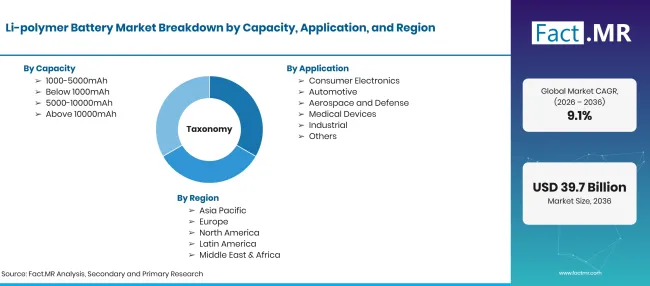
Factmr Li Polymer Battery Market Taxonomy | Source: Fact.MR
| Attribute | Details |
|---|---|
| Quantitative Units | USD billion: 2026 valuation, 2036 forecast and CAGR |
| Market Definition | Rechargeable lithium-polymer batteries designed for lightweight, compact energy storage across portable electronics and specialized applications. |
| Capacity | 1000–5000 mAh; Below 1000 mAh; 5000–10000 mAh; Above 10000 mAh |
| Application | Consumer Electronics; Automotive; Aerospace and Defense; Medical Devices; Industrial; Others |
| Distribution Channel | Offline; Online |
| Regions Covered | North America; Latin America; Western Europe; Eastern Europe; East Asia; South Asia & Pacific; Middle East & Africa |
| Countries Covered | Germany; Brazil; USA; UK; Japan |
| Companies Profiled | LiPol Battery Co. Ltd; Amperex Technology Limited (ATL); Samsung SDI LG Energy Solution; Panasonic Energy; Shenzhen Motoma Power Co., Ltd; and Shenzhen Grepow Battery Co., Ltd. (Grepow) |
| Forecast Period | 2026 to 2036 |
| Approach | Market segmentation and scenario-based analysis supported by battery industry developments, application trends, and technological advancements |
Source: Fact.MR analysis. Updated Oct 19, 2026
How is the Li-polymer Battery Market segmented?
-
By Capacity
- Below 1000mAh
- 1000–5000mAh
- 5000–10000mAh
- Above 10000mAh
-
By Application
- Consumer Electronics
- Automotive
- Aerospace and Defense
- Medical Devices
- Industrial
- Others
-
By Distribution Channel
- Offline
- Online
-
By Region
- North America
- Latin America
- Western Europe
- Eastern Europe
- East Asia
- South Asia & Pacific
- Middle East & Africa
Frequently Asked Questions
How big is the Li-polymer Battery Market in 2026?
What is the CAGR of the Li-polymer Battery Market from 2026 to 2036?
What was the Li-polymer Battery Market value in 2025?
Which capacity segment leads the Li-polymer Battery Market?
Which application holds the largest share of the Li-polymer Battery Market?
Which distribution channel dominates the Li-polymer Battery Market?
Which country is expected to grow fastest in the Li-polymer Battery Market?
Which companies are covered in the Li-polymer Battery Market?
Who worked on this report


Preview the report firsthand - request a free sample
Free SampleGet the brochure for pricing and purchase details
Download PDF