- Market Value (2025): USD 8.8 Bn
- Estimated Value (2026): USD 9.8 Bn
- Forecast Value (2036): USD 28.6 Bn
- CAGR (2026-2036): 11.3%
What is the Lifestyle Diseases Apps Market forecast to be worth by 2036?
USD 9.8 billion in 2026 to USD 28.6 billion by 2036, at 11.3% CAGR.
- The lifestyle diseases apps market reached USD 8.8 billion in 2025 as subscriptions, enterprise programs, and provider-distributed services expanded.
- Demand is projected to increase from USD 9.8 billion in 2026 to USD 28.6 billion by 2036.
- The market is forecast to record an 11.3% CAGR from 2026 to 2036 as chronic-condition management moves further into daily app-based workflows.
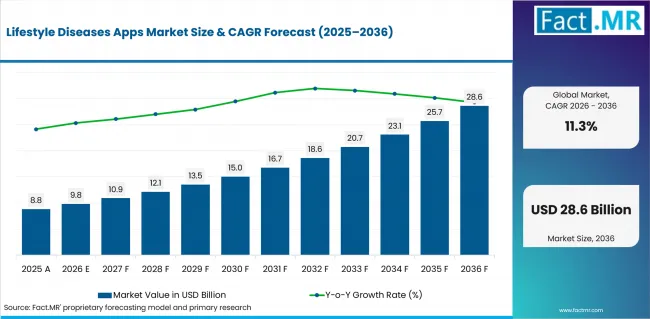
Lifestyle Diseases Apps Market Value Analysis | Source: Fact.MR
What are the defining numbers behind Lifestyle Diseases Apps Market growth?
USD 19.8 billion absolute opportunity by 2036, led by Diabetes Management Apps, Diabetes Management applications; and Individual Consumers.
- Demand Drivers in the Market
- People managing chronic conditions make decisions about food, medication, activity; symptoms; and measurements every day; while professional contact remains periodic.
- Health plans and employers use app-mediated support to extend coaching and monitoring beyond appointments. In May 2026, the U.S. Centers for Disease Control and Prevention reported that chronic and mental health conditions account for 90% of annual U.S. healthcare expenditures.
- Prescription and reimbursement routes, including Germany's pathway for eligible digital health applications, can convert clinical need into paid access when evidence and privacy requirements are met.
- Connected devices and medication-support functions increase commercial value when incoming data produces a timely action for the user or care team.
- Key Segments Analyzed
- By Product Type: Diabetes Management Apps are projected to hold 29.0% share in 2026 because glucose, food, insulin; medication; activity; and symptom decisions create frequent use.
- By Application: Diabetes Management is anticipated to account for 31.0% share in 2026 as type 1 and type 2 users require recurring self-management support.
- By End User: Individual Consumers are forecast to represent 44.0% share in 2026 because most logging, coaching, meal planning; and symptom recording occurs on a personally owned phone.
- Analyst Opinion at Fact.MR
- Shambhu Nath Jha, Principal Consultant at Fact.MR, states: “The commercial test for a lifestyle disease app is not download volume. It is whether the product changes a daily decision; fits a funded care pathway; and retains users long enough for an employer; payer; provider; or consumer to renew. Connected data matters only when it triggers an action; and clinical claims must be matched by evidence; privacy controls; and workflow accountability.”
- Strategic Implications
- App providers should define the clinical or behavioral decision their product supports before expanding feature breadth.
- Employer, payer, and provider buyers should connect renewal decisions to utilization; measurable outcomes; and operating burden rather than enrollment alone.
- Connected-device partnerships should specify who reviews incoming data, what triggers an intervention, and how missed or inconsistent readings are handled.
- Country strategy should separate consumer acquisition from regulated, reimbursed, or provider-led routes because evidence and integration requirements differ.
How does the Lifestyle Diseases Apps Market break down by segment?
Diabetes Management Apps lead Product Type at 29.0%, Diabetes Management leads Application at 31.0%, and Individual Consumers lead End User at 44.0% in 2026. Clinical workflow constraints remain relevant to the mental health apps and diabetes management software markets.
Why do Diabetes Management Apps lead Product Type?
Diabetes Management Apps hold 29.0% share in 2026.
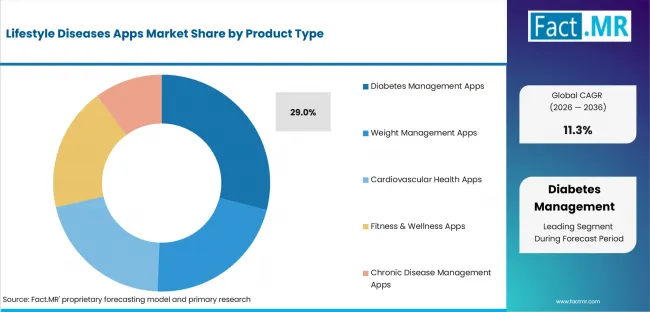
Lifestyle Diseases Apps Market Analysis By Product Type | Source: Fact.MR
Diabetes management creates a high-frequency digital task because users may record glucose, food, insulin; medication; activity; and symptoms several times a day. This rhythm supports subscriptions and connected-device services more reliably than occasional wellness use. Weight management apps remain important where coaching; meal planning; and behavior change are the primary need; but diabetes apps sit closer to recurring treatment decisions.
Why does Diabetes Management lead Application?
Diabetes Management accounts for 31.0% share in 2026.
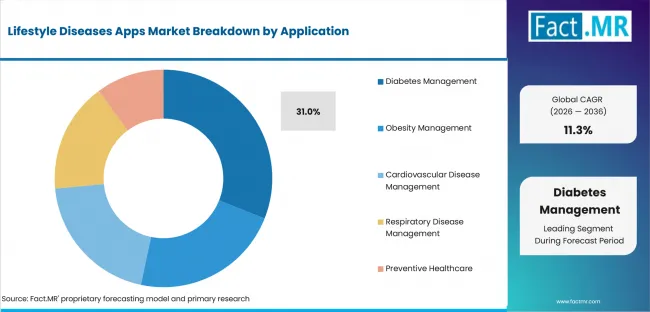
Lifestyle Diseases Apps Market Analysis By Application | Source: Fact.MR
Diabetes management leads because type 1 and type 2 users need repeated support between clinical visits. Apps can organize readings, medication reminders, food records; and trend review around immediate choices. Obesity management remains a major adjacent application; particularly when weight; nutrition; and medication services are integrated; but its commercial model varies more widely across direct subscriptions; employer benefits; and provider programs.
Why do Individual Consumers lead End User?
Individual Consumers represent 44.0% share in 2026.
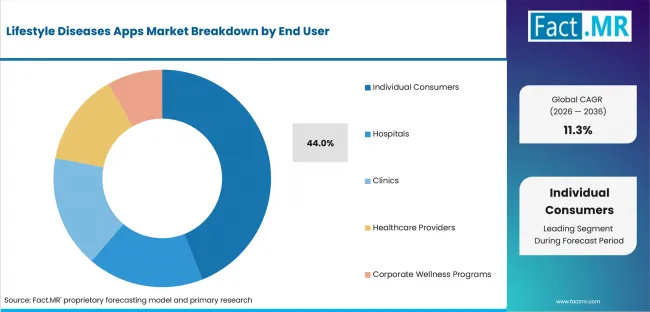
Lifestyle Diseases Apps Market Analysis By End User | Source: Fact.MR
Individual consumers form the largest end-user group because most logging, coaching, meal planning; exercise tracking; and symptom recording occurs on a personally owned phone. Freemium entry reduces the initial purchase barrier; while paid tiers convert users who need deeper analysis; reminders; personalization; or an ad-free experience. Hospitals remain relevant when app outputs enter governed care pathways that require escalation rules and integration.
How do distribution channels and platforms shape commercial access?
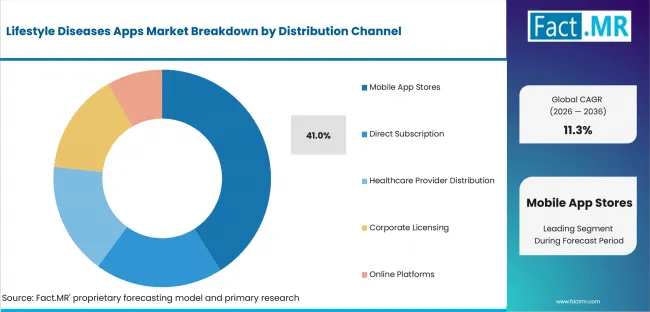
Lifestyle Diseases Apps Market Analysis By Distribution Channel | Source: Fact.MR
Mobile app stores support broad discovery and low-friction installation, while direct subscription routes give providers more control over pricing, onboarding; and customer relationships. Android and iOS availability determines addressable reach; but handset access alone does not secure retention. Smartphones support the most frequent daily interaction; while tablets serve narrower contexts where a larger interface is useful. Enterprise distribution through employers; payers; and providers can produce steadier revenue when adoption; privacy; and support obligations are clearly assigned.
What is accelerating Lifestyle Diseases Apps Market adoption, and what is holding it back?
Chronic-disease cost and self-management needs drive adoption, integrated cardiometabolic programs create the clearest opportunity, and evidence; integration; privacy; and sustained engagement remain the principal constraints.
Which force is driving adoption?
| DRIVER | QUALITATIVE RELEVANCE | GEOGRAPHIC RELEVANCE | IMPACT TIMELINE |
|---|---|---|---|
| Chronic-disease cost and self-management needs | High | Germany | Current forecast period |
Source: Fact.MR analysis. Updated Aug 3, 2026
- Chronic-disease economics: Conditions that require daily decisions create a strong case for extending support beyond periodic appointments. Employers and health plans seek programs that can improve access without adding a matching volume of in-person encounters.
- Daily self-management: Frequent readings, food choices, medication tasks; and symptom changes give diabetes and cardiometabolic apps a clearer use rhythm than occasional wellness tools.
Opportunity Impact Analysis
| OPPORTUNITY | QUALITATIVE RELEVANCE | GEOGRAPHIC RELEVANCE | IMPACT TIMELINE |
|---|---|---|---|
| Integrated cardiometabolic programs | High | Brazil | Current forecast period |
Source: Fact.MR analysis. Updated Aug 3, 2026
- Integrated cardiometabolic programs: A single service that links weight, diabetes, blood pressure; nutrition; medication; and connected measurements can give benefits buyers one accountable pathway instead of several unrelated trackers and coaching subscriptions. The commercial advantage depends on clear clinical scope; coordinated support; and a renewal case built on actual use. Data governance connects this demand with the weight management and digital patient engagement markets.
Restraints Impact Analysis
| RESTRAINT | QUALITATIVE RELEVANCE | GEOGRAPHIC RELEVANCE | IMPACT TIMELINE |
|---|---|---|---|
| Evidence, integration, privacy; and sustained engagement | High | USA | Current forecast period |
Source: Fact.MR analysis. Updated Aug 3, 2026
- Evidence and workflow fit: A consumer app faces a higher approval threshold when it claims clinical value or enters a funded care pathway. Buyers must assess the intended use, target population, validation; integration; alert burden; and responsibility for follow-up.
- Privacy and retention: Sensitive health data, cybersecurity obligations, data portability; device compatibility; and sustained engagement can delay procurement or weaken renewal. A technically capable app does not create value when users stop participating or when clinicians receive another ungoverned dashboard.
Which countries are scaling Lifestyle Diseases Apps Market fastest?
Germany 13.0%, Brazil 11.9%, USA 10.7%; Australia 10.4%; Canada 10.1%; UK 9.6%; and Japan 8.5% through 2036.
Regional analysis covers North America, Latin America, Western Europe; Eastern Europe; East Asia; South Asia and Pacific; and the Middle East and Africa.
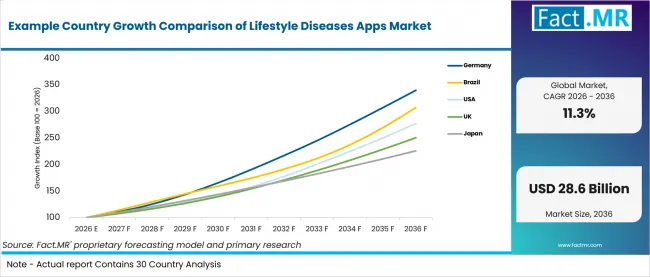
Example Country Growth Comparison Of Lifestyle Diseases Apps Market | Source: Fact.MR
| COUNTRY | CAGR, 2026 to 2036 |
|---|---|
| Germany | 13.0% |
| Brazil | 11.9% |
| USA | 10.7% |
| Australia | 10.4% |
| Canada | 10.1% |
| UK | 9.6% |
| Japan | 8.5% |
Source: Fact.MR analysis. Updated Aug 3, 2026
What is shaping Germany's outlook through 2036?
13.0% CAGR through 2036, supported by a formal prescription and reimbursement route for eligible digital health applications.
German statutory health insurers can reimburse qualifying prescription digital health applications, giving providers and patients a defined route from clinical need to paid app access. Suppliers must still satisfy evidence, medical-device; privacy; and interoperability requirements before scaling. This framework supports faster growth for products that can move beyond consumer wellness positioning.
What is shaping Brazil's outlook through 2036?
11.9% CAGR through 2036, shaped by mixed public, private; pharmacy; and direct-consumer channels.
Brazilian suppliers must work across a large public health system, private plans, pharmacies; and direct-consumer channels. Portuguese-language support and simple mobile access are commercially important because the same product may need to serve users with different care pathways and levels of digital support. The national digital health strategy provides policy context; but execution depends on local usability and channel fit.
What is shaping USA's outlook through 2036?
10.7% CAGR through 2036, driven by employer benefits, health-plan purchasing; provider contracts; and direct subscriptions.
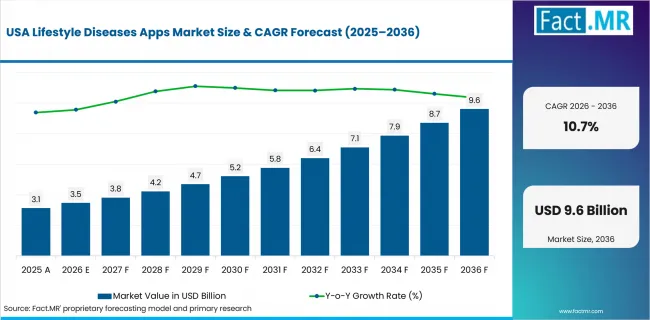
Lifestyle Diseases Apps Market Country Value Analysis | Source: Fact.MR
U.S. purchasing is led by employer benefits, commercial and government health plans, provider contracts; and direct subscriptions. Program continuation is closely tied to engagement and measurable cost or clinical outcomes. Providers that can connect app use with medication support; coaching; and connected measurements have a clearer enterprise proposition than vendors selling an isolated tracker.
What is shaping Australia's outlook through 2036?
10.4% CAGR through 2036, with medical-purpose software subject to a clearer regulatory threshold.
Australia distinguishes general wellness software from products intended to diagnose, prevent, monitor; predict; or treat disease. The Therapeutic Goods Administration clarified in January 2026 that software with those purposes may be regulated as a medical device. This makes intended use; claims; evidence; and product governance central to commercialization.
What is shaping Canada's outlook through 2036?
10.1% CAGR through 2036, placing Canada between Australia and the UK in the profiled growth comparison.
Canada is forecast to expand at a 10.1% CAGR from 2026 to 2036. The rate places the country above the UK and Japan within the profiled comparison, while remaining below Germany, Brazil; the USA; and Australia. Provider adoption conditions also affect the patient engagement solutions and electronic health records markets.
What is shaping the UK's outlook through 2036?
9.6% CAGR through 2036, owing to NHS referral, procurement; evidence; and primary-care integration requirements.
UK adoption depends heavily on National Health Service referral, procurement, evidence; and integration with primary care rather than unrestricted consumer marketing alone. A national route can support broad access after approval; but suppliers must fit established clinical and commissioning workflows. Products that reduce operating burden and demonstrate sustained use are better positioned for continuation.
What is shaping Japan's outlook through 2036?
8.5% CAGR through 2036, attributable to regulated medical claims, physician involvement; local evidence; and accessible interfaces.
Japanese providers and payers place strong value on regulated medical claims, physician involvement, and local clinical evidence. Interfaces also need to work for an aging population; which raises the importance of readable design; reliable support; and clear user instructions. Commercial scale is therefore linked to clinical credibility and usability rather than broad consumer promotion alone.
Who leads the Lifestyle Diseases Apps Market?
Competition centers on clinical integration and consumer engagement. Connected data and distribution access strengthen commercial positioning.
Omada Health, Teladoc Health, DarioHealth; and WellDoc emphasize clinically integrated chronic-care programs and enterprise distribution. Their commercial position depends on evidence; care-team integration; payer or employer access; and the ability to support multiple conditions without fragmenting the user experience. Noom; HealthifyMe; and MyFitnessPal compete more directly through behavior change; nutrition; logging; and subscription engagement.
mySugr, Livongo Health, and Virta Health use diabetes or metabolic specialization to anchor longitudinal care. Across the provider set; the strongest differentiation comes from a clear intended use; reliable engagement; connected measurements; and a channel that can fund ongoing support. A wide feature list without renewal evidence or workflow ownership is less defensible.
Which companies are the key providers?
Omada Health and Teladoc Health are leading companies in the market.
- Omada Health
- Teladoc Health
- Noom
- mySugr
- Livongo Health
- HealthifyMe
- DarioHealth
- MyFitnessPal
- WellDoc
- Virta Health
Bibliography
- World Health Organization. (2025, September 25). Noncommunicable diseases.
- German Federal Institute for Drugs and Medical Devices. (2020, August 7). The Fast-Track Process for Digital Health Applications (DiGA).
- Brazil Ministry of Health. (2024, January 12). Digital Health Strategy for Brazil 2020–2028.
- U.S. Centers for Disease Control and Prevention. (2026, May 26). Fast Facts: Health and Economic Costs of Chronic Conditions.
- NHS England. (2024, April 22). NHS online weight loss programme highlighted as a success in new study.
This Report Addresses
- The report provides strategic intelligence on Lifestyle Diseases Apps across Product Type, Application, End User; Distribution Channel; Platform; and Region.
- Segment analysis quantifies Diabetes Management Apps, Diabetes Management, and Individual Consumers as the 2026 share leaders.
- Country analysis compares Germany, Brazil, the USA; Australia; Canada; the UK; and Japan using the reported 2026 to 2036 growth rates.
- Competitive analysis evaluates product quality and application support across active suppliers.
- Channel and platform assessment explains how app stores, direct subscriptions, smartphones; tablets; Android; and iOS shape access and retention.
- Scope and methodology sections define the revenue boundary, exclusions, sizing approach; and validation process used in the assessment.
What does the Lifestyle Diseases Apps Market cover?
Paid lifestyle disease apps, subscriptions, enterprise licenses; provider-distributed services; and app-based coaching or monitoring within the defined segmentation universe.
The Lifestyle Diseases Apps Market covers revenue from paid applications and associated software subscriptions used to support recurring self-management of chronic and lifestyle-related conditions. The commercial boundary includes direct consumer subscriptions, enterprise licenses, provider-distributed app services; and productized app-based coaching or monitoring. Value is tied to the software or service offering rather than the downstream value of care; medication; or connected hardware.
What is included in the scope?
The scope includes Product Type, Application, End User; Distribution Channel; Platform; and Region. It covers Diabetes Management Apps; Blood Glucose Monitoring; Insulin Dose Tracking; and Weight Management Apps across diabetes and obesity applications. Individual consumers and hospitals are included alongside mobile app stores; direct subscriptions; Android; iOS; smartphones; and tablets. Enterprise and provider-distributed services remain in scope when the purchased function is app-based coaching; monitoring; or self-management.
What is excluded from the scope?
Stand-alone device hardware, pharmaceuticals, general telehealth; electronic health records; and adjacent or substitute product revenue are excluded. Consumer wellness tools without a defined lifestyle-disease management function remain outside the boundary. Downstream clinical-service revenue and unrelated digital-health revenue are not counted unless the purchased offering is an in-scope app; subscription; license; or app-based service. Procurement scrutiny appears in the remote patient monitoring systems and remote patient monitoring device markets.
How was the analysis built?
A hybrid bottom-up and top-down assessment of subscriptions, enterprise licenses, provider-distributed services; app-based coaching; disease demand; and country adoption conditions.
- Primary Research
- Structured discussions with app developers, digital health vendors, healthcare providers; hospital and clinic buyers; health plans; employers; channel partners; subject-matter experts; and end users test purchase triggers; pricing models; implementation barriers; utilization; and renewal conditions.
- Desk Research
- The review covers regulators, ministries, national statistics agencies; public health systems; company filings; product documentation; peer-reviewed evidence; and dated first-party announcements relevant to the defined market boundary.
- Market-Sizing and Forecasting
- Sizing reconciles direct subscriptions, premium memberships, enterprise licenses; provider-distributed services; and app-based coaching or monitoring revenue. Forecasting also considers disease-specific demand; channel economics; country adoption; and the conditions required for sustained use.
- Data Validation and Update Cycle
- Values and narratives are cross-checked across top-down demand indicators and bottom-up commercial evidence. Scope, company participation, segment logic; country growth; and exclusion boundaries are reviewed together to reduce double counting and unsupported inference.
Segmentation
What is the report’s scope and coverage?
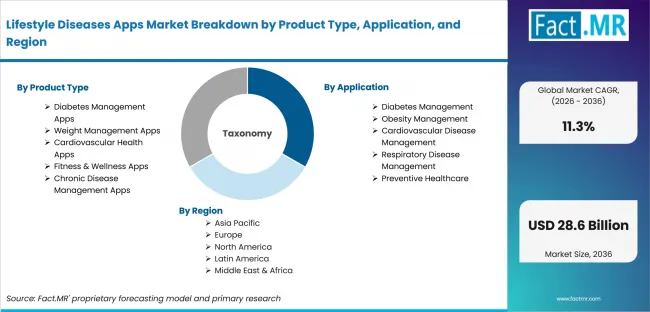
Lifestyle Diseases Apps Market Breakdown By Product Type, Application, And Region | Source: Fact.MR
| Attribute | Details |
|---|---|
| Quantitative Units | USD Billion in 2026 to USD Billion by 2036 at CAGR |
| Market Definition | Revenue from paid lifestyle diseases apps and associated software subscriptions, enterprise licenses, provider-distributed app services; and app-based coaching or monitoring within the defined segmentation universe. |
| Product Type | Diabetes Management Apps; Blood Glucose Monitoring; Insulin Dose Tracking; Weight Management Apps |
| Application | Diabetes Management; Type 1 Diabetes; Type 2 Diabetes; Obesity Management |
| End User | Individual Consumers; Adults; Senior Citizens; Hospitals |
| Distribution Channel | Mobile App Stores; Apple App Store; Google Play Store; Direct Subscription |
| Platform | Android; Smartphones; Tablets; iOS |
| Regions Covered | North America; Latin America; Western Europe; Eastern Europe; East Asia; South Asia and Pacific; Middle East and Africa |
| Countries Covered | Germany; Brazil; USA; UK; Japan; Australia; Canada |
| Key Companies Profiled | Omada Health; Teladoc Health; Noom; mySugr; Livongo Health; HealthifyMe; DarioHealth; MyFitnessPal; WellDoc; Virta Health |
| Forecast Period | 2026 to 2036 |
| Approach | Hybrid bottom-up and top-down approach using app subscriptions, enterprise and provider contracts, distribution channels; disease-specific demand; and country-level adoption conditions within the defined revenue boundary. |
Source: Fact.MR analysis. Updated Aug 3, 2026
How is the market segmented?
-
By Product Type:
- Diabetes Management Apps
- Blood Glucose Monitoring
- Insulin Dose Tracking
- Weight Management Apps
- Calorie Tracking
- Personalized Diet Planning
- Cardiovascular Health Apps
- Blood Pressure Monitoring
- Heart Rate Tracking
- Fitness & Wellness Apps
- Activity Tracking
- Workout Planning
- Chronic Disease Management Apps
- Medication Management
- Symptom Tracking
- Diabetes Management Apps
-
By Application:
- Diabetes Management
- Type 1 Diabetes
- Type 2 Diabetes
- Obesity Management
- Weight Reduction
- BMI Monitoring
- Cardiovascular Disease Management
- Hypertension Management
- Cholesterol Monitoring
- Respiratory Disease Management
- Asthma Monitoring
- COPD Management
- Preventive Healthcare
- Health Risk Assessment
- Lifestyle Coaching
- Diabetes Management
-
By End User:
- Individual Consumers
- Adults
- Senior Citizens
- Hospitals
- Public Hospitals
- Private Hospitals
- Clinics
- Primary Care Clinics
- Specialty Clinics
- Healthcare Providers
- Physicians
- Dietitians
- Corporate Wellness Programs
- Employer Wellness Programs
- Health Insurance Providers
- Individual Consumers
-
By Distribution Channel:
- Mobile App Stores
- Apple App Store
- Google Play Store
- Direct Subscription
- Individual Subscription
- Premium Membership
- Healthcare Provider Distribution
- Hospital Partnerships
- Clinic Partnerships
- Corporate Licensing
- Enterprise Wellness Programs
- Insurance Partnerships
- Online Platforms
- Official Websites
- Digital Health Portals
- Mobile App Stores
-
By Platform:
- Android
- Smartphones
- Tablets
- iOS
- iPhone
- iPad
- Web-Based Platforms
- Browser Applications
- Cloud Portals
- Wearable-Integrated Platforms
- Smartwatches
- Fitness Bands
- Cross-Platform Solutions
- Hybrid Applications
- Multi-Device Synchronization
- Android
-
By Region:
- North America
- Latin America
- Western Europe
- Eastern Europe
- East Asia
- South Asia and Pacific
- Middle East & Africa
Frequently Asked Questions
Which Product Type leads the Lifestyle Diseases Apps Market?
Which Application leads the Lifestyle Diseases Apps Market?
Which End User leads the Lifestyle Diseases Apps Market?
Which country records the highest CAGR in the Lifestyle Diseases Apps Market?
How does Brazil perform in the Lifestyle Diseases Apps Market?
How does the USA perform in the Lifestyle Diseases Apps Market?
How does Australia perform in the Lifestyle Diseases Apps Market?
How does Canada perform in the Lifestyle Diseases Apps Market?
How does the UK perform in the Lifestyle Diseases Apps Market?
How does Japan perform in the Lifestyle Diseases Apps Market?
What is the primary driver in the Lifestyle Diseases Apps Market?
What is the main restraint in the Lifestyle Diseases Apps Market?
Why are diabetes-focused apps important?
What is the strongest opportunity in the Lifestyle Diseases Apps Market?
How do mobile app stores shape distribution?
Which platforms are included in the Lifestyle Diseases Apps Market?
Why is sustained engagement commercially important?
What should enterprise buyers evaluate before procurement?
Which revenue streams are included in the market?
Which categories are excluded from the market?
Who worked on this report


Preview the report firsthand - request a free sample
Free SampleGet the brochure for pricing and purchase details
Download PDF