- Market Value (2025): USD 1.2 Bn
- Estimated Value (2026): USD 1.3 Bn
- Forecast Value (2036): USD 3.7 Bn
- CAGR (2026-2036): 11.2%
What is the Liposomal Carrier Systems Market forecast to be worth by 2036?
USD 1.3 billion in 2026 to USD 3.7 billion by 2036 at an 11.2% CAGR.
- 2025 market value: USD 1.2 billion.
- 2026 to 2036 value progression: USD 1.3 billion to USD 3.7 billion.
- 2026 to 2036 CAGR: 11.2%.
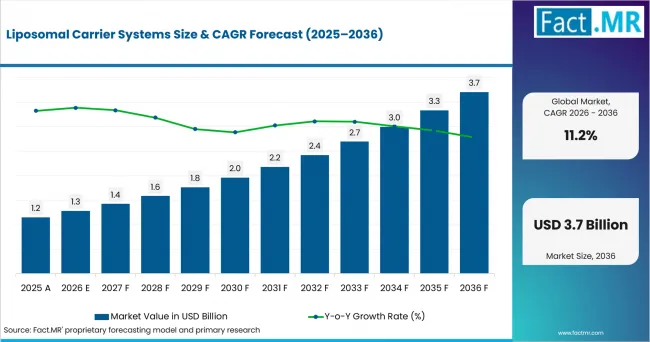
Liposomal Carrier Systems Value Analysis | Source: Fact.MR
What are the defining numbers behind Liposomal Carrier Systems Market growth?
The market is expected to create an absolute opportunity of USD 2.4 billion between 2026 and 2036.
- Demand Drivers in the Market
- Regulated pharmaceutical development creates demand for carrier systems that can be characterized reproducibly. FDA guidance requires developers to address lipid composition, morphology, mean particle size, size distribution, encapsulated versus free active and release behavior. The European Medicines Agency likewise asks developers of intravenous liposomal products to establish pharmaceutical comparability before clinical development. These requirements direct spending toward well-documented carrier inputs, analytical support and manufacturing processes that can hold critical attributes within specification.
- This regulatory and formulation work overlaps directly with the broader liposome market, where product quality depends on controlling the carrier as part of the finished dosage form.
- Nutrition and wellness formulations add a second purchasing route. A 2024 randomized crossover trial published in the European Journal of Nutrition found higher plasma and leukocyte exposure from a tested liposomal vitamin C formulation than from the non-liposomal comparator. A 2025 scoping review also found enough human evidence to keep bioavailability as an active formulation question while noting variation across products. For brand owners, this shifts procurement toward carriers with payload-specific evidence, particle characterization and stability data instead of relying on the word liposomal as a standalone claim.
- The resulting demand intersects with the nutraceuticals market, especially where vitamins and botanical actives are sold in differentiated liquid, capsule or powder formats.
- Poorly soluble and degradation-sensitive payloads create additional demand for lipid-based systems. Gattefossé notes that lipid excipients can maintain poorly water-soluble drugs in a solubilized state during digestion, while peer-reviewed work on protein and peptide delivery describes liposomes as carriers that can encapsulate hydrophilic and hydrophobic compounds but still require careful control of stability and release. Buyers therefore evaluate carrier architecture against the payload rather than selecting one liposomal format for every molecule.
- This mechanism also connects liposomal carriers with drug delivery systems, where the commercial value comes from solving a specific delivery constraint for the active ingredient.
- Key Segments Analyzed
- Carrier Architecture: Phospholipid liposomes account for 41.0% in 2026 because phospholipid bilayers can accommodate water-soluble and lipid-soluble payloads while fitting established pharmaceutical and nutrition formulation workflows.
- Payload Class: Vitamins account for 31.0% in 2026 as liposomal formats are widely used to differentiate vitamin products around dispersion, protection and absorption-related performance.
- Delivery Format: Liquid concentrates represent 29.0% in 2026 because pre-formed vesicles can be dosed into drops, oral liquids and other formulations without a separate drying and reconstitution step.
- Performance Need: Bioavailability enhancement accounts for 39.0% in 2026 because formulators often turn to lipid carriers when conventional delivery leaves an active poorly dispersed, poorly soluble or vulnerable to degradation.
- Analyst Opinion at Fact.MR
- “Liposomal carrier purchasing is becoming more technical. A buyer needs to know the lipid source, particle-size profile, encapsulation behavior and stability of the system under the intended dosage-form conditions. Suppliers that can connect those attributes to the payload and then reproduce them at scale are better placed to support repeat commercial programs.” - Shambhu Nath Jha, Senior Consultant, Fact.MR
- Strategic Implications
- Carrier suppliers should organize product development around payload compatibility. A vitamin liquid, a botanical powder and a peptide formulation impose different requirements on lipid composition, water activity, oxidation control and release behavior. Product documentation should therefore show what the carrier does under relevant formulation conditions instead of relying on broad liposomal positioning.
- Dry formats deserve separate process development from liquid concentrates because dehydration can improve handling and shelf-life potential while introducing rehydration, particle-size and encapsulation challenges. Pharmaceutical customers will place more weight on analytical comparability, while nutrition customers will also evaluate taste, label compatibility and manufacturing simplicity. Suppliers that separate these use cases can price technical support more rationally.
How does the Liposomal Carrier Systems Market break down by segment?
The market is segmented by Carrier Architecture, Payload Class, Delivery Format and Performance Need.
Why do Phospholipid liposomes lead Carrier Architecture?
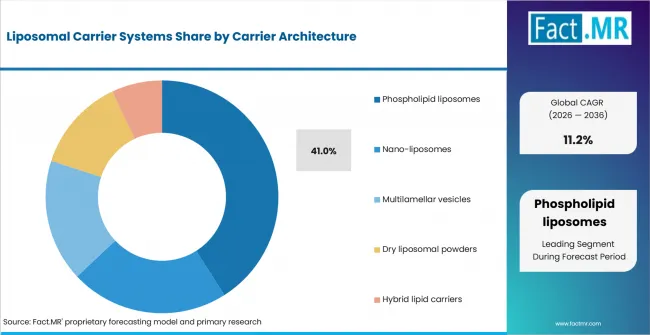
Liposomal Carrier Systems Analysis By Carrier Architecture | Source: Fact.MR
- Phospholipid liposomes account for 41.0% of Carrier Architecture in 2026. Their bilayer structure can hold hydrophilic material in the aqueous phase while incorporating lipophilic material within the lipid membrane, giving formulators a broad starting architecture for nutrition and pharmaceutical payloads.
- Lipoid supplies pre-formed liposomes as well as pharmaceutical phospholipids for liposome formation, and its portfolio spans natural, hydrogenated and synthetic phospholipids. FDA and EMA guidance also focus directly on liposomal quality attributes, giving this architecture a defined development framework for regulated drug programs.
- Phospholipid systems also sit close to the commercial controlled release opportunity when the formulation objective includes sustained or modified release rather than simple encapsulation.
Why do Vitamins lead Payload Class?
Vitamins account for 31.0% of Payload Class in 2026.
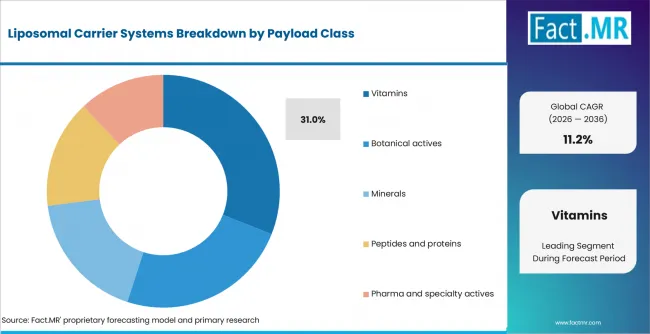
Liposomal Carrier Systems Analysis By Payload Class | Source: Fact.MR
- They are used across daily supplements, liquid drops and functional nutrition products, creating repeat demand for carrier formats that can protect sensitive ingredients and support differentiated delivery claims.
- Lipoid markets ready-to-use liposomal systems including vitamin C formulations, while the 2024 randomized trial on liposomal vitamin C reported higher exposure than a standard vitamin C comparator for the formulation tested. The commercial implication is specific: vitamin buyers can evaluate carrier systems against measurable absorption or stability outcomes, but claims must remain tied to the finished formulation and supporting evidence.
- Vitamin-led carrier demand also overlaps with nutraceutical supplements, where tablets, capsules, liquids and powders compete for repeat consumer use.
Why do Liquid concentrates lead Delivery Format?
Liquid concentrates represent 29.0% of Delivery Format in 2026.
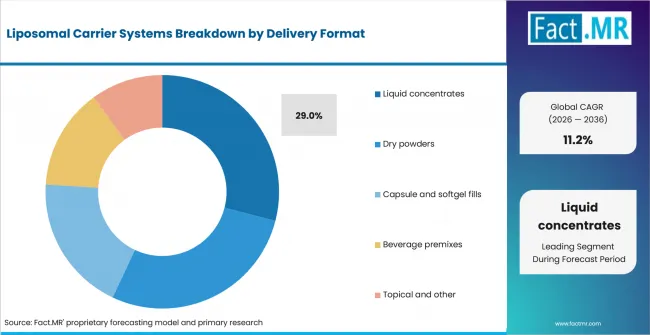
Liposomal Carrier Systems Analysis By Delivery Format | Source: Fact.MR
- They allow formulators to start with pre-formed vesicles and dose the carrier directly into oral, topical or specialty liquid systems, reducing the need for an additional drying and reconstitution stage.
- Lipoid describes its Liposome Basic product as a ready-to-use liposomal concentrate that can be used directly or after dilution in oral, topical and health-nutrition formulations. Dry powders follow closely at 28.0% because they can improve handling for sachets, capsules and premixes, but the drying process has to preserve vesicle behavior after rehydration.
Why does Bioavailability enhancement lead Performance Need?
Bioavailability enhancement accounts for 39.0% of Performance Need in 2026.
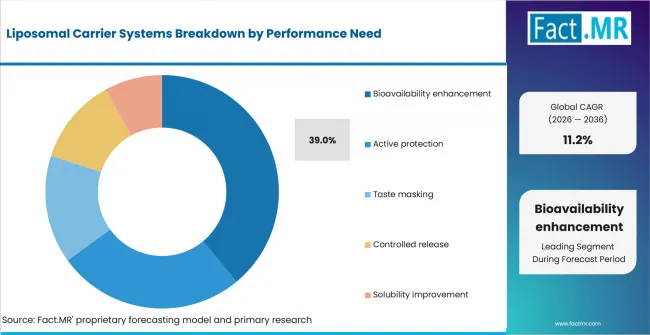
Liposomal Carrier Systems Analysis By Performance Need | Source: Fact.MR
- Poor solubility, limited permeability and degradation before absorption can reduce effective exposure for some actives, giving formulators a reason to test lipid-based delivery rather than use a conventional solution or powder alone.
- Gattefossé describes lipid excipients as tools for keeping poorly water-soluble drugs solubilized through digestion. Human vitamin C trials show that some liposomal formulations can change exposure, while the 2025 scoping review emphasizes that performance varies across products. Buyers therefore pay for formulation-specific evidence, particle control and stability rather than assuming a universal bioavailability gain.
What is accelerating Liposomal Carrier Systems Market adoption, and what is holding it back?
Adoption is being accelerated by the need to improve delivery of poorly soluble or unstable actives, the presence of established regulatory guidance for liposomal drug products, and the availability of ready-to-use carrier formats for nutrition and specialty formulations. Supplier investment in lipid manufacturing and drug-product development also lowers the burden for customers that do not want to build every process step internally. The main constraints are stability, scale-up and proof. Liposomes can leak payload, oxidize or change particle-size distribution during processing and storage.
Drivers Impact Analysis
| DRIVER | (~) % IMPACT ON CAGR | GEOGRAPHIC RELEVANCE | IMPACT TIMELINE |
|---|---|---|---|
| Bioavailability-driven reformulation of active ingredients | +2.0% | USA, Europe and Japan | Near to Long term (2026-2036) |
| Regulatory familiarity with liposomal drug products | +1.5% | USA, Europe, Japan and UK | Near to Long term (2026-2036) |
| Premium nutrition formats using liposomal carriers | +1.2% | USA, Germany, UK and Japan | Near to Mid term (2026-2032) |
Opportunity Impact Analysis
| OPPORTUNITY | (~) % IMPACT ON CAGR | GEOGRAPHIC RELEVANCE | IMPACT TIMELINE |
|---|---|---|---|
| Dry liposomal powders for capsules and premixes | +0.9% | Global nutrition and specialty formulation markets | Mid to Long term (2029-2036) |
| Protein and peptide carrier development | +0.8% | USA, Europe and Japan | Mid to Long term (2029-2036) |
| Hybrid lipid carriers for stability and release control | +0.7% | USA, Europe and Japan | Long term (2032-2036) |
Restraints Impact Analysis
| RESTRAINT | (~) % IMPACT ON CAGR | GEOGRAPHIC RELEVANCE | IMPACT TIMELINE |
|---|---|---|---|
| Particle stability, leakage and lipid oxidation | -1.2% | Global | Near to Long term (2026-2036) |
| Scale-up and analytical characterization burden | -0.9% | Regulated pharmaceutical markets | Near to Long term (2026-2036) |
| Finished-product claim substantiation requirements | -0.7% | USA, Europe, Japan and UK | Near to Mid term (2026-2032) |
Which countries are scaling the Liposomal Carrier Systems Market through 2036?
- USA: FDA guidance gives developers a defined quality and clinical-information framework for liposome drug products, encouraging procurement of carrier systems that can support CMC, pharmacokinetic and bioavailability requirements.
- Germany: Domestic phospholipid and pharmaceutical-lipid manufacturing gives formulators access to carrier raw materials and technical support close to European development and production sites.
- Japan: MHLW and PMDA maintain a dedicated guideline for liposome drug products, giving developers a clear route for addressing manufacturing, quality and nonclinical requirements.
- Italy: A broad authorized pharmaceutical manufacturing base supports formulation and contract-development work that can incorporate specialized carrier systems into commercial dosage forms.
- UK: MHRA has published a nanomedicine decision tree after reporting increased scientific-advice interest in nanomedicines, providing developers with a clearer route to regulatory dialogue for lipid-based delivery projects.
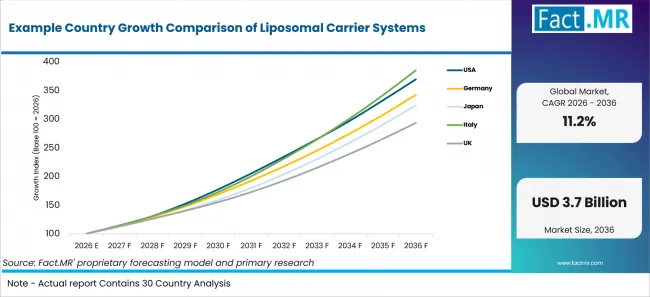
Example Country Growth Comparison Of Liposomal Carrier Systems | Source: Fact.MR
Country CAGR (2026-2036)
| Country | CAGR (2026-2036) |
|---|---|
| USA | 14.0% |
| Germany | 13.1% |
| Japan | 12.5% |
| Italy | 14.5% |
| UK | 11.4% |
What is driving USA's growth through 2036?
USA is projected to record a 14.0% CAGR through 2036.
- FDA has a dedicated guidance for liposome drug products covering chemistry, manufacturing and controls together with pharmacokinetics, bioavailability and labeling. FDA technical material also lists approved generic versions of liposomal doxorubicin and amphotericin B products, showing that liposomal development has moved beyond a single innovator pathway.
- That regulatory familiarity supports demand for carrier suppliers able to provide reproducible lipid composition, particle characterization and scale-up documentation. Nutrition applications add a separate route, particularly for vitamins and botanical actives where brands use liposomal formats to distinguish premium products but still need finished-product substantiation.
What is driving Germany's growth through 2036?
Germany is projected to record a 13.1% CAGR through 2036.
- Lipoid is headquartered in Ludwigshafen and states that more than 250 employees work there, with more than 160 at its Cologne site. The company supplies natural, hydrogenated and synthetic phospholipids used in liposomes and related lipid systems.
- Evonik also maintains pharmaceutical lipid and advanced drug-delivery capabilities in Germany while focusing investment on lipid-based systems for injectable and precision delivery. This supplier depth lowers the distance between formulation development, lipid sourcing and regulated manufacturing support for European customers.
What is driving Japan's growth through 2036?
Japan is projected to record a 12.5% CAGR through 2036.
- PMDA maintains a nanomedicines information page that links directly to the MHLW Guideline for the Development of Liposome Drug Products. The guideline addresses manufacturing method, process control, physicochemical properties, biodistribution and therapeutic or adverse effects.
- This framework raises the value of carrier systems that arrive with clear lipid specifications and analytical methods. Japanese pharmaceutical developers can assess liposomal products within an established regulatory vocabulary instead of treating the carrier as an unclassified formulation novelty.
What is driving Italy's growth through 2036?
Italy is projected to record a 14.5% CAGR through 2036.
- The Italian Medicines Agency maintains a current list of sites authorized to manufacture medicinal products, while the government-backed OpportunItaly platform reports 607 pharmaceutical-production enterprises and 75,969 employees at the end of 2025.
- That manufacturing base creates a route for specialized carrier inputs through formulation companies and contract manufacturers. Liposomal systems are particularly relevant when customers need a carrier that can be integrated into oral, topical or parenteral development with documented control of particle and stability attributes.
What is driving UK's growth through 2036?
UK is projected to record an 11.4% CAGR through 2036.
- MHRA published a nanomedicine decision tree in February 2025 after noting increased scientific-advice queries, particularly around lipid nanoparticles. The agency states that the framework can support development of nano drug-delivery systems including liposomes and lipid nanoparticles.
- The manufacturing environment also supports formulation demand. The Office for National Statistics reported that pharmaceutical manufacturing output increased 5.4% in the three months to May 2026 compared with the previous three-month period. For carrier suppliers, the commercial opportunity is to support developers with characterization, process-transfer and regulatory documentation that can move from laboratory formulation to manufactured product.
Who Leads the Liposomal Carrier Systems Market?
Key players in the Liposomal Carrier Systems Market include Lipoid GmbH, Lubrizol Life Science, Gattefossé, Evonik, BASF and Lonza. Competition is shaped by the depth of lipid and excipient portfolios, formulation support, analytical capability and the ability to transfer a carrier system into repeatable commercial manufacturing.
Lipoid has direct phospholipid and pre-formed liposome offerings. Evonik combines pharmaceutical lipid capabilities with lipid-based drug-delivery development and manufacturing. Gattefossé and BASF compete through lipid excipients and solubilization technologies, while Lubrizol Life Science and Lonza add formulation, process-development and drug-product support for customers working on complex delivery systems.
Supplier selection therefore depends on the intended payload and regulatory route. Nutrition programs may prioritize ready-to-use concentrates and clean technical documentation, whereas pharmaceutical programs place more weight on GMP sourcing, critical-quality-attribute control and process transfer.
Which companies are the key providers?
Lipoid GmbH, Lubrizol Life Science, Gattefossé, Evonik, BASF and Lonza are key providers in the Liposomal Carrier Systems Market.
- Lipoid GmbH
- Lubrizol Life Science
- Gattefossé
- Evonik
- BASF
- Lonza
Bibliography
- Food and Drug Administration. (2018). Liposome Drug Products: Chemistry, Manufacturing, and Controls; Human Pharmacokinetics and Bioavailability; and Labeling Documentation. U.S. Food and Drug Administration.
- Food and Drug Administration. (2023). Quality Considerations and Controls for Drug Products Containing Nanomaterials. U.S. Food and Drug Administration.
- European Medicines Agency. (2013). Reflection paper on the data requirements for intravenous liposomal products developed with reference to an innovator liposomal product. European Medicines Agency.
- Pharmaceuticals and Medical Devices Agency. (2016). Guideline for the Development of Liposome Drug Products. Ministry of Health, Labour and Welfare, Japan.
- Medicines and Healthcare products Regulatory Agency. (2025). Decision tree for navigating nanotechnology-based products for medical application. UK Government.
- Office for National Statistics. (2026). GDP monthly estimate, UK: May 2026. UK Statistics Authority.
- Italian Medicines Agency. (2026). Authorised sites for manufacture of medicinal products. AIFA.
- OpportunItaly. (2026). Health and Wellness sector profile. Government of Italy.
- Lipoid GmbH. (2025). About Us. Lipoid GmbH.
- Lipoid GmbH. (n.d.). LIPOID Liposome product portfolio. Lipoid GmbH.
- Gattefossé. (n.d.). Excipients for solubility and bioavailability enhancement. Gattefossé.
- Evonik Industries. (2026). Parenteral Drug Delivery - Lipids. Evonik Health Care.
- BASF. (n.d.). Lipid-Based Excipients for Pharmaceutical Applications. BASF Pharma Solutions.
- BASF. (2026). BASF Pharma Solutions Announces Global Price Adjustment for Pharmaceutical Excipients and Selected APIs. BASF.
- Lonza. (n.d.). Biologics Drug Product Services. Lonza.
- Lubrizol. (n.d.). Long-Acting Drug Delivery. Lubrizol Life Science Health.
- Purpura, M., Jäger, R., Godavarthi, A., Bhaskarachar, D., & Tinsley, G. M. (2024). Liposomal delivery enhances absorption of vitamin C into plasma and leukocytes: a double-blind, placebo-controlled, randomized trial. European Journal of Nutrition.
- Carr, A. C. (2025). Do Liposomal Vitamin C Formulations Have Improved Bioavailability? A Scoping Review Identifying Future Research Directions. Basic & Clinical Pharmacology & Toxicology.
- Lu, X.-S., Yang, L.-Q., Ma, L., Wu, J.-F., Zhang, H.-B., & Wang, Y. (2025). Liposome stability: multifactorial regulation and optimization strategies in in vivo delivery. Journal of Liposome Research.
- Swaminathan, J., & Ehrhardt, C. (2012). Liposomal delivery of proteins and peptides. Expert Opinion on Drug Delivery.
This Report Answers
- How is demand split across carrier architecture, payload class, delivery format and performance need?
- Why do phospholipid liposomes account for 41.0% of Carrier Architecture in 2026?
- What makes vitamins the leading payload class?
- Why do liquid concentrates remain slightly ahead of dry powders?
- How do regulatory requirements affect pharmaceutical carrier procurement?
- Which stability and scale-up issues limit wider adoption?
- How do USA, Germany, Japan, Italy and UK differ in their growth mechanisms?
- What capabilities separate current carrier and excipient suppliers?
What does the Liposomal Carrier Systems Market cover?
The market covers liposomal and related lipid carrier systems sold as formulation inputs for vitamins, botanical actives, minerals, peptides and proteins, plus pharmaceutical and specialty actives. Revenue is counted at the carrier-system level across liquid concentrates, dry powders, capsule or softgel fills, beverage premixes and topical or other formats.
What is included in the scope?
Included products are phospholipid liposomes, nano-liposomes, multilamellar vesicles, dry liposomal powders and hybrid lipid carriers used for bioavailability enhancement, active protection, taste masking, controlled release or solubility improvement.
The scope includes carrier systems incorporated into nutrition, pharmaceutical and specialty formulation programs when the carrier is a distinct commercial input or formulated intermediate.
What is excluded from the scope?
The scope excludes finished consumer supplements and finished medicines when their value is primarily attributable to the final branded product rather than the carrier system.
It also excludes commodity lecithin or phospholipids sold without a carrier-system function, polymer-only delivery systems, and standalone manufacturing equipment used to produce liposomes.
How Was the Analysis Built?
- Primary Research: Primary research focuses on phospholipid and excipient suppliers, liposomal formulation specialists, pharmaceutical development teams, nutrition formulators, contract manufacturers and technical procurement functions. Interviews are used to test how buyers qualify carrier inputs, where value is captured between raw lipid and formulated system, and which performance attributes affect repeat purchasing.
- Desk Research: Desk research uses regulator guidance, pharmacopeial and technical literature, peer-reviewed formulation studies, public manufacturing statistics and first-party supplier documentation to evaluate demand mechanisms and company capabilities.
- Market Sizing and Forecasting: Market sizing uses carrier-system volumes, formulated-system pricing, payload mix, format mix, pharmaceutical development activity, nutrition formulation demand and replacement or repeat-order patterns. Forecasting tests how regulation, manufacturing capacity, product stability and formulation performance affect adoption across the five country markets.
- Data Validation and Update Cycle: Validation tracks changes in regulatory guidance, lipid and phospholipid product availability, manufacturing capacity, formulation stability evidence and supplier capabilities. Updates also review new carrier formats, payload applications and material changes that can alter commercial adoption.
What is the report's scope and coverage?
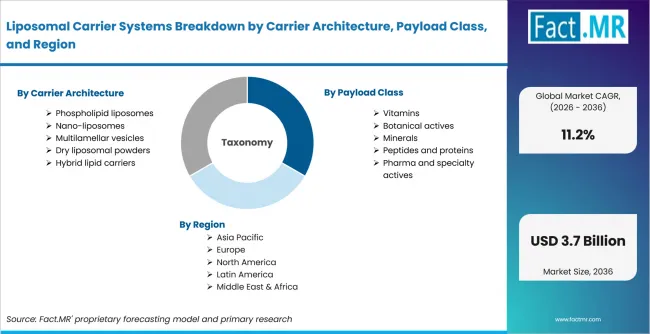
Liposomal Carrier Systems Breakdown By Carrier Architecture, Payload Class, And Region | Source: Fact.MR
| Attribute | Details |
|---|---|
| Quantitative Units | USD billion |
| Market Definition | Liposomal and related lipid carrier systems sold as formulation inputs across nutrition, pharmaceutical and specialty applications |
| Segments Covered | Carrier Architecture; Payload Class; Delivery Format; Performance Need |
| Countries Covered | USA; Germany; Japan; Italy; UK |
| Key Companies | Lipoid GmbH; Lubrizol Life Science; Gattefossé; Evonik; BASF; Lonza |
| Forecast Period | 2026-2036 |
| Base Year | 2026 |
| Market Value, 2026 | USD 1.3 billion |
| Market Value, 2036 | USD 3.7 billion |
| CAGR, 2026-2036 | 11.2% |
| Absolute Opportunity | USD 2.4 billion |
| Approach | Demand-side and supply-side validation using carrier volumes, formulated-system pricing, payload and format mix, regulatory activity and supplier capability |
How is the market segmented?
-
By Carrier Architecture
- Phospholipid liposomes
- Nano-liposomes
- Multilamellar vesicles
- Dry liposomal powders
- Hybrid lipid carriers
-
By Payload Class
- Vitamins
- Botanical actives
- Minerals
- Peptides and proteins
- Pharma and specialty actives
-
By Delivery Format
- Liquid concentrates
- Dry powders
- Capsule and softgel fills
- Beverage premixes
- Topical and other
-
By Performance Need
- Bioavailability enhancement
- Active protection
- Taste masking
- Controlled release
- Solubility improvement