Liquid-Phase Barrier Laminates Market
Liquid-Phase Barrier Laminates Market Size and Share Forecast Outlook 2026 to 2036
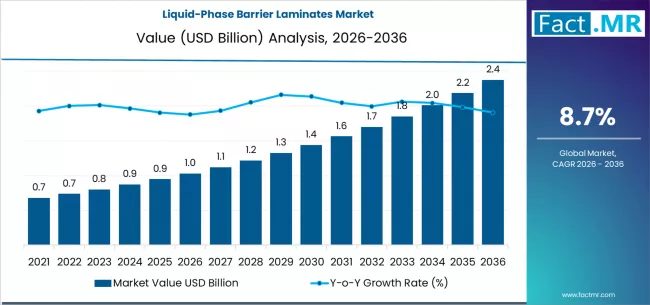
Liquid-phase barrier laminates market is projected to grow from USD 1.0 billion in 2026 to USD 2.4 billion by 2036, at a CAGR of 8.7%. Beverages & liquid foods will dominate with a 42.0% market share, while carton & pouch laminates will lead the packaging format segment with a 47.3% share.
Liquid-Phase Barrier Laminates Market Forecast and Outlook 2026 to 2036
The global market for liquid-phase barrier laminates will likely total USD 1.03 billion in 2026, and is projected to reach USD 2.37 billion by 2036, advancing at an 8.7% CAGR. This expansion is anchored in the escalating global demand for extended shelf life and sustainable packaging solutions for beverages, dairy, and liquid foods.
Key Takeaways from the Liquid-Phase Barrier Laminates Market
- Market Value for 2026: USD 1.03 Billion
- Market Value for 2036: USD 2.37 Billion
- Forecast CAGR 2026 to 2036: 8.7%
- Leading End-Use Segment (2026): Beverages & Liquid Foods (42.0%)
- Leading Packaging Format Segment (2026): Carton & Pouch Laminates (47.3%)
- Leading Material Segment (2026): Paper/PE, EVOH-based Laminates (50.0%)
- Leading Technology Segment (2026): Liquid-Tight Extrusion & Coating (57.8%)
- Key Growth Countries: India (12.4% CAGR), China (11.3% CAGR), USA (8.2% CAGR), Brazil (8.2% CAGR), Germany (7.2% CAGR), Japan (5.0% CAGR)
- Key Players: Tetra Pak, Mondi, Greatview, UFlex, Klabin, Toyo Seikan, Amcor, Elopak, Xinjufeng, SIG
Stringent food safety regulations and shifting consumer preferences toward convenience and reduced food waste are compelling brand owners to invest in advanced packaging materials that ensure product integrity.
Innovations in aseptic packaging technology and high-speed lamination processes are enabling thinner, more efficient barrier structures without compromising performance. This evolution directly supports brand sustainability goals by reducing material usage and enhancing recyclability potential.
The economic imperative is clear, packaging that minimizes spoilage and preserves nutritional value directly impacts supply chain efficiency and consumer trust, making advanced laminates a critical investment for the food and beverage industry.
Liquid-Phase Barrier Laminates Market
| Metric | Value |
|---|---|
| Market Value (2026) | USD 1.03 Billion |
| Market Forecast Value (2036) | USD 2.37 Billion |
| Forecast CAGR 2026 to 2036 | 8.7% |
Category
| Category | Segments |
|---|---|
| End-Use | Beverages & Liquid Foods, Dairy & Juice, RTD Beverages, Milk & Value Beverages, Juices & Dairy, Premium Liquids |
| Packaging Format | Carton & Pouch Laminates, Aseptic Carton Laminates, Pouches & Cartons, Sachets & Cartons, Others |
| Material | Paper/PE, EVOH-based Laminates, Paperboard + Barrier Layers, PE/EVOH Blends, PE-based Laminates, Others |
| Technology | Liquid-Tight Extrusion & Coating, Aseptic Barrier Engineering, High-Speed Lamination, Cost-Optimised Coating, Others |
| Region | North America, Latin America, Western Europe, Eastern Europe, East Asia, South Asia & Pacific, Middle East & Africa |
Industry Nexus: Convergence of Material Science and Automation
Growth within the liquid-phase barrier laminates space incorporates broader trends in the chemicals and industrial automation sectors. Developments in polymer chemistry, specifically in ethylene vinyl alcohol and advanced polyethylene blends, are yielding thinner yet more effective barrier layers.
Automation in converting and filling lines demands laminates with exceptional consistency and machinability at high speeds. This synergy between advanced material innovation and precision engineering is reducing unit costs and enabling scalable adoption of high-performance packaging formats across both established and emerging economies.
Segmental Analysis
By Technology, Which Segment is Fundamental to Achieving Aseptic Integrity?
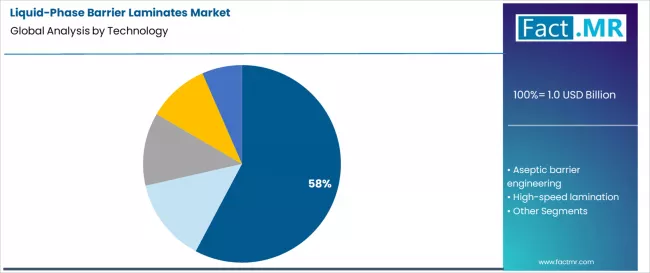
Liquid-tight extrusion and coating technology is expected to capture a 57.8% share in 2026. This process is fundamental for creating seamless, pinhole-free barrier layers essential for aseptic packaging. It involves the precise application of polymer melts to substrate materials like paperboard, forming an impermeable seal against oxygen and moisture ingress.
The reliability of this technology directly dictates the shelf stability and safety of sensitive liquid food products, making it a non-negotiable capital investment for packaging converters serving the dairy and beverage industries.
- Core Enabler: Provides the hermetic seal critical for non-refrigerated, long-life liquid packaging.
- Quality Determinant: Process precision directly influences spoilage rates and brand liability.
By End-Use, Which Segment Exerts the Highest Volume Demand?
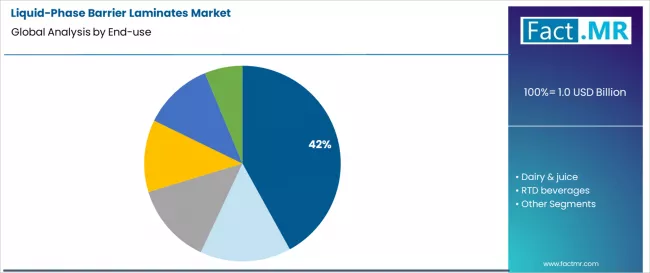
Beverages and liquid foods constitute the primary end-use segment at 42.0%. This sector’s relentless drive for shelf presence, logistical efficiency, and product differentiation creates sustained high-volume demand.
The need for packaging that combines lightweighting, graphic print quality, and reliable barrier properties for products ranging from soups to plant-based drinks makes laminates the material of choice for major global brands.
- Volume Driver: High-volume, fast-moving consumer goods underpin consistent laminate demand.
- Innovation Catalyst: Brand competition in this space fuels continuous material and design advancements.
By Material, Which Configuration Balances Performance with Sustainability Goals?
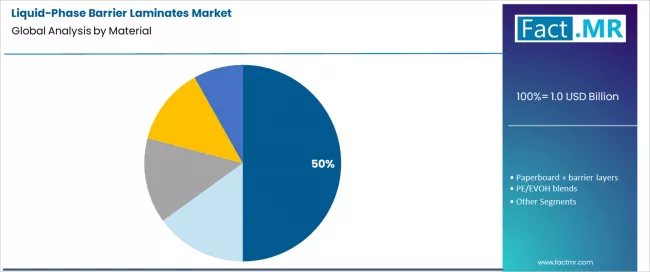
Paper/PE and EVOH-based laminates command a 50.0% share, representing the industry benchmark for performance-sustainability balance. The paperboard provides stiffness and a renewable substrate, polyethylene ensures liquid tightness and heat-sealability, while EVOH layers deliver superior oxygen barrier.
This multi-material structure is at the center of recyclability debates and design-for-recycling initiatives, pushing innovation toward monomaterial solutions that retain equivalent barrier properties.
- Incumbent Standard: The established material system for most carton-based liquid packaging.
- Transition Focus: Subject to intense R&D aimed at simplifying the structure for improved end-of-life recycling.
What are the Dynamics Influencing the Liquid-Phase Barrier Laminates Market?
| Attribute | Impact |
|---|---|
| Global Sustainability Mandates | Legislation targeting plastic waste and mandating recyclable packaging compels material innovation, driving R&D into monomaterial and easily separable laminate structures. |
| High Raw Material & CAPEX Intensity | Fluctuating polymer costs and significant capital required for extrusion-coating lines constrain profit margins and slow capacity expansion, particularly for mid-sized converters. |
| Expansion in Cold Chain-Limited Regions | Rising consumption of liquid dairy and beverages in regions with underdeveloped refrigeration logistics opens substantial opportunities for aseptic laminate packaging formats. |
| Integration of Smart Packaging Features | Growing brand interest in embedding traceability codes and freshness indicators within the laminate structure creates value-added, higher-margin product segments. |
Analysis of the Liquid-Phase Barrier Laminates Market by Key Countries
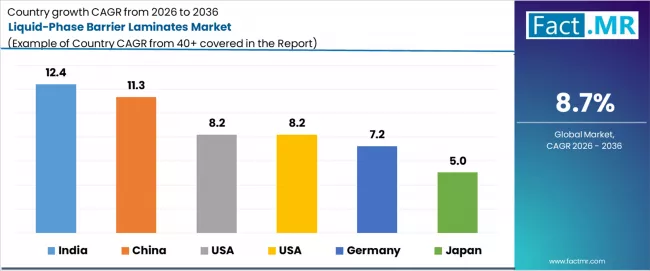
| Country | CAGR 2026 to 2036 |
|---|---|
| USA | 8.2% |
| Germany | 7.2% |
| China | 11.3% |
| India | 12.4% |
| Brazil | 8.2% |
| Japan | 5.0% |
How do Shifting Consumer Preferences and Regulatory Pressure Shape Demand in the USA?
An 8.2% CAGR reflects steady demand driven by robust consumption of alternative dairy and RTD beverages. Regulatory focus on post-consumer recycled content in packaging and corporate sustainability commitments are accelerating the shift toward laminate structures designed for recycling compatibility. Investments are targeting next-generation barrier solutions that maintain performance while aligning with evolving EPR frameworks and consumer environmental expectations.
- Demand Stability: Sustained by premiumization in beverage categories and plant-based alternatives.
- Regulatory Pivot: EPR laws are redirecting innovation toward recyclable laminate designs.
What Characterizes Germany's Focus on Circularity and Premium Product Packaging?
A 7.2% CAGR underscores a mature landscape centered on circular economy principles and premium liquid packaging. German converters and brand owners are leaders in developing and implementing recycling pathways for polyaluminium laminates.
Demand is for high-performance materials that meet stringent EU food contact regulations while incorporating recycled content and enabling advanced sorting through digital watermarking technologies.
- Circularity Leader: Pioneering chemical and mechanical recycling processes for complex laminate waste streams.
- Performance Benchmark: Sets high standards for barrier integrity aligned with reusable packaging system integration.
What Underpins the Scale of Infrastructure Development in China?
An 11.3% CAGR is fueled by massive domestic consumption of liquid dairy and beverages coupled with national investments in modern packaging infrastructure. The government's focus on food security and supply chain modernization supports the installation of high-speed aseptic filling lines, which in turn drives volume demand for compatible laminates. Local manufacturing of both raw materials and converting machinery creates an integrated, cost-competitive supply chain.
- Infrastructure Scale: New filling line installations directly correlate with high-volume laminate procurement.
- Integrated Supply Chain: Domestic production of resins and paperboard supports rapid market responsiveness.
How is Demographic Growth and Formal Retail Expansion Catalyzing Demand in India?
A young demographic propel India’s leading 12.4% CAGR, rising disposable incomes, and the rapid formalization of the retail sector. The need for affordable, shelf-stable packaging for milk and value-added beverages in both urban and rural areas is paramount. This dynamic favors cost-optimized laminate formats like sachets and smaller carton sizes, fostering innovation in efficient, lower-cost coating technologies.
- Demographic Driver: A growing, urbanizing population boosts consumption of packaged liquids.
- Format Innovation: Price sensitivity fuels demand for smaller unit sizes and lean laminate structures.
Why is Brazil's Growth Closely Tied to Dairy and Juice Consumption Patterns?
An 8.2% CAGR is closely linked to strong domestic consumption of milk and fruit-based beverages. The vast geographic size of the country makes aseptic, ambient-storage packaging a logistical necessity.
Enforcement of solid waste management policies is gradually encouraging packaging design improvements, while economic factors prioritize solutions that balance performance with cost containment.
- Logistical Necessity: Aseptic laminates are essential for distributing perishable liquids across large distances.
- Policy-Driven Evolution: Waste management regulations are slowly incentivizing more sustainable material choices.
What defines Japan's Pursuit of Premiumization and Technical Precision?
A 5.0% CAGR represents a sophisticated landscape focused on ultra-high-quality packaging for premium beverages and dairy. Japanese converters emphasize precision engineering, leading to laminates with exceptional print fidelity, unique opening features, and lightweighting achievements. Demand stems from brand differentiation in a saturated consumer market and the need for packaging compatible with advanced retail and vending distribution systems.
- Premiumization Focus: High-value product segments drive demand for technically sophisticated laminate features.
- Precision Engineering: Leadership in lightweighting and miniaturization of high-barrier packaging formats.
Competitive Landscape of the Liquid-Phase Barrier Laminates Market
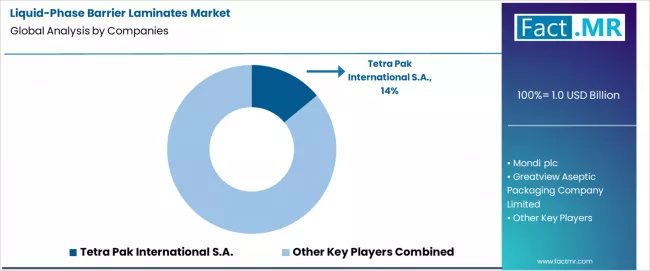
The competitive environment is stratified, with integrated giants dominating through vertical control over material supply, converting technology, and filling machine systems. Companies like Tetra Pak and SIG leverage this integrated model, offering brand owners a complete ecosystem from laminate to filled package.
Specialized material suppliers like Mondi and Amcor compete based on advanced polymer science and co-development partnerships with brand owners, focusing on sustainability breakthroughs.
Competition increasingly hinges on the ability to deliver circular economy solutions, such as laminates compatible with specific recycling streams or incorporating certified recycled content, while maintaining stringent food-grade safety standards.
Key Players in the Liquid-Phase Barrier Laminates Market
- Tetra Pak International S.A.
- Mondi plc
- Greatview Aseptic Packaging Company Limited
- UFlex Limited
- Klabin S.A.
- Toyo Seikan Group Holdings, Ltd.
- Amcor plc
- Elopak ASA
- Shandong Xin Jufeng Packaging Co., Ltd.
- SIG Group AG
Scope of Report
| Items | Metrics |
|---|---|
| Quantitative Units | USD Billion |
| Technology | Liquid-Tight Extrusion & Coating, Aseptic Barrier Engineering, High-Speed Lamination, Cost-Optimised Coating, Others |
| Packaging Format | Carton & Pouch Laminates, Aseptic Carton Laminates, Pouches & Cartons, Sachets & Cartons, Others |
| End-Use | Beverages & Liquid Foods, Dairy & Juice, RTD Beverages, Milk & Value Beverages, Juices & Dairy, Premium Liquids |
| Material | Paper/PE, EVOH-based Laminates, Paperboard + Barrier Layers, PE/EVOH Blends, PE-based Laminates, Others |
| Key Countries | India, China, USA, Brazil, Germany, Japan |
| Key Companies | Tetra Pak, Mondi, Greatview, UFlex, Klabin, Toyo Seikan, Amcor, Elopak, Xinjufeng, SIG |
| Additional Analysis | Lifecycle assessment of various laminate structures; cost-benefit analysis of monomaterial vs. multi-material barriers; impact of digital printing on laminate design; analysis of supply chain resilience for key polymer inputs; study of end-of-life management infrastructure for laminate packaging. |
Market by Segments
-
End-Use :
- Beverages & Liquid Foods
- Dairy & Juice
- RTD Beverages
- Milk & Value Beverages
- Juices & Dairy
- Premium Liquids
-
Packaging Format :
- Carton & Pouch Laminates
- Aseptic Carton Laminates
- Pouches & Cartons
- Sachets & Cartons
- Others
-
Material :
- Paper/PE & EVOH-based Laminates
- Paperboard & Barrier Layers
- PE/EVOH Blends
- PE-based Laminates
- Others
-
Technology :
- Liquid-Tight Extrusion & Coating
- Aseptic Barrier Engineering
- High-Speed Lamination
- Cost-Optimised Coating
- Others
-
Region :
- North America
- USA
- Canada
- Latin America
- Brazil
- Mexico
- Argentina
- Rest of Latin America
- Western Europe
- Germany
- France
- Italy
- Spain
- UK
- BENELUX
- Rest of Western Europe
- Eastern Europe
- Russia
- Poland
- Czech Republic
- Rest of Eastern Europe
- East Asia
- China
- Japan
- South Korea
- Rest of East Asia
- South Asia & Pacific
- India
- ASEAN
- Australia
- Rest of South Asia & Pacific
- MEA
- GCC Countries
- South Africa
- Turkiye
- Rest of MEA
- North America
References
- European Commission. (2025). A European strategy for plastics in a circular economy: 2025 implementation review.
- Food and Agriculture Organization of the United Nations. (2024). The State of Food and Agriculture: Reducing food loss through innovative packaging.
- Institute of Food Technologists. (2023). Food Packaging and Shelf Life: A Scientific Guide.
- International Journal of Packaging Research and Technology. (2024). Advanced barrier coatings for sustainable flexible packaging.
- Smithers Pira. (2025). The Future of Aseptic Packaging to 2035.
- World Packaging Organisation. (2024). Global packaging trends for circularity and resource efficiency.
Table of Content
- Executive Summary
- Global Market Outlook
- Demand to side Trends
- Supply to side Trends
- Technology Roadmap Analysis
- Analysis and Recommendations
- Market Overview
- Market Coverage / Taxonomy
- Market Definition / Scope / Limitations
- Market Background
- Market Dynamics
- Drivers
- Restraints
- Opportunity
- Trends
- Scenario Forecast
- Demand in Optimistic Scenario
- Demand in Likely Scenario
- Demand in Conservative Scenario
- Opportunity Map Analysis
- Product Life Cycle Analysis
- Supply Chain Analysis
- Investment Feasibility Matrix
- Value Chain Analysis
- PESTLE and Porter’s Analysis
- Regulatory Landscape
- Regional Parent Market Outlook
- Production and Consumption Statistics
- Import and Export Statistics
- Market Dynamics
- Global Market Analysis 2021 to 2025 and Forecast, 2026 to 2036
- Historical Market Size Value (USD Million) Analysis, 2021 to 2025
- Current and Future Market Size Value (USD Million) Projections, 2026 to 2036
- Y to o to Y Growth Trend Analysis
- Absolute $ Opportunity Analysis
- Global Market Pricing Analysis 2021 to 2025 and Forecast 2026 to 2036
- Global Market Analysis 2021 to 2025 and Forecast 2026 to 2036, By End-use
- Introduction / Key Findings
- Historical Market Size Value (USD Million) Analysis By End-use, 2021 to 2025
- Current and Future Market Size Value (USD Million) Analysis and Forecast By End-use, 2026 to 2036
- Beverages & liquid foods
- Dairy & juice
- RTD beverages
- Milk & value beverages
- Juices & dairy
- Premium liquids
- Beverages & liquid foods
- Y to o to Y Growth Trend Analysis By End-use, 2021 to 2025
- Absolute $ Opportunity Analysis By End-use, 2026 to 2036
- Global Market Analysis 2021 to 2025 and Forecast 2026 to 2036, By Packaging Format
- Introduction / Key Findings
- Historical Market Size Value (USD Million) Analysis By Packaging Format, 2021 to 2025
- Current and Future Market Size Value (USD Million) Analysis and Forecast By Packaging Format, 2026 to 2036
- Carton & pouch laminates
- Aseptic carton laminates
- Pouches & cartons
- Sachets & cartons
- Others
- Carton & pouch laminates
- Y to o to Y Growth Trend Analysis By Packaging Format, 2021 to 2025
- Absolute $ Opportunity Analysis By Packaging Format, 2026 to 2036
- Global Market Analysis 2021 to 2025 and Forecast 2026 to 2036, By Material
- Introduction / Key Findings
- Historical Market Size Value (USD Million) Analysis By Material, 2021 to 2025
- Current and Future Market Size Value (USD Million) Analysis and Forecast By Material, 2026 to 2036
- Paper/PE, EVOH-based laminates
- Paperboard + barrier layers
- PE/EVOH blends
- PE-based laminates
- Others
- Paper/PE, EVOH-based laminates
- Y to o to Y Growth Trend Analysis By Material, 2021 to 2025
- Absolute $ Opportunity Analysis By Material, 2026 to 2036
- Global Market Analysis 2021 to 2025 and Forecast 2026 to 2036, By Technology
- Introduction / Key Findings
- Historical Market Size Value (USD Million) Analysis By Technology, 2021 to 2025
- Current and Future Market Size Value (USD Million) Analysis and Forecast By Technology, 2026 to 2036
- Liquid-tight extrusion & coating
- Aseptic barrier engineering
- High-speed lamination
- Cost-optimised coating
- Others
- Liquid-tight extrusion & coating
- Y to o to Y Growth Trend Analysis By Technology, 2021 to 2025
- Absolute $ Opportunity Analysis By Technology, 2026 to 2036
- Global Market Analysis 2021 to 2025 and Forecast 2026 to 2036, By Region
- Introduction
- Historical Market Size Value (USD Million) Analysis By Region, 2021 to 2025
- Current Market Size Value (USD Million) Analysis and Forecast By Region, 2026 to 2036
- North America
- Latin America
- Western Europe
- Eastern Europe
- East Asia
- South Asia and Pacific
- Middle East & Africa
- Market Attractiveness Analysis By Region
- North America Market Analysis 2021 to 2025 and Forecast 2026 to 2036, By Country
- Historical Market Size Value (USD Million) Trend Analysis By Market Taxonomy, 2021 to 2025
- Market Size Value (USD Million) Forecast By Market Taxonomy, 2026 to 2036
- By Country
- USA
- Canada
- Mexico
- By End-use
- By Packaging Format
- By Material
- By Technology
- By Country
- Market Attractiveness Analysis
- By Country
- By End-use
- By Packaging Format
- By Material
- By Technology
- Key Takeaways
- Latin America Market Analysis 2021 to 2025 and Forecast 2026 to 2036, By Country
- Historical Market Size Value (USD Million) Trend Analysis By Market Taxonomy, 2021 to 2025
- Market Size Value (USD Million) Forecast By Market Taxonomy, 2026 to 2036
- By Country
- Brazil
- Chile
- Rest of Latin America
- By End-use
- By Packaging Format
- By Material
- By Technology
- By Country
- Market Attractiveness Analysis
- By Country
- By End-use
- By Packaging Format
- By Material
- By Technology
- Key Takeaways
- Western Europe Market Analysis 2021 to 2025 and Forecast 2026 to 2036, By Country
- Historical Market Size Value (USD Million) Trend Analysis By Market Taxonomy, 2021 to 2025
- Market Size Value (USD Million) Forecast By Market Taxonomy, 2026 to 2036
- By Country
- Germany
- UK
- Italy
- Spain
- France
- Nordic
- BENELUX
- Rest of Western Europe
- By End-use
- By Packaging Format
- By Material
- By Technology
- By Country
- Market Attractiveness Analysis
- By Country
- By End-use
- By Packaging Format
- By Material
- By Technology
- Key Takeaways
- Eastern Europe Market Analysis 2021 to 2025 and Forecast 2026 to 2036, By Country
- Historical Market Size Value (USD Million) Trend Analysis By Market Taxonomy, 2021 to 2025
- Market Size Value (USD Million) Forecast By Market Taxonomy, 2026 to 2036
- By Country
- Russia
- Poland
- Hungary
- Balkan & Baltic
- Rest of Eastern Europe
- By End-use
- By Packaging Format
- By Material
- By Technology
- By Country
- Market Attractiveness Analysis
- By Country
- By End-use
- By Packaging Format
- By Material
- By Technology
- Key Takeaways
- East Asia Market Analysis 2021 to 2025 and Forecast 2026 to 2036, By Country
- Historical Market Size Value (USD Million) Trend Analysis By Market Taxonomy, 2021 to 2025
- Market Size Value (USD Million) Forecast By Market Taxonomy, 2026 to 2036
- By Country
- China
- Japan
- South Korea
- By End-use
- By Packaging Format
- By Material
- By Technology
- By Country
- Market Attractiveness Analysis
- By Country
- By End-use
- By Packaging Format
- By Material
- By Technology
- Key Takeaways
- South Asia and Pacific Market Analysis 2021 to 2025 and Forecast 2026 to 2036, By Country
- Historical Market Size Value (USD Million) Trend Analysis By Market Taxonomy, 2021 to 2025
- Market Size Value (USD Million) Forecast By Market Taxonomy, 2026 to 2036
- By Country
- India
- ASEAN
- Australia & New Zealand
- Rest of South Asia and Pacific
- By End-use
- By Packaging Format
- By Material
- By Technology
- By Country
- Market Attractiveness Analysis
- By Country
- By End-use
- By Packaging Format
- By Material
- By Technology
- Key Takeaways
- Middle East & Africa Market Analysis 2021 to 2025 and Forecast 2026 to 2036, By Country
- Historical Market Size Value (USD Million) Trend Analysis By Market Taxonomy, 2021 to 2025
- Market Size Value (USD Million) Forecast By Market Taxonomy, 2026 to 2036
- By Country
- Kingdom of Saudi Arabia
- Other GCC Countries
- Turkiye
- South Africa
- Other African Union
- Rest of Middle East & Africa
- By End-use
- By Packaging Format
- By Material
- By Technology
- By Country
- Market Attractiveness Analysis
- By Country
- By End-use
- By Packaging Format
- By Material
- By Technology
- Key Takeaways
- Key Countries Market Analysis
- USA
- Pricing Analysis
- Market Share Analysis, 2025
- By End-use
- By Packaging Format
- By Material
- By Technology
- Canada
- Pricing Analysis
- Market Share Analysis, 2025
- By End-use
- By Packaging Format
- By Material
- By Technology
- Mexico
- Pricing Analysis
- Market Share Analysis, 2025
- By End-use
- By Packaging Format
- By Material
- By Technology
- Brazil
- Pricing Analysis
- Market Share Analysis, 2025
- By End-use
- By Packaging Format
- By Material
- By Technology
- Chile
- Pricing Analysis
- Market Share Analysis, 2025
- By End-use
- By Packaging Format
- By Material
- By Technology
- Germany
- Pricing Analysis
- Market Share Analysis, 2025
- By End-use
- By Packaging Format
- By Material
- By Technology
- UK
- Pricing Analysis
- Market Share Analysis, 2025
- By End-use
- By Packaging Format
- By Material
- By Technology
- Italy
- Pricing Analysis
- Market Share Analysis, 2025
- By End-use
- By Packaging Format
- By Material
- By Technology
- Spain
- Pricing Analysis
- Market Share Analysis, 2025
- By End-use
- By Packaging Format
- By Material
- By Technology
- France
- Pricing Analysis
- Market Share Analysis, 2025
- By End-use
- By Packaging Format
- By Material
- By Technology
- India
- Pricing Analysis
- Market Share Analysis, 2025
- By End-use
- By Packaging Format
- By Material
- By Technology
- ASEAN
- Pricing Analysis
- Market Share Analysis, 2025
- By End-use
- By Packaging Format
- By Material
- By Technology
- Australia & New Zealand
- Pricing Analysis
- Market Share Analysis, 2025
- By End-use
- By Packaging Format
- By Material
- By Technology
- China
- Pricing Analysis
- Market Share Analysis, 2025
- By End-use
- By Packaging Format
- By Material
- By Technology
- Japan
- Pricing Analysis
- Market Share Analysis, 2025
- By End-use
- By Packaging Format
- By Material
- By Technology
- South Korea
- Pricing Analysis
- Market Share Analysis, 2025
- By End-use
- By Packaging Format
- By Material
- By Technology
- Russia
- Pricing Analysis
- Market Share Analysis, 2025
- By End-use
- By Packaging Format
- By Material
- By Technology
- Poland
- Pricing Analysis
- Market Share Analysis, 2025
- By End-use
- By Packaging Format
- By Material
- By Technology
- Hungary
- Pricing Analysis
- Market Share Analysis, 2025
- By End-use
- By Packaging Format
- By Material
- By Technology
- Kingdom of Saudi Arabia
- Pricing Analysis
- Market Share Analysis, 2025
- By End-use
- By Packaging Format
- By Material
- By Technology
- Turkiye
- Pricing Analysis
- Market Share Analysis, 2025
- By End-use
- By Packaging Format
- By Material
- By Technology
- South Africa
- Pricing Analysis
- Market Share Analysis, 2025
- By End-use
- By Packaging Format
- By Material
- By Technology
- USA
- Market Structure Analysis
- Competition Dashboard
- Competition Benchmarking
- Market Share Analysis of Top Players
- By Regional
- By End-use
- By Packaging Format
- By Material
- By Technology
- Competition Analysis
- Competition Deep Dive
- Tetra Pak International S.A.
- Overview
- Product Portfolio
- Profitability by Market Segments (Product/Age /Sales Channel/Region)
- Sales Footprint
- Strategy Overview
- Marketing Strategy
- Product Strategy
- Channel Strategy
- Mondi plc
- Greatview Aseptic Packaging Company Limited
- UFlex Limited
- Klabin S.A.
- Toyo Seikan Group Holdings, Ltd.
- Amcor plc
- Elopak ASA
- Shandong Xin Jufeng Packaging Co., Ltd.
- SIG Group AG
- Tetra Pak International S.A.
- Competition Deep Dive
- Assumptions & Acronyms Used
- Research Methodology
List Of Table
- Table 1: Global Market Value (USD Million) Forecast by Region, 2021 to 2036
- Table 2: Global Market Value (USD Million) Forecast by End-use, 2021 to 2036
- Table 3: Global Market Value (USD Million) Forecast by Packaging Format, 2021 to 2036
- Table 4: Global Market Value (USD Million) Forecast by Material, 2021 to 2036
- Table 5: Global Market Value (USD Million) Forecast by Technology, 2021 to 2036
- Table 6: North America Market Value (USD Million) Forecast by Country, 2021 to 2036
- Table 7: North America Market Value (USD Million) Forecast by End-use, 2021 to 2036
- Table 8: North America Market Value (USD Million) Forecast by Packaging Format, 2021 to 2036
- Table 9: North America Market Value (USD Million) Forecast by Material, 2021 to 2036
- Table 10: North America Market Value (USD Million) Forecast by Technology, 2021 to 2036
- Table 11: Latin America Market Value (USD Million) Forecast by Country, 2021 to 2036
- Table 12: Latin America Market Value (USD Million) Forecast by End-use, 2021 to 2036
- Table 13: Latin America Market Value (USD Million) Forecast by Packaging Format, 2021 to 2036
- Table 14: Latin America Market Value (USD Million) Forecast by Material, 2021 to 2036
- Table 15: Latin America Market Value (USD Million) Forecast by Technology, 2021 to 2036
- Table 16: Western Europe Market Value (USD Million) Forecast by Country, 2021 to 2036
- Table 17: Western Europe Market Value (USD Million) Forecast by End-use, 2021 to 2036
- Table 18: Western Europe Market Value (USD Million) Forecast by Packaging Format, 2021 to 2036
- Table 19: Western Europe Market Value (USD Million) Forecast by Material, 2021 to 2036
- Table 20: Western Europe Market Value (USD Million) Forecast by Technology, 2021 to 2036
- Table 21: Eastern Europe Market Value (USD Million) Forecast by Country, 2021 to 2036
- Table 22: Eastern Europe Market Value (USD Million) Forecast by End-use, 2021 to 2036
- Table 23: Eastern Europe Market Value (USD Million) Forecast by Packaging Format, 2021 to 2036
- Table 24: Eastern Europe Market Value (USD Million) Forecast by Material, 2021 to 2036
- Table 25: Eastern Europe Market Value (USD Million) Forecast by Technology, 2021 to 2036
- Table 26: East Asia Market Value (USD Million) Forecast by Country, 2021 to 2036
- Table 27: East Asia Market Value (USD Million) Forecast by End-use, 2021 to 2036
- Table 28: East Asia Market Value (USD Million) Forecast by Packaging Format, 2021 to 2036
- Table 29: East Asia Market Value (USD Million) Forecast by Material, 2021 to 2036
- Table 30: East Asia Market Value (USD Million) Forecast by Technology, 2021 to 2036
- Table 31: South Asia and Pacific Market Value (USD Million) Forecast by Country, 2021 to 2036
- Table 32: South Asia and Pacific Market Value (USD Million) Forecast by End-use, 2021 to 2036
- Table 33: South Asia and Pacific Market Value (USD Million) Forecast by Packaging Format, 2021 to 2036
- Table 34: South Asia and Pacific Market Value (USD Million) Forecast by Material, 2021 to 2036
- Table 35: South Asia and Pacific Market Value (USD Million) Forecast by Technology, 2021 to 2036
- Table 36: Middle East & Africa Market Value (USD Million) Forecast by Country, 2021 to 2036
- Table 37: Middle East & Africa Market Value (USD Million) Forecast by End-use, 2021 to 2036
- Table 38: Middle East & Africa Market Value (USD Million) Forecast by Packaging Format, 2021 to 2036
- Table 39: Middle East & Africa Market Value (USD Million) Forecast by Material, 2021 to 2036
- Table 40: Middle East & Africa Market Value (USD Million) Forecast by Technology, 2021 to 2036
List Of Figures
- Figure 1: Global Market Pricing Analysis
- Figure 2: Global Market Value (USD Million) Forecast 2021 to 2036
- Figure 3: Global Market Value Share and BPS Analysis by End-use, 2026 and 2036
- Figure 4: Global Market Y to o to Y Growth Comparison by End-use, 2026 to 2036
- Figure 5: Global Market Attractiveness Analysis by End-use
- Figure 6: Global Market Value Share and BPS Analysis by Packaging Format, 2026 and 2036
- Figure 7: Global Market Y to o to Y Growth Comparison by Packaging Format, 2026 to 2036
- Figure 8: Global Market Attractiveness Analysis by Packaging Format
- Figure 9: Global Market Value Share and BPS Analysis by Material, 2026 and 2036
- Figure 10: Global Market Y to o to Y Growth Comparison by Material, 2026 to 2036
- Figure 11: Global Market Attractiveness Analysis by Material
- Figure 12: Global Market Value Share and BPS Analysis by Technology, 2026 and 2036
- Figure 13: Global Market Y to o to Y Growth Comparison by Technology, 2026 to 2036
- Figure 14: Global Market Attractiveness Analysis by Technology
- Figure 15: Global Market Value (USD Million) Share and BPS Analysis by Region, 2026 and 2036
- Figure 16: Global Market Y to o to Y Growth Comparison by Region, 2026 to 2036
- Figure 17: Global Market Attractiveness Analysis by Region
- Figure 18: North America Market Incremental Dollar Opportunity, 2026 to 2036
- Figure 19: Latin America Market Incremental Dollar Opportunity, 2026 to 2036
- Figure 20: Western Europe Market Incremental Dollar Opportunity, 2026 to 2036
- Figure 21: Eastern Europe Market Incremental Dollar Opportunity, 2026 to 2036
- Figure 22: East Asia Market Incremental Dollar Opportunity, 2026 to 2036
- Figure 23: South Asia and Pacific Market Incremental Dollar Opportunity, 2026 to 2036
- Figure 24: Middle East & Africa Market Incremental Dollar Opportunity, 2026 to 2036
- Figure 25: North America Market Value Share and BPS Analysis by Country, 2026 and 2036
- Figure 26: North America Market Value Share and BPS Analysis by End-use, 2026 and 2036
- Figure 27: North America Market Y to o to Y Growth Comparison by End-use, 2026 to 2036
- Figure 28: North America Market Attractiveness Analysis by End-use
- Figure 29: North America Market Value Share and BPS Analysis by Packaging Format, 2026 and 2036
- Figure 30: North America Market Y to o to Y Growth Comparison by Packaging Format, 2026 to 2036
- Figure 31: North America Market Attractiveness Analysis by Packaging Format
- Figure 32: North America Market Value Share and BPS Analysis by Material, 2026 and 2036
- Figure 33: North America Market Y to o to Y Growth Comparison by Material, 2026 to 2036
- Figure 34: North America Market Attractiveness Analysis by Material
- Figure 35: North America Market Value Share and BPS Analysis by Technology, 2026 and 2036
- Figure 36: North America Market Y to o to Y Growth Comparison by Technology, 2026 to 2036
- Figure 37: North America Market Attractiveness Analysis by Technology
- Figure 38: Latin America Market Value Share and BPS Analysis by Country, 2026 and 2036
- Figure 39: Latin America Market Value Share and BPS Analysis by End-use, 2026 and 2036
- Figure 40: Latin America Market Y to o to Y Growth Comparison by End-use, 2026 to 2036
- Figure 41: Latin America Market Attractiveness Analysis by End-use
- Figure 42: Latin America Market Value Share and BPS Analysis by Packaging Format, 2026 and 2036
- Figure 43: Latin America Market Y to o to Y Growth Comparison by Packaging Format, 2026 to 2036
- Figure 44: Latin America Market Attractiveness Analysis by Packaging Format
- Figure 45: Latin America Market Value Share and BPS Analysis by Material, 2026 and 2036
- Figure 46: Latin America Market Y to o to Y Growth Comparison by Material, 2026 to 2036
- Figure 47: Latin America Market Attractiveness Analysis by Material
- Figure 48: Latin America Market Value Share and BPS Analysis by Technology, 2026 and 2036
- Figure 49: Latin America Market Y to o to Y Growth Comparison by Technology, 2026 to 2036
- Figure 50: Latin America Market Attractiveness Analysis by Technology
- Figure 51: Western Europe Market Value Share and BPS Analysis by Country, 2026 and 2036
- Figure 52: Western Europe Market Value Share and BPS Analysis by End-use, 2026 and 2036
- Figure 53: Western Europe Market Y to o to Y Growth Comparison by End-use, 2026 to 2036
- Figure 54: Western Europe Market Attractiveness Analysis by End-use
- Figure 55: Western Europe Market Value Share and BPS Analysis by Packaging Format, 2026 and 2036
- Figure 56: Western Europe Market Y to o to Y Growth Comparison by Packaging Format, 2026 to 2036
- Figure 57: Western Europe Market Attractiveness Analysis by Packaging Format
- Figure 58: Western Europe Market Value Share and BPS Analysis by Material, 2026 and 2036
- Figure 59: Western Europe Market Y to o to Y Growth Comparison by Material, 2026 to 2036
- Figure 60: Western Europe Market Attractiveness Analysis by Material
- Figure 61: Western Europe Market Value Share and BPS Analysis by Technology, 2026 and 2036
- Figure 62: Western Europe Market Y to o to Y Growth Comparison by Technology, 2026 to 2036
- Figure 63: Western Europe Market Attractiveness Analysis by Technology
- Figure 64: Eastern Europe Market Value Share and BPS Analysis by Country, 2026 and 2036
- Figure 65: Eastern Europe Market Value Share and BPS Analysis by End-use, 2026 and 2036
- Figure 66: Eastern Europe Market Y to o to Y Growth Comparison by End-use, 2026 to 2036
- Figure 67: Eastern Europe Market Attractiveness Analysis by End-use
- Figure 68: Eastern Europe Market Value Share and BPS Analysis by Packaging Format, 2026 and 2036
- Figure 69: Eastern Europe Market Y to o to Y Growth Comparison by Packaging Format, 2026 to 2036
- Figure 70: Eastern Europe Market Attractiveness Analysis by Packaging Format
- Figure 71: Eastern Europe Market Value Share and BPS Analysis by Material, 2026 and 2036
- Figure 72: Eastern Europe Market Y to o to Y Growth Comparison by Material, 2026 to 2036
- Figure 73: Eastern Europe Market Attractiveness Analysis by Material
- Figure 74: Eastern Europe Market Value Share and BPS Analysis by Technology, 2026 and 2036
- Figure 75: Eastern Europe Market Y to o to Y Growth Comparison by Technology, 2026 to 2036
- Figure 76: Eastern Europe Market Attractiveness Analysis by Technology
- Figure 77: East Asia Market Value Share and BPS Analysis by Country, 2026 and 2036
- Figure 78: East Asia Market Value Share and BPS Analysis by End-use, 2026 and 2036
- Figure 79: East Asia Market Y to o to Y Growth Comparison by End-use, 2026 to 2036
- Figure 80: East Asia Market Attractiveness Analysis by End-use
- Figure 81: East Asia Market Value Share and BPS Analysis by Packaging Format, 2026 and 2036
- Figure 82: East Asia Market Y to o to Y Growth Comparison by Packaging Format, 2026 to 2036
- Figure 83: East Asia Market Attractiveness Analysis by Packaging Format
- Figure 84: East Asia Market Value Share and BPS Analysis by Material, 2026 and 2036
- Figure 85: East Asia Market Y to o to Y Growth Comparison by Material, 2026 to 2036
- Figure 86: East Asia Market Attractiveness Analysis by Material
- Figure 87: East Asia Market Value Share and BPS Analysis by Technology, 2026 and 2036
- Figure 88: East Asia Market Y to o to Y Growth Comparison by Technology, 2026 to 2036
- Figure 89: East Asia Market Attractiveness Analysis by Technology
- Figure 90: South Asia and Pacific Market Value Share and BPS Analysis by Country, 2026 and 2036
- Figure 91: South Asia and Pacific Market Value Share and BPS Analysis by End-use, 2026 and 2036
- Figure 92: South Asia and Pacific Market Y to o to Y Growth Comparison by End-use, 2026 to 2036
- Figure 93: South Asia and Pacific Market Attractiveness Analysis by End-use
- Figure 94: South Asia and Pacific Market Value Share and BPS Analysis by Packaging Format, 2026 and 2036
- Figure 95: South Asia and Pacific Market Y to o to Y Growth Comparison by Packaging Format, 2026 to 2036
- Figure 96: South Asia and Pacific Market Attractiveness Analysis by Packaging Format
- Figure 97: South Asia and Pacific Market Value Share and BPS Analysis by Material, 2026 and 2036
- Figure 98: South Asia and Pacific Market Y to o to Y Growth Comparison by Material, 2026 to 2036
- Figure 99: South Asia and Pacific Market Attractiveness Analysis by Material
- Figure 100: South Asia and Pacific Market Value Share and BPS Analysis by Technology, 2026 and 2036
- Figure 101: South Asia and Pacific Market Y to o to Y Growth Comparison by Technology, 2026 to 2036
- Figure 102: South Asia and Pacific Market Attractiveness Analysis by Technology
- Figure 103: Middle East & Africa Market Value Share and BPS Analysis by Country, 2026 and 2036
- Figure 104: Middle East & Africa Market Value Share and BPS Analysis by End-use, 2026 and 2036
- Figure 105: Middle East & Africa Market Y to o to Y Growth Comparison by End-use, 2026 to 2036
- Figure 106: Middle East & Africa Market Attractiveness Analysis by End-use
- Figure 107: Middle East & Africa Market Value Share and BPS Analysis by Packaging Format, 2026 and 2036
- Figure 108: Middle East & Africa Market Y to o to Y Growth Comparison by Packaging Format, 2026 to 2036
- Figure 109: Middle East & Africa Market Attractiveness Analysis by Packaging Format
- Figure 110: Middle East & Africa Market Value Share and BPS Analysis by Material, 2026 and 2036
- Figure 111: Middle East & Africa Market Y to o to Y Growth Comparison by Material, 2026 to 2036
- Figure 112: Middle East & Africa Market Attractiveness Analysis by Material
- Figure 113: Middle East & Africa Market Value Share and BPS Analysis by Technology, 2026 and 2036
- Figure 114: Middle East & Africa Market Y to o to Y Growth Comparison by Technology, 2026 to 2036
- Figure 115: Middle East & Africa Market Attractiveness Analysis by Technology
- Figure 116: Global Market - Tier Structure Analysis
- Figure 117: Global Market - Company Share Analysis
- FAQs -
How big is the liquid-phase barrier laminates market in 2026?
The global liquid-phase barrier laminates market is estimated to be valued at USD 1.0 billion in 2026.
What will be the size of liquid-phase barrier laminates market in 2036?
The market size for the liquid-phase barrier laminates market is projected to reach USD 2.4 billion by 2036.
How much will be the liquid-phase barrier laminates market growth between 2026 and 2036?
The liquid-phase barrier laminates market is expected to grow at a 8.7% CAGR between 2026 and 2036.
What are the key product types in the liquid-phase barrier laminates market?
The key product types in liquid-phase barrier laminates market are beverages & liquid foods, dairy & juice, rtd beverages, milk & value beverages, juices & dairy and premium liquids.
Which packaging format segment to contribute significant share in the liquid-phase barrier laminates market in 2026?
In terms of packaging format, carton & pouch laminates segment to command 47.3% share in the liquid-phase barrier laminates market in 2026.