- Base Value(2026): 0.8 Bn
- Estimated Value(2026): 0.8 Bn
- Forecast Value (2036): 2.1 Bn
- CAGR (2026 - 2036): 9.8%
Food-Grade PCR Polypropylene Market Forecast and Outlook 2026 to 2036
The global food-grade PCR polypropylene market is will likely total USD 0.84 billion in 2026, expected to reach USD 2.13 billion by 2036 at a CAGR of 9.8%. Growth is anchored in the critical need to close the loop for food packaging, the largest single-use plastic application.
Key Takeaways from the Food-Grade PCR Polypropylene Market
- Market Value for 2026: USD 0.84 Billion
- Market Value for 2036: USD 2.13 Billion
- Forecast CAGR 2026 to 2036: 9.8%
- Leading Technology Segment (2026): Super-Clean Recycling & Decontamination (51.0%)
- Leading Packaging Format Segment (2026): Tubs, Lids, Caps (45.0%)
- Leading Material Segment (2026): Food-Grade PCR-PP (55.0%)
- Leading End-Use Segment (2026): Food Containers & Closures (42.0%)
- Key Growth Countries: India (12.5% CAGR), China (11.5% CAGR), USA (8.6% CAGR), Brazil (8.0% CAGR), Germany (7.8% CAGR), Japan (5.0% CAGR)
- Key Players in the Market: PureCycle Technologies, Inc., ALPLA Group, Kingfa Sci. & Tech. Co., Ltd., Manjushree Technopack Ltd., Braskem S.A., Mitsui Chemicals, Inc., Berry Global Inc., Borealis AG
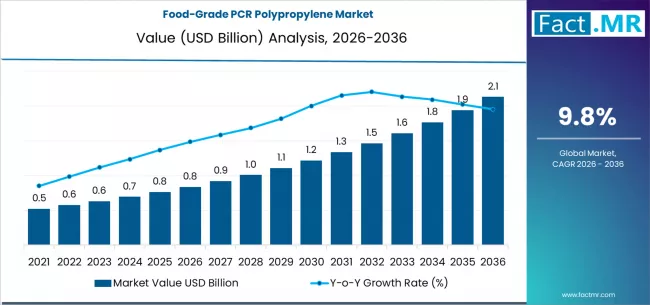
Food Grade Pcr Polypropylene Market Market Value Analysis | Source: Fact.MR
Expansion is fueled by binding legislative targets for recycled content in food-contact materials, particularly in the EU and North America, which are forcing a once-impossible alignment of safety, functionality, and circularity. The journey from post-consumer waste to certified food-grade resin defines a complex value chain where advanced decontamination is the primary gatekeeper to market access.
The market's evolution is characterized by a technological arms race between mechanical and chemical recycling pathways. Advanced melt filtration and super-cleaning of mechanically recycled PP aim to meet stringent migration limits, while emerging solvent-based purification technologies promise virgin-like quality from mixed waste streams.
Brand owners are transitioning from pilot projects to large-scale offtake agreements, providing the demand certainty needed to justify massive capital investments in food-grade recycling infrastructure. This shift is transforming the sector from a niche endeavor into a fundamental pillar of sustainable packaging portfolios.
Metric
| Metric | Value |
|---|---|
| Market Value (2026) | USD 0.84 Billion |
| Market Forecast Value (2036) | USD 2.13 Billion |
| Forecast CAGR 2026 to 2036 | 9.8% |
Source: Fact.MR analysis. Updated Jan 12, 2026
Category
| Category | Segments |
|---|---|
| End-Use | Food Containers & Closures, Dairy & Ready Meals, FMCG Food Packaging, Value Food Packaging, Foodservice Packaging, Premium Food Packs |
| Packaging Format | Tubs, Lids, Caps; Thermoformed Containers; Rigid Food Packs; Small Containers; Others |
| Material | Food-Grade PCR-PP; High-Purity rPP; PCR-PP Blends; PCR-PP; Others |
| Technology | Super-Clean Recycling & Decontamination; EFSA-Compliant Purification; Advanced Melt Filtration; Cost-Optimised Food-Grade Upgrading; Others |
| Region | North America, Latin America, Western Europe, Eastern Europe, East Asia, South Asia & Pacific, Middle East & Africa |
Source: Fact.MR analysis. Updated Jan 12, 2026
Segmental Analysis
By Technology, Which Process is Defining the Safety Threshold for the Entire Industry?
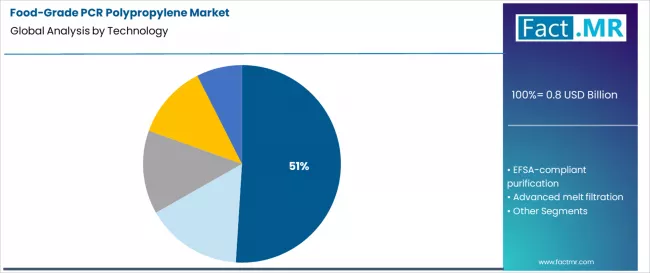
Food Grade Pcr Polypropylene Market Analysis By Technology | Source: Fact.MR
Super-clean recycling and decontamination technologies command a dominant 51.0% share. This segment sets the critical benchmark for removing and deactivating contaminants to meet global food-contact regulations like FDA and EFSA standards.
The process involves multi-stage washing, high-temperature treatment, and advanced filtration to reduce non-intentionally added substances (NIAS) and surrogate contaminants to parts-per-billion levels. Technological leadership here is less about volume and more about certifiable purity, establishing the essential license to operate for any food-grade PCR-PP supplier.
By End-Use, Which Application is Forcing the Most Rigorous Supply Chain Integration?
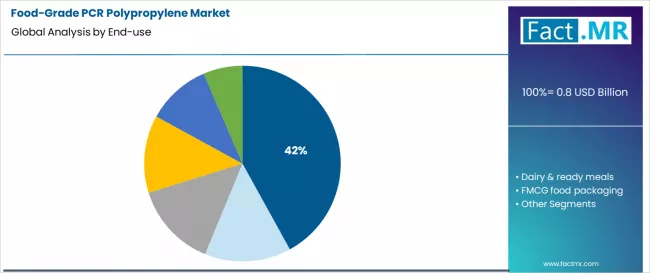
Food Grade Pcr Polypropylene Market Analysis By End Use | Source: Fact.MR
Food containers and closures constitute the primary end-use segment at 42.0%. This application, encompassing yogurt pots, deli packs, and beverage caps, demands not only safety certification but also consistent performance in high-speed filling and sealing lines.
It drives the need for fully integrated, traceable supply chains from sorted balle to finished package, fostering strategic partnerships between chemical companies, recyclers, and packaging converters to ensure unbroken quality assurance.
By Packaging Format, Which Segment is the Most Sensitive to Fluctuations in PCR Processability?
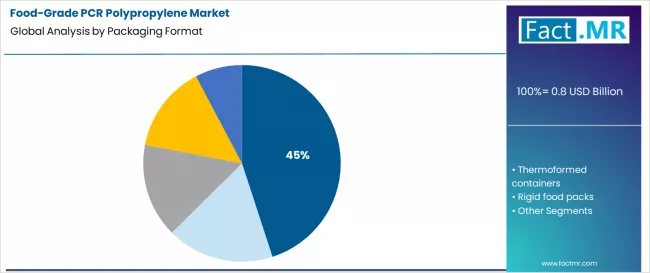
Food Grade Pcr Polypropylene Market Analysis By Packaging Format | Source: Fact.MR
Tubs, lids, and caps represent the leading format with a 45.0% share. These thin-walled, often injection-molded items are highly sensitive to variations in the melt flow rate and thermal stability of the PCR polymer.
Inconsistent material can lead to production defects like warping or weak seals. Therefore, this segment acts as the primary testing ground for the consistency and reliability of food-grade PCR-PP, pushing technology providers to deliver not just pure, but also highly processable materials.
What are the Principal Drivers, Constraints, and Evolving Dynamics of this Market?
| Factor | Influence |
|---|---|
| Legally Mandated Recycled Content for Food Packaging | Direct regulations, such as the EU’s PPWR setting specific targets, create non-negotiable, long-term demand, de-risking investment in expensive purification plants. |
| Extreme Capital Intensity and Lengthy Regulatory Approval Cycles | Building a food-grade PCR facility requires hundreds of millions in capital, and each new process requires 12-18 months for EFSA/FDA approval, severely limiting rapid market entry. |
| First-Mover Advantage in Offtake Agreements with Global Brands | Major CPG companies are securing future supply via multi-year contracts with pioneering technology providers, offering stable revenue streams and market validation. |
| The Rise of "Mass Balance" Attribution for Chemical Recycling Output | To scale supply, the industry is adopting certified mass balance models, allowing chemically recycled content to be credited to food packaging, even from mixed feedstocks. |
Source: Fact.MR analysis. Updated Jan 12, 2026
Analysis of the Food-Grade PCR Polypropylene Market by Key Countries
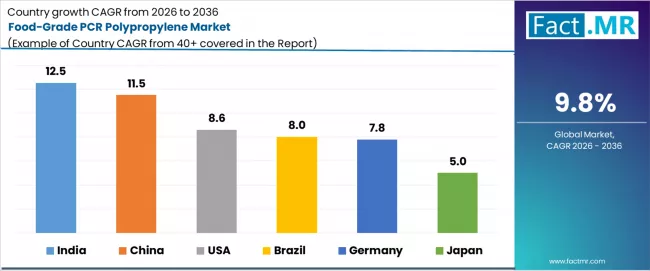
Food Grade Pcr Polypropylene Market Cagr Analysis By Country | Source: Fact.MR
| Country | CAGR 2026 to 2036 |
|---|---|
| India | 12.5% |
| China | 11.5% |
| USA | 8.6% |
| Brazil | 8.0% |
| Germany | 7.8% |
| Japan | 5.0% |
Source: Fact.MR analysis. Updated Jan 12, 2026
How is the USA's Dual-Track Regulatory Environment Shaping Investment Priorities?
The USA's 8.6% CAGR is propelled by a dual-track system: federal FDA guidelines for food-contact safety combined with state-level recycled content mandates. This environment favors investments in technologies that can achieve both FDA Letter of No Objection and scale to meet volume targets like California’s. Growth is characterized by a race between large-scale mechanical purification plants and first commercial-scale advanced recycling facilities aiming to set the new quality standard.
Is Germany's Leadership being Challenged by its Own Regulatory Caution?
Germany’s 7.8% CAGR reflects its role as the EU’s regulatory testing ground, where growth is tempered by extreme caution. The market prioritizes technologies with full EFSA compliance dossiers and demonstrable closed-loop systems, such as bottle-to-bottle recycling for dairy. While this ensures high quality, it also slows the adoption of innovative but less-proven chemical recycling pathways, potentially ceding long-term technological leadership to more agile regions.
Can China's Domestic 'Closed-Loop' Ecosystems Bypass Global Supply Chain Complexities?
China’s 11.5% CAGR is increasingly driven by the development of self-contained regional ecosystems. Major dairy and FMCG producers are partnering with local recyclers and compounders to create vertically integrated loops for specific products (e.g., yogurt cup-to-cup). This model seeks to ensure security of supply, simplify contamination control, and meet national circular economy goals without relying on complex, global food-grade PCR-PP trade flows.
Will India's Growth be defined by Adaptive, Tiered Quality Standards?
India’s leading 12.5% CAGR is pioneering a tiered approach to food-grade standards. While premium segments aim for full international compliance, the vast market for value food packaging is driving innovation in functional barrier technologies and cost-optimized decontamination. This approach aims to safely incorporate PCR into layers not in direct food contact, enabling rapid market growth at multiple price points and safety levels.
Is Brazil's Agri-Industrial Waste Stream the Unexpected Feedstock Source?
Brazil’s 8.0% CAGR is exploring a unique feedstock advantage: agricultural packaging waste. The consistent, high-volume stream of PP from pesticide containers and bulk food sacks, when properly managed, presents a less contaminated input for food-grade recycling compared to complex municipal waste. This is driving a niche focus on building specialized collection and super-cleaning infrastructure tailored to this agri-industrial circular economy.
Does Japan's Pursuit of 'Ultra-Purity' for Premium Segments Limit Scalability?
Japan’s 5.0% CAGR is concentrated in ultra-premium segments like ready meals for convenience stores and high-end confectionery. The relentless focus on odorless, crystal-clear, and sensorially neutral PCR-PP results in exceptionally high processing costs and low yield rates. This specialization creates a high-value niche but may limit the volume scalability needed to impact broader national recycling targets.
Competitive Landscape of the Food-Grade PCR Polypropylene Market
Food Grade Pcr Polypropylene Market Analysis By Company | Source: Fact.MR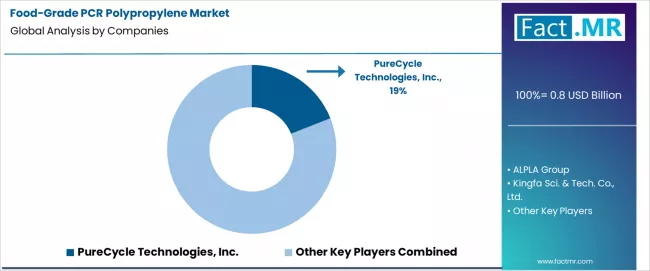
The fiercest competition lies in securing multi-year offtake agreements from global brands, which serve as both financing validation and a barrier to entry for others. Success is increasingly dependent on forming consortia that link feedstock suppliers, technology providers, and brand owners to share the massive financial and regulatory burden of bringing food-grade PCR to market.
Key Players in the Food-Grade PCR Polypropylene Market
- PureCycle Technologies, Inc.
- ALPLA Group
- Kingfa Sci. & Tech. Co., Ltd.
- Manjushree Technopack Ltd.
- Braskem S.A.
- Mitsui Chemicals, Inc.
- Berry Global Inc.
- Borealis AG
Bibliography
- European Food Safety Authority (EFSA). (2025). Scientific Opinion on the Safety Assessment of Post-Consumer Polypropylene Recycling Processes. EFSA Journal.
- Food and Drug Administration (FDA). (2024). Guidance for Industry: Use of Recycled Plastics in Food Packaging (Chemistry Considerations). U.S. Department of Health.
- Food Packaging Forum. (2024). Overview of Global Regulations for Recycled Materials in Food Contact Applications. Foundation Report.
- International Life Sciences Institute (ILSI) Europe. (2025). Practical Guidance on Challenge Tests and Contaminant Removal Efficiency for Plastic Recycling Processes. Packaging Materials Task Force.
Segmentation
Scope of Report
| Items | Metrics |
|---|---|
| Quantitative Units | USD Billion |
| Technology | Super-Clean Recycling, EFSA-Compliant Purification, Advanced Melt Filtration, Cost-Optimised Upgrading, Others |
| Packaging Format | Tubs, Lids, Caps; Thermoformed Containers; Rigid Food Packs; Small Containers; Others |
| End-Use | Food Containers & Closures, Dairy & Ready Meals, FMCG Food Packaging, Value Food Packaging, Foodservice Packaging, Premium Food Packs |
| Material | Food-Grade PCR-PP, High-Purity rPP, PCR-PP Blends, PCR-PP, Others |
| Key Countries | India, China, USA, Brazil, Germany, Japan |
| Key Companies | PureCycle, ALPLA, Kingfa, Manjushree, Braskem, Mitsui Chemicals, Berry Global, Borealis, Others |
| Additional Analysis | Comparative lifecycle assessment (LCA) of mechanical vs. chemical food-grade recycling; migration testing data analysis for different decontamination technologies; total cost-in-use models including regulatory compliance; analysis of mass balance certification models and their market acceptance. |
Source: Fact.MR analysis. Updated Jan 12, 2026
Market by Segments
-
End-Use :
- Food Containers & Closures
- Dairy & Ready Meals
- FMCG Food Packaging
- Value Food Packaging
- Foodservice Packaging
- Premium Food Packs
-
Packaging Format :
- Tubs, Lids, Caps
- Thermoformed Containers
- Rigid Food Packs
- Small Containers
- Others
-
Material :
- Food-Grade PCR-PP
- High-Purity rPP
- PCR-PP Blends
- PCR-PP
- Others
-
Region :
-
North America
- USA
- Canada
-
Latin America
- Brazil
- Mexico
- Argentina
- Rest of Latin America
-
Western Europe
- Germany
- France
- Italy
- Spain
- UK
- BENELUX
- Rest of Western Europe
-
Eastern Europe
- Russia
- Poland
- Czech Republic
- Rest of Eastern Europe
-
East Asia
- China
- Japan
- South Korea
- Rest of East Asia
-
South Asia & Pacific
- India
- ASEAN
- Australia
- Rest of South Asia & Pacific
-
MEA
- GCC Countries
- South Africa
- Turkiye
- Rest of MEA
-
Frequently Asked Questions
How big is the food-grade pcr polypropylene market in 2026?
What will be the size of food-grade pcr polypropylene market in 2036?
How much will be the food-grade pcr polypropylene market growth between 2026 and 2036?
What are the key product types in the food-grade pcr polypropylene market?
Which packaging format segment to contribute significant share in the food-grade pcr polypropylene market in 2026?
Who worked on this report


Preview the report firsthand - request a free sample
Free SampleGet the brochure for pricing and purchase details
Download PDF