- Market Value (2025): USD 136.5 Mn
- Estimated Value (2026): USD 152 Mn
- Forecast Value (2036): USD 445 Mn
- CAGR (2026-2036): 11.3%
What is the LNG Fueling Breakaway Couplings Market forecast to be worth by 2036?
USD 152 million in 2026 to USD 445 million by 2036, at 11.3% CAGR.
- The market stood at roughly USD 136.5 million in 2025 as LNG truck fueling networks and marine bunkering operations expanded their installed coupling base.
- Revenue is projected to rise from USD 152 million in 2026 to USD 445 million by 2036 as LNG fueling infrastructure spreads across road, marine, rail and industrial fleet applications.
- An 11.3% CAGR from 2026 to 2036 reflects connection count growth in Chinese truck fueling, European and Asian bunkering, and fleet fueling for heavy transport, plus the replacement and test cycles that safety rules impose.
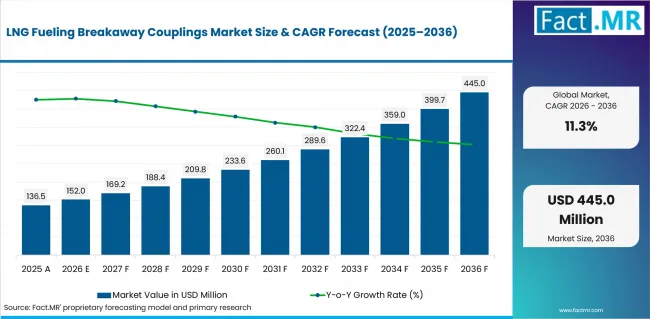
Lng Fueling Breakaway Couplings Market Value Analysis | Source: Fact.MR
What are the defining numbers behind LNG Fueling Breakaway Couplings Market growth?
USD 293 million absolute opportunity by 2036, led by Dual-shutoff breakaways and LNG truck fueling within their respective segments.
- Demand Drivers in the Market
- China sold approximately 198,700 LNG-powered heavy trucks in 2025, up 11.6% year on year, with LNG models holding about a quarter of heavy-truck sales, and every fueling event across that fleet passes through a connection protected by a breakaway coupling.
- The ABS Guide for LNG Bunkering requires delivery systems to disconnect rapidly via dry-break emergency release couplings or breakaway couplings that operate when design loads are exceeded in any direction, function under ice formation, and release minimum LNG when activated.
- The European Environment Agency counts 67 ports in the EU-27 with LNG bunkering capacity, 45 of them on the TEN-T core network, following AFIR’s requirement for liquefied methane refuelling points at core ports, and each bunkering point needs breakaway protection.
- The Maritime and Port Authority of Singapore recorded LNG bunker sales up 23.1% to 571,400 tonnes in 2025 and opened applications for new LNG bunker supply licences in January 2026, expanding the bunkering fleet whose transfer connections require certified couplings.
- Fleet operators running LNG trucks, buses and industrial vehicles build private fueling stations whose dispensers and hose assemblies incorporate breakaways as standard safety hardware.
- Key Segments Analyzed
- By Coupling Type: Dual-shutoff breakaways lead at 48.4% of 2026 demand because sealing both the station side and the vehicle or hose side on separation is what prevents a cryogenic release during a drive-away, and both safety codes and operator experience have made single-sided closure effectively unsalable in LNG fueling service.
- By Application: LNG truck fueling accounts for 40.0% of application demand on the strength of China’s heavy-truck fleet and expanding station networks in Asia, while LNG marine bunkering at 22.0% grows fastest as ship-to-ship and truck-to-ship bunkering multiply exposed connections.
- By Reconnection: Reusable and reconnectable designs hold 41.0% of demand because a drive-away that can be reset on site costs an operator minutes, while single-use frangible designs at 28.0% persist where their lower purchase price and guaranteed fresh shear elements suit low-frequency stations.
- By End User: Fleet operators hold 29.0% of end user demand as owners of private fueling infrastructure. LNG fueling stations and bunkering operators also buy couplings for their transfer points, reflecting demand across private and public fueling operations.
- Analyst Opinion at Fact.MR
- Shambhu Nath Jha, Sr. Consultant at Fact.MR, states, “The breakaway is cheap insurance until the day it fires, and then it is the only thing between a mishap and a cryogenic release across the forecourt. What buyers have learned is to ask two questions: does it seal both sides every time, and what does it cost to put back in service. The suppliers winning fleet accounts are the ones whose coupling reconnects in the field with standard tools, because a station that is down is a station losing money.”
- Strategic Implications
- Station operators should standardize breakaway models across networks, so spare parts, test procedures and staff training transfer between sites.
- Suppliers can differentiate on reconnection cost and time, publishing reset procedures and spare shear element pricing rather than only separation specifications.
- Bunkering operators should select couplings tested to operate under ice formation conditions, as class guidance explicitly demands performance in iced states.
- Fleet owners gain from couplings with integrated break detection tied to station controls, so a fired breakaway shuts the dispenser and logs the event automatically.
Dixon MannTek and Trelleborg KLAW document cryogenic breakaway and emergency-release coupling ranges used in LNG transfer systems. For fleet stations and bunkering operators, the practical issue is whether a fired coupling can isolate both sides, be inspected quickly, and return the fueling line to service with documented reset steps.
The United States is projected to grow at 11.6% on fleet fueling and marine bunkering pilots. Germany follows at 11.2% on corridor fueling and bunkering, the Netherlands advances at 11.0% as Europe’s bunkering hub, and India records 10.5% as its LNG station rollout begins from a low base.
How does the LNG Fueling Breakaway Couplings Market break down by segment?
The leading shares are Dual-shutoff breakaways at 48.4% by Coupling Type and LNG truck fueling at 40.0% by Application.
Why do dual-shutoff breakaways dominate the coupling mix?
At 48.4% share in 2026, dual-shutoff breakaways lead because sealing both sides on separation is the defining safety requirement of cryogenic fueling.
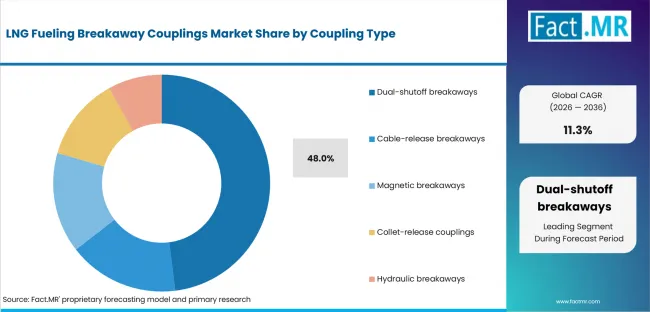
Lng Fueling Breakaway Couplings Market Analysis By Coupling Type | Source: Fact.MR
Dual-shutoff breakaways account for 48.4% of demand because LNG at minus 162 degrees C cannot be allowed to vent from either the station or the vehicle side when a line parts, and valves on both ends of the break plane are the only design that guarantees it. Cable-release breakaways suit vehicle fueling where a tension cable triggers separation. Magnetic designs prioritize fast reconnection, collet-release couplings fit marine service, and hydraulic breakaways serve specialized high-flow installations.
Why does LNG truck fueling lead the application group?
A 40.0% share puts LNG truck fueling first in 2026 because China’s heavy-truck fleet alone generates fueling events at a scale no other application matches.
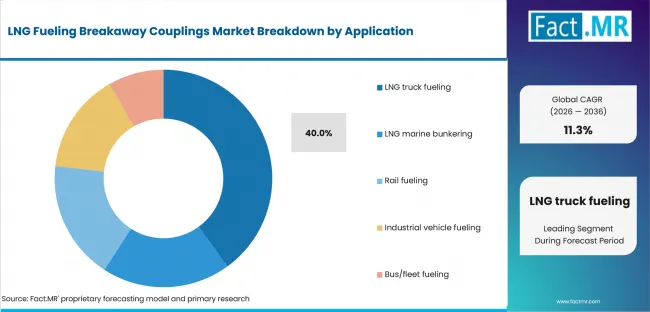
Lng Fueling Breakaway Couplings Market Analysis By Application | Source: Fact.MR
LNG truck fueling represents 40.0% of application demand because roughly 200,000 LNG heavy trucks were sold in China in 2025 on top of the existing fleet, and each truck fuels weekly or more across a station network that must protect every hose connection. LNG marine bunkering adds exposed ship-to-ship and truck-to-ship connections. Rail fueling follows locomotive pilots, while industrial vehicles and bus fleets use dedicated fueling arrangements.
Why do reconnectable designs lead reconnection types?
The 2026 leader is reusable/reconnectable couplings at 41.0% share because high-utilization stations cannot afford consumable shear elements after every incident.
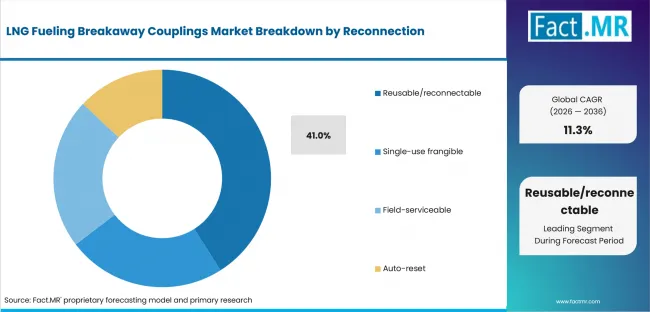
Lng Fueling Breakaway Couplings Market Analysis By Reconnection | Source: Fact.MR
Reusable and reconnectable breakaways account for 41.0% of demand because busy truck stations and bunkering operations experience drive-away and drift events often enough that per-incident hardware replacement is a real operating cost. Single-use frangible designs suit low-frequency stations where purchase price dominates. Field-serviceable couplings support on-site maintenance, while auto-reset designs fit automated fueling operations.
Why do fleet operators lead the end user group?
The leading 2026 share is 29.0% for fleet operators because private fueling infrastructure has spread couplings beyond the public station network.
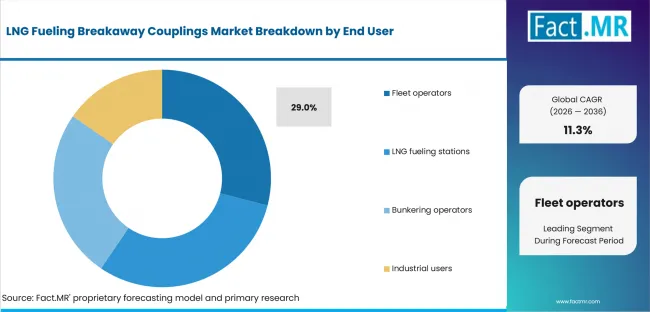
Lng Fueling Breakaway Couplings Market Analysis By End User | Source: Fact.MR
Fleet operators represent 29.0% of demand because trucking, mining, port and industrial fleets running LNG vehicles build their own fueling points, each equipped with breakaway-protected dispensers and hoses. LNG fueling stations provide the public retail channel, bunkering operators equip transfer connections, and industrial users install protection at on-site fueling locations.
What is accelerating LNG Fueling Breakaway Couplings Market adoption, and what is holding it back?
The principal accelerator is the growth of LNG fueling connections across truck, marine, rail and industrial applications, each requiring certified breakaway protection. Adoption is slowed by the capital cost of station buildout, competition from electric trucks in China, and fragmented standards across fueling applications.
Drivers Impact Analysis
| DRIVER | (~) % IMPACT ON CAGR | GEOGRAPHIC RELEVANCE | IMPACT TIMELINE |
|---|---|---|---|
| Chinese LNG truck fleet | +1.8% | China | Medium term (2-4 years) |
| Marine bunkering expansion | +1.5% | Singapore, Netherlands, China | Medium term (2-4 years) |
| European corridor fueling | +1.2% | Germany, Netherlands, Spain | Short term (<= 2 years) |
| Fleet station buildout | +1.0% | Global | Long term (>= 4 years) |
| Rail LNG fueling pilots | +0.7% | United States, India | Long term (>= 4 years) |
Source: Fact.MR analysis. Updated Jul 24, 2026
- Chinese LNG truck fleet: With about 198,700 LNG heavy trucks sold in 2025 at an 11.6% growth rate, China’s fueling station network keeps adding dispensers and hoses, each carrying breakaways that are replaced on test and incident cycles.
- Marine bunkering expansion: Singapore’s LNG bunker sales rose 23.1% to 571,400 tonnes in 2025 per the Maritime and Port Authority, and the EEA counts 67 LNG-capable bunkering ports in the EU-27. More bunkering points mean more transfer connections requiring certified separation protection.
- European corridor fueling: AFIR-driven infrastructure obligations and national truck decarbonization programs sustain LNG fueling corridors across Northwest Europe even as zero-emission alternatives develop.
Opportunity Impact Analysis
| OPPORTUNITY | (~) % IMPACT ON CAGR | GEOGRAPHIC RELEVANCE | IMPACT TIMELINE |
|---|---|---|---|
| Bunker vessel standard packages | +0.6% | Singapore, Northwest Europe | Short term (<= 2 years) |
| Smart breakaways with event logging | +0.5% | Fleet stations | Medium term (2-4 years) |
| Indian station rollout | +0.4% | India | Long term (>= 4 years) |
| Bio-LNG and e-methane compatibility | +0.3% | Europe | Long term (>= 4 years) |
Source: Fact.MR analysis. Updated Jul 24, 2026
- Bunker vessel standard packages: Singapore’s forthcoming Standards for Port Limit LNG Bunker Vessels and the upgrade of its TR56 bunkering reference to a full Singapore Standard in 2026 will standardize vessel transfer equipment, pulling coupling specifications behind it.
- Smart breakaways: Couplings with separation detection wired into dispenser controls log incidents, trigger shutdowns and support insurance documentation, a premium feature fleet operators increasingly specify.
- Indian station rollout: India’s city gas and transport energy policies include LNG stations for long-haul trucking, and the network buildout from a near-zero base multiplies coupling demand through the forecast period.
Restraints Impact Analysis
| RESTRAINT | (~) % IMPACT ON CAGR | GEOGRAPHIC RELEVANCE | IMPACT TIMELINE |
| Electric truck competition | -0.6% | China | Long term (>= 4 years) |
| Station capital cost | -0.4% | Developing markets | Medium term (2-4 years) |
| Standards fragmentation | -0.3% | Cross-border operations | Medium term (2-4 years) |
| Diesel price cycles | -0.2% | Fuel economics globally | Short term (<= 2 years) |
Source: Fact.MR analysis. Updated Jul 24, 2026
- Electric truck competition: Chinese electric heavy trucks overtook LNG models in 2025 sales share, with new energy trucks reaching 29% of heavy-truck sales, and provincial policies now favor electric vehicles, capping long-run LNG fleet growth in the market’s largest country.
- Station capital cost: LNG fueling stations require cryogenic storage, dispensing and safety systems whose cost slows network expansion, particularly in price-sensitive markets.
- Standards fragmentation: Vehicle-side and station-side connection standards vary by region and application, complicating coupling qualification across markets and raising testing costs for suppliers.
How do the leading LNG fueling breakaway coupling markets compare?
United States 11.6%. Germany 11.2%. Netherlands 11.0%.
Regional analysis addresses Asia Pacific, North America, and Europe through country sections, the United States, Germany, the Netherlands, and India, with more than 30 countries treated in the complete report.
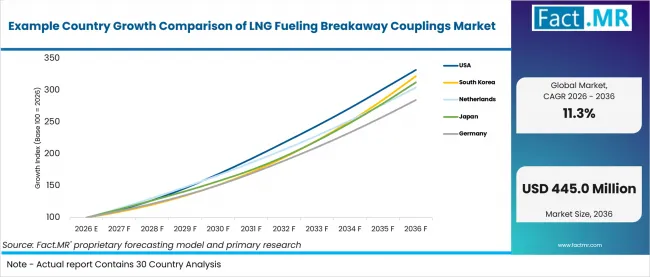
Example Country Growth Comparison Of Lng Fueling Breakaway Couplings Market | Source: Fact.MR
| COUNTRY | CAGR |
|---|---|
| United States | 11.6% |
| Germany | 11.2% |
| Netherlands | 11.0% |
Source: Fact.MR analysis. Updated Jul 24, 2026
Why Do US Fleet and Marine Programs Compound from a Small Base?
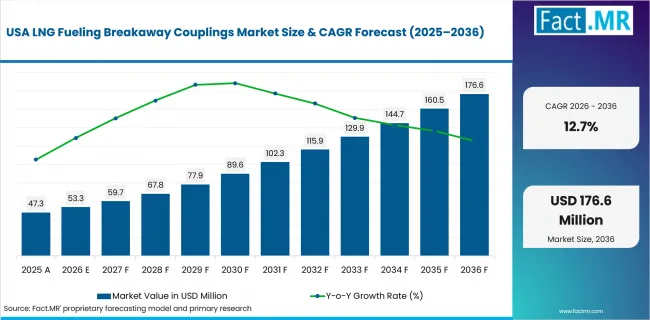
Lng Fueling Breakaway Couplings Market Country Value Analysis | Source: Fact.MR
The United States runs LNG fueling for drayage, refuse and regional haul fleets, with station networks concentrated in California and Texas, and federal alternative fuel infrastructure programs continue to support corridor fueling. Marine bunkering adds a second stream as LNG-fuelled vessel calls at U.S. ports increase and bunkering operations formalize under Coast Guard oversight.
The regulatory framework for cryogenic transfer, from PHMSA’s transport rules to class society bunkering guides adopted in U.S. operations, specifies breakaway and emergency release protection at every connection. The United States carries an 11.6% CAGR from 2026 to 2036.
Why Is Germany a Corridor and Bunkering Dual Market?
Germany’s highway network hosts one of Europe’s denser LNG fueling station footprints serving long-haul trucking, and its ports, led by Hamburg, are developing LNG bunkering under the EU framework that the European Environment Agency credits with 67 LNG-capable bunkering ports across the EU-27.
German equipment standards and TUV-style certification culture raise the specification bar, favoring couplings with complete type test documentation. Germany’s demand grows at an 11.2% CAGR from 2026 to 2036.
Why Does the Netherlands Anchor European Bunkering Coupling Demand?
The Netherlands, through Rotterdam, operates Europe’s largest bunkering port and its most developed LNG bunkering operation, with ship-to-ship LNG transfer running as routine business. Dutch ports have offered environmental incentives for cleaner vessels for years, as documented in OECD and ITF analysis of port fee differentiation.
Every bunkering connection in that ecosystem carries emergency release and breakaway hardware tested to class guidance, and fleet expansion keeps coupling demand growing at an 11.0% CAGR from 2026 to 2036.
Who leads the LNG Fueling Breakaway Couplings Market?
OPW (Dover), MannTek, Trelleborg KLAW, Stäubli, Dixon, and ARTA compete through dual-shutoff reliability, reconnection economics, and certification depth.
Competition centers on dual-side shut-off reliability, low-cost reconnection, certification, and documented test performance. Dixon MannTek’s documented cryogenic dry-disconnect and safety-breakaway products illustrate the importance of return-to-service economics; OPW, Trelleborg KLAW, Stäubli, and ARTA offer additional sourcing options for station, fleet, and bunkering applications.
Competitive differentiation centers on bunker-vessel standard packages, event-logging couplings, and the Indian station rollout.
Which companies are the key providers?
The company set includes OPW (Dover), MannTek, Trelleborg KLAW, Stäubli, Dixon, and ARTA.
- OPW (Dover)
- MannTek
- Trelleborg KLAW
- Stäubli
- Dixon
- ARTA
The six named manufacturers anchor the comparison, and the full report reviews more than 20 coupling and fueling equipment suppliers.
Bibliography
- ICIS / Commercial Vehicle World. (2026). China’s shift to electric heavy trucks pressures LNG use in transport (2025 LNG truck sales data).
- European Environment Agency. (2026). Energy infrastructure: AFIR liquefied methane refuelling points and LNG bunkering facilities in EU ports.
- Maritime and Port Authority of Singapore. (2026). Singapore Posts Record Port Performance in 2025 (LNG bunker sales and new supply licences).
- American Bureau of Shipping. (2018). Guide for LNG Bunkering, Section 9.7: Emergency Release System.
- OECD / International Transport Forum. (2018). Fuelling Maritime Shipping with Liquefied Natural Gas.
- Dixon. (n.d.). Cryogenic Products: Dixon MannTek cryogenic dry disconnects and safety breakaway couplings.
- Stäubli. (n.d.). KBH cryogenic breakaway couplings.
This Report Addresses
- The report quantifies the 2025 baseline and forecasts revenue from 2026 through 2036.
- It compares China, the United States, Germany, the Netherlands, and India, drawing on country coverage of 30+ markets.
- It evaluates OPW (Dover), MannTek, Trelleborg KLAW, Stäubli, Dixon, and ARTA.
- It examines coupling type, application, reconnection, and end user choices.
- It separates truck, marine, rail, industrial, and fleet fueling demand.
- It tests the forecast against fleet growth, bunkering expansion, station buildout, and electric truck competition.
What does the LNG Fueling Breakaway Couplings Market cover?
The study follows breakaway safety hardware from station and vessel specification through daily fueling service and incident replacement.
Revenue includes the coupling body, shut-off valves, release mechanisms, shear elements and reconnection components, plus spare parts and recertification billed by the manufacturer. Dispensers and complete hose assemblies are excluded.
Demand is segmented by coupling type, application, reconnection, and end user. Country estimates reflect vehicle fleet sizes, station and bunkering point counts, safety enforcement, and replacement cycles.
What is included in the scope?
Included devices protect LNG fueling connections by separating and sealing under drive-away or excess-load conditions.
Dual-shutoff, cable-release, magnetic, collet-release and hydraulic breakaways are counted across truck, marine, rail, industrial and fleet fueling applications. Spare shear elements, seal kits and recertification are covered when supplied by the coupling manufacturer.
What is excluded from the scope?
Fueling nozzles, dispensers, complete hose assemblies, and emergency release couplings for cargo transfer are not included.
The study excludes fueling nozzles and receptacles, dispenser systems, full hose assemblies, marine cargo emergency release couplings covered in a separate study, and station cryogenic storage equipment.
How was the analysis built?
Fleet and station counts, connection data, operator interviews, and forecast cross-checks referencing more than 30 countries.
- Primary Research: Primary research targets station operators, fleet managers, bunkering companies, coupling manufacturers, and safety inspectors. Interviews test connection counts, incident rates, reconnection practice, test cycles, and procurement criteria.
- Desk Research: Desk research reviews port authority statistics, European environmental agency infrastructure data, vehicle registration reporting, class society guides, and manufacturer literature. Named statistics are used only when supported by the government or intergovernmental sources listed in the bibliography.
- Market-Sizing and Forecasting: Sizing is developed from connection counts, couplings per connection, type and size mixes, realized pricing, incident replacement rates, and test cycles. The result is reconciled to USD 152 million in 2026 and USD 445 million in 2036.
- Data Validation and Update Cycle: Validation compares segment shares, supplier positions, and country growth with vehicle sales and bunkering statistics. Update signals include station openings, bunker licence awards, standard revisions, and fleet orders.
Segmentation
What is the report’s scope and coverage?
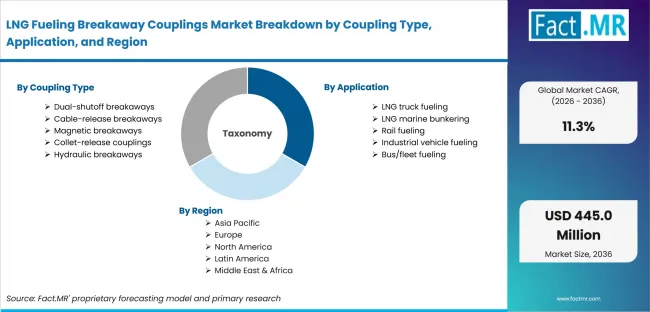
Lng Fueling Breakaway Couplings Market Breakdown By Coupling Type, Application, And Region | Source: Fact.MR
| ATTRIBUTE | DETAILS |
|---|---|
| Quantitative Units | USD 152 million in 2026 to USD 445 million by 2036 at 11.3% CAGR |
| Market Definition | The market covers breakaway couplings for LNG vehicle and vessel fueling that separate safely under drive-away or excess-load conditions, sealing both ends to prevent cryogenic release, across truck, marine, rail and fleet fueling. |
| Coupling Type | Dual-shutoff breakaways; Cable-release breakaways; Magnetic breakaways; Collet-release couplings; Hydraulic breakaways |
| Application | LNG truck fueling; LNG marine bunkering; Rail fueling; Industrial vehicle fueling; Bus/fleet fueling |
| Reconnection | Reusable/reconnectable; Single-use frangible; Field-serviceable; Auto-reset |
| End User | LNG fueling stations; Fleet operators; Bunkering operators; Industrial users |
| Regions Covered | Asia Pacific; North America; Europe |
| Countries Covered | United States; Germany; Netherlands(full report analyzes 30+ countries) |
| Key Companies Profiled | OPW (Dover); MannTek; Stäubli; Trelleborg KLAW; Dixon; ARTA |
| Forecast Period | 2026 to 2036 |
| Approach | Sizing combines fueling connection counts by application, coupling prices by type and size, test and replacement cycles, and separately billed spares and recertification. |
Source: Fact.MR analysis. Updated Jul 24, 2026
How is the market segmented?
-
By Coupling Type:
- Dual-shutoff breakaways
- Cable-release breakaways
- Magnetic breakaways
- Collet-release couplings
- Hydraulic breakaways
-
By Application:
- LNG truck fueling
- LNG marine bunkering
- Rail fueling
- Industrial vehicle fueling
- Bus/fleet fueling
-
By Reconnection:
- Reusable/reconnectable
- Single-use frangible
- Field-serviceable
- Auto-reset
-
By End User:
- LNG fueling stations
- Fleet operators
- Bunkering operators
- Industrial users
-
By Region:
- Asia Pacific
- North America
- Europe
Frequently Asked Questions
What is the LNG fueling breakaway couplings market worth in 2026?
What revenue level is projected for LNG fueling breakaway couplings in 2036?
What CAGR is expected through 2036?
Which coupling type leads demand?
Which application is the largest segment?
Which reconnection type has the largest share?
Which end user is most common?
Who worked on this report


Preview the report firsthand - request a free sample
Free SampleGet the brochure for pricing and purchase details
Download PDF