- Market Value (2025): USD 1.0 Bn
- Estimated Value (2026): USD 1.2 Bn
- Forecast Value (2036): USD 4.4 Bn
- CAGR (2026-2036): 14.0%
What is the Low-Noise Industrial Blowers Market forecast to be worth by 2036?
USD 1.2 billion in 2026 to USD 4.4 billion by 2036 at a 14.0% CAGR.
- The Low-Noise Industrial Blowers Market reached USD 1.0 billion in 2025.
- Demand is set to increase from USD 1.2 billion in 2026 to USD 4.4 billion by 2036.
- The market is forecast to record 14.0% CAGR from 2026 to 2036. Water treatment teams and plants are likely to place more weight on sound performance and energy-efficient airflow control.
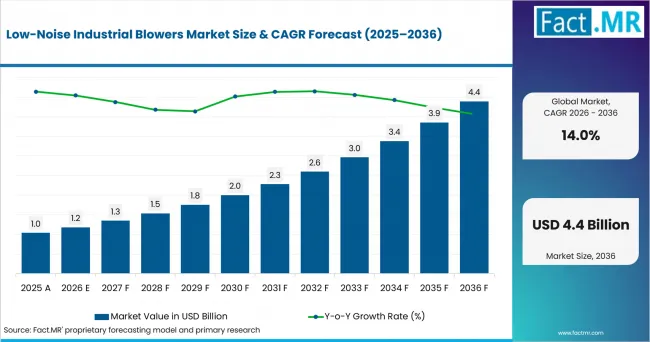
Low Noise Industrial Blowers Market Value Analysis | Source: Fact.MR
What are the defining numbers behind Low-Noise Industrial Blowers Market growth?
An absolute opportunity of USD 3.2 billion is expected between 2026 and 2036.
- Demand Drivers in the Market
- Water treatment plants need steady airflow for aeration and need to reduce noise in blower rooms.
- Food plants need clean air for production and less noise in work areas. Oil-free enclosed units can help keep the area clean and make maintenance easier.
- Factories require compact air-flow equipment which can be situated close to the worker. In April 2026 NIOSH reported that about 38% of U.S. manufacturing workers had been exposed to hazardous noise levels in the past year. Quieter blowers can help reduce noise around workers.
- Key Segments Analyzed
- By Blower Technology: Regenerative is likely to hold 31.0% share in 2026 due to compact construction and smooth airflow.
- By Noise Level: <65 dBA is expected to account for 37.0% share in 2026.
- By Noise Reduction: Acoustic enclosure is anticipated to capture 33.0% share in 2026 because the same approach fits several blower technologies.
- By Application: Wastewater is estimated to represent 31.0% share in 2026 owing to long aeration hours and close review of sound.
- Analyst Opinion at Fact.MR
- Fact.MR Principal Consultant Shambhu Nath Jha states, “Demand for low-noise blowers is growing because these systems run for long hours near workers and equipment. Buyers need to compare noise levels, energy use, and how well the blower works at different operating levels.”
- Strategic Implications
- System providers can use covers and silencers that match the blower. These parts need to reduce noise without blocking cooling air. The same setup can also be used in stationary air compressor rooms.
- Water treatment contractors need to check blower noise and performance at different speeds. Ofwat reported in November 2025 that the 2025–2030 water-sector program supports GBP 104 billion in spending.
- Plant owners can use removable sound panels for easier maintenance. Workers can open the panels for checks and repairs without removing the full cover or stopping the plant for a long time.
Japan is forecast to post 13.9% CAGR through 2036 because water and factory investment support equipment renewal. The USA is projected at 13.6% while Germany reaches 13.3%. France is anticipated at 13.0% and the UK at 9.9%.
How does the Low-Noise Industrial Blowers Market break down by segment?
Regenerative blowers lead Blower Technology at 31.0%; <65 dBA leads Noise Level at 37.0% share.
Which Blower Technology dominates?
Regenerative blowers are expected to hold 31.0% share in 2026.
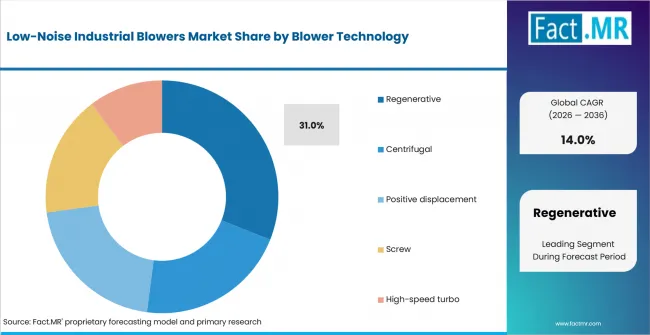
Low Noise Industrial Blowers Market Analysis By Blower Technology | Source: Fact.MR
Regenerative blowers are likely to hold a 31.0% share in 2026 because they need less space and provide steady airflow. Centrifugal blowers handle large and continuous airflow. Positive displacement and screw blowers create steady pressure and are easy to maintain. High-speed blowers handle high airflow in which noise and controls are important.
What leads the Noise Level segment?
<65 dBA is projected to account for 37.0% share in 2026.
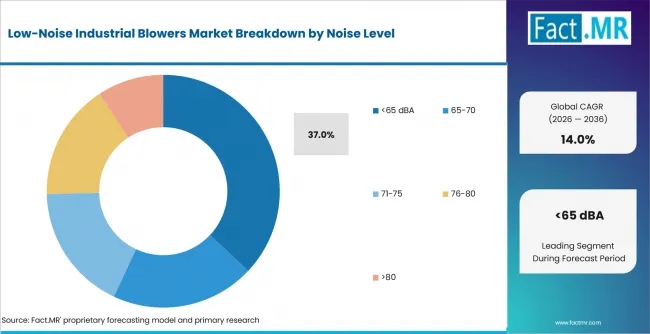
Low Noise Industrial Blowers Market Analysis By Noise Level | Source: Fact.MR
<65 dBA is leading this segment, as plants look for low-noise equipment near work areas. In August 2025, AERZEN reported that its new Delta Hybrid D23S and D31S models have maximum noise levels of 72 dB(A) and 73 dB(A), respectively.
How does Noise Reduction shape demand?
Acoustic enclosure is anticipated to capture 33.0% share in 2026.
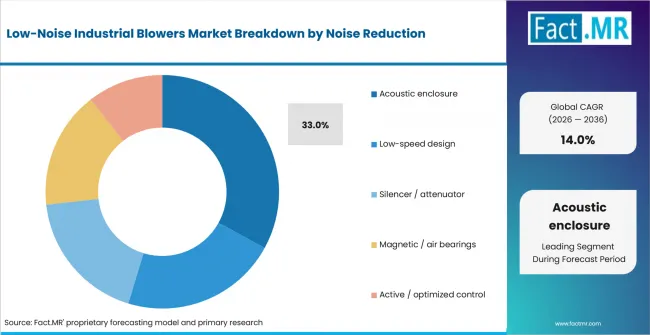
Low Noise Industrial Blowers Market Analysis By Noise Reduction | Source: Fact.MR
Acoustic enclosure is expected to hold a 33.0% share in 2026 because they work with different blower types and existing systems. Low-speed designs reduce blower noise, compare to silencers reduce noise at the air inlet and outlet. Magnetic or air bearings reduce noise from moving parts.
What supports Wastewater within Application?
Wastewater is estimated to represent 31.0% share in 2026.
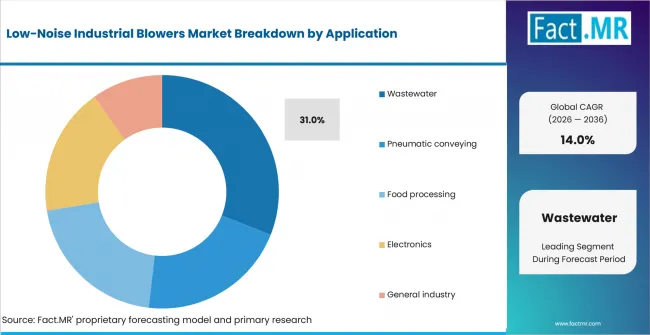
Low Noise Industrial Blowers Market Analysis By Application | Source: Fact.MR
Wastewater leading the application segment because aeration runs for long hours. Pneumatic conveying transports materials using a steady low pressure airflow. Food plants use blowers to keep the air clean. Factories use quieter blowers near workers and production lines.
What is accelerating Low-Noise Industrial Blowers Market adoption, and what is holding it back?
Adoption helps to increases noise limits and wastewater upgrades, while high upgrade costs and different operating needs reduces the growth.
Drivers Impact Analysis
| DRIVER | (~) % IMPACT ON CAGR | GEOGRAPHIC RELEVANCE | IMPACT TIMELINE |
|---|---|---|---|
| Wastewater aeration modernization | +2.0% | North America, Europe, East Asia | Short term (<= 2 years) |
| Workplace and community noise control | +1.6% | North America, Europe, Japan | Medium term (2-4 years) |
| Energy-efficient variable-speed blowers | +1.3% | Global | Medium term (2-4 years) |
| Pneumatic conveying upgrades | +0.9% | North America, Europe, East Asia | Long term (>= 4 years) |
Source: Fact.MR analysis. Updated Oct 1, 2026
Opportunity Impact Analysis
| OPPORTUNITY | (~) % IMPACT ON CAGR | GEOGRAPHIC RELEVANCE | IMPACT TIMELINE |
|---|---|---|---|
| Low-noise retrofit packages | +1.2% | North America, Western Europe | Short term (<= 2 years) |
| Integrated controls and monitoring | +1.0% | Global | Medium term (2-4 years) |
| Compact high-speed systems | +0.8% | East Asia, Europe | Medium term (2-4 years) |
Source: Fact.MR analysis. Updated Oct 1, 2026
Restraints Impact Analysis
| RESTRAINT | (~) % IMPACT ON CAGR | GEOGRAPHIC RELEVANCE | IMPACT TIMELINE |
|---|---|---|---|
| Higher capital cost of quiet packages | -0.8% | Global | Short term (<= 2 years) |
| Acoustic performance varies by duty | -0.6% | Global | Medium term (2-4 years) |
| Retrofit ventilation and space limits | -0.4% | Europe, North America | Medium term (2-4 years) |
Source: Fact.MR analysis. Updated Oct 1, 2026
Which countries are scaling the Low-Noise Industrial Blowers Market through 2036?
- The displayed country range spans 4.0 points across the 2026 to 2036 forecast period.
- Japan remains 0.3 percentage point above the USA as water and factory investment support equipment renewal.
- The USA remains 0.3 percentage point above Germany as water systems and manufacturing investment support new equipment.
- Germany remains 0.3 percentage point above France as its manufacturing and wastewater base sustains plant-air demand.
- France remains 3.1 percentage points above the UK as water financing supports treatment upgrades.
- The UK closes the range while AMP8 water treatment spending provides a defined project pipeline.
Entry conditions differ because blower demand depends on treatment spending and factory activity. Site noise and retrofit economics shape the final equipment choice.
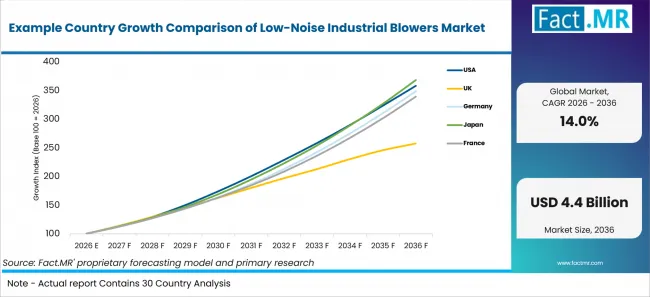
Example Country Growth Comparison Of Low Noise Industrial Blowers Market | Source: Fact.MR
| Country | CAGR (2026-2036) |
|---|---|
| Japan | 13.9% |
| United States | 13.6% |
| Germany | 13.3% |
| France | 13.0% |
| United Kingdom | 9.9% |
Source: Fact.MR analysis. Updated Oct 1, 2026
What supports USA adoption?
13.6% CAGR, driven by manufacturing investment and wastewater renewal.
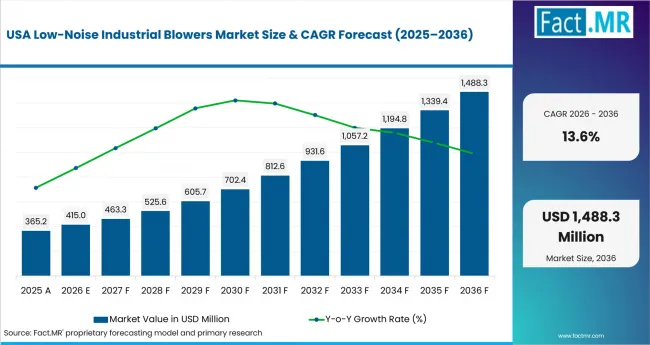
Low Noise Industrial Blowers Market Country Value Analysis | Source: Fact.MR
U.S. plant operators look to blower noise, energy use in replacement of air equipment. In June 2026, the Bureau of Economic Analysis reported new foreign investment in U.S. manufacturing of USD 121.8 billion in 2025. As new and expanded factories come on line, demand is increasing for low-pressure air flow systems. Industrial ventilation fans may run in the same areas, so plants need to control noise from both systems.
How is the United Kingdom scaling demand?
9.9% CAGR, backed by manufacturing activity and water-sector upgrades.
UK demand is supported by manufacturing and wastewater treatment. In July 2026, the Office for National Statistics states that UK manufacturers recorded GBP 452.0 billion in product sales in 2025. Manufacturing plants need blowers for process air and material movement.
What is supporting Germany’s adoption?
13.3% CAGR, supported by manufacturing depth and wastewater modernization.
Germany has a large industrial sector, which drives demand for low-pressure airflow equipment. In 2024, there were 209,815 manufacturing units in Germany, Destatis said as of December 2025. This supports the replacement of equipment in factories and wastewater plants.
How does Japan perform?
13.9% CAGR, led by factory investment and wastewater equipment renewal.
Factories in Japan are expected to prefer compact and low-noise blowers with stable air flow. Large manufacturers saw software, research and development and fixed investment (excluding land) rise 7.8% in fiscal 2025, the Bank of Japan said in June 2026. This spending supports blower replacement in factories.
What supports France’s growth?
13.0% CAGR, supported by water financing and food-industry activity.
Adoption of blowers in France is supported by water projects and food-processing activity. The Ministry for Ecological Transition reported in July 2026 that funding for the AquaPrêts program will reach EUR 6 billion by 2028. This funding supports water and sanitation projects that use low-pressure airflow. Waste management equipment and blowers are also used at treatment sites.
Who leads the Low-Noise Industrial Blowers Market?
Ingersoll Rand acquired Lone Star Blower in August 2026. The deal added centrifugal, geared, gearless, and multistage blowers, along with controls, services, and rental equipment. Lone Star supplies blowers for water treatment, wastewater treatment, and other industries. Ingersoll Rand said the deal expands its blower business in the water and wastewater sector.
Atlas Copco, Kaeser, and AERZEN supply blowers for industrial and wastewater use. Gardner Denver is part of Ingersoll Rand, so it should not be listed as a separate company. Howden supplies centrifugal blowers for water and industrial use and is now part of Baker Hughes after the integration of Chart Industries.
Buyers consider noise, energy use, airflow, maintenance, controls and service in blowers. The noise levels depend on the blower type, design, operating conditions, installation location and noise control system. Wastewater plants and factories compare airflow, pressure, energy use, and noise when choosing blowers.
Which companies are the key providers?
Key companies include Atlas Copco; Ingersoll Rand; Kaeser; AERZEN; Gardner Denver; and Howden.
- Atlas Copco
- Ingersoll Rand
- Kaeser
- AERZEN
- Gardner Denver
- Howden
Bibliography
- National Institute for Occupational Safety and Health. (2026, April 13). Manufacturing statistics. Centers for Disease Control and Prevention.
- Ofwat. (2024, December 19). PR24 final determinations: Expenditure allowances.
- Aerzener Maschinenfabrik GmbH. (2025, August 26). AERZEN Delta Hybrid with new sizes: D23S and D31S.
- U.S. Bureau of Economic Analysis. (2026, June 10). New foreign direct investment in the United States, 2025.
- Office for National Statistics. (2026, July 24). UK manufacturers’ sales by product: 2025.
- Federal Statistical Office (Destatis). (2025, December 1). Business Register: Legal Units, employees and turnover 2024.
- Bank of Japan. (2026, July 1). Tankan (Summary): June 2026 Survey.
- Ministère de la Transition écologique. (2026, July 21). Plan Eau : le Gouvernement et la Banque des Territoires portent l’enveloppe d’AquaPrêts de 4 à 6 milliards d’euros d’ici 2028.
- Ingersoll Rand Inc. (2026, August 3). Ingersoll Rand expands key blower technologies, rental capabilities, and services with acquisition of Lone Star Blower, Inc.
This Report Answers
- The report explains low-noise industrial blowers across technology and noise level. It covers noise-reduction method and application.
- Segment review identifies the main subsegments and explains why plant teams select them.
- Country analysis reviews the five listed markets and the water factors shaping equipment demand. Manufacturing activity and site noise are considered in the same country framework.
- Competitive analysis covers the named suppliers across regenerative and positive-displacement systems. Screw, centrifugal and turbo blower systems are covered in the same provider review.
- Application analysis assesses how sound and airflow control affect purchase decisions. Energy use and retrofit constraints are considered within the same operating context.
What does the Low-Noise Industrial Blowers Market cover?
The Low-Noise Industrial Blowers Market covers industrial airflow equipment designed to reduce source noise through package or compression choices. It includes positive displacement blowers and centrifugal blowers. High-speed blowers are included when sound design is part of equipment selection.
The assessment considers adjacent utility systems only when they affect blower installation. Shared utility rooms can create space or power constraints for low-pressure blower equipment.
What is included in the scope?
The scope includes low-pressure blower equipment and acoustic enclosures. Integrated silencers and low-pulsation designs are covered when they form part of the blower package. Variable-speed controls and bearing systems are included when they reduce blower noise. Food-processing and waste-management applications are covered where blowers supply process air.
What is excluded from the scope?
The scope excludes general HVAC fans and consumer air-moving products. Standalone silencers and unrelated high-pressure compressors remain outside the market boundary.
Building sound materials remain outside the main market boundary unless they are directly integrated with the blower package.
How Was the Analysis Built?
The analysis draws on 120+ sources, 35+ company portfolios, 25+ countries, and more than 20 industry interviews.
- Primary Research: Primary research includes discussions with manufacturers, service providers, technology developers, distributors, end users, and subject-matter experts. These conversations examine purchasing priorities, product adoption, operational challenges, approval requirements, competitive positioning, and the factors that influence wider market acceptance.
- Desk Research: Desk research covers government statistics, regulatory publications, company filings, trade data, technical studies, industry associations, standards, public policy, and other authoritative sources. Every source used in the analysis is documented in the bibliography.
- Market Sizing and Forecasting: Market estimates combine historical performance, demand indicators, pricing and volume trends, segment shares, company participation, country-level growth, adoption patterns, investment activity, and barriers to market expansion.
- Data Validation and Update Cycle: Findings are validated by comparing primary interviews with public data, company activity, regulatory changes, trade patterns, and industry developments. Regular updates review new product launches, capacity changes, partnerships, approvals, and shifts in commercial adoption.
Segmentation
What is the report’s scope and coverage?
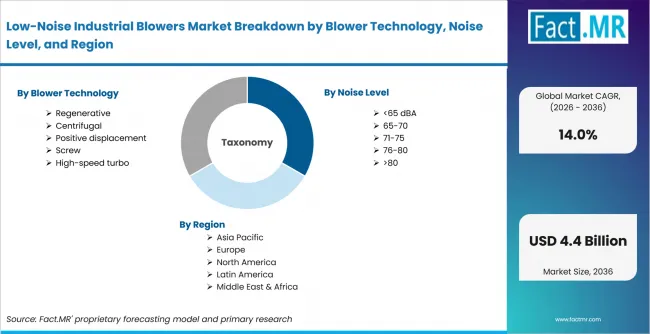
Low Noise Industrial Blowers Market Breakdown By Blower Technology, Noise Level, And Region | Source: Fact.MR
| Attribute | Details |
|---|---|
| Quantitative Units | USD billion |
| Market Definition | Industrial blowers designed or packaged to reduce operating sound while delivering low-pressure airflow for wastewater aeration, conveying, food processing, electronics and general industrial applications. |
| Blower Technology | Regenerative; Centrifugal; Positive displacement; Screw; High-speed turbo |
| Noise Level | <65 dBA; 65-70 dBA; 71-75 dBA; 76-80 dBA; >80 dBA |
| Noise Reduction | Acoustic enclosure; Low-speed design; Silencer / attenuator; Magnetic / air bearings; Active / optimized control |
| Application | Wastewater; Pneumatic conveying; Food processing; Electronics; General industry |
| Regions Covered | North America; Latin America; Western Europe; Eastern Europe; East Asia; South Asia & Pacific; Middle East & Africa |
| Countries Covered | United States; United Kingdom; Germany; Japan; France |
| Key Companies Profiled | Atlas Copco; Ingersoll Rand; Kaeser; AERZEN; Gardner Denver; Howden |
| Forecast Period | 2026 to 2036 |
| Approach | Hybrid top-down and bottom-up approach using blower technology mix, application intensity, acoustic specifications, replacement cycles, industrial activity and provider portfolio review. |
Source: Fact.MR analysis. Updated Oct 1, 2026
How is the market segmented?
-
By Blower Technology:
- Regenerative
- Centrifugal
- Positive displacement
- Screw
- High-speed turbo
-
By Noise Level:
- <65 dBA
- 65-70 dBA
- 71-75 dBA
- 76-80 dBA
- >80 dBA
-
By Noise Reduction:
- Acoustic enclosure
- Low-speed design
- Silencer / attenuator
- Magnetic / air bearings
- Active / optimized control
-
By Application:
- Wastewater
- Pneumatic conveying
- Food processing
- Electronics
- General industry
-
By Region:
- North America
- Latin America
- Western Europe
- Eastern Europe
- East Asia
- South Asia & Pacific
- Middle East & Africa
Frequently Asked Questions
How big is the low-noise industrial blowers market in 2026?
What is the CAGR of the low-noise industrial blowers market from 2026 to 2036?
Which noise level leads the low-noise industrial blowers market?
Which noise-reduction method leads the low-noise industrial blowers market?
Who are the leading companies in the low-noise industrial blowers market?
Who worked on this report


Preview the report firsthand - request a free sample
Free SampleGet the brochure for pricing and purchase details
Download PDF