- Market Value (2025): USD 13.0 Bn
- Estimated Value (2026): USD 14.6 Bn
- Forecast Value (2036): USD 48.8 Bn
- CAGR (2026-2036): 12.8%
What is the Embedded Subscriber Identity Module (e-SIM) Market forecast to be worth by 2036?
USD 14.6 billion in 2026 to USD 48.8 billion by 2036 at a 12.8% CAGR.
- According to Fact.MR, the Embedded Subscriber Identity Module (e-SIM) Market was valued at USD 13.0 billion in 2025.
- Market value is projected to rise from USD 14.6 billion in 2026 to USD 48.8 billion by 2036.
- The market is forecast to grow at a 12.8% CAGR from 2026 to 2036, reflecting wider adoption of embedded connectivity across consumer and industrial applications.
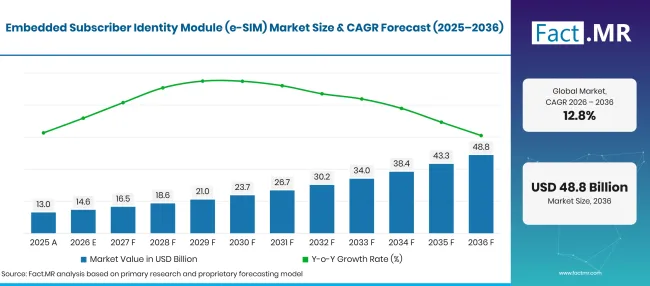
Embedded Subscriber Identity Module E Sim Market Forecast Global | Source: Fact.MR
| Year | Basis | Market Value (USD billion) |
|---|---|---|
| 2025 | Actual | 13.0 |
| 2026 | Estimate | 14.6 |
| 2036 | Forecast | 48.8 |
| CAGR 2026 to 2036 | Forecast period | 12.8% |
Source: Fact.MR analysis. Updated Nov 2, 2026
What are the defining numbers behind Embedded Subscriber Identity Module (e-SIM) Market growth?
USD 34.2 billion in absolute opportunity between 2026 and 2036.
- Demand Drivers in the Market
- Digital activation of compatible consumer devices supports demand for eSIM technology. eSIM-compatible smartphones and other connected electronics enable digital mobile-plan activation and reduce reliance on physical SIM cards.
- Industrial IoT connectivity is creating additional demand for eSIM technology. Connected equipment, smart meters and industrial devices benefit from remote provisioning and the ability to manage cellular subscriptions over their operating life. Infineon identifies industrial and IoT applications within its eSIM portfolio, including OPTIGA Connect IoT solutions [1] [2][1]
- Remote subscription management supports the use of eSIM technology in connected consumer and industrial devices. eSIM technology supports remote profile provisioning and changes to mobile network subscriptions, helping device makers serve international markets with fewer hardware variations. On February 27, 2026, Giesecke+Devrient announced a cloud-based remote eSIM provisioning solution developed with Amazon Web Services for consumer and IoT applications [3] [2][2]
- Key Segments Analyzed
- By Solution: Connectivity Services accounts for 42.5% of the market in 2026
- By Application: Consumer Electronics leads with a 38.4% share in 2026, reflecting the importance of eSIM-enabled personal devices.
- By End-User: Device Manufacturers account for 38.7% in 2026, owing to their role in integrating eSIM capabilities into connected products.
- Analyst Opinion at Fact.MR
- Shambhu Nath Jha, Principal Consultant at Fact.MR, states, “eSIM adoption depends on more than embedding a secure component into a device. Technology providers and network operators need compatible provisioning systems and reliable connectivity management. Device manufacturers will benefit from designing for remote activation and long-term subscription flexibility, particularly across consumer electronics and connected industrial equipment.”
- Strategic Implications
- eSIM technology providers should demonstrate compliance with relevant GSMA specifications and support secure remote provisioning across suitable device categories.
- Semiconductor manufacturers need to develop solutions that meet the size, power consumption and reliability requirements of consumer electronics, vehicles and industrial equipment.
- Telecom operators must improve activation and subscription-management processes to make switching devices or plans easier for customers.
- Device manufacturers can evaluate eSIM compatibility, regional operator support and lifecycle connectivity requirements early in product development.
Germany is projected to record a 14.7% CAGR through 2036. Brazil is forecast to post 13.4%, followed by the USA at 12.2%. The UK is estimated to advance at 10.9%, while Japan is forecast at 9.6%.
How does the Embedded Subscriber Identity Module (e-SIM) Market break down by segment?
Fact.MR finds that Connectivity Services leads the Solution segment at 42.5%; Consumer Electronics leads Application at 38.4%; and Device Manufacturers leads End-User at 38.7%.
Which Solution segment dominates?
Connectivity Services is set to hold a 42.5% share in 2026.
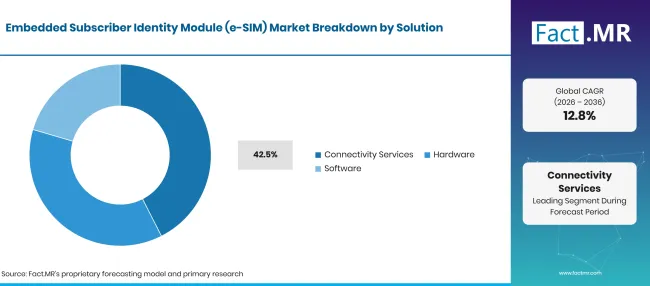
Embedded Subscriber Identity Module E Sim Market Breakdown Solution | Source: Fact.MR
| Solution | Share (2026) |
|---|---|
| Connectivity Services (Leading segment) | 42.5% |
| Other segments combined | 57.5%* |
| Total | 100.0% |
Source: Fact.MR analysis. Updated Nov 2, 2026
Connectivity services support subscriber activation, network access and subscription management. Their role is particularly relevant when connected devices are deployed across different countries or need remote changes to network profiles. Hardware and software remain important parts of the eSIM ecosystem, supporting secure storage, device integration and provisioning operations.
What leads the Application segment?
Consumer Electronics is set to represent 38.4% of the market in 2026.
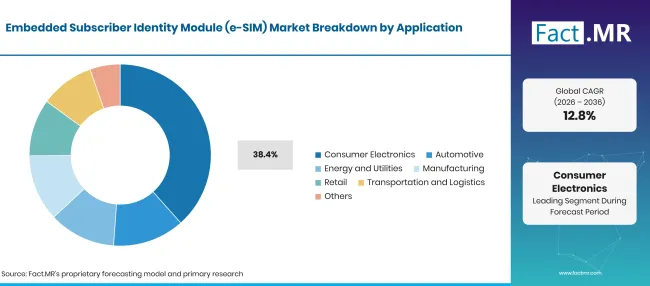
Embedded Subscriber Identity Module E Sim Market Breakdown Application | Source: Fact.MR
| Application | Share (2026) |
|---|---|
| Consumer Electronics (Leading segment) | 38.4% |
| Other segments combined | 61.6%* |
| Total | 100.0% |
Source: Fact.MR analysis. Updated Nov 2, 2026
Consumer electronics include compatible smartphones, tablets, smartwatches and other personal devices. Embedded SIM functionality allows users to activate cellular plans digitally on supported products. Adoption depends on device compatibility and the availability of carriers that support eSIM activation.
How does End-User shape demand?
Device Manufacturers are likely to account for 38.7% of the market in 2026.
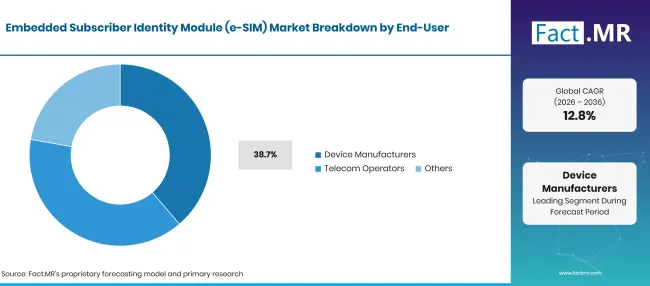
Embedded Subscriber Identity Module E Sim Market Breakdown End User | Source: Fact.MR
| End-User | Share (2026) |
|---|---|
| Device Manufacturers (Leading segment) | 38.7% |
| Other segments combined | 61.3%* |
| Total | 100.0% |
Source: Fact.MR analysis. Updated Nov 2, 2026
Device manufacturers integrate eSIM capabilities during product development and coordinate with semiconductor suppliers and connectivity providers. Telecom operators support activation and subscription provisioning, while industrial customers use eSIM-enabled equipment to maintain connectivity across distributed operations. The share attributed to device manufacturers reflects the market classification rather than the proportion of all devices that contain eSIMs.
What is accelerating eSIM Market adoption, and what is holding it back?
Digital activation, connected-device deployment and remote provisioning support growth, while compatibility requirements and fragmented operator support can slow adoption.
Drivers Impact Analysis
| Driver | Approximate impact on CAGR | Geographic relevance | Impact timeline |
|---|---|---|---|
| Rising eSIM-compatible device adoption | +1.0% | Global | Medium term (2–4 years) |
| Industrial IoT connectivity expansion | +0.9% | Global | Medium term (2–4 years) |
| Remote subscriber provisioning | +0.8% | Global | Short term (≤ 2 years) |
| Connected vehicle deployment | +0.6% | Europe, Asia, North America | Long term (≥ 4 years) |
| Digital mobile-plan activation | +0.5% | Global | Short term (≤ 2 years) |
Source: Fact.MR analysis. Updated Nov 2, 2026
Opportunity Impact Analysis
| Opportunity | Approximate impact on CAGR | Geographic relevance | Impact timeline |
|---|---|---|---|
| GSMA-compliant IoT provisioning | +0.8% | Global | Medium term (2–4 years) |
| Cloud-based subscription management | +0.7% | Global | Medium term (2–4 years) |
| eSIM integration in industrial devices | +0.6% | Europe, Asia | Long term (≥ 4 years) |
| Cross-border connectivity services | +0.5% | Global | Medium term (2–4 years) |
Source: Fact.MR analysis. Updated Nov 2, 2026
Restraints Impact Analysis
| Restraint | Approximate impact on CAGR | Geographic relevance | Impact timeline |
|---|---|---|---|
| Inconsistent carrier and device compatibility | −0.8% | Global | Short term (≤ 2 years) |
| Security and provisioning complexity | −0.6% | Global | Medium term (2–4 years) |
| Integration costs for legacy devices | −0.5% | Global | Medium term (2–4 years) |
| Uneven local operator support | −0.4% | Emerging markets | Medium term (2–4 years) |
Source: Fact.MR analysis. Updated Nov 2, 2026
Which countries are scaling the eSIM Market through 2036?
| Country | CAGR (2026–2036) |
|---|---|
| Germany | 14.7% |
| Brazil | 13.4% |
| USA | 12.2% |
| UK | 10.9% |
| Japan | 9.6% |
Source: Fact.MR analysis. Updated Nov 2, 2026
What supports adoption in Germany?
14.7% CAGR, driven by demand for connected automotive systems, industrial IoT devices and secure digital connectivity across industrial applications.
Germany's opportunity is linked to connected industrial equipment, automotive electronics and digital connectivity services. Industrial users need secure provisioning and reliable connectivity across devices operating in different locations. Semiconductor suppliers and connectivity providers can support adoption by ensuring that eSIM products meet applicable standards and device requirements.
How is Brazil developing eSIM adoption?
13.4% CAGR, supported by the adoption of eSIM-compatible smartphones and growing demand for connected mobile devices.
Brazil's market opportunity includes eSIM-compatible consumer devices and connected equipment requiring mobile connectivity. Wider adoption depends on compatible smartphones, carrier activation support and access to suitable mobile services. Service providers can improve adoption by simplifying digital activation and explaining device and network compatibility.
What supports United States adoption?
12.2% CAGR, led by demand for digitally activated mobile services and growing connectivity requirements across consumer and industrial devices.
The US market benefits from consumer demand for connected devices and applications requiring mobile connectivity. eSIM-enabled smartphones allow digital plan activation, while industrial IoT deployments can use remote subscription management to maintain connectivity across distributed equipment.
How is the United Kingdom building adoption?
10.9% CAGR, backed by the adoption of eSIM-compatible consumer devices and expanding demand for connected services.
The UK's eSIM opportunity includes connected consumer electronics, mobile services and IoT deployments. Telecom operators play an important role in making digital activation accessible, while technology suppliers provide the secure components and provisioning systems required for compatible devices. Adoption will depend on network availability, device support and customer awareness.
What supports adoption in Japan?
9.6% CAGR, shaped by demand for connected electronics, automotive applications and industrial IoT devices.
Japan's opportunity includes connected electronics, automotive systems and industrial IoT equipment. Manufacturers require reliable embedded connectivity and remote profile management for devices distributed across domestic and international markets. eSIM hardware and IoT provisioning standards provide a technical foundation for such deployments.
Who leads the Embedded Subscriber Identity Module (e-SIM) Market?
Fact.MR identifies Thales Group, Giesecke+Devrient, STMicroelectronics, Infineon Technologies, and Deutsche Telekom as participants across the eSIM ecosystem, alongside NXP Semiconductors.
Thales Group and Giesecke+Devrient participate in eSIM technology and subscription provisioning. STMicroelectronics, Infineon Technologies, and NXP Semiconductors operate in semiconductor and secure-connectivity technologies, while Deutsche Telekom provides mobile-network services. These companies occupy different positions in the eSIM ecosystem and should be assessed according to their specific product and service offerings.[3][4][5]
Competition depends on the role each company plays in the eSIM value chain. Semiconductor suppliers focus on secure hardware integration and device compatibility. eSIM technology providers support secure profile management and provisioning. Network operators enable subscription activation, while device manufacturers influence adoption through product design and user experience. These companies participate in complementary parts of the ecosystem rather than competing directly across every product category.
Which companies are the key providers?
Key companies include Thales Group; STMicroelectronics; Infineon Technologies; Giesecke+Devrient; Deutsche Telekom; and NXP Semiconductors.
- Thales Group
- STMicroelectronics
- Infineon Technologies
- Giesecke+Devrient
- Deutsche Telekom
- NXP Semiconductors
Bibliography
- [1] Infineon Technologies AG. (n.d.). eSIM applications.
- [2] Infineon Technologies AG. (n.d.). OPTIGA™ Connect IoT.
- [3] Giesecke+Devrient. (2026, February 27). G+D and AWS collaborate on new cloud-based Remote eSIM Provisioning for consumer and IoT solutions.
- [4] GSMA. (n.d.). eSIM Consumer and IoT Specifications.
- [5] GSMA. (n.d.). What is eSIM for Consumer and IoT?
- [6] STMicroelectronics. (n.d.). ST4SIM: SIM & eSIM cellular connectivity portfolio
This report answers
- The report examines the embedded subscriber identity module (eSIM) market size in 2026 and its projected value in 2036.
- Segment analysis compares the specified solution, application and end-user categories alongside their 2026 market shares.
- Country analysis discusses Germany, Brazil, the USA, the UK and Japan alongside their embedded subscriber identity module (eSIM) market growth.
- The competitive overview profiles Thales Group, STMicroelectronics, Infineon Technologies, Giesecke+Devrient, Deutsche Telekom, and NXP Semiconductors.
- Technology analysis examines embedded SIM hardware, remote SIM provisioning and connectivity services supporting adoption across consumer devices and connected equipment.
What does the e-SIM Market cover?
The embedded subscriber identity module (eSIM) market covers embedded SIM hardware and associated software that support secure subscriber identity storage and mobile network connectivity. It tracks adoption across smartphones, wearables, automotive systems and Internet of Things (IoT) devices. Product coverage includes eSIM components and enabling platforms, while service coverage includes remote SIM provisioning and connectivity services. Adoption depends on device compatibility and support from mobile network operators.
What is included in the scope?
The scope includes embedded SIM hardware and software used to support secure subscriber profile storage, remote SIM provisioning and profile management.
It covers associated platforms and connectivity services used in compatible consumer devices and connected equipment. The segmentation also covers the specified solution, application and end-user categories.
What is excluded from the scope?
The analysis excludes conventional removable SIM cards when they are not part of an embedded SIM solution.
General-purpose semiconductor components without a defined role in eSIM functionality are outside the product boundary. Unrelated telecommunications services and devices without eSIM functionality are also excluded. Revenue from products or services unrelated to eSIM deployment is not included.
How Was the Analysis Built?
The analysis draws on 120+ sources, 35+ company portfolios, 25+ countries, and more than 20 industry interviews.
- Primary Research: Primary research includes discussions with manufacturers, service providers, technology developers, distributors, end users, and subject-matter experts. These conversations examine purchasing priorities, product adoption, operational challenges, approval requirements, competitive positioning, and the factors that influence wider market acceptance.
- Desk Research: Desk research covers government statistics, regulatory publications, company filings, trade data, technical studies, industry associations, standards, public policy, and other authoritative sources. Every source used in the analysis is documented in the bibliography.
- Market Sizing and Forecasting: Market estimates combine historical performance, demand indicators, pricing and volume trends, segment shares, company participation, country-level growth, adoption patterns, investment activity, and barriers to market expansion.
- Data Validation and Update Cycle: Findings are validated by comparing primary interviews with public data, company activity, regulatory changes, trade patterns, and industry developments. Regular updates review new product launches, capacity changes, partnerships, approvals, and shifts in commercial adoption.
Segmentation
What is the report's scope and coverage?
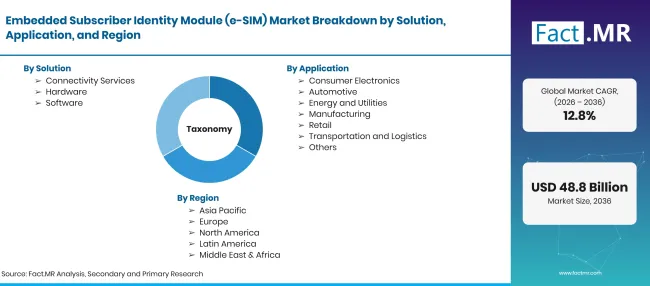
Embedded Subscriber Identity Module E Sim Market Taxonomy | Source: Fact.MR
| Attribute | Details |
|---|---|
| Quantitative units | USD billion |
| Market definition | The Embedded Subscriber Identity Module (e-SIM) Market comprises embedded SIM hardware and integrated software that enable secure subscriber identity storage, remote SIM provisioning, profile management and mobile network connectivity in compatible consumer devices and connected equipment. |
| Solution | Connectivity Services; Hardware; Software |
| Application | Consumer Electronics; Automotive; Energy and Utilities; Manufacturing; Retail; Transportation and Logistics; Others |
| End-user | Device Manufacturers; Telecom Operators; Others |
| Countries covered | Germany; Brazil; USA; UK; Japan |
| Companies profiled | Thales Group; STMicroelectronics; Infineon Technologies; NXP Semiconductors; Giesecke+Devrient; Deutsche Telekom |
| Forecast period | 2026 to 2036 |
| Approach | Segment analysis, company verification and scenario-based forecasting |
Source: Fact.MR analysis. Updated Nov 2, 2026
How is the market segmented?
-
By Solution
- Connectivity Services
- Hardware
- Software
-
By Application
- Consumer Electronics
- Automotive
- Energy and Utilities
- Manufacturing
- Retail
- Transportation and Logistics
- Others
-
By End-User
- Device Manufacturers
- Telecom Operators
- Others
-
By Region
- North America
- Latin America
- Western Europe
- Eastern Europe
- East Asia
- South Asia and Pacific
- Middle East and Africa
Frequently Asked Questions
How big is the eSIM market in 2026?
What is the CAGR from 2026 to 2036?
Which application has the largest share?
Which solution segment leads?
Which companies are covered?
Who worked on this report


Preview the report firsthand - request a free sample
Free SampleGet the brochure for pricing and purchase details
Download PDF