- Market Value (2025): USD 895.2 Mn
- Estimated Value (2026): USD 965.0 Mn
- Forecast Value (2036): USD 2045.1 Mn
- CAGR (2026-2036): 7.8%
What is the Low Viscosity Epoxies Market forecast to be worth by 2036?
USD 2045.1 million by 2036 at 7.8% CAGR.
- The Low Viscosity Epoxies Market reached USD 895.2 million in 2025.
- Demand is projected to increase from USD 965.0 million in 2026 to USD 2045.1 million by 2036.
- The market is forecast to record a 7.8% CAGR from 2026 to 2036.
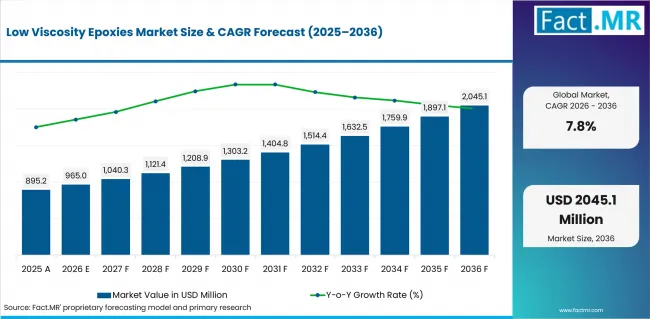
Low Viscosity Epoxies Market Value Analysis | Source: Fact.MR
What are the defining numbers behind Low Viscosity Epoxies Market growth?
An absolute opportunity of USD 1,085.0 million is expected between 2026 and 2036.
- Demand Drivers in the Market
- Low-viscosity epoxy in the 200-500 cP range supports capillary penetration into narrow gaps and porous structures, making it suitable for underfill and impregnation processes where incomplete wetting can leave voids or unprotected interfaces.
- Bisphenol-A epoxy provides formulators with a broad base of curing agents and modifiers. This allows viscosity, adhesion and cured mechanical properties to be adjusted for different substrates without moving away from an established resin platform.
- Capillary underfill creates direct demand for low-viscosity epoxy because the material must flow beneath fine-pitch semiconductor packages after soldering. Incomplete filling can leave interconnects exposed to thermal-mechanical stress, making flow behaviour and void control part of package reliability.
- Semiconductor packaging investment is increasing the number of assemblies that require underfill and low-stress encapsulation. Taiwan is adding advanced packaging and testing capacity, while the U.S. CHIPS National Advanced Packaging Manufacturing Program finalized USD 1.4 billion in awards to move packaging technologies toward scaled manufacturing.
- Room-temperature and low-temperature curing widen the addressable application base beyond conventional oven processing. Large structures, repair operations and heat-sensitive assemblies can use low-viscosity epoxy where thermal exposure would otherwise complicate production.
- Key Segments Analyzed
- Low (200-500 cP) accounts for 41.0% of Viscosity Range in 2026, supported by its ability to penetrate narrow spaces while retaining enough body for controlled dispensing.
- Bisphenol-A epoxy holds 40.0% of Chemistry in 2026 because its established formulation base allows viscosity and cured properties to be adjusted across different bonding and impregnation requirements.
- Capillary underfill represents 33.0% of Application in 2026 as fine-pitch semiconductor packages require resin to move beneath the package and surround interconnects after soldering.
- Room-temperature cure captures 31.0% of Cure System in 2026 because heat-sensitive assemblies, repair work and large components can be processed without dedicated oven curing.
- Analyst Opinion at Fact.MR
- Shambhu Nath Jha, Senior Consultant at Fact.MR, states, "Low Viscosity Epoxies Market demand will increasingly depend on whether suppliers can combine capillary flow with low void formation and controlled cure behaviour. Semiconductor packaging raises the cost of incomplete wetting, while industrial impregnation requires consistent penetration across larger structures. Suppliers that support process trials and maintain lot-to-lot formulation consistency are better positioned for repeat production."
- Strategic Implications
- Suppliers should document viscosity at defined temperatures and relate it directly to expected flow distance, gap size and dispensing conditions.
- Underfill qualification should use the actual package geometry and substrate because capillary behaviour changes with gap height, surface condition and cure profile.
- Semiconductor-focused suppliers should expand technical support around Taiwan, China, South Korea, Japan and the USA as packaging investment creates additional material-qualification activity.
- Room-temperature products should be positioned around applications where oven curing is impractical rather than presented as a general substitute for thermally cured epoxy.
- D.E.R. should remain identified as an Olin epoxy-resin brand and should not be treated as a separate company in the competitive set.
How does the Low Viscosity Epoxies Market break down by segment?
The market is segmented by Viscosity Range, Chemistry, Application and Cure System.
Why does Low (200-500 cP) lead Viscosity Range?
Low (200-500 cP) is projected to account for a 40.8% share in 2026.
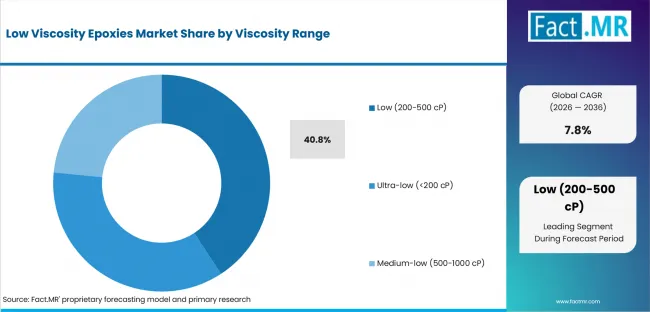
Low Viscosity Epoxies Market Analysis By Viscosity Range | Source: Fact.MR
This viscosity range provides sufficient mobility for resin to enter fine gaps through capillary action while remaining manageable during dispensing. That balance is important in underfill, potting and impregnation processes where excessive viscosity can prevent complete penetration.
The range can also be handled by conventional metering and dispensing equipment, allowing manufacturers to improve flow without adopting unusually specialized processing systems.
Why does Bisphenol-A epoxy lead Chemistry?
Bisphenol-A epoxy is projected to account for a 40.3% share in 2026.
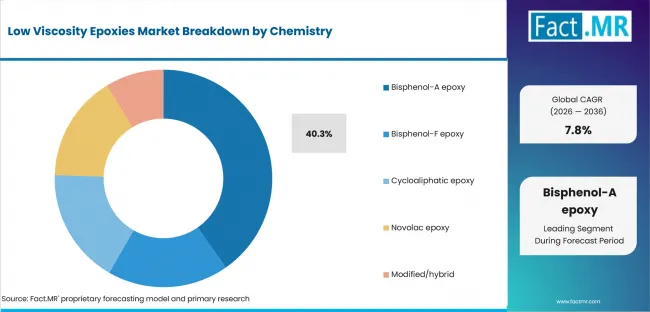
Low Viscosity Epoxies Market Analysis By Chemistry | Source: Fact.MR
Bisphenol-A epoxy provides an established resin platform with a wide choice of curing agents and modifiers. Formulators can therefore adjust viscosity and adhesion while retaining a chemistry already familiar to industrial users.
Existing supply availability also matters during qualification. Once a formulation has been approved for a package or impregnation process, manufacturers place value on resin consistency and continuity because formulation changes can require additional testing.
Why does Capillary underfill lead Application?
Capillary underfill is projected to account for a 32.7% share in 2026.
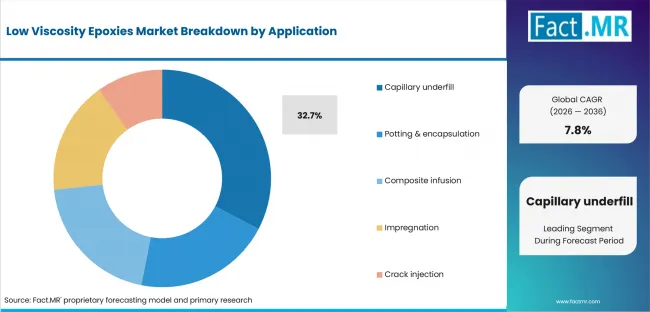
Low Viscosity Epoxies Market Analysis By Application | Source: Fact.MR
Capillary underfill depends directly on low viscosity because resin is introduced after package attachment and must travel beneath the component through a narrow gap. Fine-pitch and advanced packages increase the importance of complete filling around solder joints and other interconnects.
Underfill also supports reliability by reducing mechanical stress on interconnects during thermal cycling. Advanced-packaging investment in Taiwan and the USA is increasing the number of package architectures where flow distance and void formation must be qualified carefully.
Why does Room-temperature cure lead Cure System?
Room-temperature cure is projected to account for a 31.4% share in 2026.
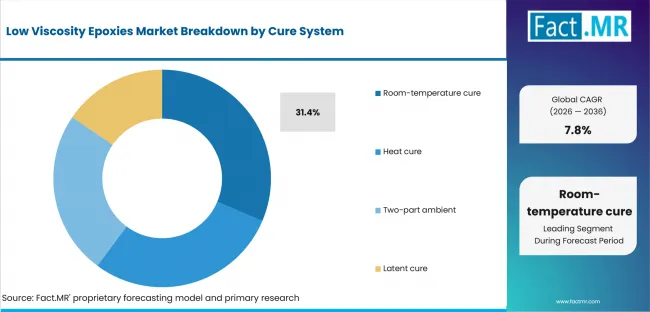
Low Viscosity Epoxies Market Analysis By Cure System | Source: Fact.MR
Room-temperature systems allow large or heat-sensitive assemblies to be bonded or impregnated without transferring them into an oven. This can simplify processing where part dimensions or adjacent materials make elevated-temperature curing difficult.
The cure system also suits field repair and maintenance applications. Users can combine low-viscosity penetration with curing under normal workshop conditions, although cure time must still be balanced against required throughput.
What is accelerating Low Viscosity Epoxies Market adoption, and what is holding it back?
Drivers Impact Analysis
| Factor | (~) % Impact on CAGR | Geographic Relevance | Impact Timeline |
|---|---|---|---|
| Capillary underfill demand in fine-pitch semiconductor packages | +2.1% | China, Taiwan, South Korea, Japan and USA | Short term (<= 2 years) |
| Established formulation base for Bisphenol-A epoxy | +1.7% | Global | Medium term (2-4 years) |
| Expansion of advanced semiconductor packaging capacity | +1.3% | Taiwan, USA, Japan, South Korea and China | Long term (>= 4 years) |
Opportunity Impact Analysis
| Factor | (~) % Impact on CAGR | Geographic Relevance | Impact Timeline |
|---|---|---|---|
| Lower-void underfill for dense package geometries | +1.1% | Taiwan, China, South Korea, Japan and USA | Short term (<= 2 years) |
| Room-temperature impregnation of large or heat-sensitive assemblies | +0.9% | USA, Germany, Japan, China and India | Medium term (2-4 years) |
| Low-viscosity resin systems for composite infusion | +0.6% | USA, Germany, Japan, China and France | Long term (>= 4 years) |
Restraints Impact Analysis
| Factor | (~) % Impact on CAGR | Geographic Relevance | Impact Timeline |
|---|---|---|---|
| Uncontrolled flow or bleed beyond the intended bond area | -1.0% | Global | Short term (<= 2 years) |
| Void formation during underfill and impregnation | -0.8% | Global | Medium term (2-4 years) |
| Package-specific material and process qualification | -0.5% | Global | Long term (>= 4 years) |
Which countries are scaling the Low Viscosity Epoxies Market through 2036?
- Japan: Japan is expanding next-generation semiconductor capability while retaining established automotive and precision-electronics manufacturing. METI selected Rapidus for financial support and intends to invest JPY 100 billion from the fiscal 2025 budget, supporting additional material qualification around pilot and future production lines.
- Taiwan: Advanced packaging and testing investment is increasing the number of semiconductor packages that require carefully controlled underfill processes. ASE and partners are investing NT$17.8 billion in new advanced packaging, testing and logistics facilities in the Nanzih Technology Industrial Park.
- South Korea: Semiconductor policy is supporting additional manufacturing capacity and domestic materials capability. A government-backed plan announced KRW 4.5 trillion of public and private investment for a new foundry while also identifying materials and equipment as areas requiring further strengthening.
- USA: The CHIPS National Advanced Packaging Manufacturing Program is adding research and scale-up capacity for packaging substrates and related materials. Final awards of USD 1.4 billion support technologies intended to transition advanced packaging into domestic manufacturing.
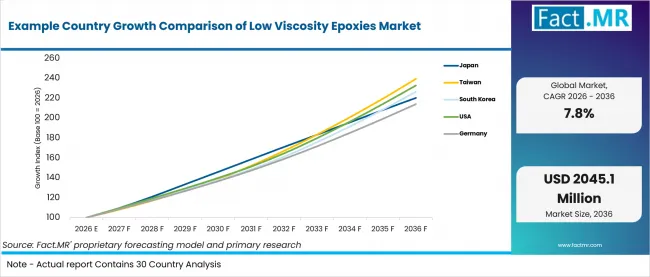
Example Country Growth Comparison Of Low Viscosity Epoxies Market | Source: Fact.MR
| Country | CAGR (2026-2036) |
|---|---|
| Japan | 8.3% |
| Taiwan | 8.8% |
| South Korea | 8.6% |
| USA | 8.7% |
What is driving Japan's growth through 2036?
Japan is forecast to expand at an 8.3% CAGR from 2026 to 2036.
Japan is adding next-generation semiconductor production capability through Rapidus. METI selected the company for support under its advanced-semiconductor framework and intends to invest JPY 100 billion from the fiscal 2025 budget.
The programme includes pilot-production development and customer qualification activity. This increases opportunities for low-viscosity epoxy suppliers to work with package manufacturers on underfill flow and cured stress before materials enter volume manufacturing.
What is driving Taiwan's growth through 2036?
Taiwan is forecast to expand at an 8.8% CAGR from 2026 to 2036.
Taiwan's growth is tied closely to advanced semiconductor packaging. ASE-related companies and partners are investing NT$17.8 billion in new packaging and testing facilities at Nanzih, adding production capacity where underfill materials must be qualified alongside package geometry and automated processes.
A separate ASE project involves NT$17.6 billion of investment in a plant designed around advanced packaging, final testing and smart manufacturing. Greater packaging complexity increases the value of epoxies that can flow consistently through narrow gaps without leaving voids.
What is driving South Korea's growth through 2036?
South Korea is forecast to expand at an 8.6% CAGR from 2026 to 2036.
South Korea is expanding semiconductor manufacturing while addressing domestic supply of materials and production equipment. A December 2025 industry plan included KRW 4.5 trillion of public and private investment in a new foundry and specifically identified materials and equipment capability as a strategic requirement.
Higher semiconductor capacity increases demand for underfill and encapsulation materials that can be qualified for precise package dimensions. Local application support becomes particularly important when viscosity and cure conditions must be adjusted without increasing void formation.
What is driving the USA's growth through 2036?
The USA is forecast to expand at an 8.7% CAGR from 2026 to 2036.
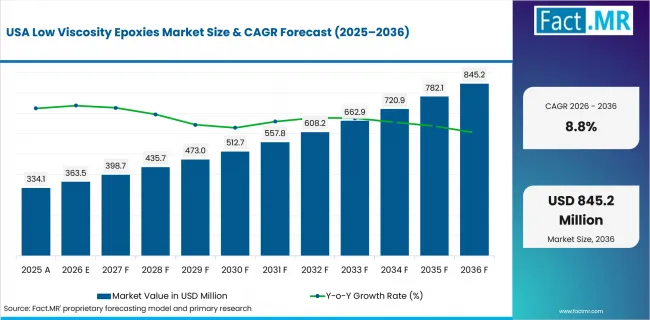
Low Viscosity Epoxies Market Country Value Analysis | Source: Fact.MR
U.S. investment is moving beyond wafer fabrication into advanced packaging. The Department of Commerce finalized USD 1.4 billion in awards under the CHIPS National Advanced Packaging Manufacturing Program, including materials and substrate projects intended to transition packaging technologies into scaled manufacturing.
NIST's programme also targets domestic capacity for advanced packaging substrates and substrate materials. As package density increases, underfill suppliers face greater demand for low viscosity and low void formation while maintaining mechanical reliability after cure.
Who leads the Low Viscosity Epoxies Market?
Henkel is positioned as a leading supplier through its broad electronics-material portfolio and application support for bonding, encapsulation and semiconductor assembly. Master Bond and Epoxy Technology compete through application-specific epoxy systems serving electronics and industrial applications.
Competition depends on the interaction between viscosity and cured performance. A resin may flow effectively during dispensing but still require acceptable thermal, dielectric and mechanical properties after cure, making formulation balance central to supplier qualification.
Process history also creates switching costs. Underfill and impregnation materials are commonly qualified against specific substrates, package dimensions and cure profiles, so manufacturers place value on lot consistency and technical support once a formulation enters production.
D.E.R. is an Olin epoxy-resin brand and should therefore remain part of Olin's product portfolio rather than being listed as a separate supplier.
Which companies are the key providers?
Key companies include Henkel; Master Bond; Epoxy Technology (Epo-Tek); Huntsman; and DER (Olin/Aditya Birla).
- Henkel
- Master Bond
- Epoxy Technology (Epo-Tek)
- Huntsman
- DER (Olin/Aditya Birla)
Bibliography
- U.S. Department of Commerce. (2025). CHIPS for America Advanced Packaging Manufacturing Program. U.S. Government.
- National Institute of Standards and Technology. (2026). Thermal Property Measurements for Electronic Materials. U.S. Department of Commerce.
- U.S. Department of Energy. (2025). Materials Innovation for Distribution Transformers and Grid Equipment. U.S. Government.
- National Renewable Energy Laboratory. (2025). Thermal Management for Power Electronics. U.S. Department of Energy.
- ASTM International. (2019). Adhesive Bond and Material Test Standards. ASTM International.
- Ministry of Industry and Information Technology, China. (2026). Development of the Electronic Information Manufacturing Industry in 2025. Government of China.
- Ministry of Economy, Trade and Industry, Japan. (2025). Strategy for Semiconductor and Digital Industry Revitalization. Government of Japan.
- Ministry of Economic Affairs, Taiwan. (2026). Advanced Semiconductor Research and Development and Packaging Support. Government of Taiwan.
- Ministry of Trade, Industry and Energy, Republic of Korea. (2025). High-Tech Strategic Industry and Materials Development Measures. Government of the Republic of Korea.
- Master Bond. (2026). Low-Viscosity Epoxy Systems for Underfill and Impregnation. Master Bond.
- Olin Corporation. (2026). D.E.R. Liquid Epoxy Resins. Olin Corporation.
This Report Answers
- The report examines demand across Viscosity Range, Chemistry, Application, Cure System.
- Segment analysis explains the operating reason behind each leading category.
- Country analysis evaluates the listed markets and adoption conditions through 2036.
- Competitive analysis reviews the listed companies and clarifies ownership or research roles where relevant.
- The analysis considers qualification, process control and application fit that influence purchasing decisions.
What does the Low Viscosity Epoxies Market cover?
Low-viscosity epoxy resins for capillary underfill, potting, impregnation, vacuum infusion and fine-gap penetration in electronics, composites and industrial applications.
The assessment follows the stated segmentation by Viscosity Range, Chemistry, Application, Cure System. Revenue is counted only where the stated product or equipment is sold for the listed applications.
What is included in the scope?
The scope includes Ultra-low (<200 cP), Low (200-500 cP), Medium-low (500-1000 cP).
It also covers Bisphenol-A epoxy, Bisphenol-F epoxy, Cycloaliphatic epoxy, Novolac epoxy, Modified/hybrid.
Demand is assessed across Application: Capillary underfill, Potting & encapsulation, Composite infusion, Impregnation, Crack injection; Cure System: Heat cure, Room-temperature cure, Two-part ambient, Latent cure.
What is excluded from the scope?
Materials that do not meet the defined viscosity, electrical, thermal, vacuum or chemistry requirement are excluded.
Standalone mixers, dispensers and curing equipment are excluded from material revenue.
General construction resins are outside the market unless sold into the listed application.
How Was the Analysis Built?
The analysis combines product scope, segment demand, country outlook and supplier coverage.
- Primary Research: Interviews focus on formulators, distributors, equipment suppliers and end users responsible for bonding, potting or thermal management.
- Desk Research: The review covers technical standards, government manufacturing programmes and company product literature.
- Market Sizing and Forecasting: Estimates combine application volume, material use per part, formulation mix, pack size and realized pricing.
- Data Validation and Update Cycle: Findings are checked against public evidence and supplier portfolios. Updates review formulation changes, ownership changes and manufacturing shifts.
What is the report's scope and coverage?
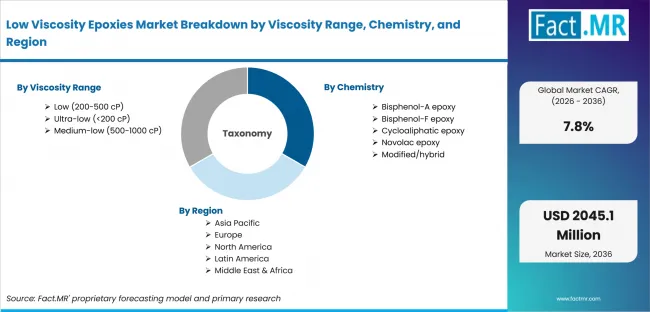
Low Viscosity Epoxies Market Breakdown By Viscosity Range, Chemistry, And Region | Source: Fact.MR
| Attribute | Details |
|---|---|
| Quantitative Units | USD 965.0 million in 2026 to USD 2,050.0 million by 2036 at a 7.8% CAGR |
| Market Definition | Low-viscosity epoxy resins for capillary underfill, potting, impregnation, vacuum infusion and fine-gap penetration in electronics, composites and industrial applications. |
| Segments Covered | Viscosity Range; Chemistry; Application; Cure System |
| Regions Covered | North America; Latin America; Europe; East Asia; South Asia and Oceania; Middle East and Africa |
| Countries Covered | China; Japan; Taiwan; South Korea; USA |
| Key Companies Profiled | Henkel; Master Bond; Epoxy Technology (Epo-Tek); Huntsman; DER (Olin/Aditya Birla) |
| Forecast Period | 2026 to 2036 |
| Base Year | 2025 |
| Market Value, 2026 | USD 965.0 million |
| Market Value, 2036 | USD 2,050.0 million |
| CAGR, 2026-2036 | 7.8% |
| Absolute Opportunity | USD 1,085.0 million |
| Approach | Combines application volume, material use per part, formulation mix, pack size and realized pricing. |
How is the market segmented?
-
By Viscosity Range
- Ultra-low (<200 cP)
- Low (200-500 cP)
- Medium-low (500-1000 cP)
-
By Chemistry
- Bisphenol-A epoxy
- Bisphenol-F epoxy
- Cycloaliphatic epoxy
- Novolac epoxy
- Modified/hybrid
-
By Application
- Capillary underfill
- Potting & encapsulation
- Composite infusion
- Impregnation
- Crack injection
-
By Cure System
- Heat cure
- Room-temperature cure
- Two-part ambient
- Latent cure
-
By Region
- North America
- Latin America
- Western Europe
- Eastern Europe
- East Asia
- South Asia and Pacific
- Middle East & Africa