- Forecast Value (2036): 820.0 Mn
- CAGR (2036): 11.3%
What is the low-carbon ceramic binders market forecast to be worth by 2036?
USD 280.0 million in 2026 to USD 820.0 million by 2036, at 11.3% CAGR.
- The low-carbon ceramic binders market crossed a valuation of USD 240.0 million in 2025.
- Demand is expected to increase from USD 280.0 million in 2026 to USD 820.0 million by 2036.
- The market is forecast to record 11.3% CAGR from 2026 to 2036.
- Growth is supported by ceramic producers working to lower firing defects and volatile organic compound exposure during tile, sanitaryware, and technical ceramic production.
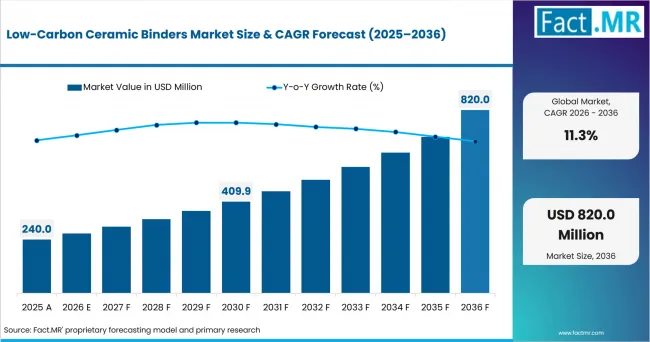
Low Carbon Ceramic Binders Market Market Value Analysis | Source: Fact.MR
What are the defining numbers behind low-carbon ceramic binders growth?
USD 540.0 million absolute opportunity by 2036, led by China and India.
- Demand Drivers in the Market
- Ceramic producers are reformulating binder systems due to kiln fuel pressure and product carbon reporting requirements.
- Tile manufacturers need lower burnout residue owing to scrap losses during energy-saving kiln programs.
- Technical ceramic firms require pre-fired strength during pressing and extrusion. Tape casting and ceramic binder jetting create additional binder checks.
- Construction material suppliers use low-carbon binder claims to support environmental product declarations for tiles and sanitaryware.
- Key Segments Analyzed
- By Chemistry: Bio-based binders are expected to hold 33.5% share in 2026 due to lower fossil-input claims and water-based formulation use.
- By Application: Tiles are projected to account for 31.0% share in 2026 owing to high production volume and frequent binder reformulation.
- By Sustainability Benefit: Lower volatile organic compound systems are anticipated to capture 29.0% share in 2026 supported by air-quality compliance pressure.
- By End User: Tile manufacturers are estimated to represent 36.0% share in 2026 attributable to large batch volumes and export quality checks.
- By Delivery Form: Liquid dispersions are forecast to hold 34.0% share in 2026 due to easier dosing in slip and body preparation lines.
- By Geography: China is projected to record 12.8% CAGR through 2036 led by ceramic production scale and local reformulation capability.
- Analyst Opinion at Fact.MR
- Shambhu Nath Jha, Senior Analyst at Fact.MR, states, "Ceramic producers are not buying a binder only for holding powder together anymore. They are asking whether the binder lowers burnout trouble and supports cleaner air permits. Suppliers that prove this balance in plant trials are expected to win the next round of specification work."
- Strategic Implications
- Binder suppliers should document burnout residue and ash content before commercial trials.
- Tile producers need qualification programs that compare pre-fired strength and drying time in one test plan.
- Ceramic producers should separate low-carbon binder savings from kiln energy savings during procurement reviews.
- Regional distributors need application support due to binder performance differences by clay body and firing curve.
China is projected to record 12.8% CAGR through 2036 owing to large ceramic production clusters and binder reformulation capacity. India is expected to expand at 12.5% CAGR through 2036 supported by tile output and export scrutiny. Germany is forecast to grow at 11.7% CAGR by 2036 due to European permitting discipline and high-value ceramic manufacturing. Italy is expected to advance at 11.1% CAGR during 2026 to 2036 attributable to specification-led tile exports. The United States is projected to rise at 10.9% CAGR by 2036 supported by air-emission reviews and import quality checks.
How does the low-carbon ceramic binders market break down by segment?
Bio-based binders lead at 33.5%; tiles lead at 31.0%.
Which chemistry dominates?
Bio-based binders hold 33.5% share in 2026.
Bio-based binders are expected to hold 33.5% share in 2026 due to buyer interest in lower fossil-content formulations. Supplier positioning in bio-based coatings shows a similar shift toward material claims that can be explained inside a customer specification.
Aqueous systems remain close to bio-based chemistry owing to simpler solvent handling and plant dosing. BASF’s ACRONAL MB BC 5555 should be used only as adjacent construction-formulation evidence because it is positioned for ceramic tile adhesive applications, not ceramic-body binder use.
Which application dominates?
Tiles lead with 31.0% share in 2026.
Tiles account for 31.0% share in 2026 due to large batch volumes and repeated reformulation work. The related ceramic adhesives category shows how construction-facing ceramic materials are specified for stronger application performance.
WACKER Chemie reported in March 2025 that its VINNAPAS binders support the use of CEM II cement in tile adhesives. The development matters for ceramic binder buyers due to lower-carbon formulation testing across adjacent ceramic material systems.
Which sustainability benefit dominates?
Lower volatile organic compound systems hold 29.0% share in 2026.
Lower volatile organic compound systems are anticipated to capture 29.0% share in 2026 owing to plant air-quality reviews and customer audit pressure. Adjacent coating binders use similar evidence due to buyer requests for lower-emission resin systems that protect process reliability.
Which end user dominates?
Tile manufacturers account for 36.0% share in 2026.
Tile manufacturers are estimated to represent 36.0% share in 2026 attributable to volume scale and sensitivity to firing defects. These buyers qualify binders around pre-fired strength and residue after burnout before material origin is discussed.
Technical ceramic producers are smaller by value share. They specify ceramic additives around low ash content and reliable shape retention during handling.
Which delivery form dominates?
Liquid dispersions hold 34.0% share in 2026.
Liquid dispersions are forecast to hold 34.0% share in 2026 due to easier dosing and faster plant trials. They fit slip preparation and body-mix systems that already use water-based process control.
Powder formats remain relevant where plants need dry blending or long storage stability. Procurement teams compare them with redispersible polymer powder technology when construction ceramic formulations require dry premix handling.
What is accelerating low-carbon ceramic binder demand, and what is holding it back?
Emissions permitting and construction product data drive it; qualification risk and cost restrain it.
The main driver is regulatory pressure on industrial emissions and product performance evidence. European Union Industrial Emissions Directive 2.0 requires tighter attention to air and waste impacts.
The second driver is specification transfer from construction materials into ceramic production. Buyers that compare ceramic coatings also ask for binder evidence that supports lower emissions and consistent surface quality.
The main restraint is plant qualification time. A binder that lowers carbon-related claims can still fail if it changes drying speed or firing residue.
Cost is the second restraint due to higher prices for premium bio-based and low-residue chemistries. Suppliers need trial data that connects binder cost to lower scrap.
Where do the biggest low-carbon ceramic binder opportunities sit?
Low-temperature firing support, binder jet ceramics and export-led tile reformulation.
- Low-Temperature Firing Support: Suppliers can target tile plants that need pre-fired strength while lowering kiln load.
- Renewable Binder Systems: Formulators can pair plant-derived chemistry with lower burnout residue for sanitaryware and tile bodies.
- Export-Led Reformulation: Ceramic producers selling into Europe need cleaner documentation for product carbon and air-emission audits.
Ceramic additive manufacturing provides a smaller but faster specification route for binders. Demand for binder jet systems creates a need for powders and binders that print cleanly before sintering. High-value ceramics also support binder testing beyond tiles. Materials including technical ceramic materials and silicon nitride require binder systems that protect shape during firing. Non-oxide ceramic users often specify tighter residue behavior. This creates a smaller route for silicon carbide applications that need clean burnout and stable geometry.
Which countries are scaling low-carbon ceramic binders fastest?
China 12.8%, India 12.5%, Germany 11.7%, Italy 11.1%, United States 10.9%, South Korea 10.6%, Japan 10.1%.
Based on regional analysis, the low-carbon ceramic binders market is segmented into East Asia and Europe. It also covers North America and South Asia. Latin America and Middle East and Africa are included.
| Country | CAGR |
|---|---|
| China | 12.8% |
| India | 12.5% |
| Germany | 11.7% |
| Italy | 11.1% |
| United States | 10.9% |
| South Korea | 10.6% |
| Japan | 10.1% |
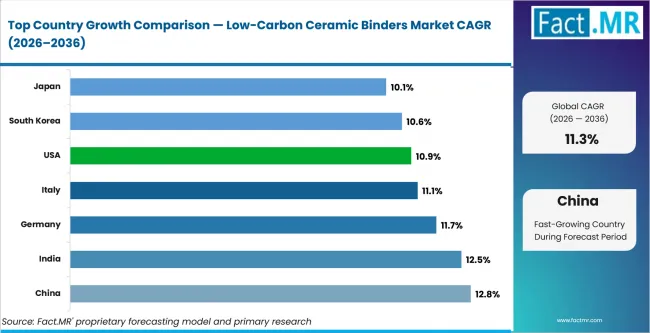
Low Carbon Ceramic Binders Market Cagr Analysis By Country | Source: Fact.MR
What is powering China’s lead?
12.8% CAGR, supported by ceramic production scale and local reformulation capacity.
China’s binder demand is tied to ceramic clusters that can test new formulations across large production batches. China is projected to record 12.8% CAGR through 2036 supported by tile output scale and faster supplier qualification near manufacturing sites. Local buyers are expected to favor binders that reduce defects without raising batch cost.
Why is India a fast-expanding binder market?
12.5% CAGR, driven by tile exports and stronger formulation scrutiny.
India’s tile producers are moving from volume-led selling toward export accounts that ask for clearer product claims. India Brand Equity Foundation reported in January 2026 that India’s ceramic tile sector reached Rs. 62,000 crore. India is expected to expand at 12.5% CAGR through 2036 led by tile capacity and buyer checks on formulation performance.
What supports Germany’s above-average outlook?
11.7% CAGR, backed by emissions discipline and high-value ceramic production.
Germany’s ceramic binder demand starts from strict manufacturing controls and high buyer scrutiny. Germany is forecast to grow at 11.7% CAGR through 2036 owing to European industrial emissions rules and technical ceramic applications.
How does Italy benefit from ceramic cluster density?
11.1% CAGR, led by export-led tile production and specification-led buyers.
Italy’s ceramic binder demand is concentrated around a tile cluster that sells into design and construction channels. Confindustria Ceramica states that the Italian ceramic industry includes 248 companies. Italy is expected to advance at 11.1% CAGR through 2036 supported by premium tile exports and product documentation.
What supports the United States outlook?
10.9% CAGR, supported by import quality checks and air-emission reviews.
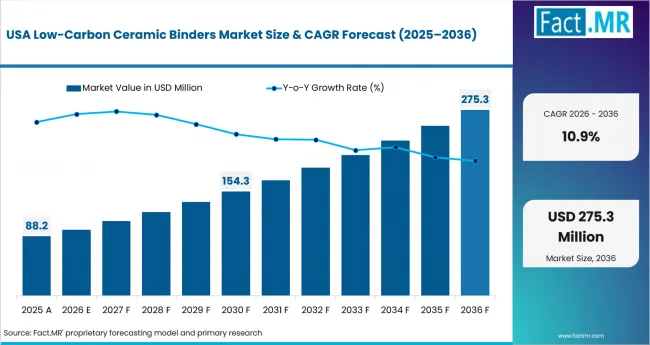
Low Carbon Ceramic Binders Market Country Value Analysis | Source: Fact.MR
United States demand is shaped by a large tile consumption base and a high import share. Tile Council of North America reported in September 2025 that imports accounted for 73.0% of United States ceramic tile consumption. The United States is projected to rise at 10.9% CAGR through 2036 driven by buyer quality checks and air-emission review exposure.
The United States Environmental Protection Agency review of brick and clay air rules keeps manufacturers attentive to emission-control costs. The review matters for binder buyers due to its focus on brick and clay ceramic manufacturing facilities.
Why is South Korea included in the country view?
10.6% CAGR, backed by technical ceramics and electronics-related production.
South Korea’s binder opportunity is smaller than China’s. It is tied to demanding ceramic components used near electronics and precision manufacturing. South Korea is forecast at 10.6% CAGR through 2036 due to buyer requirements around residue and dimensional stability.
Why does Japan remain a quality-led binder market?
10.1% CAGR, driven by technical ceramic manufacturing and conservative qualification cycles.
Japan’s binder purchases are tied to technical ceramic producers that place high weight on process stability. Kyocera announced in March 2026 that it developed ceramic hermetic seals for liquid hydrogen applications. Japan is expected to post 10.1% CAGR through 2036 led by specification depth and longer qualification cycles.
Who leads the low-carbon ceramic binders landscape?
BASF lead alongside WACKER Chemie and Kuraray through polymer chemistry and ceramic formulation support.
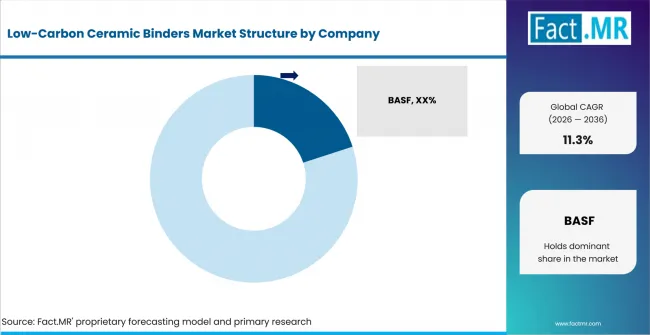
Low Carbon Ceramic Binders Market Analysis By Company | Source: Fact.MR
Low-carbon ceramic binder competition is split between polymer chemistry suppliers and ceramic mineral specialists. BASF bring binder chemistry depth across dispersions and construction material formulations. WACKER Chemie and Kuraray add polyvinyl alcohol and application support. Kuraray positions its polyvinyl alcohol as a temporary binder for ceramic compounds. Imerys and Zschimmer & Schwarz support ceramic production through mineral and additive experience.
Winning suppliers are expected to compete on burnout residue and pre-fired strength. Volatile organic compound profile and plant trial support also shape supplier selection. Providers that connect low-carbon claims with fewer firing defects are better placed than suppliers relying on generic renewable content claims.
Budenheim adds inorganic binder depth through phosphate-based products for ceramics. Its FFB and FABUTIT product lines support refractory and ceramic applications where setting behavior matters.
Which companies are the key players?
BASF are profiled. Ashland and WACKER Chemie are included. Imerys and Zschimmer & Schwarz are also profiled. Kuraray is covered.
- BASF
- Ashland
- WACKER Chemie
- Imerys
- Zschimmer & Schwarz
- Kuraray
Bibliography
- European Commission. (2024, August 4). Industrial and Livestock Rearing Emissions Directive 2.0.
- Wacker Chemie AG. (2025, March 18). WACKER’s high-performance binders help construction industry reduce carbon footprint.
- BASF SE. (2026). Dispersions and additives for ceramic tile adhesives.
- Kuraray Co., Ltd. (2026). Ceramics.
- Budenheim. (2026). Ceramics.
- India Brand Equity Foundation. (2026, January). Tiles of transformation: Exploring India’s ceramic tile industry.
- Tile Council of North America. (2025, September 3). 2Q 2025 U.S. ceramic tile market update.
- Confindustria Ceramica. (2025, June 10). 2024 figures released for the Italian ceramic industry.
- U.S. Small Business Administration, Office of Advocacy. (2025, April 1). EPA announces review of brick and clay air regulation.
- KYOCERA Corporation. (2026, March 19). Kyocera accelerates liquid hydrogen ceramic hermetic seal development.
This Report Addresses
- Strategic intelligence on low-carbon ceramic binders across chemistry, application and end-user groups.
- Segment analysis covers bio-based binders and tiles. It also covers lower volatile organic compound systems and liquid dispersions.
- Regional outlook covers China and India. Germany, Italy, United States, South Korea and Japan are included.
- Competitive analysis covers BASF. Ashland and WACKER Chemie are included. Imerys and Zschimmer & Schwarz are also profiled.
- Supplier assessment covers burnout residue and pre-fired strength. It also covers volatile organic compound profile and plant trial support.
- Source review covers industrial emissions rules and tile-sector signals. It also covers official industry portals and company product literature.
- Primary interviews, supplier portfolio checks and country demand validation support the forecast.
What does the low-carbon ceramic binders market cover?
Binders and additives used to reduce carbon, emissions or firing burden in ceramic manufacturing.
The low-carbon ceramic binders market covers organic and inorganic binding systems used in ceramic bodies before firing or low-energy curing. The scope includes products selected for lower kiln load and lower volatile organic compound release. It also includes renewable feedstock use, lower burnout residue and recycled-content compatibility.
What is included in the scope?
Bio-based and aqueous binder systems used inside ceramic production.
The scope includes bio-based, aqueous, low-VOC, low-ash, low-burnout-residue, inorganic phosphate, and polymer binder systems used inside ceramic manufacturing.It also includes aqueous binder systems and low-volatile-organic-compound organics. It covers plant-based additives and inorganic phosphate binders used in ceramic bodies. Recycled-content binders are included for tiles and refractories.
What is excluded from the scope?
Finished ceramic products, tile installation adhesives, construction mortars, cementitious tile adhesive systems, and binders sold without a low-carbon, low-emission, low-ash, low-residue, or energy-reduction claim are excluded.
The scope excludes finished tiles and refractory bricks. It also excludes sanitaryware and ceramic components. It excludes tile installation adhesives unless binder chemistry is sold into ceramic manufacturing. Standard dispersants and plasticizers are excluded when they do not provide binding performance.
How was the analysis built?
120+ sources, 35+ supplier portfolios, 25+ countries and 20+ interviews.
- Primary Research:
- Primary research includes interviews with ceramic producers and binder formulators. It also includes input from tile manufacturers and procurement managers.
- Desk Research:
- Desk research reviews European emissions rules and construction product requirements. It also checks supplier product literature and ceramic manufacturing references.
- Market-Sizing and Forecasting:
- Forecasting uses ceramic production exposure and binder dosing ranges. Estimates were reconciled against supplier portfolios and country ceramic output signals.
- Data Validation and Update Cycle:
- Forecasts were validated through buyer-side specification checks and supplier capability reviews. The update cycle reflects regulatory changes and emissions scrutiny.
What is the report’s scope and coverage?
| Attribute | Details |
|---|---|
| Quantitative Units | USD Million in 2026 to USD Million by 2036 |
| Market Definition | Low-carbon ceramic binders used inside ceramic manufacturing to reduce kiln load, burnout residue, volatile organic compound exposure or fossil-input reliance |
| Chemistry | Bio-based binders, Low-temperature binders, Aqueous systems, Recycled-content binders, Low-VOC organics, Plant-based additives |
| Application | Tiles, Refractories, Technical ceramics, Sanitaryware, Ceramic composites, Low-energy curing products |
| Sustainability Benefit | Lower kiln load, Lower VOC, Lower burnout residue, Renewable feedstock, Reduced emissions, Recycled content |
| End User | Ceramic producers, Tile manufacturers, Technical ceramics firms, Construction material suppliers |
| Delivery Form | Liquid dispersions, Powder binders, Granules, Paste systems, Premixes |
| Regions Covered | North America, Europe, East Asia, South Asia, Latin America, Middle East & Africa |
| Countries Covered | China, India, Germany, Italy, United States, South Korea, Japan |
| Key Companies Profiled | BASF, Ashland, WACKER Chemie, Imerys, Zschimmer & Schwarz, Kuraray |
| Forecast Period | 2026 to 2036 |
| Approach | Hybrid top-down and bottom-up approach using ceramic output exposure, binder dosing ranges, formulation pricing, supplier portfolios, and buyer validation |
How is the market segmented?
-
By Chemistry:
- Bio-based binders
- Low-temperature binders
- Aqueous systems
- Recycled-content binders
- Low-VOC organics
- Plant-based additives
-
By Application:
- Tiles
- Refractories
- Technical ceramics
- Sanitaryware
- Ceramic composites
- Low-energy curing products
-
By Sustainability Benefit:
- Lower kiln load
- Lower VOC
- Lower burnout residue
- Renewable feedstock
- Reduced emissions
- Recycled content
-
By End User:
- Ceramic producers
- Tile manufacturers
- Technical ceramics firms
- Construction material suppliers
-
By Delivery Form:
- Liquid dispersions
- Powder binders
- Granules
- Paste systems
- Premixes
-
By Region:
- North America
- United States
- Canada
- Mexico
- Latin America
- Brazil
- Argentina
- Rest of Latin America
- Europe
- Germany
- Italy
- United Kingdom
- France
- Spain
- Rest of Europe
- East Asia
- China
- Japan
- South Korea
- South Asia
- India
- ASEAN
- Rest of South Asia
- Middle East & Africa
- GCC Countries
- South Africa
- UAE
- Rest of Middle East & Africa
- North America