- Market Value (2025): USD 224.0 Mn
- Estimated Value (2026): USD 241.5 Mn
- Forecast Value (2036): USD 511.8 Mn
- CAGR (2026-2036): 7.8%
What is the Machinable Ceramics Market forecast to be worth by 2036?
USD 511.8 million by 2036.
- The Machinable Ceramics Market reached a valuation of USD 224.0 million in 2025.
- Demand is projected to increase from USD 241.5 million in 2026 to USD 511.8 million by 2036. CAGR 7.8%
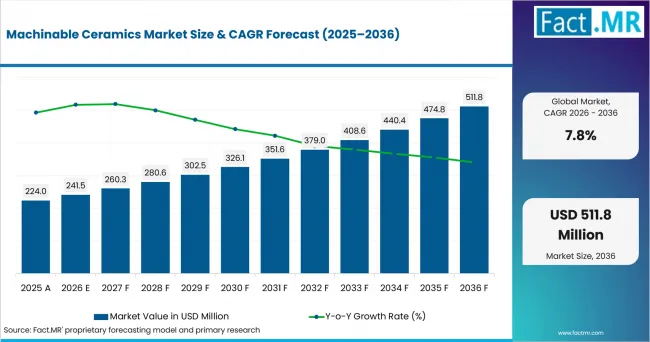
Machinable Ceramics Market Value Analysis | Source: Fact.MR
What are the defining numbers behind Machinable Ceramics Market growth?
USD 270.3 million absolute opportunity is expected between 2026 and 2036.
- Demand Drivers in the Market
- Precision component production is expected to support demand because machinable ceramic grades allow complex shapes and tight features to be produced without relying solely on dedicated ceramic forming tools. Corning states that MACOR can be machined as a precision material, while Ferrotec offers machinable ceramic grades for precision component production.
- Semiconductor equipment investment is anticipated to increase demand for ceramic components that combine dimensional control with electrical, thermal or contamination-related performance. Ferrotec identifies semiconductor processing equipment as an application for its high-purity ceramic parts.
- Aerospace and defense applications are projected to support consumption where engineered ceramics are selected for demanding operating environments. Morgan Advanced Materials supplies technical ceramics into aerospace, defense and other high-specification applications.
- Shorter design and prototyping cycles are estimated to support machinable ceramic adoption because engineers can modify component dimensions during development without repeating a full ceramic tooling and firing sequence. Ferrotec positions machinable ceramic materials for rapid prototyping and precision machining.
- Key Segments Analyzed
- By Product: Alumina Machinable Ceramics are expected to hold 61.8% share in 2026, supported by their use across precision engineering applications requiring ceramic insulation, structural performance and established material familiarity.
- By Application: Aerospace & Defense Applications are projected to account for 47.6% share in 2026 as ceramic components are used where thermal stability, electrical isolation or precision geometry influence material selection.
- By End Use: Industrial Manufacturing Companies are anticipated to capture 66.9% share in 2026 because machinable ceramics are purchased for production equipment, engineered fixtures and precision industrial components.
- By Technology: Precision Ceramic Machining Technology is estimated to represent 53.4% share in 2026 as CNC ceramic machining and laser-assisted processes allow manufacturers to meet tighter dimensional requirements.
- By Formulation: High Purity Ceramic Formulations are forecast to hold 72.3% share in 2026 as electronics and semiconductor-related applications place greater emphasis on material consistency and controlled composition.
- By Distribution Channel: Direct Industrial Sales are projected to account for 44.1% share in 2026 because many ceramic components require drawing review, material selection and application-specific machining before purchase.
- Analyst Opinion at Fact.MR
- Shambhu Nath Jha, Principal Consultant, Fact.MR says, “Machinable ceramics compete where the customer cannot choose material performance separately from manufacturing practicality. Buyers need the ceramic to survive the operating environment, but they also need a supplier that can hold tolerances and control machining damage. Suppliers that connect material selection with precision processing and application engineering are expected to capture more repeat business as semiconductor equipment and high-specification manufacturing expand.”
- Strategic Implications
- Ceramic suppliers should separate prototype-oriented grades from materials intended for repeated production because buyers evaluate machining speed and final operating performance differently.
- Semiconductor equipment suppliers should qualify material purity alongside dimensional capability. A component that is easy to machine still needs to meet the contamination and operating requirements of the installed system.
- Aerospace and industrial buyers should evaluate machining-induced damage during qualification because NIST research identifies surface and subsurface damage as a material issue in ceramic machining.
How does the Machinable Ceramics Market break down by segment?
Alumina Machinable Ceramics are expected to lead Product with 61.8% share in 2026. Aerospace & Defense Applications are projected to lead Application with 47.6% share during the same year.
Why do Alumina Machinable Ceramics lead Product?
Alumina Machinable Ceramics are projected to account for 61.8% share in 2026.
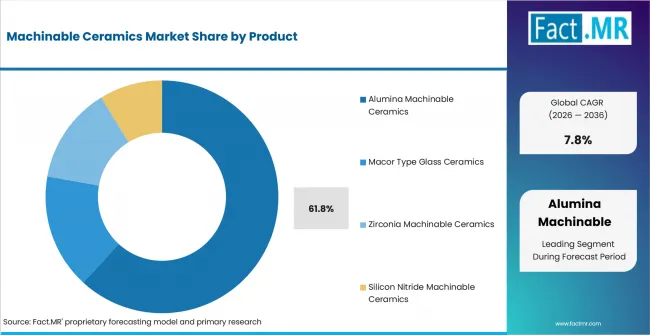
Machinable Ceramics Market Analysis By Product | Source: Fact.MR
Alumina-based materials benefit from extensive familiarity across electrical and industrial ceramic applications. Buyers understand their insulation behavior, temperature capability and engineering limitations, which reduces material-selection risk. Machinable grades extend this familiarity into parts that need more design flexibility during prototyping or lower-volume production.
Aremco supplies both machinable ceramics and dense alumina-based technical ceramics for applications that span aerospace, automotive and semiconductor industries. This established industrial use base supports the position of alumina-related grades within the assessed Product structure.
Why do Aerospace & Defense Applications lead Application?
Aerospace & Defense Applications are projected to account for 47.6% share in 2026.
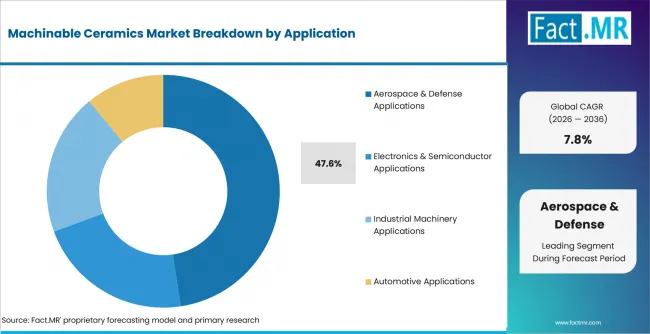
Machinable Ceramics Market Analysis By Application | Source: Fact.MR
Aerospace and defense systems create demand for components that may need electrical insulation, thermal stability or dimensional precision while operating under demanding conditions. Machinability becomes commercially useful during prototype work and low-volume production because engineers can alter dimensions without committing to a new forming tool for every design revision.
Morgan Advanced Materials identifies aerospace and defense among the markets served by its Technical Ceramics business. Corning also records widespread use of MACOR machinable glass ceramic in electronics and aerospace applications.
Why do Industrial Manufacturing Companies lead End Use?
Industrial Manufacturing Companies are projected to hold 66.9% share in 2026.
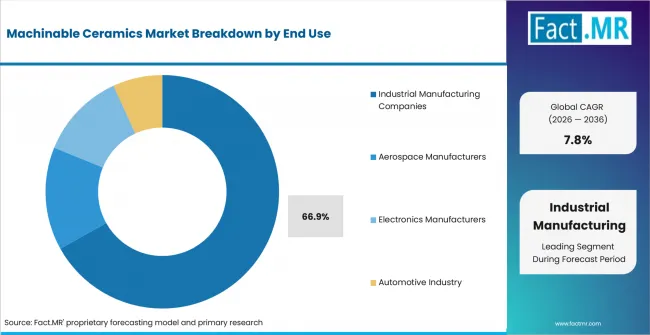
Machinable Ceramics Market Analysis By End Use | Source: Fact.MR
Industrial manufacturers use technical ceramic components in equipment where ordinary metals or polymers may not provide the required electrical, thermal or wear characteristics. Machinable grades add value when a company needs a custom fixture, insulator or precision component without moving immediately to a high-volume ceramic production route.
The End Use base includes Heavy Engineering Firms and Precision Engineering Companies. These buyers frequently work from drawings and operating specifications, which makes material selection and machining capability part of the same purchasing decision.
Why does Precision Ceramic Machining Technology lead Technology?
Precision Ceramic Machining Technology is projected to account for 53.4% share in 2026.
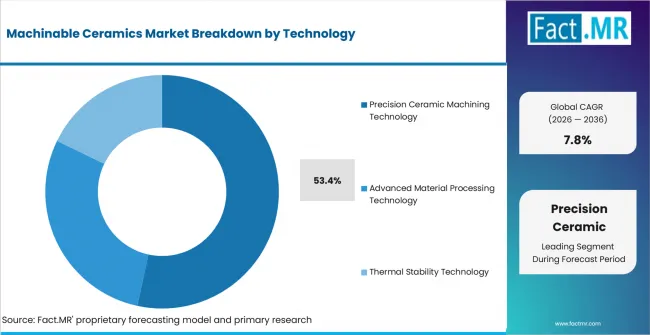
Machinable Ceramics Market Analysis By Technology | Source: Fact.MR
Precision machining leads because the commercial purpose of machinable ceramics depends on converting ceramic stock into components with controlled dimensions. CNC machining supports repeatable geometries, while laser-assisted processes can expand the range of features that manufacturers can produce.
The challenge remains damage control. NIST research documents machining-related cracking and surface or subsurface damage in advanced ceramics, making process control a central part of component reliability.
Why do High Purity Ceramic Formulations lead Formulation?
High Purity Ceramic Formulations are projected to hold 72.3% share in 2026.
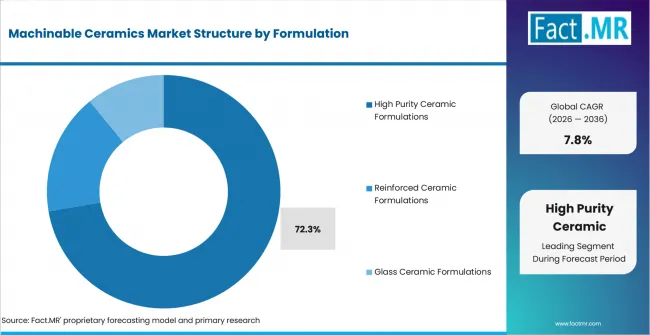
Machinable Ceramics Market Analysis By Formulation | Source: Fact.MR
High purity formulations are important where the ceramic component sits close to sensitive manufacturing processes or electrical systems. Semiconductor processing is one example because equipment suppliers require materials with controlled composition and dependable physical properties.
Ferrotec states that it supplies high-purity ceramic materials and precision components for semiconductor processing equipment and integrated circuit testing. Its portfolio illustrates why purity and processing capability increasingly need to be addressed together.
Why do Direct Industrial Sales lead Distribution Channel?
Direct Industrial Sales are projected to account for 44.1% share in 2026.
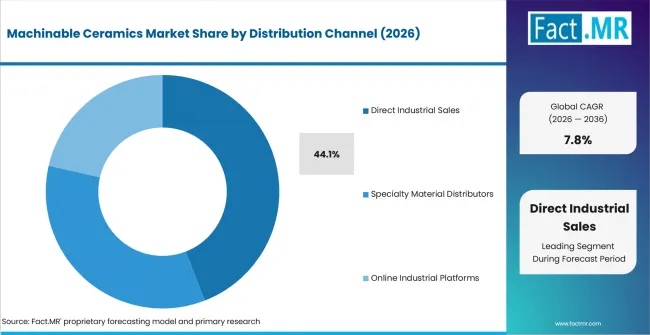
Machinable Ceramics Market Analysis By Distribution Channel | Source: Fact.MR
Direct selling suits a market where material grade, geometry and machining requirements can vary by customer. OEM Supply Contracts and Enterprise Supply Contracts allow engineering information to move directly between the buyer and supplier before production starts.
This channel also supports qualification work. A supplier may need to review drawings, surface-finish requirements or operating temperatures before recommending a grade. Direct technical engagement therefore carries more value than a purely transactional distribution model for many high-specification parts.
What is accelerating Machinable Ceramics Market adoption, and what is holding it back?
Demand for precision components across semiconductor equipment and high-specification manufacturing is anticipated to support market expansion. Machining cost and the risk of ceramic damage are expected to remain the principal restraints.
Drivers Impact Analysis
| DRIVER | (~) % IMPACT ON CAGR | GEOGRAPHIC RELEVANCE | IMPACT TIMELINE |
|---|---|---|---|
| Semiconductor equipment expansion | +1.8% | USA, Japan, South Korea, Germany | Short term (≤2 years) |
| Precision component requirements | +1.4% | Global | Short term (≤2 years) |
| Aerospace & defense engineering demand | +1.0% | USA, UK, Japan | Medium term (2–4 years) |
| Faster prototyping and design iteration | +0.6% | Advanced manufacturing markets | Medium term (2–4 years) |
- Semiconductor equipment expansion: New fabrication capacity is expected to widen the installed base of process equipment that uses high-purity and precision ceramic components.
- Precision component requirements: Buyers increasingly need parts that combine ceramic properties with controlled dimensions and complex geometries.
- Aerospace & defense engineering demand: Ceramic components are projected to gain from continued investment in aircraft systems and high-specification engineering.
- Faster prototyping and design iteration: Machinable grades can reduce the need to create dedicated forming tools during early design cycles. Ferrotec specifically positions machinable ceramics for prototype production.
Opportunity Impact Analysis
| OPPORTUNITY | (~) % IMPACT ON CAGR | GEOGRAPHIC RELEVANCE | IMPACT TIMELINE |
|---|---|---|---|
| Custom precision components | +1.1% | USA, Europe, Japan | Short term (≤2 years) |
| High-purity semiconductor ceramics | +0.9% | USA, Japan, South Korea, Germany | Medium term (2–4 years) |
| Prototype-to-production services | +0.6% | Global advanced manufacturing | Medium term (2–4 years) |
- Custom precision components: Suppliers can expand value per customer by moving beyond stock material into finished components made to drawings and application tolerances.
- High-purity semiconductor ceramics: Fab expansion creates opportunities for suppliers able to combine purity control with precise component fabrication.
- Prototype-to-production services: Machinable grades can act as an entry point during development before a customer moves toward higher-volume ceramic manufacturing.
Restraints Impact Analysis
| RESTRAINT | (~) % IMPACT ON CAGR | GEOGRAPHIC RELEVANCE | IMPACT TIMELINE |
|---|---|---|---|
| Machining damage and brittle fracture risk | -1.4% | Global | Short term (≤2 years) |
| Material and precision-processing cost | -1.0% | Global | Short term (≤2 years) |
| Qualification and supplier complexity | -0.7% | Semiconductor and aerospace markets | Medium term (2–4 years) |
- Machining damage and brittle fracture risk: Surface or subsurface defects can reduce component reliability. NIST has documented machining cracks and damage as persistent concerns in advanced ceramics.
- Material and precision-processing cost: Advanced ceramic machining can require specialized equipment and controlled cutting conditions. NIST has identified machining cost as an impediment to broader advanced ceramic use.
- Qualification and supplier complexity: Aerospace and semiconductor buyers may require material documentation and dimensional validation before a component enters a critical process.
Which countries are scaling the Machinable Ceramics Market fastest?
The worldwide CAGR represents a weighted result across the markets included in the study and therefore does not need to equal the growth rate of every country in the comparison. Japan, the USA and the UK are above the 7.8% global rate. South Korea matches the global CAGR, while Germany remains below it at 7.12%.
- Japan and the USA form the upper end of the supplied country set as semiconductor manufacturing investment expands the need for precision process equipment.
- The UK follows through a different demand route, with aerospace and advanced manufacturing contributing to the requirement for high-specification ceramic components.
- South Korea combines a major semiconductor production base with ongoing cluster investment.
- Germany's growth is tied to its semiconductor, automotive and advanced industrial manufacturing base.
The full report evaluates regional demand across North America, Latin America, Europe, East Asia, South Asia and Oceania, and the Middle East and Africa.
COUNTRY CAGR, 2026 to 2036
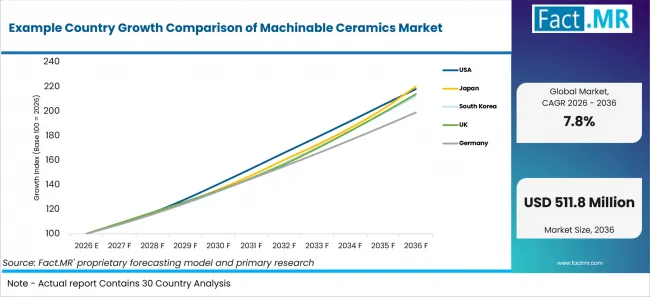
Example Country Growth Comparison Of Machinable Ceramics Market | Source: Fact.MR
| COUNTRY | CAGR |
|---|---|
| Japan | 8.2% |
| USA | 8.1% |
| UK | 7.9% |
| South Korea | 7.8% |
| Germany | 7.12% |
What is driving Japan’s growth through 2036?
Japan is projected to record an 8.2% CAGR in the Machinable Ceramics Market from 2026 to 2036.
Japan's growth is supported by investment around next-generation semiconductor manufacturing and the associated equipment and materials ecosystem. In December 2025, METI stated that AIST would establish an open R&D center for cutting-edge semiconductors in Chitose, Hokkaido, where a semiconductor cluster is forming around Rapidus. Precision ceramic suppliers can benefit as equipment developers require components that combine controlled dimensions with electrical or thermal performance.
What supports USA adoption?
The USA is projected to expand at an 8.1% CAGR from 2026 to 2036.
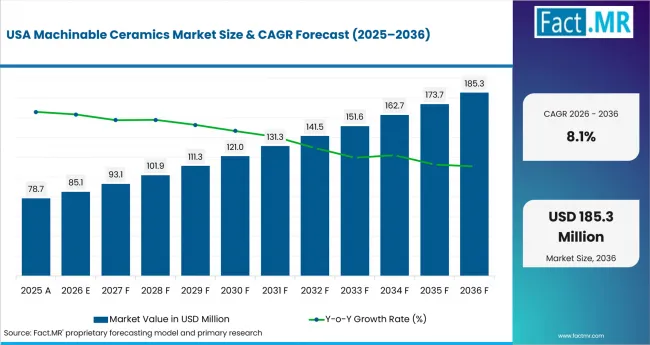
Machinable Ceramics Market Country Value Analysis | Source: Fact.MR
The U.S. outlook is supported by domestic semiconductor manufacturing investment alongside aerospace and industrial demand. In July 2026, the U.S. Department of Commerce announced an additional USD 100 billion of TSMC investment, taking the company's stated U.S. semiconductor manufacturing investment to USD 265 billion. Fab construction and equipment installation enlarge the addressable base for precision ceramic parts used in semiconductor tools and supporting systems.
How is the UK developing demand?
The UK is forecast to register a 7.9% CAGR from 2026 to 2036.
The UK develops through aerospace and advanced manufacturing. In June 2025, the Department for Business and Trade announced more than £250 million of joint government-industry funding for aerospace technology projects. The same government release reported that the UK aerospace sector supported around 100,000 direct jobs and contributed £13.6 billion to the economy in 2024. Continued aerospace engineering activity supports demand for high-specification materials used in components, fixtures and development systems.
What supports South Korea’s outlook?
South Korea is projected to record a 7.8% CAGR from 2026 to 2036.
South Korea's outlook is tied closely to semiconductor manufacturing. Construction of the Yongin Semiconductor Cluster began in February 2025, while government and industry bodies have coordinated power and water infrastructure required for the production complex. These investments expand the equipment base where precision ceramic components are used for process control, electrical isolation and high-purity handling environments.
What shapes Germany’s growth?
Germany is projected to register a 7.12% CAGR from 2026 to 2036.
Germany combines semiconductor expansion with established automotive and industrial manufacturing demand. In February 2025, Germany's federal economic ministry reported European Commission approval for another German Chips Act project supporting Infineon's expansion of chip production in Dresden. The country's growing semiconductor equipment ecosystem adds to demand already created by precision engineering and automotive manufacturing.
Who leads the Machinable Ceramics Market?
Morgan Advanced Materials plc is positioned among the prominent suppliers in the assessed company set. Its Technical Ceramics business supplies structural ceramic components and MACOR machinable glass ceramic, with applications spanning aerospace, semiconductors and industrial markets.
Corning Inc. participates through MACOR machinable glass ceramic. Corning describes the material as a glass ceramic that combines technical ceramic performance with machinability suited to precision component production.
Ferrotec Holdings Corporation supplies advanced and machinable ceramics, including Photoveel materials. Its ceramic portfolio serves semiconductor processing equipment and integrated circuit testing, while its machinable grades support rapid prototype and precision component work.
Tokuyama Corporation participates through advanced ceramic materials such as SHAPAL Hi M-soft machinable aluminum nitride. This sits within the company's wider electronic and advanced materials portfolio.
Aremco Products, Inc. supplies machinable and dense technical ceramics for aerospace, automotive, electrical and semiconductor applications. Its machinable ceramic range is engineered to balance hardness with practical machining requirements.
INNOVACERA supplies machinable glass ceramics and other advanced ceramic materials. Its machinable glass ceramic materials can be processed into complex shapes and precision dimensions using conventional cutting tools.
Competition from 2026 to 2036 is expected to center on material consistency, machining accuracy and application support. Suppliers able to move from raw ceramic stock to qualified finished components can reduce the number of interfaces that OEM buyers need to manage.
Which companies are the key providers?
The assessed company set includes Morgan Advanced Materials plc, Corning Inc., Tokuyama Corporation, Ferrotec Holdings Corporation, Aremco Products, Inc., Crystex Composites, Wuxi Creative Ceramic, INNOVACERA and .
- Morgan Advanced Materials plc
- Corning Inc.
- Tokuyama Corporation
- Ferrotec Holdings Corporation
- Aremco Products, Inc.
- Crystex Composites
- Wuxi Creative Ceramic
- INNOVACERA
Bibliography
- National Institute of Standards and Technology. Ceramic Machining. NIST Special Publication 834.
- U.S. Department of Commerce. Semiconductor Industry and U.S. manufacturing investment updates, 2026.
- Ministry of Economy, Trade and Industry, Japan. Semiconductor R&D and Chitose cluster update, December 2025.
- Ministry of Trade, Industry and Resources, Republic of Korea. Yongin Semiconductor Cluster infrastructure programme.
- Invest Korea. Yongin Semiconductor Cluster General Industrial Complex, 2025.
- Federal Ministry for Economic Affairs, Germany. Infineon Dresden Chips Act project, February 2025.
- UK Department for Business and Trade. Aerospace technology investment announcement, June 2025.
- Corning Incorporated. MACOR Machinable Glass Ceramic technical information.
- Morgan Advanced Materials plc. Technical Ceramics portfolio and 2025 business information.
- Ferrotec. Advanced and Machinable Ceramics portfolio.
- Tokuyama Corporation. SHAPAL Hi M-soft machinable ceramic product information.
- Aremco Products, Inc. Machinable Ceramics and Technical Ceramics portfolio.
This Report Addresses
- The report provides strategic intelligence on the Machinable Ceramics Market across product and application choices that influence material selection.
- Segment analysis examines the leading ceramic categories and the manufacturing conditions supporting their use.
- Regional outlook evaluates the supplied country markets alongside the wider regional demand structure.
- Competitive analysis profiles established ceramic material suppliers and precision component manufacturers active in the assessed market.
- Use-case assessment examines aerospace, semiconductor, industrial and automotive applications across the forecast period.
What does the Machinable Ceramics Market cover?
Machinable ceramics are ceramic materials designed to permit controlled machining into precision shapes while providing functional ceramic properties in the finished component.
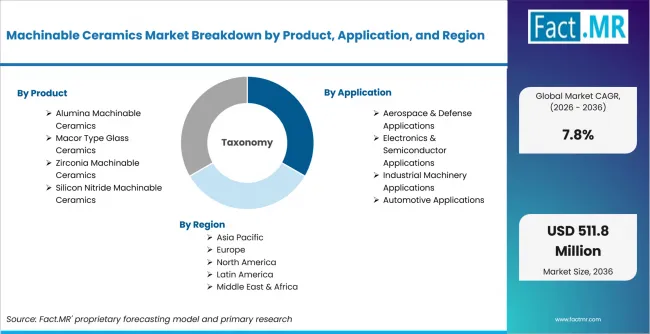
The Machinable Ceramics Market covers alumina machinable ceramics, Macor type glass ceramics, zirconia machinable ceramics and silicon nitride machinable ceramics within the supplied Product taxonomy. Applications include aerospace and defense, electronics and semiconductor equipment, industrial machinery and automotive systems.
The market differs from the broader advanced ceramics sector because the commercial boundary centers on materials and components where machinability forms part of the product value. Dense ceramics that require entirely different forming and finishing routes remain part of the wider technical ceramics industry but are outside this market unless sold within the supplied machinable ceramic categories.
What is included in the scope?
The market includes machinable ceramic materials and finished components purchased by industrial manufacturers, aerospace companies, electronics manufacturers and automotive companies.
Product coverage includes Alumina Machinable Ceramics, Macor Type Glass Ceramics, Zirconia Machinable Ceramics and Silicon Nitride Machinable Ceramics. Application coverage spans Aerospace & Defense Applications, Electronics & Semiconductor Applications, Industrial Machinery Applications and Automotive Applications.
The scope also includes precision ceramic machining, advanced material processing and thermal stability technologies where they are directly applied to the assessed machinable ceramic products. High Purity Ceramic Formulations, Reinforced Ceramic Formulations and Glass Ceramic Formulations remain within the boundary when sold as part of the covered ceramic product.
Direct industrial contracts, specialty material distribution and online industrial platforms are included when they facilitate the sale of covered machinable ceramics or finished machinable ceramic components.
What is excluded from the scope?
Ordinary structural ceramics and unrelated ceramic products sold outside the supplied machinable ceramic taxonomy are outside the market boundary.
The scope excludes ceramic tiles, sanitary ceramics, tableware and commodity refractory products. General cutting tools and machine tools are excluded when sold independently of a machinable ceramic component or processing service. Semiconductor equipment, aircraft, vehicles and industrial machinery are not counted at their full equipment value. Only the relevant machinable ceramic material or component value falls within the assessed market.
Standalone engineering consulting and general machining services are excluded when they do not involve one of the covered machinable ceramic products.
How Was the Analysis Built?
The analysis draws on 120+ sources, 35+ company portfolios, 25+ countries, and more than 20 industry interviews.
- Primary Research: Primary research includes discussions with ceramic material suppliers, precision machining companies, semiconductor equipment manufacturers, aerospace suppliers, industrial engineering companies, distributors, procurement teams and subject-matter experts. These discussions examine material selection, machining requirements, tolerances, qualification procedures and purchasing priorities.
- Desk Research: Desk research covers government manufacturing data, semiconductor investment programmes, aerospace policy, technical standards, company product documentation and authoritative ceramic engineering research. Every external source used in the analysis is documented in the bibliography.
- Market Sizing and Forecasting: Market estimates combine historical performance with material demand, application mix, segment shares, precision component adoption, country-level growth and company participation. Manufacturing constraints are considered before the forecast is finalized.
- Data Validation and Update Cycle: Findings are cross-checked against primary research, public investment activity, supplier portfolios and technical evidence. Updates review semiconductor capacity, aerospace investment, ceramic processing capabilities and changes in customer qualification requirements.
What is the report’s scope and coverage?
Machinable Ceramics Market Breakdown By Product, Application, And Region | Source: Fact.MR
| ATTRIBUTE | DETAILS |
|---|---|
| Quantitative Units | USD Million |
| Market Definition | Machinable ceramic materials and associated precision ceramic components sold for applications where ceramic properties are required together with practical machining into defined shapes and dimensions |
| Segments Covered | Product; Application; End Use; Technology; Formulation; Distribution Channel |
| Regions Covered | North America; Latin America; Europe; East Asia; South Asia and Oceania; Middle East and Africa |
| Countries Covered | USA; Japan; South Korea; UK; Germany |
| Key Companies Profiled | Morgan Advanced Materials plc; Corning Inc.; Tokuyama Corporation; Ferrotec Holdings Corporation; Aremco Products, Inc.; Crystex Composites; Wuxi Creative Ceramic; INNOVACERA; |
| Forecast Period | 2026 to 2036 |
| Base Year | 2025 |
| Market Value, 2026 | USD 241.5 million |
| Market Value, 2036 | USD 511.8 million |
| CAGR, 2026–2036 | 7.8% |
| Absolute Opportunity | USD 270.3 million |
| Approach | Hybrid top-down and bottom-up approach using demand indicators across Product, Application, End Use, Technology, Formulation and Distribution Channel; country-level growth; company participation and adoption trends |
How is the market segmented?
-
By Product:
- Alumina Machinable Ceramics
- High Purity Alumina Grades
- Standard Alumina Blends
- Macor Type Glass Ceramics
- Microwave Compatible Ceramics
- General Glass Ceramic Grades
- Zirconia Machinable Ceramics
- Stabilized Zirconia Grades
- Partially Stabilized Zirconia
- Silicon Nitride Machinable Ceramics
- Industrial Grade Silicon Nitride
- Precision Silicon Nitride Parts
- Alumina Machinable Ceramics
-
By Application:
- Aerospace & Defense Applications
- Aircraft Structural Components
- Defense Equipment Systems
- Electronics & Semiconductor Applications
- Wafer Processing Equipment
- Electronic Insulation Systems
- Industrial Machinery Applications
- Heavy Equipment Manufacturing
- Automation Equipment Systems
- Automotive Applications
- Powertrain Components
- EV System Applications
- Aerospace & Defense Applications
-
By End Use:
- Industrial Manufacturing Companies
- Heavy Engineering Firms
- Precision Engineering Companies
- Aerospace Manufacturers
- Aircraft OEMs
- Aerospace Component Suppliers
- Electronics Manufacturers
- Semiconductor Equipment Makers
- Electronic Device OEMs
- Automotive Industry
- Vehicle OEMs
- EV Technology Firms
- Industrial Manufacturing Companies
-
By Technology:
- Precision Ceramic Machining Technology
- CNC Ceramic Machining Systems
- Laser Assisted Machining
- Advanced Material Processing Technology
- Sintering Optimization Systems
- Powder Engineering Systems
- Thermal Stability Technology
- High Temperature Processing Systems
- Shock Resistance Engineering
- Precision Ceramic Machining Technology
-
By Formulation:
- High Purity Ceramic Formulations
- Ultra Fine Grain Structures
- High Density Formulations
- Reinforced Ceramic Formulations
- Fiber Reinforced Ceramics
- Metal Doped Ceramics
- Glass Ceramic Formulations
- Amorphous Ceramic Blends
- Hybrid Glass Systems
- High Purity Ceramic Formulations
-
By Distribution Channel:
- Direct Industrial Sales
- OEM Supply Contracts
- Enterprise Supply Contracts
- Specialty Material Distributors
- Technical Ceramic Distributors
- Regional Industrial Distributors
- Online Industrial Platforms
- B2B Material Marketplaces
- Manufacturer Direct Platforms
- Direct Industrial Sales
-
By Region:
- North America
- Latin America
- Western Europe
- Eastern Europe
- East Asia
- South Asia and Pacific
- Middle East & Africa