- Base Value(2025): 8.40 Bn
- Estimated Value(2026): 9.01 Bn
- Forecast Value (2036): 18.23 Bn
- CAGR (2026 - 2036): 7.30%
Thermal Ceramics Market Size, Market Forecast and Outlook By Fact.MR
The thermal ceramics market was valued at USD 8.40 billion in 2025, projected to reach USD 9.01 billion in 2026, and is forecast to expand to USD 18.23 billion by 2036 at a 7.30% CAGR. Industrial furnace lining requirements and energy efficiency mandates in metallurgical, petrochemical, and power generation facilities are sustaining procurement of thermal ceramic insulation products globally. Thermal ceramics reduce heat loss from high-temperature process equipment, lowering fuel consumption and greenhouse gas emissions while maintaining the structural integrity of furnace walls, kiln linings, and reactor vessels operating at temperatures from 600 to over 1,600 degrees Celsius.
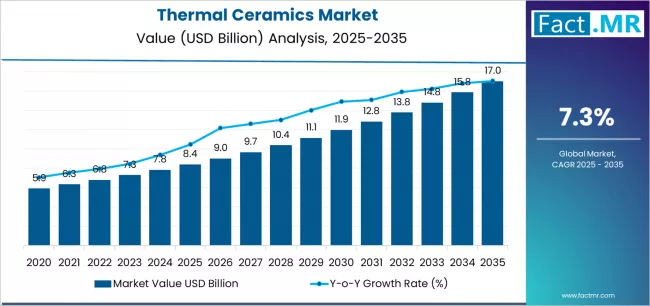
Thermal Ceramics Market Market Value Analysis | Source: Fact.MR
Summary of Thermal Ceramics Market
- Market Overview
- The market is valued at USD 8.40 billion in 2025 and is projected to reach USD 18.23 billion by 2036.
- The industry is expected to grow at a 7.30% CAGR from 2026 to 2036, creating an incremental opportunity of USD 9.22 billion.
- The market operates as a high-temperature industrial insulation category where thermal conductivity, temperature rating, and installation durability define competitive positioning across metallurgy, petrochemical, power generation, and transportation sectors.
- Demand and Growth Drivers
- Steel and aluminium production capacity expansion in India and China drives demand for ceramic fibre blankets, refractory bricks, and insulating boards in blast furnace and electric arc furnace lining applications.
- Industrial energy efficiency regulations mandate improved furnace insulation that reduces heat loss and fuel consumption across metallurgical, cement, and petrochemical processing facilities.
- Petrochemical plant maintenance cycles and reactor vessel relining requirements generate recurring procurement of thermal ceramic products with documented high-temperature performance.
- Among key countries, India leads at 8.0% CAGR, followed by China at 7.7%, Brazil at 6.8%, Germany at 6.4%, the USA at 6.1%, the UK at 5.9%, and Japan at 5.6%.
- Product and Segment View
- Thermal ceramics are high-temperature insulation materials engineered to resist heat transfer and protect industrial equipment operating from 600 to over 1,600 degrees Celsius.
- Ceramics Fibers hold 55.0% of the Material Type segment in 2026, reflecting the dominance of alumina-silica fibre blankets, modules, and papers in furnace lining and kiln insulation.
- Industrial applications command 64.0% in 2026, representing furnace, kiln, oven, and process vessel insulation across manufacturing and processing facilities.
- Metallurgy & Foundry holds 42.0% of the End Use Industry segment in 2026, driven by blast furnace, electric arc furnace, ladle, and foundry lining requirements.
- Scope includes ceramic fibres, refractory bricks, and insulating boards for industrial, transportation, petrochemical, and other applications. Structural refractories, castables, and downstream metallurgical and petrochemical process equipment are excluded.
- Geography and Competitive Outlook
- India and China are the fastest-growing markets, driven by steel production expansion, industrial modernization, and energy efficiency regulation implementation.
- Germany and the USA anchor technology-intensive demand through advanced metallurgical processing, petrochemical facility maintenance, and energy sector insulation.
- Competition is shaped by high-temperature performance certification, product range breadth, and installation service capability, with Morgan Advanced Materials, 3M, Unifrax, CeramTec, and Ibiden among the principal suppliers.
- Analyst Opinion at Fact.MR
- Shambhu Nath Jha , Principal Consultant for Industrial Automation, opines: 'In my analysis, I have observed that the thermal ceramics market is entering an energy audit-driven specification phase where industrial facility operators select insulation products based on documented thermal conductivity data at operating temperature rather than catalogue specifications at ambient conditions. The decisive procurement variable for metallurgical plant engineers is insulation system thermal performance at actual furnace operating temperatures with documented aging characteristics over multi-year campaigns. Ceramic fibre producers that provide installed thermal conductivity certificates with aging degradation curves will capture specification positions at energy audit-driven facility upgrades.'
- Strategic Implications / Executive Takeaways
- Thermal ceramic producers must provide installed thermal conductivity certificates with documented aging degradation data to capture specification positions at energy audit-driven industrial facility upgrades.
- Product development teams should invest in low-biopersistent ceramic fibre formulations that meet evolving occupational health regulations while maintaining high-temperature insulation performance.
- Installation service teams need to develop turnkey furnace lining solutions with guaranteed energy savings contracts to convert one-time material sales into recurring service revenue.
Thermal Ceramics Market Key Takeaways
| Metric | Details |
|---|---|
| Industry Size (2026) | USD 9.01 billion |
| Industry Value (2036) | USD 18.23 billion |
| CAGR (2026 to 2036) | 7.30% |
Source: Fact.MR analysis. Updated Apr 1, 2026
Between 2026 and 2036, the market is set to register an absolute dollar opportunity of USD 9.22 billion. This expansion reflects the convergence of steel and aluminium production capacity expansion in emerging economies, petrochemical facility maintenance and upgrade cycles, and the tightening of industrial energy efficiency regulations that mandate improved furnace insulation performance. Alumina and silica fibre raw material costs and the energy intensity of ceramic fibre production introduce pricing dynamics that shape manufacturer margin structures.
India leads with an 8.0% CAGR, driven by steel production expansion, cement kiln modernization, and petrochemical facility construction. China follows at 7.7%, supported by industrial furnace capacity and energy efficiency compliance programmes. Brazil registers 6.8%, reflecting metallurgical and petrochemical sector investment. Germany advances at 6.4%, the USA at 6.1%, the UK at 5.9%, and Japan at 5.6%.
Imperatives for Stakeholders in Thermal Ceramics Market
Design for thermal efficiency, not just temperature resistance
- Offer complete insulation solutions: material formulation + thermal conductivity optimization + structural integrity + installation systems + technical consultation.
- Preconfigured application packages: furnace lining protocols, kiln insulation systems, boiler refractory solutions, and temperature gradient management for industrial optimization.
Regulatory compliance for environmental standards
- Real-time emissions monitoring systems, material safety documentation, and supply chain certification (ISO standards, environmental compliance, quality assurance protocols).
Energy-efficiency-by-design approach
- Low thermal conductivity formulations, composite material engineering, advanced fiber technology, and transparent performance specification documentation.
Industry-focused market entry
- Clear application pathway navigation + established distributor partnerships (industrial suppliers, OEM relationships, direct manufacturer engagement); technical support services for installation guidance and performance optimization.
Segmental Analysis
The market segments by application into industrial, transportation, petrochemical & chemical, and others, representing the evolution from traditional ceramics materials to sophisticated thermal management solutions for energy-intensive and high-temperature industrial applications.
The material type segmentation divides the market into ceramics fibers (55.0%), refractory bricks (30.0%), and insulating boards (15.0%), reflecting distinct performance characteristics for lightweight insulation versus heavy-duty refractory applications and thermal resistance patterns.
The end-use industry segmentation reveals metallurgy & foundry's commanding 42.0% market leadership, followed by energy & power at 27.0% and oil & gas/petrochemical at 19.0%, demonstrating varied operational requirements and temperature management levels.
Why do Industrial Applications Command the Largest Share in the Thermal Ceramics Market?
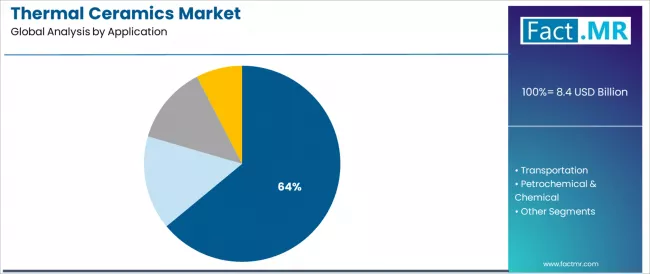
Thermal Ceramics Market Analysis By Application | Source: Fact.MR
Industrial applications command the leading position in the thermal ceramics market with dominant 64.0% market share through proven high-temperature features, including superior thermal resistance characteristics, zero heat transfer properties, and refractory optimization that enable manufacturers to achieve desired energy efficiency across diverse furnace operations and kiln applications.
The segment benefits from manufacturer preference for materials that provide consistent thermal insulation, reduced energy consumption, and durability characteristics without requiring frequent replacement or maintenance modifications.
Advanced ceramics technologies enable nano-structured fibers, enhanced thermal barriers, and integration with existing industrial infrastructure categories, where energy cost reduction and operational reliability represent critical manufacturing requirements. Reheating furnaces and kilns hold 38.0% share within the industrial segment, appealing to steel and cement manufacturers seeking optimized thermal management systems.
Industrial applications differentiate through proven cost savings, consistent thermal performance, and integration with energy efficiency initiatives that enhance operational competitiveness while maintaining optimal safety standards for diverse metallurgical and high-temperature manufacturing applications.
Key market characteristics:
- Advanced fiber technology with optimized thermal conductivity and structural integrity enhancement capabilities
- Superior temperature resistance, enabling continuous operation at 1,200-1,800°C with reliable performance control
- Energy efficiency compatibility, including reduced heat loss, lower fuel consumption, and operational cost optimization for comprehensive industrial applications
What makes Transportation an Emerging Growth Segment?
Transportation applications maintain significant market position with 20.0% share due to their specialized thermal management properties and lightweight positioning characteristics.
These materials appeal to automotive and aerospace manufacturers seeking enhanced engine efficiency with heat shielding capabilities, offering sophisticated thermal protection for premium performance applications. Market growth is driven by electric vehicle innovation, emphasizing battery thermal management and heat dissipation through optimized ceramics composite formulations.
How does Ceramics Fiber Dominance Shape Material Preferences in Thermal Ceramics?
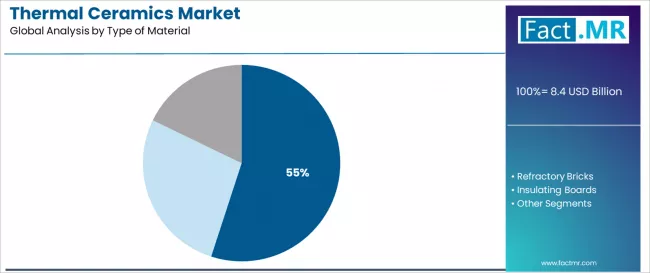
Thermal Ceramics Market Analysis By Type Of Material | Source: Fact.MR
Ceramics fibers demonstrate material leadership in the thermal ceramics market with a 55.0% share due to widespread adoption of lightweight insulation technology and increasing focus on energy-efficient manufacturing, thermal shock resistance, and flexible installation capabilities that maximize operational effectiveness while maintaining consistent high-temperature performance standards.
Manufacturers prioritize weight reduction, installation flexibility, and integration with modernization programs that enables coordinated efficiency improvements across multiple production facilities. The segment benefits from substantial industrial infrastructure investment and energy conservation mandates that emphasize ceramics fiber adoption for thermal optimization and operational cost reduction applications. Alumina-silica fiber captures 46.0% share within the ceramics fiber segment, demonstrating manufacturer preference for balanced thermal and mechanical properties.
Energy efficiency regulations incorporate ceramics fiber insulation as standard industrial specifications for furnace modernization, while sustainability initiatives increase demand for thermal ceramics capabilities that comply with emissions reduction targets and minimize environmental impact exposure.
Why are Refractory Bricks Experiencing Sustained Demand in Heavy Industry?
Refractory bricks capture 30.0% material share through comprehensive durability requirements in high-temperature applications, structural load-bearing capabilities, and extreme condition resistance.
Refractory bricks demand superior compressive strength capable of maintaining thermal stability while providing effective insulation benefits and maximum structural integrity, appealing to metallurgical operations and heavy industrial facilities seeking proven refractory solutions.
What drives Metallurgy & Foundry's Market Leadership in End-Use Applications?
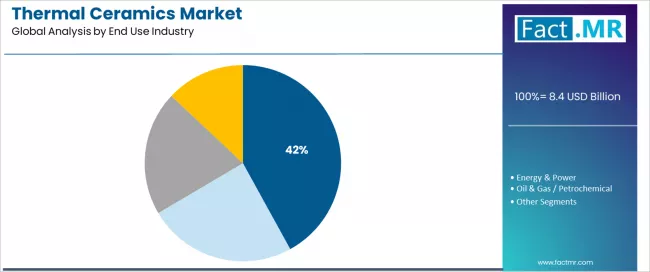
Thermal Ceramics Market Analysis By End Use Industry | Source: Fact.MR
Metallurgy & foundry establishes market leadership in the thermal ceramics sector with commanding 42.0% share due to comprehensive steel production requirements and increasing focus on furnace efficiency optimization, continuous casting operations, and refractory performance capabilities that maximize production output while maintaining operational reliability standards.
Steel manufacturers and foundry operators prioritize thermal stability, erosion resistance, and integration with established production infrastructure that enables coordinated capacity expansion across multiple processing stages. The sector benefits from substantial global steel demand and infrastructure development programs that emphasize the adoption of advanced refractory platforms for production optimization and quality assurance applications.
Emerging market industrialization programs incorporate thermal ceramics specifications as standard furnace requirements for steel manufacturing, while production efficiency mandates increase demand for advanced refractory capabilities that meet temperature control regulations and minimize maintenance downtime exposure.
Industry dynamics include:
- Strong growth in Asian steel markets with production expansion requiring advanced thermal ceramics capabilities
- Increasing adoption in electric arc furnace operations for energy-efficient steel production applications
- Rising integration with continuous casting systems for improved thermal management and production consistency
How are Energy & Power Applications Developing Thermal Ceramics Requirements?
Energy & power captures 27.0% end-use share through evolving power generation frameworks, turbine insulation requirements, and waste heat recovery applications. The sector demonstrates varied thermal management approaches across generation technologies, with ceramics materials gaining traction in high-efficiency power plants while renewable energy applications face integration challenges requiring specialized thermal storage and insulation solutions.
Why is Oil & Gas/Petrochemical Emerging as a Strategic End-Use Segment?
Oil & gas/petrochemical holds 19.0% end-use share with substantial growth potential through refinery modernization programs, boiler efficiency improvements, and reactor lining applications.
Markets including refineries, chemical complexes, and processing facilities demonstrate increasing acceptance of advanced ceramics materials within established high-temperature operation frameworks, while capacity expansion in emerging regions creates opportunities for thermal ceramics suppliers seeking industrial diversification platforms.
What are the Drivers, Restraints, and Key Trends of the Thermal Ceramics Market?
| Category | Factor | Impact | Why It Matters |
|---|---|---|---|
| Driver | Industrial expansion & energy efficiency mandates (steel production growth, emission regulations) | ★★★★★ | Large-scale manufacturing growth enables widespread thermal ceramics adoption; regulatory pressure for energy conservation drives ceramics fiber demand across industrial heating applications. |
| Driver | Infrastructure development & metallurgical capacity expansion (emerging market industrialization, construction boom) | ★★★★★ | Drives demand for refractory materials and high-temperature insulation solutions; manufacturers providing cost-effective ceramics solutions gain competitive advantage in price-sensitive segments. |
| Driver | Material technology advancement & performance optimization (nano-fiber development, composite engineering) | ★★★★☆ | Manufacturers demand superior thermal resistance and durability characteristics; technological advancement expanding addressable applications beyond traditional furnace lining patterns. |
| Restraint | Raw material price volatility & supply chain complexity (alumina costs, fiber production capacity) | ★★★★☆ | Manufacturers face margin pressure and pricing uncertainty; increases operational costs and affects project profitability across commodity ceramics markets. |
| Restraint | Installation expertise requirements & technical complexity (specialized application knowledge, skilled labor shortage) | ★★★☆☆ | Quality-focused projects face implementation challenges and commissioning delays, limiting rapid market penetration and affecting adoption rates in cost-sensitive markets. |
| Trend | Renewable energy integration & sustainable manufacturing (solar thermal systems, waste heat recovery) | ★★★★★ | Growing demand for thermal management in clean energy applications; sustainability positioning becomes core market expansion strategy for long-term growth. |
| Trend | Advanced composite development & multi-functional materials (fiber-matrix optimization, hybrid insulation) | ★★★★☆ | Thermal ceramics merging with structural material trends; multi-functional positioning drives premium pricing and differentiation in competitive industrial markets. |
Source: Fact.MR analysis. Updated Apr 1, 2026
Analysis of the Thermal Ceramics Market by Key Countries
The thermal ceramics market demonstrates exceptional regional growth dynamics with emerging leaders including India (8.0% CAGR) and China (7.7% CAGR) driving expansion through industrial capacity additions and steel production growth. Strong Performers encompass Brazil (6.8% CAGR), USA (6.1% CAGR), and Germany (6.4% CAGR), benefiting from infrastructure modernization and advanced manufacturing capabilities. Developed Markets feature UK (5.9% CAGR) and Japan (5.6% CAGR), where industrial efficiency improvement and technology integration support consistent growth patterns.
Regional synthesis reveals Asian markets leading adoption through comprehensive industrialization infrastructure and steel production expansion, while emerging countries demonstrate highest growth potential supported by manufacturing capacity development and infrastructure investment. Developed markets show robust development driven by energy efficiency mandates and industrial modernization frameworks.
.webp "Top Country Growth Comparison Thermal Ceramics Market Cagr (2026 2036)")
Top Country Growth Comparison Thermal Ceramics Market Cagr (2026 2036) | Source: Fact.MR
| Region/Country | 2026-2036 Growth | How to win | What to watch out |
|---|---|---|---|
| India | 8.0% | Focus on steel industry partnerships and cost-effective solutions | Infrastructure gaps; fragmented distribution networks |
| China | 7.7% | Lead with advanced fiber technology and volume production | Price competition; environmental compliance costs |
| Brazil | 6.8% | Offer infrastructure project readiness and local manufacturing | Economic volatility; import dependency |
| USA | 6.1% | Provide energy-efficient solutions and technical support | Mature market saturation; pricing pressure |
| Germany | 6.4% | Push advanced composite materials and sustainability positioning | High labor costs; stringent regulations |
| UK | 5.9% | Industrial efficiency optimization and retrofit solutions | Post-Brexit supply chain adjustments; market consolidation |
| Japan | 5.6% | High-performance materials for specialized applications | Aging infrastructure; conservative adoption patterns |
Source: Fact.MR analysis. Updated Apr 1, 2026
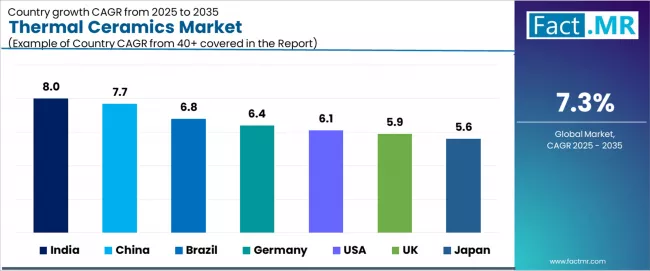
Thermal Ceramics Market Cagr Analysis By Country | Source: Fact.MR
What is the Outlook for the Thermal Ceramics Market in India?
India establishes fastest market growth through aggressive steel capacity expansion programs and comprehensive infrastructure development initiatives, positioning thermal ceramics as critical components of furnace construction and industrial heating applications in metallurgical and cement manufacturing sectors.
The country's 8.0% growth rate reflects government initiatives promoting domestic steel production and energy efficiency mandates that encourage the deployment of advanced refractory materials in regulated industrial settings. Growth concentrates in major industrial regions, including Gujarat, Maharashtra, and Odisha, where steel manufacturers and cement producers showcase increasing adoption of ceramics fiber insulation that appeals to cost-conscious operators demanding energy savings and operational efficiency improvements.
Indian ceramics manufacturers are developing competitive pricing strategies that combine domestic alumina sourcing advantages with labor cost benefits, including volume production capabilities and distribution network expansion. Market penetration through industrial distributors and direct OEM relationships expands accessibility, while technical service initiatives support evidence-based material selection across diverse high-temperature applications and manufacturing segments.
What is the Outlook for the Thermal Ceramics Market in China?
In Hebei, Jiangsu, and Shandong regions, steel producers and industrial manufacturers are adopting advanced ceramics materials as essential components for furnace modernization and energy conservation programs, driven by increasing government emphasis on environmental compliance and reduction of coal consumption that emphasizes the importance of thermal efficiency improvements.
The market holds a 7.7% growth rate, supported by national industrial upgrading policies and emission reduction mandates that promote ceramics fiber adoption for energy-intensive manufacturing applications. Chinese manufacturers are favoring thermal ceramics that provide measurable fuel savings and environmental benefits, particularly appealing in regions where emission penalties and energy costs represent critical operational priorities.
Market expansion benefits from massive refractory manufacturing infrastructure and material innovation capabilities that enable domestic production of advanced alumina-silica fibers for industrial applications. Adoption follows patterns established in state-owned enterprise modernization programs, where government directives and centralized procurement approaches drive purchasing decisions and technology acceptance patterns.
How is Infrastructure Development Generating Thermal Ceramics Demand in Brazil?
Brazil establishes rapid infrastructure momentum through progressive industrial expansion frameworks and emerging steel production capacity additions, integrating thermal ceramics across refinery operations and petrochemical facilities. The country's 6.8% growth rate reflects growing industrial investment climate and increasing adoption of international manufacturing standards that supports expanding thermal ceramics deployment in Brazilian industrial markets.
Growth concentrates in major industrial regions, including São Paulo, Rio de Janeiro, and Minas Gerais, where manufacturers showcase openness to advanced refractory solutions that appeal to quality-focused operations seeking reliable thermal management with proven performance profiles.
Brazilian industrial suppliers focus on import substitution strategies and partnership development with international ceramics manufacturers, creating demand for locally-supplied materials that combine global technology standards with regional price expectations. The market benefits from expanding industrial base and growing petrochemical infrastructure that support thermal ceramics adoption while maintaining cost competitiveness important to Brazilian manufacturing economics.
How will Industrial Modernization Generate Prospects for Thermal Ceramics in USA?
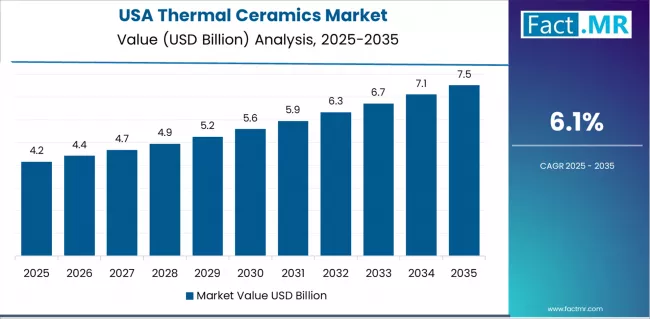
Thermal Ceramics Market Country Value Analysis | Source: Fact.MR
The USA establishes industrial modernization leadership through comprehensive facility upgrade programs and mature manufacturing infrastructure, integrating thermal ceramics across steel mills, power generation facilities, and industrial heating applications. The country's 6.1% growth rate reflects established energy efficiency priorities and sophisticated procurement capabilities that support widespread deployment of advanced ceramics materials in industrial and commercial applications.
Growth concentrates in industrial regions, including the Midwest, Gulf Coast, and Southeast, where facility managers showcase adoption of high-performance insulation systems that appeal to operators seeking lifecycle cost optimization and regulatory compliance for sustainable operations.
American manufacturers leverage established technical support networks and comprehensive distribution infrastructure, including specialized refractory contractors and engineering service partnerships that create specification advantages and repeat purchase patterns. The market benefits from robust industrial maintenance budgets and facility reliability programs that encourage material upgrades while supporting sustainability initiatives and operational efficiency improvements for competitive manufacturing.
How will the Thermal Ceramics Market Grow in Germany?
Germany's advanced manufacturing sector demonstrates sophisticated thermal ceramics integration with documented effectiveness in steel production applications and industrial furnace operations through engineering-focused procurement channels and technical specification networks.
The country leverages manufacturing excellence in material characterization and application engineering to maintain a 6.4% growth rate. Industrial centers, including North Rhine-Westphalia, Bavaria, and Baden-Württemberg, showcase performance-based material selection where thermal ceramics integrate with comprehensive maintenance programs and efficiency monitoring systems to optimize operational outcomes and ensure regulatory compliance.
German industrial companies prioritize material consistency and technical documentation in ceramics specification processes, creating demand for certified formulations with verified performance characteristics, including standardized thermal conductivity values and engineering-grade quality assurance. The market benefits from established industrial customer relationships and technical service excellence that provide engineering-supported material recommendations and compliance with strict industrial safety regulations.
Europe Market Split by Country
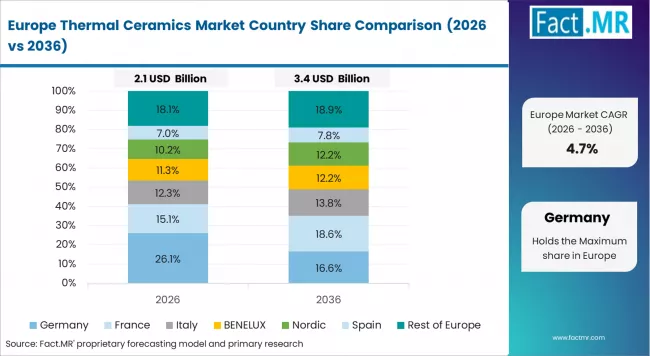
Thermal Ceramics Market Europe Country Market Share Analysis, 2026 & 2036 | Source: Fact.MR
The European thermal ceramics market is projected to grow from USD 1.7 billion in 2026 to USD 2.9 billion by 2036, representing 20% of the global market throughout the forecast period. Germany is expected to maintain its leadership position with USD 0.46 billion in 2026, accounting for 27.1% of the European market, supported by its advanced manufacturing infrastructure and comprehensive steel production capabilities.
UK follows with USD 0.32 billion, representing 18.8% of the European market in 2026, driven by industrial modernization programs and energy efficiency initiatives. France holds USD 0.28 billion with 16.5% market share through established refractory manufacturing base and industrial heating applications.
Italy commands USD 0.24 billion representing 14.1% share, while Spain accounts for USD 0.20 billion or 11.8% in 2026. The rest of Europe region maintains USD 0.20 billion, representing 11.7% of the European market, attributed to increasing thermal ceramics adoption in Nordic countries and emerging Eastern European markets implementing industrial modernization programs.
How will Thermal Ceramics Demand Expand in the UK?
The UK's industrial sector demonstrates sophisticated ceramics fiber integration with documented effectiveness in furnace retrofit applications and energy conservation programs through established industrial supply channels and engineering consultancy networks.
The country maintains a 5.9% growth rate, leveraging established manufacturing expertise and energy cost pressures in thermal insulation adoption. Industrial centers, including Midlands, Yorkshire, and Scotland, showcase efficiency-focused material upgrades where thermal ceramics integrate with facility improvement initiatives and maintenance optimization programs to reduce operating costs and maintain regulatory compliance under UK industrial standards.
British industrial suppliers prioritize energy payback analysis and lifecycle cost modeling in product positioning, creating demand for certified materials with documented fuel savings, including third-party verification and engineering calculation support. The market benefits from established industrial infrastructure and operator willingness to invest in proven efficiency technologies that provide operational cost reduction and comply with UK environmental standards.
How does Advanced Material Integration in Key Industries Drive Thermal Ceramics Demand in Japan?
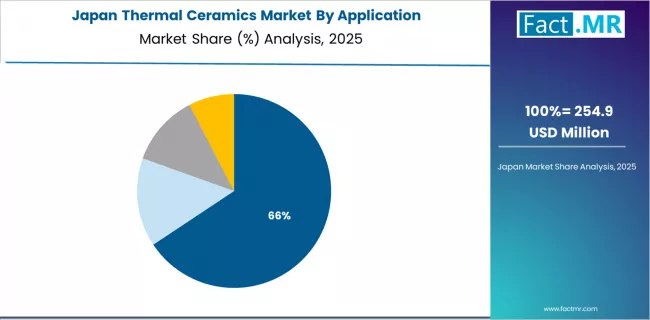
Thermal Ceramics Market Japan Market Share Analysis By Application | Source: Fact.MR
Japan's sophisticated industrial sector demonstrates emerging advanced ceramics integration with documented performance in steel production applications and high-efficiency furnace operations through specialized industrial channels and technical distribution networks.
The country maintains a 5.6% growth rate, leveraging traditional materials expertise and quality-focused manufacturing culture in ceramics material adoption. Industrial centers, including Tokyo-Yokohama, Osaka, and Nagoya, showcase high-performance material specifications where thermal ceramics integrate with established maintenance protocols and quality assurance systems to optimize production reliability and maintain regulatory compliance under strict Japanese industrial regulations.
Japanese manufacturers prioritize material longevity and performance consistency in ceramics procurement processes, creating demand for premium formulations with extended service life, including documented durability testing and comprehensive technical support. The market benefits from established industrial purchasing relationships and cultural emphasis on quality materials that provide operational reliability and comply with conservative Japanese engineering standards.
Competitive Landscape of the Thermal Ceramics Market
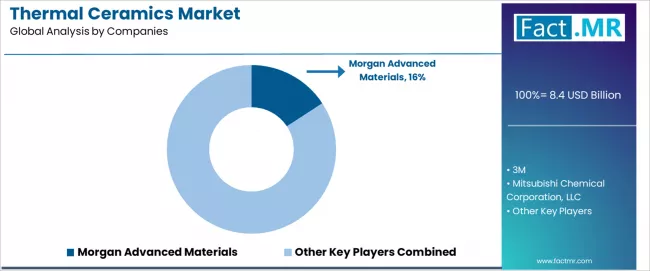
Thermal Ceramics Market Analysis By Company | Source: Fact.MR
The thermal ceramics market exhibits a moderately consolidated competitive structure with approximately 30-50 active players operating across regional distribution networks and international manufacturing operations. Morgan Advanced Materials maintains market leadership at a 15.8% share, reflecting strong technological capabilities in advanced fiber production and comprehensive global distribution strategies.
This consolidated landscape demonstrates the capital-intensive nature of thermal ceramics manufacturing, where production scale, raw material access, and technical expertise create barriers for new entrants while established players leverage manufacturing efficiency and customer relationships to maintain market positions through targeted industrial segments and application-focused strategies.
Market leadership is maintained through several critical competitive advantages extending beyond material formulation and production capabilities. Global manufacturing networks enable leading players to optimize production costs through scale economies and access diverse raw material sources including bauxite and kaolin deposits. Technical service expertise represents crucial differentiators in industrial markets, where application engineering support, installation guidance, and performance troubleshooting create loyalty among demanding industrial customers.
Material innovation in nano-structured fibers, composite formulations, and ultra-high temperature ceramics separates premium suppliers from commodity producers, while comprehensive quality assurance programs addressing material consistency, thermal testing, and certification requirements strengthen market position and support category expansion.
The market demonstrates emerging commoditization trends in basic ceramics fiber blankets and standard refractory bricks, where product standardization diminishes differentiation and price-based competition intensifies among regional producers lacking innovation capabilities. However, significant margin opportunities persist in specialty product categories and value-added service experiences. Advanced composite materials combining multiple fiber types with engineered matrix systems command premium pricing through superior thermal performance and extended service life.
Custom-engineered solutions addressing specific furnace geometries, temperature profiles, and installation constraints create project-level differentiation that justifies higher price points beyond standard product sales. Sustainability-focused materials emphasizing recycled content, reduced embodied energy, and end-of-life recyclability generate brand premiums and specification preferences beyond transactional pricing competition.
| Stakeholder | What they actually control | Typical strengths | Typical blind spots |
|---|---|---|---|
| Integrated ceramics manufacturers | Production facilities; raw material sourcing; R&D capabilities | Manufacturing scale; material innovation; quality consistency | Market agility; regional customization; niche applications |
| Specialty refractory producers | Application expertise; custom formulations; technical service | Customer relationships; engineering support; problem-solving | Production scale; cost competitiveness; commodity markets |
| Regional suppliers | Local distribution; installation services; market knowledge | Customer proximity; service responsiveness; regional expertise | Technology development; global reach; premium positioning |
| Raw material producers | Alumina supply; fiber production; mineral resources | Cost structure; material quality; supply security | End-user understanding; application knowledge; market trends |
| Industrial distributors | Channel access; inventory management; customer relationships | Market coverage; logistics efficiency; credit provision | Technical expertise; material innovation; manufacturing insight |
Source: Fact.MR analysis. Updated Apr 1, 2026
Key Players in the Thermal Ceramics Market
- Morgan Advanced Materials
- 3M
- Mitsubishi Chemical Corporation, LLC
- CeramTec
- YESO Insulating Products
- FibreCast Inc.
- Ibiden Co. Ltd.
- Dyson Technical Ceramics
- Rauschert GmbH
- Unifrax LLC
Bibliography
World Steel Association. (2025). World steel in figures: Global production and consumption data. worldsteel.
International Energy Agency. (2025). Industrial energy efficiency: Furnace insulation technology assessment. IEA.
European Industrial Insulation Foundation. (2024). EiiF thermal insulation energy savings calculator methodology. EiiF.
American Ceramic Society. (2025). Ceramic and glass industry annual report. ACerS.
Unified International Technical Committee on Refractories. (2024). UNITECR proceedings: Thermal ceramic performance standards. UNITECR.
This bibliography is provided for reader reference. The full Fact.MR report contains the complete reference list with primary research documentation.
This Report Addresses
- Market sizing and quantitative forecast metrics detailing thermal ceramic expenditure across global metallurgical, petrochemical, and power generation sectors through 2036.
- Segmentation analysis mapping adoption across ceramic fibres, refractory bricks, and insulating boards and evaluating industrial, transportation, and petrochemical end-use dynamics.
- Country-level deployment intelligence comparing steel production, petrochemical capacity, and energy efficiency regulation across covered markets.
- Competitive posture evaluation tracking high-temperature performance, product range breadth, and installation service capability among leading thermal ceramic suppliers.
- Energy efficiency assessment analyzing furnace insulation thermal performance documentation and energy savings quantification across metallurgical and petrochemical applications.
- Occupational health assessment identifying low-biopersistence ceramic fibre regulatory requirements and their impact on product specification and manufacturing.
- Custom data delivery formats encompassing interactive dashboards, raw Excel datasets, and comprehensive PDF narrative reports.
Thermal Ceramics Market Definition
Thermal ceramics are high-temperature insulation materials manufactured from alumina, silica, zirconia, and other mineral oxide raw materials. Products include ceramic fibre blankets, modules, papers, refractory bricks, and insulating boards engineered to minimize heat transfer in industrial furnaces, kilns, reactors, and process vessels. The market covers production, distribution, and sale of thermal ceramic insulation products globally.
Thermal Ceramics Market Inclusions
Market scope includes ceramic fibres, refractory bricks, and insulating boards for industrial, transportation, petrochemical and chemical, and other applications. End-use industry coverage spans metallurgy and foundry, energy and power, oil and gas / petrochemical, and others. Country coverage spans India, China, Brazil, Germany, USA, UK, and Japan. Forecast covers 2026 to 2036 with base year 2025.
Thermal Ceramics Market Exclusions
Structural refractory castables, monolithics, and gunning mixes, downstream metallurgical and petrochemical processing equipment, and non-ceramic insulation materials (mineral wool, calcium silicate) are excluded.
Thermal Ceramics Market Research Methodology
- Primary Research: Analysts engaged with steel plant furnace engineering managers, petrochemical maintenance directors, and industrial insulation installation contractors to map insulation specifications, replacement cycles, and energy efficiency compliance requirements.
- Desk Research: Data collection aggregated World Steel Association production statistics, national energy efficiency regulation databases, and refractory industry association production reports from covered countries.
- Market-Sizing and Forecasting: Baseline values derive from bottom-up aggregation of thermal ceramic shipment volumes by material type and end use, applying steel production indices and petrochemical capacity data to project demand velocity.
- Data Validation and Update Cycle: Projections are tested against steel production data from the World Steel Association and industrial insulation market data from refractory industry associations.
Segmentation
Scope of the Report
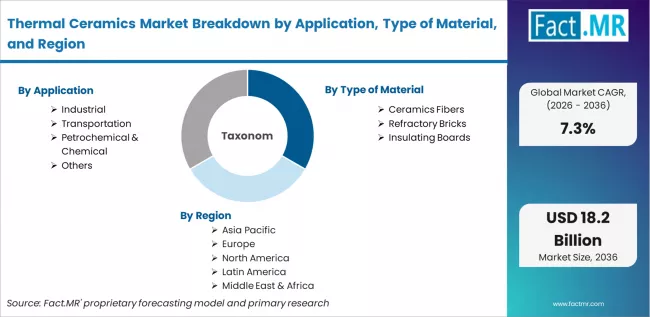
Thermal Ceramics Market Breakdown By Application, Type Of Material, And Region | Source: Fact.MR
| Metric | Value |
|---|---|
| Quantitative Units | USD 9.01 billion to USD 18.23 billion, at a CAGR of 7.30% |
| Market Definition | Thermal ceramics encompass ceramic fibre, refractory brick, and insulating board products for high-temperature insulation in metallurgical, petrochemical, power generation, and transportation applications globally. |
| Application Segmentation | Industrial, Transportation, Petrochemical & Chemical, Others |
| Type of Material Segmentation | Ceramics Fibers, Refractory Bricks, Insulating Boards |
| End Use Industry Segmentation | Metallurgy & Foundry, Energy & Power, Oil & Gas / Petrochemical, Others |
| Regions Covered | India, China, Brazil, Germany, USA, UK, Japan |
| Key Companies Profiled | Morgan Advanced Materials, 3M, Mitsubishi Chemical Corporation, CeramTec, YESO Insulating Products, FibreCast Inc., Ibiden Co. Ltd., Dyson Technical Ceramics, Rauschert GmbH, Unifrax LLC |
| Forecast Period | 2026 to 2036 |
| Approach | Forecasting models apply bottom-up methodology starting with steel production and petrochemical capacity data, cross-validated against refractory industry shipment records and energy efficiency regulation compliance schedules. |
Source: Fact.MR analysis. Updated Apr 1, 2026
Thermal Ceramics Market by Segments
-
Application :
- Industrial
- Transportation
- Petrochemical & Chemical
- Others
-
Type of Material :
- Ceramics Fibers
- Refractory Bricks
- Insulating Boards
-
End Use Industry :
- Metallurgy & Foundry
- Energy & Power
- Oil & Gas / Petrochemical
- Others
-
Region :
- North America
- USA
- Canada
- Mexico
- Europe
- Germany
- France
- UK
- Italy
- Spain
- Rest of Europe
- Asia Pacific
- India
- China
- Japan
- South Korea
- ASEAN
- Australia & New Zealand
- Rest of Asia Pacific
- Latin America
- Brazil
- Rest of Latin America
- Middle East & Africa
- GCC Countries
- South Africa
- Rest of Middle East & Africa
- North America
Frequently Asked Questions
How large is the thermal ceramics market in 2026?
What will be the market size by 2036?
What is the expected demand growth between 2026 and 2036?
Which Material Type leads?
Which End Use Industry commands the largest share?
Which country is the fastest-growing?
What is included in the scope?
What is excluded?
Who worked on this report


Preview the report firsthand - request a free sample
Free SampleGet the brochure for pricing and purchase details
Download PDF