Scourer Machine Market Size, Share, Growth and Forecast (2026 - 2036)

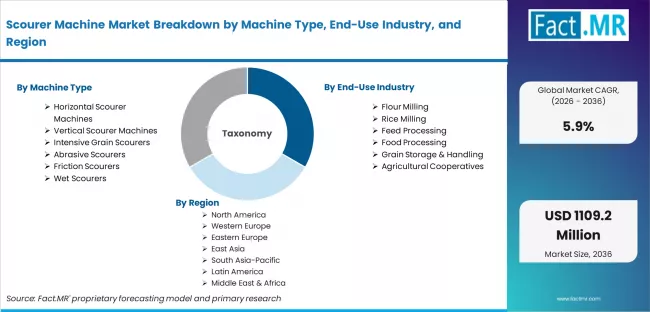
The Scourer Machine Market is segmented by Machine Type, by Throughput Capacity, by Operating Technology, by Automation Level, by Application, by End-Use Industry, by Distribution Channel, and by Region. Forecast for 2026 to 2036.

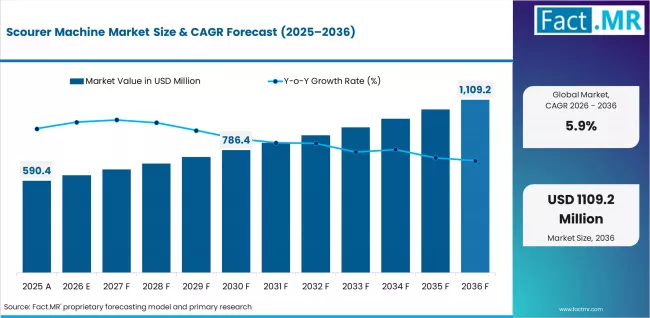
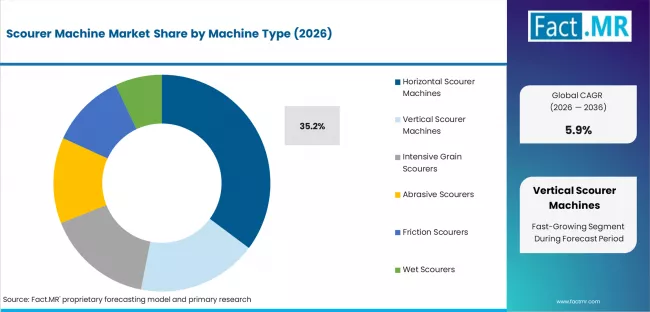
According to market estimates, the scourer machine market was valued at USD 590.4 million in 2025 and is projected to reach USD 625.2 million in 2026 and USD 1,109.2 million by 2036, registering a CAGR of 5.9% during the forecast period. By Machine Type, Horizontal Scourer Machines are expected to dominate with a 35.2% market share in 2026, driven by their high throughput efficiency and widespread use in flour milling operations. By End-Use Industry, Flour Milling is projected to account for 38.9% of the market share in 2026, supported by increasing flour production capacity and rising demand for grain quality enhancement.
Scourer Machine Market Overview, Growth Outlook, and Forecast by Fact.MR

  • In 2025, the scourer machine market was valued at USD 590.4 million.
  • Demand for scourer machines is projected to grow to USD 625.2 million in 2026 and reach USD 1,109.2 million by 2036.
  • The market is expected to expand at a CAGR of 5.9% during the forecast period.

Scourer Machine Market  Value Analysis

The scourer machine market is projected to create an absolute dollar opportunity of USD 484.0 million between 2026 and 2036. Market growth is driven by increasing expansion of flour milling and grain processing facilities, rising demand for improved grain quality and contaminant removal, and growing adoption of automated and high-throughput grain cleaning systems. Increasing investments in food safety compliance, grain yield optimization, and modernization of milling infrastructure are further supporting market expansion globally. However, high capital investment requirements, equipment maintenance costs, and slower adoption among small-scale processing facilities may restrain long-term market growth.

Summary of the Scourer Machine Market

  • Market Snapshot
    • Global scourer machine market revenue stood at USD 625.2 million in 2026 and is forecast to reach USD 1,109.2 million by 2036.
    • At a 5.9% CAGR from 2026 to 2036, the market is expected to expand ~1.8x in value, creating an absolute dollar opportunity of USD 484.0 million.
    • The growth is attributed to rising investment in grain processing infrastructure and flour milling upgradation, along with growing demand for reliable grain cleaning equipment.
    • Grain quality improvement, removal of contaminants and compliance with food safety standards are among the issues which are pushing the worldwide adoption of more advanced scourer machines.
    • Development of automation technology, PLC based systems & grain processing machinery with high throughputs is driving operational efficiency in the flour milling and grain processing industry.
  • Demand and Growth Drivers
    • Rapid growth of commercial flour mill and grain processing plant
    • Growing demand for quality grain cleaning and surface treatment equipment
    • Increasing penetration of automated and high processing capacity grain processing machinery
    • Growing investments in technologies for enhancing food safety and grain quality
    • Increasing upgrading of infrastructure for grain handling and processing
    • Need for solutions providing:
      • Efficient removal of dust and surface contaminants
      • Improved grain yield and reduced losses
      • High-throughput grain processing capability
      • Reduced grain damage during cleaning
      • Automated process monitoring and control
      • Enhanced operational efficiency
      • Compliance with food quality and hygiene standards
  • Product and Segment View
    • Horizontal Scourer Machines hold 35.2% of machine type share in 2026, emerging as the leading segment due to their widespread deployment in commercial flour milling operations and high processing efficiency.
    • Medium Capacity (5–20 TPH) accounts for 40.2% of throughput capacity share in 2026, driven by broad adoption across medium-scale grain processing facilities.
    • Friction-Based Scouring represents 34.1% of operating technology share in 2026, reflecting its strong efficiency in grain surface cleaning and contaminant removal.
    • Flour Milling accounts for 38.9% of end-use industry share in 2026, supported by increasing flour production demand and expanding milling infrastructure.
    • Fully Automatic Systems and Smart/PLC-Controlled Systems are expected to witness the fastest growth through 2036 due to increasing automation adoption and digital process optimization.
  • Geography and Competitive Outlook
    • The expanding capabilities of the grain processing infrastructure, growing investments in automations, and increasing food processing activities drive the robust market growth in East Asia, South Asia & Pacific, and North America.
    • Major growth markets in the Scourer Machine Market include India (7.5% CAGR), Japan (7.4% CAGR), China (7.1% CAGR), Italy (7.1% CAGR), Brazil (6.8% CAGR), United States (5.1% CAGR), and Germany (4.3% CAGR) during the forecast period.
    • Market growth is supported by:
    • Increasing investment in flour milling modernization
    • Rising adoption of automated grain cleaning systems
    • Growing focus on food quality and grain safety regulations
    • Expansion of grain processing facilities
    • Increasing use of PLC-integrated processing systems
    • Prominent players in the market include Bühler Group, Satake Corporation, Alapala, MILLTEC Machinery, AGI, Henry Simon Milling, PETKUS Technologie, Westrup A/S, and Golfetto Sangati.
  • Analyst Opinion
    • Shambhu Nath Jha, Principal Consultant at Fact.MR, opines, “CXO leaders are expected to recognize that future competitive advantage in the Scourer Machine Market will increasingly depend on adopting automated grain processing systems, high-throughput scourer technologies, PLC-integrated controls, and advanced grain cleaning solutions to improve processing efficiency, grain quality, and food safety compliance.

Scourer Machine Market — At a Glance

Attribute Details
Market Value 2025 USD 590.4 Million
Market Value 2026 USD 625.2 Million
Market Value 2036 USD 1,109.2 Million
Absolute Dollar Opportunity USD 484.0 Million
Total Growth 77.40%
CAGR 5.90%
Growth Multiple 1.8x
Key Demand Theme Rising investments in grain processing infrastructure, increasing flour milling modernization, growing demand for grain quality improvement, food safety compliance, automated grain cleaning systems, and high-throughput processing technologies
Leading Machine Type Horizontal Scourer Machines
Machine Type Share 35.20%
Leading Throughput Capacity Medium Capacity (5–20 TPH)
Throughput Capacity Share 40.20%
Leading Operating Technology Friction-Based Scouring
Operating Technology Share 34.10%
Leading End-Use Industry Flour Milling
End-Use Industry Share 38.90%
Key Growth Regions East Asia, South Asia & Pacific, North America
Key Companies Bühler Group, Satake Corporation, Alapala, MILLTEC Machinery, AGI, Henry Simon Milling, PETKUS Technologie, Westrup A/S, Golfetto Sangati
Segmentation by Machine Type Vertical Scourer Machines, Horizontal Scourer Machines, Intensive Grain Scourers, Abrasive Scourers, Friction Scourers, Wet Scourers
Segmentation by Throughput Capacity Small Capacity (Below 5 TPH), Medium Capacity (5–20 TPH), Large Capacity (20–50 TPH), Industrial Capacity (Above 50 TPH)
Segmentation by Operating Technology Abrasion-Based Scouring, Friction-Based Scouring, Air-Assisted Scouring, Centrifugal Scouring, Hybrid Scouring Systems
Segmentation by Automation Level Manual Systems, Semi-Automatic Systems, Fully Automatic Systems, Smart/PLC-Controlled Systems
Segmentation by Application Grain Cleaning, Grain Polishing, Surface De-Branning, Dust & Contaminant Removal, Pre-Milling Preparation, Seed Cleaning, Food Safety & Hygiene Processing
Segmentation by End-Use Industry Flour Milling, Rice Milling, Feed Processing, Food Processing, Grain Storage & Handling, Agricultural Cooperatives
Segmentation by Distribution Channel Direct OEM Sales, Milling Equipment Distributors, Agricultural Machinery Dealers, EPC / Turnkey Plant Integrators, Online Industrial Equipment Platforms
Segmentation by Region North America, Latin America, East Asia, South Asia & Pacific, Western Europe, Eastern Europe, Middle East & Africa

How are Industry 4.0 technologies transforming the operational performance of scourer machines in grain processing facilities?

Technologies that make up Industry 4.0 are revolutionizing scourer machines due to the adoption of IoT sensors, predictive maintenance, AI-powered quality control systems, and smart manufacturing processes. IoT sensors will keep track of factors like vibrations, temperature, engine efficiency, and capacity to ensure real-time tracking. Predictive maintenance systems will help cut down unexpected downtime by about 30-50%, maintenance expenses by 15-25%, and prolong machine lifespan by 20-30%. AI-powered quality control will improve the detection of defects to almost 95-99% with lower costs and time spent on the process. Integration into the MES and factory automation system will enhance production efficiency by 8-15%, machine efficiency, and reduce operational costs for more effective grain processing.

What are the key demand drivers influencing the growth of the Scourer Machine Market, and how can demand be estimated?

The main factors influencing the demand for scouring machines include plant construction, expansion of processing capacities, replacements, automation initiatives, and the expansion of the grain processing sector. The establishment of new mills and grain processing plants creates a need for additional machinery, while expansion projects contribute to an increase in machinery at existing sites. Demand from replacement also accounts for a large proportion of total demand, considering that the operational lifespan of such machinery is usually 10 to 15 years. Automation initiatives, which include PLC integrated and high production-rate systems, drive demand as well. A realistic demand model would consider new plant construction, expansion demand, replacement demand, automation demand, and industrial growth rates.

Key Growth Drivers, Constraints, and Opportunities
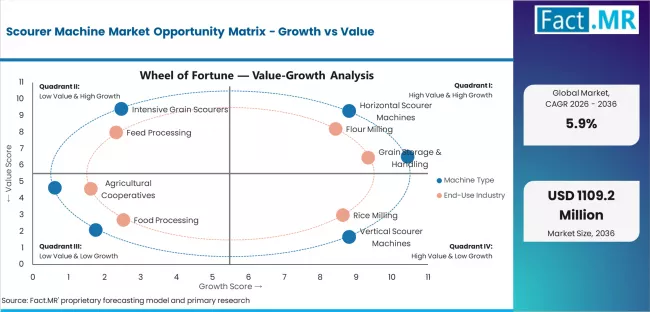
Scourer Machine Market Opportunity Matrix Growth Vs Value

Key Factors Driving Growth

  • Global demand for high-end scourer machines is on the rise due to flour milling and grain processing plant expansions.
  • The adoption of superior grain cleaning technologies is increasing due to the rising emphasis on improving quality of grain, removing contaminants and compliances towards food safety.
  • Growing utilization of automated grain processing machinery, PLC-based system and high-yield processing technology is driving the growth of the market in commercial flour mills.
  • The need to modernize and optimize grain processing infrastructure and processing efficiency is driving demand for sophisticated scourer technology.
Growth Driver Demand Impact Time Horizon Key Impact Area Fact.MR Insight
Expansion of flour milling and grain processing facilities High Short–Mid Term Processing capacity expansion & equipment demand Increasing investments in commercial flour mills and grain processing infrastructure are driving demand for high-throughput scourer machines globally.
Rising focus on grain quality improvement and food safety compliance High Short–Mid Term Grain cleaning efficiency & contaminant removal Growing emphasis on food safety standards and grain quality enhancement is accelerating adoption of advanced grain cleaning and scouring technologies.
Increasing adoption of automated and PLC-controlled processing systems Medium-High Mid–Long Term Smart processing operations & production efficiency Flour mills and grain processors are increasingly integrating automated systems to improve throughput, reduce labor dependency, and optimize process control.
Advancements in high-capacity and energy-efficient scourer technologies Medium-High Mid–Long Term Operational efficiency & processing optimization Development of high-capacity and low-energy consumption scourer machines is improving productivity and reducing operating costs across processing facilities.

Key Market Constraints

  • The high cost of initial investment and equipment installation might hinder the adoption in small and medium-sized processing plants.
  • The total cost of ownership of sophisticated scourer machinery may be increased by needs for maintenance and running costs.
  • Integration issues related to retrofitting older processing lines as well as legacy malls may limit industry adoption.
  • Low technology adoption rate and less investment capacity in the growing processing plants may hinder market growth.

Key Opportunity Areas

  • Rising investments in intelligent grain processing plants, automated milling lines, and so on are anticipated to offer immense growth opportunities.
  • Demand for grain cleaning machines with larger production capacities and higher energy efficiency is boosting the market opportunities across the processing industries.
  • The development of food processing/feed processing and agriculture processing plants is likely to drive the demand for the equipment in the future.
  • Growing penetration of PLC-based systems, digital monitoring solutions and process optimization solutions is anticipated to bolster the long-term market growth.

Segment-wise Analysis of the Scourer Machine Market

  • Horizontal Scourer Machines account for 35.2% share of the machine type segment in 2026, driven by their widespread deployment in commercial flour milling operations, high throughput capability, and efficient grain surface cleaning performance across grain processing facilities.
  • Medium Capacity (5–20 TPH) represents 40.2% share of the throughput capacity segment in 2026, supported by increasing adoption across medium-scale flour mills and regional grain processing plants requiring balanced processing capacity and operational efficiency.
  • Friction-Based Scouring holds 34.1% share of the operating technology segment in 2026, owing to its strong grain cleaning efficiency, reduced grain damage, and broad applicability in grain preparation and contaminant removal processes.

The Scourer Machine Market is segmented by machine type, throughput capacity, operating technology, automation level, application, end-use industry, distribution channel, and region.

Which Machine Type Segment Topped the Scourer Machine Market?
Scourer Machine Market Analysis By Machine Type

It is estimated that Horizontal Scourer Machines will hold the largest share of 35.2% by the end of 2026 in the Scourer Machine Market. This dominance is due to the fact that they are widely used in commercial flour mills with a large capacity, good cleaning performance on grain surface, and can be run in continuous flow type processing on large scale processing around whole cereals.

Which Throughput Capacity Segment Accounts for the Highest Share in the Market?
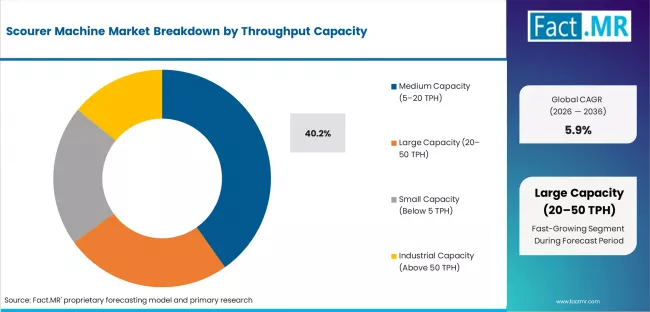
Scourer Machine Market Analysis By Throughput Capacity

Medium Capacity (5–20 TPH) is anticipated to account for the highest share of 40.2% in the throughput capacity segment by 2026. This dominance is fueled by rising applications in medium scale flour mills and grain processing units that demand balanced processing efficiency, operational flexibility and cost-effective performance.

Which Operating Technology Segment Leads the Market?
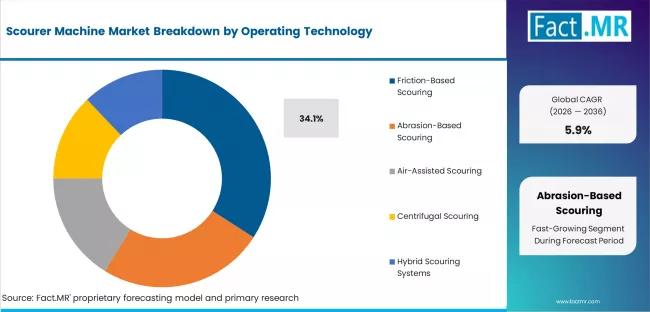
Scourer Machine Market Analysis By Operating Technology

Friction-Based Scouring is anticipated to hold the highest market share, accounting for 34.1% in 2026, owing to its strong cleaning efficiency, lower grain damage rates, and broad application across grain preparation and contaminant removal processes. Growing demand for improved grain quality and optimized processing efficiency further supports segment growth.

Which End-Use Industry Segment Holds the Largest Share in the Market?
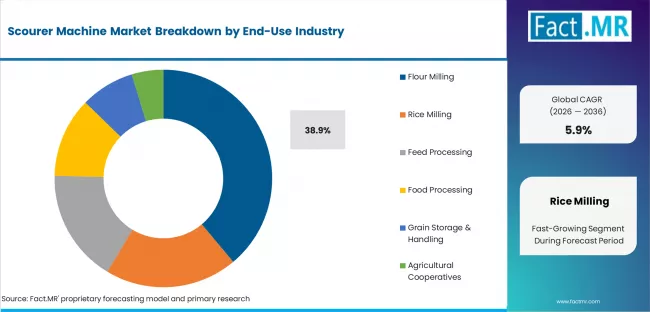
Scourer Machine Market Analysis By End Use Industry

Flour Milling is expected to emerge as the leading end-use industry segment, accounting for 38.9% share in 2026. This growth is supported by increasing flour production demand, expansion of milling infrastructure, rising grain consumption, and growing investments in advanced grain cleaning and processing technologies globally.

Regional Outlook Across Key Markets

The geographies covered in this study include North America, Latin America, Western Europe, Eastern Europe, East Asia, South Asia & Pacific, and Middle East & Africa. Regional analysis includes assessment of grain processing infrastructure expansion, flour milling capacity additions, adoption of automated and PLC-controlled scourer systems, investments in grain quality enhancement technologies, modernization of processing facilities, food safety compliance requirements, and increasing deployment of high-throughput grain cleaning equipment across global grain processing markets.

Top Country Growth Comparison Scourer Machine Market Cagr (2026 2036)

CAGR Table

Country CAGR (%)
India 7.5%
Japan 6.4%
China 7.1%
Italy 6.1%
United States 5.1%
Brazil 6.8%
Germany 4.3%

Source: Fact.MR (FMR) analysis, based on proprietary forecasting model and primary research.
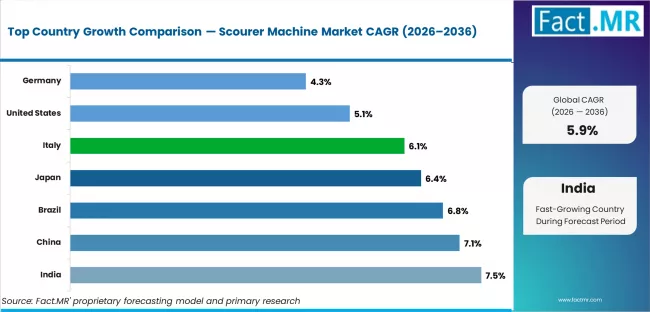
Scourer Machine Market Cagr Analysis By Country

North America Scourer Machine Market

North America is the hub for advanced grain processing modernization and automation adoption in the Scourer Machine Market owing to robust grain processing infrastructure, growing investment in technologies for food quality improvement, and modernization of flour milling plants. Bühler Group, Satake Corporation, and AGI continue to expand their market share with high throughput solutions for grain processing, automated milling, and integrated process solutions.

  • U.S.: Demand for scourer machines in the U.S. is projected to rise at 5.1% CAGR through 2036. Growth is driven by increasing investments in automated grain cleaning systems, food safety compliance initiatives, modernization of flour milling operations, and expansion of grain processing infrastructure.
  • Canada: Market growth in Canada is supported by increasing investments in grain handling infrastructure, modernization of food processing facilities, and adoption of advanced grain processing technologies.

Europe Scourer Machine Market
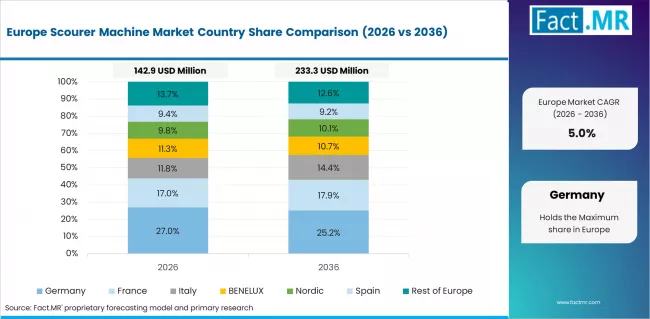
Scourer Machine Market Europe Country Market Share Analysis, 2026 & 2036

Europe is the high-efficiency and technology-oriented grain processing region in the Scourer Machine Market due to the presence of sophisticated milling infrastructure, high level of automation investment, stringent food safety regulation and increasing focus on processing efficiency. Alapala, Henry Simon Milling, PETKUS Technologies and Golfetto Sangati continue to grow their market presence with state-of-the-art solutions for cleaning and processing grain.

  • Germany: Demand for scourer machines in Germany is projected to rise at 4.3% CAGR through 2036, driven by Industry 4.0 adoption, increasing investments in smart grain processing technologies, and modernization of processing facilities.
  • Italy: Demand for scourer machines in Italy is expected to grow at 7.1% CAGR through 2036 due to the presence of grain processing equipment manufacturers and increasing investments in processing modernization initiatives.
  • France: Demand for scourer machines in France is supported by increasing adoption of automated grain processing systems and rising focus on food quality improvement technologies.

East Asia Scourer Machine Market
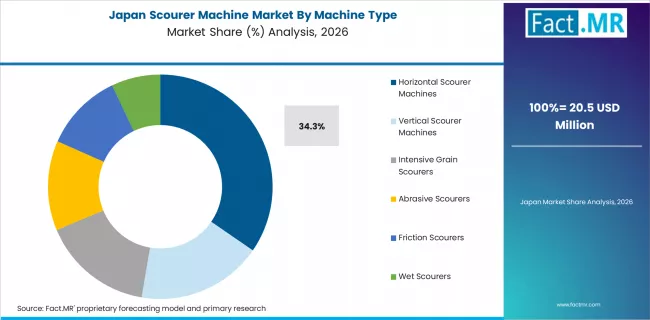
Scourer Machine Market Japan Market Share Analysis By Machine Type

Strong industrial base, growing food processing facilities, and quick adoption of automated grain processing solutions have led East Asia to be the world's manufacturing and processing center for grain processing technologies. Regional producers are continuing to roll out intelligent processing technologies and an integrated grain cleaning system.

  • China: Demand for scourer machines in China is projected to rise at 7.1% CAGR through 2036, driven by increasing grain processing capacity, flour production expansion, and investments in automated processing systems.
  • Japan: Demand for scourer machines in Japan is expected to grow at 7.4% CAGR through 2036 due to increasing investments in high-efficiency processing technologies, automated grain cleaning systems, and smart processing infrastructure.

South Asia & Pacific Scourer Machine Market

South Asia & Pacific is being identified as the lucrative region for grain processing equipment market due to flour mill setup growing at a rapid pace, increase in food processing investment, and the rise in the food processing infrastructure. Regional players are now introducing more sophisticated grain cleaning solutions and automation processing systems.

  • India: Demand for scourer machines in India is projected to rise at 7.5% CAGR through 2036, driven by rapid flour milling expansion, increasing investments in grain processing facilities, rising food quality requirements, and modernization of agricultural processing infrastructure.

The Fact.MR report reviews the recommendations, overview, policies, and engagements of the Scourer Machine Market in individual countries in North America, Latin America, Europe, East Asia, South Asia & Pacific, and Middle East & Africa. Readers will gain deep insights into grain processing infrastructure trends, flour milling capacity additions, automation implementation, equipment obsolescence, competitive benchmarking, and long-term growth prospects across developed and developing markets globally.

Competitive Benchmarking and Company Positioning
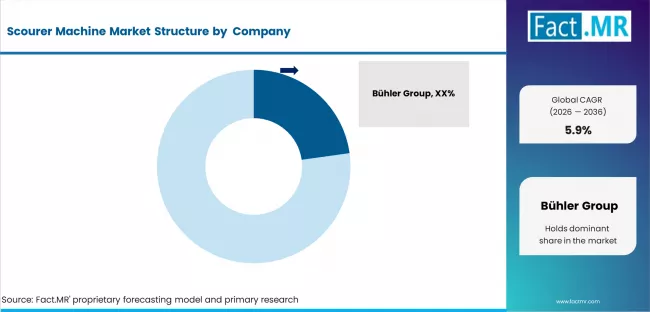
Scourer Machine Market Analysis By Company

Leading Companies Shaping the Scourer Machine Market

The scourer machine market is partially concentrated, with the major market players being Bühler Group, Satake Corporation, Alapala, MILLTEC Machinery, AGI, Henry Simon Milling, PETKUS Technologie, Westrup A/S, and Golfetto Sangati. Competition within the market relies on the efficiency of processing, throughput capability, efficiency of grain cleaning, automation, energy saving, durability of machines, and compatibility with modern milling systems. The established players distinguish themselves in terms of superior processing technology, effective distribution network across the globe, wide range of grain processing applications, automation of machinery, and large-scale project implementation within flour milling and grain processing industries.

Recent Industry Developments

  • Bühler – Acquisition of CEREX Puffing Technology to Expand Product Portfolio (January 2025)
  • Bühler acquired advanced puffing technology from CEREX to strengthen its grain and food processing portfolio and broaden its product capabilities across cereal and grain applications. The acquisition enhances Bühler’s position in grain processing technologies by supporting innovation in food processing systems, product diversification, and advanced processing solutions across milling and grain value-chain applications.
  • Satake – Collaboration with My PlantCo in Oat-Based Product Development (June 2025)
  • Satake announced collaboration with My PlantCo for development of oat-based food products including rice alternatives, noodles, and pasta applications. The initiative expands Satake’s grain processing ecosystem through innovation in cereal processing technologies and supports diversification of grain-based processing capabilities.
  • PETKUS – Smart Grain Processing and Efficiency Technology Expansion (November 2025)
  • PETKUS introduced new smart grain processing and efficiency-focused technologies aimed at improving automation, processing precision, and operational performance across grain and seed processing facilities. The development strengthens PETKUS’ position in intelligent grain processing and advanced agricultural processing systems.
  • Alapala – Marata Group Strategic Partnership Expansion with New 1,600 TPD Flour Milling Investment (December 2025)
  • Alapala expanded its partnership with Marata Group through a new 1,600 TPD flour milling investment, increasing total installed milling capacity significantly. The expansion directly supports growth in grain processing infrastructure and increases demand for upstream grain preparation and cleaning technologies, including scourer systems
  • Bühler – Opening of New Puffing Technology Center (June 2025)
  • Bühler opened a new Puffing Technology Center in Switzerland to support testing, scaling, and innovation of grain-based products and processing technologies. The initiative strengthens Bühler’s grain processing ecosystem and supports technological advancement across cereal, grain, and food processing applications.

Leading Companies Shaping the Scourer Machine Market

  • Bühler Group
  • Satake Corporation
  • Alapala
  • MILLTEC Machinery
  • AGI
  • Henry Simon Milling
  • PETKUS Technologie
  • Westrup A/S
  • Golfetto Sangati

Sources and Research References

  • [1] Bühler Group, “Bühler acquires cutting-edge puffing technology from CEREX to expand product portfolio”, January 2025
  • [2] Satake Group, “SATAKE Collaborates with My PlantCo in Oat Products”, June 2025
  • [3] PETKUS Technologie GmbH, “News Detail – Smart Grain Processing and Efficiency Solutions”, November 2025
  • [4] African Agri Magazine, “Alapala and Marata Group Expand Strategic Partnership with New 1,600 TPD Flour Milling Investment”, December 2025
  • [5] Bühler Group, “Where Grains Get Their Volume – Bühler Opens Puffing Technology Center”, June 2025

Scourer Machine Market Definition

Scourer machine market is an account of machinery and systems that are used to clean grains from dust, dirt, surface contaminants, attach particles, mold residues and outer impurities before performing the milling and processing activities. These systems are based on different principles such as abrasion, friction, air flow and use principles of air flow in scouring radially using a centrifugal force to supplement scouring, and enhances the cleaning efficiency, processing efficiency and product quality of grains. Scourer machines with higher intensity and lower grain damage than traditional grain cleaning machines. The market finds application in flour mills, rice mills, animal feed processing plants, food processing industry, grain storage and agricultural processing works across the globe.

Scourer Machine Market Inclusions

The scourer machine market analysis report includes forecasts of the global and regional market size for 2025-2036. It offers detailed information about the various segments based on type of machine, throughput capacity, operating technology, level of automation, application, industry that uses the product, and type of distribution channel as well as thorough analysis of adoption trends on regional level, competitive landscape, grain processing infrastructure, and technology advancements. The report also includes up and coming trends such as automatic grain cleaning systems, PLC-based processing machinery, high throughput scourer technology, food safety compliance, grain quality enrichment solutions, and upgradation of flour milling & grain processing units.

Scourer Machine Market Exclusions

This report focuses on scourer machines applied in the grain processing and flour milling industries and is not applicable to other types of cleaning equipment that are not involved in cleaning or removing impurities from the grain surface. It does not cover general cleaning of grain, separators, destoners, magnetic separators, color sorters, driers, conveyors, storage facilities, or complete milling lines except if they have scourer functions. It also excludes the machinery for the manufacture of scrubber/scouring pads, industrial air scrubbers, floor scrubbers, and air pollution-control equipment used in other industries than the processing of grains.

Scourer Machine Market Research Methodology

  • Primary Research
    • To estimate the market size, Fact.MR has used a top-down and bottom-up approach for a global scope. Fact.MR conducted a broad primary research with a granulose of market participants, including manufacturers of grain processing equipment, suppliers of flour milling equipment, automation solutions provider, distributors, industry consultants, and end users in flour milling, rice milling, feed processing and food processing industries to triangulate the key market trends, technology adoption patterns and future demand outlook.
  • Desk Research
    • The study combines data and knowledge derived from company annual reports and investor presentations, flour milling and grain processing industry white papers, reports on flour milling equipment, agricultural machinery research, trade journals, technical white papers, databases of industry associations, government agricultural programmers and trends in investment in processing equipment.
  • Market-Sizing and Forecasting
    • Fact.MR’s market research approach combines a Bottom-up analysis of scourer machine manufacturer revenues with a Top-down assessment of grain processing equipment, flour milling infrastructure, and grain cleaning equipment expenditure across key industries and regions.
  • Data Validation and Update Cycle
    • Market estimates were validated through triangulation of primary interviews, company financial analysis, regional grain processing trends, equipment penetration rates, and historical grain processing infrastructure developments. Forecasts are periodically updated to reflect changes in automation adoption, food safety regulations, milling capacity expansion, grain processing investments, and advancements in smart and high-throughput processing technologies.

Scope of Analysis

Scourer Machine Market Breakdown By Machine Type, End Use Industry, And Region


Parameter
Details
Quantitative Units USD 590.4 Million (2025) to USD 1,109.2 Million (2036), at a CAGR of 5.9%
Market Definition The scourer machine market covers industrial grain cleaning and processing equipment designed to remove dust, dirt, adhering particles, surface contaminants, and outer grain impurities prior to milling and processing operations. These machines integrate technologies such as abrasion-based, friction-based, air-assisted, centrifugal, and automated processing systems to improve grain quality, processing efficiency, contaminant removal, and operational productivity across flour milling, rice milling, feed processing, food processing, and agricultural processing facilities.
Regions Covered North America, Eastern Europe, Western Europe, East Asia, South Asia & Pacific, Latin America, Middle East & Africa
Countries Covered USA, Canada, Germany, Italy, China, Japan, India, Brazil, Turkey, South Africa, Saudi Arabia, UAE, and 20+ countries
Key Companies Bühler Group, Satake Corporation, Alapala, MILLTEC Machinery, AGI, Henry Simon Milling, PETKUS Technologie, Westrup A/S, Golfetto Sangati
Forecast Period 2026 to 2036
Approach Hybrid demand-side and top-down methodology based on flour milling expansion, grain processing infrastructure development, equipment replacement cycles, automation adoption, throughput capacity additions, and increasing investments in grain quality enhancement technologies, validated through primary interviews with grain processing equipment manufacturers, flour mill operators, distributors, automation solution providers, and industry experts across key regions.

Scourer Machine Market By Segment

  • Scourer Machine Market by Machine Type:

    • Vertical Scourer Machines
    • Horizontal Scourer Machines
    • Intensive Grain Scourers
    • Abrasive Scourers
    • Friction Scourers
    • Wet Scourers
  • Scourer Machine Market by Throughput Capacity:

    • Small Capacity (Below 5 TPH)
    • Medium Capacity (5–20 TPH)
    • Large Capacity (20–50 TPH)
    • Industrial Capacity (Above 50 TPH)
  • Scourer Machine Market by Operating Technology:

    • Abrasion-Based Scouring
    • Friction-Based Scouring
    • Air-Assisted Scouring
    • Centrifugal Scouring
    • Hybrid Scouring Systems
  • Scourer Machine Market by Automation Level:

    • Manual Systems
    • Semi-Automatic Systems
    • Fully Automatic Systems
    • Smart / PLC-Controlled Systems
  • Scourer Machine Market by Application:

    • Grain Cleaning
    • Grain Polishing
    • Surface De-Branning
    • Dust & Contaminant Removal
    • Pre-Milling Preparation
    • Seed Cleaning
    • Food Safety & Hygiene Processing
  • Scourer Machine Market by End-Use Industry:

    • Flour Milling
    • Rice Milling
    • Feed Processing
    • Food Processing
    • Grain Storage & Handling
    • Agricultural Cooperatives
  • Scourer Machine Market by Distribution Channel:

    • Direct OEM Sales
    • Milling Equipment Distributors
    • Agricultural Machinery Dealers
    • EPC / Turnkey Plant Integrators
    • Online Industrial Equipment Platforms
  • Scourer Machine Market by Region:

    • North America
      • USA
      • Canada
      • Mexico
    • Latin America
      • Brazil
      • Chile
      • Rest of LATAM
    • East Asia
      • China
      • Japan
      • South Korea
      • Taiwan
    • South Asia & Pacific
      • India
      • Singapore
      • Australia
      • ASEAN
    • Western Europe
      • Germany
      • France
      • U.K.
      • Italy
      • Spain
      • BENELUX
      • Nordic
      • Rest of Western Europe
    • Eastern Europe
      • Poland
      • Hungary
      • Czech Republic
      • Balkan & Baltics
      • Rest of Eastern Europe
    • Middle East and Africa
      • Kingdom of Saudi Arabia
      • United Arab Emirates
      • South Africa
      • Rest of Middle East and Africa

- Frequently Asked Questions -

How large is the demand for Scourer Machines in the global market in 2025?

Demand for Scourer Machines in the global market is estimated to be valued at USD 590.4 million in 2025.

What will be the market size of the Scourer Machine Market by 2036?

The Scourer Machine Market is projected to reach USD 1,109.2 million by 2036.

What is the expected demand growth for the Scourer Machine Market between 2026 and 2036?

Demand for Scourer Machines is expected to grow at a CAGR of 5.9% between 2026 and 2036, supported by increasing expansion of flour milling facilities, rising grain processing capacity additions, growing demand for food safety compliance, adoption of automated grain cleaning systems, and increasing investments in high-throughput processing technologies.

How significant is the growth outlook for India in this market?

India is expected to grow at a CAGR of 7.5% through 2036, supported by increasing flour milling capacity expansion, modernization of grain processing facilities, growing food processing investments, and rising demand for advanced grain cleaning technologies.

Which company is identified as a leading player in the Scourer Machine Market?

Bühler Group is recognized as a leading player in the Scourer Machine Market, offering advanced grain cleaning systems, integrated flour milling solutions, automated processing technologies, and high-performance grain preparation equipment across global grain processing industries.

Table of Content

  1. Scourer Machine Market - Executive Summary
  2. Market Overview
    • Market Definition and Introduction
    • Market Taxonomy/ Research Scope
  3. Global Scourer Machine Market Demand Analysis 2021-2025 and Forecast, 2026–2036
    • Historical Market Volume Analysis, 2021-2025
    • Current and Future Market Volume Forecast, 2026–2036
    • Y-o-Y Growth Trend Analysis
  4. Global Scourer Machine Market - Pricing Analysis
    • Product Category and Country-Level Pricing Analysis
    • Global Average Pricing Analysis Benchmark
    • Factors Influencing Pricing
    • Cost Structure Analysis: Elementary Deep Dive
    • Competitive Pricing Strategies
    • Price Trends and Forecasts
      • Historical price trends
      • Future price forecasts
  5. Global Scourer Machine Market Demand Analysis 2021-2025 and Forecast, 2026–2036
    • Historical Market Value Analysis, 2021-2025
    • Current and Future Market Value Forecast, 2026–2036
      • Y-o-Y Growth Trend Analysis
      • Absolute $ Opportunity Analysis
  6. Market Background and Foundation Data
    • Global Scourer Machine Market Outlook, 2025
      • Rising demand for grain quality enhancement
      • Growth in flour milling capacity expansion
      • Increasing automation in grain processing plants
      • Growing food safety and hygiene requirements
      • Increasing investments in grain processing infrastructure
    • Penetration of Scourer Machines in Global Grain Processing Equipment Market
      • High penetration in commercial flour mills
      • Moderate penetration in rice and feed processing
      • Growing adoption in emerging agricultural economies
      • Higher adoption in automated milling facilities
    • Scourer Machine: End-User Perception Analysis
      • Preference for high-throughput systems
      • Demand for low-maintenance machines
      • Preference for energy-efficient systems
      • Demand for improved grain yield and reduced losses
      • Increasing preference for PLC-controlled systems
    • Recent Developments in Scourer Machines, by Market Players
      • Integration of PLC and smart controls
      • Launch of high-capacity systems
      • Energy-efficient machine development
      • Expansion of customized solutions
      • Adoption of predictive maintenance technologies
    • Scourer Machine Production Analysis
      • By Region
      • By Key Companies
    • Trade Scenario, 2025
      • Imports and Export Analysis
      • By Region
      • By Country
    • Scourer Machine Raw Material Sourcing
      • Key Raw Materials
      • Key Importing Countries
      • Key Exporting Countries
    • Investment in Scourer Machines, by Region
    • Scourer Machine Market Opportunity Assessment
      • Total Available Market (US$ Mn)
      • Serviceable Addressable Market (US$ Mn)
      • Serviceable Obtainable Market (US$ Mn)
    • Porter’s Five Forces and PESTEL Analysis
    • Investment Feasibility Analysis
    • Macro-Economic Factors
    • Forecast Factors - Relevance & Impact
    • Industry Value and Supply Chain Analysis
      • List of Key Channel Partners
      • Profit Margin & Operating Margin at Each Node of Supply Chain.
      • Notes on Value Added at Each Node in the Value Chain
      • Factors Influencing Value Chain
    • Market Dynamics
      • Drivers
      • Restraints
      • Opportunity Analysis
    • Key Regulations & Certifications
  7. Global Scourer Machine Market Analysis 2021-2025 and Forecast 2026–2036, By Machine Type
    • Introduction / Key Findings
    • Market Size & Volume Analysis by Market Taxonomy, 2021–2036
      • Vertical Scourer Machines
      • Horizontal Scourer Machines
      • Intensive Grain Scourers
      • Abrasive Scourers
      • Friction Scourers
      • Wet Scourers
    • Market Attractiveness Analysis by Machine Type
  8. Global Scourer Machine Market Analysis 2021-2025 and Forecast 2026–2036, By Throughput Capacity
    • Introduction / Key Findings
    • Market Size & Volume Analysis by Market Taxonomy, 2021–2036
      • Small Capacity (Below 5 TPH)
      • Medium Capacity (5–20 TPH)
      • Large Capacity (20–50 TPH)
      • Industrial Capacity (Above 50 TPH)
    • Market Attractiveness Analysis by Throughput Capacit
  9. Global Scourer Machine Market Analysis 2021-2025 and Forecast 2026–2036, By Operating Technology
    • Introduction / Key Findings
    • Market Size & Volume Analysis by Market Taxonomy, 2021–2036
      • Abrasion-Based Scouring
      • Friction-Based Scouring
      • Air-Assisted Scouring
      • Centrifugal Scouring
      • Hybrid Scouring Systems
    • Market Attractiveness Analysis by Operating Technology
  10. Global Scourer Machine Market Analysis 2021-2025 and Forecast 2026–2036, By Automation Level
    • Introduction / Key Findings
    • Market Size & Volume Analysis by Market Taxonomy, 2021–2036
      • Manual Systems
      • Semi-Automatic Systems
      • Fully Automatic Systems
      • Smart / PLC-Controlled Systems
    • Market Attractiveness Analysis by Automation Level
  11. Global Scourer Machine Market Analysis 2021-2025 and Forecast 2026–2036, By Application
    • Introduction / Key Findings
    • Market Size & Volume Analysis by Market Taxonomy, 2021–2036
      • Grain Cleaning
      • Grain Polishing
      • Surface De-Branning
      • Dust & Contaminant Removal
      • Pre-Milling Preparation
      • Seed Cleaning
      • Food Safety & Hygiene Processing
    • Market Attractiveness Analysis by Application
  12. Global Scourer Machine Market Analysis 2021-2025 and Forecast 2026–2036, By End-Use Industry
    • Introduction / Key Findings
    • Market Size & Volume Analysis by Market Taxonomy, 2021–2036
      • Flour Milling
      • Rice Milling
      • Feed Processing
      • Food Processing
      • Grain Storage & Handling
      • Agricultural Cooperatives
    • Market Attractiveness Analysis by End-Use Industry
  13. Global Scourer Machine Market Analysis 2021-2025 and Forecast 2026–2036, By Distribution Channel
    • Introduction / Key Findings
    • Market Size & Volume Analysis by Market Taxonomy, 2021–2036
      • Direct OEM Sales
      • Milling Equipment Distributors
      • Agricultural Machinery Dealers
      •  EPC / Turnkey Plant Integrators
      • Online Industrial Equipment Platforms
    • Market Attractiveness Analysis by Distribution Channel
  14. Global Scourer Machine Market Analysis and Forecast, by Region
    • Introduction / Key Findings
    • Market Size & Volume Analysis by Market Taxonomy, 2021–2036
      • North America
      • Latin America
      • Western Europe
      • Eastern Europe
      • East Asia
      • South Asia & Pacific
      • Middle East & Africa
    • Market Attractiveness Analysis by Region
  15. North America Scourer Machine Market Analysis and Forecast
    • Market Size & Volume Analysis by Market Taxonomy, 2021–2036
      • By Country
        • United States
        • Canada
        • Mexico
      • By Taxonomy
    • Market Attractiveness Analysis by Country & Taxonomy
  16. Latin America Scourer Machine Market Analysis and Forecast
    • Market Size & Volume Analysis by Market Taxonomy, 2021–2036
      • By Country
        • Brazil
        • Chile
        • Rest of LATAM
      • By Taxonomy
    • Market Attractiveness Analysis by Country & Taxonomy
  17. Western Europe Scourer Machine Market Analysis and Forecast
    • Market Size & Volume Analysis by Market Taxonomy, 2021–2036
      • By Country
        • Germany
        • Italy
        • France
        • United Kingdom
        • Spain
        • BENELUX
        • Nordics
        • Rest of Western Europe
      • By Taxonomy
    • Market Attractiveness Analysis by Country & Taxonomy
  18. Eastern Europe Scourer Machine Market Analysis and Forecast
    • Market Size & Volume Analysis by Market Taxonomy, 2021–2036
      • By Country
        • Russia
        • Hungary
        • Poland
        • Balkan & Baltics
        • Rest of Eastern Europe
      • By Taxonomy
    • Market Attractiveness Analysis by Country & Taxonomy
  19. East Asia Scourer Machine Market Analysis and Forecast
    • Market Size & Volume Analysis by Market Taxonomy, 2021–2036
      • By Country
        • China
        • Japan
        • South Korea
      • By Taxonomy
    • Market Attractiveness Analysis by Country & Taxonomy
  20. South Asia & Pacific Scourer Machine Market Analysis and Forecast
    • Market Size & Volume Analysis by Market Taxonomy, 2021–2036
      • By Country
        • India
        • ASEAN
        • Australia & New Zealand
        • Rest of South Asia & Pacific
      • By Taxonomy
    • Market Attractiveness Analysis by Country & Taxonomy
  21. Middle East & Africa Scourer Machine Market Analysis and Forecast
    • Market Size & Volume Analysis by Market Taxonomy, 2021–2036
      • By Country
        • Kingdom of Saudi Arabia
        • Other GCC Countries
        • Türkiye
        • South Africa
        • Other African Union
      • By Taxonomy
    • Market Attractiveness Analysis by Country & Taxonomy
  22. Country-level Scourer Machine Market Analysis and Forecast
    • Introduction
      • Market Value Proportion Analysis, By Key Countries
      • Global Vs. Country Growth Comparison
    • United States Scourer Machine Market Analysis
      • Market Size & Volume Analysis by Market Taxonomy, 2021–2036
        • By Machine Type
        • By Throughput Capacity
        • By Operating Technology
        • By Automation Level
        • By Application
        • By End-Use Industry
        • By Distribution Channel
      • Canada Scourer Machine Market Analysis
      • Mexico Scourer Machine Market Analysis
      • Brazil Scourer Machine Market Analysis
      • Chile Scourer Machine Market Analysis
      • Germany Scourer Machine Market Analysis
      • France Scourer Machine Market Analysis
      • Italy Scourer Machine Market Analysis
      • Spain Scourer Machine Market Analysis
      • United Kingdom Scourer Machine Market Analysis
      • BENELUX Scourer Machine Market Analysis
      • Nordics Scourer Machine Market Analysis
      • Poland Scourer Machine Market Analysis
      • Russia Scourer Machine Market Analysis
      • Hungary Scourer Machine Market Analysis
      • Balkan & Baltics Scourer Machine Market Analysis
      • China Scourer Machine Market Analysis
      • Japan Scourer Machine Market Analysis
      • South Korea Scourer Machine Market Analysis
      • India Scourer Machine Market Analysis
      • ASEAN Scourer Machine Market Analysis
      • ANZ Scourer Machine Market Analysis
      • KSA Scourer Machine Market Analysis
      • Other GCC Countries Scourer Machine Market Analysis
      • South Africa Scourer Machine Market Analysis
      • Türkiye Scourer Machine Market Analysis
    • Scourer Machine Market Structure Analysis
      • Market Analysis by Tier of Companies
      • Market Share Analysis of Top Players
      • Market Space for New Brands and Dollar Opportunity
      • Market Presence Analysis
        • Regional Footprint of Players
        • Product Footprint by Players
        • Application Footprint by Players
    • Scourer Machine Competition Analysis
      • Competition Dashboard
      • Pricing Analysis by Competition
      • Competition Benchmarking
      • Competition Deep Dive
        • Bühler Group
          • Overview
          • Product Portfolio
          • Sales Footprint
          • Key Developments
          • SWOT Analysis
          • Strategy Overview
          • Key Financials
        • Satake Corporation
        • Alapala
        • MILLTEC Machinery
        • AGI
        • Henry Simon Milling
        • PETKUS Technologie
        • Westrup A/S
        • Golfetto Sangati
        • Other Prominent Players
    • Primary Insights
    • Assumption & Acronyms Used
    • Research Methodology & Data Sources

List Of Table

  • Table 1: Global Market Value (Units) Forecast by Region, 2021 to 2036
  • Table 2: Global Market Volume (Cubic Meters) Forecast by Region, 2021 to 2036
  • Table 3: Global Market Value (Units) Forecast by Machine Type, 2021 to 2036
  • Table 4: Global Market Volume (Cubic Meters) Forecast by Machine Type, 2021 to 2036
  • Table 5: Global Market Value (Units) Forecast by Throughput Capacity, 2021 to 2036
  • Table 6: Global Market Volume (Cubic Meters) Forecast by Throughput Capacity, 2021 to 2036
  • Table 7: Global Market Value (Units) Forecast by Operating Technology, 2021 to 2036
  • Table 8: Global Market Volume (Cubic Meters) Forecast by Operating Technology, 2021 to 2036
  • Table 9: Global Market Value (Units) Forecast by Automation Level, 2021 to 2036
  • Table 10: Global Market Volume (Cubic Meters) Forecast by Automation Level, 2021 to 2036
  • Table 11: Global Market Value (Units) Forecast by Application, 2021 to 2036
  • Table 12: Global Market Volume (Cubic Meters) Forecast by Application, 2021 to 2036
  • Table 13: Global Market Value (Units) Forecast by End-Use Industry, 2021 to 2036
  • Table 14: Global Market Volume (Cubic Meters) Forecast by End-Use Industry, 2021 to 2036
  • Table 15: Global Market Value (Units) Forecast by Distribution Channel, 2021 to 2036
  • Table 16: Global Market Volume (Cubic Meters) Forecast by Distribution Channel, 2021 to 2036
  • Table 17: North America Market Value (Units) Forecast by Country, 2021 to 2036
  • Table 18: North America Market Volume (Cubic Meters) Forecast by Country, 2021 to 2036
  • Table 19: North America Market Value (Units) Forecast by Machine Type, 2021 to 2036
  • Table 20: North America Market Volume (Cubic Meters) Forecast by Machine Type, 2021 to 2036
  • Table 21: North America Market Value (Units) Forecast by Throughput Capacity, 2021 to 2036
  • Table 22: North America Market Volume (Cubic Meters) Forecast by Throughput Capacity, 2021 to 2036
  • Table 23: North America Market Value (Units) Forecast by Operating Technology, 2021 to 2036
  • Table 24: North America Market Volume (Cubic Meters) Forecast by Operating Technology, 2021 to 2036
  • Table 25: North America Market Value (Units) Forecast by Automation Level, 2021 to 2036
  • Table 26: North America Market Volume (Cubic Meters) Forecast by Automation Level, 2021 to 2036
  • Table 27: North America Market Value (Units) Forecast by Application, 2021 to 2036
  • Table 28: North America Market Volume (Cubic Meters) Forecast by Application, 2021 to 2036
  • Table 29: North America Market Value (Units) Forecast by End-Use Industry, 2021 to 2036
  • Table 30: North America Market Volume (Cubic Meters) Forecast by End-Use Industry, 2021 to 2036
  • Table 31: North America Market Value (Units) Forecast by Distribution Channel, 2021 to 2036
  • Table 32: North America Market Volume (Cubic Meters) Forecast by Distribution Channel, 2021 to 2036
  • Table 33: Latin America Market Value (Units) Forecast by Country, 2021 to 2036
  • Table 34: Latin America Market Volume (Cubic Meters) Forecast by Country, 2021 to 2036
  • Table 35: Latin America Market Value (Units) Forecast by Machine Type, 2021 to 2036
  • Table 36: Latin America Market Volume (Cubic Meters) Forecast by Machine Type, 2021 to 2036
  • Table 37: Latin America Market Value (Units) Forecast by Throughput Capacity, 2021 to 2036
  • Table 38: Latin America Market Volume (Cubic Meters) Forecast by Throughput Capacity, 2021 to 2036
  • Table 39: Latin America Market Value (Units) Forecast by Operating Technology, 2021 to 2036
  • Table 40: Latin America Market Volume (Cubic Meters) Forecast by Operating Technology, 2021 to 2036
  • Table 41: Latin America Market Value (Units) Forecast by Automation Level, 2021 to 2036
  • Table 42: Latin America Market Volume (Cubic Meters) Forecast by Automation Level, 2021 to 2036
  • Table 43: Latin America Market Value (Units) Forecast by Application, 2021 to 2036
  • Table 44: Latin America Market Volume (Cubic Meters) Forecast by Application, 2021 to 2036
  • Table 45: Latin America Market Value (Units) Forecast by End-Use Industry, 2021 to 2036
  • Table 46: Latin America Market Volume (Cubic Meters) Forecast by End-Use Industry, 2021 to 2036
  • Table 47: Latin America Market Value (Units) Forecast by Distribution Channel, 2021 to 2036
  • Table 48: Latin America Market Volume (Cubic Meters) Forecast by Distribution Channel, 2021 to 2036
  • Table 49: Western Europe Market Value (Units) Forecast by Country, 2021 to 2036
  • Table 50: Western Europe Market Volume (Cubic Meters) Forecast by Country, 2021 to 2036
  • Table 51: Western Europe Market Value (Units) Forecast by Machine Type, 2021 to 2036
  • Table 52: Western Europe Market Volume (Cubic Meters) Forecast by Machine Type, 2021 to 2036
  • Table 53: Western Europe Market Value (Units) Forecast by Throughput Capacity, 2021 to 2036
  • Table 54: Western Europe Market Volume (Cubic Meters) Forecast by Throughput Capacity, 2021 to 2036
  • Table 55: Western Europe Market Value (Units) Forecast by Operating Technology, 2021 to 2036
  • Table 56: Western Europe Market Volume (Cubic Meters) Forecast by Operating Technology, 2021 to 2036
  • Table 57: Western Europe Market Value (Units) Forecast by Automation Level, 2021 to 2036
  • Table 58: Western Europe Market Volume (Cubic Meters) Forecast by Automation Level, 2021 to 2036
  • Table 59: Western Europe Market Value (Units) Forecast by Application, 2021 to 2036
  • Table 60: Western Europe Market Volume (Cubic Meters) Forecast by Application, 2021 to 2036
  • Table 61: Western Europe Market Value (Units) Forecast by End-Use Industry, 2021 to 2036
  • Table 62: Western Europe Market Volume (Cubic Meters) Forecast by End-Use Industry, 2021 to 2036
  • Table 63: Western Europe Market Value (Units) Forecast by Distribution Channel, 2021 to 2036
  • Table 64: Western Europe Market Volume (Cubic Meters) Forecast by Distribution Channel, 2021 to 2036
  • Table 65: Eastern Europe Market Value (Units) Forecast by Country, 2021 to 2036
  • Table 66: Eastern Europe Market Volume (Cubic Meters) Forecast by Country, 2021 to 2036
  • Table 67: Eastern Europe Market Value (Units) Forecast by Machine Type, 2021 to 2036
  • Table 68: Eastern Europe Market Volume (Cubic Meters) Forecast by Machine Type, 2021 to 2036
  • Table 69: Eastern Europe Market Value (Units) Forecast by Throughput Capacity, 2021 to 2036
  • Table 70: Eastern Europe Market Volume (Cubic Meters) Forecast by Throughput Capacity, 2021 to 2036
  • Table 71: Eastern Europe Market Value (Units) Forecast by Operating Technology, 2021 to 2036
  • Table 72: Eastern Europe Market Volume (Cubic Meters) Forecast by Operating Technology, 2021 to 2036
  • Table 73: Eastern Europe Market Value (Units) Forecast by Automation Level, 2021 to 2036
  • Table 74: Eastern Europe Market Volume (Cubic Meters) Forecast by Automation Level, 2021 to 2036
  • Table 75: Eastern Europe Market Value (Units) Forecast by Application, 2021 to 2036
  • Table 76: Eastern Europe Market Volume (Cubic Meters) Forecast by Application, 2021 to 2036
  • Table 77: Eastern Europe Market Value (Units) Forecast by End-Use Industry, 2021 to 2036
  • Table 78: Eastern Europe Market Volume (Cubic Meters) Forecast by End-Use Industry, 2021 to 2036
  • Table 79: Eastern Europe Market Value (Units) Forecast by Distribution Channel, 2021 to 2036
  • Table 80: Eastern Europe Market Volume (Cubic Meters) Forecast by Distribution Channel, 2021 to 2036
  • Table 81: East Asia Market Value (Units) Forecast by Country, 2021 to 2036
  • Table 82: East Asia Market Volume (Cubic Meters) Forecast by Country, 2021 to 2036
  • Table 83: East Asia Market Value (Units) Forecast by Machine Type, 2021 to 2036
  • Table 84: East Asia Market Volume (Cubic Meters) Forecast by Machine Type, 2021 to 2036
  • Table 85: East Asia Market Value (Units) Forecast by Throughput Capacity, 2021 to 2036
  • Table 86: East Asia Market Volume (Cubic Meters) Forecast by Throughput Capacity, 2021 to 2036
  • Table 87: East Asia Market Value (Units) Forecast by Operating Technology, 2021 to 2036
  • Table 88: East Asia Market Volume (Cubic Meters) Forecast by Operating Technology, 2021 to 2036
  • Table 89: East Asia Market Value (Units) Forecast by Automation Level, 2021 to 2036
  • Table 90: East Asia Market Volume (Cubic Meters) Forecast by Automation Level, 2021 to 2036
  • Table 91: East Asia Market Value (Units) Forecast by Application, 2021 to 2036
  • Table 92: East Asia Market Volume (Cubic Meters) Forecast by Application, 2021 to 2036
  • Table 93: East Asia Market Value (Units) Forecast by End-Use Industry, 2021 to 2036
  • Table 94: East Asia Market Volume (Cubic Meters) Forecast by End-Use Industry, 2021 to 2036
  • Table 95: East Asia Market Value (Units) Forecast by Distribution Channel, 2021 to 2036
  • Table 96: East Asia Market Volume (Cubic Meters) Forecast by Distribution Channel, 2021 to 2036
  • Table 97: South Asia and Pacific Market Value (Units) Forecast by Country, 2021 to 2036
  • Table 98: South Asia and Pacific Market Volume (Cubic Meters) Forecast by Country, 2021 to 2036
  • Table 99: South Asia and Pacific Market Value (Units) Forecast by Machine Type, 2021 to 2036
  • Table 100: South Asia and Pacific Market Volume (Cubic Meters) Forecast by Machine Type, 2021 to 2036
  • Table 101: South Asia and Pacific Market Value (Units) Forecast by Throughput Capacity, 2021 to 2036
  • Table 102: South Asia and Pacific Market Volume (Cubic Meters) Forecast by Throughput Capacity, 2021 to 2036
  • Table 103: South Asia and Pacific Market Value (Units) Forecast by Operating Technology, 2021 to 2036
  • Table 104: South Asia and Pacific Market Volume (Cubic Meters) Forecast by Operating Technology, 2021 to 2036
  • Table 105: South Asia and Pacific Market Value (Units) Forecast by Automation Level, 2021 to 2036
  • Table 106: South Asia and Pacific Market Volume (Cubic Meters) Forecast by Automation Level, 2021 to 2036
  • Table 107: South Asia and Pacific Market Value (Units) Forecast by Application, 2021 to 2036
  • Table 108: South Asia and Pacific Market Volume (Cubic Meters) Forecast by Application, 2021 to 2036
  • Table 109: South Asia and Pacific Market Value (Units) Forecast by End-Use Industry, 2021 to 2036
  • Table 110: South Asia and Pacific Market Volume (Cubic Meters) Forecast by End-Use Industry, 2021 to 2036
  • Table 111: South Asia and Pacific Market Value (Units) Forecast by Distribution Channel, 2021 to 2036
  • Table 112: South Asia and Pacific Market Volume (Cubic Meters) Forecast by Distribution Channel, 2021 to 2036
  • Table 113: Middle East & Africa Market Value (Units) Forecast by Country, 2021 to 2036
  • Table 114: Middle East & Africa Market Volume (Cubic Meters) Forecast by Country, 2021 to 2036
  • Table 115: Middle East & Africa Market Value (Units) Forecast by Machine Type, 2021 to 2036
  • Table 116: Middle East & Africa Market Volume (Cubic Meters) Forecast by Machine Type, 2021 to 2036
  • Table 117: Middle East & Africa Market Value (Units) Forecast by Throughput Capacity, 2021 to 2036
  • Table 118: Middle East & Africa Market Volume (Cubic Meters) Forecast by Throughput Capacity, 2021 to 2036
  • Table 119: Middle East & Africa Market Value (Units) Forecast by Operating Technology, 2021 to 2036
  • Table 120: Middle East & Africa Market Volume (Cubic Meters) Forecast by Operating Technology, 2021 to 2036
  • Table 121: Middle East & Africa Market Value (Units) Forecast by Automation Level, 2021 to 2036
  • Table 122: Middle East & Africa Market Volume (Cubic Meters) Forecast by Automation Level, 2021 to 2036
  • Table 123: Middle East & Africa Market Value (Units) Forecast by Application, 2021 to 2036
  • Table 124: Middle East & Africa Market Volume (Cubic Meters) Forecast by Application, 2021 to 2036
  • Table 125: Middle East & Africa Market Value (Units) Forecast by End-Use Industry, 2021 to 2036
  • Table 126: Middle East & Africa Market Volume (Cubic Meters) Forecast by End-Use Industry, 2021 to 2036
  • Table 127: Middle East & Africa Market Value (Units) Forecast by Distribution Channel, 2021 to 2036
  • Table 128: Middle East & Africa Market Volume (Cubic Meters) Forecast by Distribution Channel, 2021 to 2036

List Of Figures

  • Figure 1: Global Market Volume (Cubic Meters) Forecast 2021 to 2036
  • Figure 2: Global Market Pricing Analysis
  • Figure 3: Global Market Value (Units) Forecast 2021 to 2036
  • Figure 4: Global Market Value Share and BPS Analysis by Machine Type, 2026 and 2036
  • Figure 5: Global Market Y-o-Y Growth Comparison by Machine Type, 2026 to 2036
  • Figure 6: Global Market Attractiveness Analysis by Machine Type
  • Figure 7: Global Market Value Share and BPS Analysis by Throughput Capacity, 2026 and 2036
  • Figure 8: Global Market Y-o-Y Growth Comparison by Throughput Capacity, 2026 to 2036
  • Figure 9: Global Market Attractiveness Analysis by Throughput Capacity
  • Figure 10: Global Market Value Share and BPS Analysis by Operating Technology, 2026 and 2036
  • Figure 11: Global Market Y-o-Y Growth Comparison by Operating Technology, 2026 to 2036
  • Figure 12: Global Market Attractiveness Analysis by Operating Technology
  • Figure 13: Global Market Value Share and BPS Analysis by Automation Level, 2026 and 2036
  • Figure 14: Global Market Y-o-Y Growth Comparison by Automation Level, 2026 to 2036
  • Figure 15: Global Market Attractiveness Analysis by Automation Level
  • Figure 16: Global Market Value Share and BPS Analysis by Application, 2026 and 2036
  • Figure 17: Global Market Y-o-Y Growth Comparison by Application, 2026 to 2036
  • Figure 18: Global Market Attractiveness Analysis by Application
  • Figure 19: Global Market Value Share and BPS Analysis by End-Use Industry, 2026 and 2036
  • Figure 20: Global Market Y-o-Y Growth Comparison by End-Use Industry, 2026 to 2036
  • Figure 21: Global Market Attractiveness Analysis by End-Use Industry
  • Figure 22: Global Market Value Share and BPS Analysis by Distribution Channel, 2026 and 2036
  • Figure 23: Global Market Y-o-Y Growth Comparison by Distribution Channel, 2026 to 2036
  • Figure 24: Global Market Attractiveness Analysis by Distribution Channel
  • Figure 25: Global Market Value (Units) Share and BPS Analysis by Region, 2026 and 2036
  • Figure 26: Global Market Y-o-Y Growth Comparison by Region, 2026 to 2036
  • Figure 27: Global Market Attractiveness Analysis by Region
  • Figure 28: North America Market Incremental $ Opportunity, 2026 to 2036
  • Figure 29: Latin America Market Incremental $ Opportunity, 2026 to 2036
  • Figure 30: Western Europe Market Incremental $ Opportunity, 2026 to 2036
  • Figure 31: Eastern Europe Market Incremental $ Opportunity, 2026 to 2036
  • Figure 32: East Asia Market Incremental $ Opportunity, 2026 to 2036
  • Figure 33: South Asia and Pacific Market Incremental $ Opportunity, 2026 to 2036
  • Figure 34: Middle East & Africa Market Incremental $ Opportunity, 2026 to 2036
  • Figure 35: North America Market Value Share and BPS Analysis by Country, 2026 and 2036
  • Figure 36: North America Market Value Share and BPS Analysis by Machine Type, 2026 and 2036
  • Figure 37: North America Market Y-o-Y Growth Comparison by Machine Type, 2026 to 2036
  • Figure 38: North America Market Attractiveness Analysis by Machine Type
  • Figure 39: North America Market Value Share and BPS Analysis by Throughput Capacity, 2026 and 2036
  • Figure 40: North America Market Y-o-Y Growth Comparison by Throughput Capacity, 2026 to 2036
  • Figure 41: North America Market Attractiveness Analysis by Throughput Capacity
  • Figure 42: North America Market Value Share and BPS Analysis by Operating Technology, 2026 and 2036
  • Figure 43: North America Market Y-o-Y Growth Comparison by Operating Technology, 2026 to 2036
  • Figure 44: North America Market Attractiveness Analysis by Operating Technology
  • Figure 45: North America Market Value Share and BPS Analysis by Automation Level, 2026 and 2036
  • Figure 46: North America Market Y-o-Y Growth Comparison by Automation Level, 2026 to 2036
  • Figure 47: North America Market Attractiveness Analysis by Automation Level
  • Figure 48: North America Market Value Share and BPS Analysis by Application, 2026 and 2036
  • Figure 49: North America Market Y-o-Y Growth Comparison by Application, 2026 to 2036
  • Figure 50: North America Market Attractiveness Analysis by Application
  • Figure 51: North America Market Value Share and BPS Analysis by End-Use Industry, 2026 and 2036
  • Figure 52: North America Market Y-o-Y Growth Comparison by End-Use Industry, 2026 to 2036
  • Figure 53: North America Market Attractiveness Analysis by End-Use Industry
  • Figure 54: North America Market Value Share and BPS Analysis by Distribution Channel, 2026 and 2036
  • Figure 55: North America Market Y-o-Y Growth Comparison by Distribution Channel, 2026 to 2036
  • Figure 56: North America Market Attractiveness Analysis by Distribution Channel
  • Figure 57: Latin America Market Value Share and BPS Analysis by Country, 2026 and 2036
  • Figure 58: Latin America Market Value Share and BPS Analysis by Machine Type, 2026 and 2036
  • Figure 59: Latin America Market Y-o-Y Growth Comparison by Machine Type, 2026 to 2036
  • Figure 60: Latin America Market Attractiveness Analysis by Machine Type
  • Figure 61: Latin America Market Value Share and BPS Analysis by Throughput Capacity, 2026 and 2036
  • Figure 62: Latin America Market Y-o-Y Growth Comparison by Throughput Capacity, 2026 to 2036
  • Figure 63: Latin America Market Attractiveness Analysis by Throughput Capacity
  • Figure 64: Latin America Market Value Share and BPS Analysis by Operating Technology, 2026 and 2036
  • Figure 65: Latin America Market Y-o-Y Growth Comparison by Operating Technology, 2026 to 2036
  • Figure 66: Latin America Market Attractiveness Analysis by Operating Technology
  • Figure 67: Latin America Market Value Share and BPS Analysis by Automation Level, 2026 and 2036
  • Figure 68: Latin America Market Y-o-Y Growth Comparison by Automation Level, 2026 to 2036
  • Figure 69: Latin America Market Attractiveness Analysis by Automation Level
  • Figure 70: Latin America Market Value Share and BPS Analysis by Application, 2026 and 2036
  • Figure 71: Latin America Market Y-o-Y Growth Comparison by Application, 2026 to 2036
  • Figure 72: Latin America Market Attractiveness Analysis by Application
  • Figure 73: Latin America Market Value Share and BPS Analysis by End-Use Industry, 2026 and 2036
  • Figure 74: Latin America Market Y-o-Y Growth Comparison by End-Use Industry, 2026 to 2036
  • Figure 75: Latin America Market Attractiveness Analysis by End-Use Industry
  • Figure 76: Latin America Market Value Share and BPS Analysis by Distribution Channel, 2026 and 2036
  • Figure 77: Latin America Market Y-o-Y Growth Comparison by Distribution Channel, 2026 to 2036
  • Figure 78: Latin America Market Attractiveness Analysis by Distribution Channel
  • Figure 79: Western Europe Market Value Share and BPS Analysis by Country, 2026 and 2036
  • Figure 80: Western Europe Market Value Share and BPS Analysis by Machine Type, 2026 and 2036
  • Figure 81: Western Europe Market Y-o-Y Growth Comparison by Machine Type, 2026 to 2036
  • Figure 82: Western Europe Market Attractiveness Analysis by Machine Type
  • Figure 83: Western Europe Market Value Share and BPS Analysis by Throughput Capacity, 2026 and 2036
  • Figure 84: Western Europe Market Y-o-Y Growth Comparison by Throughput Capacity, 2026 to 2036
  • Figure 85: Western Europe Market Attractiveness Analysis by Throughput Capacity
  • Figure 86: Western Europe Market Value Share and BPS Analysis by Operating Technology, 2026 and 2036
  • Figure 87: Western Europe Market Y-o-Y Growth Comparison by Operating Technology, 2026 to 2036
  • Figure 88: Western Europe Market Attractiveness Analysis by Operating Technology
  • Figure 89: Western Europe Market Value Share and BPS Analysis by Automation Level, 2026 and 2036
  • Figure 90: Western Europe Market Y-o-Y Growth Comparison by Automation Level, 2026 to 2036
  • Figure 91: Western Europe Market Attractiveness Analysis by Automation Level
  • Figure 92: Western Europe Market Value Share and BPS Analysis by Application, 2026 and 2036
  • Figure 93: Western Europe Market Y-o-Y Growth Comparison by Application, 2026 to 2036
  • Figure 94: Western Europe Market Attractiveness Analysis by Application
  • Figure 95: Western Europe Market Value Share and BPS Analysis by End-Use Industry, 2026 and 2036
  • Figure 96: Western Europe Market Y-o-Y Growth Comparison by End-Use Industry, 2026 to 2036
  • Figure 97: Western Europe Market Attractiveness Analysis by End-Use Industry
  • Figure 98: Western Europe Market Value Share and BPS Analysis by Distribution Channel, 2026 and 2036
  • Figure 99: Western Europe Market Y-o-Y Growth Comparison by Distribution Channel, 2026 to 2036
  • Figure 100: Western Europe Market Attractiveness Analysis by Distribution Channel
  • Figure 101: Eastern Europe Market Value Share and BPS Analysis by Country, 2026 and 2036
  • Figure 102: Eastern Europe Market Value Share and BPS Analysis by Machine Type, 2026 and 2036
  • Figure 103: Eastern Europe Market Y-o-Y Growth Comparison by Machine Type, 2026 to 2036
  • Figure 104: Eastern Europe Market Attractiveness Analysis by Machine Type
  • Figure 105: Eastern Europe Market Value Share and BPS Analysis by Throughput Capacity, 2026 and 2036
  • Figure 106: Eastern Europe Market Y-o-Y Growth Comparison by Throughput Capacity, 2026 to 2036
  • Figure 107: Eastern Europe Market Attractiveness Analysis by Throughput Capacity
  • Figure 108: Eastern Europe Market Value Share and BPS Analysis by Operating Technology, 2026 and 2036
  • Figure 109: Eastern Europe Market Y-o-Y Growth Comparison by Operating Technology, 2026 to 2036
  • Figure 110: Eastern Europe Market Attractiveness Analysis by Operating Technology
  • Figure 111: Eastern Europe Market Value Share and BPS Analysis by Automation Level, 2026 and 2036
  • Figure 112: Eastern Europe Market Y-o-Y Growth Comparison by Automation Level, 2026 to 2036
  • Figure 113: Eastern Europe Market Attractiveness Analysis by Automation Level
  • Figure 114: Eastern Europe Market Value Share and BPS Analysis by Application, 2026 and 2036
  • Figure 115: Eastern Europe Market Y-o-Y Growth Comparison by Application, 2026 to 2036
  • Figure 116: Eastern Europe Market Attractiveness Analysis by Application
  • Figure 117: Eastern Europe Market Value Share and BPS Analysis by End-Use Industry, 2026 and 2036
  • Figure 118: Eastern Europe Market Y-o-Y Growth Comparison by End-Use Industry, 2026 to 2036
  • Figure 119: Eastern Europe Market Attractiveness Analysis by End-Use Industry
  • Figure 120: Eastern Europe Market Value Share and BPS Analysis by Distribution Channel, 2026 and 2036
  • Figure 121: Eastern Europe Market Y-o-Y Growth Comparison by Distribution Channel, 2026 to 2036
  • Figure 122: Eastern Europe Market Attractiveness Analysis by Distribution Channel
  • Figure 123: East Asia Market Value Share and BPS Analysis by Country, 2026 and 2036
  • Figure 124: East Asia Market Value Share and BPS Analysis by Machine Type, 2026 and 2036
  • Figure 125: East Asia Market Y-o-Y Growth Comparison by Machine Type, 2026 to 2036
  • Figure 126: East Asia Market Attractiveness Analysis by Machine Type
  • Figure 127: East Asia Market Value Share and BPS Analysis by Throughput Capacity, 2026 and 2036
  • Figure 128: East Asia Market Y-o-Y Growth Comparison by Throughput Capacity, 2026 to 2036
  • Figure 129: East Asia Market Attractiveness Analysis by Throughput Capacity
  • Figure 130: East Asia Market Value Share and BPS Analysis by Operating Technology, 2026 and 2036
  • Figure 131: East Asia Market Y-o-Y Growth Comparison by Operating Technology, 2026 to 2036
  • Figure 132: East Asia Market Attractiveness Analysis by Operating Technology
  • Figure 133: East Asia Market Value Share and BPS Analysis by Automation Level, 2026 and 2036
  • Figure 134: East Asia Market Y-o-Y Growth Comparison by Automation Level, 2026 to 2036
  • Figure 135: East Asia Market Attractiveness Analysis by Automation Level
  • Figure 136: East Asia Market Value Share and BPS Analysis by Application, 2026 and 2036
  • Figure 137: East Asia Market Y-o-Y Growth Comparison by Application, 2026 to 2036
  • Figure 138: East Asia Market Attractiveness Analysis by Application
  • Figure 139: East Asia Market Value Share and BPS Analysis by End-Use Industry, 2026 and 2036
  • Figure 140: East Asia Market Y-o-Y Growth Comparison by End-Use Industry, 2026 to 2036
  • Figure 141: East Asia Market Attractiveness Analysis by End-Use Industry
  • Figure 142: East Asia Market Value Share and BPS Analysis by Distribution Channel, 2026 and 2036
  • Figure 143: East Asia Market Y-o-Y Growth Comparison by Distribution Channel, 2026 to 2036
  • Figure 144: East Asia Market Attractiveness Analysis by Distribution Channel
  • Figure 145: South Asia and Pacific Market Value Share and BPS Analysis by Country, 2026 and 2036
  • Figure 146: South Asia and Pacific Market Value Share and BPS Analysis by Machine Type, 2026 and 2036
  • Figure 147: South Asia and Pacific Market Y-o-Y Growth Comparison by Machine Type, 2026 to 2036
  • Figure 148: South Asia and Pacific Market Attractiveness Analysis by Machine Type
  • Figure 149: South Asia and Pacific Market Value Share and BPS Analysis by Throughput Capacity, 2026 and 2036
  • Figure 150: South Asia and Pacific Market Y-o-Y Growth Comparison by Throughput Capacity, 2026 to 2036
  • Figure 151: South Asia and Pacific Market Attractiveness Analysis by Throughput Capacity
  • Figure 152: South Asia and Pacific Market Value Share and BPS Analysis by Operating Technology, 2026 and 2036
  • Figure 153: South Asia and Pacific Market Y-o-Y Growth Comparison by Operating Technology, 2026 to 2036
  • Figure 154: South Asia and Pacific Market Attractiveness Analysis by Operating Technology
  • Figure 155: South Asia and Pacific Market Value Share and BPS Analysis by Automation Level, 2026 and 2036
  • Figure 156: South Asia and Pacific Market Y-o-Y Growth Comparison by Automation Level, 2026 to 2036
  • Figure 157: South Asia and Pacific Market Attractiveness Analysis by Automation Level
  • Figure 158: South Asia and Pacific Market Value Share and BPS Analysis by Application, 2026 and 2036
  • Figure 159: South Asia and Pacific Market Y-o-Y Growth Comparison by Application, 2026 to 2036
  • Figure 160: South Asia and Pacific Market Attractiveness Analysis by Application
  • Figure 161: South Asia and Pacific Market Value Share and BPS Analysis by End-Use Industry, 2026 and 2036
  • Figure 162: South Asia and Pacific Market Y-o-Y Growth Comparison by End-Use Industry, 2026 to 2036
  • Figure 163: South Asia and Pacific Market Attractiveness Analysis by End-Use Industry
  • Figure 164: South Asia and Pacific Market Value Share and BPS Analysis by Distribution Channel, 2026 and 2036
  • Figure 165: South Asia and Pacific Market Y-o-Y Growth Comparison by Distribution Channel, 2026 to 2036
  • Figure 166: South Asia and Pacific Market Attractiveness Analysis by Distribution Channel
  • Figure 167: Middle East & Africa Market Value Share and BPS Analysis by Country, 2026 and 2036
  • Figure 168: Middle East & Africa Market Value Share and BPS Analysis by Machine Type, 2026 and 2036
  • Figure 169: Middle East & Africa Market Y-o-Y Growth Comparison by Machine Type, 2026 to 2036
  • Figure 170: Middle East & Africa Market Attractiveness Analysis by Machine Type
  • Figure 171: Middle East & Africa Market Value Share and BPS Analysis by Throughput Capacity, 2026 and 2036
  • Figure 172: Middle East & Africa Market Y-o-Y Growth Comparison by Throughput Capacity, 2026 to 2036
  • Figure 173: Middle East & Africa Market Attractiveness Analysis by Throughput Capacity
  • Figure 174: Middle East & Africa Market Value Share and BPS Analysis by Operating Technology, 2026 and 2036
  • Figure 175: Middle East & Africa Market Y-o-Y Growth Comparison by Operating Technology, 2026 to 2036
  • Figure 176: Middle East & Africa Market Attractiveness Analysis by Operating Technology
  • Figure 177: Middle East & Africa Market Value Share and BPS Analysis by Automation Level, 2026 and 2036
  • Figure 178: Middle East & Africa Market Y-o-Y Growth Comparison by Automation Level, 2026 to 2036
  • Figure 179: Middle East & Africa Market Attractiveness Analysis by Automation Level
  • Figure 180: Middle East & Africa Market Value Share and BPS Analysis by Application, 2026 and 2036
  • Figure 181: Middle East & Africa Market Y-o-Y Growth Comparison by Application, 2026 to 2036
  • Figure 182: Middle East & Africa Market Attractiveness Analysis by Application
  • Figure 183: Middle East & Africa Market Value Share and BPS Analysis by End-Use Industry, 2026 and 2036
  • Figure 184: Middle East & Africa Market Y-o-Y Growth Comparison by End-Use Industry, 2026 to 2036
  • Figure 185: Middle East & Africa Market Attractiveness Analysis by End-Use Industry
  • Figure 186: Middle East & Africa Market Value Share and BPS Analysis by Distribution Channel, 2026 and 2036
  • Figure 187: Middle East & Africa Market Y-o-Y Growth Comparison by Distribution Channel, 2026 to 2036
  • Figure 188: Middle East & Africa Market Attractiveness Analysis by Distribution Channel
  • Figure 189: Global Market – Tier Structure Analysis
  • Figure 190: Global Market – Company Share Analysis

Scourer Machine Market