Manure-Derived Pelletized Premium Fertilizer Market
Manure-Derived Pelletized Premium Fertilizer Market Size and Share Forecast Outlook 2026 to 2036
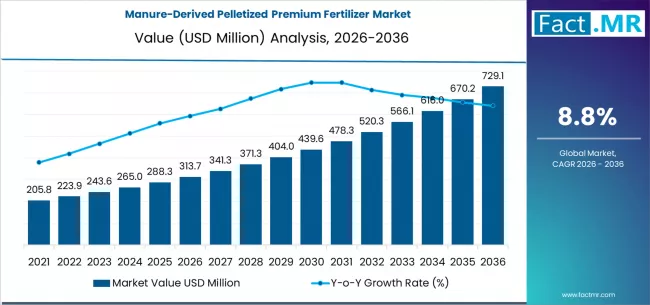
Manure-derived pelletized premium fertilizer market is projected to grow from USD 313.7 million in 2026 to USD 729.1 million by 2036, at a CAGR of 8.8%. Animal Manure will dominate with a 49.7% market share, while anaerobic digestion will lead the technology segment with a 47.2% share.
Manure-Derived Pelletized Premium Fertilizer Market Forecast and Outlook 2026 to 2036
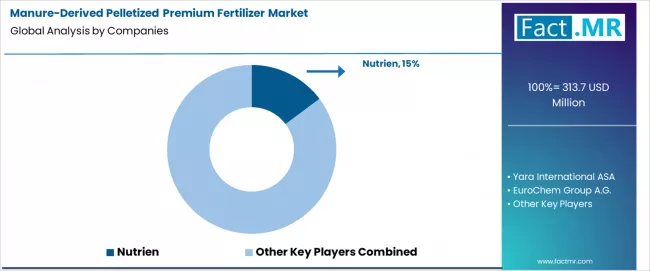
The global market for manure-derived pelletized premium fertilizer is projected to experience substantial growth, expanding from USD 313.70 million in 2026 to USD 729.13 million by 2036, progressing at a CAGR of 8.8%.
Key Takeaways from the Manure-Derived Pelletized Premium Fertilizer Market
- Market Value for 2026: USD 313.70 Million
- Market Value for 2036: USD 729.13 Million
- Forecast CAGR (2026-2036): 8.8%
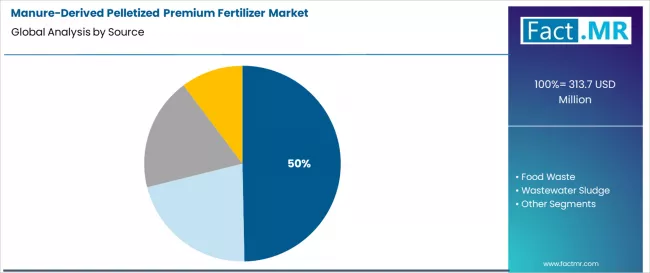
- Leading Source Segment (2026): Animal Manure (50%)
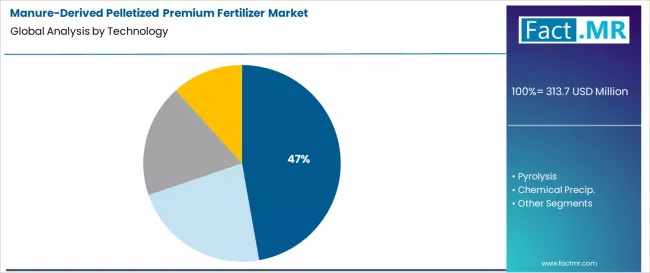
- Leading Technology Segment (2026): Anaerobic Digestion (47%)
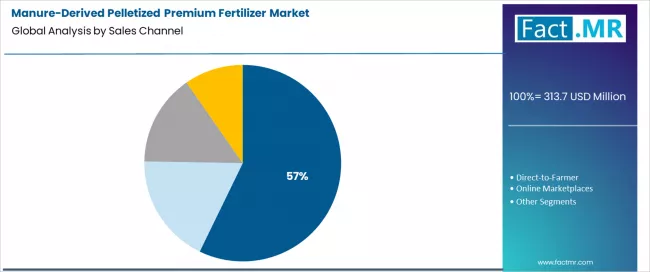
- Leading Sales Channel Segment (2026): Ag-Retailers (57%)
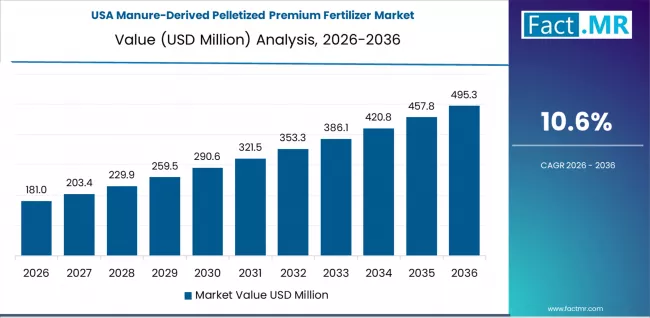
- Key Growth Countries: India (12.2% CAGR), China (11.4% CAGR), USA (10.6% CAGR), Brazil (10.9% CAGR)
- Key Players in the Market: Nutrien, Yara International ASA, EuroChem Group A.G., ICL Group Ltd., UPL Limited, BASF SE

This evolution represents a sophisticated segment within the organic fertilizer industry, moving beyond basic compost to value-engineered, nutrient-dense products that command premium pricing. The market's expansion is fueled by the convergence of advanced organic waste valorization technologies and escalating demand for certified, performance-guaranteed soil health inputs in commercial agriculture and horticulture.
Pelletization transforms raw, bulky manure into a clean, granular product with improved nutrient consistency, ease of handling, and controlled release properties. This process directly addresses the major drawbacks of traditional manure use, odor, pathogen risk, nutrient variability, and high transportation costs.
The resulting premium designation signifies products that are often chemically balanced, enriched with micronutrients or beneficial microbes, and verified through rigorous testing for purity and performance, enabling them to compete directly with mid-tier synthetic fertilizers.
Growth is primarily driven by the intensification of organic farming, the rise of sustainability standards in conventional supply chains, and stringent regulations governing raw manure application near waterways.
Farmers increasingly view these pellets not merely as a waste derivative but as a strategic tool for building soil organic matter, improving water retention, and meeting crop-specific nutritional needs with precision, all while satisfying environmental stewardship criteria demanded by regulators and consumers.
Metric
| Metric | Value |
|---|---|
| Market Value (2026) | USD 313.70 Million |
| Market Forecast Value (2036) | USD 729.13 Million |
| Forecast CAGR (2026-2036) | 8.8% |
Category
| Category | Segments |
|---|---|
| Source | Animal Manure, Food Waste, Wastewater Sludge, Crop Residue |
| Technology | Anaerobic Digestion, Pyrolysis, Chemical Precipitation, Composting |
| Sales Channel | Ag-Retailers, Direct-to-Farmer, Online Marketplaces, Cooperatives |
| Region | North America, Latin America, Western Europe, Eastern Europe, East Asia, South Asia & Pacific, Middle East & Africa |
Segmental Analysis
By Source, Which Feedstock Dominates Production?

Animal manure is the leading source, holding a 50% market share. Its dominance stems from widespread availability from concentrated livestock operations and its inherently balanced macro-nutrient profile.
The urgency to manage manure liabilities in regulated regions creates a consistent, high-volume feedstock stream. Pelletization offers a scalable solution for odor and nutrient runoff problems, transforming a handling challenge into a transportable and storable asset, particularly from poultry, dairy, and swine operations.
By Technology, Which Process Adds the Most Value?

Anaerobic digestion leads with a 47% share, favored for its dual-value proposition. The process first captures biogas for energy, with the resulting digestate then serving as an excellent feedstock for pelletizing.
Digestion stabilizes the material, reduces pathogens, and partially breaks down organic matter, making subsequent drying and pelletization more efficient. This integrated approach maximizes resource recovery from waste, making it a cornerstone technology for producing premium, sanitized fertilizer pellets.
By Sales Channel, Where is Market Trust Established?

Ag-retailers constitute the primary channel, commanding 57% of the market. For pelletized products to gain acceptance as reliable alternatives to traditional fertilizers, presence in established agricultural supply networks is essential.
Retailers provide the credibility, local agronomic expertise, and convenience that farmers trust. Their ability to blend these organic pellets with other inputs and offer application advice is crucial for transitioning farmers from trial to routine use.
What are the Drivers, Restraints, and Key Trends of the Manure-Derived Pelletized Premium Fertilizer Market?
The key market driver is the rapid global growth of organic farmland and the stringent certification requirements that often prohibit raw manure use. Even in conventional agriculture, retailer and consumer sustainability programs are creating premium markets for crops grown with verified soil health practices. Regulatory pressure to reduce phosphorus loading in watersheds also favors the controlled application of pelletized forms over raw manure.
A significant restraint is the high capital and operational energy cost associated with drying and pelletization, which can erode profit margins. Competition from lower-cost, non-premium organic amendments like simple compost can also limit market penetration in price-sensitive segments. Furthermore, the variable chemical composition of source manure can challenge producers in maintaining batch-to-batch consistency required for a premium branded product.
Key trends include the functional enhancement of pellets through post-processing coatings with micronutrients, bio-stimulants, or microbial consortia to target specific crop needs. Branding and certification are becoming increasingly important, with products carrying certifications for organic use, low contaminant levels, and carbon footprint claims. There is also a trend toward regional production hubs that aggregate waste from multiple farms to achieve the scale necessary for cost-effective premium pellet production, reducing transportation of raw materials.
Analysis of the Manure-Derived Pelletized Premium Fertilizer Market by Key Countries

| Country | CAGR (2026-2036) |
|---|---|
| India | 12.2% |
| China | 11.4% |
| Brazil | 10.9% |
| USA | 10.6% |
How is India's Agricultural Policy and Scale Driving High Growth?
India’s leading CAGR of 12.2% is fueled by a massive government push under initiatives like the Promotion of Agricultural Mechanization for In-Situ Management of Crop Residue and the National Mission on Natural Farming.
These policies aim to curb pollution from burning crop residue and manage livestock waste, directly incentivizing the creation of pelletization plants. The vast scale of Indian agriculture provides an enormous addressable market for affordable, upgraded organic fertilizers to improve degraded soils.
What is the Impact of China's Environmental and Food Security Policies?
China’s 11.4% growth is driven by its Zero Waste city policies and the "Fertilizer Use Zero Growth" action plan. The government is actively investing in centralized, high-tech organic waste processing facilities to tackle pollution.
The resulting pelletized fertilizers are seen as strategic inputs for enhancing soil quality and ensuring food security, with state-backed programs often facilitating their distribution and use, creating a powerful, policy-driven market.
Why is Brazil a Key Market for Large-Scale Agriculture Integration?
Brazil’s 10.9% CAGR reflects its status as an agricultural powerhouse with vast integrated livestock and crop operations. Large-scale farms seek efficient solutions to recycle nutrients from on-site manure, and pelletization offers a logistically viable method.
The growing export market for sustainably produced soy and other commodities, where premium pellets can verify improved soil management practices, adds a commercial incentive for adoption among large commercial growers.
How is the USA's Diverse Agricultural Sector Influencing Adoption?

The USA’s 10.6% growth is segmented. In regions with dense livestock and nutrient-impaired watersheds, pelletization is a compliance solution. The robust organic food sector and the rise of regenerative agriculture provide a strong premium market. Adoption is often led by large cooperatives or specialized firms that market branded pellet products with specific soil health promises to both commodity and specialty crop producers.
Competitive Landscape of the Manure-Derived Pelletized Premium Fertilizer Market

The competitive landscape is diverse, featuring global fertilizer majors, specialized organic waste processors, and agricultural cooperatives. Competition revolves around securing long-term feedstock supply agreements, mastering the energy-efficient drying and pelletization process, and building strong brands based on proven agronomic results.
Establishing recognized product certifications and developing direct relationships with large-scale sustainable farming operations or specialty crop growers are critical strategies for differentiation and capturing value.
Key Players in the Manure-Derived Pelletized Premium Fertilizer Market
- Nutrien
- Yara International ASA
- EuroChem Group A.G.
- ICL Group Ltd.
- UPL Limited
- BASF SE
Scope of Report
| Items | Values |
|---|---|
| Quantitative Units | USD Million |
| Source | Animal Manure, Food Waste, Wastewater Sludge, Crop Residue |
| Technology | Anaerobic Digestion, Pyrolysis, Chemical Precipitation, Composting |
| Sales Channel | Ag-Retailers, Direct-to-Farmer, Online Marketplaces, Cooperatives |
| Key Countries | USA, China, Brazil, India |
| Key Companies | Nutrien, Yara International ASA, EuroChem Group A.G., ICL Group Ltd., UPL Limited, BASF SE |
| Additional Analysis | Agronomic yield response comparison with synthetic fertilizers; energy and carbon footprint analysis of pelletization pathways; assessment of contaminant (e.g., heavy metals, antibiotics) reduction through processing; market analysis of organic and regenerative agriculture supply chains; review of quality certification standards for organic fertilizers; economic model for centralized vs. on-farm pellet production. |
Market by Segments
-
Source :
- Animal Manure
- Food Waste
- Wastewater Sludge
- Crop Residue
-
Technology :
- Anaerobic Digestion
- Pyrolysis
- Chemical Precipitation
- Composting
-
Sales Channel :
- Ag-Retailers
- Direct-to-Farmer
- Online Marketplaces
- Cooperatives
-
Region :
-
North America
- USA
- Canada
-
Latin America
- Brazil
- Mexico
- Argentina
- Rest of Latin America
-
Western Europe
- Germany
- UK
- France
- Spain
- Italy
- BENELUX
- Rest of Western Europe
-
Eastern Europe
- Russia
- Poland
- Czech Republic
- Rest of Eastern Europe
-
East Asia
- China
- Japan
- South Korea
- Rest of East Asia
-
South Asia & Pacific
- India
- ASEAN
- Australia
- Rest of South Asia & Pacific
-
Middle East & Africa
- Saudi Arabia
- UAE
- Turkiye
- Rest of MEA
-
Table of Content
- Executive Summary
- Global Market Outlook
- Demand to side Trends
- Supply to side Trends
- Technology Roadmap Analysis
- Analysis and Recommendations
- Market Overview
- Market Coverage / Taxonomy
- Market Definition / Scope / Limitations
- Market Background
- Market Dynamics
- Drivers
- Restraints
- Opportunity
- Trends
- Scenario Forecast
- Demand in Optimistic Scenario
- Demand in Likely Scenario
- Demand in Conservative Scenario
- Opportunity Map Analysis
- Product Life Cycle Analysis
- Supply Chain Analysis
- Investment Feasibility Matrix
- Value Chain Analysis
- PESTLE and Porter’s Analysis
- Regulatory Landscape
- Regional Parent Market Outlook
- Production and Consumption Statistics
- Import and Export Statistics
- Market Dynamics
- Global Market Analysis 2021 to 2025 and Forecast, 2026 to 2036
- Historical Market Size Value (USD Million) Analysis, 2021 to 2025
- Current and Future Market Size Value (USD Million) Projections, 2026 to 2036
- Y to o to Y Growth Trend Analysis
- Absolute $ Opportunity Analysis
- Global Market Pricing Analysis 2021 to 2025 and Forecast 2026 to 2036
- Global Market Analysis 2021 to 2025 and Forecast 2026 to 2036, By Source
- Introduction / Key Findings
- Historical Market Size Value (USD Million) Analysis By Source, 2021 to 2025
- Current and Future Market Size Value (USD Million) Analysis and Forecast By Source, 2026 to 2036
- Animal Manure
- Food Waste
- Wastewater Sludge
- Crop Residue
- Animal Manure
- Y to o to Y Growth Trend Analysis By Source, 2021 to 2025
- Absolute $ Opportunity Analysis By Source, 2026 to 2036
- Global Market Analysis 2021 to 2025 and Forecast 2026 to 2036, By Technology
- Introduction / Key Findings
- Historical Market Size Value (USD Million) Analysis By Technology, 2021 to 2025
- Current and Future Market Size Value (USD Million) Analysis and Forecast By Technology, 2026 to 2036
- Anaerobic Digestion
- Pyrolysis
- Chemical Precip.
- Composting
- Anaerobic Digestion
- Y to o to Y Growth Trend Analysis By Technology, 2021 to 2025
- Absolute $ Opportunity Analysis By Technology, 2026 to 2036
- Global Market Analysis 2021 to 2025 and Forecast 2026 to 2036, By Sales Channel
- Introduction / Key Findings
- Historical Market Size Value (USD Million) Analysis By Sales Channel, 2021 to 2025
- Current and Future Market Size Value (USD Million) Analysis and Forecast By Sales Channel, 2026 to 2036
- Ag-Retailers
- Direct-to-Farmer
- Online Marketplaces
- Cooperatives
- Ag-Retailers
- Y to o to Y Growth Trend Analysis By Sales Channel, 2021 to 2025
- Absolute $ Opportunity Analysis By Sales Channel, 2026 to 2036
- Global Market Analysis 2021 to 2025 and Forecast 2026 to 2036, By Region
- Introduction
- Historical Market Size Value (USD Million) Analysis By Region, 2021 to 2025
- Current Market Size Value (USD Million) Analysis and Forecast By Region, 2026 to 2036
- North America
- Latin America
- Western Europe
- Eastern Europe
- East Asia
- South Asia and Pacific
- Middle East & Africa
- Market Attractiveness Analysis By Region
- North America Market Analysis 2021 to 2025 and Forecast 2026 to 2036, By Country
- Historical Market Size Value (USD Million) Trend Analysis By Market Taxonomy, 2021 to 2025
- Market Size Value (USD Million) Forecast By Market Taxonomy, 2026 to 2036
- By Country
- USA
- Canada
- Mexico
- By Source
- By Technology
- By Sales Channel
- By Country
- Market Attractiveness Analysis
- By Country
- By Source
- By Technology
- By Sales Channel
- Key Takeaways
- Latin America Market Analysis 2021 to 2025 and Forecast 2026 to 2036, By Country
- Historical Market Size Value (USD Million) Trend Analysis By Market Taxonomy, 2021 to 2025
- Market Size Value (USD Million) Forecast By Market Taxonomy, 2026 to 2036
- By Country
- Brazil
- Chile
- Rest of Latin America
- By Source
- By Technology
- By Sales Channel
- By Country
- Market Attractiveness Analysis
- By Country
- By Source
- By Technology
- By Sales Channel
- Key Takeaways
- Western Europe Market Analysis 2021 to 2025 and Forecast 2026 to 2036, By Country
- Historical Market Size Value (USD Million) Trend Analysis By Market Taxonomy, 2021 to 2025
- Market Size Value (USD Million) Forecast By Market Taxonomy, 2026 to 2036
- By Country
- Germany
- UK
- Italy
- Spain
- France
- Nordic
- BENELUX
- Rest of Western Europe
- By Source
- By Technology
- By Sales Channel
- By Country
- Market Attractiveness Analysis
- By Country
- By Source
- By Technology
- By Sales Channel
- Key Takeaways
- Eastern Europe Market Analysis 2021 to 2025 and Forecast 2026 to 2036, By Country
- Historical Market Size Value (USD Million) Trend Analysis By Market Taxonomy, 2021 to 2025
- Market Size Value (USD Million) Forecast By Market Taxonomy, 2026 to 2036
- By Country
- Russia
- Poland
- Hungary
- Balkan & Baltic
- Rest of Eastern Europe
- By Source
- By Technology
- By Sales Channel
- By Country
- Market Attractiveness Analysis
- By Country
- By Source
- By Technology
- By Sales Channel
- Key Takeaways
- East Asia Market Analysis 2021 to 2025 and Forecast 2026 to 2036, By Country
- Historical Market Size Value (USD Million) Trend Analysis By Market Taxonomy, 2021 to 2025
- Market Size Value (USD Million) Forecast By Market Taxonomy, 2026 to 2036
- By Country
- China
- Japan
- South Korea
- By Source
- By Technology
- By Sales Channel
- By Country
- Market Attractiveness Analysis
- By Country
- By Source
- By Technology
- By Sales Channel
- Key Takeaways
- South Asia and Pacific Market Analysis 2021 to 2025 and Forecast 2026 to 2036, By Country
- Historical Market Size Value (USD Million) Trend Analysis By Market Taxonomy, 2021 to 2025
- Market Size Value (USD Million) Forecast By Market Taxonomy, 2026 to 2036
- By Country
- India
- ASEAN
- Australia & New Zealand
- Rest of South Asia and Pacific
- By Source
- By Technology
- By Sales Channel
- By Country
- Market Attractiveness Analysis
- By Country
- By Source
- By Technology
- By Sales Channel
- Key Takeaways
- Middle East & Africa Market Analysis 2021 to 2025 and Forecast 2026 to 2036, By Country
- Historical Market Size Value (USD Million) Trend Analysis By Market Taxonomy, 2021 to 2025
- Market Size Value (USD Million) Forecast By Market Taxonomy, 2026 to 2036
- By Country
- Kingdom of Saudi Arabia
- Other GCC Countries
- Turkiye
- South Africa
- Other African Union
- Rest of Middle East & Africa
- By Source
- By Technology
- By Sales Channel
- By Country
- Market Attractiveness Analysis
- By Country
- By Source
- By Technology
- By Sales Channel
- Key Takeaways
- Key Countries Market Analysis
- USA
- Pricing Analysis
- Market Share Analysis, 2025
- By Source
- By Technology
- By Sales Channel
- Canada
- Pricing Analysis
- Market Share Analysis, 2025
- By Source
- By Technology
- By Sales Channel
- Mexico
- Pricing Analysis
- Market Share Analysis, 2025
- By Source
- By Technology
- By Sales Channel
- Brazil
- Pricing Analysis
- Market Share Analysis, 2025
- By Source
- By Technology
- By Sales Channel
- Chile
- Pricing Analysis
- Market Share Analysis, 2025
- By Source
- By Technology
- By Sales Channel
- Germany
- Pricing Analysis
- Market Share Analysis, 2025
- By Source
- By Technology
- By Sales Channel
- UK
- Pricing Analysis
- Market Share Analysis, 2025
- By Source
- By Technology
- By Sales Channel
- Italy
- Pricing Analysis
- Market Share Analysis, 2025
- By Source
- By Technology
- By Sales Channel
- Spain
- Pricing Analysis
- Market Share Analysis, 2025
- By Source
- By Technology
- By Sales Channel
- France
- Pricing Analysis
- Market Share Analysis, 2025
- By Source
- By Technology
- By Sales Channel
- India
- Pricing Analysis
- Market Share Analysis, 2025
- By Source
- By Technology
- By Sales Channel
- ASEAN
- Pricing Analysis
- Market Share Analysis, 2025
- By Source
- By Technology
- By Sales Channel
- Australia & New Zealand
- Pricing Analysis
- Market Share Analysis, 2025
- By Source
- By Technology
- By Sales Channel
- China
- Pricing Analysis
- Market Share Analysis, 2025
- By Source
- By Technology
- By Sales Channel
- Japan
- Pricing Analysis
- Market Share Analysis, 2025
- By Source
- By Technology
- By Sales Channel
- South Korea
- Pricing Analysis
- Market Share Analysis, 2025
- By Source
- By Technology
- By Sales Channel
- Russia
- Pricing Analysis
- Market Share Analysis, 2025
- By Source
- By Technology
- By Sales Channel
- Poland
- Pricing Analysis
- Market Share Analysis, 2025
- By Source
- By Technology
- By Sales Channel
- Hungary
- Pricing Analysis
- Market Share Analysis, 2025
- By Source
- By Technology
- By Sales Channel
- Kingdom of Saudi Arabia
- Pricing Analysis
- Market Share Analysis, 2025
- By Source
- By Technology
- By Sales Channel
- Turkiye
- Pricing Analysis
- Market Share Analysis, 2025
- By Source
- By Technology
- By Sales Channel
- South Africa
- Pricing Analysis
- Market Share Analysis, 2025
- By Source
- By Technology
- By Sales Channel
- USA
- Market Structure Analysis
- Competition Dashboard
- Competition Benchmarking
- Market Share Analysis of Top Players
- By Regional
- By Source
- By Technology
- By Sales Channel
- Competition Analysis
- Competition Deep Dive
- Nutrien
- Overview
- Product Portfolio
- Profitability by Market Segments (Product/Age /Sales Channel/Region)
- Sales Footprint
- Strategy Overview
- Marketing Strategy
- Product Strategy
- Channel Strategy
- Yara International ASA
- EuroChem Group A.G.
- ICL Group Ltd.
- UPL Limited
- BASF SE
- Nutrien
- Competition Deep Dive
- Assumptions & Acronyms Used
- Research Methodology
List Of Table
- Table 1: Global Market Value (USD Million) Forecast by Region, 2021 to 2036
- Table 2: Global Market Value (USD Million) Forecast by Source, 2021 to 2036
- Table 3: Global Market Value (USD Million) Forecast by Technology, 2021 to 2036
- Table 4: Global Market Value (USD Million) Forecast by Sales Channel, 2021 to 2036
- Table 5: North America Market Value (USD Million) Forecast by Country, 2021 to 2036
- Table 6: North America Market Value (USD Million) Forecast by Source, 2021 to 2036
- Table 7: North America Market Value (USD Million) Forecast by Technology, 2021 to 2036
- Table 8: North America Market Value (USD Million) Forecast by Sales Channel, 2021 to 2036
- Table 9: Latin America Market Value (USD Million) Forecast by Country, 2021 to 2036
- Table 10: Latin America Market Value (USD Million) Forecast by Source, 2021 to 2036
- Table 11: Latin America Market Value (USD Million) Forecast by Technology, 2021 to 2036
- Table 12: Latin America Market Value (USD Million) Forecast by Sales Channel, 2021 to 2036
- Table 13: Western Europe Market Value (USD Million) Forecast by Country, 2021 to 2036
- Table 14: Western Europe Market Value (USD Million) Forecast by Source, 2021 to 2036
- Table 15: Western Europe Market Value (USD Million) Forecast by Technology, 2021 to 2036
- Table 16: Western Europe Market Value (USD Million) Forecast by Sales Channel, 2021 to 2036
- Table 17: Eastern Europe Market Value (USD Million) Forecast by Country, 2021 to 2036
- Table 18: Eastern Europe Market Value (USD Million) Forecast by Source, 2021 to 2036
- Table 19: Eastern Europe Market Value (USD Million) Forecast by Technology, 2021 to 2036
- Table 20: Eastern Europe Market Value (USD Million) Forecast by Sales Channel, 2021 to 2036
- Table 21: East Asia Market Value (USD Million) Forecast by Country, 2021 to 2036
- Table 22: East Asia Market Value (USD Million) Forecast by Source, 2021 to 2036
- Table 23: East Asia Market Value (USD Million) Forecast by Technology, 2021 to 2036
- Table 24: East Asia Market Value (USD Million) Forecast by Sales Channel, 2021 to 2036
- Table 25: South Asia and Pacific Market Value (USD Million) Forecast by Country, 2021 to 2036
- Table 26: South Asia and Pacific Market Value (USD Million) Forecast by Source, 2021 to 2036
- Table 27: South Asia and Pacific Market Value (USD Million) Forecast by Technology, 2021 to 2036
- Table 28: South Asia and Pacific Market Value (USD Million) Forecast by Sales Channel, 2021 to 2036
- Table 29: Middle East & Africa Market Value (USD Million) Forecast by Country, 2021 to 2036
- Table 30: Middle East & Africa Market Value (USD Million) Forecast by Source, 2021 to 2036
- Table 31: Middle East & Africa Market Value (USD Million) Forecast by Technology, 2021 to 2036
- Table 32: Middle East & Africa Market Value (USD Million) Forecast by Sales Channel, 2021 to 2036
List Of Figures
- Figure 1: Global Market Pricing Analysis
- Figure 2: Global Market Value (USD Million) Forecast 2021 to 2036
- Figure 3: Global Market Value Share and BPS Analysis by Source, 2026 and 2036
- Figure 4: Global Market Y to o to Y Growth Comparison by Source, 2026 to 2036
- Figure 5: Global Market Attractiveness Analysis by Source
- Figure 6: Global Market Value Share and BPS Analysis by Technology, 2026 and 2036
- Figure 7: Global Market Y to o to Y Growth Comparison by Technology, 2026 to 2036
- Figure 8: Global Market Attractiveness Analysis by Technology
- Figure 9: Global Market Value Share and BPS Analysis by Sales Channel, 2026 and 2036
- Figure 10: Global Market Y to o to Y Growth Comparison by Sales Channel, 2026 to 2036
- Figure 11: Global Market Attractiveness Analysis by Sales Channel
- Figure 12: Global Market Value (USD Million) Share and BPS Analysis by Region, 2026 and 2036
- Figure 13: Global Market Y to o to Y Growth Comparison by Region, 2026 to 2036
- Figure 14: Global Market Attractiveness Analysis by Region
- Figure 15: North America Market Incremental Dollar Opportunity, 2026 to 2036
- Figure 16: Latin America Market Incremental Dollar Opportunity, 2026 to 2036
- Figure 17: Western Europe Market Incremental Dollar Opportunity, 2026 to 2036
- Figure 18: Eastern Europe Market Incremental Dollar Opportunity, 2026 to 2036
- Figure 19: East Asia Market Incremental Dollar Opportunity, 2026 to 2036
- Figure 20: South Asia and Pacific Market Incremental Dollar Opportunity, 2026 to 2036
- Figure 21: Middle East & Africa Market Incremental Dollar Opportunity, 2026 to 2036
- Figure 22: North America Market Value Share and BPS Analysis by Country, 2026 and 2036
- Figure 23: North America Market Value Share and BPS Analysis by Source, 2026 and 2036
- Figure 24: North America Market Y to o to Y Growth Comparison by Source, 2026 to 2036
- Figure 25: North America Market Attractiveness Analysis by Source
- Figure 26: North America Market Value Share and BPS Analysis by Technology, 2026 and 2036
- Figure 27: North America Market Y to o to Y Growth Comparison by Technology, 2026 to 2036
- Figure 28: North America Market Attractiveness Analysis by Technology
- Figure 29: North America Market Value Share and BPS Analysis by Sales Channel, 2026 and 2036
- Figure 30: North America Market Y to o to Y Growth Comparison by Sales Channel, 2026 to 2036
- Figure 31: North America Market Attractiveness Analysis by Sales Channel
- Figure 32: Latin America Market Value Share and BPS Analysis by Country, 2026 and 2036
- Figure 33: Latin America Market Value Share and BPS Analysis by Source, 2026 and 2036
- Figure 34: Latin America Market Y to o to Y Growth Comparison by Source, 2026 to 2036
- Figure 35: Latin America Market Attractiveness Analysis by Source
- Figure 36: Latin America Market Value Share and BPS Analysis by Technology, 2026 and 2036
- Figure 37: Latin America Market Y to o to Y Growth Comparison by Technology, 2026 to 2036
- Figure 38: Latin America Market Attractiveness Analysis by Technology
- Figure 39: Latin America Market Value Share and BPS Analysis by Sales Channel, 2026 and 2036
- Figure 40: Latin America Market Y to o to Y Growth Comparison by Sales Channel, 2026 to 2036
- Figure 41: Latin America Market Attractiveness Analysis by Sales Channel
- Figure 42: Western Europe Market Value Share and BPS Analysis by Country, 2026 and 2036
- Figure 43: Western Europe Market Value Share and BPS Analysis by Source, 2026 and 2036
- Figure 44: Western Europe Market Y to o to Y Growth Comparison by Source, 2026 to 2036
- Figure 45: Western Europe Market Attractiveness Analysis by Source
- Figure 46: Western Europe Market Value Share and BPS Analysis by Technology, 2026 and 2036
- Figure 47: Western Europe Market Y to o to Y Growth Comparison by Technology, 2026 to 2036
- Figure 48: Western Europe Market Attractiveness Analysis by Technology
- Figure 49: Western Europe Market Value Share and BPS Analysis by Sales Channel, 2026 and 2036
- Figure 50: Western Europe Market Y to o to Y Growth Comparison by Sales Channel, 2026 to 2036
- Figure 51: Western Europe Market Attractiveness Analysis by Sales Channel
- Figure 52: Eastern Europe Market Value Share and BPS Analysis by Country, 2026 and 2036
- Figure 53: Eastern Europe Market Value Share and BPS Analysis by Source, 2026 and 2036
- Figure 54: Eastern Europe Market Y to o to Y Growth Comparison by Source, 2026 to 2036
- Figure 55: Eastern Europe Market Attractiveness Analysis by Source
- Figure 56: Eastern Europe Market Value Share and BPS Analysis by Technology, 2026 and 2036
- Figure 57: Eastern Europe Market Y to o to Y Growth Comparison by Technology, 2026 to 2036
- Figure 58: Eastern Europe Market Attractiveness Analysis by Technology
- Figure 59: Eastern Europe Market Value Share and BPS Analysis by Sales Channel, 2026 and 2036
- Figure 60: Eastern Europe Market Y to o to Y Growth Comparison by Sales Channel, 2026 to 2036
- Figure 61: Eastern Europe Market Attractiveness Analysis by Sales Channel
- Figure 62: East Asia Market Value Share and BPS Analysis by Country, 2026 and 2036
- Figure 63: East Asia Market Value Share and BPS Analysis by Source, 2026 and 2036
- Figure 64: East Asia Market Y to o to Y Growth Comparison by Source, 2026 to 2036
- Figure 65: East Asia Market Attractiveness Analysis by Source
- Figure 66: East Asia Market Value Share and BPS Analysis by Technology, 2026 and 2036
- Figure 67: East Asia Market Y to o to Y Growth Comparison by Technology, 2026 to 2036
- Figure 68: East Asia Market Attractiveness Analysis by Technology
- Figure 69: East Asia Market Value Share and BPS Analysis by Sales Channel, 2026 and 2036
- Figure 70: East Asia Market Y to o to Y Growth Comparison by Sales Channel, 2026 to 2036
- Figure 71: East Asia Market Attractiveness Analysis by Sales Channel
- Figure 72: South Asia and Pacific Market Value Share and BPS Analysis by Country, 2026 and 2036
- Figure 73: South Asia and Pacific Market Value Share and BPS Analysis by Source, 2026 and 2036
- Figure 74: South Asia and Pacific Market Y to o to Y Growth Comparison by Source, 2026 to 2036
- Figure 75: South Asia and Pacific Market Attractiveness Analysis by Source
- Figure 76: South Asia and Pacific Market Value Share and BPS Analysis by Technology, 2026 and 2036
- Figure 77: South Asia and Pacific Market Y to o to Y Growth Comparison by Technology, 2026 to 2036
- Figure 78: South Asia and Pacific Market Attractiveness Analysis by Technology
- Figure 79: South Asia and Pacific Market Value Share and BPS Analysis by Sales Channel, 2026 and 2036
- Figure 80: South Asia and Pacific Market Y to o to Y Growth Comparison by Sales Channel, 2026 to 2036
- Figure 81: South Asia and Pacific Market Attractiveness Analysis by Sales Channel
- Figure 82: Middle East & Africa Market Value Share and BPS Analysis by Country, 2026 and 2036
- Figure 83: Middle East & Africa Market Value Share and BPS Analysis by Source, 2026 and 2036
- Figure 84: Middle East & Africa Market Y to o to Y Growth Comparison by Source, 2026 to 2036
- Figure 85: Middle East & Africa Market Attractiveness Analysis by Source
- Figure 86: Middle East & Africa Market Value Share and BPS Analysis by Technology, 2026 and 2036
- Figure 87: Middle East & Africa Market Y to o to Y Growth Comparison by Technology, 2026 to 2036
- Figure 88: Middle East & Africa Market Attractiveness Analysis by Technology
- Figure 89: Middle East & Africa Market Value Share and BPS Analysis by Sales Channel, 2026 and 2036
- Figure 90: Middle East & Africa Market Y to o to Y Growth Comparison by Sales Channel, 2026 to 2036
- Figure 91: Middle East & Africa Market Attractiveness Analysis by Sales Channel
- Figure 92: Global Market - Tier Structure Analysis
- Figure 93: Global Market - Company Share Analysis
- FAQs -
How big is the manure-derived pelletized premium fertilizer market in 2026?
The global manure-derived pelletized premium fertilizer market is estimated to be valued at USD 313.7 million in 2026.
What will be the size of manure-derived pelletized premium fertilizer market in 2036?
The market size for the manure-derived pelletized premium fertilizer market is projected to reach USD 729.1 million by 2036.
How much will be the manure-derived pelletized premium fertilizer market growth between 2026 and 2036?
The manure-derived pelletized premium fertilizer market is expected to grow at a 8.8% CAGR between 2026 and 2036.
What are the key product types in the manure-derived pelletized premium fertilizer market?
The key product types in manure-derived pelletized premium fertilizer market are animal manure, food waste, wastewater sludge and crop residue.
Which technology segment to contribute significant share in the manure-derived pelletized premium fertilizer market in 2026?
In terms of technology, anaerobic digestion segment to command 47.2% share in the manure-derived pelletized premium fertilizer market in 2026.