- Market Value (2025): USD 1.08 Bn
- Estimated Value (2026): USD 1.13 Bn
- Forecast Value (2036): USD 1.85 Bn
- CAGR (2026-2036): 5.1%
Cradles Market Forecast and Outlook 2026 to 2036
According to the Fact.MR analysis, the cradles market crossed a valuation of USD 1.08 billion in 2025 and is projected to grow from USD 1.13 billion in 2026 to USD 1.85 billion by 2036. Demand for cradles is likely to grow at a CAGR of 5.1% over the forecast period.
Demand for cradles is rising as parents spend more per child on safe, well-designed sleep products even as birth numbers fall in many countries. Suppliers of cradles are offering convertible and bedside designs that meet strict sleep-safety standards. For example, the US Safe Sleep for Babies Act of May 2022 banned inclined infant sleepers and padded crib bumpers, steering parents toward flat, certified sleep surfaces. Similar safety rules are projected to drive sales of compliant cradles through 2036.
Key Takeaways from the Cradles Market
- Cradles Market Value (2025): USD 1.08 billion
- Cradles Market Value (2026): USD 1.13 billion
- Cradles Market Forecast Value (2036): USD 1.85 billion
- Cradles Market Forecast CAGR (2026-2036): 5.1%
- Leading Product Type: Traditional Cradles (38.7%)
- Key Market Participants: Chicco, Graco, Fisher-Price, Stokke, BabyBjörn, Delta Children
- Key Growth Regions: Germany, Brazil, United States, United Kingdom, Japan
Japan recorded fewer than 690,000 births in 2024, the lowest on record, and Germany and the United States also reported declining births. Demand for cradles is shifting toward premium, longer-use products as households have fewer children and spend more on each. Suppliers of cradles are adding convertible frames that become toddler beds or chairs. Similar demographic shifts are projected to raise value rather than volume in cradle sales.
Cradles Market
| Metric | Value |
|---|---|
| Estimated Value in (2026) | USD 1.13 billion |
| Forecast Value in (2036) | USD 1.85 billion |
| Forecast CAGR (2026 to 2036) | 5.1% |
Source: Fact.MR analysis. Updated Nov 20, 2026
Source: Fact.MR analysis.
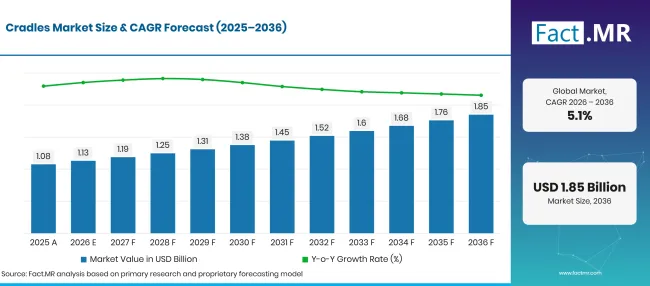
Cradles Market Forecast Global | Source: Fact.MR
Category
| Category | Segments |
|---|---|
| Product Type | Traditional Cradles, Convertible Cradles, Portable Cradles |
| Material | Wood, Metal, Plastic, Others |
| End-User | Residential, Commercial |
| Distribution Channel | Online Stores, Specialty Stores, Supermarkets/Hypermarkets, Others |
| Region | Germany; Brazil; United States; United Kingdom; Japan |
Source: Fact.MR analysis. Updated Nov 20, 2026
Segmental Analysis
What is supporting traditional cradle demand in the Cradles Market?
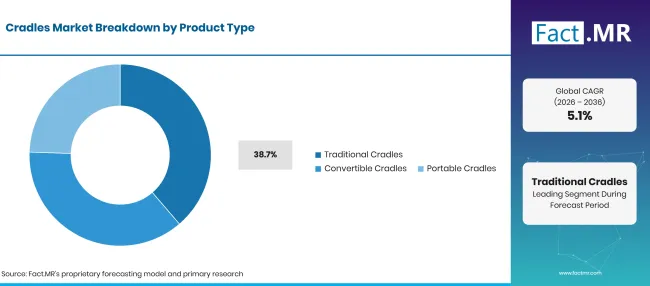
Cradles Market Breakdown Product Type | Source: Fact.MR
Sales of traditional cradles account for 38.7% of revenue in 2026, about USD 435 million, as rocking and gliding wooden designs remain popular gifts and nursery centerpieces. Convertible and portable cradles are gaining attention among urban households with limited living space. Manufacturers are incorporating adjustable rocking mechanisms, locking systems and safety-certified mattresses to improve product functionality. The U.S. Consumer Product Safety Commission published its 2026 Nursery Products Annual Report in October, estimating 1,700 emergency department-treated injuries associated with bassinets and cradles during 2025. This highlights the importance of product safety and compliance in nursery furniture purchasing. Demand for traditional designs with improved safety features is expected to support sales.
Which factors are strengthening wood demand in the Cradles Market?
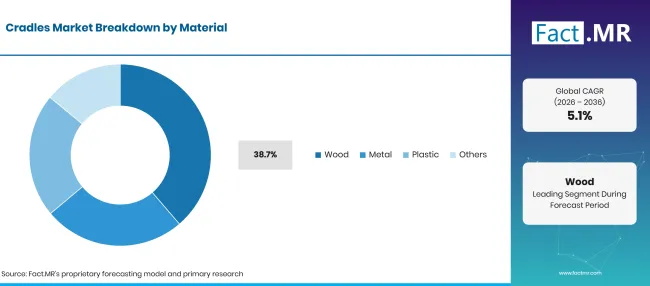
Cradles Market Breakdown Material | Source: Fact.MR
Demand for wood accounts for 38.7% of cradle revenue in 2026, about USD 435 million, as beech, birch and pine offer durability, natural appeal and easy compliance with toy and furniture safety rules. Metal and plastic remain important for lightweight travel and portable models. Manufacturers are increasingly emphasizing responsibly sourced timber and durable wooden construction to appeal to environmentally conscious parents. The UK's Forestry Commission and Forest Research reported in October 2026 that 3.30 million hectares of woodland were recorded across the country, with 1.42 million hectares independently certified as sustainably managed. The same publication recorded 10.4 million green tonnes of roundwood delivered to primary wood processors in 2025. Established timber availability and sustainable forestry initiatives support the use of wood in furniture manufacturing.
What is accelerating online store sales in the Cradles Market?
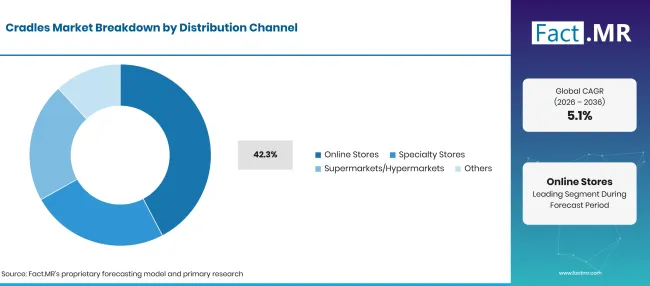
Cradles Market Breakdown Distribution Channel | Source: Fact.MR
Online stores account for 42.3% of revenue in 2026, about USD 480 million, as parents compare safety ratings and reviews and use online baby registries. Specialty stores and hypermarkets remain important for touch-and-feel purchases. Online baby registries and direct-to-consumer websites also simplify gift purchases by relatives and friends. Specialty baby stores remain relevant for customers who prefer to inspect construction quality, mattress compatibility and rocking mechanisms before buying. The U.S. Census Bureau reported in August 2026 that second-quarter retail e-commerce sales reached USD 340.2 billion, increasing 12.2% year over year and representing 17.1% of total retail sales. Continued expansion of online retail activity is expected to support digital cradle sales and direct-to-consumer distribution.
How are household purchases shaping residential demand in the Cradles Market?
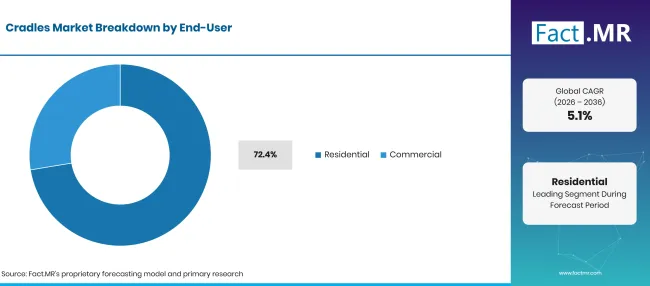
Cradles Market Breakdown End User | Source: Fact.MR
Demand from residential buyers account for 72.4% of revenue in 2026, about USD 820 million, as parents and grandparents buy cradles for home nurseries. Commercial demand comes from maternity hospitals, hotels and childcare facilities requiring multiple units for infant accommodation. The U.S. National Center for Health Statistics published provisional 2025 birth data in April 2026, reporting 3,606,400 births in the country. Although this represented a 1% decline from 2024, the substantial number of annual births continues to create a recurring household customer base for cradles, bassinets and other infant sleeping products. Demand for safe and functional nursery furniture is expected to sustain residential purchases.
Cradles Market-Drivers, Restraints & Trends
Drivers: Growing Preference for Safe Infant Sleep Arrangements
Demand for cradles and bedside sleepers is supported by growing attention to infant sleep safety and recommendations for room-sharing without bed-sharing. The U.S. Centers for Disease Control and Prevention reported in its 2026 analysis of sudden unexpected infant deaths that 59% of registered cases involved infants sharing a sleep surface, while 78% involved soft bedding. The American Academy of Pediatrics recommends room-sharing on a separate infant sleep surface, ideally for at least the first six months. These safety considerations support demand for standalone bassinets and bedside cradles that allow parents to keep infants nearby while maintaining a separate sleep space.
Restraints: Declining Birth Rates and Short Product Replacement Cycles
Cradle sales face demographic pressure from declining birth rates and the limited period during which infants use bassinets and cradles. According to the U.S. National Center for Health Statistics' October 2026 report, the country recorded 3,612,012 births in 2025, down from 3,628,934 in 2024, while the general fertility rate declined from 53.8 to 53.2 births per 1,000 women aged 15–44. Short product-use periods can also encourage parents to purchase secondhand products or reuse cradles across children. These factors may limit new-unit purchases, increasing the importance of convertible designs, extended-use functionality and compliance with updated safety requirements.
Opportunity: Convertible and Long-Life Cradle Designs
Demand for convertible cradles is gaining support as parents seek products that provide greater value beyond the first few months of infancy. Manufacturers offering bassinets that transition into toddler beds, storage furniture or other nursery products can address concerns about short product-use periods and resale. The U.S. Consumer Product Safety Commission introduced an updated mandatory safety standard for bassinets and cradles, ASTM F2194-25, effective February 21, 2026. Products manufactured or imported from that date must meet the revised requirements. This regulatory development creates opportunities for manufacturers to combine extended product functionality with improved structural safety, stability and compliant design.
Trend: Increasing Focus on Smart and Technology-Enabled Bassinets
Demand for smart bassinets is attracting attention as parents explore automated soothing, motion control, sound functions and app-connected monitoring features. The U.S. Consumer Product Safety Commission's infant sleep product regulations require products intended for infant sleep to meet applicable mandatory safety standards, including requirements addressing falls, suffocation and unsafe sleep surfaces. Its 2026 guidance also confirms that products marketed for infant sleep must meet relevant regulatory requirements even when they incorporate additional functions. This regulatory environment is encouraging manufacturers to prioritize safe sleep surfaces, structural stability and appropriate product testing when introducing technology-enabled bassinets.
Cradles Market by Analysis by Key Country
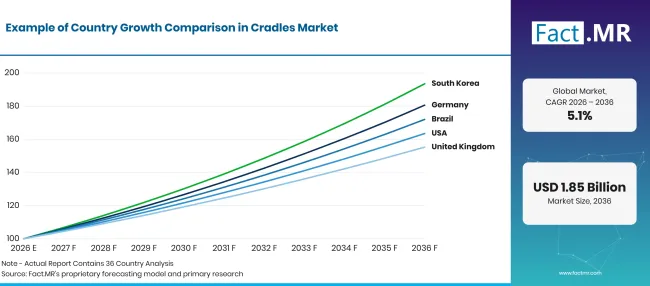
Cradles Market Growth Index | Source: Fact.MR
| Country | CAGR (2026-2036) |
|---|---|
| Germany | 6.1% |
| Brazil | 5.6% |
| United States | 5.0% |
| United Kingdom | 4.5% |
| Japan | 4.0% |
Source: Fact.MR analysis. Updated Nov 20, 2026
Source: Fact.MR analysis.
Why is Germany the fastest-growing market for cradles?
Demand for cradles in Germany is projected to increase at a 6.1% CAGR, the fastest among the five key countries, as parents favor premium wooden and eco-certified nursery furniture despite fewer births.
Specialty baby stores and online retailers carry wide ranges. Destatis reported 654,241 births in 2025, down 3.4% from 2024, while preliminary figures showed a further 1.7% decline in births between January and August 2026. This demographic pressure makes value-added products, including solid-wood cradles, certified materials and low-emission finishes, important areas for suppliers to target. Premium positioning and product differentiation could support sales even as the potential customer base contracts.
What is supporting cradle demand in Brazil?
Sales of cradles in Brazil are estimated to grow at a 5.6% CAGR as rising middle-class spending supports nursery purchases and e-commerce expands into smaller cities.
Local furniture makers compete with imported brands. IBGE reported that internet access reached 95.0% of Brazilian households in 2025, equivalent to 76 million homes, while 52.7% of internet users reported purchasing or ordering goods and services online. These figures indicate a substantial digital channel through which nursery furniture brands and local manufacturers can reach parents. IBGE’s September 2026 retail data also showed year-on-year growth of 1.7% in retail sales volume.
How are safe-sleep rules shaping cradle sales in the United States?
Sales of cradles in the United States are projected to record a 5.0% CAGR as CPSC bassinet and cradle standards and the Safe Sleep for Babies Act shape product design.
About 3.6 million births a year sustain a large market. Graco, Delta Children and Halo lead US sales. Similar safety focus is projected to drive sales in the United States. The CPSC requires bassinets and cradles manufactured or imported from February 21, 2026, to meet the updated ASTM F2194-25 standard; products manufactured from July 1, 2026, must fully comply following the agency’s enforcement-discretion period. This reinforces the importance of stable construction, safe sleep surfaces and compliant product testing. The customer base also remains substantial: CDC final data recorded 3,612,012 U.S. births in 2025. Together, regulatory requirements and continuing birth volumes support demand for compliant infant sleep products.
What is shaping cradle demand in the United Kingdom?
Demand for cradles in the United Kingdom is anticipated to hold a 4.5% CAGR as parents buy bedside cribs following Lullaby Trust safe-sleep advice. Falling births limit volume.
The Office for National Statistics recorded 585,396 live births in England and Wales in 2025, 1.6% fewer than in 2024, with the total fertility rate falling to 1.39 children per woman. Safe-sleep guidance is also shaping product selection. From September 1, 2026, updated Early Years Foundation Stage requirements specify that early-years providers use compliant cots, carrycots, Moses baskets or travel cots for babies aged 12 months and under. This strengthens the focus on suitable, standards-compliant infant sleep spaces, while compact designs may appeal to households with limited room.
Why is cradle growth slower in Japan?
Demand for cradles in Japan is projected to grow at a 4.0% CAGR, the slowest among the five key countries, as births fell to a record low in 2024. Government child-support measures aim to slow the decline. Suppliers are focusing on premium and rental models.
Similar demographics are projected to keep growth slower. The Ministry of Health, Labour and Welfare reported 671,270 births in 2025, a record low and a 2.2% decrease from the previous year. Its 2026 monthly statistics showed 464,110 births from January to August, marginally below the 464,517 recorded over the same period in 2025. This continuing demographic pressure is likely to restrain volume-led cradle sales. Suppliers may therefore focus on higher-value products, space-efficient designs and rental or resale options to serve families seeking flexibility and affordability.
Competitive Landscape for Cradles Market
The global cradles market is characterized by established baby-care brands competing through product innovation, infant safety, multifunctional designs and distribution network expansion. Manufacturers are expanding traditional, convertible and portable cradle portfolios to address changing parental preferences. Chicco focuses on portable and multifunctional bassinets, while Graco offers affordable bedside sleepers, travel bassinets and automatic soothing products. Stokke targets premium consumers through Scandinavian-inspired designs and compact sleeping solutions. BabyBjörn differentiates itself through lightweight construction, minimalist aesthetics and gentle rocking functionality.
Delta Children emphasizes convertible bassinets, nursery furniture integration and extended product usability. Simmons Kids, owned by Delta Children, competes through gliding bassinets and comfort-oriented sleeping solutions. Arm's Reach specializes in bedside co-sleepers and adjustable standalone bassinets, while HALO Innovations focuses on premium BassiNest products featuring swivel functionality, breathable mesh panels and convenient bedside positioning. Competition is increasingly shaped by demand for space-saving designs, portability, adjustable configurations and integrated soothing features. Companies are strengthening their product offerings through functional improvements, safety-oriented engineering and differentiated designs to attract parents seeking convenient and versatile infant sleeping solutions.
Recent Developments
- In 2025, Japan reported a record-low number of births for 2024.
- In February 2026, HALO launched the BassiNest Swivel Sleeper 4.0, featuring 360-degree swivel functionality, a patented lowering wall, improved base stability and breathable mesh construction to enhance bedside infant care.
- In March 2026, HALO introduced BassiNest Swivel Sleeper 4.0 Air, incorporating its DreamWeave breathable and washable mattress pad to improve airflow while retaining the brand's signature swivel functionality and lowering-wall design.
- In August 2026, Delta Children announced a technology-focused product lineup featuring the Aero Smart Auto Glide Bassinet with cry detection, Bluetooth connectivity and automated soothing, alongside its Jalen 9-in-1 Convertible Bassinet-to-Crib.
Key Players in Cradles Market
Key companies profiled include Chicco; Graco; Stokke; BabyBjörn; Delta Children; Simmons Kids; Arm's Reach; and HALO Innovations.
- Chicco
- Graco
- Stokke
- BabyBjörn
- Delta Children
- Simmons Kids
- Arm's Reach
- HALO Innovations
Bibliography
- Centers for Disease Control and Prevention. (2026). Characteristics of sudden unexpected infant deaths, 2020–2024.
- Centers for Disease Control and Prevention. (2026). Births in the United States, 2025 (Data Brief No. 571).
- Centers for Disease Control and Prevention. (2026). National vital statistics: Data brief No. 571.
- Delta Children. (n.d.). Aero Smart Auto Glide Bassinet with cry detection and Bluetooth wireless.
- Federal Register. (2025). Updated safety standard for bassinets and cradles.
- German Federal Statistical Office (Destatis). (2026). Total fertility rate drops to 1.32 children per woman in 2025.
- HALO. (n.d.). BassiNest Swivel Sleeper 4.0 Air with DreamWeave breathable pad.
- HALO. (2026). HALO introduces BassiNest 4.0 Air, a breathable evolution of its iconic bedside sleeper. StreetInsider.
- Instituto Brasileiro de Geografia e Estatística. (2026). Internet chega a 95% de domicílios do país em 2025. Agência de Notícias.
- Ministry of Health, Labour and Welfare. (2025). Vital statistics 2024. Government of Japan.
- U.S. Census Bureau. (2026). Quarterly retail e-commerce sales: Second quarter 2026.
- U.S. Consumer Product Safety Commission. (2026). Nursery products annual report 2026.
- U.S. Consumer Product Safety Commission. (n.d.). Bassinets and cradles business guidance.
- U.S. Consumer Product Safety Commission. (n.d.). Infant sleep products: Safety requirements.
- U.S. Consumer Product Safety Commission. (n.d.). Infant sleep products business guidance.
- U.S. National Center for Health Statistics. (2026). Births: Provisional data for 2025. National Library of Medicine
- UK Forestry Commission, & Forest Research. (2026). Forestry statistics 2026. GOV.UK.
Segmentation
Scope of Report
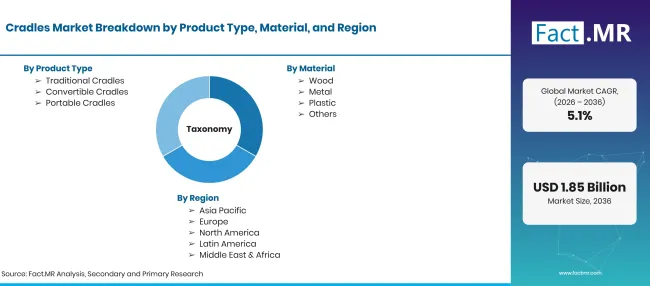
Cradles Market Taxonomy | Source: Fact.MR
| Items | Values |
|---|---|
| Quantitative Units (2026) | USD 1.13 Billion |
| Product Type | Traditional Cradles, Convertible Cradles, Portable Cradles |
| Material | Wood, Metal, Plastic, Others |
| End-User | Residential, Commercial |
| Distribution Channel | Online Stores, Specialty Stores, Supermarkets/Hypermarkets, Others |
| Regions Covered | North America, Latin America, Europe, East Asia, South Asia and Pacific, Middle East & Africa |
| Countries Covered | United States, Germany, Japan, United Kingdom, Brazil, and other countries |
| Key Companies Profiled | Chicco; Graco; Stokke; BabyBjörn; Delta Children; Simmons Kids; Arm's Reach; HALO Innovations |
| Additional Attributes | Dollar revenue in the Cradles Market is segmented by product type (traditional cradles, convertible cradles, portable cradles); material (wood, metal, plastic); end-user (residential, commercial); distribution channel (online stores, specialty stores, supermarkets/hypermarkets) and region. |
Source: Fact.MR analysis. Updated Nov 20, 2026
Cradles Market by Segments
-
Product Type
- Traditional Cradles
- Convertible Cradles
- Portable Cradles
-
Material
- Wood
- Metal
- Plastic
- Others
-
End-User
- Residential
- Commercial
-
Distribution Channel
- Online Stores
- Specialty Stores
- Supermarkets/Hypermarkets
- Others
-
Region:
- North America
- United States
- Canada
- Mexico
- Europe
- Germany
- United Kingdom
- France
- Italy
- Spain
- Rest of Europe
- Asia Pacific
- China
- India
- Japan
- South Korea
- Australia
- Rest of Asia Pacific
- Latin America
- Brazil
- Mexico
- Argentina
- Rest of Latin America
- Middle East & Africa
- GCC Countries
- South Africa
- Rest of Middle East & Africa
- North America
Frequently Asked Questions
How big is the global Cradles Market in 2026?
What will be the size of the Cradles Market by 2036?
How fast will the Cradles Market grow during the forecast period?
Which product type segment holds the largest share of the Cradles Market?
Who worked on this report


Preview the report firsthand - request a free sample
Free SampleGet the brochure for pricing and purchase details
Download PDF