Marine Propulsion Low-Carbon Ammonia Market

Marine Propulsion Low-Carbon Ammonia Market Size and Share Forecast Outlook 2026 to 2036

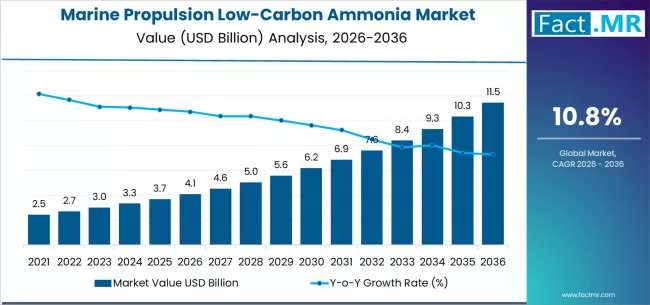
Marine propulsion low-carbon ammonia market is projected to grow from USD 4.1 billion in 2026 to USD 11.5 billion by 2036, at a CAGR of 10.8%. Low‑Carbon Ammonia will dominate with a 46.5% market share, while container ships will lead the vessel type segment with a 32.4% share.

Marine Propulsion Low-Carbon Ammonia Market Forecast and Outlook 2026 to 2036

The global market for low-carbon ammonia as a marine fuel is positioned at the forefront of maritime decarbonization, projected to surge from USD 4.11 billion in 2026 to USD 11.46 billion by 2036, advancing at a CAGR of 10.8%.

Key Takeaways from the Marine Propulsion Low-Carbon Ammonia Market

  • Market Value for 2026: USD 4.11 Billion
  • Market Value for 2036: USD 11.46 Billion
  • Forecast CAGR (2026-2036): 10.8%
  • Leading Fuel Type Segment (2026): Low-Carbon Ammonia (47%)
  • Leading Vessel Type Segment (2026): Container Ships (32%)
  • Leading End-User Segment (2026): Commercial Shipping (46.9%)
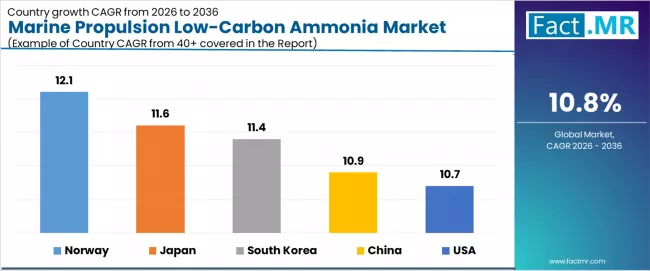
  • Key Growth Countries: Norway (12.1% CAGR), Japan (11.6% CAGR), South Korea (11.4% CAGR), China (10.9% CAGR), USA (10.7% CAGR)
  • Key Players in the Market: Yara International, Japan Engine Corporation (J-ENG), MAN Energy Solutions, Wärtsilä Corporation, Mitsubishi Heavy Industries.

Marine Propulsion Low Carbon Ammonia Market Market Value Analysis

This growth trajectory is not merely an expansion but a fundamental shift in the maritime energy paradigm. The transition is being catalysed by the International Maritime Organization's tightening emissions regulations and the maritime sector’s urgent pursuit of viable, scalable zero-carbon fuels.

Ammonia’s potential stems from its lack of carbon atoms during combustion and its established global production and handling infrastructure. The market's evolution is centered on green and blue ammonia value chains, overcoming hurdles related to energy density, engine technology adaptation, and the creation of complete fuel-ready ecosystems encompassing bunkering, storage, and safety protocols.

Success in this market hinges on the synchronized development of engine technologies, fuel supply logistics, and clear regulatory frameworks that balance environmental ambition with operational safety and economic feasibility.

Metric

Metric Value
Market Value (2026) USD 4.11 Billion
Market Forecast Value (2036) USD 11.46 Billion
Forecast CAGR (2026-2036) 10.8%

Category

Category Segments
Fuel Type Low-Carbon Ammonia, Ammonia-Hydrogen Blends, Green Hydrogen, Others
Vessel Type Container Ships, Bulk Carriers, Tankers, Cruise Ships, Ferries & Ro-Ro, Offshore Support Vessels, Others
EndUser Commercial Shipping, Offshore Support Vessels, Cruise & Passenger Liners, Naval & Defense, Others
Region North America, Latin America, Western Europe, Eastern Europe, East Asia, South Asia & Pacific, MEA

Segmental Analysis

By Fuel Type, Which Segment is the Current Foundation of the Market?

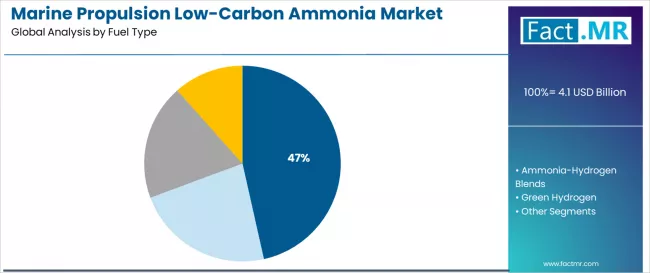
Marine Propulsion Low Carbon Ammonia Market Analysis By Fuel Type

The low-carbon ammonia segment, encompassing both green and blue ammonia, commands a leading 47% market share. This dominance reflects its status as the most immediate and scalable pathway for deep-sea decarbonization.

While ammonia-hydrogen blends and pure green hydrogen are critical for long-term research, low-carbon ammonia benefits from existing production knowledge and is the primary focus of first-mover engine development projects and pilot bunkering operations.

By Vessel Type, Which Segment is the Primary Early Adopter?

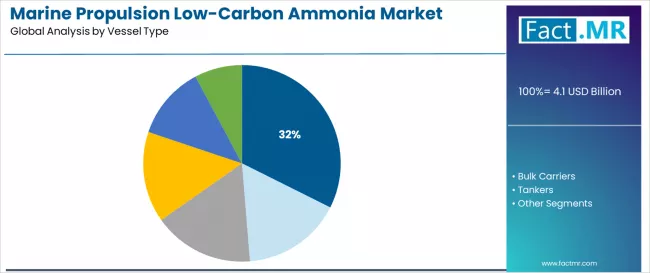
Marine Propulsion Low Carbon Ammonia Market Analysis By Vessel Type

Container ships lead with a 32% share. Their operational profile, fixed routes, high fuel consumption, and pressure from cargo owners demanding greener logistics, makes them a primary driver for adoption.

The predictability of their sailing schedules facilitates the establishment of initial green corridor routes between specific ports, where ammonia bunkering infrastructure can be first deployed at scale.

By End-User, Which Sector is Driving Initial Demand?

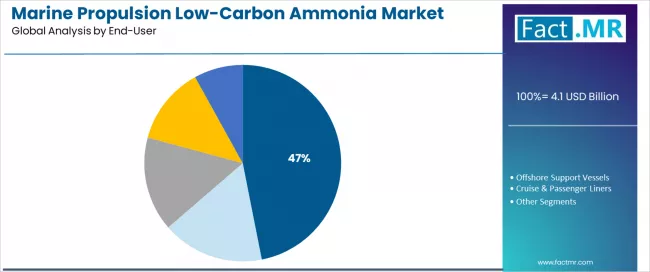
Marine Propulsion Low Carbon Ammonia Market Analysis By End User

Commercial shipping is the dominant end-user, accounting for 46.9% of the market. This segment’s vast scale and direct exposure to carbon pricing mechanisms and charterer requirements create a powerful commercial imperative.

The focus within commercial shipping is initially on newbuild vessels designed for ammonia compatibility, with retrofits expected to gain significance later in the forecast period.

What are the Drivers, Restraints, and Key Trends of the Marine Propulsion Low-Carbon Ammonia Market?

The unequivocal driver is regulatory pressure, primarily the IMO’s strategy targeting net-zero greenhouse gas emissions by or around 2050. Supporting this are regional regulations like the EU’s Emissions Trading System (ETS) inclusion of maritime transport and national net-zero commitments that are prompting state-backed investment in fuel infrastructure. Corporate commitments from major shipping lines and their customers to decarbonize supply chains are translating regulatory pressure into tangible demand signals.

A central restraint is the current lack of a global, safe bunkering network and the significant capital expenditure required for new vessel designs or retrofits. The energy density of ammonia and concerns over nitrogen oxide emissions and potential ammonia slip require complex engine and after-treatment solutions. The chicken-and-egg dilemma between vessel uptake and fuel availability persists, slowing widespread deployment.

Key trends include the active development of ammonia-capable and ammonia-dedicated engines by major manufacturers, moving from test beds to pilot installations. The strategic establishment of green shipping corridors between key port pairs is de-risking early investments in bunkering infrastructure. There is also a trend toward integrated energy consortiums, where fuel producers, engine makers, shipyards, and shipping companies collaborate to create entire ecosystem solutions, reducing risk for all parties.

Analysis of the Marine Propulsion Low-Carbon Ammonia Market by Key Countries

Marine Propulsion Low Carbon Ammonia Market Cagr Analysis By Country

Country CAGR (2026-2036)
Norway 12.1%
Japan 11.6%
South Korea 11.4%
China 10.9%
USA 10.7%

How is Norway’s Maritime Cluster and Policy Leadership Catalysing Growth?

Norway’s leading 12.1% CAGR stems from its holistic approach. The country leverages its formidable maritime industry, offshore expertise, and hydropower resources to position itself as a green ammonia producer and pioneer.

Norwegian policy, including tax incentives for zero-emission vessels and public funding for pilot projects like ammonia-fuelled tankers and bulk carriers, creates a fertile testing ground for technology and operations.

What Role Do Japan and South Korea Play as Technology and Shipbuilding Hubs?

Japan’s 11.6% and South Korea’s 11.4% CAGRs are driven by their dual roles as leading shipbuilding nations and technology developers. Japanese conglomerates are investing across the value chain, from ammonia synthesis and cracking technology to engine development.

South Korea’s shipyards are pivotal, designing and building the world’s first ammonia-ready and ammonia-fuelled vessels. Their national strategies explicitly target leadership in future marine fuel systems, ensuring sustained investment.

Why is China’s Domestic and International Strategy Influencing the Market?

China’s 10.9% growth is powered by a dual-track strategy. Domestically, its vast coastal shipping network offers a potential early-adoption market for ammonia, supported by national decarbonization goals.

Internationally, Chinese state-owned enterprises are securing green ammonia offtake agreements from projects worldwide, aiming to control segments of the future fuel supply chain while servicing its own growing fleet and export-focused shipbuilding industry.

How is the USA’s Legislative and Energy Policy Shaping its Path?

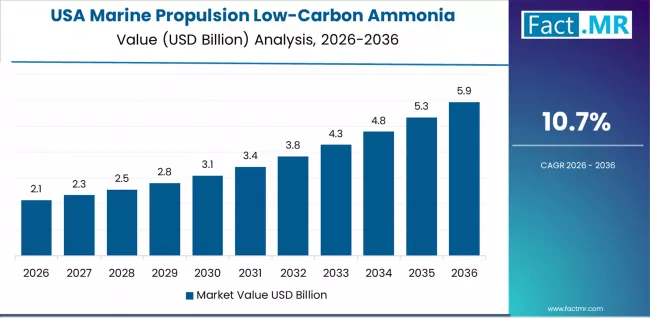
Marine Propulsion Low Carbon Ammonia Market Country Value Analysis

The USA’s 10.7% CAGR is fueled by the Inflation Reduction Act’s production tax credits, which make green ammonia production economically competitive. Major gulf coast ports see ammonia as an opportunity to become future clean bunkering hubs. The U.S. Navy’s interest in alternative fuels for strategic resilience also spurs advanced research and development, with spill-over benefits for the commercial sector.

Competitive Landscape of the Marine Propulsion Low-Carbon Ammonia Market

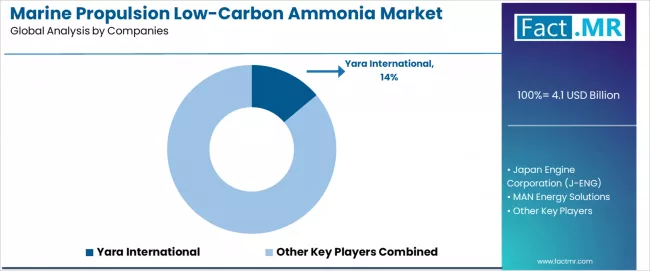
Marine Propulsion Low Carbon Ammonia Market Analysis By Company

The competitive landscape is defined by unprecedented cross-industry collaboration. Competition exists not just between companies but between emerging technology pathways and consortium models. Traditional marine engine manufacturers are competing to certify the first commercially viable large-bore ammonia engines.

Chemical and fertilizer giants are vying to become the dominant low-carbon fuel suppliers. Success depends on forming strategic alliances across the value chain, demonstrating operational safety, and securing early pilot projects that serve as proof points for the broader industry.

Key Players in the Marine Propulsion Low-Carbon Ammonia Market

  • Yara International
  • Japan Engine Corporation (J-ENG)
  • MAN Energy Solutions
  • Wärtsilä Corporation
  • Mitsubishi Heavy Industries

Scope of Report

Items Values
Quantitative Units USD Billion
Fuel Type Low-Carbon Ammonia, Ammonia-Hydrogen Blends, Green Hydrogen, Others
Vessel Type Container Ships, Bulk Carriers, Tankers, Cruise Ships, Ferries & Ro-Ro, Offshore Support Vessels, Others
End-User Commercial Shipping, Offshore Support Vessels, Cruise & Passenger Liners, Naval & Defense, Others
Key Countries Norway, Japan, South Korea, China, USA
Key Companies Yara International, Japan Engine Corporation (J-ENG), MAN Energy Solutions, Wärtsilä Corporation, Mitsubishi Heavy Industries
Additional Analysis Lifecycle assessment (Well-to-Wake) of green/blue ammonia; safety and risk assessment for bunkering and storage; techno-economic analysis of engine retrofits vs. newbuilds; analysis of green corridor economics; review of port authority readiness and regulations.

Market by Segments

  • Fuel Type :

    • Low-Carbon Ammonia
    • Ammonia-Hydrogen Blends
    • Green Hydrogen
    • Others
  • Vessel Type :

    • Container Ships
    • Bulk Carriers
    • Tankers
    • Cruise Ships
    • Ferries & Ro-Ro
    • Offshore Support Vessels
    • Others
  • End-User :

    • Commercial Shipping
    • Offshore Support Vessels
    • Cruise & Passenger Liners
    • Naval & Defense
    • Others
  • Region :

    • North America

      • USA
      • Canada
    • Latin America

      • Brazil
      • Mexico
      • Argentina
      • Rest of Latin America
    • Western Europe

      • Germany
      • UK
      • France
      • Spain
      • Italy
      • BENELUX
      • Norway
      • Rest of Western Europe
    • Eastern Europe

      • Russia
      • Poland
      • Czech Republic
      • Rest of Eastern Europe
    • East Asia

      • China
      • Japan
      • South Korea
      • Rest of East Asia
    • South Asia & Pacific

      • India
      • ASEAN
      • Australia
      • Rest of South Asia & Pacific
    • MEA

      • Saudi Arabia
      • UAE
      • Turkiye
      • Rest of MEA

References

  • Absi Halabi, M., & Al-Masri, A. (2023). Technical and environmental assessment of ammonia as a marine fuel. Journal of Marine Science and Engineering, 11(5), 1022.
  • Brynolf, S., Fridell, E., & Andersson, K. (2024). Environmental assessment of marine fuels: A life cycle perspective on ammonia, hydrogen, and other alternatives. Proceedings of the Institution of Mechanical Engineers, Part M: Journal of Engineering for the Maritime Environment, 238(1), 89-104.
  • International Maritime Organization (IMO). (2023). 2023 IMO Strategy on Reduction of GHG Emissions from Ships. MEPC 80/INF.7.
  • Kim, J., Park, C., & Lee, D. (2024). A review of ammonia combustion and emissions control for marine engines. Fuel Processing Technology, 252, 108003.
  • Lloyd’s Register & University Maritime Advisory Services (UMAS). (2025). Zero-Carbon Fuel Monitor: Ammonia. Technology Report ZCFM-2025-01.
  • Motoda, Y., & Kameyama, H. (2023). Japan’s national strategy for the development and adoption of ammonia-fueled ships. Ship Technology Research, 70(2), 78-95.
  • Pavlenko, N., Comer, B., & Zhou, Y. (2024). The climate implications of using ammonia as a shipping fuel. The International Council on Clean Transportation (ICCT) White Paper.
  • Shin, Y., & Lee, T. (2023). Economic feasibility and infrastructure requirements for green ammonia bunkering in Northeast Asia. Energy Policy, 183, 113812.
  • Smith, T., Raucci, C., & Hosseinloo, S. F. (2022). The potential of ammonia as a zero-carbon shipping fuel. International Transport Forum (ITF) Policy Papers, No. 101.
  • Wang, H., & Olav Schjølberg, I. (2024). Safety considerations and risk assessment for ammonia as a marine fuel: A systematic review. Ocean Engineering, 295, 116987.

Table of Content

  1. Executive Summary
    • Global Market Outlook
    • Demand to side Trends
    • Supply to side Trends
    • Technology Roadmap Analysis
    • Analysis and Recommendations
  2. Market Overview
    • Market Coverage / Taxonomy
    • Market Definition / Scope / Limitations
  3. Market Background
    • Market Dynamics
      • Drivers
      • Restraints
      • Opportunity
      • Trends
    • Scenario Forecast
      • Demand in Optimistic Scenario
      • Demand in Likely Scenario
      • Demand in Conservative Scenario
    • Opportunity Map Analysis
    • Product Life Cycle Analysis
    • Supply Chain Analysis
    • Investment Feasibility Matrix
    • Value Chain Analysis
    • PESTLE and Porter’s Analysis
    • Regulatory Landscape
    • Regional Parent Market Outlook
    • Production and Consumption Statistics
    • Import and Export Statistics
  4. Global Market Analysis 2021 to 2025 and Forecast, 2026 to 2036
    • Historical Market Size Value (USD Million) Analysis, 2021 to 2025
    • Current and Future Market Size Value (USD Million) Projections, 2026 to 2036
      • Y to o to Y Growth Trend Analysis
      • Absolute $ Opportunity Analysis
  5. Global Market Pricing Analysis 2021 to 2025 and Forecast 2026 to 2036
  6. Global Market Analysis 2021 to 2025 and Forecast 2026 to 2036, By Fuel Type
    • Introduction / Key Findings
    • Historical Market Size Value (USD Million) Analysis By Fuel Type, 2021 to 2025
    • Current and Future Market Size Value (USD Million) Analysis and Forecast By Fuel Type, 2026 to 2036
      • Low‑Carbon Ammonia
      • Ammonia‑Hydrogen Blends
      • Green Hydrogen
      • Others
    • Y to o to Y Growth Trend Analysis By Fuel Type, 2021 to 2025
    • Absolute $ Opportunity Analysis By Fuel Type, 2026 to 2036
  7. Global Market Analysis 2021 to 2025 and Forecast 2026 to 2036, By Vessel Type
    • Introduction / Key Findings
    • Historical Market Size Value (USD Million) Analysis By Vessel Type, 2021 to 2025
    • Current and Future Market Size Value (USD Million) Analysis and Forecast By Vessel Type, 2026 to 2036
      • Container Ships
      • Bulk Carriers
      • Tankers
      • Cruise Ships
      • Ferries & Ro‑Ro
      • Others
    • Y to o to Y Growth Trend Analysis By Vessel Type, 2021 to 2025
    • Absolute $ Opportunity Analysis By Vessel Type, 2026 to 2036
  8. Global Market Analysis 2021 to 2025 and Forecast 2026 to 2036, By End‑User
    • Introduction / Key Findings
    • Historical Market Size Value (USD Million) Analysis By End‑User, 2021 to 2025
    • Current and Future Market Size Value (USD Million) Analysis and Forecast By End‑User, 2026 to 2036
      • Commercial Shipping
      • Offshore Support Vessels
      • Cruise & Passenger Liners
      • Naval & Defense
      • Others
    • Y to o to Y Growth Trend Analysis By End‑User, 2021 to 2025
    • Absolute $ Opportunity Analysis By End‑User, 2026 to 2036
  9. Global Market Analysis 2021 to 2025 and Forecast 2026 to 2036, By Region
    • Introduction
    • Historical Market Size Value (USD Million) Analysis By Region, 2021 to 2025
    • Current Market Size Value (USD Million) Analysis and Forecast By Region, 2026 to 2036
      • North America
      • Latin America
      • Western Europe
      • Eastern Europe
      • East Asia
      • South Asia and Pacific
      • Middle East & Africa
    • Market Attractiveness Analysis By Region
  10. North America Market Analysis 2021 to 2025 and Forecast 2026 to 2036, By Country
    • Historical Market Size Value (USD Million) Trend Analysis By Market Taxonomy, 2021 to 2025
    • Market Size Value (USD Million) Forecast By Market Taxonomy, 2026 to 2036
      • By Country
        • USA
        • Canada
        • Mexico
      • By Fuel Type
      • By Vessel Type
      • By End‑User
    • Market Attractiveness Analysis
      • By Country
      • By Fuel Type
      • By Vessel Type
      • By End‑User
    • Key Takeaways
  11. Latin America Market Analysis 2021 to 2025 and Forecast 2026 to 2036, By Country
    • Historical Market Size Value (USD Million) Trend Analysis By Market Taxonomy, 2021 to 2025
    • Market Size Value (USD Million) Forecast By Market Taxonomy, 2026 to 2036
      • By Country
        • Brazil
        • Chile
        • Rest of Latin America
      • By Fuel Type
      • By Vessel Type
      • By End‑User
    • Market Attractiveness Analysis
      • By Country
      • By Fuel Type
      • By Vessel Type
      • By End‑User
    • Key Takeaways
  12. Western Europe Market Analysis 2021 to 2025 and Forecast 2026 to 2036, By Country
    • Historical Market Size Value (USD Million) Trend Analysis By Market Taxonomy, 2021 to 2025
    • Market Size Value (USD Million) Forecast By Market Taxonomy, 2026 to 2036
      • By Country
        • Germany
        • UK
        • Italy
        • Spain
        • France
        • Nordic
        • BENELUX
        • Rest of Western Europe
      • By Fuel Type
      • By Vessel Type
      • By End‑User
    • Market Attractiveness Analysis
      • By Country
      • By Fuel Type
      • By Vessel Type
      • By End‑User
    • Key Takeaways
  13. Eastern Europe Market Analysis 2021 to 2025 and Forecast 2026 to 2036, By Country
    • Historical Market Size Value (USD Million) Trend Analysis By Market Taxonomy, 2021 to 2025
    • Market Size Value (USD Million) Forecast By Market Taxonomy, 2026 to 2036
      • By Country
        • Russia
        • Poland
        • Hungary
        • Balkan & Baltic
        • Rest of Eastern Europe
      • By Fuel Type
      • By Vessel Type
      • By End‑User
    • Market Attractiveness Analysis
      • By Country
      • By Fuel Type
      • By Vessel Type
      • By End‑User
    • Key Takeaways
  14. East Asia Market Analysis 2021 to 2025 and Forecast 2026 to 2036, By Country
    • Historical Market Size Value (USD Million) Trend Analysis By Market Taxonomy, 2021 to 2025
    • Market Size Value (USD Million) Forecast By Market Taxonomy, 2026 to 2036
      • By Country
        • China
        • Japan
        • South Korea
      • By Fuel Type
      • By Vessel Type
      • By End‑User
    • Market Attractiveness Analysis
      • By Country
      • By Fuel Type
      • By Vessel Type
      • By End‑User
    • Key Takeaways
  15. South Asia and Pacific Market Analysis 2021 to 2025 and Forecast 2026 to 2036, By Country
    • Historical Market Size Value (USD Million) Trend Analysis By Market Taxonomy, 2021 to 2025
    • Market Size Value (USD Million) Forecast By Market Taxonomy, 2026 to 2036
      • By Country
        • India
        • ASEAN
        • Australia & New Zealand
        • Rest of South Asia and Pacific
      • By Fuel Type
      • By Vessel Type
      • By End‑User
    • Market Attractiveness Analysis
      • By Country
      • By Fuel Type
      • By Vessel Type
      • By End‑User
    • Key Takeaways
  16. Middle East & Africa Market Analysis 2021 to 2025 and Forecast 2026 to 2036, By Country
    • Historical Market Size Value (USD Million) Trend Analysis By Market Taxonomy, 2021 to 2025
    • Market Size Value (USD Million) Forecast By Market Taxonomy, 2026 to 2036
      • By Country
        • Kingdom of Saudi Arabia
        • Other GCC Countries
        • Turkiye
        • South Africa
        • Other African Union
        • Rest of Middle East & Africa
      • By Fuel Type
      • By Vessel Type
      • By End‑User
    • Market Attractiveness Analysis
      • By Country
      • By Fuel Type
      • By Vessel Type
      • By End‑User
    • Key Takeaways
  17. Key Countries Market Analysis
    • USA
      • Pricing Analysis
      • Market Share Analysis, 2025
        • By Fuel Type
        • By Vessel Type
        • By End‑User
    • Canada
      • Pricing Analysis
      • Market Share Analysis, 2025
        • By Fuel Type
        • By Vessel Type
        • By End‑User
    • Mexico
      • Pricing Analysis
      • Market Share Analysis, 2025
        • By Fuel Type
        • By Vessel Type
        • By End‑User
    • Brazil
      • Pricing Analysis
      • Market Share Analysis, 2025
        • By Fuel Type
        • By Vessel Type
        • By End‑User
    • Chile
      • Pricing Analysis
      • Market Share Analysis, 2025
        • By Fuel Type
        • By Vessel Type
        • By End‑User
    • Germany
      • Pricing Analysis
      • Market Share Analysis, 2025
        • By Fuel Type
        • By Vessel Type
        • By End‑User
    • UK
      • Pricing Analysis
      • Market Share Analysis, 2025
        • By Fuel Type
        • By Vessel Type
        • By End‑User
    • Italy
      • Pricing Analysis
      • Market Share Analysis, 2025
        • By Fuel Type
        • By Vessel Type
        • By End‑User
    • Spain
      • Pricing Analysis
      • Market Share Analysis, 2025
        • By Fuel Type
        • By Vessel Type
        • By End‑User
    • France
      • Pricing Analysis
      • Market Share Analysis, 2025
        • By Fuel Type
        • By Vessel Type
        • By End‑User
    • India
      • Pricing Analysis
      • Market Share Analysis, 2025
        • By Fuel Type
        • By Vessel Type
        • By End‑User
    • ASEAN
      • Pricing Analysis
      • Market Share Analysis, 2025
        • By Fuel Type
        • By Vessel Type
        • By End‑User
    • Australia & New Zealand
      • Pricing Analysis
      • Market Share Analysis, 2025
        • By Fuel Type
        • By Vessel Type
        • By End‑User
    • China
      • Pricing Analysis
      • Market Share Analysis, 2025
        • By Fuel Type
        • By Vessel Type
        • By End‑User
    • Japan
      • Pricing Analysis
      • Market Share Analysis, 2025
        • By Fuel Type
        • By Vessel Type
        • By End‑User
    • South Korea
      • Pricing Analysis
      • Market Share Analysis, 2025
        • By Fuel Type
        • By Vessel Type
        • By End‑User
    • Russia
      • Pricing Analysis
      • Market Share Analysis, 2025
        • By Fuel Type
        • By Vessel Type
        • By End‑User
    • Poland
      • Pricing Analysis
      • Market Share Analysis, 2025
        • By Fuel Type
        • By Vessel Type
        • By End‑User
    • Hungary
      • Pricing Analysis
      • Market Share Analysis, 2025
        • By Fuel Type
        • By Vessel Type
        • By End‑User
    • Kingdom of Saudi Arabia
      • Pricing Analysis
      • Market Share Analysis, 2025
        • By Fuel Type
        • By Vessel Type
        • By End‑User
    • Turkiye
      • Pricing Analysis
      • Market Share Analysis, 2025
        • By Fuel Type
        • By Vessel Type
        • By End‑User
    • South Africa
      • Pricing Analysis
      • Market Share Analysis, 2025
        • By Fuel Type
        • By Vessel Type
        • By End‑User
  18. Market Structure Analysis
    • Competition Dashboard
    • Competition Benchmarking
    • Market Share Analysis of Top Players
      • By Regional
      • By Fuel Type
      • By Vessel Type
      • By End‑User
  19. Competition Analysis
    • Competition Deep Dive
      • Yara International
        • Overview
        • Product Portfolio
        • Profitability by Market Segments (Product/Age /Sales Channel/Region)
        • Sales Footprint
        • Strategy Overview
          • Marketing Strategy
          • Product Strategy
          • Channel Strategy
      • Japan Engine Corporation (J‑ENG)
      • MAN Energy Solutions
      • Wärtsilä Corporation
      • Mitsubishi Heavy Industries
      • Others
  20. Assumptions & Acronyms Used
  21. Research Methodology

List Of Table

  • Table 1: Global Market Value (USD Million) Forecast by Region, 2021 to 2036
  • Table 2: Global Market Value (USD Million) Forecast by Fuel Type, 2021 to 2036
  • Table 3: Global Market Value (USD Million) Forecast by Vessel Type, 2021 to 2036
  • Table 4: Global Market Value (USD Million) Forecast by End‑User, 2021 to 2036
  • Table 5: North America Market Value (USD Million) Forecast by Country, 2021 to 2036
  • Table 6: North America Market Value (USD Million) Forecast by Fuel Type, 2021 to 2036
  • Table 7: North America Market Value (USD Million) Forecast by Vessel Type, 2021 to 2036
  • Table 8: North America Market Value (USD Million) Forecast by End‑User, 2021 to 2036
  • Table 9: Latin America Market Value (USD Million) Forecast by Country, 2021 to 2036
  • Table 10: Latin America Market Value (USD Million) Forecast by Fuel Type, 2021 to 2036
  • Table 11: Latin America Market Value (USD Million) Forecast by Vessel Type, 2021 to 2036
  • Table 12: Latin America Market Value (USD Million) Forecast by End‑User, 2021 to 2036
  • Table 13: Western Europe Market Value (USD Million) Forecast by Country, 2021 to 2036
  • Table 14: Western Europe Market Value (USD Million) Forecast by Fuel Type, 2021 to 2036
  • Table 15: Western Europe Market Value (USD Million) Forecast by Vessel Type, 2021 to 2036
  • Table 16: Western Europe Market Value (USD Million) Forecast by End‑User, 2021 to 2036
  • Table 17: Eastern Europe Market Value (USD Million) Forecast by Country, 2021 to 2036
  • Table 18: Eastern Europe Market Value (USD Million) Forecast by Fuel Type, 2021 to 2036
  • Table 19: Eastern Europe Market Value (USD Million) Forecast by Vessel Type, 2021 to 2036
  • Table 20: Eastern Europe Market Value (USD Million) Forecast by End‑User, 2021 to 2036
  • Table 21: East Asia Market Value (USD Million) Forecast by Country, 2021 to 2036
  • Table 22: East Asia Market Value (USD Million) Forecast by Fuel Type, 2021 to 2036
  • Table 23: East Asia Market Value (USD Million) Forecast by Vessel Type, 2021 to 2036
  • Table 24: East Asia Market Value (USD Million) Forecast by End‑User, 2021 to 2036
  • Table 25: South Asia and Pacific Market Value (USD Million) Forecast by Country, 2021 to 2036
  • Table 26: South Asia and Pacific Market Value (USD Million) Forecast by Fuel Type, 2021 to 2036
  • Table 27: South Asia and Pacific Market Value (USD Million) Forecast by Vessel Type, 2021 to 2036
  • Table 28: South Asia and Pacific Market Value (USD Million) Forecast by End‑User, 2021 to 2036
  • Table 29: Middle East & Africa Market Value (USD Million) Forecast by Country, 2021 to 2036
  • Table 30: Middle East & Africa Market Value (USD Million) Forecast by Fuel Type, 2021 to 2036
  • Table 31: Middle East & Africa Market Value (USD Million) Forecast by Vessel Type, 2021 to 2036
  • Table 32: Middle East & Africa Market Value (USD Million) Forecast by End‑User, 2021 to 2036

List Of Figures

  • Figure 1: Global Market Pricing Analysis
  • Figure 2: Global Market Value (USD Million) Forecast 2021 to 2036
  • Figure 3: Global Market Value Share and BPS Analysis by Fuel Type, 2026 and 2036
  • Figure 4: Global Market Y to o to Y Growth Comparison by Fuel Type, 2026 to 2036
  • Figure 5: Global Market Attractiveness Analysis by Fuel Type
  • Figure 6: Global Market Value Share and BPS Analysis by Vessel Type, 2026 and 2036
  • Figure 7: Global Market Y to o to Y Growth Comparison by Vessel Type, 2026 to 2036
  • Figure 8: Global Market Attractiveness Analysis by Vessel Type
  • Figure 9: Global Market Value Share and BPS Analysis by End‑User, 2026 and 2036
  • Figure 10: Global Market Y to o to Y Growth Comparison by End‑User, 2026 to 2036
  • Figure 11: Global Market Attractiveness Analysis by End‑User
  • Figure 12: Global Market Value (USD Million) Share and BPS Analysis by Region, 2026 and 2036
  • Figure 13: Global Market Y to o to Y Growth Comparison by Region, 2026 to 2036
  • Figure 14: Global Market Attractiveness Analysis by Region
  • Figure 15: North America Market Incremental Dollar Opportunity, 2026 to 2036
  • Figure 16: Latin America Market Incremental Dollar Opportunity, 2026 to 2036
  • Figure 17: Western Europe Market Incremental Dollar Opportunity, 2026 to 2036
  • Figure 18: Eastern Europe Market Incremental Dollar Opportunity, 2026 to 2036
  • Figure 19: East Asia Market Incremental Dollar Opportunity, 2026 to 2036
  • Figure 20: South Asia and Pacific Market Incremental Dollar Opportunity, 2026 to 2036
  • Figure 21: Middle East & Africa Market Incremental Dollar Opportunity, 2026 to 2036
  • Figure 22: North America Market Value Share and BPS Analysis by Country, 2026 and 2036
  • Figure 23: North America Market Value Share and BPS Analysis by Fuel Type, 2026 and 2036
  • Figure 24: North America Market Y to o to Y Growth Comparison by Fuel Type, 2026 to 2036
  • Figure 25: North America Market Attractiveness Analysis by Fuel Type
  • Figure 26: North America Market Value Share and BPS Analysis by Vessel Type, 2026 and 2036
  • Figure 27: North America Market Y to o to Y Growth Comparison by Vessel Type, 2026 to 2036
  • Figure 28: North America Market Attractiveness Analysis by Vessel Type
  • Figure 29: North America Market Value Share and BPS Analysis by End‑User, 2026 and 2036
  • Figure 30: North America Market Y to o to Y Growth Comparison by End‑User, 2026 to 2036
  • Figure 31: North America Market Attractiveness Analysis by End‑User
  • Figure 32: Latin America Market Value Share and BPS Analysis by Country, 2026 and 2036
  • Figure 33: Latin America Market Value Share and BPS Analysis by Fuel Type, 2026 and 2036
  • Figure 34: Latin America Market Y to o to Y Growth Comparison by Fuel Type, 2026 to 2036
  • Figure 35: Latin America Market Attractiveness Analysis by Fuel Type
  • Figure 36: Latin America Market Value Share and BPS Analysis by Vessel Type, 2026 and 2036
  • Figure 37: Latin America Market Y to o to Y Growth Comparison by Vessel Type, 2026 to 2036
  • Figure 38: Latin America Market Attractiveness Analysis by Vessel Type
  • Figure 39: Latin America Market Value Share and BPS Analysis by End‑User, 2026 and 2036
  • Figure 40: Latin America Market Y to o to Y Growth Comparison by End‑User, 2026 to 2036
  • Figure 41: Latin America Market Attractiveness Analysis by End‑User
  • Figure 42: Western Europe Market Value Share and BPS Analysis by Country, 2026 and 2036
  • Figure 43: Western Europe Market Value Share and BPS Analysis by Fuel Type, 2026 and 2036
  • Figure 44: Western Europe Market Y to o to Y Growth Comparison by Fuel Type, 2026 to 2036
  • Figure 45: Western Europe Market Attractiveness Analysis by Fuel Type
  • Figure 46: Western Europe Market Value Share and BPS Analysis by Vessel Type, 2026 and 2036
  • Figure 47: Western Europe Market Y to o to Y Growth Comparison by Vessel Type, 2026 to 2036
  • Figure 48: Western Europe Market Attractiveness Analysis by Vessel Type
  • Figure 49: Western Europe Market Value Share and BPS Analysis by End‑User, 2026 and 2036
  • Figure 50: Western Europe Market Y to o to Y Growth Comparison by End‑User, 2026 to 2036
  • Figure 51: Western Europe Market Attractiveness Analysis by End‑User
  • Figure 52: Eastern Europe Market Value Share and BPS Analysis by Country, 2026 and 2036
  • Figure 53: Eastern Europe Market Value Share and BPS Analysis by Fuel Type, 2026 and 2036
  • Figure 54: Eastern Europe Market Y to o to Y Growth Comparison by Fuel Type, 2026 to 2036
  • Figure 55: Eastern Europe Market Attractiveness Analysis by Fuel Type
  • Figure 56: Eastern Europe Market Value Share and BPS Analysis by Vessel Type, 2026 and 2036
  • Figure 57: Eastern Europe Market Y to o to Y Growth Comparison by Vessel Type, 2026 to 2036
  • Figure 58: Eastern Europe Market Attractiveness Analysis by Vessel Type
  • Figure 59: Eastern Europe Market Value Share and BPS Analysis by End‑User, 2026 and 2036
  • Figure 60: Eastern Europe Market Y to o to Y Growth Comparison by End‑User, 2026 to 2036
  • Figure 61: Eastern Europe Market Attractiveness Analysis by End‑User
  • Figure 62: East Asia Market Value Share and BPS Analysis by Country, 2026 and 2036
  • Figure 63: East Asia Market Value Share and BPS Analysis by Fuel Type, 2026 and 2036
  • Figure 64: East Asia Market Y to o to Y Growth Comparison by Fuel Type, 2026 to 2036
  • Figure 65: East Asia Market Attractiveness Analysis by Fuel Type
  • Figure 66: East Asia Market Value Share and BPS Analysis by Vessel Type, 2026 and 2036
  • Figure 67: East Asia Market Y to o to Y Growth Comparison by Vessel Type, 2026 to 2036
  • Figure 68: East Asia Market Attractiveness Analysis by Vessel Type
  • Figure 69: East Asia Market Value Share and BPS Analysis by End‑User, 2026 and 2036
  • Figure 70: East Asia Market Y to o to Y Growth Comparison by End‑User, 2026 to 2036
  • Figure 71: East Asia Market Attractiveness Analysis by End‑User
  • Figure 72: South Asia and Pacific Market Value Share and BPS Analysis by Country, 2026 and 2036
  • Figure 73: South Asia and Pacific Market Value Share and BPS Analysis by Fuel Type, 2026 and 2036
  • Figure 74: South Asia and Pacific Market Y to o to Y Growth Comparison by Fuel Type, 2026 to 2036
  • Figure 75: South Asia and Pacific Market Attractiveness Analysis by Fuel Type
  • Figure 76: South Asia and Pacific Market Value Share and BPS Analysis by Vessel Type, 2026 and 2036
  • Figure 77: South Asia and Pacific Market Y to o to Y Growth Comparison by Vessel Type, 2026 to 2036
  • Figure 78: South Asia and Pacific Market Attractiveness Analysis by Vessel Type
  • Figure 79: South Asia and Pacific Market Value Share and BPS Analysis by End‑User, 2026 and 2036
  • Figure 80: South Asia and Pacific Market Y to o to Y Growth Comparison by End‑User, 2026 to 2036
  • Figure 81: South Asia and Pacific Market Attractiveness Analysis by End‑User
  • Figure 82: Middle East & Africa Market Value Share and BPS Analysis by Country, 2026 and 2036
  • Figure 83: Middle East & Africa Market Value Share and BPS Analysis by Fuel Type, 2026 and 2036
  • Figure 84: Middle East & Africa Market Y to o to Y Growth Comparison by Fuel Type, 2026 to 2036
  • Figure 85: Middle East & Africa Market Attractiveness Analysis by Fuel Type
  • Figure 86: Middle East & Africa Market Value Share and BPS Analysis by Vessel Type, 2026 and 2036
  • Figure 87: Middle East & Africa Market Y to o to Y Growth Comparison by Vessel Type, 2026 to 2036
  • Figure 88: Middle East & Africa Market Attractiveness Analysis by Vessel Type
  • Figure 89: Middle East & Africa Market Value Share and BPS Analysis by End‑User, 2026 and 2036
  • Figure 90: Middle East & Africa Market Y to o to Y Growth Comparison by End‑User, 2026 to 2036
  • Figure 91: Middle East & Africa Market Attractiveness Analysis by End‑User
  • Figure 92: Global Market - Tier Structure Analysis
  • Figure 93: Global Market - Company Share Analysis

- FAQs -

How big is the marine propulsion low-carbon ammonia market in 2026?

The global marine propulsion low-carbon ammonia market is estimated to be valued at USD 4.1 billion in 2026.

What will be the size of marine propulsion low-carbon ammonia market in 2036?

The market size for the marine propulsion low-carbon ammonia market is projected to reach USD 11.5 billion by 2036.

How much will be the marine propulsion low-carbon ammonia market growth between 2026 and 2036?

The marine propulsion low-carbon ammonia market is expected to grow at a 10.8% CAGR between 2026 and 2036.

What are the key product types in the marine propulsion low-carbon ammonia market?

The key product types in marine propulsion low-carbon ammonia market are low‑carbon ammonia, ammonia‑hydrogen blends, green hydrogen and others.

Which vessel type segment to contribute significant share in the marine propulsion low-carbon ammonia market in 2026?

In terms of vessel type, container ships segment to command 32.4% share in the marine propulsion low-carbon ammonia market in 2026.
Marine Propulsion Low-Carbon Ammonia Market