- Market Value (2025): USD 187.4 Mn
- Estimated Value (2026): USD 196.4 Mn
- Forecast Value (2036): USD 313.9 Mn
- CAGR (2026-2036): 4.8%
What is the Maskne Treatment Market forecast to be worth by 2036?
USD 196.4 million in 2026 to USD 313.9 million by 2036 at a 4.8% CAGR.
- The Maskne Treatment Market crossed a valuation of USD 187.4 million in 2025.
- Demand is projected to increase from USD 196.4 million in 2026 to USD 313.9 million by 2036.
- The market is forecast to record 4.8% CAGR from 2026 to 2036 as consumers, pharmacies and clinics prioritize acne prevention and skin-barrier recovery.
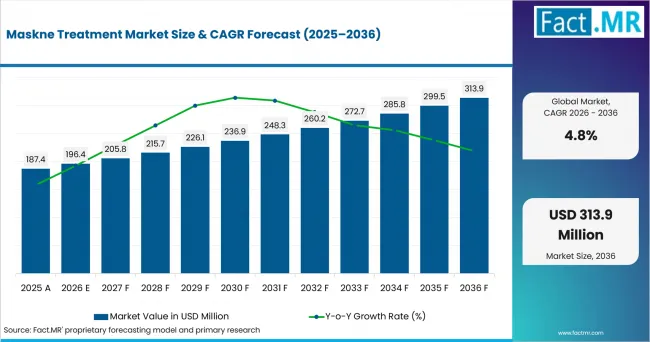
Maskne Treatment Market Value Analysis | Source: Fact.MR
What are the defining numbers behind Maskne Treatment Market growth?
An absolute opportunity of USD 117.5 million is expected between 2026 and 2036.
- Demand Drivers in the Market
- Healthcare workers need tolerable face-care routines because protective equipment keeps friction and occlusion visible during long shifts.
- The U.S. Bureau of Labor Statistics projected about 1.9 million healthcare occupation openings each year from 2025 to 2035, keeping workplace skin-care needs relevant to maskne prevention.
- Adult consumers need acne products that combine pore care with post-acne mark management, since mask irritation often appears alongside uneven skin tone.
- Pharmacists need clear OTC product choices for mild and moderate maskne, especially when shoppers compare benzoyl peroxide, salicylic acid and barrier creams.
- Beauty retailers need replenishment-friendly formats because serums, patches and cream formulations depend on repeated consumer use.
- Key Segments Analyzed
- By Product: Topical Therapeutic Products are expected to hold 53.80% share in 2026 due to their direct role in active acne treatment.
- By Application: Acne Prevention is projected to account for 37.40% share in 2026, supported by daily skin protection before irritation worsens.
- By End Use: Individual Consumers are anticipated to capture 68.70% share in 2026 owing to self-care purchasing across pharmacies and online channels.
- By Technology: Controlled Release Technology is estimated to represent 44.90% share in 2026 since slower delivery helps active ingredients remain tolerable.
- By Formulation: Cream Formulations are forecast to hold 62.10% share in 2026, driven by familiar application and barrier-support use.
- By Distribution Channel: Retail Pharmacies are projected to account for 49.30% share in 2026, reinforced by advice-led selection for acne actives.
- Analyst Opinion at Fact.MR
- Shambhu Nath Jha, Principal Consultant at Fact.MR, states, “Maskne treatment sits between acne therapy and barrier care. The category is expected to expand when brands make active ingredients feel safe for daily use. Suppliers that combine tolerability data, pharmacy education and convenient formats are better placed than firms that only add acne claims to ordinary skincare.”
- Strategic Implications
- Dermatology brands should separate maskne prevention, active breakout care and barrier recovery in product claims and pack communication.
- Compliance teams should account for FDA’s February 2026 Cosmetics Direct update, which stated that more than 14,000 cosmetic product facilities were registered with FDA and reiterated the requirement for facility registrations to be renewed every two years.
- Pharmacy chains should group cleansers, patches and protective creams around mild, moderate and maintenance routines to reduce shopper confusion.
- Formulation teams should test occlusion, irritation and oil control together because mask wear changes how skin reacts during the day.
Germany is projected to record 4.1% CAGR through 2036, supported by pharmacy advice and a mature dermocosmetic routine. South Korea is anticipated to post 3.8% CAGR as online beauty retail and K-beauty routines support acne care. The USA is estimated to reach 3.1% CAGR due to healthcare-worker exposure and retail access. The UK is forecast to post 2.8% CAGR, while France is expected to reach 2.3% CAGR through pharmacy-led dermocosmetic care.
How does the Maskne Treatment Market break down by segment?
Topical Therapeutic Products lead Product at 53.80%; Individual Consumers lead End Use at 68.70%.
Which Product dominates?
Topical Therapeutic Products are expected to hold 53.80% share in 2026.
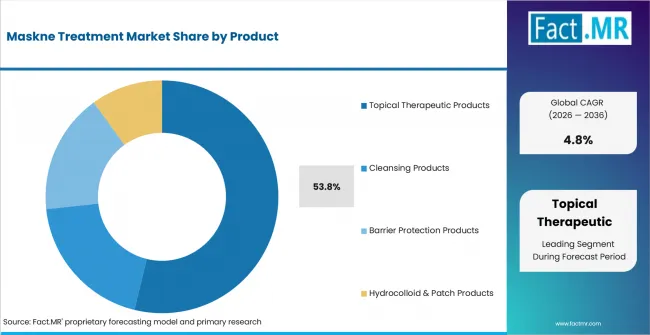
Maskne Treatment Market Analysis By Product | Source: Fact.MR
Topical therapeutic products lead because maskne shoppers look first for visible breakout control. Medicated creams and gels meet that need through benzoyl peroxide, salicylic acid, retinoid or related acne-care ingredients. Cleansers, barrier creams and hydrocolloid patches support the routine around oil removal, redness control and spot care.
What leads the Application segment?
Acne Prevention is projected to account for 37.40% share in 2026.
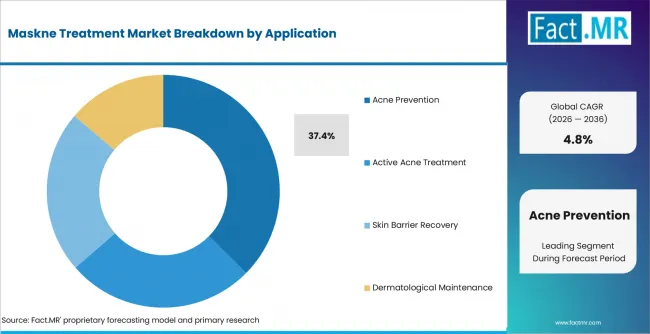
Maskne Treatment Market Analysis By Application | Source: Fact.MR
Acne prevention leads because maskne care often starts before breakouts become severe. Daily protection and occupational prevention products help consumers control friction and clogged pores early. Active acne treatment, skin barrier recovery and maintenance products then support inflamed or recurring breakouts.
How does End Use shape demand?
Individual Consumers are anticipated to capture 68.70% share in 2026.
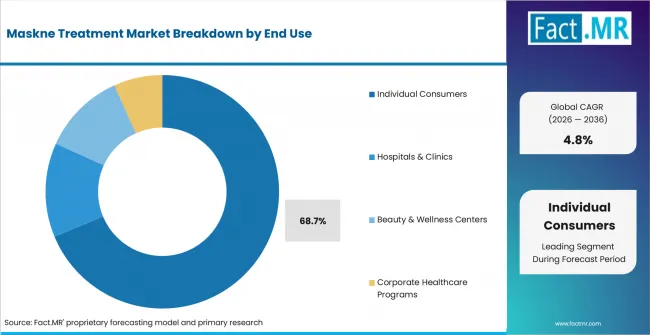
Maskne Treatment Market Analysis By End Use | Source: Fact.MR
Individual consumers lead end use because most maskne care happens through self-selection. Adults and younger consumers buy cleansers, creams and patches through pharmacies, beauty retailers and online platforms. Clinics and wellness centers remain relevant when breakouts recur or irritation needs assessment.
What supports Controlled Release Technology?
Controlled Release Technology is estimated to represent 44.90% share in 2026.
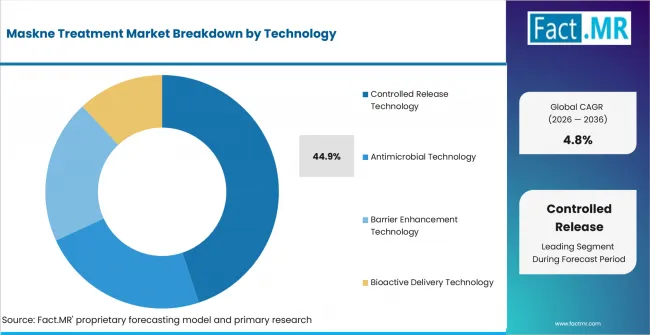
Maskne Treatment Market Analysis By Technology | Source: Fact.MR
Controlled release technology leads because tolerability is central to daily maskne care. Microencapsulation and nanocarrier systems spread active ingredients gradually. Antimicrobial systems support active breakout care, while barrier enhancement helps consumers protect skin under repeated mask contact.
What leads the Formulation segment?
Cream Formulations are forecast to hold 62.10% share in 2026.
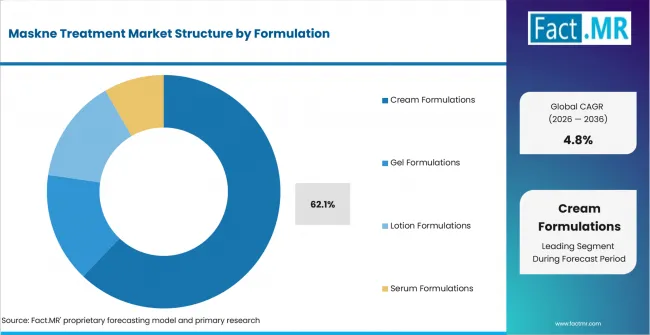
Maskne Treatment Market Analysis By Formulation | Source: Fact.MR
Cream formulations lead because they are familiar and easy to add to daily routines. Oil-in-water and water-in-oil creams support different skin types. Gels, lotions and serums add lighter options for consumers who dislike heavy textures under a mask.
What supports Distribution Channel demand?
Retail Pharmacies are projected to account for 49.30% share in 2026.
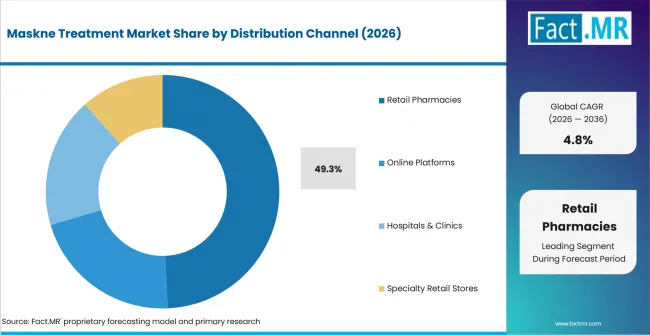
Maskne Treatment Market Analysis By Distribution Channel | Source: Fact.MR
Retail pharmacies lead because maskne shoppers often want quick access and some level of advice. The U.S. Census Bureau estimated July 2026 retail and food services sales at USD 763.6 billion, up 5.0% from July 2025. Online platforms expand discovery through reviews and ingredient filters.
What is accelerating Maskne Treatment Market adoption, and what is holding it back?
Routine acne prevention drives it; irritation and claim control restrain it.
Driver Impact Analysis
| DRIVER | (~) % IMPACT ON CAGR | GEOGRAPHIC RELEVANCE | IMPACT TIMELINE |
|---|---|---|---|
| Daily mask-related acne prevention routines | +1.1% | Global | Short term (<= 2 years) |
| OTC access to acne actives | +0.9% | North America, Europe, East Asia | Short term (<= 2 years) |
| Barrier-recovery positioning in skincare | +0.8% | Europe, East Asia | Medium term (2-4 years) |
| Retail pharmacy advice and replenishment | +0.6% | North America, Western Europe | Medium term (2-4 years) |
| Online beauty discovery and reviews | +0.5% | East Asia, North America | Long term (>= 4 years) |
- Daily mask-related acne prevention routines: Mask friction creates a repeated use case for gentle cleansing and barrier support. Consumers prefer creams and cleansers that reduce oil buildup without stripping skin.
- OTC access to acne actives: Benzoyl peroxide, salicylic acid and adapalene products give consumers direct options for mild to moderate acne. Clear instructions help limit overuse.
- Barrier-recovery positioning in skincare: Maskne consumers often describe irritation and dryness along with pimples. Barrier creams and ceramide-led products support prevention and recovery in one routine.
- Retail pharmacy advice and replenishment: Pharmacy access helps shoppers choose actives by skin type and severity. Advice becomes more valuable when product labels use similar acne claims.
- Online beauty discovery and reviews: E-commerce platforms help consumers compare ingredients and skin-type claims. Reviews and filters are expected to support trial for acne and maskne routines.
Opportunity Impact Analysis
| OPPORTUNITY | (~) % IMPACT ON CAGR | GEOGRAPHIC RELEVANCE | IMPACT TIMELINE |
|---|---|---|---|
| Adult acne routines with post-acne care | +0.8% | North America, East Asia | Short term (<= 2 years) |
| Patch and spot treatment formats | +0.7% | Global | Medium term (2-4 years) |
| Pharmacy-led barrier education | +0.5% | Western Europe | Medium term (2-4 years) |
| Mobile regimen selection and skin analysis | +0.4% | East Asia, North America | Long term (>= 4 years) |
- Adult acne routines with post-acne care: Adult maskne users often want products that treat pimples and visible marks. Routine-based product sets are expected to support repeat use across creams, cleansers and spot products.
- Patch and spot treatment formats: Hydrocolloid patches offer a visible and targeted format for blemishes. They fit maskne routines because consumers can use them on specific spots after mask removal.
- Pharmacy-led barrier education: Pharmacies can explain when a consumer needs active treatment and when the skin barrier needs recovery. This improves product matching and reduces irritation from over-layering.
- Mobile regimen selection and skin analysis: Digital tools guide users toward routines based on severity, skin type and tolerance. Regimen selection is expected to support consumers who compare acne products without in-store advice.
Restraint Impact Analysis
| RESTRAINT | (~) % IMPACT ON CAGR | GEOGRAPHIC RELEVANCE | IMPACT TIMELINE |
|---|---|---|---|
| Benzoyl peroxide safety scrutiny | -0.5% | United States, Europe | Short term (<= 2 years) |
| Irritation from strong actives | -0.4% | Global | Short term (<= 2 years) |
| Crowded claims across skincare shelves | -0.3% | North America, East Asia | Medium term (2-4 years) |
| Premium pricing in multi-step routines | -0.2% | Europe, North America | Medium term (2-4 years) |
- Benzoyl peroxide safety scrutiny: Product safety remains an important consideration in medicated acne care. Concerns around ingredient stability and product quality can influence consumer confidence, retailer selection, and regulatory attention across acne-treatment products.
- Irritation from strong actives: Maskne users may already have sensitive or compromised skin due to rubbing, heat, and sweating. Strong actives can increase dryness, stinging, or irritation when several products are introduced too quickly.
- Crowded claims across skincare shelves: Many skincare products use similar language around blemishes, pores, oil control, and skin barriers. Clear positioning, ingredient communication, and product-use guidance can help brands differentiate and support repeat purchasing.
- Premium pricing in multi-step routines: Cleansers, creams, patches, and serums can increase the cost of a complete skincare routine. Smaller entry packs, simplified regimens, and clear usage instructions can reduce purchase friction and improve accessibility.
Which countries are scaling Maskne Treatment Market through 2036?
- The country comparison spans 1.8 percentage points and forms a narrow growth band across the forecast period.
- Germany remains 0.3 percentage point above South Korea through pharmacy access and dermocosmetic routines.
- South Korea remains 0.7 percentage point above the USA as online cosmetics sales support discovery and repeat purchases.
- The USA remains 0.3 percentage point above the UK through healthcare-worker exposure and broad retail access.
- The UK remains 0.5 percentage point above France as online sales and pharmacy services support self-care routines.
- France closes the displayed range through established pharmacy-led dermocosmetic use and regulated claims.
Comparable CAGRs create different entry conditions due to pharmacy density, digital skincare channels and product-safety rules. Full coverage includes North America, Latin America, Western Europe, Eastern Europe, East Asia, South Asia & Pacific, Middle East & Africa.
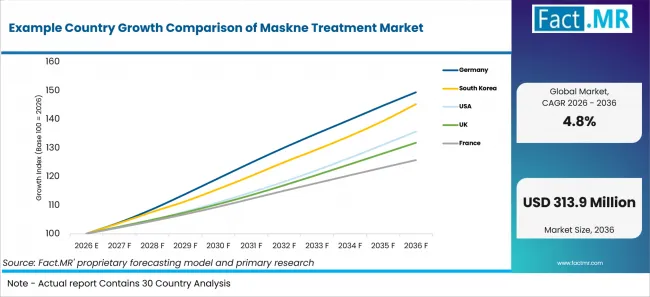
Example Country Growth Comparison Of Maskne Treatment Market | Source: Fact.MR
| Country | CAGR (2026-2036) |
|---|---|
| Germany | 4.1% |
| South Korea | 3.8% |
| United States | 3.1% |
| United Kingdom | 2.8% |
| France | 2.3% |
What supports Germany’s outlook?
4.1% CAGR through 2036, driven by pharmacy access and barrier-repair routines.
Germany’s maskne treatment demand is expected to benefit from a pharmacy channel that remains central to advice-led skin care. ABDA reported in January 2026 that Germany had 16,601 pharmacies at the end of 2025. That access supports creams, gels and cleansers when consumers want guidance on acne actives and irritation control.
How is South Korea scaling demand?
3.8% CAGR through 2036, supported by online beauty shopping and K-beauty routines.
South Korea’s routine-based skincare culture is projected to support maskne treatment across creams, serums and patches. The Ministry of Data and Statistics reported in July 2026 that the online shopping transaction value for cosmetics increased 36.6% year over year in May 2026. Digital discovery helps consumers compare active ingredients and barrier-support claims before repeat purchase.
What supports USA adoption?
3.1% CAGR through 2036, driven by healthcare exposure and retail access.
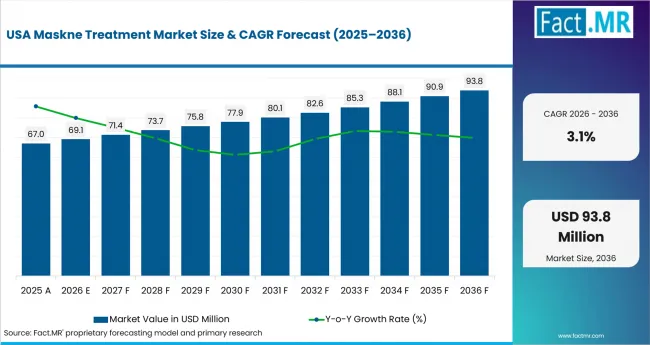
Maskne Treatment Market Country Value Analysis | Source: Fact.MR
The USA is anticipated to gain from healthcare exposure and broad OTC access to acne products. Retail pharmacies and online platforms make creams, gels and patches easy to replenish. That channel reach sustains gentle maskne routines among workers exposed to face coverings and respirators.
What underpins the UK growth path?
2.8% CAGR through 2036, backed by online skincare sales and pharmacy services.
The UK is forecast to expand through digital skincare discovery and high-street pharmacy access. ONS reported in April 2026 that online spending values in Great Britain rose 11.7% in Quarter 1 2026 from Quarter 1 2025. That channel helps consumers compare creams, patches and cleansers before selecting a daily maskne routine.
How does France perform?
2.3% CAGR through 2036, supported by dermocosmetic access and regulated skin care.
France is expected to grow through pharmacy-led dermocosmetic routines and clinician access for recurring acne. DREES reported in July 2026 that 242,200 physicians were active in France at the beginning of 2026. That healthcare base supports referral pathways when acne-like maskne becomes persistent or inflamed.
Who leads the Maskne Treatment Market?
Kenvue, Galderma and L’Oréal lead direct acne and dermocosmetic coverage, while Sun Pharma and The Procter & Gamble Company (TULA Skincare) support adjacent skin-care access.
Kenvue is active through Neutrogena acne products for adult breakouts and post-acne marks. Galderma supports the market through Differin and Cetaphil, linking OTC acne actives with dermocosmetic care. L’Oréal participates through La Roche-Posay and CeraVe, where acne-prone products overlap with maskne prevention and recovery.
Sun Pharma adds acne relevance through dermatology products such as adapalene and acne-focused specialty medicines. The Procter & Gamble Company (TULA Skincare) participates through Olay and broader skin-care portfolios. Competition is expected to center on tolerability, label clarity, active-ingredient stability and channel education.
Which companies are the key providers?
Key companies include Kenvue Inc. (Neutrogena), Galderma S.A. (Differin and Cetaphil), L’Oréal Groupe (La Roche-Posay and CeraVe), Sun Pharmaceutical Industries, Ltd., The Procter & Gamble Company (TULA Skincare), and Estée Lauder Companies Inc. (Clinique).
- Kenvue Inc. (Neutrogena)
- Galderma S.A. (Differin and Cetaphil)
- L’Oréal Groupe (La Roche-Posay and CeraVe)
- Sun Pharmaceutical Industries, Ltd.
- The Procter & Gamble Company (TULA Skincare)
- Estée Lauder Companies Inc. (Clinique)
Bibliography
- ABDA – Bundesvereinigung Deutscher Apothekerverbände. (2026, January 13). 2025: Apothekenzahl sinkt auf 16.601 Betriebsstätten.
- U.S. Food and Drug Administration. (2025, March 11). Limited number of voluntary recalls initiated after FDA testing of acne products for benzene; findings show a small number of products with elevated levels of benzene contamination.
- U.S. Food and Drug Administration. (2026, February 11). FDA updates web portal and informational materials to help cosmetic facilities prepare for biennial registration renewal.
- Galderma. (2026, May 22). Galderma receives U.S. FDA approval for Differin® Epiduo® Acne Gel Prescription-to-OTC switch.
- Ministry of Data and Statistics. (2026, July 1). Online Shopping in May 2026.
- Office for National Statistics. (2026, April 24). Retail sales, Great Britain: March 2026.
- U.S. Bureau of Labor Statistics. (2026, August 27). Healthcare occupations. Occupational Outlook Handbook.
- U.S. Census Bureau. (2026, August 14). Advance monthly sales for retail and food services.
- Direction de la recherche, des études, de l’évaluation et des statistiques. (2026, July 2). 5 000 médecins supplémentaires en activité en France au 1er janvier 2026.
This Report Answers
- The report explains where maskne treatment products are used across product type and application.
- Segmentation analysis identifies why consumers choose creams, retail pharmacies and controlled release technologies.
- Country analysis examines Germany, South Korea, the USA, the UK and France using official evidence.
- Competitive analysis reviews current providers across acne actives, dermocosmetic skincare, patches and barrier-care portfolios.
- Application analysis assesses how acne prevention and barrier recovery shape self-care decisions.
- The report reviews primary interviews, portfolio checks and official sources supporting the forecast.
What does the Maskne Treatment Market cover?
The Maskne Treatment Market covers products used to prevent, treat or manage acne linked to mask wear. It includes topical treatments, cleansers, barrier products and patches for mild to moderate routines.
The assessment covers creams, gels, lotions and serums across consumers, clinics, beauty centers and corporate healthcare programs. General skincare products are covered only when tied to mask-related skin stress.
What is included in the scope?
The scope includes face-care products such as medicated creams, gels, cleansers, protective creams, barrier sprays, acne patches and spot treatment patches.
Adjacent acne treatment products are referenced when they overlap with maskne care.
Patch formats are covered where anti-acne dermal patches address short-term spot care. Broader skin care products enter the scope when they support acne-prone skin.
Online analysis uses e-commerce personal care products context for replenishment.
Microbiome formulas are included where skin microbiome products support acne-prone skin.
What is excluded from the scope?
Decorative cosmetics and unrelated prescription dermatology products are outside the scope.
The scope excludes makeup, fragrance and beauty products lacking acne prevention, active treatment or barrier-recovery roles. General healing skin care products are outside the scope unless they address mask-irritated skin.
Prescription-only retinoid categories such as adapalene products are treated as adjacent acne-care pathways. Sebum-control categories such as astringent skin care products are included only for mild acne care. Wound-care adjacent formats such as advanced wound care OTC products are excluded unless sold as acne patches.
How Was the Analysis Built?
120+ sources, 35+ company portfolios, 25+ countries and more than 20 interviews.
- Primary Research: Primary research includes discussions with dermatology brands, pharmacy channel teams, online skincare retailers, clinicians and product formulation specialists. These discussions examine treatment routines, adoption barriers, active-ingredient tolerance and repeat purchase behavior.
- Desk Research: Desk research covers government statistics, regulatory publications, official company product releases, product portfolios, pharmacy data and credible institutional sources. Every source used in the analysis is documented in the bibliography.
- Market Sizing and Forecasting: Market estimates combine historical values, segment shares, country growth, product portfolio mapping, retail channel indicators and adoption patterns. Forecasts preserve the supplied market values, segment shares and country CAGRs.
- Data Validation and Update Cycle: Findings are validated by comparing product claims with official sources, company activity, country indicators and channel evidence. Updates review product launches, regulatory changes, portfolio expansion and shifts in consumer self-care behavior.
What is the report’s scope and coverage?
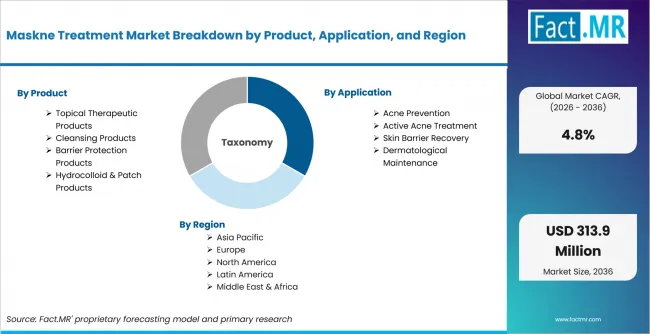
Maskne Treatment Market Breakdown By Product, Application, And Region | Source: Fact.MR
| Attribute | Details |
|---|---|
| Quantitative Units | USD million |
| Market Definition | Products used to prevent, treat or manage acne linked to mask wear, including topical treatments, cleansers, barrier products and hydrocolloid or patch products. |
| Product | Topical Therapeutic Products; Cleansing Products; Barrier Protection Products; Hydrocolloid & Patch Products |
| Application | Acne Prevention; Active Acne Treatment; Skin Barrier Recovery; Dermatological Maintenance |
| End Use | Individual Consumers; Hospitals & Clinics; Beauty & Wellness Centers; Corporate Healthcare Programs |
| Technology | Controlled Release Technology; Antimicrobial Technology; Barrier Enhancement Technology; Bioactive Delivery Technology |
| Formulation | Cream Formulations; Gel Formulations; Lotion Formulations; Serum Formulations |
| Distribution Channel | Retail Pharmacies; Online Platforms; Hospitals & Clinics; Specialty Retail Stores |
| Regions Covered | North America; Latin America; Western Europe; Eastern Europe; East Asia; South Asia & Pacific; Middle East & Africa |
| Countries Covered | Germany; South Korea; United States; United Kingdom; France |
| Key Companies Profiled | Kenvue Inc.; Galderma S.A.; L’Oréal Groupe; Sun Pharmaceutical Industries, Ltd.; The Procter & Gamble Company (TULA Skincare); Estée Lauder Companies Inc. |
| Forecast Period | 2026 to 2036 |
| Approach | Hybrid top-down and bottom-up approach using acne-care routines, channel checks, portfolios, country indicators and provider validation. |
How is the market segmented?
-
By Product
- Topical Therapeutic Products
- Medicated Creams
- Medicated Gels
- Cleansing Products
- Facial Cleansers
- Micellar Cleansing Products
- Barrier Protection Products
- Protective Creams
- Barrier Sprays
- Hydrocolloid & Patch Products
- Acne Patches
- Spot Treatment Patches
- Topical Therapeutic Products
-
By Application
- Acne Prevention
- Daily Skin Protection
- Occupational Prevention
- Active Acne Treatment
- Mild Maskne Management
- Moderate Maskne Management
- Skin Barrier Recovery
- Post Acne Recovery
- Irritation Management
- Dermatological Maintenance
- Long Term Maintenance
- Sensitive Skin Care
- Acne Prevention
-
By End Use
- Individual Consumers
- Adult Consumers
- Youth Consumers
- Hospitals & Clinics
- Dermatology Clinics
- General Hospitals
- Beauty & Wellness Centers
- Medical Spas
- Cosmetology Centers
- Corporate Healthcare Programs
- Employer Wellness Programs
- Insurance Health Networks
- Individual Consumers
-
By Technology
- Controlled Release Technology
- Microencapsulation Systems
- Nanocarrier Systems
- Antimicrobial Technology
- Broad Spectrum Systems
- Targeted Antimicrobial Systems
- Barrier Enhancement Technology
- Ceramide Technologies
- Occlusive Technologies
- Bioactive Delivery Technology
- Probiotic Systems
- Botanical Delivery Systems
- Controlled Release Technology
-
By Formulation
- Cream Formulations
- Oil in Water Creams
- Water in Oil Creams
- Gel Formulations
- Aqueous Gels
- Polymer Gels
- Lotion Formulations
- Emulsion Lotions
- Fluid Lotions
- Serum Formulations
- Water Based Serums
- Oil Based Serums
- Cream Formulations
-
By Distribution Channel
- Retail Pharmacies
- Chain Pharmacies
- Independent Pharmacies
- Online Platforms
- E-Commerce Marketplaces
- Brand Owned Websites
- Hospitals & Clinics
- Hospital Pharmacies
- Clinic Dispensing Units
- Specialty Retail Stores
- Beauty Retail Chains
- Health Stores
- Retail Pharmacies
-
By Region
- North America
- Latin America
- Western Europe
- Eastern Europe
- East Asia
- South Asia & Pacific
- Middle East & Africa