Heating Skincare Treatments Market (2026 - 2036)

Heating Skincare Treatments Market Size and Share Forecast Outlook 2026 to 2036

Core Findings

    Heating Skincare Treatments Market Forecast and Outlook 2026 to 2036

    Heating skincare treatments market is valued at USD 3.25 billion in 2026 and projected to reach USD 6.1 billion by 2036, reflecting a 6.50% CAGR, according to Fact.MR analysis.

    Heating Skincare Treatments Market Key Takeaways

    • Heating Skincare Treatments Market Value (2026): USD 3.25 billion
    • Heating Skincare Treatments Forecast Value (2036): USD 6.1 billion
    • Heating Skincare Treatments Forecast CAGR (2026-2036): 6.5%
    • Heating Skincare Treatments Leading Product Type: Heating masks (39%)
    • Heating Skincare Treatments Leading Technology: Self-heating chemical reaction (46%)
    • Heating Skincare Treatments Key Growth Regions: China, India, Germany, Brazil, USA
    • Heating Skincare Treatments Top Players: L’Oréal, Procter and Gamble, Johnson and Johnson, Beiersdorf, Unilever, Shiseido, Kao Corporation, Amorepacific
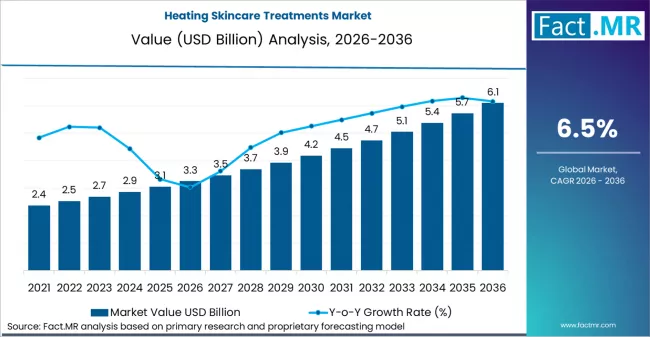
    Heating Skincare Treatments Market Market Value Analysis

    Market growth is driven by the shift from conventional anti-aging treatments to biomarker-led, heat-activated repair approaches that enhance cellular recovery and skin longevity. Evidence from 2025-2026 highlights high-value innovation adoption: Galderma’s Therapeutic Dermatology segment posted 40.4% growth in Q3 2025, validating the commercial demand for clinically backed interventions.

    L’Oréal’s CES 2026 showcases, including infrared and LED technologies, demonstrate the integration of thermal energy and tissue repair at scale. Beiersdorf’s Epicelline® launch underscores epigenetic repair as a scalable mass-market proposition, while Unilever’s Skin-Brain Axis research links consumer wellness to skin physiology, reinforcing preventive health adoption. Operational alignment across production, distribution, and multi-channel fulfillment is reducing friction for high-volume deployment. Market expansion indicates a long-term structural pivot toward medicalized, performance-driven skincare, where heat-enabled formulations, scientific validation, and standardized delivery systems define competitive advantage and sustainable growth.

    Heating Skincare Treatments Market

    Metric Value
    Market Value (2026) USD 3.25 billion
    Forecast Value (2036) USD 6.1 billion
    Forecast CAGR (2026-2036) 6.5%

    Category

    Category Segments
    Product Type Heating masks; Heating creams and ointments; Heating patches; Heating serums
    Technology Self-heating chemical reaction; Infrared based heating; Electric heating devices
    Application Anti-aging; Acne treatment; Muscle relaxation and skin therapy; Deep cleansing and detox
    End User Home care users; Dermatology clinics; Beauty salons and spas
    Region North America; Europe; Asia Pacific; Latin America; Middle East & Africa

    Segmental Analysis

    By Product Type, Why Do Heating Masks Lead the Heating Skincare Treatments Market?
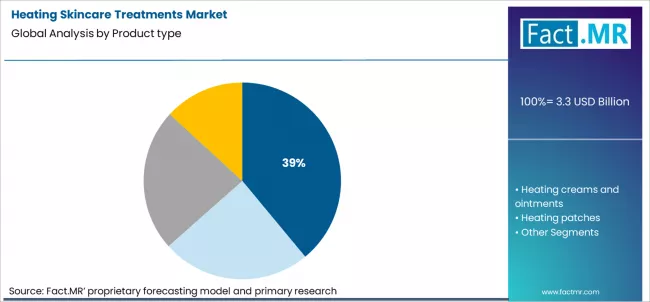
    Heating Skincare Treatments Market Analysis By Product Type

    Heating masks hold 39% share, reflecting consistent adoption across retail, e-commerce, and professional skincare channels where repeat purchase cycles are frequent. The market prioritizes scalable, multi-channel distribution and predictable inventory replenishment, enabling suppliers to maintain operational efficiency and stable revenue streams. High urban penetration, daily or routine usage patterns, and professional recommendations reinforce recurring demand. Segment dominance is defined by structural market factors such as supply chain repeatability, channel coverage, and predictable procurement cycles rather than the specific design or formulation of the masks. Market adoption is driven by operational and distribution efficiency.

    By Technology, Why Does Self-Heating Chemical Reaction Represent the Largest Segment?
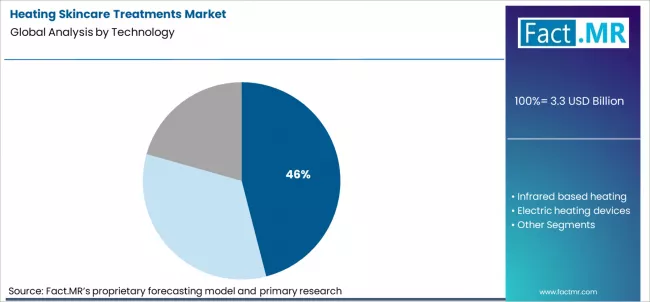
    Heating Skincare Treatments Market Analysis By Technology

    Self-heating chemical reaction based treatments account for 46% share, reflecting market preference for formats that integrate seamlessly into retail and e-commerce supply chains. Demand is concentrated in channels requiring repeatable logistics, predictable storage, and consistent replenishment. Suppliers benefit from standardized production processes, scalable material sourcing, and recurring orders. Segment prominence arises from structural market drivers, including operational efficiency, workflow optimization, and repeatable procurement, rather than the technical heating mechanism itself. Market growth is shaped by scalability across channels, reliable supply management, and adoption patterns that support repeat purchases and high-frequency usage.

    Country/Region

    Country/Region Driver Restraint Trend
    USA Rise of “Metabolic Beauty” (2026 Mintel) → drives Cellular-Charger positioning of heating skincare devices MoCRA March 2026 deadlines for talc/allergens → high CapEx for thermal-active substantiation, delaying launches Growth of professional-grade at-home heat tools and app-connected devices
    EU Expansion of AI-assisted heat therapy and professional thermal formulations → strengthens cellular repair and skin longevity EU Annex updates (July 2026) for active efficacy → forces reformulation and compliance CapEx Hyper-personalized thermal routines driven by AI mirrors
    India Quick adoption of at-home thermal tools and multifunctional LED+Heat devices → accelerates penetration in urban consumers Smaller distributors face compliance and regulatory reporting challenges → slows rollout Localized app-controlled thermal skincare solutions for mass-market
    Brazil Rising preference for natural-origin heating formulations → drives differentiated thermal product launches Import and ingredient regulation complexity → increases reformulation costs Growth of sustainable, eco-conscious thermal skincare devices

    Analysis of the Heating Skincare Treatments Market by Key Country
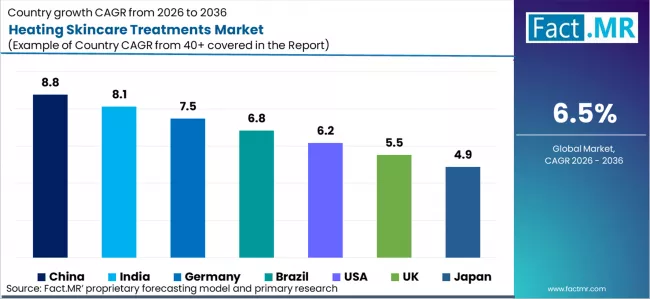
    Heating Skincare Treatments Market Cagr Analysis By Country

    Country CAGR (2026-2036)
    China 8.8%
    India 8.1%
    Germany 7.5%
    Brazil 6.8%
    USA 6.2%
    UK 5.5%
    Japan 4.9%

    The report covers an in-depth analysis of 40+ countries; top-performing countries are highlighted below.

    How Is the Heating Skincare Treatments Market Evolving in China?

    Demand for heating skincare treatments in China expands at 8.8% CAGR through 2036. The January 12, 2026 NMPA update introduces 18 revised cosmetic safety technical specifications. Combined with the January 1, 2026 ban on specific special-use categories such as hair growth and body slimming, manufacturers pivot formulations toward general safety and functional barrier repair claims. Investments focus on microbiological control, ingredient compliance, and digital traceability across production lines. Retail and e-commerce channels adjust SKUs to align with the new standards. Urban adoption increases as consumers respond to verified safety claims. Compliance-driven innovation and process standardization strengthen market positioning, enabling leading brands to capture premium and functional segments while ensuring national regulatory alignment across thermal skincare portfolios.

    What Is the Growth in Adoption of Heating Skincare Treatments in India?

    Adoption of heating skincare treatments in India grows at 8.1% CAGR through 2036. The CDSCO 2025 Borderline Guidelines reclassify products claiming deep tissue repair or physiological blood flow enhancement as Drugs, necessitating clinical validation via Form COS-1. Brands invest in compliance laboratories, clinical documentation, and validated manufacturing workflows to meet regulatory expectations. Urban wellness and premium segments drive accelerated uptake. Distribution networks prioritize compliant SKUs, and operational focus centers on traceability and safety assurance. The regulatory environment encourages innovation in validated thermal formulations. Market leaders that align with these guidelines consolidate share and maintain consumer trust, while non-compliant products face restricted access and operational challenges in the evolving Indian thermal skincare landscape.

    How Is the Heating Skincare Treatments Market Shaping in Germany?

    Outlook on the heating skincare treatments market in Germany grows at 7.5% CAGR through 2036. The EU Regulation 2024/996, effective May 1, 2026, prohibits endocrine disruptors such as 4-MBC, while the November 2025 Retinol limits impact thermal anti-aging serums. Brands reformulate SKUs, withdraw non-compliant stock, and implement automated quality control. Retailers update inventory and labeling to ensure compliance. Urban distribution centers optimize logistics for approved SKUs. Operational improvements emphasize regulatory alignment, product safety, and efficiency rather than expansion of facilities. Firms adopting early compliance strengthen market positioning and consumer confidence. Regulatory-driven reformulation encourages innovation in thermal actives while maintaining trust in premium functional products across Germany.

    What Is the Outlook on Heating Skincare Treatments in Brazil?

    Outlook on the heating skincare treatments market in Brazil expands at 6.8% CAGR through 2036. The February 1, 2026 ANVISA RDC 529/2021 ban on certain synthetic additives forces immediate SKU reformulations and recalls in therapeutic thermal creams. Manufacturers implement compliance-driven production controls, including ingredient substitution and batch verification. Distribution systems adjust to prioritize approved products and maintain consumer safety. Urban and professional channels adopt standardized compliant SKUs, while operational improvements focus on regulatory adherence, efficiency, and quality assurance. Market growth favors brands that integrate compliance into operational workflows, allowing rapid restoration of product availability and strengthening leadership in premium heating skincare segments.

    How Is the Heating Skincare Treatments Market Growing in the United States?

    Growth in the heating skincare treatments market in the United States reaches 6.2% CAGR through 2036. The MoCRA 2026 deadlines mandate facility registration and safety substantiation, requiring thermal brands to maintain detailed compliance documentation to prevent FDA recalls. Manufacturers invest in process standardization, batch-level tracking, and responsible personnel oversight. Retailers prioritize compliant SKUs, and operational efficiency is improved through automated reporting and auditing systems. Premium and urban markets adopt verified products, creating differentiation through safety and reliability. Early compliance allows firms to establish a regulatory-driven moat, while non-compliant competitors face operational risk and potential market exclusion, reinforcing competitive advantage for leading brands.

    What Is the Growth in Heating Skincare Treatments in the United Kingdom?

    Growth in the heating skincare treatments market in the United Kingdom is 5.5% CAGR through 2036. Regulatory emphasis on product safety and compliance drives adoption of validated formulations and standardized labeling. Urban distribution networks and e-commerce channels prioritize products with documented safety and functional claims. Operational improvements focus on batch traceability, consistent quality, and regulatory adherence rather than facility expansion. Premium consumers respond to verified efficacy in thermal skincare, encouraging brands to invest in research and standardized production processes. Companies that integrate compliance, efficiency, and functional product assurance consolidate market share, while laggards face slower adoption and reduced consumer trust.

    How Is the Heating Skincare Treatments Market Developing in Japan?

    Outlook on the heating skincare treatments market in Japan grows at 4.9% CAGR through 2036. The September 25, 2025 PMDA NAMs guidance allows animal-free testing for quasi-drugs, accelerating approval of thermal actives. Manufacturers implement bio-mimetic safety assessment protocols and validate formulations prior to market launch. Urban and professional retail channels adopt accredited SKUs. Operational focus emphasizes compliance, safety documentation, and process efficiency. Early NAM adopters achieve faster market penetration, strengthen brand credibility, and increase consumer trust. Premium and functional segments expand steadily, while non-compliant firms experience slower entry and constrained distribution, highlighting the strategic importance of regulatory-aligned innovation in Japan.

    How Are Smart Thermal Activation Strategies Defining Competitive Moats in the Heating Skincare Treatments Market?
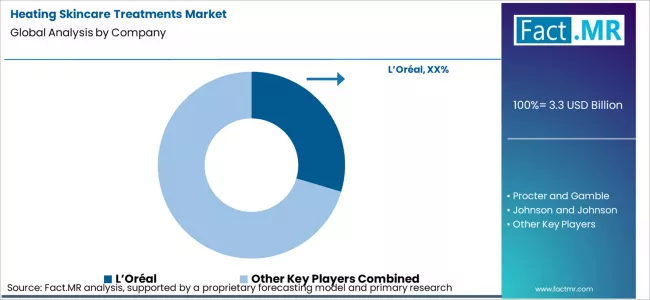
    Heating Skincare Treatments Market Analysis By Company

    As per Fact.MR analysis, the heating skincare treatments market in 2026 is defined by the transition from passive heat to smart thermal activation, where controlled thermal stimuli drive bio-repair and consumer adoption. L’Oréal’s CES 2026 Innovation Award for its NIR-powered LED Face Mask and Light Straight + Multi-styler enhanced its premium positioning, shifting perception from corrective to heat-managed preventative care. Amorepacific’s Skinsight™ platform, developed with MIT, enables real-time aging analysis and personalized thermal/light treatment, increasing user engagement and repeat purchase. Johnson & Johnson’s Kenvue acquisition by Kimberly-Clark in January 2026 consolidated personal care scale and operational depth, creating distribution and supply advantages. Shiseido’s VOYAGER AI thermal-response suncare mitigates environmental heat and humidity, driving adoption in Asia-Pacific. Kao’s Sweat Transpiration Technology accelerates evaporation, enhancing comfort and functional perception. Beiersdorf leverages Epicelline® to integrate epigenetic repair into thermal routines, while P&G and Unilever combine heat-stable formulations and microbiome-based sensory activation to support efficacy and well-being. Collectively, regulatory compliance, operational scale, and scientific substantiation form enduring thermal efficacy moats.

    Recent Developments

    • L’Oréal: Launch of Infrared-Powered Thermal Skincare at CES 2026. In January 2026, L’Oréal Groupe unveiled its latest "Beauty Tech" breakthrough, the LED Face Mask. Developed with I-Smart Developments, this device utilizes targeted near-infrared light (830 nm). Unlike traditional topical treatments, this thermal technology penetrates deeply into the skin layers to stimulate cellular repair and combat sagging. The device is designed to work in synergy with L'Oréal's professional serums, effectively moving the market from "passive" skincare to active, heat-based "longevity science." Source: L’Oréal Groupe - CES 2026 Innovation Awards (January 2026)
    • Amorepacific: Debut of "Skinsight" Electronic Skin & Thermal Therapy (2026). Amorepacific introduced Skinsight™ at CES 2026, an "electronic skin" platform developed in collaboration with MIT. This wearable sensor patch analyzes real-time aging signals and environmental stressors. The data directly connects to their makeON Skin Light Therapy 3S device, which uses micro-red LEDs and thermal energy to provide immediate improvements in skin texture. This development marks a shift toward data-driven heating treatments that adapt to the user's specific skin temperature and barrier needs. Source: Global Cosmetics News - Amorepacific AI and Beauty Tech (January 2026)
    • Shiseido: AI-Powered "VOYAGER" Platform for Thermal Formulations (2026). Shiseido has integrated its new VOYAGER AI system to accelerate the development of complex, sensorial formulations, including self-heating and mist-based treatments. By analyzing over 500,000 data points, the platform allows Shiseido to optimize the "emulsification mechanisms" required for self-heating masks and cleansers. This technology is being used to develop a new line of disruptive skincare set to launch in Summer 2026, focusing on "thermal-response" protection and enhanced ingredient absorption. Source: Global Cosmetic Industry - Shiseido VOYAGER Innovation (January 2026)

    Key Players in Heating Skincare Treatments Market

    • L’Oréal
    • Procter and Gamble
    • Johnson and Johnson
    • Beiersdorf
    • Unilever
    • Shiseido
    • Kao Corporation
    • Amorepacific

    Scope of the Report

    Items Values
    Quantitative Units (2026) USD billion
    Product Type Heating masks, Heating creams and ointments, Heating patches, Heating serums
    Technology Self-heating chemical reaction, Infrared based heating, Electric heating devices
    Application Anti-aging, Acne treatment, Muscle relaxation and skin therapy, Deep cleansing and detox
    End User Home care users, Dermatology clinics, Beauty salons and spas
    Region Asia Pacific, Europe, North America, Latin America, Middle East & Africa
    Countries Covered China, Japan, South Korea, India, Australia & New Zealand, ASEAN, Rest of Asia Pacific, Germany, United Kingdom, France, Italy, Spain, Nordic, BENELUX, Rest of Europe, United States, Canada, Mexico, Brazil, Chile, Rest of Latin America, Kingdom of Saudi Arabia, Other GCC Countries, Turkey, South Africa, Other African Union, Rest of Middle East & Africa
    Key Companies Profiled L’Oréal, Procter and Gamble, Johnson and Johnson, Beiersdorf, Unilever, Shiseido, Kao Corporation, Amorepacific
    Additional Attributes Dollar by sales by product type, technology, and application; clinical validation and biomarker-proven efficacy; thermal activation and smart device integration; packaging for hygiene, stability, and safe storage; automated filling and labeling systems for high-frequency SKUs; regulatory compliance with MoCRA, CDSCO, PMDA, NMPA, ANVISA; multi-channel distribution including professional, retail, and e-commerce; operational focus on traceability, safety verification, and process standardization; recurring consumer usage, urban penetration, and professional recommendation adoption; integration of wellness, microbiome research, and AI-assisted personalization; premium and science-backed product positioning forming defensible competitive moats.

    Heating Skincare Treatments Market Segmentation

    • Product Type :

      • Heating masks
      • Heating creams and ointments
      • Heating patches
      • Heating serums
    • Technology :

      • Self-heating chemical reaction
      • Infrared based heating
      • Electric heating devices
    • Application :

      • Anti-aging
      • Acne treatment
      • Muscle relaxation and skin therapy
      • Deep cleansing and detox
    • End User :

      • Home care users
      • Dermatology clinics
      • Beauty salons and spas
    • Region :

      • Asia Pacific
        • China
        • Japan
        • South Korea
        • India
        • Australia & New Zealand
        • ASEAN
        • Rest of Asia Pacific
      • Europe
        • Germany
        • United Kingdom
        • France
        • Italy
        • Spain
        • Nordic
        • BENELUX
        • Rest of Europe
      • North America
        • United States
        • Canada
        • Mexico
      • Latin America
        • Brazil
        • Chile
        • Rest of Latin America
      • Middle East & Africa
        • Kingdom of Saudi Arabia
        • Other GCC Countries
        • Turkey
        • South Africa
        • Other African Union
        • Rest of Middle East & Africa

    References

    • U.S. Food and Drug Administration. (2024). Cosmetic facility registration and product listing requirements under the Modernization of Cosmetics Regulation Act of 2022 (MoCRA). U.S. Department of Health and Human Services.
    • European Commission. (2024). Commission Regulation (EU) 2024/996 amending Annexes II, III, and V of Regulation (EC) No 1223/2009 on cosmetic products. Official Journal of the European Union.
    • Scientific Committee on Consumer Safety. (2023). Notes of guidance for the testing of cosmetic ingredients and their safety evaluation (12th revision). European Commission.
    • Pharmaceuticals and Medical Devices Agency. (2025). Guidance on the use of New Approach Methodologies (NAMs) in the evaluation of quasi-drug cosmetic products. Government of Japan.

    Table of Content

    1. Executive Summary
      • Global Market Outlook
      • Demand to side Trends
      • Supply to side Trends
      • Technology Roadmap Analysis
      • Analysis and Recommendations
    2. Market Overview
      • Market Coverage / Taxonomy
      • Market Definition / Scope / Limitations
    3. Research Methodology
      • Chapter Orientation
      • Analytical Lens and Working Hypotheses
        • Market Structure, Signals, and Trend Drivers
        • Benchmarking and Cross-market Comparability
        • Market Sizing, Forecasting, and Opportunity Mapping
      • Research Design and Evidence Framework
        • Desk Research Programme (Secondary Evidence)
          • Company Annual and Sustainability Reports
          • Peer-reviewed Journals and Academic Literature
          • Corporate Websites, Product Literature, and Technical Notes
          • Earnings Decks and Investor Briefings
          • Statutory Filings and Regulatory Disclosures
          • Technical White Papers and Standards Notes
          • Trade Journals, Industry Magazines, and Analyst Briefs
          • Conference Proceedings, Webinars, and Seminar Materials
          • Government Statistics Portals and Public Data Releases
          • Press Releases and Reputable Media Coverage
          • Specialist Newsletters and Curated Briefings
          • Sector Databases and Reference Repositories
          • FMR Internal Proprietary Databases and Historical Market Datasets
          • Subscription Datasets and Paid Sources
          • Social Channels, Communities, and Digital Listening Inputs
          • Additional Desk Sources
        • Expert Input and Fieldwork (Primary Evidence)
          • Primary Modes
            • Qualitative Interviews and Expert Elicitation
            • Quantitative Surveys and Structured Data Capture
            • Blended Approach
          • Why Primary Evidence is Used
          • Field Techniques
            • Interviews
            • Surveys
            • Focus Groups
            • Observational and In-context Research
            • Social and Community Interactions
          • Stakeholder Universe Engaged
            • C-suite Leaders
            • Board Members
            • Presidents and Vice Presidents
            • R&D and Innovation Heads
            • Technical Specialists
            • Domain Subject-matter Experts
            • Scientists
            • Physicians and Other Healthcare Professionals
          • Governance, Ethics, and Data Stewardship
            • Research Ethics
            • Data Integrity and Handling
        • Tooling, Models, and Reference Databases
      • Data Engineering and Model Build
        • Data Acquisition and Ingestion
        • Cleaning, Normalisation, and Verification
        • Synthesis, Triangulation, and Analysis
      • Quality Assurance and Audit Trail
    4. Market Background
      • Market Dynamics
        • Drivers
        • Restraints
        • Opportunity
        • Trends
      • Scenario Forecast
        • Demand in Optimistic Scenario
        • Demand in Likely Scenario
        • Demand in Conservative Scenario
      • Opportunity Map Analysis
      • Product Life Cycle Analysis
      • Supply Chain Analysis
      • Investment Feasibility Matrix
      • Value Chain Analysis
      • PESTLE and Porter’s Analysis
      • Regulatory Landscape
      • Regional Parent Market Outlook
      • Production and Consumption Statistics
      • Import and Export Statistics
    5. Global Market Analysis 2021 to 2025 and Forecast, 2026 to 2036
      • Historical Market Size Value (USD Million) Analysis, 2021 to 2025
      • Current and Future Market Size Value (USD Million) Projections, 2026 to 2036
        • Y to o to Y Growth Trend Analysis
        • Absolute $ Opportunity Analysis
    6. Global Market Pricing Analysis 2021 to 2025 and Forecast 2026 to 2036
    7. Global Market Analysis 2021 to 2025 and Forecast 2026 to 2036, By Product type
      • Introduction / Key Findings
      • Historical Market Size Value (USD Million) Analysis By Product type, 2021 to 2025
      • Current and Future Market Size Value (USD Million) Analysis and Forecast By Product type, 2026 to 2036
        • Heating masks
        • Heating creams and ointments
        • Heating patches
        • Heating serums
      • Y to o to Y Growth Trend Analysis By Product type, 2021 to 2025
      • Absolute $ Opportunity Analysis By Product type, 2026 to 2036
    8. Global Market Analysis 2021 to 2025 and Forecast 2026 to 2036, By Technology
      • Introduction / Key Findings
      • Historical Market Size Value (USD Million) Analysis By Technology, 2021 to 2025
      • Current and Future Market Size Value (USD Million) Analysis and Forecast By Technology, 2026 to 2036
        • Self heating chemical reaction
        • Infrared based heating
        • Electric heating devices
      • Y to o to Y Growth Trend Analysis By Technology, 2021 to 2025
      • Absolute $ Opportunity Analysis By Technology, 2026 to 2036
    9. Global Market Analysis 2021 to 2025 and Forecast 2026 to 2036, By Application
      • Introduction / Key Findings
      • Historical Market Size Value (USD Million) Analysis By Application, 2021 to 2025
      • Current and Future Market Size Value (USD Million) Analysis and Forecast By Application, 2026 to 2036
        • Anti aging
        • Acne treatment
        • Muscle relaxation and skin therapy
        • Deep cleansing and detox
      • Y to o to Y Growth Trend Analysis By Application, 2021 to 2025
      • Absolute $ Opportunity Analysis By Application, 2026 to 2036
    10. Global Market Analysis 2021 to 2025 and Forecast 2026 to 2036, By End user
      • Introduction / Key Findings
      • Historical Market Size Value (USD Million) Analysis By End user, 2021 to 2025
      • Current and Future Market Size Value (USD Million) Analysis and Forecast By End user, 2026 to 2036
        • Home care users
        • Dermatology clinics
        • Beauty salons and spas
      • Y to o to Y Growth Trend Analysis By End user, 2021 to 2025
      • Absolute $ Opportunity Analysis By End user, 2026 to 2036
    11. Global Market Analysis 2021 to 2025 and Forecast 2026 to 2036, By Region
      • Introduction
      • Historical Market Size Value (USD Million) Analysis By Region, 2021 to 2025
      • Current Market Size Value (USD Million) Analysis and Forecast By Region, 2026 to 2036
        • North America
        • Latin America
        • Western Europe
        • Eastern Europe
        • East Asia
        • South Asia and Pacific
        • Middle East & Africa
      • Market Attractiveness Analysis By Region
    12. North America Market Analysis 2021 to 2025 and Forecast 2026 to 2036, By Country
      • Historical Market Size Value (USD Million) Trend Analysis By Market Taxonomy, 2021 to 2025
      • Market Size Value (USD Million) Forecast By Market Taxonomy, 2026 to 2036
        • By Country
          • USA
          • Canada
          • Mexico
        • By Product type
        • By Technology
        • By Application
        • By End user
      • Market Attractiveness Analysis
        • By Country
        • By Product type
        • By Technology
        • By Application
        • By End user
      • Key Takeaways
    13. Latin America Market Analysis 2021 to 2025 and Forecast 2026 to 2036, By Country
      • Historical Market Size Value (USD Million) Trend Analysis By Market Taxonomy, 2021 to 2025
      • Market Size Value (USD Million) Forecast By Market Taxonomy, 2026 to 2036
        • By Country
          • Brazil
          • Chile
          • Rest of Latin America
        • By Product type
        • By Technology
        • By Application
        • By End user
      • Market Attractiveness Analysis
        • By Country
        • By Product type
        • By Technology
        • By Application
        • By End user
      • Key Takeaways
    14. Western Europe Market Analysis 2021 to 2025 and Forecast 2026 to 2036, By Country
      • Historical Market Size Value (USD Million) Trend Analysis By Market Taxonomy, 2021 to 2025
      • Market Size Value (USD Million) Forecast By Market Taxonomy, 2026 to 2036
        • By Country
          • Germany
          • UK
          • Italy
          • Spain
          • France
          • Nordic
          • BENELUX
          • Rest of Western Europe
        • By Product type
        • By Technology
        • By Application
        • By End user
      • Market Attractiveness Analysis
        • By Country
        • By Product type
        • By Technology
        • By Application
        • By End user
      • Key Takeaways
    15. Eastern Europe Market Analysis 2021 to 2025 and Forecast 2026 to 2036, By Country
      • Historical Market Size Value (USD Million) Trend Analysis By Market Taxonomy, 2021 to 2025
      • Market Size Value (USD Million) Forecast By Market Taxonomy, 2026 to 2036
        • By Country
          • Russia
          • Poland
          • Hungary
          • Balkan & Baltic
          • Rest of Eastern Europe
        • By Product type
        • By Technology
        • By Application
        • By End user
      • Market Attractiveness Analysis
        • By Country
        • By Product type
        • By Technology
        • By Application
        • By End user
      • Key Takeaways
    16. East Asia Market Analysis 2021 to 2025 and Forecast 2026 to 2036, By Country
      • Historical Market Size Value (USD Million) Trend Analysis By Market Taxonomy, 2021 to 2025
      • Market Size Value (USD Million) Forecast By Market Taxonomy, 2026 to 2036
        • By Country
          • China
          • Japan
          • South Korea
        • By Product type
        • By Technology
        • By Application
        • By End user
      • Market Attractiveness Analysis
        • By Country
        • By Product type
        • By Technology
        • By Application
        • By End user
      • Key Takeaways
    17. South Asia and Pacific Market Analysis 2021 to 2025 and Forecast 2026 to 2036, By Country
      • Historical Market Size Value (USD Million) Trend Analysis By Market Taxonomy, 2021 to 2025
      • Market Size Value (USD Million) Forecast By Market Taxonomy, 2026 to 2036
        • By Country
          • India
          • ASEAN
          • Australia & New Zealand
          • Rest of South Asia and Pacific
        • By Product type
        • By Technology
        • By Application
        • By End user
      • Market Attractiveness Analysis
        • By Country
        • By Product type
        • By Technology
        • By Application
        • By End user
      • Key Takeaways
    18. Middle East & Africa Market Analysis 2021 to 2025 and Forecast 2026 to 2036, By Country
      • Historical Market Size Value (USD Million) Trend Analysis By Market Taxonomy, 2021 to 2025
      • Market Size Value (USD Million) Forecast By Market Taxonomy, 2026 to 2036
        • By Country
          • Kingdom of Saudi Arabia
          • Other GCC Countries
          • Turkiye
          • South Africa
          • Other African Union
          • Rest of Middle East & Africa
        • By Product type
        • By Technology
        • By Application
        • By End user
      • Market Attractiveness Analysis
        • By Country
        • By Product type
        • By Technology
        • By Application
        • By End user
      • Key Takeaways
    19. Key Countries Market Analysis
      • USA
        • Pricing Analysis
        • Market Share Analysis, 2025
          • By Product type
          • By Technology
          • By Application
          • By End user
      • Canada
        • Pricing Analysis
        • Market Share Analysis, 2025
          • By Product type
          • By Technology
          • By Application
          • By End user
      • Mexico
        • Pricing Analysis
        • Market Share Analysis, 2025
          • By Product type
          • By Technology
          • By Application
          • By End user
      • Brazil
        • Pricing Analysis
        • Market Share Analysis, 2025
          • By Product type
          • By Technology
          • By Application
          • By End user
      • Chile
        • Pricing Analysis
        • Market Share Analysis, 2025
          • By Product type
          • By Technology
          • By Application
          • By End user
      • Germany
        • Pricing Analysis
        • Market Share Analysis, 2025
          • By Product type
          • By Technology
          • By Application
          • By End user
      • UK
        • Pricing Analysis
        • Market Share Analysis, 2025
          • By Product type
          • By Technology
          • By Application
          • By End user
      • Italy
        • Pricing Analysis
        • Market Share Analysis, 2025
          • By Product type
          • By Technology
          • By Application
          • By End user
      • Spain
        • Pricing Analysis
        • Market Share Analysis, 2025
          • By Product type
          • By Technology
          • By Application
          • By End user
      • France
        • Pricing Analysis
        • Market Share Analysis, 2025
          • By Product type
          • By Technology
          • By Application
          • By End user
      • India
        • Pricing Analysis
        • Market Share Analysis, 2025
          • By Product type
          • By Technology
          • By Application
          • By End user
      • ASEAN
        • Pricing Analysis
        • Market Share Analysis, 2025
          • By Product type
          • By Technology
          • By Application
          • By End user
      • Australia & New Zealand
        • Pricing Analysis
        • Market Share Analysis, 2025
          • By Product type
          • By Technology
          • By Application
          • By End user
      • China
        • Pricing Analysis
        • Market Share Analysis, 2025
          • By Product type
          • By Technology
          • By Application
          • By End user
      • Japan
        • Pricing Analysis
        • Market Share Analysis, 2025
          • By Product type
          • By Technology
          • By Application
          • By End user
      • South Korea
        • Pricing Analysis
        • Market Share Analysis, 2025
          • By Product type
          • By Technology
          • By Application
          • By End user
      • Russia
        • Pricing Analysis
        • Market Share Analysis, 2025
          • By Product type
          • By Technology
          • By Application
          • By End user
      • Poland
        • Pricing Analysis
        • Market Share Analysis, 2025
          • By Product type
          • By Technology
          • By Application
          • By End user
      • Hungary
        • Pricing Analysis
        • Market Share Analysis, 2025
          • By Product type
          • By Technology
          • By Application
          • By End user
      • Kingdom of Saudi Arabia
        • Pricing Analysis
        • Market Share Analysis, 2025
          • By Product type
          • By Technology
          • By Application
          • By End user
      • Turkiye
        • Pricing Analysis
        • Market Share Analysis, 2025
          • By Product type
          • By Technology
          • By Application
          • By End user
      • South Africa
        • Pricing Analysis
        • Market Share Analysis, 2025
          • By Product type
          • By Technology
          • By Application
          • By End user
    20. Market Structure Analysis
      • Competition Dashboard
      • Competition Benchmarking
      • Market Share Analysis of Top Players
        • By Regional
        • By Product type
        • By Technology
        • By Application
        • By End user
    21. Competition Analysis
      • Competition Deep Dive
        • L’Oréal
          • Overview
          • Product Portfolio
          • Profitability by Market Segments (Product/Age /Sales Channel/Region)
          • Sales Footprint
          • Strategy Overview
            • Marketing Strategy
            • Product Strategy
            • Channel Strategy
        • Procter and Gamble
        • Johnson and Johnson
        • Beiersdorf
        • Unilever
        • Shiseido
        • Kao Corporation
        • Amorepacific
    22. Assumptions & Acronyms Used

    List Of Table

    • Table 1: Global Market Value (USD Million) Forecast by Region, 2021 to 2036
    • Table 2: Global Market Value (USD Million) Forecast by Product type, 2021 to 2036
    • Table 3: Global Market Value (USD Million) Forecast by Technology, 2021 to 2036
    • Table 4: Global Market Value (USD Million) Forecast by Application, 2021 to 2036
    • Table 5: Global Market Value (USD Million) Forecast by End user, 2021 to 2036
    • Table 6: North America Market Value (USD Million) Forecast by Country, 2021 to 2036
    • Table 7: North America Market Value (USD Million) Forecast by Product type, 2021 to 2036
    • Table 8: North America Market Value (USD Million) Forecast by Technology, 2021 to 2036
    • Table 9: North America Market Value (USD Million) Forecast by Application, 2021 to 2036
    • Table 10: North America Market Value (USD Million) Forecast by End user, 2021 to 2036
    • Table 11: Latin America Market Value (USD Million) Forecast by Country, 2021 to 2036
    • Table 12: Latin America Market Value (USD Million) Forecast by Product type, 2021 to 2036
    • Table 13: Latin America Market Value (USD Million) Forecast by Technology, 2021 to 2036
    • Table 14: Latin America Market Value (USD Million) Forecast by Application, 2021 to 2036
    • Table 15: Latin America Market Value (USD Million) Forecast by End user, 2021 to 2036
    • Table 16: Western Europe Market Value (USD Million) Forecast by Country, 2021 to 2036
    • Table 17: Western Europe Market Value (USD Million) Forecast by Product type, 2021 to 2036
    • Table 18: Western Europe Market Value (USD Million) Forecast by Technology, 2021 to 2036
    • Table 19: Western Europe Market Value (USD Million) Forecast by Application, 2021 to 2036
    • Table 20: Western Europe Market Value (USD Million) Forecast by End user, 2021 to 2036
    • Table 21: Eastern Europe Market Value (USD Million) Forecast by Country, 2021 to 2036
    • Table 22: Eastern Europe Market Value (USD Million) Forecast by Product type, 2021 to 2036
    • Table 23: Eastern Europe Market Value (USD Million) Forecast by Technology, 2021 to 2036
    • Table 24: Eastern Europe Market Value (USD Million) Forecast by Application, 2021 to 2036
    • Table 25: Eastern Europe Market Value (USD Million) Forecast by End user, 2021 to 2036
    • Table 26: East Asia Market Value (USD Million) Forecast by Country, 2021 to 2036
    • Table 27: East Asia Market Value (USD Million) Forecast by Product type, 2021 to 2036
    • Table 28: East Asia Market Value (USD Million) Forecast by Technology, 2021 to 2036
    • Table 29: East Asia Market Value (USD Million) Forecast by Application, 2021 to 2036
    • Table 30: East Asia Market Value (USD Million) Forecast by End user, 2021 to 2036
    • Table 31: South Asia and Pacific Market Value (USD Million) Forecast by Country, 2021 to 2036
    • Table 32: South Asia and Pacific Market Value (USD Million) Forecast by Product type, 2021 to 2036
    • Table 33: South Asia and Pacific Market Value (USD Million) Forecast by Technology, 2021 to 2036
    • Table 34: South Asia and Pacific Market Value (USD Million) Forecast by Application, 2021 to 2036
    • Table 35: South Asia and Pacific Market Value (USD Million) Forecast by End user, 2021 to 2036
    • Table 36: Middle East & Africa Market Value (USD Million) Forecast by Country, 2021 to 2036
    • Table 37: Middle East & Africa Market Value (USD Million) Forecast by Product type, 2021 to 2036
    • Table 38: Middle East & Africa Market Value (USD Million) Forecast by Technology, 2021 to 2036
    • Table 39: Middle East & Africa Market Value (USD Million) Forecast by Application, 2021 to 2036
    • Table 40: Middle East & Africa Market Value (USD Million) Forecast by End user, 2021 to 2036

    List Of Figures

    • Figure 1: Global Market Pricing Analysis
    • Figure 2: Global Market Value (USD Million) Forecast 2021 to 2036
    • Figure 3: Global Market Value Share and BPS Analysis by Product type, 2026 and 2036
    • Figure 4: Global Market Y to o to Y Growth Comparison by Product type, 2026 to 2036
    • Figure 5: Global Market Attractiveness Analysis by Product type
    • Figure 6: Global Market Value Share and BPS Analysis by Technology, 2026 and 2036
    • Figure 7: Global Market Y to o to Y Growth Comparison by Technology, 2026 to 2036
    • Figure 8: Global Market Attractiveness Analysis by Technology
    • Figure 9: Global Market Value Share and BPS Analysis by Application, 2026 and 2036
    • Figure 10: Global Market Y to o to Y Growth Comparison by Application, 2026 to 2036
    • Figure 11: Global Market Attractiveness Analysis by Application
    • Figure 12: Global Market Value Share and BPS Analysis by End user, 2026 and 2036
    • Figure 13: Global Market Y to o to Y Growth Comparison by End user, 2026 to 2036
    • Figure 14: Global Market Attractiveness Analysis by End user
    • Figure 15: Global Market Value (USD Million) Share and BPS Analysis by Region, 2026 and 2036
    • Figure 16: Global Market Y to o to Y Growth Comparison by Region, 2026 to 2036
    • Figure 17: Global Market Attractiveness Analysis by Region
    • Figure 18: North America Market Incremental Dollar Opportunity, 2026 to 2036
    • Figure 19: Latin America Market Incremental Dollar Opportunity, 2026 to 2036
    • Figure 20: Western Europe Market Incremental Dollar Opportunity, 2026 to 2036
    • Figure 21: Eastern Europe Market Incremental Dollar Opportunity, 2026 to 2036
    • Figure 22: East Asia Market Incremental Dollar Opportunity, 2026 to 2036
    • Figure 23: South Asia and Pacific Market Incremental Dollar Opportunity, 2026 to 2036
    • Figure 24: Middle East & Africa Market Incremental Dollar Opportunity, 2026 to 2036
    • Figure 25: North America Market Value Share and BPS Analysis by Country, 2026 and 2036
    • Figure 26: North America Market Value Share and BPS Analysis by Product type, 2026 and 2036
    • Figure 27: North America Market Y to o to Y Growth Comparison by Product type, 2026 to 2036
    • Figure 28: North America Market Attractiveness Analysis by Product type
    • Figure 29: North America Market Value Share and BPS Analysis by Technology, 2026 and 2036
    • Figure 30: North America Market Y to o to Y Growth Comparison by Technology, 2026 to 2036
    • Figure 31: North America Market Attractiveness Analysis by Technology
    • Figure 32: North America Market Value Share and BPS Analysis by Application, 2026 and 2036
    • Figure 33: North America Market Y to o to Y Growth Comparison by Application, 2026 to 2036
    • Figure 34: North America Market Attractiveness Analysis by Application
    • Figure 35: North America Market Value Share and BPS Analysis by End user, 2026 and 2036
    • Figure 36: North America Market Y to o to Y Growth Comparison by End user, 2026 to 2036
    • Figure 37: North America Market Attractiveness Analysis by End user
    • Figure 38: Latin America Market Value Share and BPS Analysis by Country, 2026 and 2036
    • Figure 39: Latin America Market Value Share and BPS Analysis by Product type, 2026 and 2036
    • Figure 40: Latin America Market Y to o to Y Growth Comparison by Product type, 2026 to 2036
    • Figure 41: Latin America Market Attractiveness Analysis by Product type
    • Figure 42: Latin America Market Value Share and BPS Analysis by Technology, 2026 and 2036
    • Figure 43: Latin America Market Y to o to Y Growth Comparison by Technology, 2026 to 2036
    • Figure 44: Latin America Market Attractiveness Analysis by Technology
    • Figure 45: Latin America Market Value Share and BPS Analysis by Application, 2026 and 2036
    • Figure 46: Latin America Market Y to o to Y Growth Comparison by Application, 2026 to 2036
    • Figure 47: Latin America Market Attractiveness Analysis by Application
    • Figure 48: Latin America Market Value Share and BPS Analysis by End user, 2026 and 2036
    • Figure 49: Latin America Market Y to o to Y Growth Comparison by End user, 2026 to 2036
    • Figure 50: Latin America Market Attractiveness Analysis by End user
    • Figure 51: Western Europe Market Value Share and BPS Analysis by Country, 2026 and 2036
    • Figure 52: Western Europe Market Value Share and BPS Analysis by Product type, 2026 and 2036
    • Figure 53: Western Europe Market Y to o to Y Growth Comparison by Product type, 2026 to 2036
    • Figure 54: Western Europe Market Attractiveness Analysis by Product type
    • Figure 55: Western Europe Market Value Share and BPS Analysis by Technology, 2026 and 2036
    • Figure 56: Western Europe Market Y to o to Y Growth Comparison by Technology, 2026 to 2036
    • Figure 57: Western Europe Market Attractiveness Analysis by Technology
    • Figure 58: Western Europe Market Value Share and BPS Analysis by Application, 2026 and 2036
    • Figure 59: Western Europe Market Y to o to Y Growth Comparison by Application, 2026 to 2036
    • Figure 60: Western Europe Market Attractiveness Analysis by Application
    • Figure 61: Western Europe Market Value Share and BPS Analysis by End user, 2026 and 2036
    • Figure 62: Western Europe Market Y to o to Y Growth Comparison by End user, 2026 to 2036
    • Figure 63: Western Europe Market Attractiveness Analysis by End user
    • Figure 64: Eastern Europe Market Value Share and BPS Analysis by Country, 2026 and 2036
    • Figure 65: Eastern Europe Market Value Share and BPS Analysis by Product type, 2026 and 2036
    • Figure 66: Eastern Europe Market Y to o to Y Growth Comparison by Product type, 2026 to 2036
    • Figure 67: Eastern Europe Market Attractiveness Analysis by Product type
    • Figure 68: Eastern Europe Market Value Share and BPS Analysis by Technology, 2026 and 2036
    • Figure 69: Eastern Europe Market Y to o to Y Growth Comparison by Technology, 2026 to 2036
    • Figure 70: Eastern Europe Market Attractiveness Analysis by Technology
    • Figure 71: Eastern Europe Market Value Share and BPS Analysis by Application, 2026 and 2036
    • Figure 72: Eastern Europe Market Y to o to Y Growth Comparison by Application, 2026 to 2036
    • Figure 73: Eastern Europe Market Attractiveness Analysis by Application
    • Figure 74: Eastern Europe Market Value Share and BPS Analysis by End user, 2026 and 2036
    • Figure 75: Eastern Europe Market Y to o to Y Growth Comparison by End user, 2026 to 2036
    • Figure 76: Eastern Europe Market Attractiveness Analysis by End user
    • Figure 77: East Asia Market Value Share and BPS Analysis by Country, 2026 and 2036
    • Figure 78: East Asia Market Value Share and BPS Analysis by Product type, 2026 and 2036
    • Figure 79: East Asia Market Y to o to Y Growth Comparison by Product type, 2026 to 2036
    • Figure 80: East Asia Market Attractiveness Analysis by Product type
    • Figure 81: East Asia Market Value Share and BPS Analysis by Technology, 2026 and 2036
    • Figure 82: East Asia Market Y to o to Y Growth Comparison by Technology, 2026 to 2036
    • Figure 83: East Asia Market Attractiveness Analysis by Technology
    • Figure 84: East Asia Market Value Share and BPS Analysis by Application, 2026 and 2036
    • Figure 85: East Asia Market Y to o to Y Growth Comparison by Application, 2026 to 2036
    • Figure 86: East Asia Market Attractiveness Analysis by Application
    • Figure 87: East Asia Market Value Share and BPS Analysis by End user, 2026 and 2036
    • Figure 88: East Asia Market Y to o to Y Growth Comparison by End user, 2026 to 2036
    • Figure 89: East Asia Market Attractiveness Analysis by End user
    • Figure 90: South Asia and Pacific Market Value Share and BPS Analysis by Country, 2026 and 2036
    • Figure 91: South Asia and Pacific Market Value Share and BPS Analysis by Product type, 2026 and 2036
    • Figure 92: South Asia and Pacific Market Y to o to Y Growth Comparison by Product type, 2026 to 2036
    • Figure 93: South Asia and Pacific Market Attractiveness Analysis by Product type
    • Figure 94: South Asia and Pacific Market Value Share and BPS Analysis by Technology, 2026 and 2036
    • Figure 95: South Asia and Pacific Market Y to o to Y Growth Comparison by Technology, 2026 to 2036
    • Figure 96: South Asia and Pacific Market Attractiveness Analysis by Technology
    • Figure 97: South Asia and Pacific Market Value Share and BPS Analysis by Application, 2026 and 2036
    • Figure 98: South Asia and Pacific Market Y to o to Y Growth Comparison by Application, 2026 to 2036
    • Figure 99: South Asia and Pacific Market Attractiveness Analysis by Application
    • Figure 100: South Asia and Pacific Market Value Share and BPS Analysis by End user, 2026 and 2036
    • Figure 101: South Asia and Pacific Market Y to o to Y Growth Comparison by End user, 2026 to 2036
    • Figure 102: South Asia and Pacific Market Attractiveness Analysis by End user
    • Figure 103: Middle East & Africa Market Value Share and BPS Analysis by Country, 2026 and 2036
    • Figure 104: Middle East & Africa Market Value Share and BPS Analysis by Product type, 2026 and 2036
    • Figure 105: Middle East & Africa Market Y to o to Y Growth Comparison by Product type, 2026 to 2036
    • Figure 106: Middle East & Africa Market Attractiveness Analysis by Product type
    • Figure 107: Middle East & Africa Market Value Share and BPS Analysis by Technology, 2026 and 2036
    • Figure 108: Middle East & Africa Market Y to o to Y Growth Comparison by Technology, 2026 to 2036
    • Figure 109: Middle East & Africa Market Attractiveness Analysis by Technology
    • Figure 110: Middle East & Africa Market Value Share and BPS Analysis by Application, 2026 and 2036
    • Figure 111: Middle East & Africa Market Y to o to Y Growth Comparison by Application, 2026 to 2036
    • Figure 112: Middle East & Africa Market Attractiveness Analysis by Application
    • Figure 113: Middle East & Africa Market Value Share and BPS Analysis by End user, 2026 and 2036
    • Figure 114: Middle East & Africa Market Y to o to Y Growth Comparison by End user, 2026 to 2036
    • Figure 115: Middle East & Africa Market Attractiveness Analysis by End user
    • Figure 116: Global Market - Tier Structure Analysis
    • Figure 117: Global Market - Company Share Analysis

    - FAQs -

    How big is the heating skincare treatments market in 2026?

    The global heating skincare treatments market is estimated to be valued at USD 3.3 billion in 2026.

    What will be the size of heating skincare treatments market in 2036?

    The market size for the heating skincare treatments market is projected to reach USD 6.1 billion by 2036.

    How much will be the heating skincare treatments market growth between 2026 and 2036?

    The heating skincare treatments market is expected to grow at a 6.5% CAGR between 2026 and 2036.

    What are the key product types in the heating skincare treatments market?

    The key product types in heating skincare treatments market are heating masks, heating creams and ointments, heating patches and heating serums.

    Which technology segment to contribute significant share in the heating skincare treatments market in 2026?

    In terms of technology, self heating chemical reaction segment to command 46.0% share in the heating skincare treatments market in 2026.

    Heating Skincare Treatments Market