- Market Value (2025): USD 89.2 Bn
- Estimated Value (2026): USD 96.8 Bn
- Forecast Value (2036): USD 218.9 Bn
- CAGR (2026-2036): 8.5%
What is the E-Commerce Personal Care Products Market forecast to be worth by 2036?
USD 96.8 billion in 2026 to USD 218.9 billion by 2036 at an 8.5% CAGR.
- The e-commerce personal care products market reached an estimated USD 89.2 billion in 2025, calculated from the 2026 value and stated CAGR.
- Demand is projected to increase from USD 96.8 billion in 2026 to USD 218.9 billion by 2036.
- The market is forecast to record an 8.5% CAGR from 2026 to 2036.
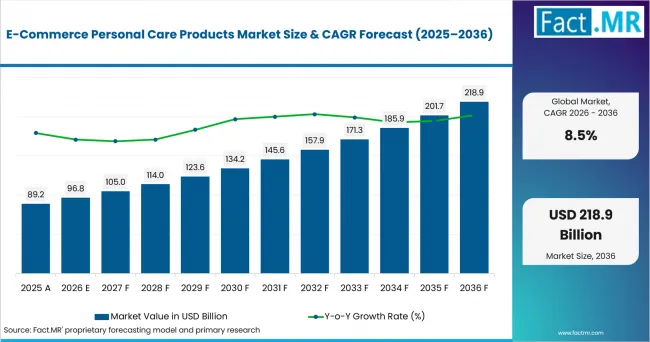
E Commerce Personal Care Products Market Value Analysis | Source: Fact.MR
What are the defining numbers behind E-Commerce Personal Care Products Market growth?
An absolute opportunity of USD 121.7 billion is expected between 2026 and 2036.
- Demand Drivers in the Market
- Rising online purchasing is expanding the addressable customer base for personal care brands. In 2025, 78% of people in the European Union bought or ordered goods or services online, compared with 62% in 2015. This wider digital buying habit supports more frequent online purchases of skincare, hair care and other replenishment-led products.
- Personal care products suit e-commerce because many categories involve repeat purchases. Products such as cleansers, moisturizers, shampoos and oral care items are consumed regularly, allowing platforms and brands to use subscriptions, reminders and personalized recommendations to improve repeat ordering.
- Marketplace and direct-to-consumer channels are giving brands access to customers beyond physical retail networks. This is particularly relevant for specialist skincare and beauty brands that can use product reviews, ingredient information and digital content to support discovery without securing extensive store distribution.
- Growth in mobile shopping and digital payments is reducing friction across product discovery and checkout. Consumers can compare formulations, prices and reviews before purchasing, while brands can use transaction data to refine promotions and product recommendations.
- The continued expansion of retail e-commerce supports investment in online personal care channels. U.S. retail e-commerce sales increased 9.7% year over year during the first quarter of 2026, compared with 4.0% growth in total retail sales.
- Key Segments Analyzed
- Skincare Products leads the Product Category segment with a 38.0% share in 2026, supported by frequent replenishment and strong online product discovery.
- Daily Personal Care accounts for 41.0% of the Shopping Purpose segment in 2026, reflecting recurring demand for routinely used products.
- Beauty & Cosmetics holds a 43.0% share of the Product Segment in 2026, aided by digital reviews and social-commerce-driven discovery.
- Individual Consumers lead the Consumer Group segment with a 40.0% share in 2026, as most purchases are made directly for personal use.
- Marketplace Platforms account for 42.0% of the Sales Platform segment in 2026, benefiting from broad assortment and established fulfilment.
- Analyst Opinion at Fact.MR
- Shambhu Nath Jha, Principal Consultant at Fact.MR, states, “E-Commerce Personal Care Products companies need to show how the product fits each use case rather than compete on generic claims. Leading positioning supports premium demand, but repeat sales are expected to depend on consistent quality, clear documentation and a measurable outcome. As the market grows from 96.8 USD Billion to 218.5 USD Billion during the forecast period, buyers are expected to reward suppliers that can prove value and reliability. Reliable supply and transparent specification are expected to decide repeat sales more than broad category narratives.”
- Strategic Implications
- Brand owners should position offerings by application fit rather than generic capability claims. Clearer articulation of the specific use case and the supporting evidence is expected to shorten the buying decision and strengthen pricing power.
- Suppliers can strengthen retention by documenting specification, compliance and performance in simple customer-facing materials. Transparent documentation reduces evaluation friction and supports repeat purchasing, particularly in compliance-heavy regions.
- Distributors should plan channel strategies around the leading segment and the fastest-growing use cases. Aligning inventory, pricing and promotion with the share leaders is expected to improve margin capture.
- Pricing strategy should reflect the value of documented outcomes rather than raw capacity. Differentiating on reliability, compliance and committed service levels is expected to protect margins against lower-cost substitutes.
How does the E-Commerce Personal Care Products Market break down by segment?
The E-Commerce Personal Care Products Market is segmented by Product Category, Shopping Purpose, Product Segment, Consumer Group and Sales Platform. By Product Category, the market includes Skincare Products, Hair Care Products, Oral Care Products, and Cosmetics & Fragrances. By Shopping Purpose, it covers Daily Personal Care, Hair Treatment, Oral Hygiene, and Beauty Enhancement. By Product Segment, the market is divided into Beauty & Cosmetics, Hair Care, Oral Care, and Color Cosmetics. By Consumer Group, it includes Individual Consumers, Men Consumers, Family Households, Young Adults, Healthcare-conscious Consumers, Beauty Enthusiasts, and Professional Users. By Sales Platform, the market covers Marketplace Platforms, Brand-owned Online Stores, Direct-to-Consumer Websites, Mobile Commerce Applications, Social Commerce Platforms, and Omnichannel Retail.
Why does Skincare Products lead Product Category?
Skincare Products is projected to account for 38.0% share in 2026.
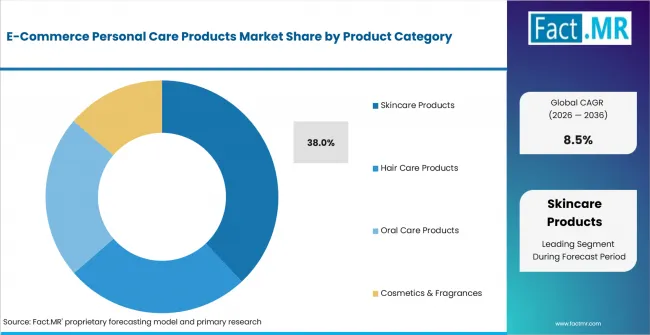
E Commerce Personal Care Products Market Analysis By Product Category | Source: Fact.MR
Skincare Products lead because they cover frequently purchased categories such as cleansers, moisturizers, sunscreens, treatment products and facial care. Online channels allow consumers to compare ingredients, product claims and reviews before purchase, while subscription and replenishment features support repeat orders. Eurostat data show that 28.1% of people in the EU bought cosmetics, beauty or wellness products online within a three-month period, demonstrating that personal-care purchasing has become a regular part of digital shopping. Skincare also benefits from broad usage across age groups and price tiers, giving retailers a larger repeat-purchase base than narrower categories such as fragrances or color cosmetics.
Why does Daily Personal Care lead Shopping Purpose?
Daily Personal Care is projected to account for 41.0% share in 2026.
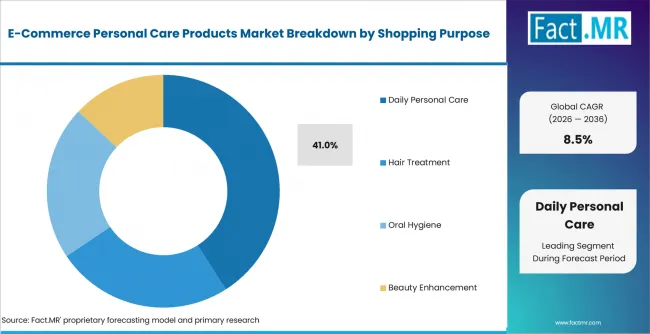
E Commerce Personal Care Products Market Analysis By Shopping Purpose | Source: Fact.MR
Daily Personal Care leads because products such as cleansers, moisturizers, shampoos, toothpaste and deodorants are consumed continuously and require regular replacement. This creates a predictable purchase cycle that suits online reminders, subscriptions and multi-pack ordering. The category is less dependent on occasional events than beauty-enhancement purchases, and consumers can reorder familiar products without evaluating them in a physical store each time. In China, online sales of daily necessities increased 4.1% in 2025, while physical-goods e-commerce represented 26.1% of total retail sales, indicating that routine household and personal-use products are increasingly purchased through digital channels.
Why does Beauty & Cosmetics lead Product Segment?
Beauty & Cosmetics is projected to account for 43.0% share in 2026.
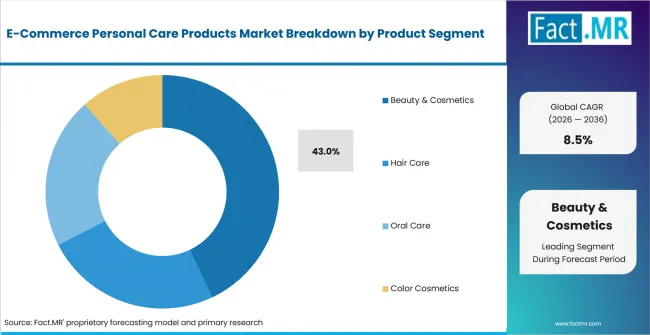
E Commerce Personal Care Products Market Analysis By Product Segment | Source: Fact.MR
Beauty & Cosmetics lead Product Segment because the category combines a broad assortment with strong digital discovery. Consumers can compare shades, formulations, prices and user reviews across multiple brands, while video demonstrations and virtual try-on tools reduce some of the uncertainty associated with purchasing cosmetics online. In South Korea, official statistics recorded KRW 13.85 trillion in online cosmetics transactions during 2025. January 2026 cosmetics transactions were 10.7% higher than a year earlier, showing continued momentum in a market where mobile shopping and product discovery are closely linked.
Why does Individual Consumers lead Consumer Group?
Individual Consumers is projected to account for 40.0% share in 2026.
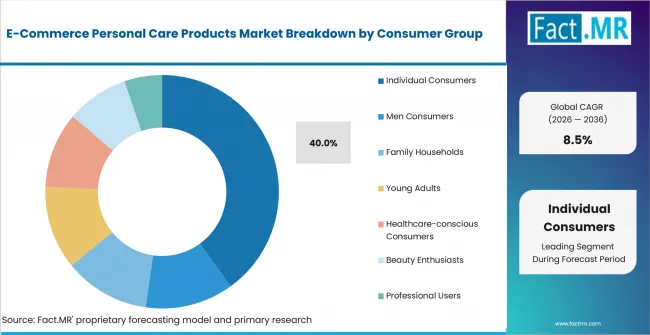
E Commerce Personal Care Products Market Analysis By Consumer Group | Source: Fact.MR
Individual Consumers lead because personal care is primarily selected according to personal skin type, hair condition, age, routine and product preference. E-commerce platforms support this behavior by offering search filters, product comparisons and personalized recommendations at the level of the individual buyer. Eurostat reported that 77% of EU internet users purchased goods or services online in 2024, up from 59% in 2014. This large consumer base gives personal-care brands direct access to buyers without relying solely on institutional or professional purchasing channels.
Why does Marketplace Platforms lead Sales Platform?
Marketplace Platforms is projected to account for 42.0% share in 2026.
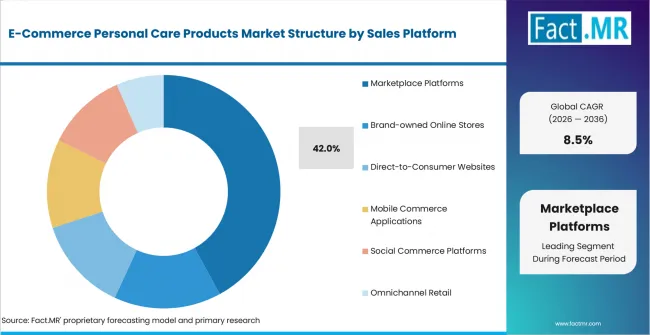
E Commerce Personal Care Products Market Analysis By Sales Platform | Source: Fact.MR
Marketplace Platforms lead because they aggregate products from established brands, specialist labels and third-party sellers within one searchable environment. Consumers can compare prices, delivery options and reviews without visiting several brand websites, while sellers gain access to an existing customer base and fulfilment infrastructure. The OECD identifies online marketplaces as important intermediaries that match buyers and sellers and can reduce search and transaction costs. Their scale is particularly relevant in personal care, where assortment depth and product comparison influence conversion, although brand-owned stores remain important for first-party data and loyalty programmes.
What is accelerating E-Commerce Personal Care Products Market adoption, and what is holding it back?
Drivers Impact Analysis
| Driver | (~) % Impact on CAGR | Geographic Relevance | Impact Timeline |
|---|---|---|---|
| Adoption and integration | +1.6% | Global | Short term (≤ 2 years) |
| Regulatory and compliance support | +1.4% | USA, Germany and UK | Short term (≤ 2 years) |
| Channel and access expansion | +1.1% | Global | Medium term (2-4 years) |
| Clear specification and documentation | +0.9% | USA, UK and Canada | Medium term (2-4 years) |
| Cost and efficiency gains | +0.6% | Global | Long term (≥ 4 years) |
Source: Fact.MR analysis. Updated Aug 6, 2026
Opportunity Impact Analysis
| Opportunity | (~) % Impact on CAGR | Geographic Relevance | Impact Timeline |
|---|---|---|---|
| Emerging application expansion | +1.0% | Global | Medium term (2-4 years) |
| Premium and specialist positioning | +0.8% | USA, UK and Germany | Medium term (2-4 years) |
| Channel and partner expansion | +0.7% | Global | Long term (≥ 4 years) |
| Standards and compliance alignment | +0.5% | USA, Canada and Singapore | Long term (≥ 4 years) |
Source: Fact.MR analysis. Updated Aug 6, 2026
Restraints Impact Analysis
| Restraint | (~) % Impact on CAGR | Geographic Relevance | Impact Timeline |
|---|---|---|---|
| Cost and complexity | -1.1% | Global | Short term (≤ 2 years) |
| Specification and compliance checks | -0.9% | USA, UK and Germany | Short term (≤ 2 years) |
| Substitution by lower-cost alternatives | -0.7% | Import-dependent markets | Medium term (2-4 years) |
| Supply chain and pricing pressure | -0.5% | Global | Long term (≥ 4 years) |
Source: Fact.MR analysis. Updated Aug 6, 2026
Which countries are scaling the E-Commerce Personal Care Products Market fastest?
- U.S. retail e-commerce sales reached USD 326.7 billion in the first quarter of 2026 and represented 16.8% of total retail sales. The scale of digital purchasing gives personal-care brands a large addressable audience for replenishment products, new launches and direct-to-consumer programmes.
- China's online retail sales reached 15.97 trillion in 2025, with physical-goods e-commerce accounting for 26.1% of total consumer-goods retail sales. The market's marketplace scale and high mobile usage support rapid distribution of skincare, cosmetics and daily-care products.
- Japan's domestic business-to-consumer e-commerce market reached 26.1 trillion in 2024, increasing 5.1% from the previous year. A mature online retail environment supports personal-care brands that compete through product detail, trusted fulfilment and repeat purchasing.
- In Germany, online purchasing is well established, while EU data show that cosmetics, beauty and wellness products are a significant online-shopping category. Demand is supported by consumers seeking ingredient information, product comparisons and dependable delivery from compliant sellers.
- Canadian retail e-commerce sales reached CAD 4.0 billion in November 2025 and accounted for 5.7% of total retail trade. The recurring online transaction base supports marketplace and omnichannel sales of personal-care products, particularly in urban markets.
- South Korea recorded KRW 13.85 trillion in online cosmetics transactions during 2025, and cosmetics sales rose 10.7% year over year in January 2026. High mobile-shopping penetration and strong digital product discovery make the country especially suitable for online beauty and skincare sales.
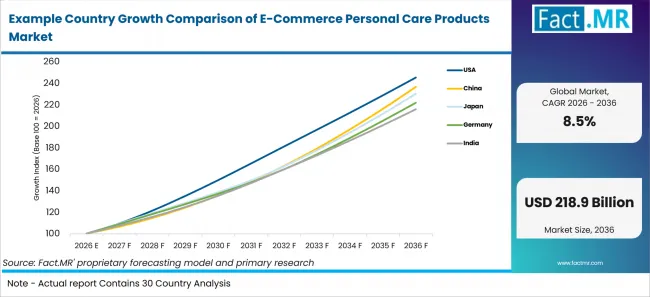
Example Country Growth Comparison Of E Commerce Personal Care Products Market | Source: Fact.MR
| Country | CAGR (2026-2036) |
|---|---|
| USA | 9.4% |
| Japan | 8.7% |
| Germany | 8.3% |
| Canada | 7.6% |
| South Korea | 7.2% |
Source: Fact.MR analysis. Updated Aug 6, 2026
What is driving USA's growth through 2036?
The USA is forecast to expand at a 9.4% CAGR from 2026 to 2036.
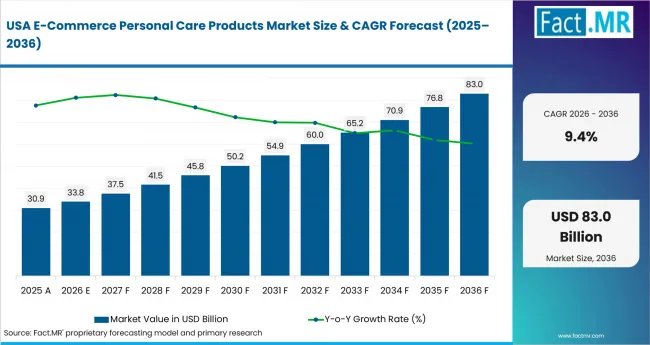
E Commerce Personal Care Products Market Country Value Analysis | Source: Fact.MR
U.S. retail e-commerce sales reached USD 326.7 billion in the first quarter of 2026 and represented 16.8% of total retail sales. This large online purchasing base supports recurring sales of skincare, hair care and oral-care products, while direct-to-consumer sites allow brands to introduce products, collect first-party customer data and offer replenishment programmes.
What is driving China's growth through 2036?
China is forecast to expand at a 9.0% CAGR from 2026 to 2036.
Online retail sales reached RMB 15.97 trillion in 2025, and physical goods sold online accounted for 26.1% of total consumer-goods retail sales. Personal-care suppliers benefit from the country's large marketplace ecosystems and mobile-first shopping behavior, which can move new products from discovery to purchase at considerable scale.
What is driving Japan's growth through 2036?
Japan is forecast to expand at an 8.7% CAGR from 2026 to 2036.
METI valued Japan's domestic B2C e-commerce market at JPY 26.1 trillion in 2024, up 5.1% from 2023. Growth in personal care is supported by an established online retail infrastructure and consumer emphasis on product quality, detailed information and reliable delivery.
What is driving Germany's growth through 2036?
Germany is forecast to expand at an 8.3% CAGR from 2026 to 2036.
Online purchasing is deeply embedded in the country's consumer market, while cosmetics, beauty and wellness products are among the categories tracked by Eurostat for internet purchases. Demand is strengthened by consumers comparing ingredients and product claims, alongside the need for sellers to maintain clear labelling and regulatory compliance.
What is driving India's growth through 2036?
India is forecast to expand at an 8.0% CAGR from 2026 to 2036.
The government-backed ONDC initiative includes beauty and personal-care categories and is designed to connect buyers and sellers through interoperable digital networks. Wider participation by smaller retailers and brands can improve assortment and geographic reach beyond conventional marketplace-led commerce.
What is driving Canada's growth through 2036?
Canada is forecast to expand at a 7.6% CAGR from 2026 to 2036.
Retail e-commerce sales reached CAD 4.0 billion in November 2025 and represented 5.7% of total retail trade. Personal-care brands can use online and omnichannel retail to serve a geographically dispersed population while maintaining consistent availability across stores and digital channels.
What is driving South Korea's growth through 2036?
South Korea is forecast to expand at a 7.2% CAGR from 2026 to 2036.
Official statistics show that online cosmetics transactions reached KRW 13.85 trillion in 2025, while January 2026 sales increased 10.7% year over year. Mobile shopping accounted for 78.2% of total online shopping value in January 2026, supporting rapid product discovery and purchase through smartphone-led commerce.
Who leads the E-Commerce Personal Care Products Market?
L'Oréal, Procter & Gamble and Unilever are among the leading participants because they combine broad personal-care portfolios with extensive retail and digital distribution. Estée Lauder, Beiersdorf and Shiseido hold strong positions in skincare and prestige beauty, while Colgate-Palmolive, Kenvue, Kao and Coty compete through oral care, skin health, hair care and cosmetics portfolios.
Competition is shaped by brand trust, product efficacy, assortment depth and the ability to convert digital discovery into repeat purchases. Large companies benefit from marketing scale and established retailer relationships, while specialist brands can gain share through focused formulations and direct-to-consumer engagement. The online channel also raises the importance of clear ingredient information, authentic reviews, compliant claims and dependable fulfilment. Eurostat's finding that 28.1% of EU consumers purchased cosmetics, beauty or wellness products online within three months illustrates the size of the digitally active customer base available to both global and specialist brands.
Which companies are the key providers?
Key companies include L'Oréal S.A.; The Procter & Gamble Company; Unilever PLC; The Estée Lauder Companies Inc.; Beiersdorf AG; Shiseido Company, Limited; Colgate-Palmolive Company; Johnson & Johnson; Kao Corporation; Coty Inc..
- L'Oréal S.A.
- The Procter & Gamble Company
- Unilever PLC
- The Estée Lauder Companies Inc.
- Beiersdorf AG
- Shiseido Company, Limited
- Colgate-Palmolive Company
- Kenvue Inc.
- Kao Corporation
- Coty Inc.
Bibliography
- Eurostat. (2025). Online shopping in the EU keeps growing. European Commission.
- Eurostat. (2026). Internet purchases: Cosmetics, beauty or wellness products. European Commission.
- Government of India, Press Information Bureau. (2025). Revolutionizing Digital Commerce: The ONDC Initiative.
- Ministry of Economy, Trade and Industry, Japan. (2025). Results of FY2024 E-Commerce Market Survey Compiled.
- National Bureau of Statistics of China. (2026). Total Retail Sales of Consumer Goods in December 2025.
- OECD. (2019). An Introduction to Online Platforms and Their Role in the Digital Transformation. OECD Publishing.
- Statistics Canada. (2026). Retail trade, November 2025.
- Statistics Korea. (2026). Online Shopping in January 2026.
- U.S. Census Bureau. (2026). Quarterly Retail E-Commerce Sales: First Quarter 2026.
This report answers
- Competitive analysis evaluates major personal-care companies according to portfolio breadth, digital distribution and category positioning.
- The assessment examines online personal-care purchasing with attention to channel access, product fit and repeat-purchase behavior.
- What does the E-Commerce Personal Care Products Market cover? The market covers personal care products purchased through online retail channels.
- The market includes skincare, hair care, oral care, cosmetics and fragrances sold through marketplaces, brand-owned stores, direct-to-consumer websites, mobile applications, social-commerce platforms and omnichannel retailers.
- What is included in the scope? The assessment covers the stated product categories, consumer groups, sales platforms, regions and countries.
Segmentation
What is the report's scope and coverage?
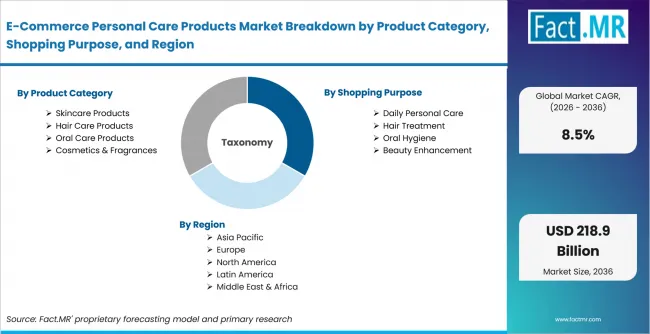
E Commerce Personal Care Products Market Breakdown By Product Category, Shopping Purpose, And Region | Source: Fact.MR
| Attribute | Details |
|---|---|
| Quantitative Units | USD billion in 2026 and 2036, with CAGR for 2026 to 2036 |
| Market Definition | Personal care products sold through marketplaces, brand-owned stores, direct-to-consumer websites, mobile applications, social-commerce platforms and omnichannel retailers |
| Segments Covered | Product Category; Shopping Purpose; Product Segment; Consumer Group; Sales Platform |
| Regions Covered | North America; Latin America; Europe; East Asia; South Asia and Pacific; Middle East and Africa |
| Countries Covered | USA; China; Japan; Germany; India; Canada; South Korea |
| Key Companies Profiled | L'Oréal S.A.; The Procter & Gamble Company; Unilever PLC; The Estée Lauder Companies Inc.; Beiersdorf AG; and others |
| Forecast Period | L'Oréal S.A.; The Procter & Gamble Company; Unilever PLC; The Estée Lauder Companies Inc.; Beiersdorf AG; and others |
| Approach | Hybrid top-down and bottom-up approach using segment demand; share; country growth; channel visibility; pricing; and company portfolio review |
Source: Fact.MR analysis. Updated Aug 6, 2026
How is the market segmented?
-
By Product Category:
- Skincare Products
- Facial Cleansers
- Moisturizers
- Hair Care Products
- Shampoos
- Conditioners
- Oral Care Products
- Toothpaste
- Mouthwash
- Cosmetics & Fragrances
- Color Cosmetics
- Fragrances
- Skincare Products
-
By Shopping Purpose:
- Daily Personal Care
- Daily Essentials
- Skin Maintenance
- Hair Treatment
- Hair Nourishment
- Hair Repair
- Oral Hygiene
- Daily Brushing
- Preventive Care
- Beauty Enhancement
- Makeup Products
- Premium Perfumes
- Daily Personal Care
-
By Product Segment:
- Beauty & Cosmetics
- Facial Care
- Anti-aging Products
- Hair Care
- Hair Styling Products
- Hair Color Products
- Oral Care
- Toothpaste
- Mouthwash
- Color Cosmetics
- Face Makeup
- Luxury Fragrances
- Beauty & Cosmetics
-
By Consumer Group:
- Individual Consumers
- Adult Consumers
- Women Consumers
- Men Consumers
- Family Households
- Young Adults
- Healthcare-conscious Consumers
- Families
- Senior Consumers
- Beauty Enthusiasts
- Professional Users
- Premium Consumers
- Individual Consumers
-
By Sales Platform:
- Marketplace Platforms
- Third-party Marketplaces
- B2C E-commerce Portals
- Brand-owned Online Stores
- Direct-to-Consumer Websites
- Mobile Commerce Applications
- Social Commerce Platforms
- Live Commerce Platforms
- Subscription Commerce
- Omnichannel Retail
- Click-and-Collect
- AI-powered Shopping Assistant
- Marketplace Platforms
-
By Region:
- North America
- Latin America
- Western Europe
- Eastern Europe
- East Asia
- South Asia and Pacific
- Middle East & Africa
Frequently Asked Questions
Which Product Category leads the market?
Which Shopping Purpose leads the market?
The primary driver is the expansion of online retail access for frequently replenished skincare, hair care and oral-care products.
The main restraint is the difficulty of assessing product suitability, authenticity and claims without physical inspection.
Major companies assessed include L'Oréal S.A.; The Procter & Gamble Company; Unilever PLC; The Estée Lauder Companies Inc.; Beiersdorf AG; Shiseido Company, Limited; Colgate-Palmolive Company; Kenvue Inc.; Kao Corporation; and Coty Inc.
Which companies are included in the market assessment?
Who worked on this report


Preview the report firsthand - request a free sample
Free SampleGet the brochure for pricing and purchase details
Download PDF