- Estimated Value(2026): 15.0 Bn
- Forecast Value (2036): 26.1 Bn
- CAGR (2026 - 2036): 5.7%
Astringent Skin Care Products Market Forecast and Outlook 2026 to 2036
In 2025, the astringent skin care products market surpassed a valuation of USD 14.2 billion. Based on Fact.MR analysis, demand for astringent skin care products is estimated to grow to USD 15.0 billion in 2026 and USD 26.1 billion by 2036. Fact.MR projects a CAGR of 5.7% during the forecast period.
The market is expected to generate an absolute dollar opportunity of USD 11.9 billion between 2026 and 2036. This transformational increment reflects the category's successful evolution beyond its traditional identity as an alcohol-heavy toner into a clinically validated sebum-management and pore-refining solution segment.
Nicolas Hieronimus, the CEO of L'Oréal noted, "We are truly entering a new era of science, where beauty and longevity will be intertwined for the wellbeing of the population. The future of beauty lies in a 'new paradigm of longevity', shifting the focus from symptom correction to root cause intervention. Our goal is to empower consumers to move from corrective care to preventive care, backed by integrative science that explores how cellular activity and inflammation impact skin health."
Country growth rates reflect the varying interplay between urbanization, regulatory frameworks, and social media-driven skin awareness. China leads at 8.2% CAGR, driven by a massive urban Gen Z population with high humidity-related oiliness and K-beauty and C-beauty influenced multi-step routines that integrate astringent products as standard toner steps. India follows at 7.9% as tropical climate conditions and Ayurvedic formulation innovation fuel a domestically produced astringent and pore-refining segment. Germany posts 6.8% growth anchored by EU cosmetics regulation compliance driving reformulation of existing astringent SKUs toward alcohol-free and dermatologically tested alternatives. Brazil records 6.0% from its humid coastal climate creating structural oily skin prevalence and expanding middle-class skincare spend. The United States grows at 5.8% led by Gen Z and Gen Alpha consumers engaging with acne and oily skin treatments.
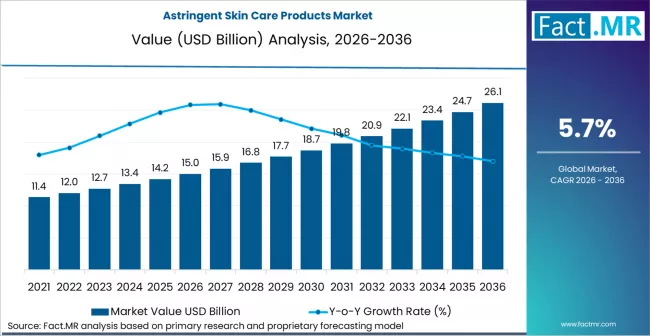
Astringent Skin Care Products Market Market Value Analysis | Source: Fact.MR
| Metric | Value |
|---|---|
| Estimated Value in 2026 | USD 15.0 billion |
| Forecast Value in 2036 | USD 26.1 billion |
| Forecast CAGR (2026 to 2036) | 5.7% |
Source: Fact.MR analysis. Updated Feb 25, 2026
Market Definition
The astringent skin care products market includes topical formulations designed to reduce excess sebum, temporarily tighten pores, and improve skin texture, primarily for oily, acne-prone, and combination skin types. Products encompass traditional alcohol-based toners, modern alcohol-free salicylic acid and BHA formulations, mattifying creams, gels, lotions, and powders, sold through mass-market, pharmacy, specialty beauty, and online channels to women, men, and unisex consumer groups globally.
Market Inclusions
The report covers global and regional revenues from 2026 to 2036 segmented by product type, skin type target, distribution channel, end user, and geography. It evaluates mass-market versus prestige pricing dynamics, alcohol-free reformulation trends, online retail penetration, and dermatologist-recommended channel performance. Country forecasts include China, India, Germany, Brazil, and the United States, with broader regional coverage across five geographies.
Market Exclusions
The study excludes general facial cleansers and micellar waters not formulated with astringent-active ingredients. It excludes medically prescribed topical acne treatments containing tretinoin, clindamycin, or adapalene, which fall under pharmaceutical rather than cosmetic regulation. Broad skincare sets where the astringent component is incidental rather than primary are excluded, as are natural/herbal products marketed purely as facial mists without pore-tightening actives.
Research Methodology
- Primary Research: Interviews were conducted with dermatologists, licensed estheticians, retail beauty buyers at major specialty and mass-market chains, brand managers at prestige and independent skincare labels, and online channel analysts across North America, Europe, and Asia Pacific.
- Desk Research: Sources included EU Cosmetics Regulation (EC) No 1223/2009 filings, FDA OTC monograph guidance on acne cosmetics, brand press releases and annual reports from L'Oreal, Beiersdorf, Shiseido, and Procter & Gamble, and retail sell-through data from publicly disclosed sources.
- Market Sizing and Forecasting: A hybrid model was applied. Top-down inputs included global oily and acne-prone skin prevalence data, total skincare market sizing, and segment penetration rates by region. Bottom-up inputs incorporated average selling price by product format and channel, unit volume estimates by skin type target, and growth rate assumptions from distributor and brand interviews.
- Data Validation and Update Cycle: Outputs were cross-validated against publicly disclosed brand revenue data, retail audit reports, dermatology journal prevalence studies, and regulatory body cosmetic ingredient registers. Forecasts are reviewed annually with semi-annual regulatory and product launch monitoring.
Summary
- Market Definition
- Astringent skin care products are sebum-control and pore-refining topical formulations sold in cream, gel, lotion, and powder formats to individuals with oily, acne-prone, combination, and sensitive skin types through mass, specialty, pharmacy, and online retail channels.
- Demand Drivers
- High prevalence of oily and acne prone skin, affecting about 54 percent of the population, sustains steady demand for dermatologist recommended sebum control products.
- Gen Z and Gen Alpha in North America and Asia Pacific are accelerating adoption of skin specific formulas, driven by social media awareness around salicylic acid, niacinamide, and BHA routines.
- EU Cosmetics Regulation requirements are pushing brands to shift from alcohol heavy formulas to clinically tested alcohol free alternatives, increasing R&D spend and raising average selling prices in Europe.
- Key Segments Analyzed
- By Product Type: Mattifying Creams hold about 36.2% share in 2025, overtaking liquid toners due to combined sebum control and moisturising benefits without excessive dryness.
- By Skin Type: Oily Skin accounts for roughly 47.3% of segment value, driven by high usage frequency, while Acne Prone Skin is the fastest growing sub segment led by Gen Z demand.
- By Distribution Channel: Online Retail is the fastest growing channel, whereas Specialty Beauty Stores generate the highest average transaction value, especially in North America.
- By End User: Women remain the largest segment, while Men is the fastest growing, supported by expanding male skincare portfolios.
- By Geography: Asia Pacific leads in volume and growth, led by China and India, while North America records the highest average revenue per unit due to premium penetration.
- Analyst Opinion at FACT.MR
- Shambhu Nath Jha, Principal Consultant at Fact.MR, opines, ‘CXOs will find this report essential for understanding how the astringent category is splitting between declining alcohol based toners and a fast growing premium barrier safe sebum control segment. It also highlights which brand models, ingredient platforms, and channel strategies are positioned to capture the USD 11.9 billion opportunity through 2036’.
- Strategic Implications / Executive Takeaways
- Prestige and mass brands must reformulate alcohol based SKUs into barrier friendly salicylic acid and ceramide blends, as Gen Z consumers prefer nondrying formulas.
- Companies should strengthen clinical testing to support dermatologist claims, following Byoma’s USD 2 million investment across 75 independent trials that raised credibility standards. [2]
- Premium launches should prioritise online and specialty beauty channels, where social commerce and influencer discovery drive trial among consumers aged 15 to 30.
- Methodology
- Market sizing combined oily and acne prone skin prevalence with adoption rates by format and channel, validated against brand revenues and retail audits.
- Segment shares were benchmarked using launch databases, distributor volumes, and primary interviews with retail buyers.
- Regional forecasts factored in EU regulations, U.S. Gen Z spending trends, China C beauty platform sales, and India urban skincare expenditure data.
Segmental Analysis
Astringent Skin Care Products Market Analysis by Product Type
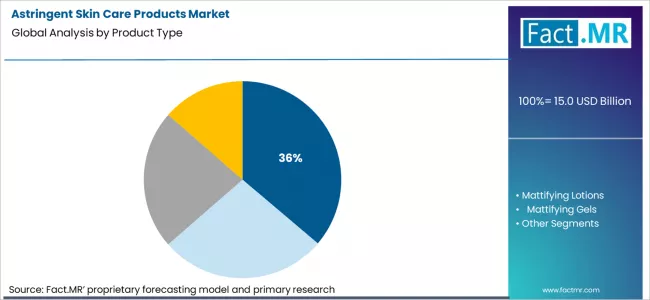
Astringent Skin Care Products Market Analysis By Product Type | Source: Fact.MR
Mattifying Creams are projected to hold 36.2% share in 2025. The format addresses dryness concerns by combining shine control with moisturising bases. It replaces separate toner and moisturizer steps, appealing to younger consumers seeking simple routines with visible results.
- L'Oreal La Roche Posay AI Acne Coaching App Launch: In May 2025, L'Oreal Groupe introduced La Roche Posay Spotscan+Coach at Viva Technology. [5] The AI app links personalised analysis with Effaclar alcohol free products, strengthening its dermatologist led positioning and premium pricing.
- Byoma Blemish Mattifying System Clinical Launch: In September 2025, BYOMA launched its Blemish range featuring Clearamide Complex with ceramides and salicylic acid. The brand invested over USD 2 million in 75 clinical trials, setting a new documentation benchmark. Industry estimates project USD 25 to 50 million in first year retail sales at accessible price points.
- Online Retail Concentration of Mattifying Toner Demand: Yipit Data shows two of the top five Amazon toners in 2025 were milky or mattifying K beauty formats from TirTir and Anua. [6] Bubble Skincare, which achieved nine figure revenue in 2024, also captures strong pore control demand through its wide omnichannel network.
Astringent Skin Care Products Market Analysis by Skin Type
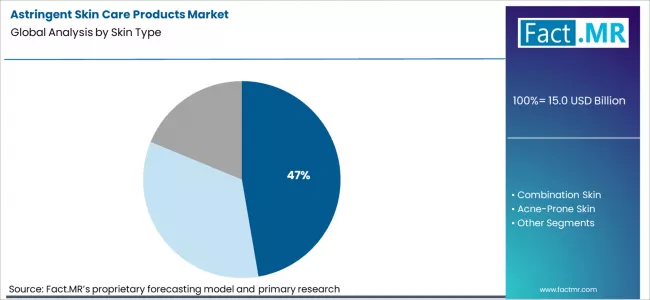
Astringent Skin Care Products Market Analysis By Skin Type | Source: Fact.MR
Oily Skin is expected to hold 47.3% share in 2025. Consumers with oily skin use multiple sebum control products daily, driving higher purchase frequency. Prevalence is especially high in humid Asian and tropical markets, supporting sustained volume growth.
- Beiersdorf NIVEA Oily Skin Range Expansion in Emerging Markets: Beiersdorf reported double digit growth in emerging markets in 2024, driven by its NIVEA Acne Control and oil balancing lines. [7] The company achieved a 14.2% operating margin, supported by expansion in Asia Pacific and Latin America.
- Shiseido Men Sebum Control Product Development for Asia: Shiseido’s 2025 to 2026 plan prioritises men’s skincare and oil control products in Asia Pacific. [8] Its MEN line targets the fast growing male oily skin segment in Japan, South Korea, and China.
- Acne Prone Skin Sub Segment Growth via Social Commerce: Acne affects 85 percent of people aged 12 to 24, and adult acne has risen 10 percent in the past decade. [2] Social platforms amplify awareness of salicylic acid and BHA routines, driving trial among 15 to 30 year olds through mass retail and online channels.
Drivers, Restraints, and Opportunities
Fact.MR estimates the astringent skin care products market at USD 14.2 billion in 2025. The category is evolving from traditional alcohol and witch hazel toners toward science backed, barrier friendly formulations. K beauty routines first expanded usage occasions, but the current shift is driven by the skin barrier movement. Brands are repositioning astringents as targeted sebum control products that support skin health rather than strip it.
The main tension is efficacy versus tolerance. Low priced alcohol toners in the USD 5 to 15 range are losing share to reformulated products priced between USD 14 and 30. These combine salicylic acid with ceramides and soothing ingredients.
- EU Cosmetics Regulation Reformulation Mandate: EU Regulation (EC) No 1223/2009 and SCCS safety reviews impose limits on alcohols, fragrances, and preservatives. [3]
- Gen Z Skin Type Specific Purchasing Behaviour: Byoma’s Blemish range, launched at Target and Sephora in September 2025, generated an estimated USD 25 to 50 million in first year sales. [2] Gen Z consumers are willing to pay more for clinically tested formulas that combine salicylic acid with ceramide protection. This creates a clear trade up opportunity for credible brands.
- Asia Pacific Humidity Driven Structural Demand: China and India are the fastest growing markets. High humidity in many Chinese cities sustains strong demand for oil control products. In India, L'Oreal and Beiersdorf expanded oily skin ranges in 2024 and 2025 as pharmacy and online sales increased. [4]
Regional Analysis
The astringent skin care products market is analysed across North America, Europe, Asia Pacific, Latin America, and Middle East and Africa, with each region assessed by skin type prevalence, regulatory framework for cosmetic actives, social media-driven skin awareness, dermatologist recommendation channel penetration, and specialty versus mass retail dynamics. Country-level coverage includes China, India, Germany, Brazil, and the United States. The full report provides market attractiveness analysis benchmarked against regulatory compliance requirements, consumer willingness to trade up to premium sebum-control formats, and online retail channel maturity.
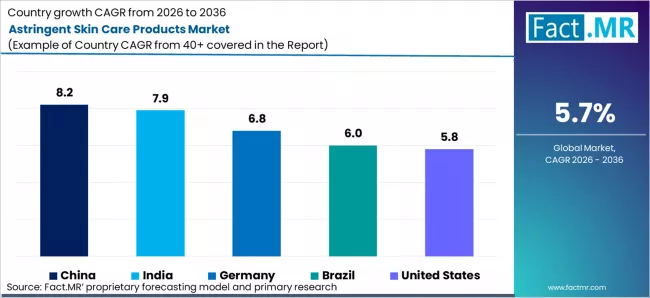
Astringent Skin Care Products Market Cagr Analysis By Country | Source: Fact.MR
| Country | CAGR (2026 to 2036) |
|---|---|
| China | 8.2% |
| India | 7.9% |
| Germany | 6.8% |
| Brazil | 6.0% |
| United States | 5.8% |
Source: Fact.MR analysis. Updated Feb 25, 2026
Source: Fact.MR (FACT.MR) analysis, based on proprietary forecasting model and primary research
Asia Pacific Astringent Skin Care Products Market Analysis
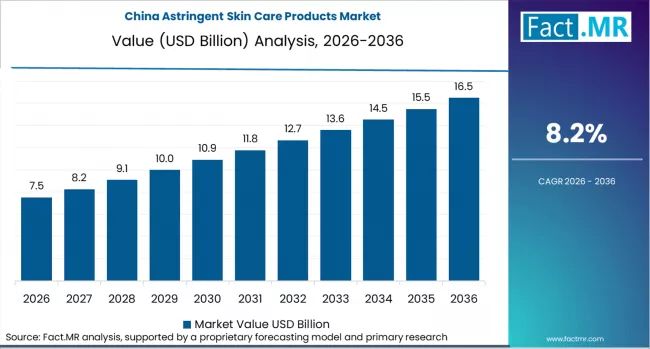
Astringent Skin Care Products Market Country Value Analysis | Source: Fact.MR
Asia Pacific is the main growth engine for astringent skin care. High humidity and a strong multi step toning culture rooted in K beauty support steady demand. L'Oreal leads across pharmacy and mass channels, while Shiseido dominates Japan’s prestige oily skin segment. Domestic Chinese and Indian brands are gaining share online with ingredient transparent formulas targeting Gen Z.
- China: Demand in China is projected to grow at 8.2% CAGR through 2036. NMPA registration rules require brands to file formulations before sale, pushing stronger safety documentation. High humidity in cities such as Shanghai and Guangzhou sustains daily sebum control use among urban youth. In May 2025, L'Oreal launched its Noli AI beauty marketplace to personalise product recommendations. [5]
- India: Demand in India is forecast to grow at 7.9% CAGR through 2036. Tropical climate conditions sustain oily skin demand across income groups. Regulatory alignment with global standards encourages local manufacturing by Beiersdorf and L'Oreal India. Beiersdorf reported strong emerging market growth in 2024, with India as a key driver. [7] Ayurvedic brands using neem and turmeric remain influential in smaller cities, while Nykaa and Amazon India lead premium online sales.
FACT.MR covers China, India, Japan, South Korea, Australia and New Zealand, ASEAN, and Rest of Asia Pacific. The report details NMPA and CDSCO compliance timelines, climate linked demand trends, and online channel benchmarks.
Europe Astringent Skin Care Products Market Analysis
Europe sets global standards for cosmetic safety through EU Regulation (EC) No 1223/2009 and SCCS updates. Reformulation requirements are raising category selling prices. Beiersdorf and L'Oreal lead mass and dermo cosmetic segments across the region.
- Germany: Demand in Germany is projected to rise at 6.8% CAGR through 2036. Beiersdorf’s NIVEA Derma Skin Clear range targets oily and acne prone skin with EU compliant formulations. The company reported 12.0% organic growth in 2024, supported by derma skin care demand. [7]
FACT.MR covers Germany, France, United Kingdom, Italy, Spain, Netherlands, Nordics, and Rest of Europe. The report includes SCCS compliance timelines, reformulation cost impacts, and pharmacy channel penetration data.
North America Astringent Skin Care Products Market Analysis
North America records the highest average revenue per unit in the category. Specialty retailers Ulta Beauty and Sephora position astringents as clinically validated products. Major players include Procter & Gamble, Estée Lauder, L'Oreal USA, Bubble Skincare, and Byoma.
- United States: Demand in the United States is projected to grow at 5.8% CAGR through 2036. Byoma’s Blemish range launched in September 2025 at Target and Sephora, with projected USD 25 to 50 million first year sales. [2] Bubble Skincare generated nine figure revenue in 2024 with 100 percent year over year growth. [6] FDA OTC monograph rules on salicylic acid guide acne related claims, favouring large brands with strong regulatory expertise.
FACT.MR covers the United States, Canada, and Mexico. The report provides FDA compliance data, specialty beauty benchmarks, and Gen Z spending trends across North America.
Latin America Astringent Skin Care Products Market Analysis
Brazil represents one of the most dynamic markets in Latin America, supported by high per capita skincare usage and strong consumer focus on oily and acne prone skin management. A tropical climate sustains year round demand for sebum control products across mass and premium tiers.
- Brazil: Demand in Brazil is projected to grow at 6.0% CAGR through 2036. Tropical climate and strong beauty culture sustain high usage rates. ANVISA regulates cosmetics under frameworks aligned with EU standards. L'Oreal Brazil and Natura & Co lead across mass and prestige tiers. Social media influence is accelerating online sales of premium mattifying formats.
FACT.MR covers Brazil within its broader Latin America assessment. The report includes ANVISA compliance benchmarks, online retail penetration trends, and premium format growth analysis across Brazilian distribution channels.
Competitive Aligners for Market Players
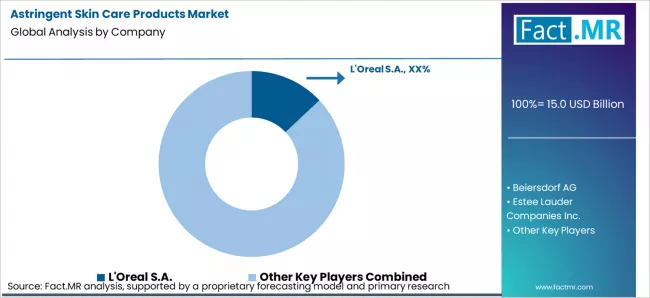
Astringent Skin Care Products Market Analysis By Company | Source: Fact.MR
The global astringent skin care products market is moderately concentrated in the premium and prestige tiers, while the mass and drugstore segment remains fragmented. L'Oreal, Beiersdorf, Shiseido, Procter & Gamble, and Unilever account for the largest share of branded revenue. Competitive advantage is increasingly defined by clinical credibility rather than distribution scale. Brands that can prove sebum control and barrier compatibility through published trials are gaining consumer trust and retail placement. Large incumbents rely on in house dermatology research, while challengers partner with independent labs to build evidence.
L'Oreal benefits from a multi-tier portfolio spanning Garnier, La Roche Posay, and SkinCeuticals, allowing coverage across price points and channels. Beiersdorf mirrors this with NIVEA and Eucerin, supported by strong Derma Skin Care growth. Shiseido is investing in sebum control research in Asia Pacific.
Byoma and Bubble Skincare are capturing Gen Z through ingredient transparency and strong social commerce performance. Retailers such as Ulta Beauty, Target, and Sephora maintain multiple brand options per tier, using shelf competition and sell through data to control pricing and encourage innovation.
Recent Developments
- In September 2025, BYOMA launched its Blemish range at Target in the United States and Sephora in Europe, featuring the Clearamide Complex with ceramide NP and salicylic acid across six products priced between USD 9.99 and USD 15.99, supported by over USD 2 million invested in 75 clinical trials.
- In May 2025, L'Oreal Groupe introduced La Roche Posay Spotscan+Coach at Viva Technology, an AI powered acne coaching app developed with dermatologists to personalise routines and drive Effaclar sebum control product sales across pharmacy and e commerce channels.
Key Players
- L'Oreal S.A.
- Beiersdorf AG
- Estee Lauder Companies Inc.
- Shiseido Company, Limited
- Procter & Gamble Company
- Bubble Skincare Inc.
- Byoma (Bansk Group)
- Unilever PLC
- Skinbetter Science
- Topicals Inc.
- Kiehl's LLC (L'Oreal Group)
Bibliography
- [1] DataM Intelligence / openPR.com. 'United States Skincare Market 2025: Market Growth, Trends & Top Companies Overview.' openPR.com.
- [2] BYOMA (Bansk Group). 'Meet BYOMA Blemish Press Release.' PRNewswire, September 21, 2025.
- [3] European Commission. 'EU Regulation (EC) No 1223/2009 on Cosmetic Products Scientific Committee on Consumer Safety (SCCS) Opinions Register.' European Commission Health & Food Safety Directorate.
- [4] Beiersdorf AG. 'Annual Report 2024 Derma Skin Care Segment and Emerging Market Performance.' Beiersdorf AG Investor Relations, March 2025.
- [5] L'Oreal Groupe. 'L'Oreal unleashes science, technology and creativity to forge new beauty frontiers at Viva Technology 2025.' L'Oreal Press Office, May 2025.
- [6] Glossy. 'Glossy Pop Newsletter: With its new milky toner, Bubble grows up.' Glossy Media, June 2025.
- [7] Beiersdorf AG. 'Beiersdorf Full Year Results 2024.' Beiersdorf AG Investor Relations Press Release, February 2025.
This Report Addresses
- Market intelligence for strategic planning: Provides demand data, segment share, and competitive insights to support formulation and channel decisions across the evolving astringent category.
- Market size and forecast to 2036: Projects revenue growth from USD 15.0 billion in 2026 to USD 26.1 billion by 2036 at 5.7% CAGR, segmented by product type, skin type, channel, end user, and region.
- Growth opportunity mapping: Identifies high growth combinations such as mattifying creams for oily and acne prone skin sold through online and specialty channels in Asia Pacific, with absolute dollar estimates.
- Segment and regional forecasts: Offers CAGR and value projections for China, India, Germany, Brazil, and the United States, with detailed segment splits.
- Competition strategy assessment: Profiles leading global and challenger brands with analysis of clinical investment, channel focus, and ingredient positioning.
- Product and compliance tracking: Monitors EU SCCS updates, FDA OTC rules, NMPA registration in China, and CDSCO alignment in India.
- Regulatory impact analysis: Evaluates how reformulation costs and compliance changes affect pricing and margins through 2036.
- Delivery formats: Available in PDF, PowerPoint, and Excel formats, with customisation options for brand, channel, and innovation scenarios.
Segmentation
Scope of Report
| Items | Values |
|---|---|
| Quantitative Units | USD 15.0 billion (2026) to USD 26.1 billion (2036), at a CAGR of 5.7% |
| Market Definition | Astringent skin care products encompass topical sebum-control and pore-refining formulations including mattifying creams, lotions, gels, and powders . |
| Product Type | Mattifying Creams (36.2% share), Mattifying Lotions, Mattifying Gels, Mattifying Powders |
| Skin Type | Oily Skin (47.3% share), Combination Skin, Acne-Prone Skin, Sensitive Skin |
| Distribution Channel | Supermarkets & Hypermarkets, Online Retail (fastest growing), Specialty Beauty Stores (highest ASP), Pharmacies & Drug Stores |
| End User | Women (leading share), Men (fastest growing), Unisex Consumers |
| Regions Covered | Asia Pacific, Europe, North America, Latin America, Middle East and Africa |
| Countries Covered | China, India, Japan, South Korea, Australia and New Zealand, ASEAN, Rest of Asia Pacific, Germany, France, United Kingdom, Italy, Spain, Netherlands, Nordics, Rest of Europe, United States, Canada, Mexico, Brazil, Colombia, Argentina, Chile, Rest of Latin America, Kingdom of Saudi Arabia, United Arab Emirates, South Africa, Turkey, Rest of Middle East and Africa |
| Key Companies Profiled | L'Oreal S.A., Beiersdorf AG, Estee Lauder Companies Inc., Shiseido Company Limited, Procter & Gamble Company, Bubble Skincare Inc., Byoma (Bansk Group), Unilever PLC, Skinbetter Science, Topicals Inc., Kiehl's LLC, Paula's Choice Skincare |
| Forecast Period | 2026 to 2036 |
| Approach | A hybrid top-down and bottom-up modelling approach was applied. Top-down inputs included global oily and acne-prone skin prevalence data, total skincare market sizing by region, and segment penetration rates by product format and distribution channel. Bottom-up inputs incorporated average selling price benchmarks by product type and channel tier, unit volume estimates by skin type target and geography. |
Source: Fact.MR analysis. Updated Feb 25, 2026
Astringent Skin Care Products Market by Segment
-
By Product Type :
- Mattifying Creams
- Mattifying Lotions
- Mattifying Gels
- Mattifying Powders
-
By Skin Type :
- Oily Skin
- Combination Skin
- Acne-Prone Skin
- Sensitive Skin
-
By Distribution Channel :
- Supermarkets & Hypermarkets
- Online Retail
- Specialty Beauty Stores
- Pharmacies & Drug Stores
-
By End User :
- Women
- Men
- Unisex Consumers
-
By Region :
- North America
- United States
- Canada
- Mexico
- Europe
- Germany
- France
- United Kingdom
- Italy
- Spain
- Netherlands
- Nordics
- Rest of Europe
- Asia Pacific
- China
- India
- Japan
- South Korea
- Australia and New Zealand
- ASEAN
- Rest of Asia Pacific
- Latin America
- Brazil
- Mexico
- Argentina
- Colombia
- Chile
- Rest of Latin America
- Middle East and Africa
- Kingdom of Saudi Arabia
- United Arab Emirates
- South Africa
- Turkey
- Rest of Middle East and Africa
- North America
Frequently Asked Questions
How large is the astringent skin care products market in 2025?
What will the astringent skin care products market size be in 2026?
What is the projected market size by 2036?
What is the expected CAGR from 2026 to 2036?
Which product type segment is poised to lead the astringent skin care products market?
Which skin type segment holds the largest share?
Which country shows the fastest growth rate?
Who worked on this report


Preview the report firsthand - request a free sample
Free SampleGet the brochure for pricing and purchase details
Download PDF