- Market Value (2025): USD 24.7 Bn
- Estimated Value (2026): USD 27.8 Bn
- Forecast Value (2036): USD 89.6 Bn
- CAGR (2026-2036): 12.4%
What is the Massive Open Online Course Mooc Market forecast to be worth by 2036?
USD 27.8 billion in 2026 to USD 89.6 billion by 2036, at 12.4% CAGR.
- Demand is projected to increase from USD 27.8 billion in 2026 to USD 89.6 billion by 2036.
- The market is forecast to record a 12.4% CAGR from 2026 to 2036 as technology skills, professional credentials, enterprise reskilling, and flexible degree-linked learning expand the paid use of online course platforms.
- Purchasing decisions are expected to favor providers that connect current course content with assessment, verified credentials, learner support, skills analytics, and integration into university or workforce systems rather than relying on enrollment volume alone.
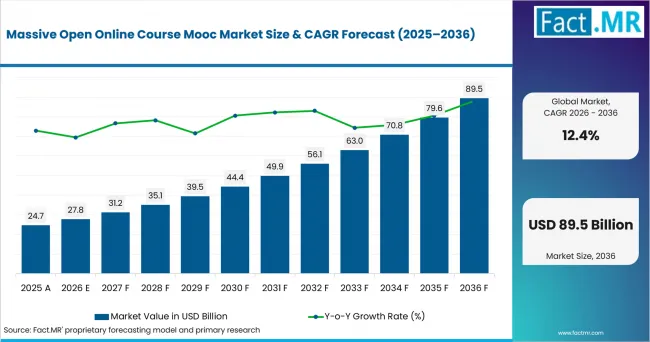
Massive Open Online Course Mooc Market Value Analysis | Source: Fact.MR
What are the defining numbers behind Massive Open Online Course Mooc Market growth?
USD 61.8 billion absolute opportunity by 2036, led by Technology & IT, Self-Paced Learning, Cloud-Based deployment, Individual Learners, and Subscription-Based access.
- Demand Drivers in the Market
- Employers need faster AI, software, data, cloud, and cybersecurity skill renewal because job requirements change more quickly than conventional degree cycles.
- Working professionals need learning formats that fit around employment, family responsibilities, and different time zones without requiring continuous classroom attendance.
- Universities and public programs need modular credentials that can extend access, support continuing education, and connect short learning units with wider academic or workforce pathways.
- Platform buyers need measurable completion, assessment, and skill evidence so course consumption can be translated into promotion, hiring, compliance, or curriculum decisions.
- Key Segments Analyzed
- By Course Type: Technology & IT is expected to hold 34% share in 2026 supported by recurring demand for programming, data science, artificial intelligence, cloud, and related digital capabilities.
- By Delivery Mode: Self-Paced Learning is projected to account for 61% share in 2026 because on-demand courses and recorded lectures allow learners to control timing and repeat difficult material.
- By Deployment: Cloud-Based is anticipated to capture 82% share in 2026 owing to rapid catalog updates, broad device access, scalable enrollment, and centralized analytics across public cloud and software-as-a-service platforms.
- By End User: Individual Learners are estimated to represent 48% share in 2026 as students and working professionals purchase courses, subscriptions, and certificates for academic progress, career entry, and role transitions.
- By Business Model: Subscription-Based is forecast to account for 43% share in 2026 driven by monthly and annual access to broad catalogs, guided pathways, and continuing skill development.
- Analyst Opinion at Fact.MR
- Shambhu Nath Jha, Principal Consultant at Fact.MR, states: “MOOC purchasing is moving beyond course-count comparisons. Individual learners, employers, and universities now evaluate whether a platform keeps artificial intelligence and technical content current, supports completion, produces credible skills evidence, and connects learning records with hiring or workforce systems. Fact.MR is of the opinion that providers will gain durable demand when self-paced convenience is paired with assessment, mentoring, localized content, and recognized credentials rather than relying only on open enrollment.”
- Strategic Implications
- Platform operators should organize large catalogs around job roles, prerequisites, projects, assessments, and next-step recommendations so learners can identify a coherent pathway instead of searching through disconnected courses.
- Enterprise buyers should compare active use, completion, skill gain, manager visibility, identity controls, and integration costs before selecting a multi-seat learning subscription.
- Universities should define how online certificates, microcredentials, and degree modules transfer into formal credit or continuing education before promoting them as stackable pathways.
- Content providers should maintain separate refresh cycles for fast-changing technology subjects and slower-moving academic material because stale examples damage trust in professional learning programs.
How does the Massive Open Online Course Mooc Market break down by segment?
Technology & IT leads at 34%, Self-Paced Learning leads at 61%, Cloud-Based leads at 82%, Individual Learners lead at 48%, and Subscription-Based leads at 43% in 2026.
Why does Technology & IT lead Course Type?
Technology & IT holds 34% share in 2026.
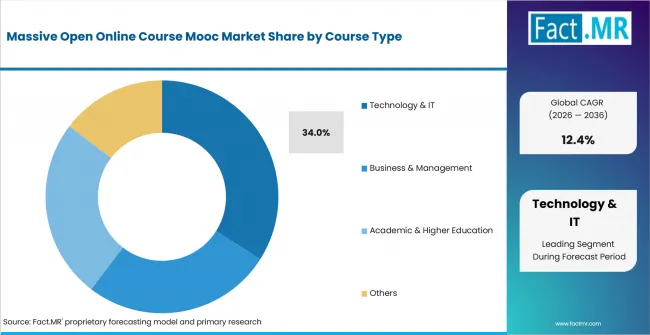
Massive Open Online Course Mooc Market Analysis By Course Type | Source: Fact.MR
Technology & IT is expected to hold 34% share in 2026 because programming and Data Science & AI courses address skills that change rapidly and can be practiced through browser-based exercises, projects, code notebooks, and graded assignments. Coursera reported 5.0 million enrollments in generative artificial intelligence content during 2025, showing how a new technical capability can generate demand across consumer and institutional channels.
Business & Management courses serve leadership and marketing development, while Academic & Higher Education supports degree programs and university courses. Healthcare, languages, and personal development widen the learner base, but their purchase cycles and assessment requirements differ from the recurring update needs of technology roles.
Why does Self-Paced Learning lead Delivery Mode?
Self-Paced Learning holds 61% share in 2026.
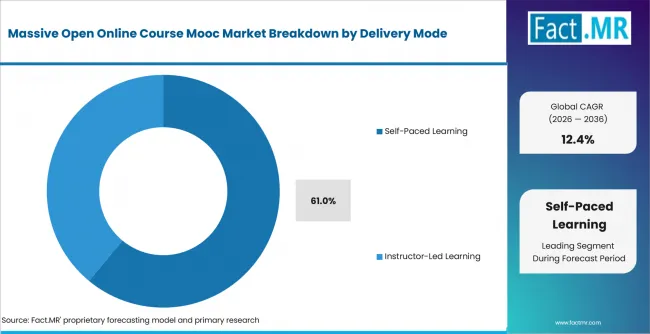
Massive Open Online Course Mooc Market Analysis By Delivery Mode | Source: Fact.MR
Self-Paced Learning is projected to account for 61% share in 2026 because on-demand courses and recorded lectures allow learners to start without waiting for a cohort, pause around work demands, and revisit difficult material. edX provides many courses through self-paced delivery, while major subscription platforms let learners move among subjects within one account. The model lowers scheduling friction but does not remove the need for structure. OECD work on adult online learning has identified motivation, digital readiness, and low completion as persistent constraints, which makes deadlines, progress prompts, peer support, tutoring, and applied projects commercially important. Instructor-Led Learning remains relevant for live virtual classes and cohort-based courses where discussion, accountability, and direct feedback justify fixed schedules.
Why does Cloud-Based lead Deployment?
Cloud-Based deployment holds 82% share in 2026.
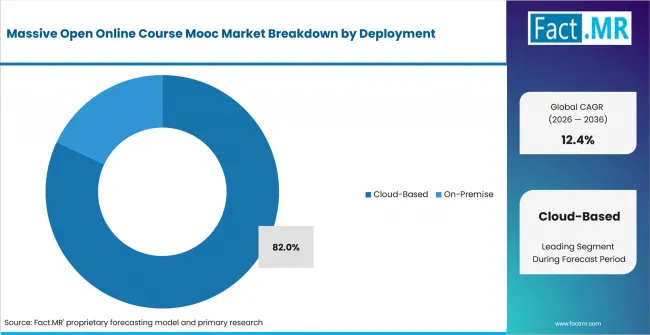
Massive Open Online Course Mooc Market Analysis By Deployment | Source: Fact.MR
Cloud-Based deployment is anticipated to capture 82% share in 2026 because public cloud and software-as-a-service platforms can serve learners across locations while updating content, assessments, subtitles, recommendations, and analytics from a central environment. This architecture supports rapid enrollment changes and enables institutions to assign courses without maintaining a separate content stack. It also helps providers connect identity, payment, proctoring, labs, credentials, and reporting through shared services. On-Premise deployment remains important for enterprise learning systems and private educational networks where data residency, internal identity, restricted content, or network policy requires tighter control. Buyers therefore compare convenience against integration, privacy, uptime, and administrative requirements rather than treating deployment as a purely technical choice.
Why do Individual Learners lead End User?
Individual Learners hold 48% share in 2026.
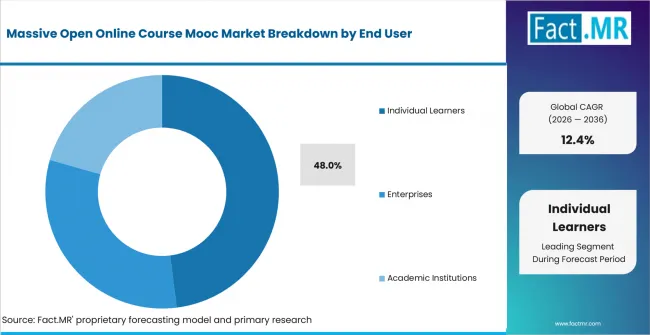
Massive Open Online Course Mooc Market Analysis By End User | Source: Fact.MR
Individual Learners are estimated to represent 48% share in 2026 because students and working professionals make direct decisions about career entry, promotion, academic preparation, certification, and personal skill gaps. A learner can purchase one professional certificate, subscribe for several months, or begin with free content before paying for assessment and credentials. Enterprises create larger account values through corporate training and employee upskilling, but adoption depends on manager sponsorship, procurement cycles, and evidence of active use. Academic Institutions use online courses to extend universities and colleges beyond campus capacity, supplement curricula, or offer modular pathways. The individual segment remains central because it supplies demand signals that often guide which courses later enter employer and university programs.
Why does Subscription-Based lead Business Model?
Subscription-Based holds 43% share in 2026.
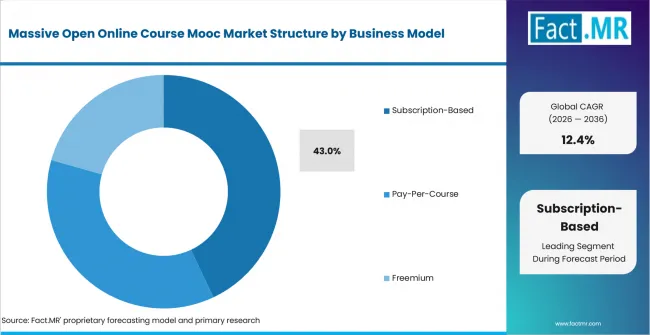
Massive Open Online Course Mooc Market Analysis By Business Model | Source: Fact.MR
Subscription-Based access is forecast to account for 43% share in 2026 because monthly and annual plans let learners move through several courses, compare adjacent subjects, and continue from introductory material into a certificate pathway. Coursera offers monthly and annual Coursera Plus access, while Udemy combines subscriptions with individual course purchases. The model creates recurring revenue for providers but raises pressure to maintain useful recommendations, current content, and visible progress so customers do not cancel after limited use. Pay-Per-Course remains suitable for professional certificates and specialized courses with a defined outcome. Freemium access supports discovery through free courses, while premium certifications create the conversion point where assessment and verified proof carry value.
What is accelerating Massive Open Online Course Mooc Market adoption, and what is holding it back?
Rapid skill change, flexible learning, and credential pathways support adoption, while completion, access, recognition, and content-maintenance requirements restrain sustained use.
Drivers Impact Analysis
| DRIVER | COMMERCIAL EFFECT | GEOGRAPHIC RELEVANCE | IMPACT TIMELINE |
|---|---|---|---|
| AI, software, cloud, data, and cybersecurity skill renewal | Expands recurring enrollment in fast-changing Technology & IT pathways | Global, with USA, Germany, South Korea, and Canada emphasis | Current forecast period |
| Employer-funded reskilling and enterprise learning | Raises demand for multi-seat subscriptions, role pathways, and skills analytics | USA, Canada, UK, Australia, and major enterprise hubs | Current forecast period |
| Stackable certificates and microcredentials | Connects short courses with employment, continuing education, and formal study | UK, Australia, Japan, and selected university systems | Medium term |
| University and company content partnerships | Broadens trusted catalogs and improves subject credibility | Global | Current forecast period |
| Mobile, multilingual, and asynchronous access | Widens participation across location, schedule, and language constraints | Asia Pacific and global learner markets | Medium to long term |
Source: Fact.MR analysis. Updated Aug 5, 2026
- Technology skill renewal: Coursera reported 5.0 million generative artificial intelligence enrollments in 2025, while Udemy reported a catalog of approximately 290,000 courses across 78 languages. These portfolios give learners several entry points into new tools, but platform value depends on whether projects, assessments, and course updates keep pace with workplace use. Providers that can retire obsolete material and publish validated replacements quickly are better positioned for recurring technical demand.
- Employer and institutional purchasing: Coursera reported more than 1,700 paid enterprise customers at the end of 2025, while Skillsoft describes a skills platform serving more than 3,000 customers and about 42 million employees. Enterprise buyers do not purchase access only for content volume. They need role mapping, assignments, reporting, identity management, security, and evidence that employees are using the learning in relevant work.
Opportunity Impact Analysis
| OPPORTUNITY | COMMERCIAL EFFECT | GEOGRAPHIC RELEVANCE | IMPACT TIMELINE |
|---|---|---|---|
| AI, cybersecurity, cloud, and data professional pathways | Creates repeatable demand for current technical content, projects, and verified credentials | USA, South Korea, Germany, Canada, and global technology markets | Current forecast period |
| Employer-integrated skills analytics and role pathways | Turns course activity into workforce planning, mobility, and capability evidence | North America, Europe, Australia, and multinational employers | Medium term |
| Local-language and country-specific catalogs | Improves relevance, comprehension, and conversion outside English-first markets | Japan, South Korea, Europe, and wider Asia Pacific | Medium to long term |
| Stackable microcredentials and credit recognition | Links short online learning with formal qualifications and continuing education | UK, Australia, Japan, Canada, and university systems | Medium to long term |
Source: Fact.MR analysis. Updated Aug 5, 2026
- Professional pathways: Technology courses create stronger commercial value when they form a sequence from foundations through projects, assessment, and job-relevant credentials. Pluralsight emphasizes cloud, artificial intelligence, data, and cybersecurity skills with hands-on practice, while Udacity organizes technology learning through Nanodegree programs. Providers can improve conversion by showing prerequisite logic, expected effort, demonstrable outputs, and the next role or certification that a completed pathway supports.
- Microcredentials and formal recognition: The Australian Government Microcredentials Pilot supports short courses in national priority fields and industry skills, while the United Kingdom Lifelong Learning Entitlement is designed to fund eligible modules and courses, including designated distance-learning and online provision. These programs create an opportunity for MOOC providers to work with accredited institutions, but commercial success requires clear credit rules, quality assurance, learner identity, assessment integrity, and transparent progression into a larger qualification.
Restraints Impact Analysis
| RESTRAINT | COMMERCIAL EFFECT | GEOGRAPHIC RELEVANCE | IMPACT TIMELINE |
|---|---|---|---|
| Low completion and weak learner engagement | Reduces realized learning value and increases subscription cancellation risk | Global individual-learner market | Current forecast period |
| Uneven internet access and digital readiness | Limits participation among learners without reliable devices, connectivity, or study support | Lower-access regions and underserved groups within mature markets | Current forecast period |
| Credential recognition and quality assurance | Slows conversion when employers or institutions cannot compare learning outcomes | Global, especially regulated professions and formal education | Medium term |
| Content refresh, assessment, and support cost | Raises operating expense for fast-changing subjects and high-touch pathways | Technology catalogs and enterprise-grade programs | Medium to long term |
Source: Fact.MR analysis. Updated Aug 5, 2026
- Completion and learner support: OECD analysis notes that online learning can extend access but that participation and completion depend on digital skills, motivation, and learning support. Large enrollment counts therefore do not guarantee course completion or skill transfer. Providers need diagnostic onboarding, realistic workload information, reminders, practice, peer interaction, and timely help so learners can recover after falling behind rather than silently leaving the platform.
- Recognition and operating cost: A certificate has limited value when an employer, university, or professional body cannot understand the assessment standard behind it. At the same time, high-quality technical courses require instructors, editors, lab environments, project review, accessibility work, subtitles, security, and frequent updates. Platforms must decide which subjects warrant deep investment and which can remain lower-cost catalog content, because uniform spending across every course is not commercially sustainable.
Which countries are scaling Massive Open Online Course Mooc Market fastest?
South Korea 13.47%, USA 12.82%, Canada 12.43%, UK 12.19%, Australia 12.12%, Germany 11.97%, and Japan 11.58% through 2036.
Regional analysis covers North America, Europe, Asia Pacific, Central & South America, and the Middle East & Africa. Country commentary below focuses on the seven approved markets and the education, workforce, and platform conditions that shape paid MOOC adoption in each one.
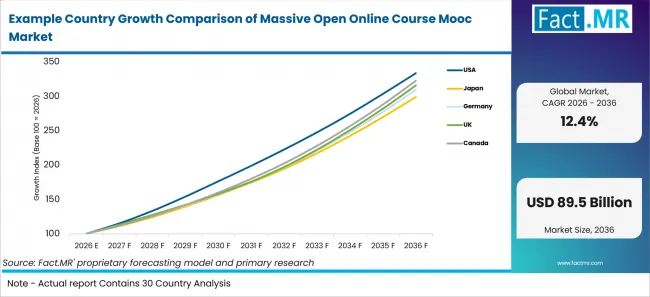
Example Country Growth Comparison Of Massive Open Online Course Mooc Market | Source: Fact.MR
| COUNTRY | CAGR (2026-2036) |
|---|---|
| South Korea | 13.47% |
| USA | 12.82% |
| Canada | 12.43% |
| UK | 12.19% |
| Australia | 12.12% |
| Germany | 11.97% |
| Japan | 11.58% |
Source: Fact.MR analysis. Updated Aug 5, 2026
What is driving South Korea's growth through 2036?
13.47% CAGR through 2036.
South Korea records the highest approved country CAGR because public digital-learning infrastructure and a technology-intensive economy create a wide base for online professional and academic courses. K-MOOC reported 208 participating institutions, 2,805 courses, and 1,576,247 learners across its first decade. That system gives universities a national channel for open courses while creating familiar pathways for learners who want certificates, job skills, or further study. The market is projected to expand at 13.47% CAGR through 2036.
How is the USA scaling Massive Open Online Course Mooc demand?
12.8% CAGR through 2036.
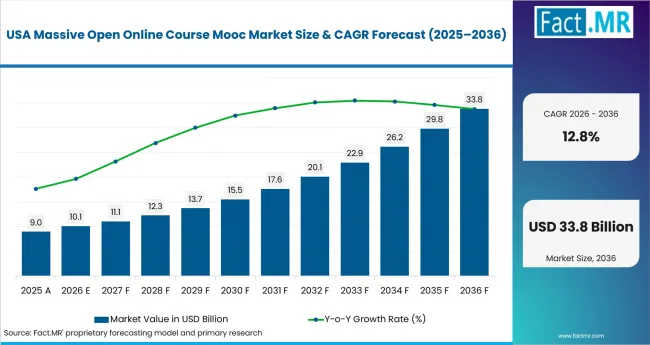
Massive Open Online Course Mooc Market Country Value Analysis | Source: Fact.MR
The USA combines major MOOC providers, universities, technology employers, professional associations, and a large population already accustomed to online study. The National Center for Education Statistics reported that 53.8% of postsecondary students took at least one distance education course in fall 2024. This does not make every distance course a MOOC, but it shows that online delivery is embedded in higher education behavior. Demand is expected to post a 12.8% CAGR through 2036.
What supports Canada’s outlook?
12.43% CAGR through 2036.
Canada’s geography, bilingual requirements, immigration-linked career transitions, and large service economy support flexible online learning across provinces and industries. Statistics Canada reported that 29.7% of workers participated in job-related nonformal training during the 12 months ending in November 2024, and most participation was mainly job-related. This creates a route for MOOC subscriptions, certificates, and short technical programs that fit around employment. The market is anticipated to grow at 12.43% CAGR through 2036.
How is the UK developing Massive Open Online Course Mooc demand?
12.19% CAGR through 2036.
The UK combines an established university sector with professional education, public skills policy, and domestic platform experience. The Lifelong Learning Entitlement is scheduled to accept applications from September 2026 for eligible courses and modules starting from January 2027, including designated distance-learning and online provision. That policy direction supports smaller units of study that can be taken at different stages of a career, although provider eligibility and credit treatment remain decisive. Demand is forecast to expand at 12.19% CAGR through 2036.
What is shaping Australia’s growth?
12.12% CAGR through 2036.
Australia has long-standing demand for distance education because learners, universities, and employers are distributed across a large geography. The Australian Government Microcredentials Pilot in Higher Education supports providers that design and deliver short courses in national priority fields, industry skills, and lifelong learning. Its second round supported 48 courses, creating practical evidence for how short online programs can be connected with public priorities and provider accountability. The market is estimated to record a 12.12% CAGR through 2036.
How is Germany scaling Massive Open Online Course Mooc adoption?
11.97% CAGR through 2036.
Germany’s industrial base creates demand for software, data, artificial intelligence, engineering, management, and compliance learning, but buyers place strong weight on technical depth, privacy, and credible certification. The publicly supported AI Campus reported about 125,000 registered learners and more than 60,000 certificates by the end of 2025. Its courses show how universities, research institutions, public administration, and companies can contribute to a shared digital-learning environment. Demand is projected to advance at 11.97% CAGR through 2036.
What underpins Japan’s outlook?
11.58% CAGR through 2036, attributable to university-backed course supply, workforce reskilling, and demand for credible local-language content.
Japan offers a mature higher education system and a large workforce facing continuing digital, management, and productivity requirements. JMOOC reported 779 certified courses, about 1.65 million unique learners, and roughly 1.87 million enrollments as of March 2025. This national record demonstrates that university and institutional providers can build a meaningful open-course base when content, certification, and language are localized. The market is expected to post an 11.58% CAGR through 2036.
Who leads the Massive Open Online Course Mooc Market?
Coursera, Inc. and the remaining profiled providers compete through marketplace scale, university partnerships, professional content, enterprise learning, and open-access education.
Coursera, Inc. competes across individual subscriptions, professional certificates, university content, degrees, and enterprise, campus, and government offerings. Its 2025 annual report described approximately 197 million registered learners, 375 content creators, more than 1,700 paid enterprise customers, and a Coursera Plus catalog exceeding 13,500 courses and related learning products. This combination gives the company broad discovery, credential, and institutional routes, but it also creates a continuing need to manage course quality, partner economics, learner completion, and renewal across a large catalog.
Udemy, Inc. operates a broad instructor marketplace and enterprise subscription business, with its 2025 annual report citing about 84 million learners and approximately 290,000 courses. edX LLC, differentiates through university-backed courses, certificates, microcredentials, and degree pathways. LinkedIn Learning connects professional content with a career and recruiting network, while FutureLearn Ltd. works with universities and organizations on online courses and degrees. Skillsoft Corporation focuses on enterprise skill management, leadership, compliance, and instructor-led learning, and Pluralsight LLC concentrates on technology skill development with hands-on practice.
Simplilearn Solutions Pvt. Ltd. and Udacity (Accenture) emphasize professional and technical pathways, while Khan Academy extends free educational access. Competition through 2036 is expected to center on trusted outcomes, current content, local relevance, assessment, completion support, enterprise integration, and the ability to translate learning activity into credible skill evidence.
Which companies are the key providers?
Coursera, Inc. is the active provider. Udemy, edX, LinkedIn Learning, FutureLearn, Skillsoft, Pluralsight, Simplilearn, Udacity, and Khan Academy are also profiled.
- Coursera, Inc.
- Udemy, Inc.
- edX LLC
- LinkedIn Learning (Microsoft)
- FutureLearn Ltd.
- Skillsoft Corporation
- Pluralsight LLC
- Simplilearn Solutions Pvt. Ltd.
- Udacity (Accenture)
- Khan Academy
- Others
Bibliography
- Australian Government Department of Education. (n.d.). Microcredentials Pilot in Higher Education. Australian Government.
- Coursera, Inc.. (2026, February 23). Annual Report for the year ended December 31, 2025. U.S. Securities and Exchange Commission.
- Department for Education. (2026). Lifelong Learning Entitlement overview. GOV.UK.
- edX. (n.d.). About edX. edX.
- FutureLearn. (n.d.). Online courses and degrees from leading universities and organizations. FutureLearn.
- JMOOC. (2025, March). For institutions. Japan Massive Open Online Education Promotion Council.
- Khan Academy. (n.d.). About Khan Academy. Khan Academy.
- K-MOOC. (2025). K-MOOC 10th Anniversary. National Institute for Lifelong Education.
- LinkedIn Learning. (n.d.). Online training courses and learning paths. LinkedIn Corporation.
- National Center for Education Statistics. (2026). Table 311.15: Number and percentage of students enrolled in distance education courses, by level and control of institution: Fall 2012 through fall 2024. U.S. Department of Education.
- OECD. (2019). Learning in a digital environment. OECD Skills Outlook 2019.
- OECD. (2020, July 24). The potential of online learning for adults: Early lessons from the COVID-19 crisis. OECD.
- Pluralsight. (n.d.). Technology skills platform. Pluralsight.
- Skillsoft Corporation. (2026). Annual Report for the fiscal year ended January 31, 2026. Skillsoft Corporation.
- Statistics Canada. (2025, August 18). Training participation, 2024. Government of Canada.
- Stifterverband and AI Campus. (2025). AI Campus Wrapped 2025: Our most popular online courses. AI Campus.
- Udacity (Accenture). (n.d.). About Udacity. Udacity.
- Udemy, Inc.. (2026). Annual Report for the year ended December 31, 2025. U.S. Securities and Exchange Commission.
This Report Answers
- The report provides strategic intelligence on Massive Open Online Course Mooc across Course Type and Delivery Mode choices that shape learner acquisition, completion, and credential pathways.
- Segment analysis covers Technology & IT and Self-Paced Learning as the approved share leaders within the 2026 market structure.
- Deployment and buyer analysis evaluates Cloud-Based delivery and Individual Learners while discussing alternative categories without assigning unsupported shares.
- Business-model assessment covers Subscription-Based, Pay-Per-Course, and Freemium approaches across consumer, enterprise, and academic purchasing routes.
- Regional outlook evaluates USA, Japan, Germany, UK, Canada, Australia, and South Korea using the country growth rates presented in this report.
- Competitive analysis evaluates Coursera, Inc. and reviews the remaining approved providers.
What does the Massive Open Online Course Mooc Market cover?
Scalable open online courses, course platforms, subscriptions, credentials, and institutional learning services delivered to individual, enterprise, and academic users.
The Massive Open Online Course Mooc Market covers digital course content and platform services designed for broad online enrollment. Coverage includes Technology & IT, Business & Management, Academic & Higher Education, healthcare, language, and personal development courses delivered through self-paced or instructor-led formats. Commercial value can arise from subscriptions, individual course purchases, professional certificates, premium certifications, enterprise licenses, university or government agreements, and platform services directly tied to course delivery, assessment, credentials, or learner administration.
The market differs from the wider education technology market because value must be connected to an open online course, scalable course catalog, credential pathway, or institutional MOOC service. General student information systems, campus administration software, video-conferencing tools, and standalone learning management systems remain outside the core boundary unless their commercial value is incorporated into the approved MOOC offering. Finished tuition revenue from conventional on-campus programs is not included simply because a university also offers online courses.
What is included in the scope?
Paid and freemium MOOC platforms, course access, professional and academic credentials, and enterprise or institutional learning packages across the approved segmentation.
The scope includes on-demand courses, recorded lectures, live virtual classes, and cohort-based courses delivered through public cloud, software-as-a-service, enterprise learning systems, or private educational networks. It includes individual students and working professionals, corporate training and employee upskilling, and university or college use. Subscription-Based, Pay-Per-Course, and Freemium models are included when the commercial offer provides course access, assessment, verified credentials, premium certification, learner support, skills analytics, or platform administration linked to MOOC delivery. Related services such as projects, labs, tutoring, proctoring, and credential verification are included when they form part of the qualifying course package.
What is excluded from the scope?
Conventional campus tuition, standalone software, private tutoring, hardware, and unrelated training services are outside the core market boundary.
The scope excludes conventional classroom tuition and campus services that are not tied to a qualifying MOOC program. It excludes standalone learning management systems, video-conferencing software, content-authoring tools, payment systems, computers, mobile devices, internet connectivity, and cloud infrastructure sold without MOOC content or delivery value. Private one-to-one tutoring, K-12-only classroom platforms, test-preparation services without an open online course structure, and corporate consulting or training delivered entirely outside a MOOC platform are also outside the core boundary. Free public content is considered only where it forms part of a freemium model or a platform pathway that monetizes assessment, credentials, subscriptions, or institutional services.
How Was the Analysis Built?
120+ sources, 40+ company portfolios, 25+ countries, 20+ interviews.
- Primary Research: Primary research includes interviews with MOOC platform operators, university online-learning teams, instructional designers, content partners, enterprise learning leaders, workforce-development specialists, procurement managers, academic administrators, technology instructors, assessment providers, and individual learners. Discussions test paid enrollment, subscription use, course completion, credential demand, content refresh, delivery format, enterprise integration, learner support, pricing, localization, and provider-selection criteria.
- Desk Research: Desk research reviews official distance-learning statistics, lifelong-learning policy, microcredential programs, national MOOC initiatives, company filings, provider course catalogs, credential structures, delivery modes, subscription plans, enterprise learning products, learner-support features, and public evidence on online participation and completion. Research distinguishes paid MOOC value from conventional campus tuition, standalone learning-management software, and general education technology revenue.
- Market-Sizing and Forecasting: Market sizing combines the approved 2026 and 2036 values with paid learner activity, subscription and course transactions, certificate and credential revenue, enterprise and academic accounts, course-type mix, self-paced and instructor-led participation, cloud and on-premise deployment, end-user purchasing, and business-model adoption. Forecasting also considers content refresh cycles, learner acquisition and retention, institutional partnerships, country growth rates, and the movement from free course discovery toward paid assessment, credentials, and continuing access.
- Data Validation and Update Cycle: The analysis combines primary interviews with structured review of public company disclosures, official statistics, regulatory material, and sector publications. Forecast interpretation considers market conditions, adoption requirements, competitive positioning, and regional operating context.
Segmentation
What is the report’s scope and coverage?
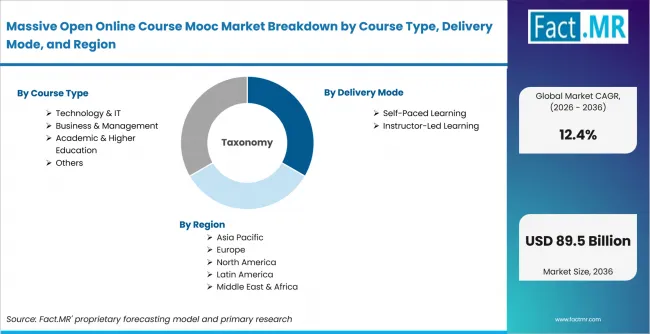
Massive Open Online Course Mooc Market Breakdown By Course Type, Delivery Mode, And Region | Source: Fact.MR
| Attribute | Details |
|---|---|
| Quantitative Units | USD 27.8 Billion in 2026 to USD 89.6 Billion by 2036 at 12.4% CAGR |
| Market Definition | Open online course platforms, content, credentials, subscriptions, and institutional services designed to deliver scalable digital learning to large learner populations |
| Course Type | Technology & IT; Business & Management; Academic & Higher Education; Others |
| Delivery Mode | Self-Paced Learning; Instructor-Led Learning |
| Deployment | Cloud-Based; On-Premise |
| End User | Individual Learners; Enterprises; Academic Institutions |
| Business Model | Subscription-Based; Pay-Per-Course; Freemium |
| Regions Covered | North America; Europe; Asia Pacific; Central & South America; Middle East & Africa |
| Countries Covered | USA; Japan; Germany; UK; Canada; Australia; South Korea |
| Key Companies Profiled | Coursera, Inc.; Udemy, Inc.; edX LLC; LinkedIn Learning (Microsoft); FutureLearn Ltd.; Skillsoft Corporation; Pluralsight LLC; Simplilearn Solutions Pvt. Ltd.; Udacity, Inc.; Khan Academy; Others |
| Forecast Period | 2026 to 2036 |
| Approach | Hybrid top-down and bottom-up assessment using paid learner activity; subscription and course transactions; enterprise, university, and government accounts; course-type mix; delivery mode; deployment; end-user purchasing; business-model adoption; country growth rates and provider validation |
Source: Fact.MR analysis. Updated Aug 5, 2026
How is the market segmented?
-
By Course Type:
- Technology & IT
- Programming
- Data Science & AI
- Business & Management
- Leadership
- Marketing
- Academic & Higher Education
- Degree Programs
- University Courses
- Others
- Healthcare
- Languages
- Personal Development
- Technology & IT
-
By Delivery Mode:
- Self-Paced Learning
- On-Demand Courses
- Recorded Lectures
- Instructor-Led Learning
- Live Virtual Classes
- Cohort-Based Courses
- Self-Paced Learning
-
By Deployment:
- Cloud-Based
- Public Cloud
- SaaS Platforms
- On-Premise
- Enterprise Learning Systems
- Private Educational Networks
- Cloud-Based
-
By End User:
- Individual Learners
- Students
- Working Professionals
- Enterprises
- Corporate Training
- Employee Upskilling
- Academic Institutions
- Universities
- Colleges
- Individual Learners
-
By Business Model:
- Subscription-Based
- Monthly Subscription
- Annual Subscription
- Pay-Per-Course
- Professional Certificates
- Specialized Courses
- Freemium
- Free Courses
- Premium Certifications
- Subscription-Based
-
By Region:
- North America
- Latin America
- Western Europe
- Eastern Europe
- East Asia
- South Asia and Pacific
- Middle East & Africa
Frequently Asked Questions
Which Course Type leads the Massive Open Online Course Mooc Market?
Which Delivery Mode leads the market?
Which Deployment leads the market?
Which End User leads the market?
Which Business Model leads the market?
Which companies are active in the market?
Which country records the highest CAGR?
How does the USA perform in the market?
How does Canada perform in the market?
How does the UK perform in the market?
How does Australia perform in the market?
How does Germany perform in the market?
How does Japan perform in the market?
Who worked on this report


Preview the report firsthand - request a free sample
Free SampleGet the brochure for pricing and purchase details
Download PDF