- Market Value (2025): USD 8.3 Bn
- Estimated Value (2026): USD 9.6 Bn
- Forecast Value (2036): USD 41.8 Bn
- CAGR (2026-2036): 15.9%
What is the Massive Multiple Input Multiple Output MIMO Market forecast to be worth by 2036?
USD 9.6 billion in 2026 to USD 41.8 billion by 2036, at 15.9% CAGR.
- Demand is projected to increase from USD 9.6 billion in 2026 to USD 41.8 billion by 2036.
- The market is forecast to record a 15.9% CAGR from 2026 to 2036 as operators expand mid-band 5G capacity, fixed wireless access, private networks, and advanced radio modernization.
- Procurement is expected to favor active antenna systems that combine measurable cell-edge performance with lower energy use, manageable site weight, broad spectrum support, and software-controlled beam optimization.
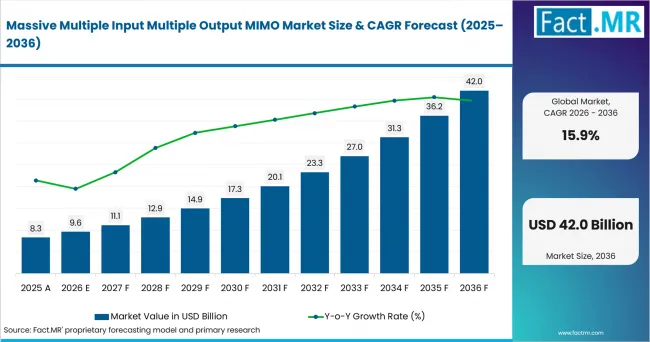
Massive Multiple Input Multiple Output Mimo Market Value Analysis | Source: Fact.MR
What are the defining numbers behind Massive Multiple Input Multiple Output MIMO Market growth?
USD 32.2 billion absolute opportunity by 2036, led by Hardware, 64T64R, Sub-6 GHz, 5G Mobile Networks, and Telecommunication Operators.
- Demand Drivers in the Market
- Mobile network operators need more capacity from finite mid-band spectrum because dense traffic areas cannot be addressed indefinitely by adding new sites or widening channels.
- Fixed wireless and coverage programs need directional gain, uplink improvement, and flexible beam control so one radio layer can serve homes, mobility users, and uneven traffic patterns.
- Enterprise, industrial, and public-sector networks need predictable performance across factories, ports, campuses, utilities, and transport sites where coverage and interference conditions differ from consumer macro networks.
- Radio-access teams need lower power consumption and simpler site engineering because active antenna systems add processing, thermal, wind-load, and maintenance requirements to already constrained towers and rooftops.
- Key Segments Analyzed
- By Component: Hardware is expected to hold 63% share in 2026 supported by active antenna arrays, radio-frequency transceivers, power electronics, and radio units required at every deployed site.
- By Antenna Configuration: 64T64R is projected to account for 46% share in 2026 because it provides a commercial balance among beamforming depth, macro coverage, capacity, power, and site weight.
- By Frequency Band: Sub-6 GHz is anticipated to capture 58% share in 2026 owing to broad low-band and mid-band deployment across national 5G networks.
- By Application: 5G Mobile Networks are estimated to represent 51% share in 2026 as enhanced mobile broadband and fixed wireless access create the largest recurring radio-upgrade programs.
- By End User: Telecommunication Operators are forecast to account for 56% share in 2026 driven by national spectrum holdings, macro-site estates, and multi-year radio-access modernization budgets.
- Analyst Opinion at Fact.MR
- Shambhu Nath Jha, Sr. Consultant at Fact.MR, states: “Massive MIMO procurement is becoming a systems-engineering decision rather than a race to advertise more antenna elements. Fact.MR opines that hardware will retain the largest revenue pool, but commercial performance will depend on how radio silicon, beamforming software, calibration, fronthaul, and site design work together. Suppliers that prove capacity, coverage, energy, and interoperability under the buyer’s actual spectrum and loading conditions will have the strongest route from laboratory validation to network-wide deployment.”
- Strategic Implications
- Telecommunication operators should compare cell-edge throughput, uplink reach, spectral efficiency, energy per carried bit, and site-loading requirements instead of choosing radios on peak downlink capacity alone.
- Radio vendors should qualify antenna arrays, transceivers, baseband features, beamforming algorithms, calibration, and thermal behavior inside one repeatable performance envelope.
- Enterprise and government buyers should map spectrum, indoor-outdoor coverage, mobility, latency, device density, and service-level requirements before selecting a macro-radio architecture for a private network.
- Open RAN programs should test fronthaul timing, feature parity, fault management, energy controls, and multi-vendor responsibility at scale before separating radio and software procurement.
How does the Massive Multiple Input Multiple Output MIMO Market break down by segment?
Hardware leads at 63%, 64T64R leads at 46%, Sub-6 GHz leads at 58%, 5G Mobile Networks lead at 51%, and Telecommunication Operators lead at 56% in 2026.
Why does Hardware lead Component?
Hardware holds 63% share in 2026.
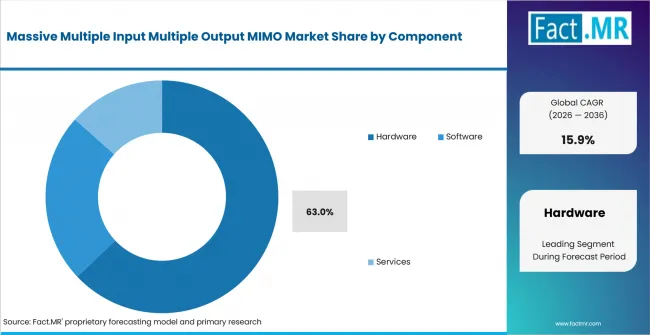
Massive Multiple Input Multiple Output Mimo Market Analysis By Component | Source: Fact.MR
Hardware is expected to hold 63% share in 2026 because every massive MIMO deployment requires physical antenna arrays, radio-frequency transceivers, amplifiers, filters, power systems, and active radio units at the site. International Telecommunication Union and 3GPP work place advanced antenna systems at the center of 5G spectral-efficiency and coverage improvement, but the commercial purchase remains anchored in deployable radio hardware. Software follows through Beamforming Software and Network Optimization Platforms that convert channel measurements into beam, power, and scheduling decisions. Services cover Deployment & Integration and Maintenance & Support, which become more important when site loading, calibration, fronthaul, and multi-vendor interfaces must be validated before traffic is migrated.
Why does 64T64R lead Antenna Configuration?
64T64R holds 46% share in 2026.
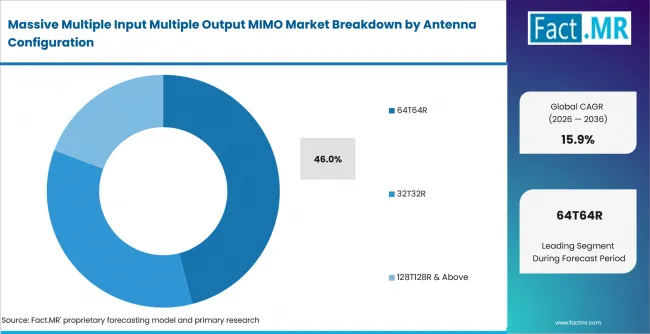
Massive Multiple Input Multiple Output Mimo Market Analysis By Antenna Configuration | Source: Fact.MR
64T64R is projected to account for 46% share in 2026 because it gives macro operators a practical balance among multi-user beamforming, mid-band bandwidth, coverage, power draw, and antenna dimensions. Official portfolios from Ericsson, Huawei, Nokia, and Samsung include 64-transmit and 64-receive radios for commercial 5G macro networks, showing why the configuration has become a familiar engineering and procurement reference point. 32T32R remains relevant for lighter sites, lower traffic layers, and selected enterprise deployments where tower loading or power limits outweigh maximum spatial capacity. 128T128R & Above is concentrated in millimeter-wave Massive MIMO and 6G Trial Networks, where narrower beams and experimental architectures justify greater element counts but also increase radio-frequency, thermal, and processing complexity.
Why does Sub-6 GHz lead Frequency Band?
Sub-6 GHz holds 58% share in 2026.
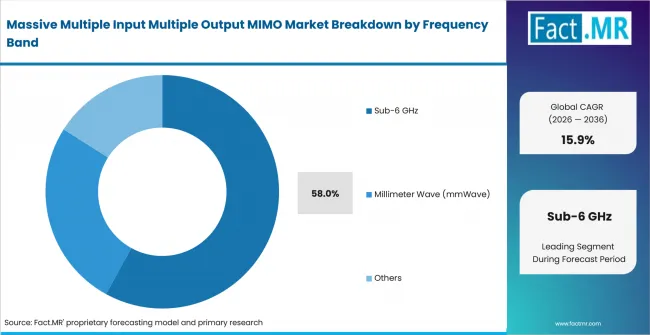
Massive Multiple Input Multiple Output Mimo Market Analysis By Frequency Band | Source: Fact.MR
Sub-6 GHz is anticipated to capture 58% share in 2026 because Low Band and Mid Band spectrum can support broad geographic coverage, mobility, indoor reach, and national network continuity. Mid-band creates the largest massive MIMO opportunity because its channel widths and propagation characteristics allow operators to add capacity without the site density required by millimeter wave. The United States Federal Communications Commission described the 3.3-4.2 GHz n77 range as widely deployed for 5G when it opened its Upper C-band proceeding in 2025. Millimeter Wave across 24-39 GHz and Above 39 GHz supports very high local capacity, fixed wireless, venue, and trial use, while Unlicensed Spectrum and Experimental 6G Bands remain smaller routes for specialized networks and research.
Why do 5G Mobile Networks lead Application?
5G Mobile Networks hold 51% share in 2026.
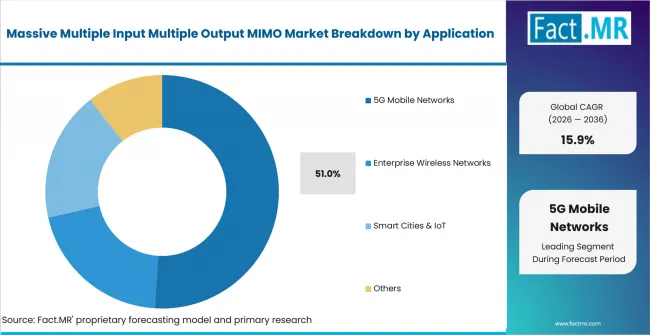
Massive Multiple Input Multiple Output Mimo Market Analysis By Application | Source: Fact.MR
5G Mobile Networks are estimated to represent 51% share in 2026 because Enhanced Mobile Broadband and Fixed Wireless Access require repeated macro-radio upgrades across thousands of sites. Massive MIMO lets operators steer energy toward active users, reuse spectrum spatially, and improve cell-edge performance without constructing a separate network for each traffic pattern. Enterprise Wireless Networks follow through Private 5G Networks and Industrial Connectivity, where buyers seek coverage and traffic control inside defined facilities. Smart Cities & IoT creates demand through Massive IoT and Intelligent Transportation, although many low-throughput devices rely on the wider mobile network rather than a dedicated massive MIMO layer. Defense Communications and Campus Networks form smaller specialized applications where resilience, controlled coverage, or local capacity drives configuration choices.
Why do Telecommunication Operators lead End User?
Telecommunication Operators hold 56% share in 2026.
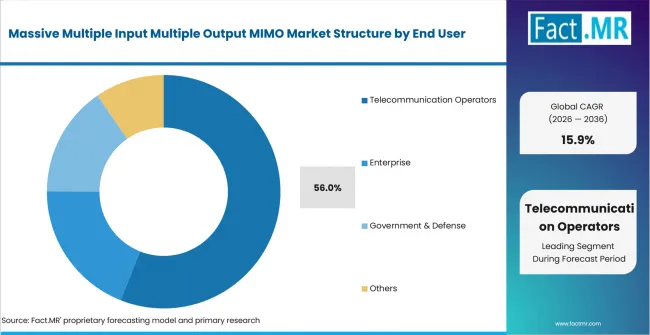
Massive Multiple Input Multiple Output Mimo Market Analysis By End User | Source: Fact.MR
Telecommunication Operators are forecast to account for 56% share in 2026 because Mobile Network Operators and Internet Service Providers control the largest licensed-spectrum positions, macro-site estates, baseband pools, transport links, and recurring radio-access budgets. Their purchases also include network-wide software, optimization, assurance, and maintenance functions that are difficult to separate from the physical radio layer. Enterprise buyers in Manufacturing and Energy & Utilities deploy smaller private networks around production, safety, remote operations, and asset visibility. Government & Defense demand includes Public Safety Networks and Defense Agencies, while Research Institutions and Transportation organizations use massive MIMO in trials, campuses, corridors, and high-capacity operational sites.
What is accelerating Massive Multiple Input Multiple Output MIMO Market adoption, and what is holding it back?
Mid-band spectrum, traffic concentration, fixed wireless, private 5G, and 5G-Advanced features support adoption, while power, site loading, fronthaul, calibration, and interoperability restrain deployment.
Drivers Impact Analysis
| DRIVER | (~) % IMPACT ON CAGR | GEOGRAPHIC RELEVANCE | IMPACT TIMELINE |
|---|---|---|---|
| Mid-band 5G capacity upgrades | Qualitative | USA, Germany, UK, and Canada | Short to medium term |
| Standalone 5G, enhanced mobile broadband, and fixed wireless expansion | Qualitative | South Korea, USA, UK, and Australia | Current forecast period |
| Private 5G and campus-network spectrum access | Qualitative | Germany, Japan, South Korea, and Australia | Medium term (2-4 years) |
| Radio energy reduction and site simplification | Qualitative | Global operator networks | Current forecast period |
| 5G-Advanced MIMO and software enhancements | Qualitative | South Korea, Japan, USA, and Europe | Medium to long term |
Source: Fact.MR analysis. Updated Aug 5, 2026
- Spectrum and capacity pressure: Mid-band licenses create revenue only when operators convert them into usable coverage and capacity. Massive MIMO helps concentrate radio energy toward users, schedule multiple spatial streams, and improve the economics of spectrum that is too valuable to leave underused. The commercial trigger is strongest where existing sites must carry more traffic without a proportional increase in towers, backhaul, and operating cost.
- Energy and site modernization: Active antenna radios combine more transmitters, processing, and cooling at the top of the site, so operators increasingly value lighter designs, efficient power amplifiers, sleep functions, and software-led energy control. South Korea’s Ministry of Science and ICT reported in March 2026 that base-station equipment represents about 70% of mobile-network power use and that a low-power Open 5G-Advanced base-station software project achieved more than 20% energy reduction, illustrating why energy performance can influence radio renewal even when coverage is already available.
Opportunity Impact Analysis
| OPPORTUNITY | (~) % IMPACT ON CAGR | GEOGRAPHIC RELEVANCE | IMPACT TIMELINE |
|---|---|---|---|
| Dual-band and multi-band active antenna radios | Qualitative | Dense and spectrum-fragmented operator networks | Short to medium term |
| Software-led beam optimization and AI-assisted energy control | Qualitative | Global 5G and 5G-Advanced networks | Current forecast period |
| Open RAN-compliant massive MIMO integration | Qualitative | Europe, Japan, USA, and selected Asia markets | Medium term (2-4 years) |
| Private and campus network packages | Qualitative | Germany, Australia, South Korea, Japan, and industrial hubs | Medium to long term |
Source: Fact.MR analysis. Updated Aug 5, 2026
- Integrated radio and software packages: Operators have an opportunity to replace multiple radio layers with dual-band or wider-band active antenna systems where spectrum, coverage, and site conditions permit. The value is not limited to fewer boxes. A supplier can attach beam management, network optimization, energy controls, and lifecycle services when the buyer wants one accountable performance envelope across antenna, radio, baseband, and software.
- Open and private network routes: NEC, Fujitsu, and Mavenir participate in Open RAN and virtualized radio-access programs, creating room for massive MIMO radios that can operate with disaggregated baseband software. Private-network licensing in Germany, Australia, South Korea, and Japan also creates smaller but technically demanding deployments where vendors can package spectrum planning, radio hardware, integration, and support around factories, ports, utilities, campuses, and public infrastructure.
Restraints Impact Analysis
| RESTRAINT | (~) % IMPACT ON CAGR | GEOGRAPHIC RELEVANCE | IMPACT TIMELINE |
|---|---|---|---|
| Power, cooling, wind load, and tower-space constraints | Qualitative | Urban rooftops and established macro sites | Current forecast period |
| Fronthaul timing, synchronization, and calibration complexity | Qualitative | Centralized and virtualized RAN deployments | Short to medium term |
| Spectrum fragmentation and radio-frequency coexistence | Qualitative | Multi-band national networks | Medium term (2-4 years) |
| Multi-vendor feature parity and operational accountability | Qualitative | Open RAN and mixed-vendor estates | Medium to long term |
Source: Fact.MR analysis. Updated Aug 5, 2026
- Physical site constraints: A massive MIMO radio can improve capacity while also increasing weight, frontal area, heat, cabling, and power demand at the site. Rooftops and towers may require structural assessment, reinforcement, revised mounting, or electrical work before a radio is installed. These costs slow replacement where the traffic benefit does not justify civil work or where landlords, planning authorities, and maintenance windows limit access.
- Integration and accountability: Beamforming relies on timely channel information, stable synchronization, calibrated radio chains, baseband feature support, and consistent fault management. A multi-vendor configuration can pass a basic interface test but still underperform when advanced features, energy controls, alarms, or software upgrades are exercised under live traffic. Buyers therefore phase disaggregation around proven combinations and insist on a clear owner for end-to-end performance.
Which countries are scaling Massive Multiple Input Multiple Output MIMO Market fastest?
South Korea 16.92%, USA 16.35%, Canada 15.97%, UK 15.69%, Australia 15.63%, Germany 15.43%, and Japan 15.08% through 2036.
Regional analysis covers North America, Europe, Asia Pacific, Central and South America, and the Middle East and Africa.
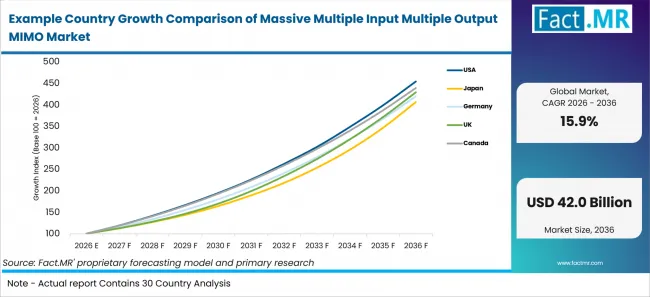
Example Country Growth Comparison Of Massive Multiple Input Multiple Output Mimo Market | Source: Fact.MR
| COUNTRY | CAGR (2026-2036) |
|---|---|
| South Korea | 16.92% |
| USA | 16.35% |
| Canada | 15.97% |
| UK | 15.69% |
| Australia | 15.63% |
| Germany | 15.43% |
| Japan | 15.08% |
Source: Fact.MR analysis. Updated Aug 5, 2026
What is driving South Korea’s growth through 2036?
16.92% CAGR through 2036.
South Korea combines a mature national 5G network with an active policy and engineering base for 5G-Advanced, Open RAN, and private 5G. The Ministry of Science and ICT’s March 2026 low-power network announcement linked artificial-intelligence-based traffic prediction with base-station energy control and reported more than 20% power reduction in the developed software. The same ministry has promoted e-Um 5G for private networks, giving factories, campuses, and public facilities a domestic route to licensed local connectivity. The market is projected to record a 16.92% CAGR through 2036.
How is the USA expanding Massive MIMO demand?
16.35% CAGR through 2036.
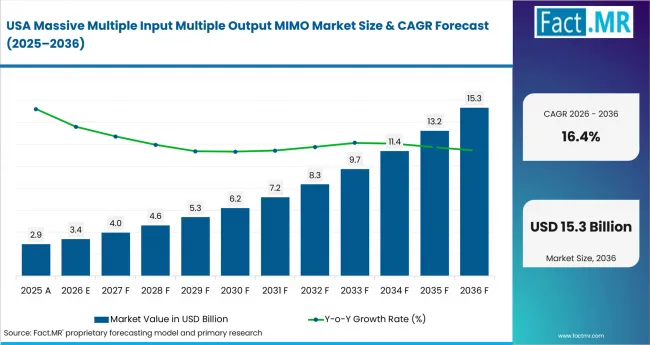
Massive Multiple Input Multiple Output Mimo Market Country Value Analysis | Source: Fact.MR
The USA has created several mid-band deployment layers through the 3.45 GHz service and C-band, while the Federal Communications Commission is considering additional Upper C-band use. In its 2025 proceeding, the FCC noted that the 3.3-4.2 GHz n77 range is widely deployed for 5G, giving equipment suppliers a large ecosystem around radios, devices, and testing. National operators use massive MIMO to add urban and suburban capacity and to support fixed wireless access where cell-edge performance and directional gain affect the number of serviceable homes. Demand is forecast to expand at a 16.35% CAGR through 2036.
What supports Canada’s outlook?
15.97% CAGR through 2036.
Canada’s massive MIMO opportunity is centered on mid-band spectrum that can add capacity in major metropolitan areas while extending useful coverage across lower-density markets. Innovation, Science and Economic Development Canada has auctioned spectrum in both the 3500 MHz and 3800 MHz bands, giving mobile operators a broader foundation for contiguous channels and capacity upgrades. The country’s geography increases the value of radio designs that balance throughput, uplink reach, site power, and fixed wireless coverage rather than optimizing only for dense urban downlink traffic. The market is expected to post a 15.97% CAGR through 2036.
How is the UK scaling Massive MIMO deployment?
15.69% CAGR through 2036.
The UK is moving from broad non-standalone 5G availability toward standalone networks that place more demand on consistent radio coverage, uplink performance, and service control. Ofcom’s Connected Nations update for spring 2026 reported that outdoor 5G standalone coverage from the three reporting mobile network operators ranged from 49% to 85% of premises, up from 47% to 65% in July 2025. That expansion creates a practical reason to add or optimize massive MIMO at sites where mid-band capacity must remain usable across indoor, outdoor, and mobility conditions. Demand is anticipated to advance at a 15.69% CAGR through 2036.
What shapes Australia’s growth path?
15.63% CAGR through 2036.
Australia combines metropolitan 5G demand with mining, energy, transport, and regional sites that require private or area-specific wireless systems. The Australian Communications and Media Authority has allocated the 3.4-4.0 GHz band through spectrum and area-wide licensing arrangements, allowing both national networks and localized use. Its 2025-30 spectrum outlook reported 82 remote-area licenses in the band as of October 1, 2025, showing that demand extends beyond the main mobile corridors. The market is forecast to record a 15.63% CAGR through 2036.
What underpins Germany’s market development?
15.43% CAGR through 2036, attributable to national 5G modernization, local 3.7-3.8 GHz networks, and industrial demand for controlled wireless coverage.
Germany’s market connects national mobile-network investment with a distinct local-spectrum route for factories, logistics sites, research facilities, and other campus users. Bundesnetzagentur’s 2025/2026 net-neutrality report stated that 56% of measured mobile broadband tests used 5G during the reporting period, indicating a large installed user base against which operators must manage capacity and quality. The regulator also provides local access in the 3.7-3.8 GHz band, supporting industrial networks that need dedicated coverage and traffic control. Demand is projected to grow at a 15.43% CAGR through 2036.
How is Japan developing Massive MIMO demand?
15.08% CAGR through 2036.
Japan has deployed commercial 5G across 3.7 GHz, 4.5 GHz, and 28 GHz bands while also enabling local 5G for enterprise and regional use. That spectrum mix creates different radio requirements: sub-6 GHz macro layers need coverage and capacity balance, millimeter-wave sites need narrow beams and dense placement, and local networks need compact integration with enterprise operations. The Ministry of Internal Affairs and Communications continues to frame Beyond 5G around advanced wireless, openness, and energy-aware infrastructure, while Japanese suppliers contribute radio and Open RAN engineering. The market is estimated to expand at a 15.08% CAGR through 2036.
Who leads the Massive Multiple Input Multiple Output MIMO Market?
Huawei Technologies Co., Ltd. is an active provider, while Ericsson AB, Nokia Corporation, and Samsung Electronics Co., Ltd. compete through broad commercial massive MIMO radio portfolios.
Huawei Technologies Co., Ltd. holds the competitive position and supplies active antenna radios across low-band, mid-band, and multi-band network requirements. Its commercial role is tied to antenna and radio integration, 64T64R macro deployments, spectrum consolidation, and software features that help operators manage coverage, capacity, and energy across large networks.
Ericsson AB competes through an extensive AIR portfolio spanning different transceiver counts, frequency ranges, radio bandwidths, and site envelopes. Its AIR 6494 and related products are positioned around wide-band mid-band deployment, lighter radio design, and integration with Ericsson Radio System baseband and software.
Which companies are the key providers?
Huawei Technologies Co., Ltd. is the active provider. Ericsson AB, Nokia Corporation, and Samsung Electronics Co., Ltd. are other key companies.
- Huawei Technologies Co., Ltd.
- Ericsson AB
- Nokia Corporation
- Samsung Electronics Co., Ltd.
- ZTE Corporation
- NEC Corporation
- Fujitsu Limited
- Mavenir Systems, Inc.
- Airspan Networks Holdings Inc.
- CommScope Holding Company, Inc.
Bibliography
- 3rd Generation Partnership Project. (2019, October 8). 5G system development and deployment.
- 3rd Generation Partnership Project. (2024, March 10). Release 18 MIMO evolution.
- Airspan Networks Holdings Inc. (n.d.). 5G and Open RAN solutions.
- Australian Communications and Media Authority. (2025). Five-year spectrum outlook 2025-30.
- Australian Communications and Media Authority. (n.d.). Area-wide apparatus licensing in the 3.4-4.0 GHz band.
- Bundesnetzagentur. (2026). Net neutrality in Germany: Annual report 2025/2026.
- Bundesnetzagentur. (n.d.). Local broadband networks in the 3.7-3.8 GHz band.
- Ericsson. (n.d.). AIR 6494.
- Ericsson. (n.d.). Massive MIMO portfolio.
- Federal Communications Commission. (2021). Auction 110: 3.45 GHz Service.
- Federal Communications Commission. (2025, October 30). Upper C-band spectrum proceeding.
- Fujitsu Limited. (2024, August 14). How Fujitsu and Qualcomm are accelerating open and virtualized networks.
- Huawei Technologies Co., Ltd. (2021). All-band, all-scenario 5G target network solution.
- Innovation, Science and Economic Development Canada. (n.d.). Auction of spectrum licenses in the 3500 MHz band.
- Innovation, Science and Economic Development Canada. (n.d.). Auction of spectrum licenses in the 3800 MHz band.
- International Telecommunication Union. (2015). Recommendation ITU-R M.2083: IMT vision framework for 2020 and beyond.
- International Telecommunication Union. (2023). Recommendation ITU-R M.2160: Framework for IMT-2030.
- Mavenir Systems, Inc. (n.d.). Cloud-native virtualized radio access network.
- Mavenir Systems, Inc. (n.d.). NEC and Mavenir collaborate on live Open RAN massive MIMO deployment.
- Ministry of Internal Affairs and Communications, Japan. (2025). Beyond 5G Promotion Strategy 2.0 for AI Society in the 2030s.
- Ministry of Science and ICT, Republic of Korea. (2022). e-Um 5G private-network policy.
- Ministry of Science and ICT, Republic of Korea. (2026, March 3). Korea secures low-power AI network technology.
- NEC Corporation. (2022, February 25). NEC expands its portfolio of O-RAN-compliant 5G radio units.
- Nokia Corporation. (2023). Nokia launches Habrok AirScale 5G radios.
- NTT Technical Review. (2020, December). Frequency bands for 5G deployment in Japan.
- Ofcom. (2026, May 13). Connected Nations update: Spring 2026.
- Samsung Electronics Co., Ltd. (n.d.). AWS-PCS dual-band massive MIMO radio.
- Samsung Electronics Co., Ltd. (n.d.). Massive MIMO radio.
- ZTE Corporation. (n.d.). Wireless access products and solutions.
This Report Answers
- The report provides strategic intelligence on Massive Multiple Input Multiple Output MIMO Market across Component and Antenna Configuration choices that shape active antenna and radio-access programs.
- Segment analysis covers Hardware, 64T64R, Sub-6 GHz, 5G Mobile Networks, and Telecommunication Operators as the leading categories within the 2026 market structure.
- Regional outlook evaluates South Korea and the USA alongside Canada, the UK, Australia, Germany, and Japan using the country growth rates presented in this report.
- Competitive analysis profiles Huawei Technologies Co., Ltd. with its competitive position and reviews nine additional providers without creating unsupported rankings.
- Application assessment covers enhanced mobile broadband, fixed wireless access, private 5G, industrial connectivity, smart-city and Internet of Things use, defense communications, and campus networks.
- Technology assessment covers sub-6 GHz and millimeter-wave radios across 32T32R, 64T64R, and 128T128R & Above configurations, together with beamforming, optimization, deployment, and support requirements.
What does the Massive Multiple Input Multiple Output MIMO Market cover?
Active antenna radios, antenna arrays, RF transceivers, beamforming software, network optimization, deployment, and support used to create multi-user spatial capacity in advanced wireless networks.
The Massive Multiple Input Multiple Output MIMO Market covers products and directly attached services in which a large array of transmit and receive paths is used to form beams, reuse spectrum spatially, improve coverage, or increase capacity. Coverage includes Hardware across Antenna Arrays and RF Transceivers; Software across Beamforming Software and Network Optimization Platforms; and Services across Deployment & Integration and Maintenance & Support.
The market differs from general radio-access-network spending because commercial value must be tied to a massive MIMO function. A conventional base station, passive antenna, transport link, core-network platform, or general network-management product is counted only when it is packaged and sold as an inseparable part of a defined massive MIMO solution. The value of spectrum licenses and the value of traffic carried over the network are outside the revenue boundary.
What is included in the scope?
Commercial massive MIMO hardware, software, integration, and support used across public mobile, fixed wireless, private 5G, industrial, government, and advanced-network deployments.
The scope includes Hardware, Software, and Services across 64T64R, 32T32R, and 128T128R & Above configurations. It includes Sub-6 GHz across Low Band and Mid Band, Millimeter Wave across 24-39 GHz and Above 39 GHz, and specified use in Unlicensed Spectrum or Experimental 6G Bands when a massive MIMO function is commercially supplied. Active antenna units, radio units, antenna arrays, transceiver chains, embedded beamforming functions, network-optimization software, deployment engineering, calibration, integration, maintenance, and support are included when sold within the market boundary.
Application coverage spans 5G Mobile Networks, Enterprise Wireless Networks, Smart Cities & IoT, Defense Communications, and Campus Networks. End users include Telecommunication Operators, Enterprise buyers, Government & Defense organizations, Research Institutions, and Transportation organizations. Open RAN and virtualized RAN software or services are included only to the extent that they directly enable, control, integrate, or support a massive MIMO radio deployment.
What is excluded from the scope?
General mobile-network infrastructure, devices, spectrum value, and passive or conventional radio equipment without a material massive MIMO function are outside the scope.
The scope excludes 5G core networks, subscriber management, billing, general cloud infrastructure, smartphones, customer-premises equipment, routers, Wi-Fi access points, distributed antenna systems, conventional small cells, passive antennas, transport networks, and standalone baseband platforms when their commercial value is not tied to a massive MIMO solution. Civil construction, towers, shelters, power systems, and backhaul are excluded except for deployment work sold directly with an included massive MIMO installation.
The value of spectrum auctions, licenses, mobile subscriptions, data traffic, fixed wireless service revenue, managed connectivity, and enterprise applications running over the network is not counted. General consulting, testing, cybersecurity, and systems integration are included only when directly attached to a product or deployment within the defined revenue boundary. Experimental academic prototypes are excluded unless supplied through a commercial contract.
How Was the Analysis Built?
120+ sources, 40+ company and product portfolios, 25+ countries, and 20+ interviews.
- Primary Research: Primary research includes interviews with mobile-network radio planners, spectrum teams, site engineers, network-optimization specialists, private-network buyers, enterprise connectivity leaders, public-safety and defense communication teams, radio vendors, antenna and RF suppliers, Open RAN software providers, systems integrators, and maintenance partners. Discussions test deployment timing, site constraints, spectrum bandwidth, configuration choices, performance acceptance, software attachment, interoperability, pricing, and renewal requirements.
- Desk Research: Desk research reviews 3GPP and ITU technical frameworks, official spectrum allocations and auction materials, regulator coverage reports, government private-network programs, company radio portfolios, product specifications, technical papers, and deployment announcements. External sources explain engineering roles, country context, and provider positioning. Market values, CAGR, segment shares, country rates, company names, and company coverage remain as presented in this report.
- Market-Sizing and Forecasting: Forecasting uses active antenna radio deployments, operator radio-access spending, hardware pricing, software and service attachment, antenna configuration, spectrum-band adoption, macro and private-network applications, end-user demand, and country-specific growth rates. Models also consider replacement of early 5G radios, spectrum activation, fixed wireless expansion, site consolidation, energy-efficiency requirements, Open RAN integration, and movement toward 5G-Advanced and experimental 6G systems.
- Data Validation and Update Cycle: The analysis combines primary interviews with structured review of public company disclosures, official statistics, regulatory material, and sector publications. Forecast interpretation considers market conditions, adoption requirements, competitive positioning, and regional operating context.
Segmentation
What is the report’s scope and coverage?
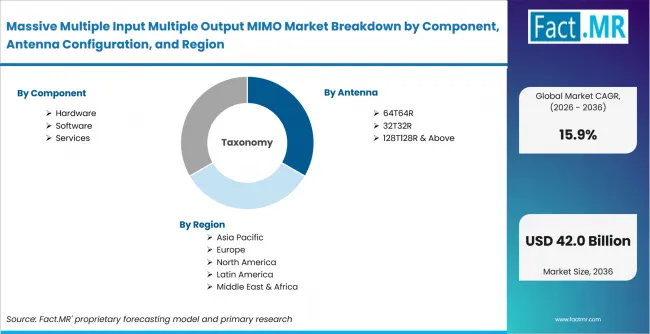
Massive Multiple Input Multiple Output Mimo Market Breakdown By Component, Antenna Configuration, And Region | Source: Fact.MR
| Attribute | Details |
|---|---|
| Quantitative Units | USD Billion |
| Market Definition | Active antenna systems, massive MIMO radio units, antenna arrays, RF transceivers, beamforming and network-optimization software, deployment and support services purchased for multi-antenna 5G, private 5G, and advanced wireless networks |
| Component | Hardware; Software; Services |
| Antenna Configuration | 64T64R; 32T32R; 128T128R & Above |
| Frequency Band | Sub-6 GHz; Millimeter Wave (mmWave); Others |
| Application | 5G Mobile Networks; Enterprise Wireless Networks; Smart Cities & IoT; Others |
| End User | Telecommunication Operators; Enterprise; Government & Defense; Others |
| Regions Covered | North America; Europe; Asia Pacific; Central and South America; Middle East and Africa |
| Countries Covered | USA; Japan; Germany; UK; Canada; Australia; South Korea |
| Key Companies Profiled | Huawei Technologies Co., Ltd.; Ericsson AB; Nokia Corporation; Samsung Electronics Co., Ltd.; ZTE Corporation; NEC Corporation; Fujitsu Limited; Mavenir Systems, Inc.; Airspan Networks Holdings Inc.; CommScope Holding Company, Inc. |
| Forecast Period | 2026 to 2036 |
| Approach | Hybrid top-down and bottom-up assessment using active antenna radio deployments; operator radio-access spending; hardware, software, and service attachment; antenna configuration; spectrum-band adoption; application and end-user demand; country growth rates; and provider validation |
Source: Fact.MR analysis. Updated Aug 5, 2026
How is the market segmented?
-
By Component
- Hardware
- Antenna Arrays
- RF Transceivers
- Software
- Beamforming Software
- Network Optimization Platforms
- Services
- Deployment & Integration
- Maintenance & Support
- Hardware
-
By Antenna Configuration
- 64T64R
- Sub-6 GHz 64T64R
- 5G Macro Base Stations
- 32T32R
- Mid-Band Deployments
- Enterprise Networks
- 128T128R & Above
- mmWave Massive MIMO
- 6G Trial Networks
- 64T64R
-
By Frequency Band
- Sub-6 GHz
- Low Band
- Mid Band
- Millimeter Wave (mmWave)
- 24–39 GHz
- Above 39 GHz
- Others
- Unlicensed Spectrum
- Experimental 6G Bands
- Sub-6 GHz
-
By Application
- 5G Mobile Networks
- Enhanced Mobile Broadband (eMBB)
- Fixed Wireless Access (FWA)
- Enterprise Wireless Networks
- Private 5G Networks
- Industrial Connectivity
- Smart Cities & IoT
- Massive IoT
- Intelligent Transportation
- Others
- Defense Communications
- Campus Networks
- 5G Mobile Networks
-
By End User
- Telecommunication Operators
- Mobile Network Operators
- Internet Service Providers
- Enterprise
- Manufacturing
- Energy & Utilities
- Government & Defense
- Public Safety Networks
- Defense Agencies
- Others
- Research Institutions
- Transportation
- Telecommunication Operators
-
By Region
- North America
- United States
- Canada
- Europe
- Germany
- United Kingdom
- France
- Italy
- Spain
- Asia Pacific
- South Korea
- Japan
- Australia
- Central & South America
- Brazil
- Argentina
- Mexico
- Chile
- Middle East & Africa
- UAE
- Saudi Arabia
- South Africa
- North America
Frequently Asked Questions
Which Component leads the Massive Multiple Input Multiple Output MIMO Market?
Which Antenna Configuration leads the market?
Which Frequency Band leads the market?
Which Application leads the market?
Which End User leads the market?
Which country records the highest CAGR?
How does the USA perform in the market?
How does Canada perform in the market?
How does the UK perform in the market?
How does Australia perform in the market?
How does Germany perform in the market?
How does Japan perform in the market?
Who worked on this report


Preview the report firsthand - request a free sample
Free SampleGet the brochure for pricing and purchase details
Download PDF