- Base Value(2025): 13.50 Bn
- Estimated Value(2026): 15.19 Bn
- Forecast Value (2036): 49.32 Bn
- CAGR (2026 - 2036): 12.5%
Dermatology Devices Market Size, Market Forecast and Outlook By FACT.MR
The Dermatology Devices market was valued at USD 13.50 billion in 2025, projected to reach USD 15.19 billion in 2026, and is forecast to expand to USD 49.32 billion by 2036 at a 12.5% CAGR. Accelerating global demand for minimally invasive aesthetic procedures driven by rising disposable income, social media-amplified aesthetic awareness, and expanding clinical evidence for laser and energy-based device efficacy across skin rejuvenation, hair removal, and body contouring indications sustains the market's high double-digit growth trajectory. Expanding medical tourism infrastructure in India, Brazil, and South Korea creates concentrated aesthetic procedure clinic clusters that generate high capital equipment procurement volumes for advanced laser and radiofrequency dermatology platforms.
The absolute dollar growth of USD 34.13 billion across the forecast decade positions dermatology devices as one of the highest-growth medical equipment categories globally, driven by the intersection of technological advancement and structural demographic demand from aging populations in developed markets seeking skin rejuvenation and anti-aging aesthetic procedure outcomes. Laser-based devices commanding 48.0% of product type share reflects the superior clinical outcome documentation, broad multi-indication capability, and premium procedure pricing that laser platforms sustain above electrocautery and radiofrequency alternatives. Dermatology clinics retaining 46.0% of end user share confirms the independent specialty clinic as the primary aesthetic procedure delivery setting, where direct-pay consumer procedure economics create recurring capital equipment investment cycles above hospital procurement timelines.
Based on FACT.MR's regional analysis, India leads at 15.62% CAGR as medical tourism infrastructure expansion, rising urban middle-class aesthetic procedure spending, and dermatology clinic network growth create massive laser and energy-based device capital procurement demand. Germany advances at 14.38% as premium aesthetic medicine market development and expanding non-invasive body contouring procedure consumer adoption drive consistent high-specification laser device investment. Brazil tracks at 13.12% as the world's largest aesthetic procedure market by volume continues expanding clinic infrastructure investment in laser hair removal, skin rejuvenation, and body contouring platforms. The United States registers 11.88% as sustained consumer demand for minimally invasive aesthetic procedures and ambulatory surgical center aesthetic program development sustain consistent device capital procurement. The United Kingdom records 10.62% where growing medical aesthetic clinic sector expansion and consumer aesthetic procedure spending sustain laser and radiofrequency device investment. Japan advances at 9.38% as the established skin care culture and aging population aesthetic procedure demand sustain laser platform procurement in dermatology clinic and hospital settings.
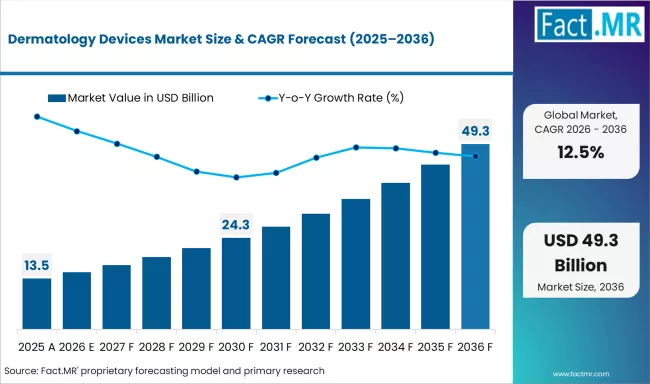
Dermatology Devices Market Market Value Analysis | Source: Fact.MR
Dermatology Devices Market Key Takeaways
| Metric | Details |
|---|---|
| Industry Size (2026) | USD 15.19 Billion |
| Industry Value (2036) | USD 49.32 Billion |
| CAGR (2026-2036) | 12.5% |
Source: Fact.MR analysis. Updated Mar 14, 2026
Dermatology Devices Market Definition
The Dermatology Devices market encompasses energy-based electromechanical medical devices used by licensed dermatologists and aesthetic medicine practitioners to perform diagnostic, therapeutic, and cosmetic procedures on the skin, hair, and subcutaneous tissue. Core device categories include laser-based platforms, electrocautery devices, ultrasonic electrosurgery systems, and radiofrequency electrosurgery units. Applications span hair removal, facial rejuvenation, tattoo removal, body contouring, skin resurfacing, and stretch mark reduction procedures performed in dermatology clinics, ambulatory surgical centers, and hospital dermatology departments.
Dermatology Devices Market Inclusions
Market scope covers laser-based, electrocautery, ultrasonic electrosurgery, and radiofrequency dermatology devices used by dermatology clinics, ambulatory surgical centers, and hospitals for hair removal, facial treatment, tattoo removal, body contouring, skin rejuvenation, and stretch mark reduction applications. Regional coverage spans India, Germany, Brazil, USA, UK, Japan, and 40 plus countries for the 2026 to 2036 forecast period.
Dermatology Devices Market Exclusions
Topical dermatological drug products and biologics without electromechanical device components are excluded. Consumer-grade home-use light therapy devices below defined clinical energy output thresholds fall outside the professional dermatology device market scope. Injectable aesthetic products including botulinum toxin and hyaluronic acid fillers without device hardware components are omitted. Surgical dermatology instruments including scalpels, forceps, and biopsy punches without energy-based electromechanical device functionality are explicitly excluded from the market valuation.
Dermatology Devices Market Research Methodology
- Primary Research: Analysts conducted interviews with dermatology clinic medical directors, aesthetic medicine practice equipment procurement managers, and hospital dermatology department heads across India, Germany, Brazil, USA, and the UK to validate procedure volume trends and capital investment decision criteria.
- Desk Research: Data aggregation covered FDA 510(k) and CE Mark medical device registration databases for aesthetic device approvals, ISAPS international aesthetic surgery statistics, and national aesthetic medicine association procedure volume reports.
- Market-Sizing and Forecasting: Baseline values derive from bottom-up aggregation of active dermatology device installation counts by facility type and procedure category, applying aesthetic procedure volume growth rates and device replacement cycle models to regional demand projections.
- Data Validation and Update Cycle: Forecasts cross-validate against aesthetic device segment revenues from Cynosure Lutronic, Candela Corporation, Alma Lasers (Sisram Medical), Cutera Inc., and Lumenis Be Ltd. annual investor disclosures.
Summary of Dermatology Devices Market
- Dermatology Devices Market Definition
- The Dermatology Devices market covers laser-based, electrocautery, ultrasonic, and radiofrequency energy-based medical devices used by dermatology clinics, ambulatory surgical centers, and hospitals for hair removal, facial treatment, tattoo removal, body contouring, and skin rejuvenation procedures globally.
- Demand Drivers in the Market
- Medical tourism infrastructure expansion in India and Brazil creates concentrated aesthetic procedure clinic clusters generating high capital equipment procurement volumes for laser and radiofrequency devices, as international procedure seekers drive facility investment cycles above domestic demand alone.
- Aging population aesthetic procedure demand in Germany, the USA, and Japan sustains consistent laser skin rejuvenation, non-invasive body contouring, and facial treatment device capital investment as the addressable consumer demographic expands annually.
- Social media and digital platform aesthetic awareness amplification drives consumer first-time aesthetic procedure adoption among younger adult demographics in South Korea and the UK, expanding the total addressable procedure volume and clinic infrastructure investment market.
- Key Segments Analyzed in the FACT.MR Report
- Laser-based Dermatology Devices lead by Product Type with 48.0% share in 2026, where superior clinical outcome documentation, multi-indication breadth across hair removal, skin rejuvenation, tattoo removal, and body contouring, and premium procedure pricing sustain dominant platform investment.
- Dermatology Clinics command 46.0% of End User share in 2026, where direct-pay consumer procedure economics and specialty clinic recurring device investment cycles above hospital procurement timelines sustain the primary capital equipment channel.
- Hair Removal accounts for 26.0% of Application share in 2026, anchoring the highest procedure volume application category through established consumer laser hair removal program adoption across global dermatology clinic and aesthetic center networks.
- Analyst Opinion at FACT.MR
- Shambhu Nath Jha, Principal Consultant at Fact. MR, opines: 'The dermatology devices market is entering an expansion phase where demographic demand growth and technology capability advancement are reinforcing each other across both developed and emerging market geographies simultaneously. Platform manufacturers that develop multi-modality systems combining laser, radiofrequency, and ultrasonic treatment capabilities in a single capital investment will capture the emerging market clinic operators seeking versatile procedure menus without multiple device capital commitments. The India and Brazil medical tourism clinic investment wave represents a once-in-a-decade capital equipment procurement opportunity for manufacturers that establish local clinical training programs and service infrastructure before competitive saturation.'
- Strategic Implications / Executive Takeaways
- Dermatology device manufacturers targeting India and Brazil medical tourism clinic operators must develop multi-modality platform configurations with comprehensive clinical training programs and localized service network infrastructure to capture the high-volume capital procurement cycle before market saturation.
- Laser platform product development programs must prioritize clinical evidence publication for skin rejuvenation and body contouring indications targeting aging consumer demographics in Germany, USA, and Japan to sustain premium pricing differentiation above emerging radiofrequency and ultrasonic alternatives.
- Financing and equipment lease program development for independent dermatology clinic operators reduces initial capital commitment barriers and accelerates device adoption among first-time aesthetic medicine practice investors in expanding markets.
- Methodology
- Primary Research: FACT.MR interviewed dermatology clinic directors and equipment procurement managers across 40 countries to validate procedure volume trends and capital investment decision criteria.
- Desk Research: Analysts aggregated FDA 510(k) and CE Mark device registration data, ISAPS aesthetic surgery statistics, and national aesthetic medicine association procedure volume reports.
- Market-Sizing and Forecasting: Bottom-up aggregation of active device installation counts with aesthetic procedure volume growth rates and device replacement cycle models applied to regional demand projections.
- Data Validation: Cross-validation against Cynosure Lutronic, Candela Corporation, Alma Lasers, Cutera Inc., and Lumenis Be Ltd. annual investor disclosures for aesthetic device segment revenues.
Demand Analysis of Dermatology Devices (2017 to 2021) Vs Future Market Projections (2022 to 2036)
The need to look aesthetically perfect and appealing has become more prominent than ever, and this has created huge demand for dermatology devices on a global scale. Increasing prevalence of skin disorders and skin cancers are also promoting the dermatological treatment market. Demand is also driven by consumers who are looking to get dermatological treatments done from the comfort of their homes, which is a result of increase in online sales of dermatology devices.
Adoption of dermatology devices for hair removal and adoption of dermatology devices for stretch marks reduction are some trends that are influencing global market growth potential. The dermatology devices market is changing drastically as the scope of application is increasing with rising investments from manufacturers and dermatology device suppliers to increase their sales.
As people show early signs of aging and the trend of not looking aged picks up, sales of dermatology devices for wrinkle removal are anticipated to increase. Overall, from 2022 to 2036, the global dermatology devices industry is expected to progress at a CAGR of 12.5%.
Which Sectors Would Benefit Most from Technological Advancements In Dermatology Devices?
Dermatology diagnostics devices market and dermatology imaging device market are the two major industries that would be shaped by advancements in dermatology devices. As technological proliferation increases, compatibility norms change for the devices used in the industry.
As technology advances, the need for advanced instruments and devices is expected to fuel demand for dermatoscopes and dermatology microscopes. Sales of dermatoscopes and dermatology microscopes are also expected to see steady increase with more advanced and precise devices being launched by various manufacturers.
Which Applications of Dermatology Devices are Expected to Be Popular?
As demand for dermatological treatments and procedures increases, research and investments are also increasing and widening the scope of applications. Dermatology devices for psoriasis are also expected to see an evolution in terms of demand, as more instances of the skin condition are expected to appear over the next ten years.
Demand for dermatology devices for skin rejuvenation treatment is also expected to rise significantly over the decade as people become more concerned about modern beauty standards. The dermatology treatment devices market is anticipated rise at a positive CAGR over the decade. Technologically advanced dermatology devices are expected to majorly drive market development.
Which Dermatology Products are Expected to Perform Well in Future?
There is a wide array of products in dermatology and most are driven by their demand for various dermatological procedures. Products such as dermatology microdermabrasion devices and dermatology lasers have gained massive popularity in the past few years, and they are expected to have a bright outlook over the forecast period.
Demand for dermatology lasers and dermatology microdermabrasion devices is expected to rise at a steady CAGR and speed up with increasing research & development by various manufacturers. Sales of dermatology lasers are expected to see an increase as the application of laser technology increases.
Demand for radiofrequency electrosurgery dermatology devices is expected to be the most significant under the product type segment. Sales of radiofrequency electrosurgery dermatology devices are expected to rake in majority of revenue share in this segment. Whereas, sales of ultrasonic electrosurgery dermatology devices are expected to bring in the least revenue in this segment. As such, demand for ultrasonic electrosurgery dermatology devices is not anticipated to be very high over the next ten years.
Demand for laser based dermatology devices is also expected to be significant owing to wide adoption of laser technology in dermatology. Sales of laser-based dermatology devices are expected to account for a substantial amount of revenue share as well.
Which Regions are Expected to Be Lucrative Markets for Dermatology Device Manufacturers?
This research details the global dermatology devices market across regions North America, Latin America, Europe, APAC, and MEA.
North America accounted for nearly 40% of the global dermatology devices market share in 2020. Increasing instances of skin cancer and skin disorders are expected to drive demand across the region. A similar trend is expected to be seen in the European region for dermatology devices.
The APAC dermatology devices market is anticipated to rise at the fastest CAGR among all the regions. High growth can be attributed to rising adoption of dermatology devices in emerging economies and increasing consumer awareness across the region. MEA is also expected to see some major increase in demand as awareness about dermatological procedures increases.
Country-wise Analysis
.webp "Top Country Growth Comparison Dermatology Devices Market Cagr (2026 2036)")
Top Country Growth Comparison Dermatology Devices Market Cagr (2026 2036) | Source: Fact.MR
What Scope Does the U.S. Dermatology Devices Market Have?
The U.S. dermatology devices market is anticipated to rise at a stellar CAGR over the next ten years. Increasing focus on looking aesthetically pleasant, high beauty standards set by social celebrities, rising prevalence of skin cancer and skin disorders, and increasing proliferation of technology in dermatological procedures are some of the key factors driving the market in the U.S.
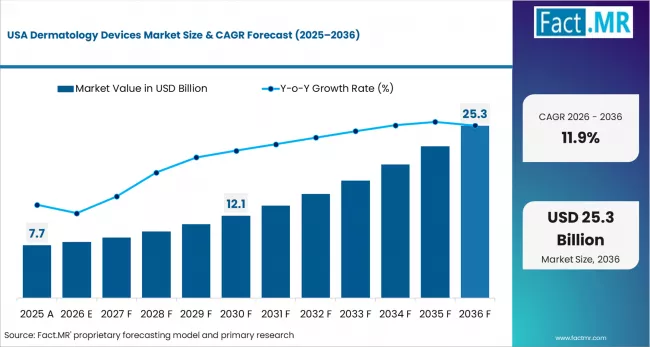
Dermatology Devices Market Country Value Analysis | Source: Fact.MR
The U.S. dermatology equipment market is also expected to evolve as demand for dermatology procedures surges.
Will India Prove to Be a High-Growth Market for Dermatology Devices?
India has a massive population and is still an emerging economy. The nation is seeing a major shift in lifestyle trends as the disposable income of people rises and awareness among people for better skin treatments increases. Changing beauty trends and standards are also expected to drive demand for dermatology devices in the country.
Category-wise Analysis
How is Demand for Dermatology Devices from Dermatology Clinics?
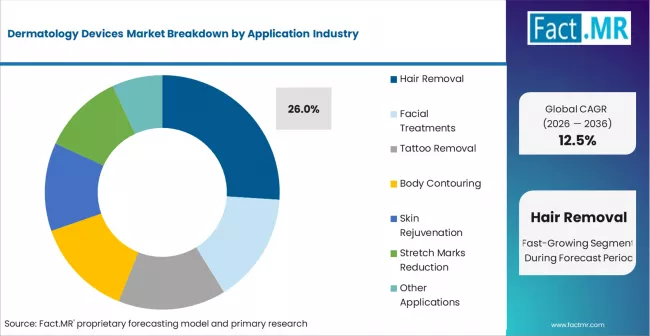
Dermatology Devices Market Analysis By Application | Source: Fact.MR
Installation of dermatology devices at dermatology clinics is expected to rise at a high rate over the next ten years, and this can be attributed to increasing demand for specialized dermatology treatments and surgeries.
While hospitals still hold majority of revenue share in terms of end use, installation of dermatology devices at hospitals is expected to see steady growth, but is not expected to be overtake the dermatology clinics segment in terms of CAGR. Demand for dermatology surgical instruments is also expected to see steady growth
Competitive Landscape
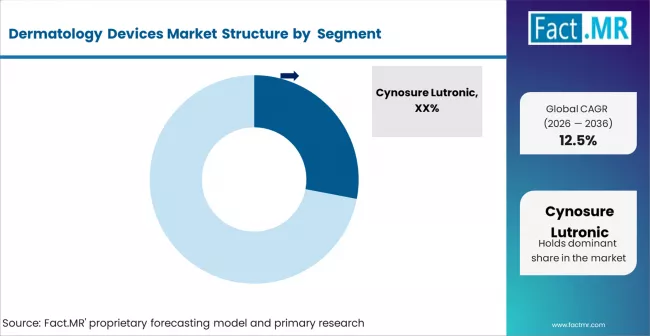
Dermatology Devices Market Analysis By Company | Source: Fact.MR
Manufacturers are investing in the research & development of new products to capture market potential as per consumer demand. New product launches and increase in research are expected to be prominent trends.
- Google as launched its dermatology AI app in June 2021. The AI-powered app will use image recognition to identify skin condition based on photos upload by a user. The app, however, did not acquire FDA certification, and hence, is only available in Europe as of now.
- In August 2021, Strata Skin Sciences announced that it has completed the acquisition of Pharos dermatology from Ra Medical. This will give Strat Skin Sciences around 400 dermatology practices that were part of the Ra Medical customer base.
- In September 2021, Swift Medical announced the launch of its new product - Swift Skin and Wound. This would enable patients and researchers to capture high-precision images of skin conditions through their smartphones.
Bibliography
- International Society of Aesthetic Plastic Surgery. (2024). ISAPS global statistics: Aesthetic procedure volumes by country and device category. ISAPS.
- United States Food and Drug Administration. (2024). 510(k) premarket notification database: Laser and energy-based dermatology device clearances. FDA.
- European Commission. (2024). Medical Device Regulation EU 2017/745: Aesthetic and dermatology device classification and conformity requirements. European Commission.
- Government of India, Ministry of Health and Family Welfare. (2024). Medical tourism policy: Aesthetic medicine facility registration and quality standards. MoHFW.
- World Health Organization. (2024). Global report on radiation safety: Laser and energy-based medical device safety standards. WHO.
- Organisation for Economic Co-operation and Development. (2024). Health at a Glance: Dermatology and aesthetic procedure workforce and facility data. OECD.
This bibliography is provided for reader reference. The full FACT.MR report contains the complete reference list with primary research documentation.
This Report Addresses
- Market sizing and quantitative forecast metrics detailing capital equipment expenditure projections for the Dermatology Devices market across product type, end user, and application categories through 2036.
- Segmentation analysis mapping procurement velocity across laser-based, electrocautery, ultrasonic, and radiofrequency platforms by dermatology clinic, ambulatory surgical center, and hospital end user.
- Regional intelligence comparing India and Brazil medical tourism clinic investment cycles against aging population aesthetic procedure demand in Germany, USA, and Japan.
- Regulatory compliance assessment analyzing FDA 510(k) clearance, EU MDR 2017/745, and national medical device authorization requirements for laser and energy-based dermatology platform market access.
- Competitive landscape evaluation tracking Cynosure Lutronic, Candela, Alma Lasers, and Cutera multi-modality platform development and emerging market clinical training investment strategies.
- Technology transition analysis identifying multi-modality platform convergence, non-invasive body contouring adoption, and AI-assisted treatment parameter optimization as the primary product differentiation investment priorities.
- Market entry guidance defining clinical training program investment, service network infrastructure, and equipment financing program requirements for emerging market aesthetic clinic operator engagement.
- Custom data delivery formats encompassing interactive dashboards, raw Excel datasets, and comprehensive PDF narrative reports.
Segmentation
Scope of the Report
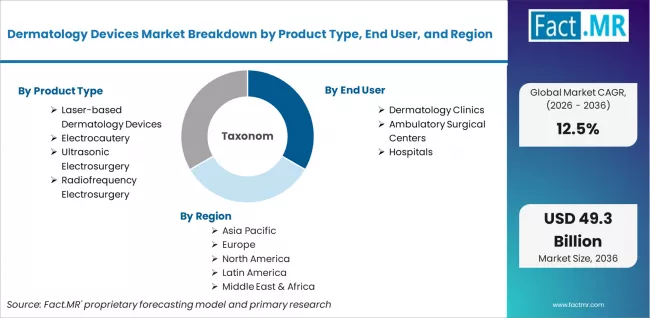
Dermatology Devices Market Breakdown By Product Type, End User, And Region | Source: Fact.MR
| Metric | Value |
|---|---|
| Quantitative Units | USD 15.19 billion to USD 49.32 billion, at a CAGR of 12.5% |
| Market Definition | The Dermatology Devices market covers laser-based, electrocautery, ultrasonic, and radiofrequency energy-based medical devices used by dermatology clinics, ambulatory surgical centers, and hospitals for hair removal, facial treatment, tattoo removal, body contouring, and skin rejuvenation procedures globally. |
| Product Type Segmentation | Laser-based Dermatology Devices, Electrocautery, Ultrasonic Electrosurgery, Radiofrequency Electrosurgery |
| End User Segmentation | Dermatology Clinics, Ambulatory Surgical Centers, Hospitals |
| Application Segmentation | Hair Removal, Facial Treatments, Tattoo Removal, Body Contouring, Skin Rejuvenation, Stretch Marks Reduction, Other Applications |
| Regions Covered | North America, Latin America, Europe, East Asia, South Asia, Oceania, Middle East and Africa |
| Countries Covered | India, Germany, Brazil, USA, UK, Japan, and 40 plus countries |
| Key Companies Profiled | Cynosure Lutronic, Candela Corporation, Alma Lasers (Sisram Medical), Solta Medical (Bausch Health), Cutera Inc., Lumenis Be Ltd., Canfield Scientific Inc., Sciton Inc., STRATA Skin Sciences, DermLite LLC (3Gen Inc.) |
| Forecast Period | 2026 to 2036 |
| Approach | Bottom-up aggregation of active dermatology device installation counts by facility type and procedure category with aesthetic procedure volume growth rates and replacement cycle models applied to regional projections |
Source: Fact.MR analysis. Updated Mar 14, 2026
Key Segments Covered in Dermatology Devices Industry Survey
-
By Product Type:
- Radiofrequency Electrosurgery
- Electrocautery
- Ultrasonic Electrosurgery
- Laser-based Dermatology Devices
-
By End User:
- Hospitals
- Ambulatory Surgical Centers
- Dermatology Clinics
-
By Application:
- Skin Rejuvenation
- Facial Treatments
- Tattoo Removal
- Body Contouring
- Hair Removal
- Stretch Marks Reduction
- Other Applications
-
By Region
- North America
- Latin America
- Europe
- APEJ
- MEA
Frequently Asked Questions
How large is the demand for Dermatology Devices in the global market in 2026?
What will be the market size of Dermatology Devices by 2036?
What is the expected demand growth between 2026 and 2036?
Which Product Type leads global sales by 2026?
Which End User category leads?
What is India's growth outlook?
What drives demand in Germany?
Which Application category leads?
What is excluded from the scope?
How does FACT.MR validate the Dermatology Devices forecast?
Who worked on this report


Preview the report firsthand - request a free sample
Free SampleGet the brochure for pricing and purchase details
Download PDF