- Base Value(2025): 19.2 Bn
- Estimated Value(2026): 21.6 Bn
- Forecast Value (2036): 67.0 Bn
- CAGR (2026 - 2036): 12.0%
Medical Aesthetic Devices Market Analysis and Forecast by Fact.MR
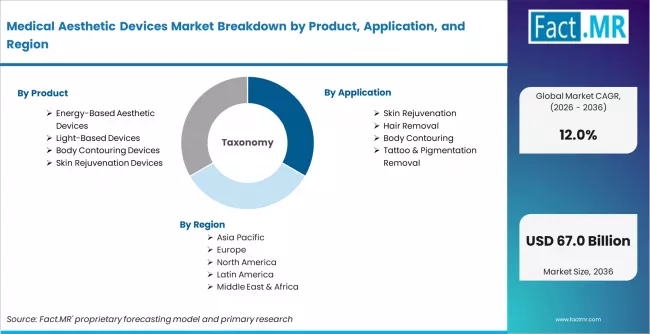
According to Fact.MR estimates, the global medical aesthetic devices market market was valued at USD 19.2 billion in 2025. The market is projected to reach USD 21.6 billion in 2026 and is expected to grow to USD 67.0 billion by 2036, expanding at a CAGR of 12.0%. Energy-Based Aesthetic Devices is anticipated to account for 46.0% of the product segment in 2026, while Skin Rejuvenation is expected to remain the leading application with around 38.0% share.
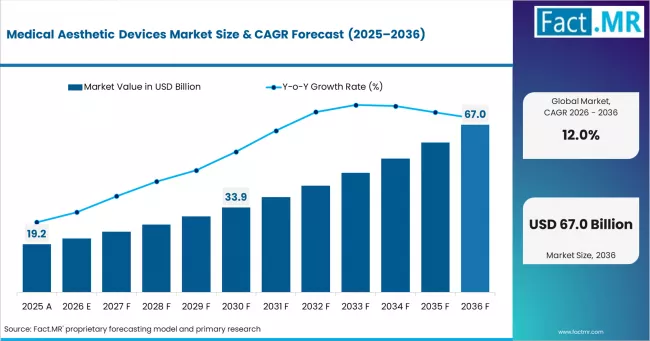
Medical Aesthetic Devices Market Market Value Analysis | Source: Fact.MR
Summary of Medical Aesthetic Devices Market
- Market Snapshot
- The medical aesthetic devices market was valued at USD 19.25 billion in 2025.
- By 2036, the Medical Aesthetic Devices Market is expected to be worth USD 66.95 billion.
- From 2026 to 2036, the market is projected to expand at a CAGR of 12.0%.
- The market is projected to create an incremental opportunity of USD 45.39 billion between 2026 and 2036.
- In 2026, energy-based aesthetic devices are expected to account for 46% of the product segment, driven by broad adoption of laser, RF, and ultrasound technology platforms.
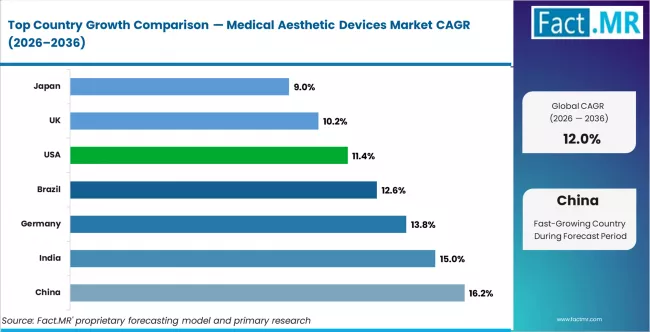
- China (16.2%) and India (15.0%) are two of the fastest growing markets in the world.
- Demand and Growth Drivers
- Demand is shaped by rising consumer spending on non-invasive cosmetic procedures across aging baby boomer populations and younger demographic cohorts.
- Growth reflects expanding medspa and dermatology clinic networks globally, which are converting surgical aesthetic procedures into non-invasive energy-based alternatives.
- Adoption is increasing due to social media visibility of aesthetic treatments, declining stigma around cosmetic procedures, and growing consumer preference for minimally invasive options.
- Product and Segment View
- Energy-based aesthetic devices lead the product segment with a 46% share in 2026, supported by broad adoption across laser, RF, ultrasound, and cryolipolysis platforms.
- Skin rejuvenation holds 38% of the application segment, anchored by large-volume wrinkle reduction and anti-aging treatment demand.
- Dermatology clinics account for 41% of end-use demand, while private skin clinics, medical spas, and cosmetic surgery departments form secondary channels.
- Geography and Competitive Outlook
- North America remains the largest regional market, supported by mature medspa networks, broad consumer spending on aesthetics, and established dermatology clinic infrastructure.
- Asia Pacific is the fastest-growing region, led by China where rapidly expanding medspa networks, rising middle-class spending, and growing dermatology clinic capacity are all supporting device adoption.
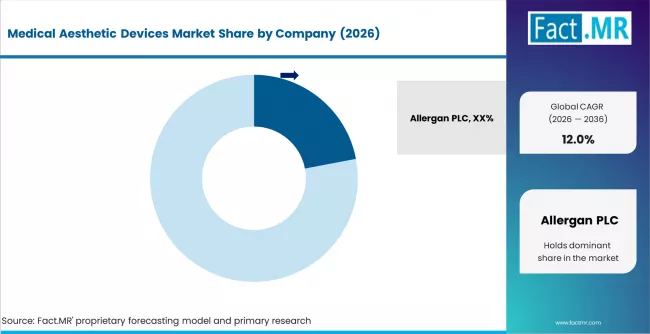
- The competitive field is led by Allergan PLC with an estimated 22% share, followed by Cynosure, Cutera Inc., Lumenis Ltd., and Galderma SA.
- Analyst Opinion
- Medical aesthetic devices sit at the fast-growing intersection of consumer beauty spending and clinical medical technology, and the commercial economics reflect this hybrid positioning. The category is structurally attractive because growth is driven by both discretionary consumer spending and established medical channel adoption, which creates multi-source demand that withstands typical consumer spending cycles. The commercial lever that matters most is treatment ecosystem depth because aesthetic practices prefer platform vendors offering complete treatment suites across laser, RF, ultrasound, and cryolipolysis rather than single-modality systems. Players that combine broad energy-based device portfolios with strong consumable recurring revenue, practitioner training programs, and brand marketing investment will capture premium positioning, while single-platform specialty players face pressure as consolidation continues across medspa and dermatology clinic networks.
Why is Medical Aesthetic Devices Market Growing?
- Growth reflects rising consumer spending on non-invasive cosmetic procedures across all age demographics globally.
- Demand is shaped by expanding medspa and dermatology clinic networks that are converting surgical procedures into non-invasive alternatives.
- Adoption is increasing due to social media visibility, declining stigma, and growing preference for minimally invasive treatment options.
The demand base rests on rising consumer spending on non-invasive cosmetic procedures across all age demographics. Baby boomer populations continue spending on skin rejuvenation and anti-aging treatments as they remain active longer. Generation X consumers are increasingly using preventive aesthetic procedures to delay visible aging. Millennials have driven broad adoption of procedures such as laser hair removal and skin rejuvenation into younger demographics. Even Generation Z consumers are beginning to adopt light preventive treatments, which expands the category base across all adult age cohorts.
The second structural driver is the broad shift from surgical to non-surgical aesthetic procedures. Cryolipolysis systems compete against surgical liposuction at meaningfully lower patient cost and recovery impact. Radiofrequency and ultrasound skin tightening provides alternatives to surgical facelifts. Laser and IPL treatments replace traditional invasive approaches to pigmentation and vascular lesion management. This procedure migration expands the addressable market by making aesthetic treatment accessible to consumers unwilling to undergo surgery.
The third driver is visibility and accessibility. Social media platforms including Instagram, TikTok, and YouTube have dramatically increased consumer awareness of aesthetic treatments and normalized cosmetic procedures. Medspa networks have expanded aesthetic device access beyond traditional medical channels into retail-adjacent locations. Home use consumer devices are also expanding the category into at-home treatment settings, which creates broader brand awareness that feeds back into clinical channel demand.
Segment-wise Analysis of Medical Aesthetic Devices Market
- Energy-based aesthetic devices lead the product segment with 46% share in 2026, anchored by broad adoption across laser, RF, and ultrasound platforms.
- Body contouring devices represent the fastest-growing sub-segment, driven by cryolipolysis and HIFU adoption replacing surgical liposuction alternatives.
- Skin rejuvenation holds 38% of the application segment, followed by hair removal and body contouring as secondary use cases.
The segmentation view shows a category where energy-based platforms dominate volume while body contouring and skin rejuvenation applications drive premium growth. Competitive advantage rests on energy-based technology portfolio breadth, consumable ecosystem depth, and practitioner training program quality. Growth over the forecast period is expected to tilt toward body contouring and combination treatment platforms as consumer demand for non-surgical alternatives expands and aesthetic practices seek multi-application system utilization.
Why Do Energy-Based Aesthetic Devices Lead the Product Segment?
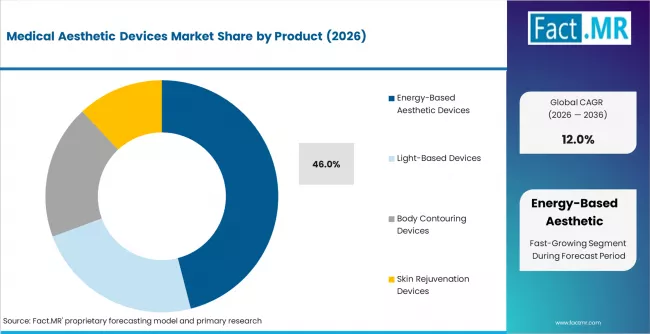
Medical Aesthetic Devices Market Analysis By Product | Source: Fact.MR
Energy-based aesthetic devices lead the product segment because they address the full spectrum of major aesthetic treatment categories including skin rejuvenation, hair removal, body contouring, and tattoo removal through a single technology family. Laser, IPL, RF, ultrasound, and cryolipolysis platforms collectively serve the vast majority of non-invasive aesthetic procedures, which positions energy-based devices as the foundational technology platform across the category.
The segment leadership is reinforced by multi-application platform economics. Modern aesthetic devices often combine multiple energy modalities in single platforms, which allows practices to offer diverse treatment menus with lower capital investment per treatment type. Cutera, Lumenis Ltd., Cynosure, and other scaled manufacturers have built broad energy-based portfolios that cover laser, IPL, RF, and ultrasound applications, which reinforces practice-level platform consolidation dynamics.
Why are Body Contouring Devices the Fastest-Growing Sub-Segment?
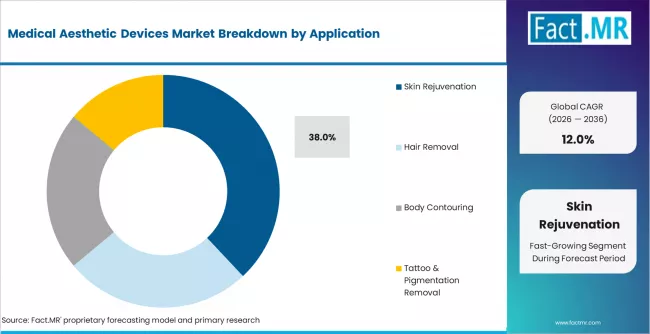
Medical Aesthetic Devices Market Analysis By Application | Source: Fact.MR
Body contouring devices are the fastest-growing sub-segment because they directly address the large market for non-surgical fat reduction that has historically required liposuction. Cryolipolysis systems such as CoolSculpting and HIFU systems such as Liposonix have demonstrated effectiveness for localized fat reduction with minimal recovery time, which has dramatically expanded the addressable patient population for body contouring beyond those willing to undergo surgical procedures.
Growth within body contouring is being lifted by technology evolution and practitioner training investment. Newer cryolipolysis applicators address challenging treatment areas including submental fat, arms, and thighs. Radiofrequency-based body contouring platforms add skin tightening benefits alongside fat reduction, which supports premium pricing for combination treatments. Scaled manufacturers with body contouring portfolios are also investing in consumer marketing that builds brand awareness and drives practice-level demand.
Key Growth Drivers, Constraints, and Market Scope
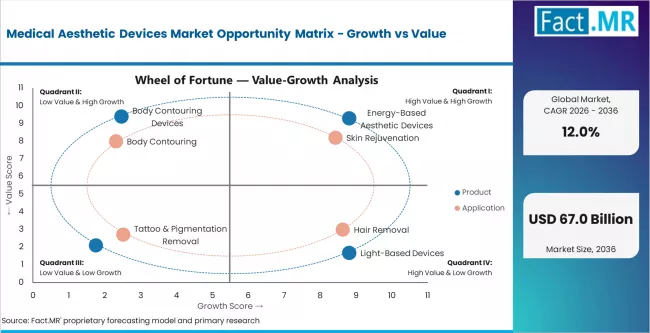
Medical Aesthetic Devices Market Opportunity Matrix Growth Vs Value | Source: Fact.MR
- Rising consumer spending on non-invasive aesthetics and procedure migration from surgical to non-surgical alternatives are the structural demand foundations.
- Body contouring platform adoption and combination treatment platform expansion are the key compositional shifts driving premium growth.
- Practitioner training requirements, regulatory complexity across geographies, and consumer price sensitivity remain the leading constraints.
The market scope is shaped by the combination of broad consumer demand expansion and premium growth in body contouring and combination treatment platforms. Competitive advantage sits in energy-based technology portfolio breadth, consumable ecosystem depth, and practitioner training and brand marketing investment.
Growth Drivers
The primary driver is rising consumer spending on non-invasive cosmetic procedures across aging baby boomer populations and younger demographic cohorts. A second driver is the broad shift from surgical to non-surgical aesthetic procedures, which expands the addressable patient population by making aesthetic treatment accessible to consumers unwilling to undergo surgery. A third driver is social media visibility, declining stigma, and accelerated accessibility through medspa network expansion. These three forces combine to deliver a strong double-digit CAGR with premium uplift from body contouring and combination treatment platforms.
Constraints
The leading constraint is practitioner training requirements. Effective use of aesthetic devices requires clinical skill in patient selection, treatment parameter optimization, and outcome management, which creates a training bottleneck that limits the pace of device deployment. A second constraint is regulatory complexity across geographies. FDA clearance, CE mark, and emerging market regulatory frameworks all differ in requirements, which creates multi-jurisdictional compliance burden. A third constraint is consumer price sensitivity. Premium aesthetic treatments cost USD 500 to USD 5,000 per session, which creates sensitivity to economic conditions and can drive treatment volume volatility in consumer discretionary spending downturns.
Opportunities
The strongest opportunity lies in body contouring portfolio expansion and combination treatment platforms, where premium pricing can support sustained margin growth. A second opportunity is emerging market penetration, particularly in China and India, where rapidly expanding medspa networks and rising middle-class spending on aesthetics both support device demand. A third opportunity is consumer home use device category expansion, where brand extensions from clinical aesthetic device manufacturers can capture share from the broader consumer beauty technology market.
Regional Outlook Across Key Markets
.webp "Top Country Growth Comparison Medical Aesthetic Devices Market Cagr (2026 2036)")
Top Country Growth Comparison Medical Aesthetic Devices Market Cagr (2026 2036) | Source: Fact.MR
- China leads country-level growth at 16.2% CAGR, supported by rapidly expanding medspa networks, rising middle-class spending on aesthetics, and growing dermatology clinic capacity.
- India follows at 15.0%, driven by growing metropolitan dermatology clinic networks, rising consumer spending on aesthetics, and expanding medspa presence.
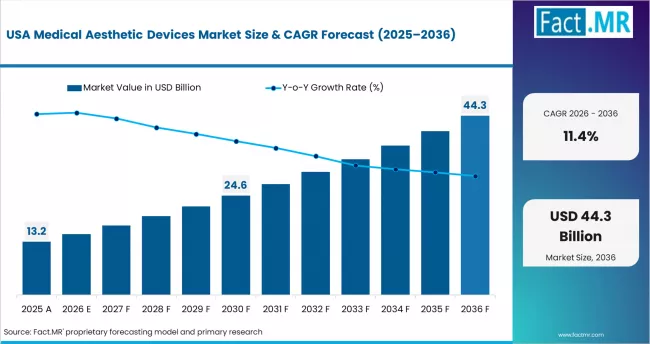
- North America remains the largest regional pool by absolute value, with the USA at 11.4% supported by mature medspa networks and broad consumer spending on aesthetics.
- European demand is led by Germany at 13.8% and the UK at 10.2%, with both countries showing active medspa network expansion and rising consumer aesthetic spending.
Country CAGR Table
| Country | CAGR (%) |
|---|---|
| China | 16.20% |
| India | 15.00% |
| Germany | 13.80% |
| Brazil | 12.60% |
| USA | 11.40% |
| UK | 10.20% |
| Japan | 9.00% |
Source: Fact.MR analysis. Updated Apr 27, 2026
Source: Fact.MR analysis, based on proprietary forecasting model and primary research.
Medical Aesthetic Devices Market Cagr Analysis By Country | Source: Fact.MR
Regional dynamics split into three profiles. Asia Pacific leads on growth rate, pulled by medspa network expansion and rising middle-class spending on aesthetics. Europe grows at double-digit rates driven by active medspa expansion and rising consumer aesthetic spending. North America remains the largest dollar market, anchored by mature medspa networks, broad consumer spending on aesthetics, and established dermatology clinic infrastructure across both coastal and interior markets.
United States
Medical Aesthetic Devices Market Country Value Analysis | Source: Fact.MR
The United States anchors global demand through its mature medspa networks, broad consumer spending on aesthetics, and established dermatology clinic infrastructure. Allergan PLC, Cynosure, Cutera Inc., and Lumenis Ltd. lead major device categories, while chain medspa operators such as Ideal Image, Laser Away, and Sono Bello drive concentrated device procurement. Insurance does not cover cosmetic procedures, which creates direct consumer spending economics but also supports high procedure pricing.
- Mature medspa networks support broad device adoption across metropolitan markets.
- Chain medspa operators drive concentrated device procurement.
- Broad consumer spending on aesthetics supports premium device positioning.
Canada
Canada represents a steady growth market shaped by medspa network expansion in Toronto, Montreal, Vancouver, and Calgary, dermatology clinic concentration in urban areas, and cross-border device distribution relationships with US manufacturers. Private pay aesthetic economics drive consumer channel dynamics, while dermatology clinics and cosmetic surgery practices drive premium device placements.
- Metropolitan medspa expansion drives device adoption.
- Dermatology clinic and cosmetic surgery practice networks support premium placements.
- Cross-border distribution supports device availability across Canadian markets.
United Kingdom
The United Kingdom market is shaped by the mix of high street aesthetic clinic chains and private dermatology and cosmetic surgery practices. Chain aesthetic clinics such as Sk:n Clinics, Harley Medical Group, and Transform have expanded rapidly across UK metropolitan markets, while independent dermatology and cosmetic surgery practices drive premium device placements. London in particular hosts concentrated aesthetic activity across Harley Street and other clinical hubs.
- High street aesthetic clinic chains drive concentrated device procurement.
- London's aesthetic clinic concentration supports premium device placements.
- Independent dermatology and cosmetic surgery practices sustain diverse device demand.
Germany
Germany leads European growth on the strength of broad dermatology clinic infrastructure, expanding medspa networks, and rising consumer spending on aesthetics. German dermatology practices and cosmetic clinics drive stable device demand, while metropolitan medspa expansion across Berlin, Munich, Hamburg, and Frankfurt supports rapid category growth. Allergan PLC, Cynosure, Cutera Inc., and Lumenis Ltd. all compete actively across the German aesthetic device channel.
- Broad dermatology clinic infrastructure supports device adoption.
- Metropolitan medspa expansion drives rapid category growth.
- Rising consumer spending on aesthetics supports premium device positioning.
China
China is the fastest-growing country in the forecast, driven by rapidly expanding medspa networks, rising middle-class spending on aesthetics, and growing dermatology clinic capacity. Chinese medspa chains such as Meitu Medical Beauty, Plus Medical Beauty, and So Young have built substantial networks across tier-1 and tier-2 cities. Chinese consumers have some of the highest aesthetic treatment adoption rates globally, particularly among women aged 20 to 45, which supports sustained category growth across treatment types.
- Rapidly expanding medspa networks drive concentrated device procurement.
- Rising middle-class spending on aesthetics supports premium device positioning.
- Growing dermatology clinic capacity sustains broad device adoption patterns.
India
India represents a strong growth market driven by growing metropolitan dermatology clinic networks, rising consumer spending on aesthetics, and expanding medspa presence. Dr. Batra's, Kaya Skin Clinic, VLCC Wellness, and other aesthetic clinic chains are expanding across Indian metropolitan markets. Rising middle-class spending and growing acceptance of aesthetic procedures among younger demographics support sustained device demand growth.
- Metropolitan dermatology clinic network expansion drives device demand.
- Rising consumer spending on aesthetics supports category growth.
- Expanding medspa presence widens device adoption beyond traditional dermatology settings.
Competitive Benchmarking and Company Positioning
Medical Aesthetic Devices Market Analysis By Company | Source: Fact.MR
- Allergan PLC leads with an estimated 22% share, supported by its CoolSculpting platform, broad aesthetic device portfolio, and strong consumer brand marketing investment.
- Cynosure, Cutera Inc., Lumenis Ltd., and Galderma SA compete through differentiated energy-based device portfolios and established aesthetic channel relationships.
- Specialty players such as Hologic Inc., PhotoMedex Inc., Danaher Corporation, and Bausch Health Companies Inc. hold focused positions in specific technology and application segments.
The competitive field is moderately concentrated, with Allergan PLC commanding a strong share position through its CoolSculpting cryolipolysis platform, broader aesthetic device portfolio, and substantial consumer brand marketing investment. Allergan's scale reach, brand recognition, and integrated aesthetic portfolio extending into injectables create meaningful competitive advantages that reinforce its position across aesthetic practice segments.
Cynosure holds strong positions across laser and IPL platforms through brands such as PicoSure, SculpSure, and TempSure. Cutera Inc. competes through its excel V+, Secret RF, and other platforms targeting dermatology and medspa channels. Lumenis Ltd. has broad energy-based device portfolio depth spanning laser, IPL, and RF platforms. Galderma SA extends into aesthetic devices from its injectable aesthetics portfolio. Danaher Corporation, Johnson and Johnson, and Hologic Inc. maintain positions through specialty portfolio extensions.
Strategic priorities across the field include expanding body contouring and combination treatment platforms, deepening consumable and applicator ecosystem revenue, and investing in consumer brand marketing and practitioner training programs. Scaled manufacturers with broad energy-based portfolios and strong consumer brand positioning will capture the bulk of forecast period growth, while single-platform specialty players must differentiate through targeted innovation or focus on specific high-growth application segments.
Competitive Analysis
Competitive positioning rests on three dimensions: energy-based technology portfolio breadth, consumable ecosystem depth, and brand marketing and practitioner training investment. Allergan PLC leads on brand strength and consumer marketing investment. Cynosure and Cutera Inc. lead on technology portfolio breadth and dermatology channel presence. Lumenis Ltd. holds broad portfolio positioning across multiple energy modalities. Galderma SA leverages its injectable aesthetics heritage to extend into device platforms.
Second-tier competitors maintain relevance through specialized technology platforms, focused application strategies, or regional channel concentration. Chinese and Korean manufacturers are building positions in value-tier segments, particularly for domestic medspa networks. The gap between branded platform manufacturers with consumer marketing investment and specialty device producers without brand depth continues to widen as consumer awareness drives practice-level purchasing decisions.
Benchmarking Table
| Company | Scale Reach | Portfolio Breadth | Consumer Brand | Practitioner Training |
|---|---|---|---|---|
| Allergan PLC | Global | Broad | Strong | Strong |
| Cynosure | Global | Broad | Strong | Strong |
| Cutera Inc. | Global | Medium-Broad | Medium-Strong | Strong |
| Lumenis Ltd. | Global | Broad | Medium | Strong |
| Galderma SA | Global | Medium | Strong | Medium-Strong |
| Hologic Inc. | Global | Focused | Medium | Medium |
| Bausch Health Companies Inc. | Global | Medium | Medium | Medium |
Source: Fact.MR analysis. Updated Apr 27, 2026
Recent Developments
- In 2025, Allergan PLC continued expanding its CoolSculpting platform through new applicator launches targeting submental fat and other challenging treatment areas.
- In 2025, Cynosure advanced its aesthetic device portfolio through platform updates targeting dermatology and medspa channels with combined energy modality systems.
- In 2026, Cutera Inc. strengthened its platform portfolio through product line updates supporting expanded treatment indications and practitioner training programs.
Leading Companies Shaping Medical Aesthetic Devices Market
-
Major Players
- Allergan PLC
- Cynosure
- Cutera Inc.
- Lumenis Ltd.
- Galderma SA
- Hologic Inc.
- Johnson & Johnson
- Bausch Health Companies Inc.
-
Emerging Players
- Danaher Corporation
- PhotoMedex Inc.
- Dentsply Sirona Inc.
- BioHorizons IPH Inc.
- Southern Implants
- Straumann
- Syneron Candela
- Alma Lasers
Sources and Research References
- United States Food and Drug Administration (FDA) - 510(k) and PMA Database for Aesthetic Devices
- American Society for Aesthetic Plastic Surgery (ASAPS) - Annual Aesthetic Procedure Statistics
- World Health Organization (WHO) - Cosmetic Procedure Safety Publications
- American Academy of Dermatology (AAD) - Clinical Guidelines on Aesthetic Treatments
- Allergan PLC - Annual Report and Aesthetic Segment Disclosures
- Cynosure - Aesthetic Device Platform Portfolio Updates
- Primary interviews with dermatologists, plastic surgeons, medspa owners, and aesthetic device manufacturers
This bibliography is provided for reader reference and is not exhaustive. The full report contains the complete reference list and detailed citations.
Key Questions This Report Addresses
- What is the current and future size of the medical aesthetic devices market?
- How fast is the market expected to grow between 2026 and 2036?
- Which product segment is likely to lead the market by 2026?
- Which application segment will account for the highest demand by 2026?
- How is the shift from surgical to non-surgical aesthetic procedures reshaping demand?
- Why are China and India emerging as the fastest-growing markets?
- Which countries are projected to show the fastest growth through 2036?
- Who are the key companies active in the medical aesthetic devices market?
- How is body contouring platform adoption changing the competitive dynamics?
Medical Aesthetic Devices Market Definition
The medical aesthetic devices market covers energy-based and mechanical devices used in clinical and medspa settings to perform non-invasive and minimally invasive cosmetic procedures for skin rejuvenation, body contouring, hair removal, tattoo removal, and related aesthetic applications. This includes laser devices, light-based devices, radiofrequency devices, ultrasound devices, cryolipolysis systems, microneedling devices, and associated consumables and applicators. The market spans dermatology clinics, private skin clinics, medical spas, hospitals, cosmetic surgery departments, dermatology units, beauty and aesthetic centers, laser treatment centers, skin care clinics, and consumer home use across primary use cases including skin rejuvenation, hair removal, body contouring, and tattoo and pigmentation removal.
Medical Aesthetic Devices Market Inclusions
The scope includes energy-based aesthetic devices across laser devices including CO2 laser systems and Nd:YAG laser systems, light-based devices including intense pulsed light (IPL) systems and photorejuvenation devices, body contouring devices including cryolipolysis systems and ultrasound fat reduction devices, skin rejuvenation devices including radiofrequency (RF) devices and microneedling devices, and associated consumables including cartridges, applicator kits, and single-use treatment packs. It covers applications across skin rejuvenation, wrinkle reduction, anti-aging treatments, hair removal, laser hair removal, IPL hair reduction, body contouring, fat reduction treatments, skin tightening procedures, and tattoo and pigmentation removal. Coverage spans dermatology clinics, private skin clinics, medical spas, hospitals, cosmetic surgery departments, dermatology units, beauty and aesthetic centers, laser treatment centers, skin care clinics, home use consumer devices, and at-home aesthetic devices from 2026 to 2036.
Medical Aesthetic Devices Market Exclusions
The scope excludes injectable aesthetic products such as botulinum toxin, dermal fillers, and mesotherapy injectables, which are separate pharmaceutical categories. It also excludes surgical aesthetic procedures equipment including rhinoplasty, breast implant surgery, and liposuction equipment used in general surgical settings. Conventional beauty products, cosmetics, topical skincare products, and over-the-counter consumer beauty items are outside the scope, as are specialty medical devices used for burn treatment, reconstructive surgery, or other non-aesthetic medical applications.
Medical Aesthetic Devices Market Research Methodology
- Primary Research: Interviews with dermatologists, plastic surgeons, medspa owners, aesthetic device manufacturers, and distribution partners to validate treatment volumes, pricing dynamics, and platform adoption patterns.
- Desk Research: Review of FDA 510(k) clearances and PMA approvals for aesthetic devices, CE mark filings, ASAPS aesthetic procedure statistics, and published clinical studies on aesthetic treatment outcomes.
- Market Sizing: Demand-side model built on treatment volumes by procedure type, clinic counts, per-device pricing across premium and value segments, consumable consumption rates, and consumer home use device adoption.
- Data Validation: Cross-validation across primary interviews, regulatory filings, aesthetic society publications, and consumer spending surveys, with sensitivity analysis on medspa network expansion and home use device adoption rates.
Segmentation
Scope of Analysis
Medical Aesthetic Devices Market Breakdown By Product, Application, And Region | Source: Fact.MR
| Parameter | Details |
|---|---|
| Quantitative Units | USD 21.56 billion to USD 66.95 billion, at a CAGR of 12.0% |
| Market Definition | The medical aesthetic devices market covers energy-based and mechanical devices used in clinical and medspa settings to perform non-invasive and minimally invasive cosmetic procedures for skin rejuvenation, body contouring, hair removal, tattoo removal, and related aesthetic applications, spanning laser, light-based, RF, ultrasound, cryolipolysis, and microneedling devices. |
| Regions Covered | North America, Latin America, Europe, East Asia, South Asia and Pacific, Middle East and Africa |
| Countries Covered | USA, Canada, UK, Germany, China, India, Brazil, Japan, 30 plus countries |
| Key Companies | Allergan PLC, Cynosure, Cutera Inc., Lumenis Ltd., Galderma SA, Hologic Inc., Johnson & Johnson, Bausch Health Companies Inc. |
| Forecast Period | 2026 to 2036 |
| Approach | Hybrid demand-side and top-down methodology built on treatment volumes by procedure type, clinic counts, per-device pricing across premium and value segments, consumable consumption rates, consumer home use device adoption, and primary interviews across dermatologists, plastic surgeons, medspa owners, and device manufacturers |
Source: Fact.MR analysis. Updated Apr 27, 2026
Market Segmentation Analysis
-
Medical Aesthetic Devices Market Market Segmented by Product:
- Energy-Based Aesthetic Devices
- Laser Devices
- CO2 Laser Systems
- Nd:YAG Laser Systems
- Laser Devices
- Light-Based Devices
- Intense Pulsed Light (IPL) Systems
- Photorejuvenation Devices
- Intense Pulsed Light (IPL) Systems
- Body Contouring Devices
- Cryolipolysis Systems
- Ultrasound Fat Reduction Devices
- Cryolipolysis Systems
- Skin Rejuvenation Devices
- Radiofrequency (RF) Devices
- Microneedling Devices
- Radiofrequency (RF) Devices
- Energy-Based Aesthetic Devices
-
Medical Aesthetic Devices Market Market Segmented by Application:
- Skin Rejuvenation
- Wrinkle Reduction
- Anti-Aging Treatments
- Wrinkle Reduction
- Hair Removal
- Laser Hair Removal
- IPL Hair Reduction
- Laser Hair Removal
- Body Contouring
- Fat Reduction Treatments
- Skin Tightening Procedures
- Fat Reduction Treatments
- Tattoo & Pigmentation Removal
- Laser Tattoo Removal
- Pigmented Lesion Treatment
- Laser Tattoo Removal
- Skin Rejuvenation
-
Medical Aesthetic Devices Market Market Segmented by End Use:
- Dermatology Clinics
- Private Skin Clinics
- Medical Spas (MedSpas)
- Private Skin Clinics
- Hospitals
- Cosmetic Surgery Departments
- Dermatology Units
- Cosmetic Surgery Departments
- Beauty & Aesthetic Centers
- Laser Treatment Centers
- Skin Care Clinics
- Laser Treatment Centers
- Home Use
- At-Home Aesthetic Devices
- Consumer Beauty Tech Devices
- At-Home Aesthetic Devices
- Dermatology Clinics
-
Medical Aesthetic Devices Market Market Segmented by Technology:
- Laser Technology
- Fractional Laser Systems
- Ablative & Non-Ablative Lasers
- Fractional Laser Systems
- Radiofrequency (RF) Technology
- Thermal Skin Tightening
- Collagen Stimulation Systems
- Thermal Skin Tightening
- Ultrasound Technology
- High-Intensity Focused Ultrasound (HIFU)
- Non-Invasive Fat Reduction
- High-Intensity Focused Ultrasound (HIFU)
- Cryolipolysis Technology
- Fat Freezing Systems
- Controlled Cooling Devices
- Fat Freezing Systems
- Laser Technology
-
Medical Aesthetic Devices Market Market Segmented by Distribution Channel:
- Direct Sales
- Manufacturers to Clinics
- Hospital Procurement Contracts
- Manufacturers to Clinics
- Specialty Distributors
- Aesthetic Equipment Suppliers
- Dermatology Device Vendors
- Aesthetic Equipment Suppliers
- Online Sales
- E-Commerce Platforms
- Direct Brand Websites
- E-Commerce Platforms
- Direct Sales
-
Medical Aesthetic Devices Market Market Segmented by Packaging:
- Device Systems Packaging
- Integrated Equipment Units
- Console-Based Systems
- Integrated Equipment Units
- Portable Device Packaging
- Handheld Aesthetic Devices
- Consumer Device Kits
- Handheld Aesthetic Devices
- Consumable Kits
- Cartridges & Applicator Kits
- Single-Use Treatment Packs
- Cartridges & Applicator Kits
- Device Systems Packaging
-
Medical Aesthetic Devices Market Market by Region:
- North America
- USA
- Canada
- Mexico
- Latin America
- Brazil
- Chile
- Rest of Latin America
- Western Europe
- Germany
- UK
- Italy
- Spain
- France
- Nordic
- BENELUX
- Rest of Western Europe
- Eastern Europe
- Russia
- Poland
- Hungary
- Balkan & Baltic
- Rest of Eastern Europe
- East Asia
- China
- Japan
- South Korea
- South Asia and Pacific
- India
- ASEAN
- Australia & New Zealand
- Rest of South Asia and Pacific
- Middle East & Africa
- Kingdom of Saudi Arabia
- Other GCC Countries
- Turkiye
- South Africa
- Other African Union
- Rest of Middle East & Africa
- North America
Frequently Asked Questions
How big is the medical aesthetic devices market in 2026?
What will be the size of the medical aesthetic devices market in 2036?
How much will the medical aesthetic devices market grow between 2026 and 2036?
Which product segment is expected to lead the market in 2026?
Which country is the fastest-growing market?
Why is India a key growth market?
What does the medical aesthetic devices market cover?
How is the market forecast estimated and validated?
Who worked on this report


Preview the report firsthand - request a free sample
Free SampleGet the brochure for pricing and purchase details
Download PDF