Medical Equipment Cooling Market Size, Share, Growth and Forecast (2026 - 2036)
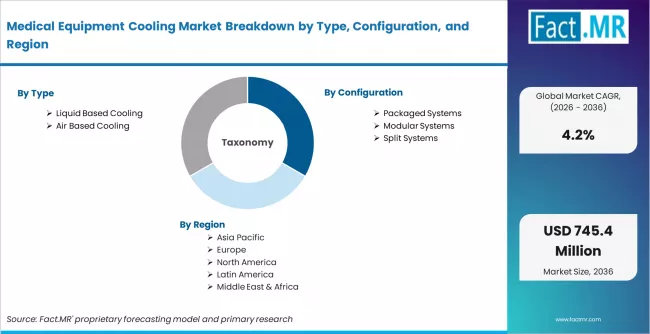
Medical Equipment Cooling Market is segmented by Type (Liquid Based Cooling, Air Based Cooling), Configuration (Packaged Systems, Modular Systems, Split Systems), Compressor (Scroll, Screw, Centrifugal, Reciprocating), and Region, with forecasts covering the period from 2026 to 2036.
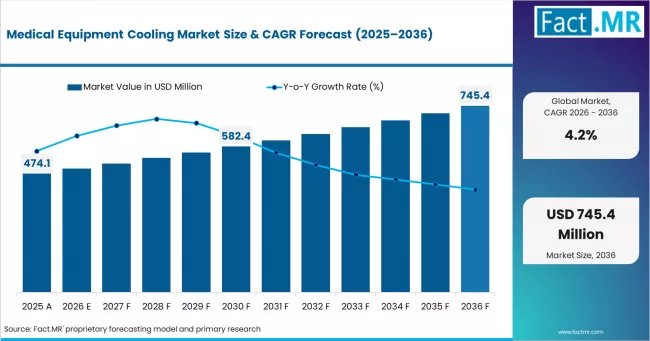
According to Fact.MR estimates, the global medical equipment cooling market market was valued at USD 474.1 million in 2025. The market is projected to reach USD 494.0 million in 2026 and is expected to grow to USD 745.4 million by 2036, expanding at a CAGR of 4.2%. Liquid Based Cooling is anticipated to account for 55.8% of the product segment in 2026, while Packaged Systems is expected to remain the leading application with around 38.6% share.
Medical Equipment Cooling Market Analysis and Forecast by Fact.MR
The medical equipment cooling market, valued at USD 474.1 million in 2025, is expanding at a 4.2% CAGR to reach USD 745.444 million by 2036. Medical equipment cooling systems include liquid-based chillers, air-based cooling units, and thermal management solutions designed to maintain optimal operating temperatures for MRI scanners, CT systems, linear accelerators, and laboratory instruments. Growth reflects the expanding global installed base of diagnostic imaging and therapeutic equipment, tightening thermal management requirements for higher-powered systems, and hospital infrastructure modernization. The USD 251.432 million incremental opportunity between 2026 and 2036 is concentrated in liquid cooling for imaging equipment across Asia and North America.
Summary of Medical Equipment Cooling Market
- Market Snapshot
- Market value in 2025: USD 474.1 million
- Projected value in 2026: USD 494.012 million; forecast to reach USD 745.444 million by 2036
- CAGR from 2026 to 2036: 4.2%
- Incremental opportunity (2026 to 2036): USD 251.432 million
- Liquid-based cooling leads type demand with 55.8% share in 2025
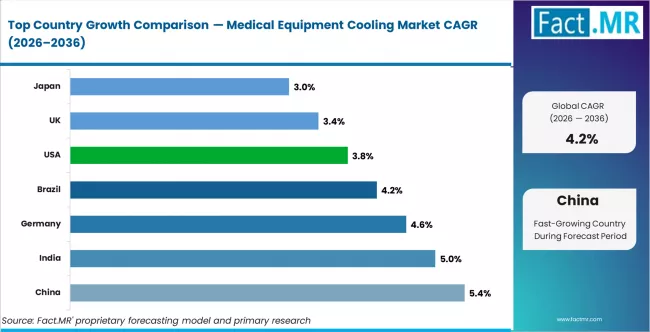
- China and India lead country-level growth, followed by Germany and Brazil
- Demand and Growth Drivers
- The global installed base of MRI, CT, PET/CT, and linear accelerator systems continues to expand, with each unit requiring dedicated cooling infrastructure for reliable operation and image quality maintenance.
- Higher-powered imaging magnets and faster CT acquisition speeds generate increased thermal loads, demanding more capable cooling systems that maintain equipment within tighter temperature tolerances.
- Hospital construction and imaging department expansion in China, India, and GCC countries are generating cooling system procurement as part of facility commissioning for new diagnostic imaging suites.
- Equipment uptime requirements are tightening as hospitals maximize utilization of high-cost imaging assets, making cooling system reliability a critical procurement criterion.
- Product and Segment View
- Liquid-based cooling holds 55.8% of type demand, driven by the thermal management requirements of MRI superconducting magnets and high-powered CT systems that exceed air cooling capacity.
- Packaged systems account for 38.6% of configuration share, reflecting procurement preference for pre-assembled cooling units that simplify installation and reduce commissioning time.
- Medical devices account for 62.4% of application demand, covering cooling for diagnostic imaging, radiation therapy, and surgical equipment.
- Key segmentation includes:
- Type: Liquid Based Cooling, Air Based Cooling
- Configuration: Packaged Systems, Modular Systems, Split Systems
- Compressor: Scroll, Screw, Centrifugal, Reciprocating
- Application: Medical Devices, Analytical and Laboratory Equipment
- Geography and Competitive Outlook
- North America is the largest revenue region, with the USA contributing USD 175.374 million in 2025 through the largest installed base of diagnostic imaging equipment globally.
- East Asia is the fastest-growing region, with China recording the highest country CAGR driven by diagnostic imaging installation growth and hospital construction.
- Europe maintains steady growth, with Germany leading through high imaging equipment density and precision cooling requirements.
- Parker Hannifin Corp leads the competitive field with a 17.9% market share, followed by American Chillers, Drake Refrigeration, and General Air Products.
- Analyst Opinion
- The medical equipment cooling market is a maintenance-critical infrastructure category where equipment uptime directly affects hospital revenue from diagnostic imaging and therapy services. Growth is tied to the expanding global installed base of high-value imaging equipment rather than discrete market dynamics. Fact.MR expects the steady installation of MRI, CT, and linear accelerator systems in emerging markets to sustain moderate but stable demand growth, while replacement and upgrade demand in mature markets reflects the aging of cooling infrastructure installed alongside imaging equipment during prior capital cycles. The trend toward higher-field MRI magnets and faster CT platforms is increasing per-unit cooling capacity requirements, creating an upgrade pathway within the existing installed base.
Key Growth Drivers, Constraints, and Opportunities
Key Factors Driving Growth
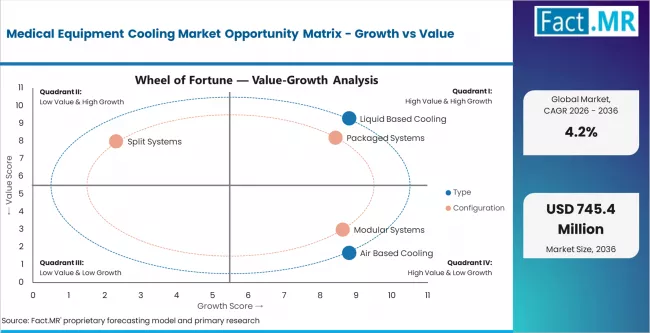
- Imaging equipment installation growth: The global MRI and CT installed base continues to expand at 3% to 5% annually, with each new system requiring dedicated cooling infrastructure that generates proportional cooling market demand.
- Higher thermal loads from advanced equipment: 3T and 7T MRI magnets, photon-counting CT detectors, and higher-dose-rate linear accelerators generate increased heat output, requiring more capable cooling systems than their predecessors.
- Hospital construction in emerging markets: New hospital builds in China, India, and the Middle East include imaging departments that require integrated cooling infrastructure at facility commissioning.
Key Market Constraints
- Low independent procurement visibility: Medical equipment cooling systems are frequently bundled with imaging equipment purchases, limiting independent market visibility and reducing standalone cooling system manufacturer negotiating power.
- Energy efficiency pressure: Hospital sustainability mandates are requiring lower-energy cooling solutions, creating R&D cost pressure for manufacturers to develop high-efficiency systems while maintaining thermal performance.
- Space constraints in hospital facilities: Imaging suite mechanical rooms have limited space for cooling equipment, constraining system size and configuration options.
Key Opportunity Areas
- Energy-efficient cooling systems: Manufacturers developing variable-speed compressor and free-cooling hybrid systems can capture procurement preference in hospitals implementing energy reduction targets.
- Predictive maintenance platforms: Cooling system manufacturers offering IoT-connected monitoring with predictive failure alerts can differentiate beyond unit pricing and reduce unplanned imaging equipment downtime.
- Modular cooling for mobile imaging: Mobile MRI and CT trailer installations require compact, transportable cooling systems, creating a niche product category.
Segment-wise Analysis of the Medical Equipment Cooling Market
- Liquid-based cooling leads type demand at 55.8%, driven by the thermal requirements of MRI and CT systems that exceed air cooling capacity.
- Packaged systems hold 38.6% of configuration share, preferred for installation simplicity and reduced commissioning time.
- Medical devices account for 62.4% of application demand, covering imaging, therapy, and surgical equipment cooling.
Which type dominates the Medical Equipment Cooling Market?
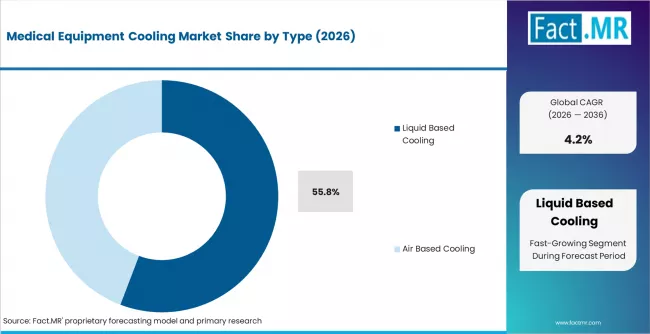
Liquid-based cooling holds a 55.8% share of type demand in 2025, the dominant cooling category. The share reflects the thermal management requirements of MRI superconducting magnets, high-powered CT systems, and linear accelerators that generate heat loads exceeding air cooling capacity. Liquid cooling systems circulate chilled water or glycol solutions through heat exchangers to remove thermal energy from equipment, maintaining operating temperatures within the narrow tolerances required for image quality and system reliability.
Air-based cooling accounts for the remaining demand, serving lower-thermal-load applications including laboratory instruments, smaller diagnostic devices, and auxiliary medical equipment. Air-based systems are preferred where liquid infrastructure is impractical or where cooling requirements are modest enough to be addressed by forced-air circulation.
Which configuration dominates the Medical Equipment Cooling Market?
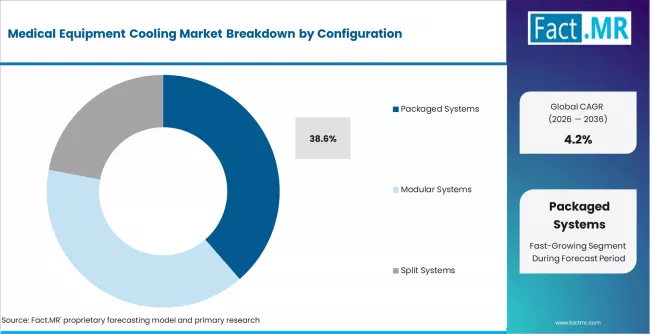
Packaged systems hold 38.6% of configuration share in 2025, the largest single configuration category. The preference reflects procurement and installation convenience, as packaged systems arrive pre-assembled and factory-tested, reducing on-site installation time and commissioning complexity. Hospital facilities teams favor packaged configurations for new imaging suite construction where space planning can accommodate a single integrated unit.
Modular and split systems serve facilities with space constraints or retrofit requirements. Modular systems allow capacity scaling by adding cooling modules, while split systems separate the condenser and evaporator components to fit within distributed mechanical room layouts.
Which compressor type dominates the Medical Equipment Cooling Market?
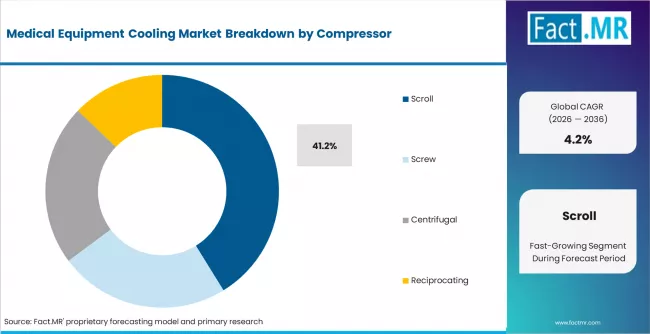
Scroll compressors hold 41.2% of compressor demand in 2025, the largest single compressor category. The share reflects scroll compressor advantages in the capacity range typical of medical equipment cooling applications, including quiet operation, high reliability, and compact size. Scroll compressors are the default choice for packaged cooling systems in the 5 to 30 ton capacity range that serves most single-equipment imaging installations.
Screw and centrifugal compressors serve larger installations where multiple imaging systems share centralized cooling infrastructure. Reciprocating compressors retain a niche in smaller, lower-cost cooling systems for laboratory and auxiliary medical equipment applications.
Which Product Trend is Shaping the Next Phase of Growth in the Medical Equipment Cooling Market?
IoT-connected predictive maintenance platforms are shaping the next growth phase in the medical equipment cooling market. Traditional cooling system maintenance operates on fixed schedules, resulting in either unnecessary service visits or unexpected failures that cause imaging equipment downtime. Cooling system manufacturers are integrating sensors, connectivity, and analytics software that monitor compressor performance, refrigerant pressure, coolant flow rates, and ambient conditions in real time, enabling predictive alerts before failure events occur.
The commercial value of predictive maintenance extends beyond hardware sales to recurring software licensing and service contract revenue. Manufacturers offering connected cooling platforms can demonstrate reduced imaging equipment downtime, which translates directly to preserved hospital revenue from imaging services. Fact.MR projects that IoT-connected cooling systems will command a 10% to 15% price premium over conventional systems and generate recurring monitoring subscription revenue that improves manufacturer lifetime customer value.
Regional Outlook Across Key Markets
.webp)
- North America is the largest revenue region, with the USA contributing USD 175.374 million in 2025 through the largest diagnostic imaging installed base.
- East Asia is the fastest-growing region, with China recording the highest country CAGR driven by imaging equipment installation growth.
- Europe maintains steady growth, shaped by high imaging density and energy efficiency requirements.
- South Asia is an emerging corridor, with India recording strong CAGR driven by hospital construction and imaging department expansion.
CAGR Table
| Country | CAGR (%) |
|---|---|
| China | 5.4% |
| India | 5.0% |
| Germany | 4.6% |
| Brazil | 4.2% |
| USA | 3.8% |
| UK | 3.4% |
| Japan | 3.0% |
Source: Fact.MR analysis, based on proprietary forecasting model and primary research.
China: Imaging equipment boom drives cooling demand
China records the highest country-level CAGR in the medical equipment cooling market, driven by rapid expansion of the diagnostic imaging equipment installed base across public and private hospitals. The government's hospital modernization program has accelerated MRI and CT installation in tier-2 and tier-3 cities, each requiring dedicated cooling infrastructure. Domestic cooling system manufacturers compete alongside international brands by offering price-competitive systems suited to Chinese hospital procurement budgets.
- Growth anchor: Diagnostic imaging installation growth is creating proportional cooling system demand at each new equipment site.
USA:Installed base maintenance and advanced system upgrades
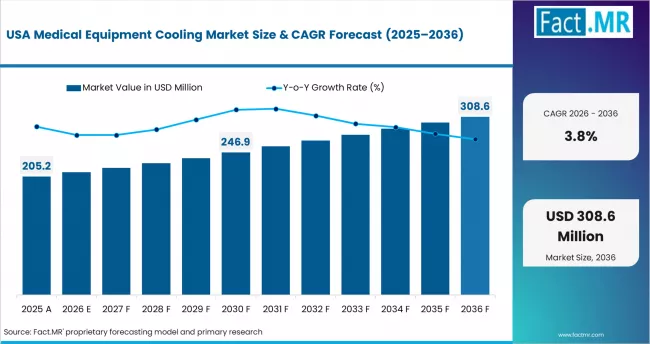
The USA contributes USD 175.374 million in 2025, the largest single-country revenue pool. Growth reflects replacement demand for aging cooling systems installed alongside imaging equipment during previous capital cycles, combined with upgrade demand as hospitals transition to higher-field MRI and faster CT platforms with increased thermal loads. Energy efficiency requirements in hospital sustainability programs are driving preference for variable-speed and hybrid cooling configurations.
- Growth anchor: Equipment replacement cycles and higher-thermal-load advanced imaging upgrades sustain demand in a mature installed base.
India: Hospital construction and imaging access expansion
India records the second-highest country CAGR, driven by hospital construction that includes imaging department commissioning and the expansion of diagnostic imaging access beyond metropolitan centers. Government health programs and private hospital investment are adding MRI and CT installations in tier-2 cities, each generating cooling system procurement demand. Cost sensitivity in the Indian market favors manufacturers offering reliable cooling systems at price points below premium international brands.
- Growth anchor: Hospital construction with imaging department commissioning is creating new cooling infrastructure demand at scale.
Germany: Imaging density and energy efficiency leadership
Germany leads European medical equipment cooling growth, supported by one of the highest per-capita imaging equipment densities in the world and progressive energy efficiency requirements. German hospitals are early adopters of high-efficiency cooling technologies including variable-speed compressors and free-cooling modes that reduce energy consumption while maintaining thermal performance. The country's strong biomedical engineering sector supports sophisticated cooling system specification and procurement.
- Growth anchor: High imaging equipment density and energy efficiency mandates create upgrade and replacement demand for advanced cooling systems.
Competitive Benchmarking and Company Positioning
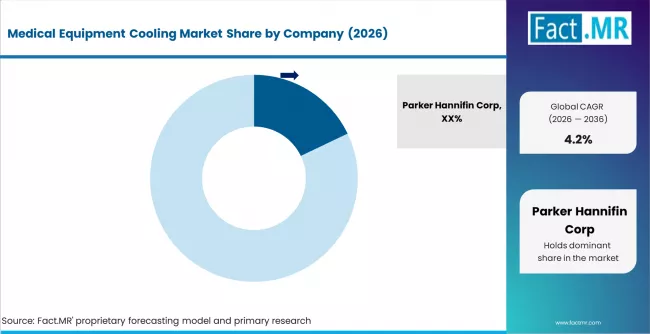
Medical Equipment Cooling Market Analysis By Company
- Parker Hannifin Corp leads with 17.9% market share, leveraging its broad thermal management portfolio and global distribution infrastructure to serve OEM imaging equipment manufacturers and hospital facilities teams.
- American Chillers and Drake Refrigeration compete in the North American hospital cooling tier, offering customized liquid cooling solutions designed for specific imaging equipment thermal management requirements.
- General Air Products and Johnson Thermal Systems maintain positions in the mid-tier, serving both new installation and replacement markets through regional distribution networks.
The competitive field is fragmented, with the top five players accounting for a combined share below 40%. Parker Hannifin's leadership reflects its diversified thermal management portfolio and OEM relationships with major imaging equipment manufacturers that specify Parker cooling systems as standard configurations for their installed base.
Competition is characterized by a mix of large industrial cooling companies with medical equipment divisions and specialized medical cooling manufacturers that focus exclusively on healthcare applications. Specialized players differentiate through healthcare-specific design features including low-noise operation, medical-grade materials, and compliance with hospital facility codes.
Regional manufacturers in China and India are gaining share by offering price-competitive cooling systems that meet the performance requirements of standard MRI and CT installations at 30% to 50% below international brand pricing.
Key Companies in the Medical Equipment Cooling Market
Parker Hannifin Corp, American Chillers, Drake Refrigeration Inc, General Air Products Inc, Haskris, Johnson Thermal Systems, Laird Technologies Inc, Cold Shot Chillers, Filtrine Manufacturing Company, Glen Dimplex Group, Legacy Chiller Systems, and Whaley Products Inc are the principal companies operating in the global medical equipment cooling market.
Recent Industry Developments
- Parker Hannifin: IoT-connected cooling platform launch (2025)
- Parker Hannifin launched a connected medical equipment cooling platform in 2025 integrating real-time performance monitoring, predictive maintenance alerts, and remote diagnostics accessible through a cloud-based dashboard for hospital facilities teams.
- American Chillers: energy-efficient variable-speed chiller (2025)
- American Chillers introduced a variable-speed compressor medical chiller in 2025, targeting hospital sustainability programs with documented 25% energy reduction compared to fixed-speed equivalents while maintaining cooling performance for MRI and CT applications.
- Drake Refrigeration: modular cooling for mobile imaging (2025)
- Drake Refrigeration developed a compact modular cooling system in 2025 designed for mobile MRI and CT trailer installations, addressing the growing demand for transportable imaging services in underserved areas.
- Johnson Thermal Systems: MRI 7T cooling solution (2026)
- Johnson Thermal Systems introduced a specialized liquid cooling system in early 2026 designed to meet the increased thermal management requirements of 7T ultra-high-field MRI research systems being installed at academic medical centers.
Leading Companies Shaping the Medical Equipment Cooling Market
-
Global Players
- Parker Hannifin Corp
- American Chillers
- Drake Refrigeration, Inc
- General Air Products, Inc
- Haskris
- Johnson Thermal Systems
-
Regional Players
- Laird Technologies, Inc
- Cold Shot Chillers
- Filtrine Manufacturing Company
- Glen Dimplex Group
-
Emerging / Start-up Players
- Legacy Chiller Systems
- Whaley Products, Inc
- KKT Chillers
Sources and Research References
- Parker Hannifin Corporation Annual Report 2024 and Thermal Management Division Updates
- OECD Health Statistics, Diagnostic Imaging Equipment per Capita Data
- WHO Global Atlas of Medical Devices
- National Health Commission of China, Hospital Equipment Standards
- ASHRAE Healthcare HVAC Applications Handbook
- Medical imaging equipment manufacturer annual reports (Siemens, GE, Philips) for installed base data
All numerical data in this report is derived from Fact.MR proprietary research. Source references are provided for contextual and directional validation only.
Key Questions This Report Addresses
- What is the projected size of the medical equipment cooling market by 2036?
- Which cooling type holds the largest share?
- What CAGR is expected from 2026 to 2036?
- Which country is growing fastest?
- Who is the leading company?
- What is the incremental opportunity between 2026 and 2036?
- How does imaging equipment installation affect cooling demand?
- What role does energy efficiency play in cooling system procurement?
Medical Equipment Cooling Market Definition
The medical equipment cooling market covers thermal management systems designed to maintain optimal operating temperatures for medical diagnostic imaging equipment (MRI, CT, PET/CT), radiation therapy systems (linear accelerators), and analytical/laboratory instruments. Products include liquid-based chillers, air-based cooling systems, and heat exchangers configured as packaged, modular, or split systems using scroll, screw, centrifugal, or reciprocating compressor technologies.
Medical Equipment Cooling Market Inclusions
- Liquid-based chiller systems for MRI, CT, and linear accelerator cooling
- Air-based cooling units for medical devices and laboratory equipment
- Packaged, modular, and split system configurations for healthcare facility installation
- Compressor-based and heat-exchanger-based thermal management solutions
Medical Equipment Cooling Market Exclusions
- HVAC systems for general hospital building climate control
- Cryogenic cooling systems for MRI superconducting magnet operation (helium recondensers)
- Server room and data center cooling for hospital IT infrastructure
- Portable cooling devices for patient therapeutic hypothermia applications
Medical Equipment Cooling Market Research Methodology
- Bottom-up revenue modeling using diagnostic imaging equipment installed base, cooling system attach rates, and replacement cycle analysis across 15+ countries
- Primary interviews with hospital facilities managers, biomedical engineering directors, and imaging equipment service engineers
- Cross-referencing diagnostic imaging equipment installation data from manufacturer annual reports and industry databases
- Validation of segment shares through cooling system manufacturer product catalogues, hospital procurement records, and service contract databases
- Forecasting calibrated against imaging equipment installation projections, hospital construction data, and equipment power consumption trends
- Company-level revenue triangulation using annual reports and product line disclosures from listed industrial cooling and medical equipment companies
Scope of Analysis

| Parameter | Details |
|---|---|
| Market size (2025) | USD 474.1 million |
| Forecast period | 2026 to 2036 |
| CAGR | 4.2% |
| Base year | 2025 |
| Units | USD Million |
| Segments covered | Type (Liquid Based, Air Based); Configuration (Packaged, Modular, Split); Compressor (Scroll, Screw, Centrifugal, Reciprocating); Application (Medical Devices, Analytical and Laboratory Equipment) |
| Regions covered | North America, Latin America, Europe, East Asia, South Asia and Pacific, Middle East and Africa |
| Countries profiled | USA, China, India, Germany, UK, Brazil, Japan |
| Companies profiled | Parker Hannifin Corp, American Chillers, Drake Refrigeration, General Air Products, Haskris, Johnson Thermal Systems |
| Forecasting approach | Bottom-up revenue modeling validated through primary research, imaging installed base analysis, and company-level financial triangulation |
Market Segmentation Analysis
-
Medical Equipment Cooling Market Market Segmented by Type:
- Liquid Based Cooling
- Chilled Water Cooling
- Glycol Based Cooling
- Immersion Cooling
- Air Based Cooling
- Forced Air Cooling
- Precision Air Conditioning
- Thermoelectric Cooling
- Liquid Based Cooling
-
Medical Equipment Cooling Market Market Segmented by Configuration:
- Packaged Systems
- Self Contained Units
- Rooftop Systems
- Compact Packaged Units
- Modular Systems
- Scalable Modular Units
- Rack Based Cooling Systems
- Containerized Cooling Units
- Split Systems
- Single Split Systems
- Multi Split Systems
- Variable Refrigerant Flow Systems
- Packaged Systems
-
Medical Equipment Cooling Market Market Segmented by Compressor:
- Scroll
- Fixed Speed Scroll
- Digital Scroll
- Inverter Scroll
- Screw
- Single Screw
- Twin Screw
- Oil Injected Screw
- Centrifugal
- Single Stage Centrifugal
- Multi Stage Centrifugal
- Oil Free Centrifugal
- Reciprocating
- Semi Hermetic
- Hermetic
- Open Type
- Scroll
-
Medical Equipment Cooling Market Market Segmented by Application:
- Medical Devices
- Imaging Equipment
- Patient Monitoring Systems
- Therapeutic Equipment
- Analytical and Laboratory Equipment
- Diagnostic Equipment
- Laboratory Instruments
- Research Equipment
- Medical Devices
-
Medical Equipment Cooling Market Market by Region:
- North America
- USA
- Canada
- Mexico
- Latin America
- Brazil
- Chile
- Rest of Latin America
- Western Europe
- Germany
- UK
- Italy
- Spain
- France
- Nordic
- BENELUX
- Rest of Western Europe
- Eastern Europe
- Russia
- Poland
- Hungary
- Balkan & Baltic
- Rest of Eastern Europe
- East Asia
- China
- Japan
- South Korea
- South Asia and Pacific
- India
- ASEAN
- Australia & New Zealand
- Rest of South Asia and Pacific
- Middle East & Africa
- Kingdom of Saudi Arabia
- Other GCC Countries
- Turkiye
- South Africa
- Other African Union
- Rest of Middle East & Africa
- North America
- Frequently Asked Questions -
What is the current size of the medical equipment cooling market?
The global medical equipment cooling market is valued at USD 474.1 million in 2025.
What growth rate is expected?
The market is projected to grow at a CAGR of 4.2% from 2026 to 2036.
What will the market be worth by 2036?
The market is forecast to reach USD 745.444 million by 2036.
Which type leads?
Liquid-based cooling leads with 55.8% share of type demand in 2025.
Which country is growing fastest?
China records the highest country-level CAGR among tracked markets.
Who is the market leader?
Parker Hannifin Corp leads with a 17.9% market share in 2025.
What is the USA market value?
The USA contributes USD 175.374 million in 2025.
Table of Content
- Executive Summary
- Global Market Outlook
- Demand to side Trends
- Supply to side Trends
- Technology Roadmap Analysis
- Analysis and Recommendations
- Market Overview
- Market Coverage / Taxonomy
- Market Definition / Scope / Limitations
- Research Methodology
- Chapter Orientation
- Analytical Lens and Working Hypotheses
- Market Structure, Signals, and Trend Drivers
- Benchmarking and Cross-market Comparability
- Market Sizing, Forecasting, and Opportunity Mapping
- Research Design and Evidence Framework
- Desk Research Programme (Secondary Evidence)
- Company Annual and Sustainability Reports
- Peer-reviewed Journals and Academic Literature
- Corporate Websites, Product Literature, and Technical Notes
- Earnings Decks and Investor Briefings
- Statutory Filings and Regulatory Disclosures
- Technical White Papers and Standards Notes
- Trade Journals, Industry Magazines, and Analyst Briefs
- Conference Proceedings, Webinars, and Seminar Materials
- Government Statistics Portals and Public Data Releases
- Press Releases and Reputable Media Coverage
- Specialist Newsletters and Curated Briefings
- Sector Databases and Reference Repositories
- Fact.MR Internal Proprietary Databases and Historical Market Datasets
- Subscription Datasets and Paid Sources
- Social Channels, Communities, and Digital Listening Inputs
- Additional Desk Sources
- Expert Input and Fieldwork (Primary Evidence)
- Primary Modes
- Qualitative Interviews and Expert Elicitation
- Quantitative Surveys and Structured Data Capture
- Blended Approach
- Why Primary Evidence is Used
- Field Techniques
- Interviews
- Surveys
- Focus Groups
- Observational and In-context Research
- Social and Community Interactions
- Stakeholder Universe Engaged
- C-suite Leaders
- Board Members
- Presidents and Vice Presidents
- R&D and Innovation Heads
- Technical Specialists
- Domain Subject-matter Experts
- Scientists
- Physicians and Other Healthcare Professionals
- Governance, Ethics, and Data Stewardship
- Research Ethics
- Data Integrity and Handling
- Primary Modes
- Tooling, Models, and Reference Databases
- Desk Research Programme (Secondary Evidence)
- Data Engineering and Model Build
- Data Acquisition and Ingestion
- Cleaning, Normalisation, and Verification
- Synthesis, Triangulation, and Analysis
- Quality Assurance and Audit Trail
- Market Background
- Market Dynamics
- Drivers
- Restraints
- Opportunity
- Trends
- Scenario Forecast
- Demand in Optimistic Scenario
- Demand in Likely Scenario
- Demand in Conservative Scenario
- Opportunity Map Analysis
- Product Life Cycle Analysis
- Supply Chain Analysis
- Investment Feasibility Matrix
- Value Chain Analysis
- PESTLE and Porter’s Analysis
- Regulatory Landscape
- Regional Parent Market Outlook
- Production and Consumption Statistics
- Import and Export Statistics
- Market Dynamics
- Global Market Analysis 2021 to 2025 and Forecast, 2026 to 2036
- Historical Market Size Value (USD Million) Analysis, 2021 to 2025
- Current and Future Market Size Value (USD Million) Projections, 2026 to 2036
- Y to o to Y Growth Trend Analysis
- Absolute $ Opportunity Analysis
- Global Market Pricing Analysis 2021 to 2025 and Forecast 2026 to 2036
- Global Market Analysis 2021 to 2025 and Forecast 2026 to 2036, By Type
- Introduction / Key Findings
- Historical Market Size Value (USD Million) Analysis By Type , 2021 to 2025
- Current and Future Market Size Value (USD Million) Analysis and Forecast By Type , 2026 to 2036
- Liquid Based Cooling
- Chilled Water Cooling
- Glycol Based Cooling
- Immersion Cooling
- Air Based Cooling
- Forced Air Cooling
- Precision Air Conditioning
- Thermoelectric Cooling
- Liquid Based Cooling
- Y to o to Y Growth Trend Analysis By Type , 2021 to 2025
- Absolute $ Opportunity Analysis By Type , 2026 to 2036
- Global Market Analysis 2021 to 2025 and Forecast 2026 to 2036, By Configuration
- Introduction / Key Findings
- Historical Market Size Value (USD Million) Analysis By Configuration, 2021 to 2025
- Current and Future Market Size Value (USD Million) Analysis and Forecast By Configuration, 2026 to 2036
- Packaged Systems
- Self Contained Value (USD Million)s
- Rooftop Systems
- Compact Packaged Value (USD Million)s
- Modular Systems
- Scalable Modular Value (USD Million)s
- Rack Based Cooling Systems
- Containerized Cooling Value (USD Million)s
- Split Systems
- Single Split Systems
- Multi Split Systems
- Variable Refrigerant Flow Systems
- Packaged Systems
- Y to o to Y Growth Trend Analysis By Configuration, 2021 to 2025
- Absolute $ Opportunity Analysis By Configuration, 2026 to 2036
- Global Market Analysis 2021 to 2025 and Forecast 2026 to 2036, By Compressor
- Introduction / Key Findings
- Historical Market Size Value (USD Million) Analysis By Compressor, 2021 to 2025
- Current and Future Market Size Value (USD Million) Analysis and Forecast By Compressor, 2026 to 2036
- Scroll
- Fixed Speed Scroll
- Digital Scroll
- Inverter Scroll
- Screw
- Single Screw
- Twin Screw
- Oil Injected Screw
- Centrifugal
- Single Stage Centrifugal
- Multi Stage Centrifugal
- Oil Free Centrifugal
- Reciprocating
- Semi Hermetic
- Hermetic
- Open Type
- Scroll
- Y to o to Y Growth Trend Analysis By Compressor, 2021 to 2025
- Absolute $ Opportunity Analysis By Compressor, 2026 to 2036
- Global Market Analysis 2021 to 2025 and Forecast 2026 to 2036, By Application
- Introduction / Key Findings
- Historical Market Size Value (USD Million) Analysis By Application, 2021 to 2025
- Current and Future Market Size Value (USD Million) Analysis and Forecast By Application, 2026 to 2036
- Medical Devices
- Imaging Equipment
- Patient Monitoring Systems
- Therapeutic Equipment
- Analytical and Laboratory Equipment
- Diagnostic Equipment
- Laboratory Instruments
- Research Equipment
- Medical Devices
- Y to o to Y Growth Trend Analysis By Application, 2021 to 2025
- Absolute $ Opportunity Analysis By Application, 2026 to 2036
- Global Market Analysis 2021 to 2025 and Forecast 2026 to 2036, By Region
- Introduction
- Historical Market Size Value (USD Million) Analysis By Region, 2021 to 2025
- Current Market Size Value (USD Million) Analysis and Forecast By Region, 2026 to 2036
- North America
- Latin America
- Western Europe
- Eastern Europe
- East Asia
- South Asia and Pacific
- Middle East & Africa
- Market Attractiveness Analysis By Region
- North America Market Analysis 2021 to 2025 and Forecast 2026 to 2036, By Country
- Historical Market Size Value (USD Million) Trend Analysis By Market Taxonomy, 2021 to 2025
- Market Size Value (USD Million) Forecast By Market Taxonomy, 2026 to 2036
- By Country
- USA
- Canada
- Mexico
- By Type
- By Configuration
- By Compressor
- By Application
- By Country
- Market Attractiveness Analysis
- By Country
- By Type
- By Configuration
- By Compressor
- By Application
- Key Takeaways
- Latin America Market Analysis 2021 to 2025 and Forecast 2026 to 2036, By Country
- Historical Market Size Value (USD Million) Trend Analysis By Market Taxonomy, 2021 to 2025
- Market Size Value (USD Million) Forecast By Market Taxonomy, 2026 to 2036
- By Country
- Brazil
- Chile
- Rest of Latin America
- By Type
- By Configuration
- By Compressor
- By Application
- By Country
- Market Attractiveness Analysis
- By Country
- By Type
- By Configuration
- By Compressor
- By Application
- Key Takeaways
- Western Europe Market Analysis 2021 to 2025 and Forecast 2026 to 2036, By Country
- Historical Market Size Value (USD Million) Trend Analysis By Market Taxonomy, 2021 to 2025
- Market Size Value (USD Million) Forecast By Market Taxonomy, 2026 to 2036
- By Country
- Germany
- UK
- Italy
- Spain
- France
- Nordic
- BENELUX
- Rest of Western Europe
- By Type
- By Configuration
- By Compressor
- By Application
- By Country
- Market Attractiveness Analysis
- By Country
- By Type
- By Configuration
- By Compressor
- By Application
- Key Takeaways
- Eastern Europe Market Analysis 2021 to 2025 and Forecast 2026 to 2036, By Country
- Historical Market Size Value (USD Million) Trend Analysis By Market Taxonomy, 2021 to 2025
- Market Size Value (USD Million) Forecast By Market Taxonomy, 2026 to 2036
- By Country
- Russia
- Poland
- Hungary
- Balkan & Baltic
- Rest of Eastern Europe
- By Type
- By Configuration
- By Compressor
- By Application
- By Country
- Market Attractiveness Analysis
- By Country
- By Type
- By Configuration
- By Compressor
- By Application
- Key Takeaways
- East Asia Market Analysis 2021 to 2025 and Forecast 2026 to 2036, By Country
- Historical Market Size Value (USD Million) Trend Analysis By Market Taxonomy, 2021 to 2025
- Market Size Value (USD Million) Forecast By Market Taxonomy, 2026 to 2036
- By Country
- China
- Japan
- South Korea
- By Type
- By Configuration
- By Compressor
- By Application
- By Country
- Market Attractiveness Analysis
- By Country
- By Type
- By Configuration
- By Compressor
- By Application
- Key Takeaways
- South Asia and Pacific Market Analysis 2021 to 2025 and Forecast 2026 to 2036, By Country
- Historical Market Size Value (USD Million) Trend Analysis By Market Taxonomy, 2021 to 2025
- Market Size Value (USD Million) Forecast By Market Taxonomy, 2026 to 2036
- By Country
- India
- ASEAN
- Australia & New Zealand
- Rest of South Asia and Pacific
- By Type
- By Configuration
- By Compressor
- By Application
- By Country
- Market Attractiveness Analysis
- By Country
- By Type
- By Configuration
- By Compressor
- By Application
- Key Takeaways
- Middle East & Africa Market Analysis 2021 to 2025 and Forecast 2026 to 2036, By Country
- Historical Market Size Value (USD Million) Trend Analysis By Market Taxonomy, 2021 to 2025
- Market Size Value (USD Million) Forecast By Market Taxonomy, 2026 to 2036
- By Country
- Kingdom of Saudi Arabia
- Other GCC Countries
- Turkiye
- South Africa
- Other African Union
- Rest of Middle East & Africa
- By Type
- By Configuration
- By Compressor
- By Application
- By Country
- Market Attractiveness Analysis
- By Country
- By Type
- By Configuration
- By Compressor
- By Application
- Key Takeaways
- Key Countries Market Analysis
- USA
- Pricing Analysis
- Market Share Analysis, 2025
- By Type
- By Configuration
- By Compressor
- By Application
- Canada
- Pricing Analysis
- Market Share Analysis, 2025
- By Type
- By Configuration
- By Compressor
- By Application
- Mexico
- Pricing Analysis
- Market Share Analysis, 2025
- By Type
- By Configuration
- By Compressor
- By Application
- Brazil
- Pricing Analysis
- Market Share Analysis, 2025
- By Type
- By Configuration
- By Compressor
- By Application
- Chile
- Pricing Analysis
- Market Share Analysis, 2025
- By Type
- By Configuration
- By Compressor
- By Application
- Germany
- Pricing Analysis
- Market Share Analysis, 2025
- By Type
- By Configuration
- By Compressor
- By Application
- UK
- Pricing Analysis
- Market Share Analysis, 2025
- By Type
- By Configuration
- By Compressor
- By Application
- Italy
- Pricing Analysis
- Market Share Analysis, 2025
- By Type
- By Configuration
- By Compressor
- By Application
- Spain
- Pricing Analysis
- Market Share Analysis, 2025
- By Type
- By Configuration
- By Compressor
- By Application
- France
- Pricing Analysis
- Market Share Analysis, 2025
- By Type
- By Configuration
- By Compressor
- By Application
- India
- Pricing Analysis
- Market Share Analysis, 2025
- By Type
- By Configuration
- By Compressor
- By Application
- ASEAN
- Pricing Analysis
- Market Share Analysis, 2025
- By Type
- By Configuration
- By Compressor
- By Application
- Australia & New Zealand
- Pricing Analysis
- Market Share Analysis, 2025
- By Type
- By Configuration
- By Compressor
- By Application
- China
- Pricing Analysis
- Market Share Analysis, 2025
- By Type
- By Configuration
- By Compressor
- By Application
- Japan
- Pricing Analysis
- Market Share Analysis, 2025
- By Type
- By Configuration
- By Compressor
- By Application
- South Korea
- Pricing Analysis
- Market Share Analysis, 2025
- By Type
- By Configuration
- By Compressor
- By Application
- Russia
- Pricing Analysis
- Market Share Analysis, 2025
- By Type
- By Configuration
- By Compressor
- By Application
- Poland
- Pricing Analysis
- Market Share Analysis, 2025
- By Type
- By Configuration
- By Compressor
- By Application
- Hungary
- Pricing Analysis
- Market Share Analysis, 2025
- By Type
- By Configuration
- By Compressor
- By Application
- Kingdom of Saudi Arabia
- Pricing Analysis
- Market Share Analysis, 2025
- By Type
- By Configuration
- By Compressor
- By Application
- Turkiye
- Pricing Analysis
- Market Share Analysis, 2025
- By Type
- By Configuration
- By Compressor
- By Application
- South Africa
- Pricing Analysis
- Market Share Analysis, 2025
- By Type
- By Configuration
- By Compressor
- By Application
- USA
- Market Structure Analysis
- Competition Dashboard
- Competition Benchmarking
- Market Share Analysis of Top Players
- By Regional
- By Type
- By Configuration
- By Compressor
- By Application
- Competition Analysis
- Competition Deep Dive
- Parker Hannifin Corp
- Overview
- Product Portfolio
- Profitability by Market Segments (Product/Age /Sales Channel/Region)
- Sales Footprint
- Strategy Overview
- Marketing Strategy
- Product Strategy
- Channel Strategy
- American Chillers
- Drake Refrigeration, Inc
- General Air Products, Inc
- Haskris
- Johnson Thermal Systems
- Laird Technologies, Inc
- Cold Shot Chillers
- Filtrine Manufacturing Company
- Glen Dimplex Group
- Legacy Chiller Systems
- Whaley Products, Inc
- Parker Hannifin Corp
- Competition Deep Dive
- Assumptions & Acronyms Used
List Of Table
- Table 1: Global Market Value (USD Million) Forecast by Region, 2021 to 2036
- Table 2: Global Market Value (USD Million) Forecast by Type , 2021 to 2036
- Table 3: Global Market Value (USD Million) Forecast by Configuration, 2021 to 2036
- Table 4: Global Market Value (USD Million) Forecast by Compressor, 2021 to 2036
- Table 5: Global Market Value (USD Million) Forecast by Application, 2021 to 2036
- Table 6: North America Market Value (USD Million) Forecast by Country, 2021 to 2036
- Table 7: North America Market Value (USD Million) Forecast by Type , 2021 to 2036
- Table 8: North America Market Value (USD Million) Forecast by Configuration, 2021 to 2036
- Table 9: North America Market Value (USD Million) Forecast by Compressor, 2021 to 2036
- Table 10: North America Market Value (USD Million) Forecast by Application, 2021 to 2036
- Table 11: Latin America Market Value (USD Million) Forecast by Country, 2021 to 2036
- Table 12: Latin America Market Value (USD Million) Forecast by Type , 2021 to 2036
- Table 13: Latin America Market Value (USD Million) Forecast by Configuration, 2021 to 2036
- Table 14: Latin America Market Value (USD Million) Forecast by Compressor, 2021 to 2036
- Table 15: Latin America Market Value (USD Million) Forecast by Application, 2021 to 2036
- Table 16: Western Europe Market Value (USD Million) Forecast by Country, 2021 to 2036
- Table 17: Western Europe Market Value (USD Million) Forecast by Type , 2021 to 2036
- Table 18: Western Europe Market Value (USD Million) Forecast by Configuration, 2021 to 2036
- Table 19: Western Europe Market Value (USD Million) Forecast by Compressor, 2021 to 2036
- Table 20: Western Europe Market Value (USD Million) Forecast by Application, 2021 to 2036
- Table 21: Eastern Europe Market Value (USD Million) Forecast by Country, 2021 to 2036
- Table 22: Eastern Europe Market Value (USD Million) Forecast by Type , 2021 to 2036
- Table 23: Eastern Europe Market Value (USD Million) Forecast by Configuration, 2021 to 2036
- Table 24: Eastern Europe Market Value (USD Million) Forecast by Compressor, 2021 to 2036
- Table 25: Eastern Europe Market Value (USD Million) Forecast by Application, 2021 to 2036
- Table 26: East Asia Market Value (USD Million) Forecast by Country, 2021 to 2036
- Table 27: East Asia Market Value (USD Million) Forecast by Type , 2021 to 2036
- Table 28: East Asia Market Value (USD Million) Forecast by Configuration, 2021 to 2036
- Table 29: East Asia Market Value (USD Million) Forecast by Compressor, 2021 to 2036
- Table 30: East Asia Market Value (USD Million) Forecast by Application, 2021 to 2036
- Table 31: South Asia and Pacific Market Value (USD Million) Forecast by Country, 2021 to 2036
- Table 32: South Asia and Pacific Market Value (USD Million) Forecast by Type , 2021 to 2036
- Table 33: South Asia and Pacific Market Value (USD Million) Forecast by Configuration, 2021 to 2036
- Table 34: South Asia and Pacific Market Value (USD Million) Forecast by Compressor, 2021 to 2036
- Table 35: South Asia and Pacific Market Value (USD Million) Forecast by Application, 2021 to 2036
- Table 36: Middle East & Africa Market Value (USD Million) Forecast by Country, 2021 to 2036
- Table 37: Middle East & Africa Market Value (USD Million) Forecast by Type , 2021 to 2036
- Table 38: Middle East & Africa Market Value (USD Million) Forecast by Configuration, 2021 to 2036
- Table 39: Middle East & Africa Market Value (USD Million) Forecast by Compressor, 2021 to 2036
- Table 40: Middle East & Africa Market Value (USD Million) Forecast by Application, 2021 to 2036
List Of Figures
- Figure 1: Global Market Pricing Analysis
- Figure 2: Global Market Value (USD Million) Forecast 2021-2036
- Figure 3: Global Market Value Share and BPS Analysis by Type, 2026 and 2036
- Figure 4: Global Market Y-o-Y Growth Comparison by Type,2026 to 2036
- Figure 5: Global Market Attractiveness Analysis by Type
- Figure 6: Global Market Value Share and BPS Analysis by Configuration, 2026 and 2036
- Figure 7: Global Market Y-o-Y Growth Comparison by Configuration,2026 to 2036
- Figure 8: Global Market Attractiveness Analysis by Configuration
- Figure 9: Global Market Value Share and BPS Analysis by Compressor, 2026 and 2036
- Figure 10: Global Market Y-o-Y Growth Comparison by Compressor,2026 to 2036
- Figure 11: Global Market Attractiveness Analysis by Compressor
- Figure 12: Global Market Value Share and BPS Analysis by Application, 2026 and 2036
- Figure 13: Global Market Y-o-Y Growth Comparison by Application,2026 to 2036
- Figure 14: Global Market Attractiveness Analysis by Application
- Figure 15: Global Market Value (USD Million) Share and BPS Analysis by Region, 2026 and 2036
- Figure 16: Global Market Y-o-Y Growth Comparison by Region,2026 to 2036
- Figure 17: Global Market Attractiveness Analysis by Region
- Figure 18: North America Market Incremental Dollar Opportunity,2026 to 2036
- Figure 19: Latin America Market Incremental Dollar Opportunity,2026 to 2036
- Figure 20: Western Europe Market Incremental Dollar Opportunity,2026 to 2036
- Figure 21: Eastern Europe Market Incremental Dollar Opportunity,2026 to 2036
- Figure 22: East Asia Market Incremental Dollar Opportunity,2026 to 2036
- Figure 23: South Asia and Pacific Market Incremental Dollar Opportunity,2026 to 2036
- Figure 24: Middle East & Africa Market Incremental Dollar Opportunity,2026 to 2036
- Figure 25: North America Market Value Share and BPS Analysis by Country, 2026 and 2036
- Figure 26: North America Market Value Share and BPS Analysis by Type, 2026 and 2036
- Figure 27: North America Market Y-o-Y Growth Comparison by Type,2026 to 2036
- Figure 28: North America Market Attractiveness Analysis by Type
- Figure 29: North America Market Value Share and BPS Analysis by Configuration, 2026 and 2036
- Figure 30: North America Market Y-o-Y Growth Comparison by Configuration,2026 to 2036
- Figure 31: North America Market Attractiveness Analysis by Configuration
- Figure 32: North America Market Value Share and BPS Analysis by Compressor, 2026 and 2036
- Figure 33: North America Market Y-o-Y Growth Comparison by Compressor,2026 to 2036
- Figure 34: North America Market Attractiveness Analysis by Compressor
- Figure 35: North America Market Value Share and BPS Analysis by Application, 2026 and 2036
- Figure 36: North America Market Y-o-Y Growth Comparison by Application,2026 to 2036
- Figure 37: North America Market Attractiveness Analysis by Application
- Figure 38: Latin America Market Value Share and BPS Analysis by Country, 2026 and 2036
- Figure 39: Latin America Market Value Share and BPS Analysis by Type, 2026 and 2036
- Figure 40: Latin America Market Y-o-Y Growth Comparison by Type,2026 to 2036
- Figure 41: Latin America Market Attractiveness Analysis by Type
- Figure 42: Latin America Market Value Share and BPS Analysis by Configuration, 2026 and 2036
- Figure 43: Latin America Market Y-o-Y Growth Comparison by Configuration,2026 to 2036
- Figure 44: Latin America Market Attractiveness Analysis by Configuration
- Figure 45: Latin America Market Value Share and BPS Analysis by Compressor, 2026 and 2036
- Figure 46: Latin America Market Y-o-Y Growth Comparison by Compressor,2026 to 2036
- Figure 47: Latin America Market Attractiveness Analysis by Compressor
- Figure 48: Latin America Market Value Share and BPS Analysis by Application, 2026 and 2036
- Figure 49: Latin America Market Y-o-Y Growth Comparison by Application,2026 to 2036
- Figure 50: Latin America Market Attractiveness Analysis by Application
- Figure 51: Western Europe Market Value Share and BPS Analysis by Country, 2026 and 2036
- Figure 52: Western Europe Market Value Share and BPS Analysis by Type, 2026 and 2036
- Figure 53: Western Europe Market Y-o-Y Growth Comparison by Type,2026 to 2036
- Figure 54: Western Europe Market Attractiveness Analysis by Type
- Figure 55: Western Europe Market Value Share and BPS Analysis by Configuration, 2026 and 2036
- Figure 56: Western Europe Market Y-o-Y Growth Comparison by Configuration,2026 to 2036
- Figure 57: Western Europe Market Attractiveness Analysis by Configuration
- Figure 58: Western Europe Market Value Share and BPS Analysis by Compressor, 2026 and 2036
- Figure 59: Western Europe Market Y-o-Y Growth Comparison by Compressor,2026 to 2036
- Figure 60: Western Europe Market Attractiveness Analysis by Compressor
- Figure 61: Western Europe Market Value Share and BPS Analysis by Application, 2026 and 2036
- Figure 62: Western Europe Market Y-o-Y Growth Comparison by Application,2026 to 2036
- Figure 63: Western Europe Market Attractiveness Analysis by Application
- Figure 64: Eastern Europe Market Value Share and BPS Analysis by Country, 2026 and 2036
- Figure 65: Eastern Europe Market Value Share and BPS Analysis by Type, 2026 and 2036
- Figure 66: Eastern Europe Market Y-o-Y Growth Comparison by Type,2026 to 2036
- Figure 67: Eastern Europe Market Attractiveness Analysis by Type
- Figure 68: Eastern Europe Market Value Share and BPS Analysis by Configuration, 2026 and 2036
- Figure 69: Eastern Europe Market Y-o-Y Growth Comparison by Configuration,2026 to 2036
- Figure 70: Eastern Europe Market Attractiveness Analysis by Configuration
- Figure 71: Eastern Europe Market Value Share and BPS Analysis by Compressor, 2026 and 2036
- Figure 72: Eastern Europe Market Y-o-Y Growth Comparison by Compressor,2026 to 2036
- Figure 73: Eastern Europe Market Attractiveness Analysis by Compressor
- Figure 74: Eastern Europe Market Value Share and BPS Analysis by Application, 2026 and 2036
- Figure 75: Eastern Europe Market Y-o-Y Growth Comparison by Application,2026 to 2036
- Figure 76: Eastern Europe Market Attractiveness Analysis by Application
- Figure 77: East Asia Market Value Share and BPS Analysis by Country, 2026 and 2036
- Figure 78: East Asia Market Value Share and BPS Analysis by Type, 2026 and 2036
- Figure 79: East Asia Market Y-o-Y Growth Comparison by Type,2026 to 2036
- Figure 80: East Asia Market Attractiveness Analysis by Type
- Figure 81: East Asia Market Value Share and BPS Analysis by Configuration, 2026 and 2036
- Figure 82: East Asia Market Y-o-Y Growth Comparison by Configuration,2026 to 2036
- Figure 83: East Asia Market Attractiveness Analysis by Configuration
- Figure 84: East Asia Market Value Share and BPS Analysis by Compressor, 2026 and 2036
- Figure 85: East Asia Market Y-o-Y Growth Comparison by Compressor,2026 to 2036
- Figure 86: East Asia Market Attractiveness Analysis by Compressor
- Figure 87: East Asia Market Value Share and BPS Analysis by Application, 2026 and 2036
- Figure 88: East Asia Market Y-o-Y Growth Comparison by Application,2026 to 2036
- Figure 89: East Asia Market Attractiveness Analysis by Application
- Figure 90: South Asia and Pacific Market Value Share and BPS Analysis by Country, 2026 and 2036
- Figure 91: South Asia and Pacific Market Value Share and BPS Analysis by Type, 2026 and 2036
- Figure 92: South Asia and Pacific Market Y-o-Y Growth Comparison by Type,2026 to 2036
- Figure 93: South Asia and Pacific Market Attractiveness Analysis by Type
- Figure 94: South Asia and Pacific Market Value Share and BPS Analysis by Configuration, 2026 and 2036
- Figure 95: South Asia and Pacific Market Y-o-Y Growth Comparison by Configuration,2026 to 2036
- Figure 96: South Asia and Pacific Market Attractiveness Analysis by Configuration
- Figure 97: South Asia and Pacific Market Value Share and BPS Analysis by Compressor, 2026 and 2036
- Figure 98: South Asia and Pacific Market Y-o-Y Growth Comparison by Compressor,2026 to 2036
- Figure 99: South Asia and Pacific Market Attractiveness Analysis by Compressor
- Figure 100: South Asia and Pacific Market Value Share and BPS Analysis by Application, 2026 and 2036
- Figure 101: South Asia and Pacific Market Y-o-Y Growth Comparison by Application,2026 to 2036
- Figure 102: South Asia and Pacific Market Attractiveness Analysis by Application
- Figure 103: Middle East & Africa Market Value Share and BPS Analysis by Country, 2026 and 2036
- Figure 104: Middle East & Africa Market Value Share and BPS Analysis by Type, 2026 and 2036
- Figure 105: Middle East & Africa Market Y-o-Y Growth Comparison by Type,2026 to 2036
- Figure 106: Middle East & Africa Market Attractiveness Analysis by Type
- Figure 107: Middle East & Africa Market Value Share and BPS Analysis by Configuration, 2026 and 2036
- Figure 108: Middle East & Africa Market Y-o-Y Growth Comparison by Configuration,2026 to 2036
- Figure 109: Middle East & Africa Market Attractiveness Analysis by Configuration
- Figure 110: Middle East & Africa Market Value Share and BPS Analysis by Compressor, 2026 and 2036
- Figure 111: Middle East & Africa Market Y-o-Y Growth Comparison by Compressor,2026 to 2036
- Figure 112: Middle East & Africa Market Attractiveness Analysis by Compressor
- Figure 113: Middle East & Africa Market Value Share and BPS Analysis by Application, 2026 and 2036
- Figure 114: Middle East & Africa Market Y-o-Y Growth Comparison by Application,2026 to 2036
- Figure 115: Middle East & Africa Market Attractiveness Analysis by Application
- Figure 116: Global Market - Tier Structure Analysis
- Figure 117: Global Market - Company Share Analysis